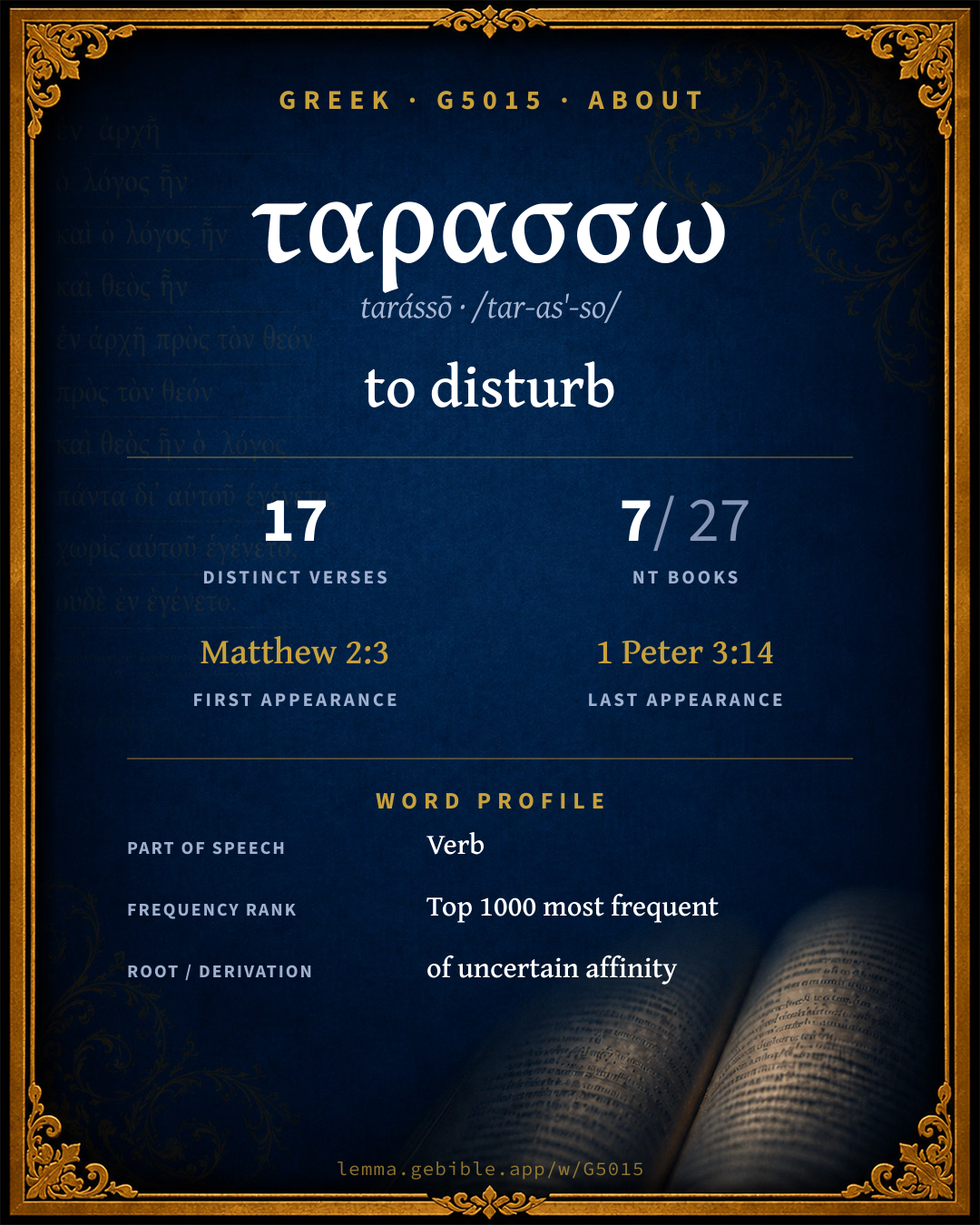
ταράσσω
to disturb
Full lexicon entry — Thayer's Greek Lexicon
From Thayer's Greek Lexicon
Where this word appears
See every Aorist-tense verb in the Greek New Testament →
Grammar key — what these labels mean
Part of speech
- Verb
- An action or state-of-being word.
Tense
- Aorist
- Action viewed as a simple whole, without regard to duration — often past (perfective aspect).
- Present
- Ongoing or general action in present time (imperfective aspect).
- Perfect
- A completed past action with continuing present results.
Voice
- Passive
- The subject receives the action.
- Active
- The subject performs the action.
Mood
- Indicative
- States a fact or asks a factual question (the mood of reality).
- Participle
- A verbal adjective (“writing,” “having written”).
- Imperative
- Expresses a command or request.
- Subjunctive
- Expresses probability, purpose, or possibility (the mood of contingency).
Case
- Nominative
- The case of the subject (and the predicate nominative).
Person
- 3rd person
- The one spoken about (“he / she / it / they”).
- 2nd person
- The one addressed (“you”).
Gender
- Masculine
- Grammatically masculine.
Number
- Singular
- One.
- Plural
- More than one.
Every verse where G5015 appears in the Book of Acts — 3 distinct verses. Click any verse to open its interlinear word-by-word view. Verse text shown in the World English Bible for context — . Each verse’s Greek form is shown with its reference; the English is not keyword-highlighted, since the data carries no word-level English alignment. Use “Compare translations” on any verse to read it across multiple English versions. This concordance covers the Greek New Testament; Septuagint (Greek Old Testament) occurrences of this word are not indexed here.
Acts
- Acts 15:24 ἐτάραξαν aor act ind 3pl Because we have heard that some who went out from us have troubled you with words, unsettling your souls, saying, 'You must be circumcised and keep the law,' to whom we gave no commandment;
- Acts 17:8 ἐτάραξαν aor act ind 3pl The multitude and the rulers of the city were troubled when they heard these things.
- Acts 17:13 ταράσσοντες pres act ptcp nom pl masc But when the Jews of Thessalonica had knowledge that the word of God was proclaimed by Paul at Beroea also, they came there likewise, agitating the multitudes.
About this entry
At a glance — auto-summarized from this page’s data, not written by a person. Every figure links to its source below. This summary describes the numbers; it doesn’t interpret them.
At its core, ταρασσω (tarássō) means “to disturb.” Scripture first uses it in Matthew 2:3. Spanning 17 verses in 7 books, it ranks among the uncommon words of the Greek New Testament. Its uses concentrate in John (35% of all occurrences). From the same root come ταραχη and ταραχος. Dig into 17-verse concordance and the renderings breakdown below.
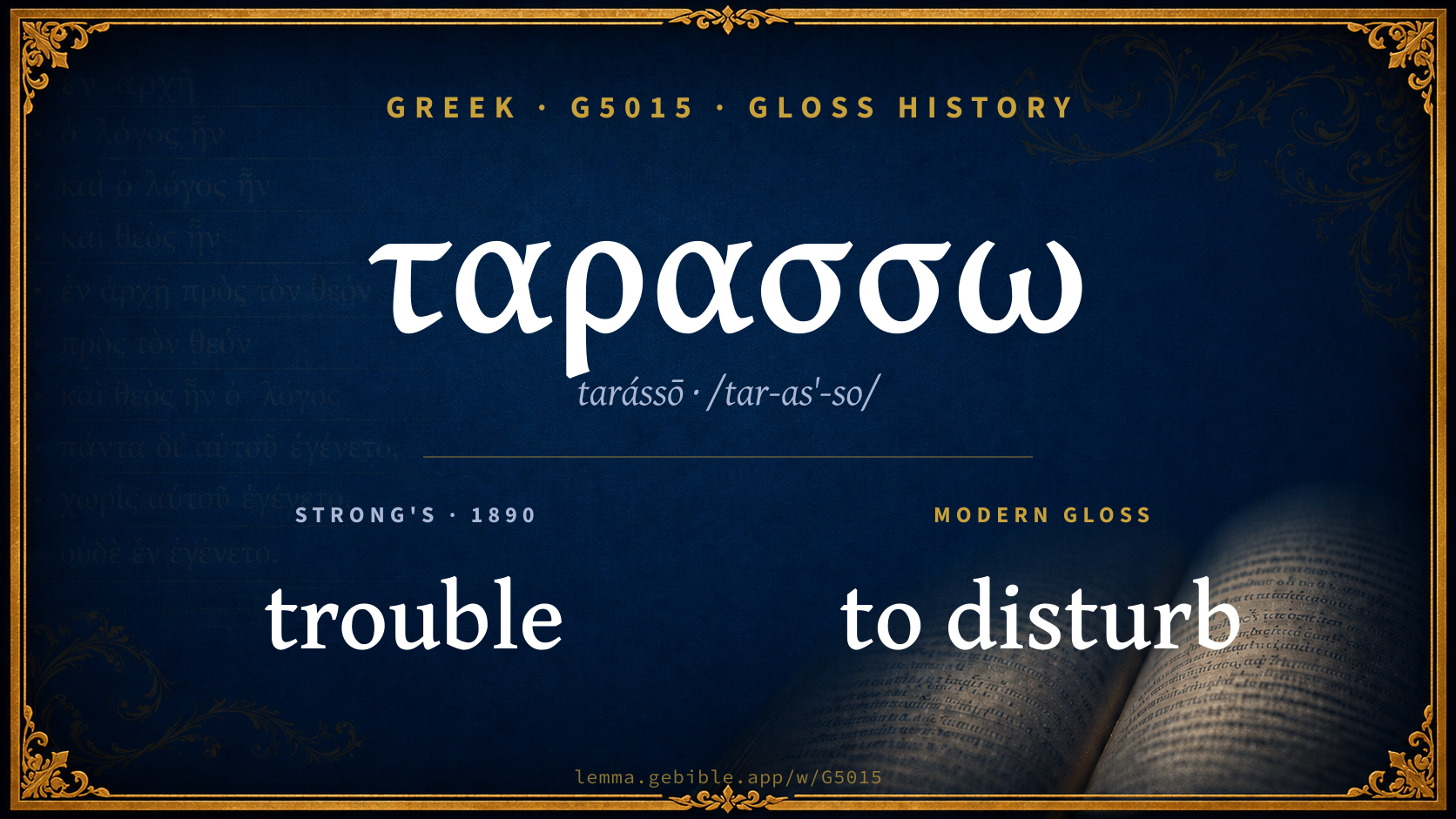
Gloss history
Strong's 1890 vs modern scholarship
About this word
Strong's G5015 catalogs a Greek word from the Greek New Testament.
These counts are not copied from any lexicon or concordance. They are computed here, from the morphology-tagged Greek New Testament. What Lemma adds →
- 17
- distinct verses
- The word appears in 17 distinct verses.
- 7 / 27
- NT books
- The word appears in 7 of 27 New Testament books.
- #697
- by frequency
- Top 1000 most frequent Greek words (rank 697 of 5,347 Greek words by occurrence).
View all 17 occurrences in the concordance →
By section of the New Testament
By traditional corpus
Conventional, traditional groupings — biblical authorship is debated, so this is a traditional corpus grouping, not an authorship claim. Some books belong to more than one corpus (Luke is in both the Gospels and the Lukan corpus, and so on), so these shares overlap and need not total 100%. Each figure is a share of the word’s 17 distinct verses.
- Gospels 11 verses · 65%
- Johannine 6 verses · 35%
- Lukan (Luke–Acts) 5 verses · 29%
- Pauline corpus 2 verses · 12%
- General (Catholic) Epistles 1 verse · 6%
How translations render this word
Counts come from each version’s own published word-to-Strong’s tagging or interlinear alignment — an approximate guide to how each version renders this word, not a word-level alignment the data otherwise carries. Because each total is that version’s own tagged count, the per-version totals vary from one another and need not match the appearance or distinct-verse counts above. These counts may also differ from a printed concordance because Lemma counts each distinctly tagged rendering and does not collapse phrase taggings into a single head-word total. This is a fixed set of word-tagged versions (KJV, ASV, BSB, ULT) and does not change with the reading translation you choose elsewhere. Each version’s license is shown beside its name below (and on Sources).
- King James Version: Be troubled 3×, Troubled 3×, He was troubled 2×
- American Standard Version: Be troubled 3×, Let 2×, Was troubled 2×
- Berean Standard Bible: Be troubled 2×, Troubled 2×, Troubling 2×
- unfoldingWord Literal Text: Be troubled 3×, Do 2×, Let 2×
King James Version Public Domain
Renders G5015 across 20 tagged occurrences — most commonly:
Plus 10 renderings that appear only once — usually multi-word phrases or single function words the recovered tagging swept in, not distinct renderings.
American Standard Version Public Domain
Renders G5015 across 19 tagged occurrences — most commonly:
Plus 12 renderings that appear only once — usually multi-word phrases or single function words the recovered tagging swept in, not distinct renderings.
Berean Standard Bible Public Domain
Renders G5015 across 17 tagged occurrences — most commonly:
Plus 11 renderings that appear only once — usually multi-word phrases or single function words the recovered tagging swept in, not distinct renderings.
unfoldingWord Literal Text CC BY-SA 4.0
Renders G5015 across 23 tagged occurrences — most commonly:
Plus 12 renderings that appear only once — usually multi-word phrases or single function words the recovered tagging swept in, not distinct renderings.
Senses in Thayer's
The 1 sense Thayer's distinguishes for this word, in lexicon order (not ranked by frequency or importance). The full entry — with sub-senses — is in the Lexicon Entry tab.
- to agitate, trouble (a thing, by the movement of its parts to and fro)
Word origin
Origin: of uncertain affinity
Of uncertain affinity; to stir or agitate ( roil water): - trouble.
— Strong’s Exhaustive Concordance (1890), public domain.
Forms in the corpus
The 11 distinct written forms G5015 takes in the Greek New Testament, most frequent first — each parse links to that tense’s occurrences in the concordance.
Same root — word family
Other Thayer's entries built from the same root as G5015, grouped by Strong’s listed origin. These share a root / origin per the lexicon — not necessarily a shared meaning. Each links to that word’s own entry.
Derived from this word
Compare all same-root words → They share a root, not necessarily a meaning.
Septuagint usage
The same Greek word ταρασσω appears 87 times in the Greek Old Testament (Septuagint), across 86 verses in 21 books.
- 87
- LXX occurrences
- Tagged occurrences of this Greek word in the Septuagint.
- 86
- verses
- Distinct Septuagint verses containing this word.
- 21 / 39
- OT books
- The word appears in 21 of the 39 Old Testament books.
Sample Septuagint occurrences
- Genesis 19:16 ταράσσω
- Deuteronomy 2:25 ταράσσω
- Judges 11:35 ταράσσω
- Ruth 3:8 ταράσσω
- 1 Samuel 14:16 ταράσσω
- 2 Samuel 19:1 ταράσσω
- 1 Kings 3:26 ταράσσω
- 1 Chronicles 29:11 ταράσσω
- Esther 3:15 ταράσσω
- Job 8:3 ταράσσω
- Psalms 2:5 ταράσσω
- Proverbs 12:25 ταράσσω
Septuagint occurrences (same lexeme)
Every verse where the same Strong’s number (G5015) appears in the Greek Septuagint — showing the first 50 of 86. Verse text shown in the World English Bible for context; the Greek form is the matched word — the English is not keyword-highlighted.
- Genesis 19:16 ταράσσω But he lingered; and the men laid hold on his hand, and on the hand of his wife, and on the hand of his two daughters, Yahweh being merciful to him; and they took him out, and set him outside of the city.
- Genesis 40:6 ταράσσω Joseph came in to them in the morning, and saw them, and saw that they were sad.
- Genesis 41:8 ταράσσω It happened in the morning that his spirit was troubled, and he sent and called for all the magicians of Egypt, and all the wise men of it. Pharaoh told them his dream, but there was no one who could interpret them to Pharaoh.
- Genesis 42:28 ταράσσω He said to his brothers, "My money is restored! Behold, it is even in my sack." Their hearts failed them, and they turned trembling one to another, saying, "What is this that God has done to us?"
- Genesis 43:30 ταράσσω Joseph made haste; for his heart yearned over his brother: and he sought a place to weep; and he entered into his room, and wept there.
- Genesis 45:3 ταράσσω Joseph said to his brothers, "I am Joseph! Does my father still live?" His brothers couldn't answer him; for they were terrified at his presence.
- Deuteronomy 2:25 ταράσσω This day will I begin to put the dread of you and the fear of you on the peoples who are under the whole sky, who shall hear the report of you, and shall tremble, and be in anguish because of you.
- Judges 11:35 ταράσσω It happened, when he saw her, that he tore his clothes, and said, Alas, my daughter! you have brought me very low, and you are one of those who trouble me; for I have opened my mouth to Yahweh, and I can't go back.
- Ruth 3:8 ταράσσω It happened at midnight, that the man was afraid, and turned himself; and, behold, a woman lay at his feet.
- 1 Samuel 14:16 ταράσσω The watchmen of Saul in Gibeah of Benjamin looked; and, behold, the multitude melted away, and they went [here] and there.
- 2 Samuel 19:1 ταράσσω It was told Joab, Behold, the king weeps and mourns for Absalom.
- 2 Samuel 22:8 ταράσσω Then the earth shook and trembled, The foundations of heaven quaked Were shaken, because he was angry.
- 1 Kings 3:26 ταράσσω Then spoke the woman whose the living child was to the king, for her heart yearned over her son, and she said, Oh, my lord, give her the living child, and in no way kill it. But the other said, It shall be neither mine nor yours; divide it.
- 1 Chronicles 29:11 ταράσσω Yours, Yahweh, is the greatness, the power, the glory, the victory, and the majesty: for all that is in the heavens and in the earth is yours. Yours is the kingdom, Yahweh, and you are exalted as head above all.
- Esther 3:15 ταράσσω The posts went forth in haste by the king's commandment, and the decree was given out in Shushan the palace. The king and Haman sat down to drink; but the city of Shushan was perplexed.
- Esther 4:4 ταράσσω Esther's maidens and her chamberlains came and told it her; and the queen was exceedingly grieved: and she sent clothing to clothe Mordecai, and to take his sackcloth from off him; but he didn't receive it.
- Esther 7:6 ταράσσω Esther said, An adversary and an enemy, even this wicked Haman. Then Haman was afraid before the king and the queen.
- Job 8:3 ταράσσω Does God pervert justice? Or does the Almighty pervert righteousness?
- Job 19:6 ταράσσω Know now that God has subverted me, And has surrounded me with his net.
- Job 34:10 ταράσσω "Therefore listen to me, you men of understanding: Far be it from God, that he should do wickedness, From the Almighty, that he should commit iniquity.
- Job 34:12 ταράσσω Yes surely, God will not do wickedly, Neither will the Almighty pervert justice.
- Job 37:1 ταράσσω "Yes, at this my heart trembles, And is moved out of its place.
- Psalms 2:5 ταράσσω Then he will speak to them in his anger, And terrify them in his wrath:
- Psalms 6:3 ταράσσω My soul is also in great anguish. But you, Yahweh--how long?
- Psalms 6:4 ταράσσω Return, Yahweh. Deliver my soul, And save me for your loving kindness' sake.
- Psalms 6:8 ταράσσω Depart from me, all you workers of iniquity, For Yahweh has heard the voice of my weeping.
- Psalms 6:11 ταράσσω
- Psalms 17:8 ταράσσω Keep me as the apple of your eye; Hide me under the shadow of your wings,
- Psalms 29:8 ταράσσω Yahweh's voice shakes the wilderness. Yahweh shakes the wilderness of Kadesh.
- Psalms 30:10 ταράσσω Hear, Yahweh, and have mercy on me. Yahweh, be my helper."
- Psalms 30:11 ταράσσω You have turned my mourning into dancing for me. You have removed my sackcloth, and clothed me with gladness,
- Psalms 37:11 ταράσσω But the humble shall inherit the land, And shall delight themselves in the abundance of peace.
- Psalms 38:7 ταράσσω For my loins are filled with burning. There is no soundness in my flesh.
- Psalms 38:12 ταράσσω They also who seek after my life lay snares. Those who seek my hurt speak mischievous things, And meditate deceits all day long.
- Psalms 41:7 ταράσσω All who hate me whisper together against me. They imagine the worst for me.
- Psalms 45:3 ταράσσω Gird your sword on your thigh, mighty one: Your splendor and your majesty.
- Psalms 45:4 ταράσσω In your majesty ride on victoriously on behalf of truth, humility, and righteousness. Let your right hand display awesome deeds.
- Psalms 45:7 ταράσσω You have loved righteousness, and hated wickedness. Therefore God, your God, has anointed you with the oil of gladness above your fellows.
- Psalms 47:6 ταράσσω Sing praise to God, sing praises. Sing praises to our King, sing praises.
- Psalms 54:3 ταράσσω For strangers have risen up against me. Violent men have sought after my soul. They haven't set God before them. Selah.
- Psalms 54:5 ταράσσω He will repay the evil to my enemies. Destroy them in your truth.
- Psalms 56:5 ταράσσω All day long they twist my words. All their thoughts are against me for evil.
- Psalms 63:9 ταράσσω But those who seek my soul, to destroy it, Shall go into the lower parts of the earth.
- Psalms 64:8 ταράσσω Their own tongues shall ruin them. All who see them will shake their heads.
- Psalms 67:5 ταράσσω Let the peoples praise you, God. Let all the peoples praise you.
- Psalms 75:6 ταράσσω For neither from the east, nor from the west, Nor yet from the south, comes exaltation.
- Psalms 76:5 ταράσσω Valiant men lie plundered, They have slept their last sleep. None of the men of war can lift their hands.
- Psalms 76:17 ταράσσω
- Psalms 82:16 ταράσσω
- Psalms 82:18 ταράσσω
These are occurrences of the same Greek lexeme (G5015) in the Septuagint — not a translation of any one Hebrew word. The store carries no word-level Hebrew↔Greek alignment, so no Hebrew original is asserted here. Counts come from the recovered LXX Strong's tagging — high-frequency vocabulary is well covered, while rare or late forms may be untagged — so they reflect tagged occurrences and may slightly undercount.