
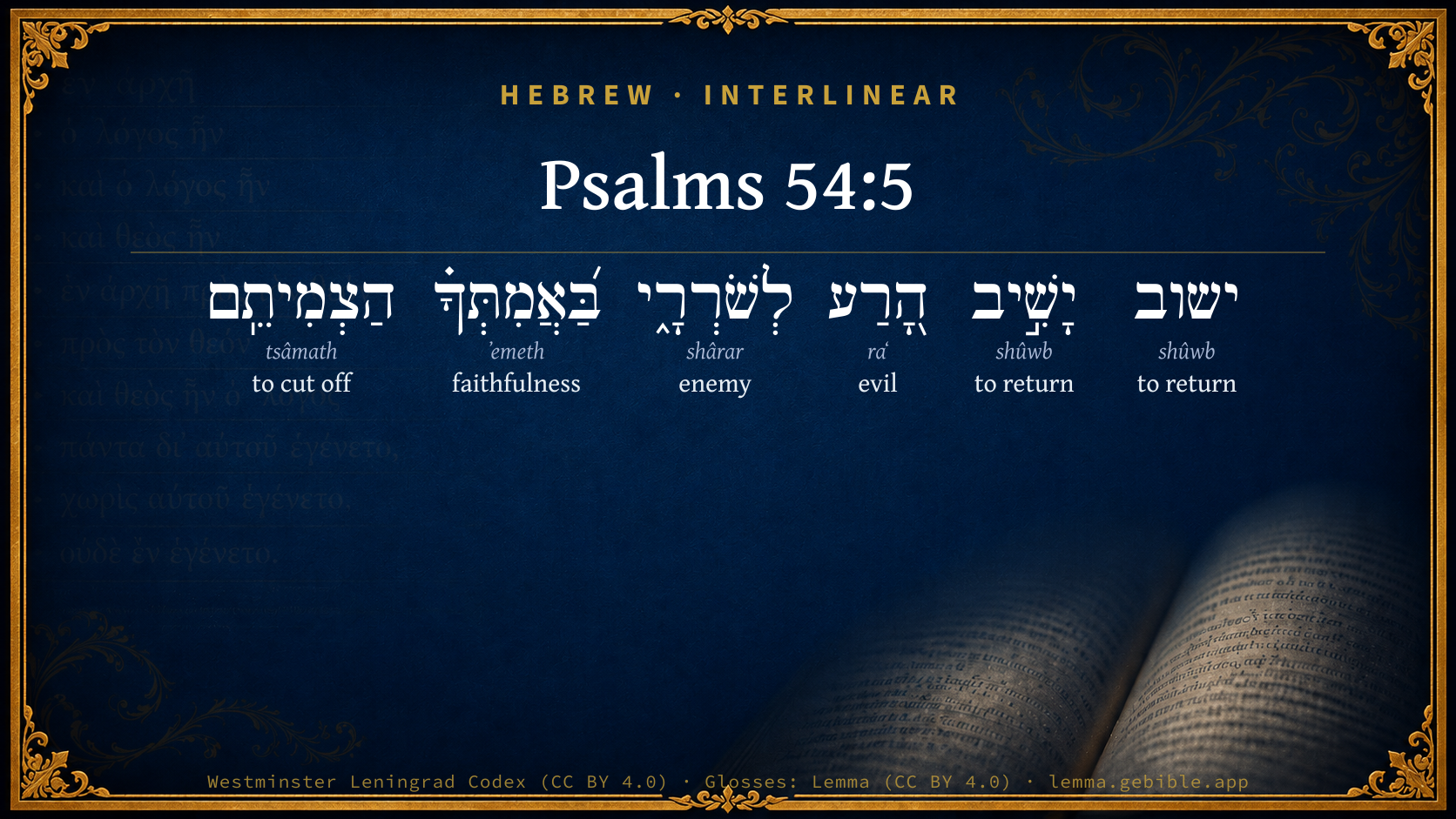
Psalms 54:5

Hebrew (Westminster Leningrad Codex) Psalms 54:5 appears in the Hebrew Old Testament. The text above is from the Westminster Leningrad Codex. Each word links to its Strong’s number, a concise gloss, and parsing drawn from the Open Scriptures Hebrew Bible morphology. Click any word for its full Brown-Driver-Briggs (BDB) entry.
Download image
Cite this verse

Psalms 54:5 (World English Bible). Public Domain. Lemma interlinear Bible study tool, https://lemma.gebible.app/v/psalms/54/5.

Show BibTeX & RIS
BibTeX
RIS
English Translation
He will repay the evil to my enemies. Destroy them in your truth.
World English Bible · Public Domain
Download a study sheet

One document with this verse’s original text, its word-by-word gloss line, the meaning frame, cross-references with their text, attributed commentary, and full source and license credits — printable, and it pastes into notes with its structure intact.

This verse Autodidact and up

Study sheet (.html) Plain text (.txt)

A passage Seminary Student

Up to 50 verses in one chapter. A passage sheet keeps up to 6 commentary sources and 12 cross-references per verse, in the order this page ranks them, and says so on the sheet whenever that leaves anything out. Ask for a single verse and you get the Autodidact verse sheet above.

Everything on this page stays free to read, with no account — the sheet is a download of what is already on screen, not access to it.

Want to remove ads? Support Godless Engineer
Compare translations 3

The same verse in 3 English versions, stacked beneath the original-language interlinear above. Click any original word for its lexicon entry.

Each is an independent rendering of the whole verse — the interlinear is not word-aligned to these translations.

Highlighted words mark where these versions differ — a whole-verse word diff, not a word-by-word alignment.

  • World English Bible Public Domain
    He will repay the evil to my enemies. Destroy them in your truth.
  • King James Version Public Domain
    He shall reward evil unto mine enemies: cut them off in thy truth.
  • unfoldingWord Literal Text CC BY-SA 4.0
    He will return harm to my enemies. In your faithfulness, destroy them!

unfoldingWord Literal Text — © unfoldingWord, licensed CC BY-SA 4.0. Word-aligned USFM3 via Door43 (git.door43.org/unfoldingWord/en_ult).

Versions to compare (up to 4)

3 of 4 selected

Show all 18 translations

Every available English version of this verse, each an independent rendering of the whole verse.

  • World English Bible Public Domain
    He will repay the evil to my enemies. Destroy them in your truth.
  • Berean Standard Bible Public Domain
    He will reward my enemies with evil. In Your faithfulness, destroy them.
  • Majority Standard Bible Public Domain
    He will reward my enemies with evil. In Your faithfulness, destroy them.
  • King James Version Public Domain
    He shall reward evil unto mine enemies: cut them off in thy truth.
  • American Standard Version (1901) Public Domain
    He will requite the evil unto mine enemies: Destroy thou them in thy truth.
  • Revised Version (1885) Public Domain
    He shall requite the evil unto mine enemies: destroy thou them in thy truth.
  • Geneva Bible (1599) Public Domain
    He shall rewarde euill vnto mine enemies: Oh cut them off in thy trueth!
  • Douay-Rheims (1899) Public Domain
    For strangers have risen up against me; and the mighty have sought after my soul: and they have not set God before their eyes.
  • Young's Literal Translation Public Domain
    Turn back doth the evil thing to mine enemies, In Thy truth cut them off.
  • Literal Standard Version CC BY-SA 4.0
    Turn back the evil to my enemies, || Cut them off in Your truth.
  • Unlocked Literal Bible CC BY-SA 4.0
    He will repay my enemies with evil; in your faithfulness, destroy them!
  • unfoldingWord Literal Text CC BY-SA 4.0
    He will return harm to my enemies. In your faithfulness, destroy them!
  • Darby Bible Public Domain
    He will requite evil to mine enemies: in thy truth cut them off.
  • World Messianic Bible Public Domain
    He will repay the evil to my enemies. Destroy them in your truth.
  • Webster's Bible Public Domain
    \\54:3\\For strangers have risen up against me, and oppressors seek after my soul: they have not set God before them. Selah.
  • Free Bible Version CC BY-SA 4.0
    The evil my enemies have done will come back upon them. I depend on you to destroy them.
  • Bible in Basic English Public Domain
    Let the evil works of my haters come back on them again; let them be cut off by your good faith.
  • JPS Tanakh (1917) Public Domain
    (54-7) He will requite the evil unto them that lie in wait for me; destroy Thou them in Thy truth.

Literal Standard Version (2020), Covenant Press — licensed CC BY-SA 4.0. Text via the HelloAO Bible API (eBible.org). Unlocked Literal Bible (unfoldingWord) — licensed CC BY-SA 4.0. Text via the HelloAO Bible API (eBible.org). unfoldingWord Literal Text — © unfoldingWord, licensed CC BY-SA 4.0. Word-aligned USFM3 via Door43 (git.door43.org/unfoldingWord/en_ult). Free Bible Version, Dr. Jonathan Gallagher — licensed CC BY-SA 4.0. Text via the HelloAO Bible API (eBible.org).

Word by word

More ways to search: Search by grammar → Find every occurrence → Compare this word →

Practice this passage: Drill this verse → Learn its vocabulary →

About this verse

These counts appear in no published source. They are computed here, from the morphology-tagged text and Lemma’s own curated glosses. What Lemma adds →

6
words
5
distinct lemmas
Wisdom
section

Notable vocabulary

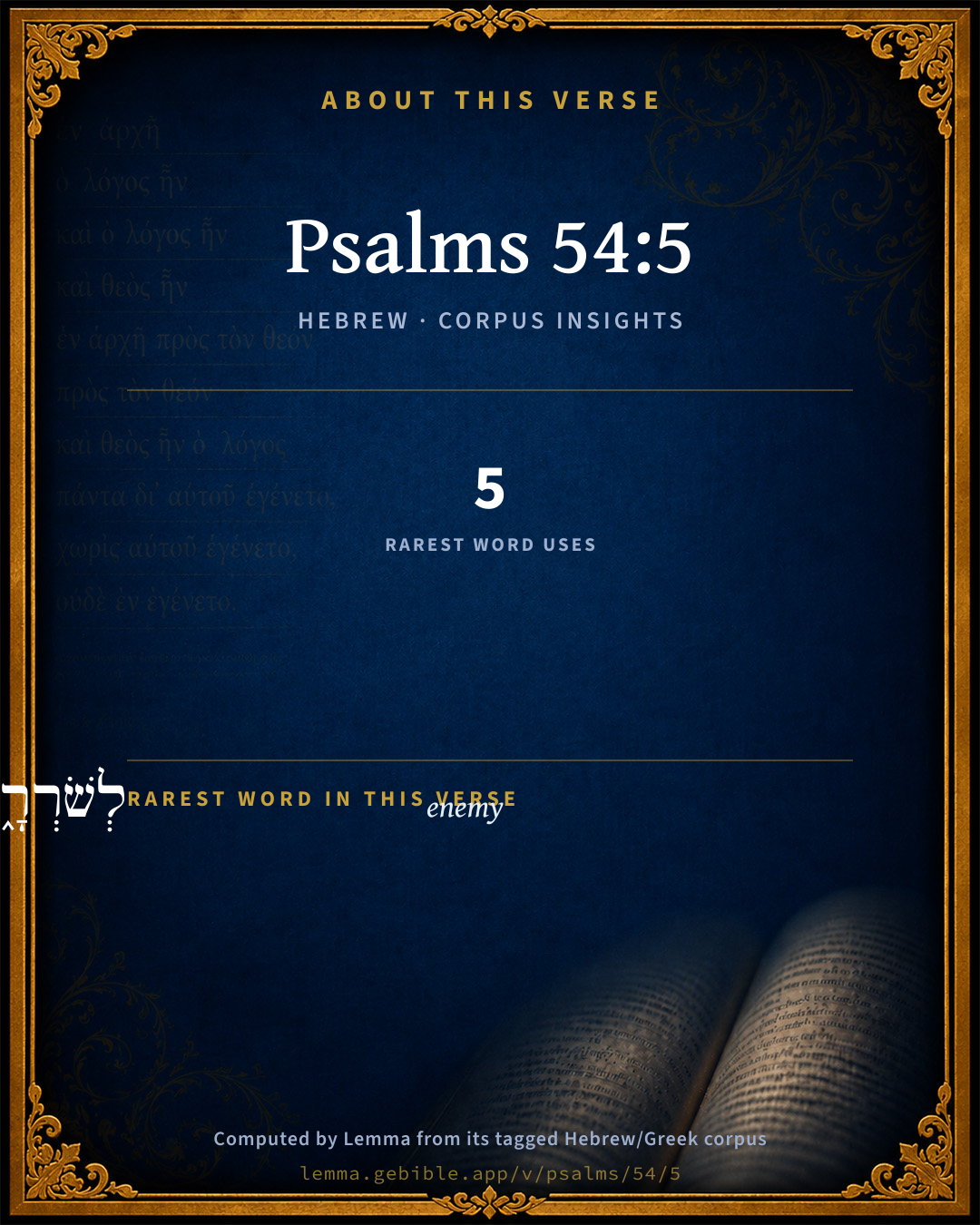
The rarest word here is לְשֹׁרְרָ֑י enemy H8324 — appearing just 5 times in the whole Hebrew Bible.

Shared distinctive vocabulary

לְשֹׁרְרָ֑י enemy H8324 occurs in 5 verses of the Hebrew Bible. Also found in:

Grammatical profile

  • 3 verbs
  • 2 nouns
  • 1 adjective

Verb forms

  • ישוב Qal · Imperfect
  • יָשִׁ֣יב Hiphil · Imperfect
  • הַצְמִיתֵֽם Hiphil · Imperative

Repetition

A word recurs within this verse — often emphatic in Hebrew:

  • ישוב to return H7725 ×2

Hebrew & Septuagint length

In English translation the verse runs 13 words from the Hebrew and 13 from the Septuagint (LXX English) — the same length.

A rough comparison of the two English renderings, which tokenize alike — not a word-level alignment.

Word counts can differ between the Hebrew and the Greek without any difference in meaning — e.g. the Hebrew direct-object marker אֵת has no separate Greek word, and Greek often adds the article ὁ.

Cross-references

10

Topical passages linked to Psalms 54:5 in the Treasury of Scripture Knowledge — connected by theme and wording, ordered by reader-vote popularity; previews shown in the World English Bible.

  • Psalms 143:12 In your loving kindness, cut off my enemies, And destroy all those who afflict my soul, For I am your servant.
  • Psalms 89:49 Lord, where are your former loving kindnesses, Which you swore to David in your faithfulness?
  • Psalms 31:23 Oh love Yahweh, all you his saints! Yahweh preserves the faithful, And pays back him who deals proudly in full.
  • Psalms 94:23 He has brought on them their own iniquity, And will cut them off in their own wickedness. Yahweh, our God, will cut them off.
  • Psalms 137:8 Daughter of Babylon, doomed to destruction, He will be happy who rewards you, As you have served us.
  • 2 Timothy 4:14 Alexander, the coppersmith, did much evil to me. The Lord will repay him according to his works,
  • Revelation 18:6 Return to her just as she returned, and repay her double as she did, and according to her works. In the cup which she mixed, mix to her double.
  • Psalms 5:8 Lead me, Yahweh, in your righteousness because of my enemies. Make your way straight before my face.
  • Psalms 27:11 Teach me your way, Yahweh. Lead me in a straight path, because of my enemies.
  • Psalms 143:1 Hear my prayer, Yahweh. Listen to my petitions. In your faithfulness and righteousness, relieve me.

Cross-references courtesy of OpenBible.info (CC BY 4.0).

Hebrew and Greek witnesses Masoretic Hebrew ↔ Greek Septuagint

The same verse in the two great witnesses to the Old Testament, shown verse-for-verse.

You’re reading Greek Psalm 53 (Hebrew Psalm 54). The Septuagint counts the superscription, so verse numbers can differ from the Hebrew — chapter-level alignment, not verse-by-verse. Numbering follows Rahlfs.

These are two independent witnesses, not word-aligned to each other, and the Septuagint is shown in lemma (dictionary) form.

Hebrew Psalms 54:5 Masoretic · Westminster Leningrad Codex

ישוב יָשִׁ֣יב הָ֭רַע לְשֹׁרְרָ֑י בַּ֝אֲמִתְּךָ֗ הַצְמִיתֵֽם

He will repay the evil to my enemies. Destroy them in your truth.

World English Bible · Public Domain

Greek LXX Greek Psalm 53:5 Septuagint · lemma form

ὅτι ἀλλότριος ἐπι ἀναἵστημι ἐπί ἐγώ καί κραταιός ζητέω ὁ ψυχή ἐγώ οὐ προτίθημι ὁ θεός ἐνώπιον αὐτός διάψαλμα

He shall return evil to my enemies; utterly destroy them in your truth.

LXX2012 (modern English Septuagint) · Public Domain

Hebrew: Westminster Leningrad Codex (CC BY 4.0). Greek: Septuagint (public domain); English from LXX2012 (modern English Septuagint) (Public Domain). How the Septuagint differs from the Hebrew →

Commentary

Notes on Psalms 54:5 from classic Christian and Jewish commentators (each source and its license shown beneath its notes). The classic Christian expositions comment on the surrounding passage and are grouped to its opening verse, so a note may address several verses; the Jewish commentaries on the Tanakh (Rashi and others) are per-verse, so they appear only where the commentator wrote on this verse.

Lemma curates 59 commentaries, every one of them public domain or Creative Commons licensed, each selected and text-cleaned for this edition rather than reprinted as found. About our sources →

Trapp's Complete Commentary

John Trapp

Psa 54:5 He shall reward evil unto mine enemies: cut them off in thy truth.

Ver. 5. He shall reward evil unto mine enemies] Or, mine observers, that watch me a mischief. I shall escape out of trouble, and they shall come in my stead, Pro 11:8.

Cut them off in thy truth] i.e. According as thou hast pronounced against such as seek and suck innocent blood.

John Trapp, A Commentary or Exposition upon All the Books of the Old and New Testament (1647–1656) — public domain. Text from a community e-Sword module.

J. A. Alexander on Psalms

Joseph Addison Alexander

7. (Psa 54:5). The evil shall return to my enemies; in thy truth destroy them. The future here runs into the imperative, as the imperative does into the future in Psa 54:3 (1), above. The imperative in this case is only a stronger form of prediction. The evil, which they mean to do me. Return to, or upon them, i.e. shall befall themselves. See above, on Psa 7:17 (16), This is the sense required by the reading in the text (bvwy), which the modern critics commonly regard as the most ancient. The marginal or masoretic reading must be rendered, he will cause to return, repay, requite. Thy truth, the truth of thy promises and threatenings, thy veracity. See above, on Psa 30:10 (9). The certain foresight of the doom of the wicked, which is expressed in the first clause, makes the prayer (if such it be considered little more than an expression of that certainty. See above, on Psa 5:11 (10).

Joseph Addison Alexander, The Psalms Translated and Explained (1850) — public domain. Text from a community e-Sword module.

Geneva Bible (1599)

Geneva Bible translators

According to thy faithful promise for my defense.

Geneva Bible (1599) marginal notes — public domain. Text via Bolls.life.

Jamieson, Fausset & Brown

Robert Jamieson, A. R. Fausset & David Brown

He shall . . . evil--or, "Evil shall return on" (Psa 7:16) my enemies or watchers, that is, to do me evil (Psa 6:7).

in thy truth--Thy verified promise.

Jamieson, Fausset & Brown — Commentary Critical and Explanatory on the Whole Bible (1871) — public domain (CC PDM 1.0). Text via the HelloAO Bible API.

Adam Clarke's Commentary

Verse 5. He shall reward evil] Saul and his courtiers, instead of having God's approbation, shall have his curse.

Cut them off in thy truth.] Thou hast promised to save me; these have purposed to destroy me. Thy truth is engaged in my defence; they will destroy me if permitted to live: to save thy truth, and to accomplish its promises, thou must cut them off.

Adam Clarke's Commentary on the Bible (1810–1826) — public domain. Text from a community e-Sword/MySword module.

John Calvin's Commentaries

5. He shall reward evil unto mine enemies As the verb ישיב, yashib, may be rendered he shall cause to return, it seems to point not only at the punishment, but the kind of punishment, which would be awarded to his enemies, in the recoiling of their wicked machinations upon their own heads. Some give an optative signification to the verb, understanding the words to express a wish or prayer; but I see no reason why it should not be taken strictly in the future tense, and imagine that David intimates his certain expectation that this favor, which he had already prayed for, would be granted. It is by no means uncommon to find the prayers of the Psalmist intersected with sentences of this kind, inserted for the purpose of stimulating his faith, as here, where he announces the general truth, that God is the righteous judge who will recompense the wicked. With the view of confirming his hopes, he adverts particularly to the truth of God; for nothing can support us in the hour of temptation, when the Divine deliverance may be long delayed, but a firm persuasion that God is true, and that he cannot deceive us by his divine promises. His confidence of obtaining his request was grounded upon the circumstance that God could no more deny his word than deny himself.

John Calvin's Commentaries (1540-1563) — public domain. Text from the Calvin Translation Society English edition (1840s-50s) via the Christian Classics Ethereal Library (ccel.org). Calvin's coverage is partial (roughly two-thirds of the Bible); uncommented books and verses are honest gaps, never fabricated. The 19th-century editor's footnotes and remarks are omitted so the notes are faithfully Calvin's own voice.

Ellicott's Commentary for English Readers

(5) Cut them off.—Or, put them to silence.

In thy truth.—Or, according to thy faithfulness.

A Bible Commentary for English Readers, edited by Charles John Ellicott (1878–1897) — public domain. Text from a community e-Sword module.

The Cambridge Bible for Schools and Colleges

gen. ed. J. J. S. Perowne

5. He shall requite the evil unto them that lie in wait for me:

Destroy thou them in thy truth.

God will cause the evil which they are plotting to recoil upon their own heads: or, according to the K’thîbh or written text (Introd. p. li), The evil shall return &c.: cp. Psa_7:16. Enemies (A.V.) is a peculiar word found only in Psa_5:8; Psa_27:11; Psa_56:2; Psa_59:10, meaning those who lie in wait for him, like fowlers (Jer_5:26 R.V.), or a leopard for its prey (Hos_13:7). Jerome renders it insidiatores.

in thy truth] For Thou canst not be false to Thy promise to deliver me.

The Cambridge Bible for Schools and Colleges (gen. ed. J. J. S. Perowne; Cambridge University Press, 1878–1918) — public domain. Text from a community e-Sword module.

John Gill's Exposition

He shall reward evil unto mine enemies,.... That eyed him as Saul did; that observed his haunts, where he resorted, and who were with him, as the Ziphites did under Saul's direction; as the Word (m) here used for "enemies" signifies: the mischief they had devised for him, he believed, would be returned upon their own heads; the pit they digged they would fall into themselves; and the net they had spread for others their own feet would be taken in. This was true as of David's enemies, so of Christ's, the wicked Jews, who narrowly watched him to take every advantage against him;

cut them off in thy truth; root and branch, as Saul, and his family, and his courtiers, quickly were, according to the truth of promises made to David, and of threatenings unto them.

(m) "observatoribus meis", Junius & Tremellius, Piscator, Michaelis.

John Gill's Exposition of the Whole Bible (1746–1763) — public domain (CC PDM 1.0). Text via the HelloAO Bible API.

Albert Barnes' Notes on the Bible

He shall reward evil unto mine enemies - Margin, “those that observe me.” The original word here means literally “to twist, to twist together;” then, to press together; then, to “oppress,” or to treat as an enemy. The reference here is to those who pressed upon him as enemies, or who endeavored to crush him. The idea is that God would recompense them for this conduct, or that he would deal with them as they deserved.

Cut them off in thy truth - In thy faithfulness; in thy regard for what is right. This is simply a prayer, or an expression of strong confidence, that God would deal with them as they deserved, or that he would not suffer such conduct to pass without a proper expression of his sense of the wrong. There is no evidence that David in this prayer was prompted by private or vindictive feeling.

Albert Barnes' Notes on the Bible (1834–1885) — public domain. Text from a community e-Sword/MySword module.

Matthew Poole's English Annotations

In thy truth; or, for or according to thy truth; whereby thou art engaged to fulfil thy promises made to me, and thy threatenings denounced against thine and mine implacable enemies.

Matthew Poole's English Annotations on the Holy Bible (1683–1685) — public domain. Text from a community e-Sword/MySword module.

The Treasury of David

Charles H. Spurgeon

Ver. 5. He shall reward evil unto mine enemies. They worked for evil, and they shall have their wages. It cannot be that malice should go unavenged. It were cruelty to the good to be lenient to their persecutors. It is appointed, and so it must ever be, that those who shoot upward the arrows of malice shall find them fall upon themselves. The recoil of their own gun has often killed oppressors.

Cut them off in thy truth. Not in ferocious revenge is this spoken, but as an Amen to the sure sentence of the just Judge. Let the veracity of thy threatenings be placed beyond dispute, the decree is right and just, let it be fulfilled. It is not a private desire, but the solemn utterance of a military man, a grossly injured man, a public leader destined to be a monarch, and a man well trained in the school of Moses, whose law ordains eye for eye, and tooth for tooth.

Ver. 5. Cut them off. He desires that God would destroy them with a death dealing blow, which is the force the word tmu contains; its primitive sense is to be silent, to keep silence, whence it is transferred to a stroke penetrating deeply and striking fatally, such as is called a silent blow, opposed to a sounding one, which is wont to rebound and not pierce deeply. Hermann Venema.

None.

Psalms 54:6*

Charles H. Spurgeon's The Treasury of David (1869–1885) — public domain. Psalms only. Text from a community e-Sword/MySword module.

Whedon's Commentary on the Bible

Daniel D. Whedon

5. He shall reward evil unto mine enemies—The “evil” they sought to do to me shall recoil upon themselves. God shall turn it back upon them. So the word rendered “reward” properly signifies. It is another instance of the lex talionis.

Cut them off in thy truth—The optative sense, here, is to be taken in connexion with the qualifying words “thy truth.” Only in accordance with this does David invoke divine interference. Immutability and authority of law are the gist and essence of the prayer. If these fail all is lost. Prayer for the deliverance of the righteous cannot be answered without the reformation or the destruction of the wicked; that is, destruction as to their power to do evil.

Daniel D. Whedon (gen. ed.), Commentary on the Old and New Testaments (1874–1909) — public domain. Text from a community e-Sword module.

The Pulpit Commentary

He shall reward evil unto mine enemies; literally, he shall return the wrong upon my adversaries. "The wrong" is that which his adversaries had wished to inflict upon the psalmist, viz. death. (see 1Sa_23:19, 1Sa_23:20) Cut them off in thy truth; or, "in thy truthfulness" (Cheyne). God had given his people those who were faithful to him the promise of his protection, and, being true, could not go back from his word.

The Pulpit Commentary (1880–1919), ed. H.D.M. Spence-Jones & Joseph S. Exell — public domain. Text from a community e-Sword module.

John Wesley's Explanatory Notes

Thy truth - Whereby thou art engaged to fulfil thy promises and threatenings.

John Wesley, Explanatory Notes Upon the Whole Bible (1754–1765) — public domain. Text via the GEBible commentary corpus.

Lesson kit

Teaching starters — assembled from the data on this page, not authored interpretation. Every prompt links to the verse data it draws on. Edit before teaching.

Psalms, in the Wisdom, opens this verse with 6 words (5 distinct Hebrew lemmas). Its most distinctive word is shârar (“enemy”). A historical commentator’s framing appears above. Read the whole chapter for the surrounding context.

Discussion questions

  1. What does “enemy” (shârar) contribute to the verse as a whole?
  2. Psalms 5:8 shares the word «enemy» with this verse. How do the two illuminate each other?
  3. “to return” occurs 2× in this one verse. What is the effect of the repetition?
  4. These translations render this verse differently. What is at stake in choosing one wording over another?
  5. The verb «ישוב» is Qal Imperfect. How does its form color the action?
  6. Reading how Trapp's Complete Commentary and J. A. Alexander on Psalms read this verse, where do the two commentators agree and where do they part?

Things to notice

  • These translations choose different wording for 13 words in this verse.
  • “to return” occurs 2× in this single verse.
  • 5 distinct Hebrew lemmas span 6 words in this verse.

Reading settings

Reading text

Shown beneath each verse's original-language words.

Old Testament
Old Testament edition

Read the OT as the Masoretic Hebrew (MT) or the Greek Septuagint (LXX).

English shown for the Greek Septuagint (in the Hebrew ↔ Greek comparison).

Comparing translations? Open the Compare panel on any verse page to stack up to four side by side.