
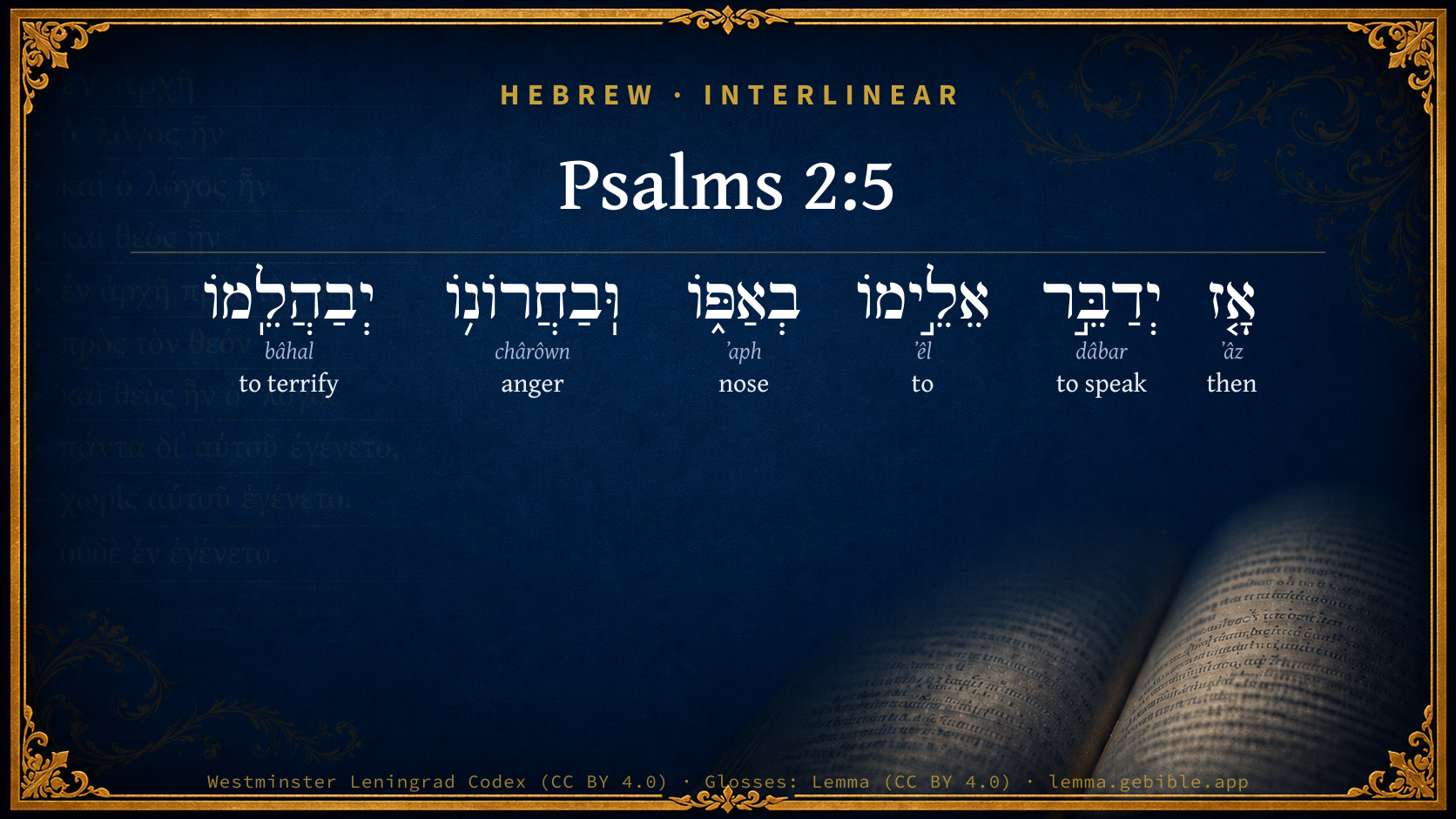
Psalms 2:5

Hebrew (Westminster Leningrad Codex) Psalms 2:5 appears in the Hebrew Old Testament. The text above is from the Westminster Leningrad Codex. Each word links to its Strong’s number, a concise gloss, and parsing drawn from the Open Scriptures Hebrew Bible morphology. Click any word for its full Brown-Driver-Briggs (BDB) entry.
Download image
Cite this verse

Psalms 2:5 (World English Bible). Public Domain. Lemma interlinear Bible study tool, https://lemma.gebible.app/v/psalms/2/5.

Show BibTeX & RIS
BibTeX
RIS
English Translation
Then he will speak to them in his anger, And terrify them in his wrath:
World English Bible · Public Domain
Download a study sheet

One document with this verse’s original text, its word-by-word gloss line, the meaning frame, cross-references with their text, attributed commentary, and full source and license credits — printable, and it pastes into notes with its structure intact.

This verse Autodidact and up

Study sheet (.html) Plain text (.txt)

A passage Seminary Student

Up to 50 verses in one chapter. A passage sheet keeps up to 6 commentary sources and 12 cross-references per verse, in the order this page ranks them, and says so on the sheet whenever that leaves anything out. Ask for a single verse and you get the Autodidact verse sheet above.

Everything on this page stays free to read, with no account — the sheet is a download of what is already on screen, not access to it.

Want to remove ads? Support Godless Engineer
Compare translations 3

The same verse in 3 English versions, stacked beneath the original-language interlinear above. Click any original word for its lexicon entry.

Each is an independent rendering of the whole verse — the interlinear is not word-aligned to these translations.

Highlighted words mark where these versions differ — a whole-verse word diff, not a word-by-word alignment.

  • World English Bible Public Domain
    Then he will speak to them in his anger, And terrify them in his wrath:
  • King James Version Public Domain
    Then shall he speak unto them in his wrath, and vex them in his sore displeasure.
  • unfoldingWord Literal Text CC BY-SA 4.0
    Then he will speak to them in his anger and terrify them in his fury,

unfoldingWord Literal Text — © unfoldingWord, licensed CC BY-SA 4.0. Word-aligned USFM3 via Door43 (git.door43.org/unfoldingWord/en_ult).

Versions to compare (up to 4)

3 of 4 selected

Show all 18 translations

Every available English version of this verse, each an independent rendering of the whole verse.

  • World English Bible Public Domain
    Then he will speak to them in his anger, And terrify them in his wrath:
  • Berean Standard Bible Public Domain
    Then He rebukes them in His anger, and terrifies them in His fury:
  • Majority Standard Bible Public Domain
    Then He rebukes them in His anger, and terrifies them in His fury:
  • King James Version Public Domain
    Then shall he speak unto them in his wrath, and vex them in his sore displeasure.
  • American Standard Version (1901) Public Domain
    Then will he speak unto them in his wrath, And vex them in his sore displeasure:
  • Revised Version (1885) Public Domain
    Then shall he speak unto them in his wrath, and vex them in his sore displeasure:
  • Geneva Bible (1599) Public Domain
    Then shall hee speake vnto them in his wrath, and vexe them in his sore displeasure, saying,
  • Douay-Rheims (1899) Public Domain
    Then shall he speak to them in his anger, and trouble them in his rage.
  • Young's Literal Translation Public Domain
    Then doth He speak unto them in His anger, And in His wrath He doth trouble them:
  • Literal Standard Version CC BY-SA 4.0
    Then He speaks to them in His anger, and in His wrath He troubles them:
  • Unlocked Literal Bible CC BY-SA 4.0
    Then he will speak to them in his anger and terrify them in his rage, saying,
  • unfoldingWord Literal Text CC BY-SA 4.0
    Then he will speak to them in his anger and terrify them in his fury,
  • Darby Bible Public Domain
    Then will he speak to them in his anger, and in his fierce displeasure will he terrify them:
  • World Messianic Bible Public Domain
    Then he will speak to them in his anger, and terrify them in his wrath:
  • Webster's Bible Public Domain
    Then shall he speak to them in his wrath, and trouble them in his sore displeasure.
  • Free Bible Version CC BY-SA 4.0
    He will thunder at them, and terrify them in his fury, saying,
  • Bible in Basic English Public Domain
    Then will his angry words come to their ears, and by his wrath they will be troubled:
  • JPS Tanakh (1917) Public Domain
    Then will He speak unto them in His wrath, and affright them in His sore displeasure:

Literal Standard Version (2020), Covenant Press — licensed CC BY-SA 4.0. Text via the HelloAO Bible API (eBible.org). Unlocked Literal Bible (unfoldingWord) — licensed CC BY-SA 4.0. Text via the HelloAO Bible API (eBible.org). unfoldingWord Literal Text — © unfoldingWord, licensed CC BY-SA 4.0. Word-aligned USFM3 via Door43 (git.door43.org/unfoldingWord/en_ult). Free Bible Version, Dr. Jonathan Gallagher — licensed CC BY-SA 4.0. Text via the HelloAO Bible API (eBible.org).

Word by word

More ways to search: Search by grammar → Find every occurrence → Compare this word →

Practice this passage: Drill this verse → Learn its vocabulary →

יְבַהֲלֵֽמוֹ
bâhal
H926
“to terrify · them”
Verb, Piel, Imperfect, 3rd Person, Masculine, Singular + Suffix, Personal, 3rd Person, Masculine, Plural
Part of Speech
Verb
Stem
Piel
Form
Imperfect
Person
3rd Person
Gender
Masculine
Number
Singular
Full BDB Definition

Origin: a primitive root

TWOT: 207

to disturb, alarm, terrify, hurry, be disturbed, be anxious, be afraid, be hurried, be nervous - (Niphal) - to be disturbed, dismayed, terrified, anxious - to be in haste, be hasty - (Piel) - to make haste, act hastily, be hurried, be hastened - to dismay, terrify - (Pual) - to hasten - hastened, hastily gained (participle) - (Hiphil) - to hasten, hurry, make haste - to dismay, terrify
  1. אָ֤ז ʼâz H227 “then” Adverb
  2. יְדַבֵּ֣ר dâbar H1696 “to speak” Verb, Piel, Imperfect, 3rd Person, Masculine, Singular
  3. אֵלֵ֣ימוֹ ʼêl H413 “to · them” Preposition + Suffix, Personal, 3rd Person, Masculine, Plural
  4. בְאַפּ֑וֹ ʼaph H639 “in/at · nose · his” Preposition + Noun, Common, Masculine, Singular, Construct + Suffix, Personal, 3rd Person, Masculine, Singular
  5. וּֽבַחֲרוֹנ֥וֹ chârôwn H2740 “and · in/at · anger · his” Conjunction + Preposition + Noun, Common, Masculine, Singular, Construct + Suffix, Personal, 3rd Person, Masculine, Singular

About this verse

These counts appear in no published source. They are computed here, from the morphology-tagged text and Lemma’s own curated glosses. What Lemma adds →

6
words
6
distinct lemmas
Wisdom
section

Shared distinctive vocabulary

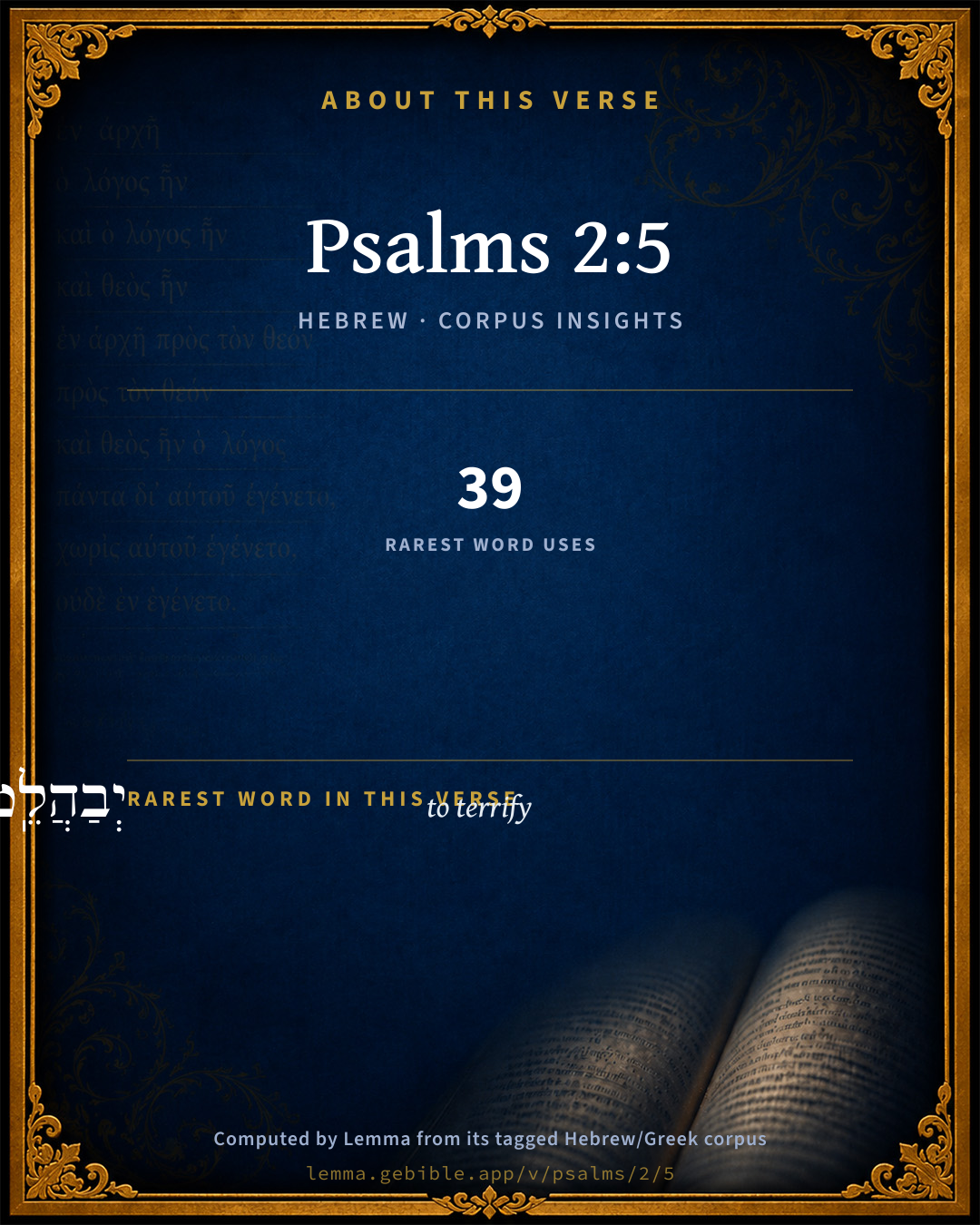
יְבַהֲלֵֽמוֹ to terrify H926 occurs in 39 verses of the Hebrew Bible. Also found in:

Grammatical profile

  • 2 verbs
  • 2 nouns
  • 1 preposition
  • 1 adverb

Verb forms

  • יְדַבֵּ֣ר Piel · Imperfect
  • יְבַהֲלֵֽמוֹ Piel · Imperfect

Hebrew & Septuagint length

In English translation the verse runs 15 words from the Hebrew and 15 from the Septuagint (LXX English) — the same length.

A rough comparison of the two English renderings, which tokenize alike — not a word-level alignment.

Word counts can differ between the Hebrew and the Greek without any difference in meaning — e.g. the Hebrew direct-object marker אֵת has no separate Greek word, and Greek often adds the article ὁ.

Cross-references

13

Topical passages linked to Psalms 2:5 in the Treasury of Scripture Knowledge — connected by theme and wording, ordered by reader-vote popularity; previews shown in the World English Bible.

  • Isaiah 11:4 but with righteousness shall he judge the poor, and decide with equity for the humble of the earth; and he shall strike the earth with the rod of his mouth; and with the breath of his lips shall he kill the wicked.
  • Revelation 19:15 Out of his mouth proceeds a sharp, double-edged sword, that with it he should strike the nations. He will rule them with a rod of iron. He treads the winepress of the fierceness of the wrath of God, the Almighty.
  • Psalms 21:9 You will make them as a fiery furnace in the time of your anger. Yahweh will swallow them up in his wrath. The fire shall devour them.
  • Psalms 110:5–6 The Lord is at your right hand. He will crush kings in the day of his wrath.
  • Psalms 78:49–50 He threw on them the fierceness of his anger, Wrath, indignation, and trouble, And a band of angels of evil.
  • Luke 19:27 But bring those enemies of mine who didn't want me to reign over them here, and kill them before me.'"
  • Isaiah 66:6 A voice of tumult from the city, a voice from the temple, a voice of Yahweh that renders recompense to his enemies.
  • Zechariah 1:15 I am very angry with the nations that are at ease; for I was but a little displeased, but they added to the calamity."
  • Psalms 50:16–22 But to the wicked God says, "What right do you have to declare my statutes, That you have taken my covenant on your lips,
  • Matthew 22:7 When the king heard that, he was angry, and he sent his armies, destroyed those murderers, and burned their city.
  • Matthew 23:33–36 You serpents, you offspring of vipers, how will you escape the judgment of Gehenna?
  • Luke 19:43–44 For the days will come on you, when your enemies will throw up a barricade against you, surround you, hem you in on every side,
  • Revelation 1:16 He had seven stars in his right hand. Out of his mouth proceeded a sharp two-edged sword. His face was like the sun shining at its brightest.

Cross-references courtesy of OpenBible.info (CC BY 4.0).

Hebrew and Greek witnesses Masoretic Hebrew ↔ Greek Septuagint

The same verse in the two great witnesses to the Old Testament, shown verse-for-verse.

You’re reading Greek Psalm 2 (Hebrew Psalm 2). The Septuagint counts the superscription, so verse numbers can differ from the Hebrew — chapter-level alignment, not verse-by-verse. Numbering follows Rahlfs.

These are two independent witnesses, not word-aligned to each other, and the Septuagint is shown in lemma (dictionary) form.

Hebrew Psalms 2:5 Masoretic · Westminster Leningrad Codex

אָ֤ז יְדַבֵּ֣ר אֵלֵ֣ימוֹ בְאַפּ֑וֹ וּֽבַחֲרוֹנ֥וֹ יְבַהֲלֵֽמוֹ

Then he will speak to them in his anger, And terrify them in his wrath:

World English Bible · Public Domain

Greek LXX Greek Psalm 2:5 Septuagint · lemma form

τότε λαλέω πρός αὐτός ἐν ὀργή αὐτός καί ἐν ὁ θυμός αὐτός ταράσσω αὐτός

Then shall he speak to them in his anger, and trouble them in his fury.

LXX2012 (modern English Septuagint) · Public Domain

Hebrew: Westminster Leningrad Codex (CC BY 4.0). Greek: Septuagint (public domain); English from LXX2012 (modern English Septuagint) (Public Domain). How the Septuagint differs from the Hebrew →

Commentary

Notes on Psalms 2:5 from classic Christian and Jewish commentators (each source and its license shown beneath its notes). The classic Christian expositions comment on the surrounding passage and are grouped to its opening verse, so a note may address several verses; the Jewish commentaries on the Tanakh (Rashi and others) are per-verse, so they appear only where the commentator wrote on this verse.

Lemma curates 59 commentaries, every one of them public domain or Creative Commons licensed, each selected and text-cleaned for this edition rather than reprinted as found. About our sources →

Trapp's Complete Commentary

John Trapp

Psa 2:5 Then shall he speak unto them in his wrath, and vex them in his sore displeasure.

Ver. 5. Then shall he speak unto them, &c.] Heb. He shall tell them, viz. a piece of his mind, to their small comfort. As a great prince sitting on a lofty throne berateth his rebels when once he hath brought them before him, and pronounceth sentence upon them in fierce wrath, see Jer 52:9, so will the King of heaven do by his sturdy refractories. Whether he will speak unto them by his words or by his rods, Job 33:14; Job 33:19-21, and when he will do it he hath reserved in his own power and pleasure, Act 1:7, but sooner or later he will not fail to do it; and

Poena venit gravior, quo mage sera venit.

And vex them] Or trouble them, as he did the builders of Babel, Pharaoh, Sennacherib, others; either by horror or conscience or corporal plagues, one way or the other he will have his penny worth of them, as he had of the old and late persecutors of his people.

John Trapp, A Commentary or Exposition upon All the Books of the Old and New Testament (1647–1656) — public domain. Text from a community e-Sword module.

Joseph Benson's Commentary

Psa 2:5. Then — In the midst of all their plots and confidence of success; shall he speak unto them in his wrath — That is, severely rebuke them, not only by his prophets and other messengers in words, but by dreadful judgments, the effects of his wrath, which he will execute upon them. He shall make them know, to their full conviction, by the disappointment of their schemes and the vengeance taken on them, 1st, That David is established king in Jerusalem; and, 2d, That the Messiah, his son, shall reign throughout all generations. In other words, by pouring out his indignation on the adversaries of his anointed king, he shall no less evidently convict and reprove their folly and impiety than if he had actually spoken to them in terrible majesty from his eternal throne. The word יבהלמו, jebahaleemo, in the next clause, rendered vex, and in the margin, trouble them, has a very strong meaning, implying “that God would put them into the utmost terror and consternation of mind, and deprive them of all power and ability of soul and body, to save themselves from the vengeance which should be executed upon them:” a prediction most awfully verified in the terrible destruction which came upon the murderers of Christ and the persecutors of his church and people.

Joseph Benson's Commentary on the Old and New Testaments (1811–1818) — public domain. Text from a community e-Sword module.

Geneva Bible (1599)

Geneva Bible translators

God’s plagues will declare that in resisting his Christ, they fought against him.

Geneva Bible (1599) marginal notes — public domain. Text via Bolls.life.

Jamieson, Fausset & Brown

Robert Jamieson, A. R. Fausset & David Brown

Then shall he speak--His righteous indignation as well as contempt is roused. For God to speak is for Him to act, for what He resolves He will do (Gen 1:3; Psa 33:9).

vex them--agitate or terrify them (Psa 83:15).

Jamieson, Fausset & Brown — Commentary Critical and Explanatory on the Whole Bible (1871) — public domain (CC PDM 1.0). Text via the HelloAO Bible API.

Adam Clarke's Commentary

Verse 5. Then shall he speak unto them in his wrath] He did so to the Jews who rejected the Gospel, and vexed and ruined them by the Roman armies; he did so with the opposing Roman emperors, destroying all the contending factions, till he brought the empire under the dominion of one, and him he converted to Christianity viz., Constantine the Great.

Adam Clarke's Commentary on the Bible (1810–1826) — public domain. Text from a community e-Sword/MySword module.

John Calvin's Commentaries

Moreover, he ascribes speech to God, not for the purpose of instructing his enemies, but only to convict them of their madness; indeed, by the term speak, he means nothing else than a manifestation of God’s wrath, which the ungodly do not perceive until they feel it. The enemies of David thought it would be the easiest thing in the world for them to destroy one who, coming from a mean shepherd’s cot, had, in their view, Il avoit a Leur avis. — Fr.

Encore qu’il ne dise un seul, si est ce qu’en effect il parle assez pour se faire entendre. — Fr.

John Calvin's Commentaries (1540-1563) — public domain. Text from the Calvin Translation Society English edition (1840s-50s) via the Christian Classics Ethereal Library (ccel.org). Calvin's coverage is partial (roughly two-thirds of the Bible); uncommented books and verses are honest gaps, never fabricated. The 19th-century editor's footnotes and remarks are omitted so the notes are faithfully Calvin's own voice.

Ellicott's Commentary for English Readers

(5) Then.—An emphatic particle, marking the climax; possibly equal to “Lo! behold.” The grand roll of the words in the original is like the roll of the thunder, and is rendered more effective by its contrast with the quiet manner of Psa_2:4.

And vex them.—Literally, and greatly (the verb is in the intensive conjugation) terrify them in his nostrils and in his heat.

A Bible Commentary for English Readers, edited by Charles John Ellicott (1878–1897) — public domain. Text from a community e-Sword module.

The Cambridge Bible for Schools and Colleges

gen. ed. J. J. S. Perowne

5. Then] There is a limit to the divine patience. He will not always look on in silence. If they persist in their folly He must speak, and His word (like that of His representative, Isa_11:4) is power.

vex] Trouble, confound, dismay, with panic terror, paralysing their efforts. Cp. Psa_48:5; Psa_83:15; Psa_83:17.

in his sore displeasure] Lit. fiery wrath (Exo_15:7), a word used almost exclusively of divine anger.

The Cambridge Bible for Schools and Colleges (gen. ed. J. J. S. Perowne; Cambridge University Press, 1878–1918) — public domain. Text from a community e-Sword module.

John Gill's Exposition

Then shall he speak unto them in his wrath,.... Or, "and he shall speak to them"; so Noldius: that is, the Lord that sits in the heavens, and laughs, and has the Heathen, the people, the kings and rulers in derision, shall not only silently despise their furious and concerted opposition to him and his Messiah, but shall at last speak out unto them, not in his word, but in his providences; and not in love, as to his own people, when he chastises them, but in great wrath, inflicting severe and just punishment. It seems to refer to the destruction of Jerusalem, after the crucifixion, sufferings, death, resurrection, and ascension of Christ; and after the pouring out of the Spirit, and when the Gospel, to their great mortification, had got ground, and made large advances in the Gentile world;

and vex them in his sore displeasure; or "in the heat of his anger" (e): see Deu 29:24, where the Holy Ghost speaks of the same people, and of the same ruin and destruction of them at the same time, as here: and as the carrying of the Jews captive into Babylon is called their vexation, Isa 9:1; much more may their destruction by the Romans; then it was they howled for vexation of spirit, Isa 65:14; the wrath of God came upon them to the uttermost; they were filled with trouble and confusion, with terror and consternation, as the word (f) used signifies; they were vexed to see themselves straitened and pent in on every side by the Roman armies, oppressed with famine and internal divisions, rapine and murder; to see their temple profaned and burnt, their city plundered and destroyed, and themselves taken and carried captive: and what most of all vexed them was, that their attempts against Jesus of Nazareth, the true Messiah, were fruitless; and that, notwithstanding all their opposition to him, his name was famous, his interest increased, his kingdom was enlarged, through the spread of his Gospel among the Gentiles; and what Jehovah in Psa 2:6 says, though it is to the comfort of his people, was to their terror and vexation.

(e) "in aestu irae suae", Junius & Tremellius. (f) "conturbabit", V. L. Vatablus, Gejerus; so Musculus; Junius & Tremellius, Piscator; "terrebit", Pagninus, Montanus; so Cocceius, Michaelis; see Ainsworth.

John Gill's Exposition of the Whole Bible (1746–1763) — public domain (CC PDM 1.0). Text via the HelloAO Bible API.

Albert Barnes' Notes on the Bible

Then shall he speak unto them - That is, this seeming indifference and unconcern will not last forever. He will not always look calmly on, nor will he suffer them to accomplish their purposes without interposing. When he has shown how he regards their schemes - how impotent they are, how much they are really the objects of derision, considered as an attempt to cast off his authority - he will interpose and declare his own purposes - his determination to establish his king on the hill of Zion. This is implied in the word “then.”

In his wrath - In anger. His contempt for their plans will be followed by indignation against themselves for forming such plans, and for their efforts to execute them. One of these things is not inconsistent with the other, for the purpose of the rebels may be very weak and futile, and yet their wickedness in forming the plan may be very great. The weakness of the scheme, and the fact that it will be vain, does not change the character of him who has made it; the fact that he is foolish does not prove that he is not wicked. God will treat the scheme and those who form it as they deserve - the one with contempt, the other with his wrath. The word “wrath” here, it is hardly necessary to say, should be interpreted in the same manner as the word “laugh” in Psa 2:4, not as denoting a feeling precisely like that which exists in the human mind, subject as man is to unreasonable passion, but as it is proper to apply it to God - the strong conviction (without passion or personal feeling) of the evil of sin, and the expression of his purpose in a manner adapted to show that evil, and to restrain others from its commission. It means that he will speak to them as if he were angry; or that his treatment of them will be such as men experience from others when they are angry.

And vex them - The word here rendered “vex” - בהל bâhal - means in the original or Qal form, to tremble; and then, in the form used here, the Piel, to cause to tremble, to terrify, to strike with consternation. This might be done either by a threat or by some judgment indicative of displeasure or anger. Psa 83:15; Dan 11:44; Job 22:10. The idea here is that he would alarm them, or make them quake with fear, by what is specified of his purpose; to wit, by his determination to set his King on his holy hill, and by placing the scepter of the earth in his hands. Their designs, therefore, would be frustrated, and if they did not submit to him they must perish (see Psa 2:9-12).

In his sore displeasure - literally, in his “heat” or “burning,” that is, in his anger; as we speak of one that is inflamed with anger, or that burns with indignation; or, as we speak of the passions, kindling into a flame. The meaning here is, that God would be displeased with their purposes, and that the expression of his design would be adapted to fill them with the deepest alarm. Of course, all such words are to be interpreted in accordance with what we know to be the nature of God, and not in accordance with the same passions in men. God is opposed to sin, and will express his opposition as if he felt angry, but it will be in the most calm manner, and not as the result of passion. It will be simply because it ought to be so.

Albert Barnes' Notes on the Bible (1834–1885) — public domain. Text from a community e-Sword/MySword module.

Matthew Poole's English Annotations

Then; in the midst of all their plots and confidences of success.

Shall he speak to them in his wrath; he shall severely rebuke them, not so much verbally as really, by dreadful judgments. For God’s speaking is oft put for his actions; and so here it is explained by vexing in the next branch. Or, he shall pronounce a terrible sentence against them.

Matthew Poole's English Annotations on the Holy Bible (1683–1685) — public domain. Text from a community e-Sword/MySword module.

The Treasury of David

Charles H. Spurgeon

Verse 5. After he has laughed he shall speak; he needs not smite; the breath of his lips is enough. At the moment when their power is at its height, and their fury most violent, then shall his Word go forth against them. And what is it that he says? it is a very galling sentence "Yet," says he, "despite your malice, despite your tumultuous gatherings, despite the wisdom of your counsels, despite the craft of your lawgivers, `yet have I set my king upon my holy hill of Zion'." Is not that a grand exclamation! He has already done that which the enemy seeks to prevent. While they are proposing, he has disposed the matter. Jehovah's will is done, and man's will frets and raves in vain. God's Anointed is appointed, and shall not be disappointed. Look back through all the ages of infidelity, hearken to the high and hard things which men have spoken against the Most High, listen to the rolling thunder of earth's volleys against the Majesty of heaven, and then think that God is saying all the while, "Yet have I set my kimg upon my holy hill of Zion."

Verse 5. "Vex them;" either by horror of conscience, or corporal plagues; one way or the other he will have his pennyworths of them, as he always has had the persecutors of his people.

John Trapp.

Verses 5, 9. It is easy for God to destroy his foes. . . . . Behold Pharaoh, his wise men, his hosts, and his horses plouting and plunging, and sinking like lead in the Red sea. Here is the end of one of the greatest plots ever formed against God's chosen. Of thirty Roman emperors, governors of provinces, and others high in office, who distinguished themselves by their zeal and bitterness in persecuting the early Christians, one became speedily deranged after some atrocious cruelty, one was slain by his own son, one became blind, the eyes of one started out of his head, one was drowned, one was strangled, one died in a miserable captivity, one fell dead in a manner that will not bear recital, one died of so loathsome a disease that several of his physicians were put to death because they could not abide the stench that filled his room, two committed suicide, a third attempted it, but had to call for help to finish the work, five were assassinated by their own people or servants, five others died the most miserable and excruciating deaths, several of them having an untold complication of diseases, and eight were killed in battle, or after being taken prisoners. Among these was Julian the apostate. In the days of his prosperity he is said to have pointed his dagger to heaven defying the Son of God, whom he commonly called the Galilean. But when he was wounded in battle, he saw that all was over with him, and he gathered up his clotted blood, and threw it into the air, exclaiming, "Thou hast conquered, O thou Galilean." Voltaire has told us of the agonies of Charles IX. of France, which drove the blood through the pores of the skin of that miserable monarch, after his cruelties and treachery to the Hugenots.

William S. Plumer, D.D., L.L.D., 1867.

Verse 5. The voice of wrath. One of a series of sermons upon the voices of the divine attributes.

Charles H. Spurgeon's The Treasury of David (1869–1885) — public domain. Psalms only. Text from a community e-Sword/MySword module.

Whedon's Commentary on the Bible

Daniel D. Whedon

5. Then—Emphatic. At the moment when their “counsel” was about to be executed: at the crisis when they expected success. See Deu_29:19-20; where “then” indicates that point where success was looked for. The connexion shows that God had suffered them to prosper for a time, but at length “he arose to judgment.” Psa_76:9.

Speak—God speaks in his acts as well as his words. The context shows that the speaking is in wrathful judgment, and that men shall hear and know.

Vex—He will perplex and terrify them by a sudden miscarriage of their plans. See Exo_14:24-25

Daniel D. Whedon (gen. ed.), Commentary on the Old and New Testaments (1874–1909) — public domain. Text from a community e-Sword module.

The Pulpit Commentary

Then shall he speak unto them in his wrath. "Then" (za) means "after a time ("Speaker"s Commentary"), when the fitting period has arrived. "He shall speak not in articulate words, not by a voice from heaven, not even by a commissioned messenger, but by accomplished facts. Christ does rule; Christ does reign; he sits a King in heaven, and is acknowledged as a King upon earth. In vain was all the opposition of the Jews, in vain persecution after persecution by the Gentiles. God has established his Church, and "the gates of hell shall not prevail against it." And vex them. "Strike terror and dismay into them" (Kay). In his sore displeasure; or, "in the heat of his anger" (Trench and Skinner).

The Pulpit Commentary (1880–1919), ed. H.D.M. Spence-Jones & Joseph S. Exell — public domain. Text from a community e-Sword module.

J. A. Alexander on Psalms

Joseph Addison Alexander

5. This contemptuous repose and seeming indifference shall not last for ever. Then, after having thus derided them, then, as the next stage in this fearful process, he will speak to them, as they, after rising up against him, spoke to one another in Psa 2:3. And in his heat, i.e. his hot displeasure, the wrath to which the laughter of Psa 2:4 was but a prelude, he will agitate them, terrify them, make them quake with fear, not as a separate act from that described in the first clause, but by the very act of speaking to them in his anger, the words spoken being given in the following verse.

Joseph Addison Alexander, The Psalms Translated and Explained (1850) — public domain. Text from a community e-Sword module.

Rashi

Rabbi Shlomo Yitzchaki (Rashi)

Then He speaks to them Heb. אלימו, like אליהם. And what is the speech?...

Rashi on the Tanakh — English translations: “The Judaica Press complete Tanach with Rashi, translated by A. J. Rosenberg” (CC BY 4.0); “Pentateuch with Rashi's commentary by M. Rosenbaum and A.M. Silbermann, 1929-1934” (public domain); “The Metsudah Tanach series, Lakewood, N.J” (CC BY 4.0); and “The Book of Joshua, Metsudah Publications, 1997” (CC BY 4.0). Text via Sefaria.

Radak

Rabbi David Kimhi (Radak)

Then shall He speak unto them in His wrath: – Then, when He shall hear their words and their pride, He shall speak unto them in His wrath.

And vex them in His sore displeasure: – And His words with them are His anger and sore displeasure which He shall hurl at them. Some interpret ידבר (speak) in the sense of דבֶר (plague) [in the passage] “a plague (דבר) grievously heavy” (Exod. 9:3). And so (also) “and she destroyed (ותדבר) all the seed royal” (2 Chron. 22:10); and they interpret אלימו (to them) as in the verse “the אילי (chief men) of the land” (2 Kings 24:15), of which the meaning is the powerful ones of the land. But the former is nearer (to the right meaning).

Radak on the Tanakh — English translations: “Sefaria Community Translation” (CC0 1.0 (public-domain dedication)); “Eliyahu Munk, HaChut Hameshulash” (CC BY 4.0); “Rabbi Mike Feuer, Jerusalem Anthology” (CC BY 4.0); and “R. David Kimhi on the first book of Psalms, Translated by R.G. Finch, London, 1919” (public domain). Text via Sefaria.

Ibn Ezra

Rabbi Abraham ibn Ezra

Some say (yesh omrim): [That the word] He will speak (yedaber) means "He will destroy" (ye'abed). [They compare it to] (II Kings 11:1) "and she destroyed (va-tedaber) all the royal seed." This [verb dabar] is thus an expression of death (leshon mavet), similar to (Hosea 13:14) "O Death, where are your plagues/destruction (devarekha)". [They argue further] that it is written in another book [referring again to the account in Kings or a related source] that va-tedaber ("and she destroyed") is from the root [meaning] a very heavy plague/matter (davar kaved me'od).

[Regarding] Eleimo (אֵלֵימוֹ - to them): [Some interpret this as referring to] the strong ones (ha-chazakim), comparing it to (Ezekiel 17:13) "and he took the mighty (eilei) of the land." However, this is not correct (ve-eineno nakhon). Because "the mighty (eilei) of the land" is used metaphorically [for leaders], in the same manner as "the strong bulls (abbirei) of Bashan" (Psalm 22:13). Also, [the word eil meaning mighty/ram] has a yod (איל) as it is derived from [a root related to] ayil (ram/strength). [Therefore, eleimo here, without the yod, is not referring to 'the mighty ones'].

Ibn Ezra on the Tanakh — English translations: “Sefaria Community Translation” (CC0 1.0 (public-domain dedication)); “Yalkut, Sifsei Chachomim Chumash, Metsudah Publications, 2009” (CC BY 4.0); and “Commentary of Ibn Ezra on Isaiah - trans. by M. Friedlander, 1873” (public domain). Text via Sefaria.

Lesson kit

Teaching starters — assembled from the data on this page, not authored interpretation. Every prompt links to the verse data it draws on. Edit before teaching.

Psalms, in the Wisdom, opens this verse with 6 words (6 distinct Hebrew lemmas). Its most distinctive word is bâhal (“to terrify”). A historical commentator’s framing appears above. Read the whole chapter for the surrounding context.

Discussion questions

  1. What does “to terrify” (bâhal) contribute to the verse as a whole?
  2. How does Genesis 45:3, which shares the word «to terrify», read alongside this verse?
  3. The translations on this page render this verse differently — a whole-verse word diff, not a word-by-word alignment. What might account for the different wordings?
  4. «יְדַבֵּ֣ר» is a Piel Imperfect verb. How does that grammatical form shape the action described?
  5. Compare how Trapp's Complete Commentary and Joseph Benson's Commentary read this verse. Where do they agree or differ?

Things to notice

Reading settings

Reading text

Shown beneath each verse's original-language words.

Old Testament
Old Testament edition

Read the OT as the Masoretic Hebrew (MT) or the Greek Septuagint (LXX).

English shown for the Greek Septuagint (in the Hebrew ↔ Greek comparison).

Comparing translations? Open the Compare panel on any verse page to stack up to four side by side.