
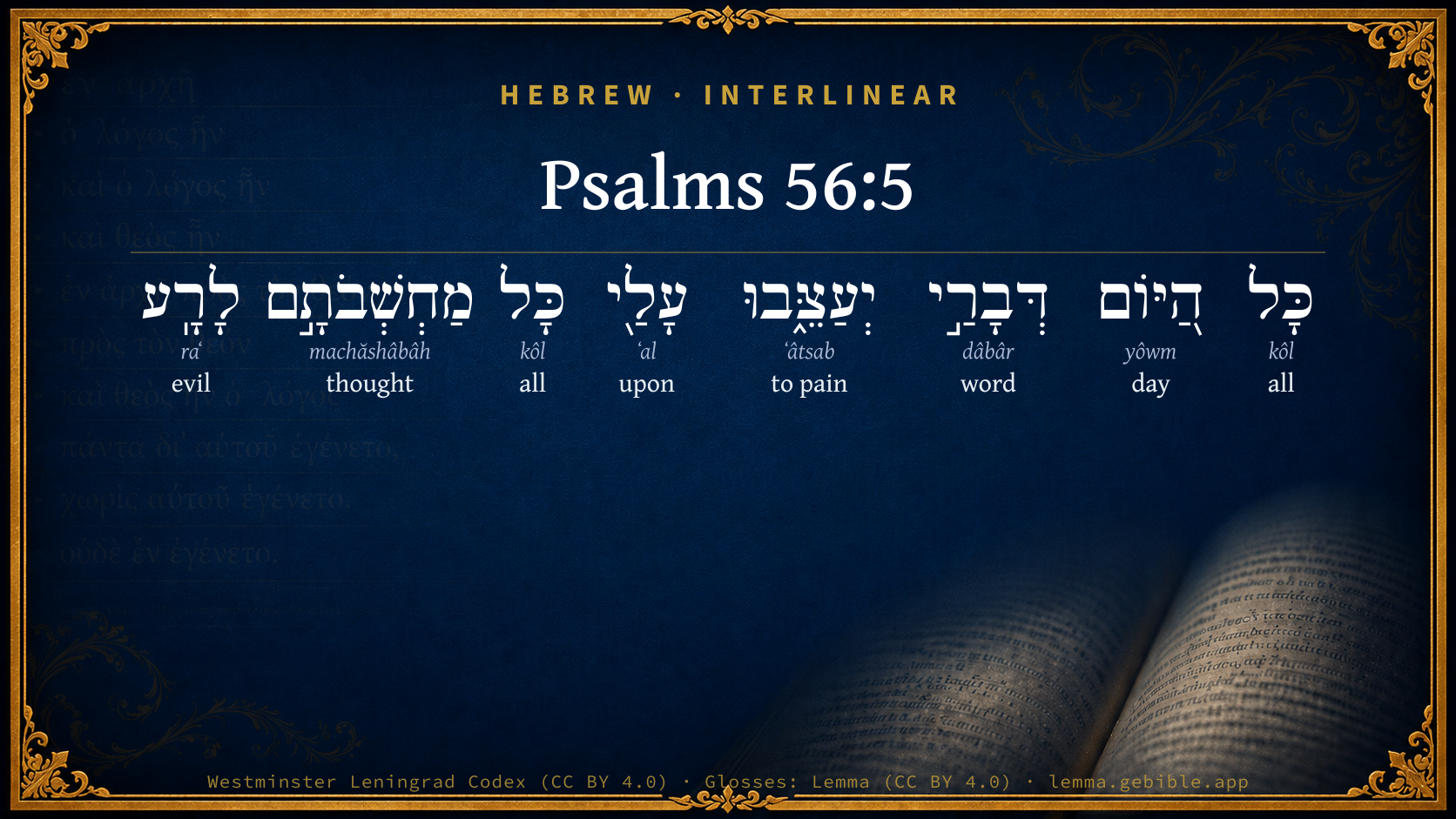
Psalms 56:5

Hebrew (Westminster Leningrad Codex) Psalms 56:5 appears in the Hebrew Old Testament. The text above is from the Westminster Leningrad Codex. Each word links to its Strong’s number, a concise gloss, and parsing drawn from the Open Scriptures Hebrew Bible morphology. Click any word for its full Brown-Driver-Briggs (BDB) entry.
Download image
Cite this verse

Psalms 56:5 (World English Bible). Public Domain. Lemma interlinear Bible study tool, https://lemma.gebible.app/v/psalms/56/5.

Show BibTeX & RIS
BibTeX
RIS
English Translation
All day long they twist my words. All their thoughts are against me for evil.
World English Bible · Public Domain
Download a study sheet

One document with this verse’s original text, its word-by-word gloss line, the meaning frame, cross-references with their text, attributed commentary, and full source and license credits — printable, and it pastes into notes with its structure intact.

This verse Autodidact and up

Study sheet (.html) Plain text (.txt)

A passage Seminary Student

Up to 50 verses in one chapter. A passage sheet keeps up to 6 commentary sources and 12 cross-references per verse, in the order this page ranks them, and says so on the sheet whenever that leaves anything out. Ask for a single verse and you get the Autodidact verse sheet above.

Everything on this page stays free to read, with no account — the sheet is a download of what is already on screen, not access to it.

Want to remove ads? Support Godless Engineer
Compare translations 3

The same verse in 3 English versions, stacked beneath the original-language interlinear above. Click any original word for its lexicon entry.

Each is an independent rendering of the whole verse — the interlinear is not word-aligned to these translations.

Highlighted words mark where these versions differ — a whole-verse word diff, not a word-by-word alignment.

  • World English Bible Public Domain
    All day long they twist my words. All their thoughts are against me for evil.
  • King James Version Public Domain
    Every day they wrest my words: all their thoughts are against me for evil.
  • unfoldingWord Literal Text CC BY-SA 4.0
    All of the day they vex my matters; all of their thoughts against me for harm.

unfoldingWord Literal Text — © unfoldingWord, licensed CC BY-SA 4.0. Word-aligned USFM3 via Door43 (git.door43.org/unfoldingWord/en_ult).

Versions to compare (up to 4)

3 of 4 selected

Show all 18 translations

Every available English version of this verse, each an independent rendering of the whole verse.

  • World English Bible Public Domain
    All day long they twist my words. All their thoughts are against me for evil.
  • Berean Standard Bible Public Domain
    All day long they twist my words; all their thoughts are on my demise.
  • Majority Standard Bible Public Domain
    All day long they twist my words; all their thoughts are on my demise.
  • King James Version Public Domain
    Every day they wrest my words: all their thoughts are against me for evil.
  • American Standard Version (1901) Public Domain
    All the day long they wrest my words: All their thoughts are against me for evil.
  • Revised Version (1885) Public Domain
    All the day long they wrest my words: all their thoughts are against me for evil.
  • Geneva Bible (1599) Public Domain
    Mine owne wordes grieue me dayly: all their thoughtes are against me to doe me hurt.
  • Douay-Rheims (1899) Public Domain
    In God I will praise my words, in God I have put my trust: I will not fear what flesh can do against me.
  • Young's Literal Translation Public Domain
    All the day they wrest my words, Concerning me all their thoughts `are' for evil,
  • Literal Standard Version CC BY-SA 4.0
    All the day they wrest my words, || All their thoughts [are] for evil concerning me,
  • Unlocked Literal Bible CC BY-SA 4.0
    All the day long they twist my words; all their thoughts are against me for evil.
  • unfoldingWord Literal Text CC BY-SA 4.0
    All of the day they vex my matters; all of their thoughts against me for harm.
  • Darby Bible Public Domain
    All the day long they wrest my words; all their thoughts are against me for evil.
  • World Messianic Bible Public Domain
    All day long they twist my words. All their thoughts are against me for evil.
  • Webster's Bible Public Domain
    \\56:4\\In God I will praise his word, in God I have put my trust; I will not fear what flesh can do to me.
  • Free Bible Version CC BY-SA 4.0
    They constantly twist my words against me; they spend all their time thinking of evil things to do to me.
  • Bible in Basic English Public Domain
    Every day they make wrong use of my words; all their thoughts are against me for evil.
  • JPS Tanakh (1917) Public Domain
    (56-6) All the day they trouble mine affairs; all their thoughts are against me for evil.

Literal Standard Version (2020), Covenant Press — licensed CC BY-SA 4.0. Text via the HelloAO Bible API (eBible.org). Unlocked Literal Bible (unfoldingWord) — licensed CC BY-SA 4.0. Text via the HelloAO Bible API (eBible.org). unfoldingWord Literal Text — © unfoldingWord, licensed CC BY-SA 4.0. Word-aligned USFM3 via Door43 (git.door43.org/unfoldingWord/en_ult). Free Bible Version, Dr. Jonathan Gallagher — licensed CC BY-SA 4.0. Text via the HelloAO Bible API (eBible.org).

Word by word

More ways to search: Search by grammar → Find every occurrence → Compare this word →

Practice this passage: Drill this verse → Learn its vocabulary →

יְעַצֵּ֑בוּ
ʻâtsab
H6087
“to pain”
Verb, Piel, Imperfect, 3rd Person, Masculine, Plural
Part of Speech
Verb
Stem
Piel
Form
Imperfect
Person
3rd Person
Gender
Masculine
Number
Plural
Full BDB Definition

Origin: a primitive root

TWOT: 1666 , 1667

to hurt, pain, grieve, displease, vex, wrest - (Qal) to hurt, pain - (Niphal) to be in pain, be pained, be grieved - (Piel) to vex, torture - (Hiphil) to cause pain - (Hithpael) to feel grieved, be vexed - to shape, fashion, make, form, stretch into shape, (TWOT) worship - (Piel) to shape, form - (Hiphil) to form, copy, fashion
  1. כָּל kôl H3605 “all of” Noun, Common, Masculine, Singular, Construct
  2. הַ֭יּוֹם yôwm H3117 “the · day” Particle, Definite Article + Noun, Common, Masculine, Singular, Absolute
  3. דְּבָרַ֣י dâbâr H1697 “words · my” Noun, Common, Masculine, Plural, Construct + Suffix, Personal, 1st Person, Common, Singular
  4. עָלַ֖י ʻal H5921 “upon · me” Preposition + Suffix, Personal, 1st Person, Common, Singular
  5. כָּל kôl H3605 “all of” Noun, Common, Masculine, Singular, Construct
  6. מַחְשְׁבֹתָ֣ם machăshâbâh H4284 “thoughts · their” Noun, Common, Feminine, Plural, Construct + Suffix, Personal, 3rd Person, Masculine, Plural
  7. לָרָֽע raʻ H7451 “to/for the · evil” Preposition, Determined + Adjective, Adjective, Masculine, Singular, Absolute

About this verse

These counts appear in no published source. They are computed here, from the morphology-tagged text and Lemma’s own curated glosses. What Lemma adds →

8
words
7
distinct lemmas
Wisdom
section

Notable vocabulary

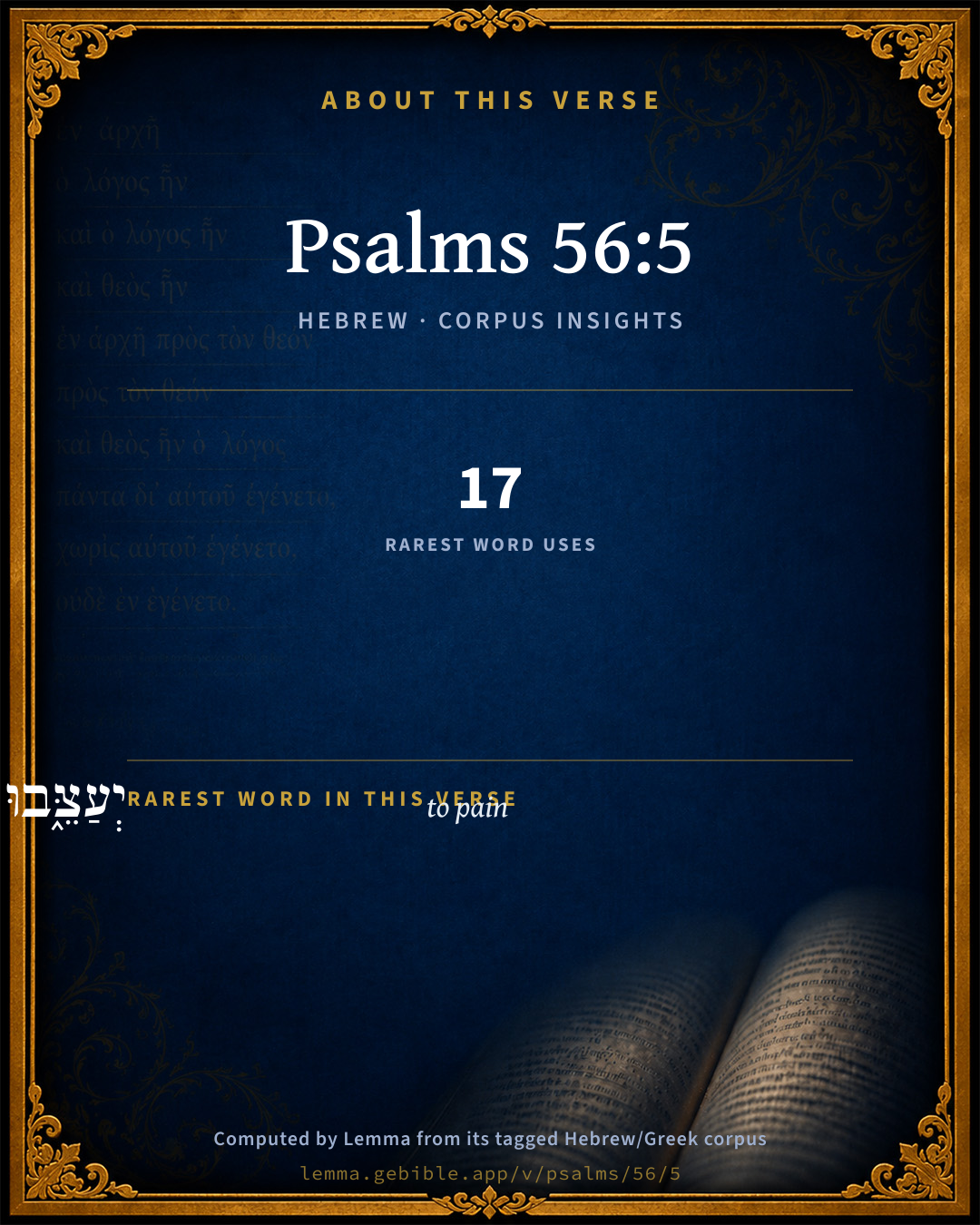
The rarest word here is יְעַצֵּ֑בוּ to pain H6087 — appearing just 17 times in the whole Hebrew Bible.

Shared distinctive vocabulary

יְעַצֵּ֑בוּ to pain H6087 occurs in 17 verses of the Hebrew Bible. Also found in:

Grammatical profile

  • 1 verb
  • 5 nouns
  • 1 adjective
  • 1 preposition

Verb forms

  • יְעַצֵּ֑בוּ Piel · Imperfect

Repetition

A word recurs within this verse — often emphatic in Hebrew:

Hebrew & Septuagint length

In English translation the verse runs 15 words from the Hebrew and 17 from the Septuagint (LXX English) — closely comparable.

A rough comparison of the two English renderings, which tokenize alike — not a word-level alignment.

Word counts can differ between the Hebrew and the Greek without any difference in meaning — e.g. the Hebrew direct-object marker אֵת has no separate Greek word, and Greek often adds the article ὁ.

Cross-references

14

Topical passages linked to Psalms 56:5 in the Treasury of Scripture Knowledge — connected by theme and wording, ordered by reader-vote popularity; previews shown in the World English Bible.

  • Matthew 22:15 Then the Pharisees went and took counsel how they might entrap him in his talk.
  • Luke 11:54 lying in wait for him, and seeking to catch him in something he might say, that they might accuse him.
  • Psalms 41:7 All who hate me whisper together against me. They imagine the worst for me.
  • Isaiah 29:20–21 For the terrible one is brought to nothing, and the scoffer ceases, and all those who watch for iniquity are cut off;
  • 2 Peter 3:16 as also in all of his letters, speaking in them of these things. In those are some things hard to be understood, which the ignorant and unsettled twist, as they also do to the other Scriptures, to their own destruction.
  • 1 Samuel 18:21 Saul said, I will give her to him, that she may be a snare to him, and that the hand of the Philistines may be against him. Therefore Saul said to David, You shall this day be my son-in-law a second time.
  • 1 Samuel 18:17 Saul said to David, Behold, my elder daughter Merab, her will I give you as wife: only be valiant for me, and fight Yahweh's battles. For Saul said, Don't let my hand be on him, but let the hand of the Philistines be on him.
  • Luke 22:3–6 Satan entered into Judas, who was surnamed Iscariot, who was numbered with the twelve.
  • John 2:19 Jesus answered them, "Destroy this temple, and in three days I will raise it up."
  • 1 Samuel 18:29 Saul was yet the more afraid of David; and Saul was David's enemy continually.
  • Jeremiah 18:18 Then said they, Come, and let us devise devices against Jeremiah; for the law shall not perish from the priest, nor counsel from the wise, nor the word from the prophet. Come, and let us strike him with the tongue, and let us not give heed to any of his words.
  • Matthew 26:61 and said, "This man said, 'I am able to destroy the temple of God, and to build it in three days.'"
  • 1 Samuel 20:7 If he says, 'It is well;' your servant shall have peace: but if he be angry, then know that evil is determined by him.
  • 1 Samuel 20:33 Saul cast his spear at him to strike him. By this Jonathan knew that his father was determined to put David to death.

Cross-references courtesy of OpenBible.info (CC BY 4.0).

Hebrew and Greek witnesses Masoretic Hebrew ↔ Greek Septuagint

The same verse in the two great witnesses to the Old Testament, shown verse-for-verse.

You’re reading Greek Psalm 55 (Hebrew Psalm 56). The Septuagint counts the superscription, so verse numbers can differ from the Hebrew — chapter-level alignment, not verse-by-verse. Numbering follows Rahlfs.

These are two independent witnesses, not word-aligned to each other, and the Septuagint is shown in lemma (dictionary) form.

Hebrew Psalms 56:5 Masoretic · Westminster Leningrad Codex

כָּל הַ֭יּוֹם דְּבָרַ֣י יְעַצֵּ֑בוּ עָלַ֖י כָּל מַחְשְׁבֹתָ֣ם לָרָֽע

All day long they twist my words. All their thoughts are against me for evil.

World English Bible · Public Domain

Greek LXX Greek Psalm 55:5 Septuagint · lemma form

ἐν ὁ θεός ἐπιαἰνέω ὁ λόγος ἐγώ ὅλος ὁ ἡμέρα ἐπί ὁ θεός ἐλπίζω οὐ φοβέω τίς ποιέω ἐγώ σάρξ

All the day long they have abominated my words; all their devices are against me for evil.

LXX2012 (modern English Septuagint) · Public Domain

On this verse, John Gill's Exposition discusses the Septuagint’s reading. Read the note in Commentary ↓

Hebrew: Westminster Leningrad Codex (CC BY 4.0). Greek: Septuagint (public domain); English from LXX2012 (modern English Septuagint) (Public Domain). How the Septuagint differs from the Hebrew →

Commentary

Notes on Psalms 56:5 from classic Christian and Jewish commentators (each source and its license shown beneath its notes). The classic Christian expositions comment on the surrounding passage and are grouped to its opening verse, so a note may address several verses; the Jewish commentaries on the Tanakh (Rashi and others) are per-verse, so they appear only where the commentator wrote on this verse.

Lemma curates 59 commentaries, every one of them public domain or Creative Commons licensed, each selected and text-cleaned for this edition rather than reprinted as found. About our sources →

Trapp's Complete Commentary

John Trapp

Psa 56:5 Every day they wrest my words: all their thoughts [are] against me for evil.

Ver. 5. Every day they wrest my words] Or, my matters; they distort and pervert everything I say, or do, from the true intention, and all to make a traitor of me. That I carried myself wisely in the court, valiantly in the field, faithfully toward Jonathan, cautiously for the safeguard of mine own life, shifting as I could from one place to another; all this they say was done out of affectation for the kingdom, and as seeking Saul’s death. So they dealt by our Saviour in the Gospel, taking that with the left hand which he tendered with the right, and many times marring a good text by an ill gloss put upon it. So Simon the leper served that good woman, who made an ewer {a} of her eyes and a towel of her hair, Luk 7:34. Men should interpret everything the best way, and not as logicians do, Sequi partem deteriorem.

All their thoughts, &c.] {See Trapp on "Psa 56:1"}

{a} A servant who supplied guests, etc. at table with water to wash their hands.

John Trapp, A Commentary or Exposition upon All the Books of the Old and New Testament (1647–1656) — public domain. Text from a community e-Sword module.

Joseph Benson's Commentary

Psa 56:5-6. They wrest my words — They misconstrue and pervert my most innocent expressions, and turn them into matter of calumny, in order that they may incense Saul against me. Hebrew, יעצבו, jegnatzeebu, they put upon the rack my words, to extort that out of them which was never in them. Or, they endeavour to squeeze from my words, as it were by torture, any sense they please, contrary to the intention of the speaker. All their thoughts, &c. — It is their whole study to do me mischief. They gather themselves together, &c. — After they have separately employed their thoughts against me, they meet together to hold consultations, and compare their schemes, and put them in execution. They hide themselves — They lurk secretly; either, that they may pry into all my most private actions; or, that they may surprise me with mischief unawares. They mark my steps — All my ways and actions, that they may find some occasion to reproach or entangle, and so destroy me; when they wait for my soul — Or life, namely, to take it away.

Joseph Benson's Commentary on the Old and New Testaments (1811–1818) — public domain. Text from a community e-Sword module.

J. A. Alexander on Psalms

Joseph Addison Alexander

6. (Psa 56:5). All the day my words they wrest; against me (are) all their thoughts for evil. The word translated wrest means strictly vex or pain, but is here used in the sense of twisting or distorting language by putting false constructions on it. Thoughts, purposes; designs. For evil, tending to my injury.

Joseph Addison Alexander, The Psalms Translated and Explained (1850) — public domain. Text from a community e-Sword module.

Tyndale Open Study Notes

Tyndale Open Resources

56:5-7 The psalmist specifies his charge against his attackers as he prays for their evil to cease.

Tyndale Open Study Notes — © Tyndale Open Resources, licensed CC BY-SA 4.0. Text via the HelloAO Bible API.

Geneva Bible (1599)

Geneva Bible translators

All my counsels have evil success, and turn to mine own sorrow.

Geneva Bible (1599) marginal notes — public domain. Text via Bolls.life.

Jamieson, Fausset & Brown

Robert Jamieson, A. R. Fausset & David Brown

A vivid picture of the conduct of malicious enemies.

Jamieson, Fausset & Brown — Commentary Critical and Explanatory on the Whole Bible (1871) — public domain (CC PDM 1.0). Text via the HelloAO Bible API.

Adam Clarke's Commentary

Verse 5. Every day they wrest my words] They have been spies on my conduct continually; they collected all my sayings, and wrested my words out of their proper sense and meaning, to make them, by inuendos, speak treason against Saul. They are full of evil purposes against me.

Adam Clarke's Commentary on the Bible (1810–1826) — public domain. Text from a community e-Sword/MySword module.

John Calvin's Commentaries

5 Every day my words vex me The first part of this verse has been variously rendered. Some understand my words to be the nominative in the sentence, and with these I agree in opinion. Others suppose a reference to the enemies of David, and translate, they calumniate my words, or, they cause me grief on account of my words. Again, יעצבו, yeatsebu, has been taken in the neuter sense, and translated, my words are troublesome. But עצב , atsab, commonly signifies to afflict with grief, and in Pihel is always taken transitively; nor does there seem any reason in this place to depart from the general rule of the language. And the passage flows more naturally when rendered, my words affect me with grief, or vex me, than by supposing that he refers to his enemies. According to this translation, the verse contains a double complaint, that, on the one hand, he was himself unsuccessful in everything which he attempted, his plans having still issued in vexatious failure; while, on the other hand, his enemies were devising every means for his destruction. It may appear at first sight rather inconsistent to suppose that he should immediately before have disclaimed being under the influence of fear, and now acknowledge that he was not only distressed, but in some measure the author of his own discomfort. I have already observed, however, that he is not to be considered as having been absolutely divested of anxiety and fear, although enabled to look down with contempt upon his enemies from the eminence of faith. Here he speaks of the circumstances which tried him, which his faith certainly overcame, but at the same time could not altogether remove out of the way. He confesses his own lack of wisdom and foresight, shown in the abortive issue of every plan which he devised. It aggravated the evil, that his enemies were employing their united counsels to plot his ruin. He adds, that they gathered themselves together; and this made his case the more calamitous, matched as he was, a single individual, against this numerous host. In mentioning that they hide themselves, he adverts to the subtile devices which they framed for surprising him into destruction. The verb יצפינו, yitsponu, by grammatical rule ought to have the letter ו, vau, in the middle; from which the general opinion is, that the י yod, is as it were the mark of Hiphil, denoting that the enemies of David came to the determination of employing an ambush, with the view of surrounding him. He tells us that they pressed upon him in every direction, and as it were trod upon his heels, so that he had no respite. And he points at their implacable hatred as the cause of their eager pursuit of him; for nothing, he informs us, would satisfy them but his death.

John Calvin's Commentaries (1540-1563) — public domain. Text from the Calvin Translation Society English edition (1840s-50s) via the Christian Classics Ethereal Library (ccel.org). Calvin's coverage is partial (roughly two-thirds of the Bible); uncommented books and verses are honest gaps, never fabricated. The 19th-century editor's footnotes and remarks are omitted so the notes are faithfully Calvin's own voice.

Ellicott's Commentary for English Readers

(5) Wrest.—Properly, afflict; and so some, “injure my cause.” But “torture my words” is intelligible.

A Bible Commentary for English Readers, edited by Charles John Ellicott (1878–1897) — public domain. Text from a community e-Sword module.

The Cambridge Bible for Schools and Colleges

gen. ed. J. J. S. Perowne

5. From the heights of faith he returns to the urgent reality of present distress. Cp. Psa_42:6.

Every day] R.V., all the day long.

they wrest my words] Distorting and perverting them. Calumniators endeavoured to poison Saul’s mind against David, 1Sa_24:9, cp. Psa_7:3 ff. But the meaning is somewhat doubtful. It may be, they pervert my affairs, i.e. injure my interests.

all their thoughts &c.] Cp. Psa_41:7.

5–11. The second division of the Psalm is similar to the first: a description of present distress, and prayer for help, followed by an expression of perfect confidence in God’s protection.

The Cambridge Bible for Schools and Colleges (gen. ed. J. J. S. Perowne; Cambridge University Press, 1878–1918) — public domain. Text from a community e-Sword module.

John Gill's Exposition

Every day they wrest my words,.... Form, fashion, and shape them at their pleasure; construe them, and put what sense upon them they think fit. The word (u) is used of the formation of the human body, in Job 10:8; They put his words upon the rack, and made them speak what he never intended; as some men wrest the Scriptures to their own destruction, Pe2 3:16; and as the Jews wrested the words of Christ, Joh 2:19. The word has also the sense of causing vexation and grief, Isa 63:10; and so it may be rendered here, "my words cause grief" (w); to his enemies; because he had said, in the preceding verses, that he would trust in the Lord, and praise his word, and not be afraid of men; just as the Sadducees were grieved at the apostles preaching, through Jesus, the resurrection of the dead, Act 4:1. Or they caused grief to himself; for because of these his enemies reproached him, cursed him, and distressed him. The Septuagint and Vulgate Latin render it, "they cursed my words"; or despised them, as the Ethiopic and Arabic versions:

all their thoughts are against me for evil; their counsels, schemes, and contrivances, were all formed to do him all the hurt and mischief they could.

(u) "fingunt mea verba", Cocceius, Gusset. p. 628. "They painfully form and frame my words", Ainsworth. (w) "Dolore afficient", Montanus, Gejerus, Vatablus.

John Gill's Exposition of the Whole Bible (1746–1763) — public domain (CC PDM 1.0). Text via the HelloAO Bible API.

Albert Barnes' Notes on the Bible

Every day they wrest my words - The word here rendered “wrest,” means literally to give pain, to grieve, to afflict; and it is used here in the sense of “wresting,” as if force were applied to words; that is, they are “tortured,” twisted, perverted. We have the same use of the word “torture” in our language. This they did by affixing a meaning to his words which he never intended, so as to injure him.

All their thoughts are against me for evil - All their plans, devices, purposes. They never seek my good, but always seek to do me harm.

Albert Barnes' Notes on the Bible (1834–1885) — public domain. Text from a community e-Sword/MySword module.

Matthew Poole's English Annotations

They wrest my words; they misconstrue and pervert my most innocent expressions, and turn them into matter of calumny, wherewith they may incense Saul against me. Or, they perplex my affairs. All their thoughts are against me for evil; it is their whole study to do me mischief.

Matthew Poole's English Annotations on the Holy Bible (1683–1685) — public domain. Text from a community e-Sword/MySword module.

The Treasury of David

Charles H. Spurgeon

Ver. 5. Every day they wrest my words. This is a common mode of warfare among the ungodly. They put our language on the rack, they extort meanings from it which it cannot be made fairly to contain. Thus our Saviour's prophecy concerning the temple of his body, and countless accusations against his servants, were founded on wilful perversions. They who do this every day become great adepts in the art. A wolf can always find in a lamb's discourse a reason for eating him. Prayers are blasphemies if you choose to read them the wrong way upwards.

All their thoughts are against me for evil. No mixture of good will tone down their malice. Whether they viewed him as a king, a psalmist, a man, a father, a warrior, a sufferer, it was all the same, they saw through coloured glass, and could not think a generous thought towards him. Even those actions of his which were an undoubted blessing to the commonwealth, they endeavoured to undervalue. Oh, foul spring, from which never a drop of pure water can come!

Ver. 5. Every day they wrest my words; or, they put my words to pain and grief, or, they painfully and grievously wrest my words. David's enemies took up what he spake, and put a new shape upon it; and this they did so vexingly, that they are said to wrest his words; a thing is vexed when it is wrested or wrought out of the form it before had. The same metaphor the apostle Peter useth in reference to doctrine, speaking of the Epistles of Paul, in which "are some things hard to be understood, which they that are unlearned and unstable wrest, "or put upon the rack; they painfully form his words, and represent them in a meaning which he never intended. 2Pe 3:16. What is spoken may be right, both in the matter and intendment of the speaker, yet another wrests, forms and fashions it in his own mould, and makes it bear a sense which the speaker never dreamed of. Joseph Caryl.

Ver. 5. Every day they wrest my words, etc. Mr. Jewel, the Bishop of Salisbury, who, according to his life, died most godly and patiently, at the point of death used the versicle of the Hymn, "Te Deum, ""O Lord, in thee have I trusted, let me never be confounded, " whereupon, suppressing the rest, they published that the principle champion of the heretics, in his very last words, cried he was confounded. Lord Bacon's "Bible Thoughts."

Ver. 5. They wrest my words. Whatever Christ said in justification of himself was twisted to a meaning injurious to him. So it is still in the world, self justification by words answers but little purpose with ungodly men. W. Wilson, D.D., 1860.

None.

Psalms 56:6*

Charles H. Spurgeon's The Treasury of David (1869–1885) — public domain. Psalms only. Text from a community e-Sword/MySword module.

Whedon's Commentary on the Bible

Daniel D. Whedon

5. They wrest my words—The word rendered “wrest,” means, fashion, shape; they shape my words to suit their purposes. The text implies that David had entered a defence of the innocent object of his visit, perhaps at different times, and as they were deficient in facts to convict him they sought occasion by torturing his language. Their thoughts—Their devices.

Daniel D. Whedon (gen. ed.), Commentary on the Old and New Testaments (1874–1909) — public domain. Text from a community e-Sword module.

The Pulpit Commentary

Every day they wrest my words; rather, all the day long. they wrest (or, torture) my words. They seek to give my words an evil meaning, and so to misrepresent me to Achish, their king. As Canon Cook says, "This description is singularly applicable to David"s position among the envious nobles at the court of Achish Still, it does not speak of his having been actually arrested, and does not, therefore, seem to have suggested the inscription." All their thoughts are against his for evil. They are entirely bent on doing the psalmist some hurt. What they really seek is his life (ver. 6); but, short of that, they would gladly do him some mischief.

The Pulpit Commentary (1880–1919), ed. H.D.M. Spence-Jones & Joseph S. Exell — public domain. Text from a community e-Sword module.

Keil & Delitzsch

C. F. Keil & F. Delitzsch

This second strophe describes the adversaries, and ends in imprecation, the fire of anger being kindled against them. Hitzig's rendering is: "All the time they are injuring my concerns," i.e., injuring my interests. This also sounds unpoetical. Just as we say חמס תורה, to do violence to the Tפra (Zep 3:4; Eze 22:26), so we can also say: to torture any one's words, i.e., his utterances concerning himself, viz., by misconstruing and twisting them. It is no good to David that he asseverates his innocence, that he asserts his filial faithfulness to Saul, God's anointed; they stretch his testimony concerning himself upon the rack, forcing upon it a false meaning and wrong inferences. They band themselves together, they place men in ambush. The verb גּוּר signifies sometimes to turn aside, turn in, dwell (= Arab. jâr); sometimes, to be afraid (= יגר, Arab. wjr); sometimes, to stir up, excite, Psa 140:3 (= גּרה); and sometimes, as here, and in Psa 59:4, Isa 54:15 : to gather together (= אגר). The Ker reads יצפּונוּ (as in Psa 10:8; Pro 1:11), but the scriptio plena points to Hiph. (cf. Job 24:6, and also Psa 126:5), and the following המּה leads one to the conclusion that it is the causative יצפּינוּ that is intended: they cause one to keep watch in concealment, they lay an ambush (synon. האריב, Sa1 15:5); so that המה refers to the liers-in-wait told off by them: as to these - they observe my heels or (like the feminine plural in Psa 77:20; Psa 89:52) footprints (Rashi: mes traces), i.e., all my footsteps or movements, because (properly, "in accordance with this, that," as in Mic 3:4) they now as formerly (which is implied in the perfect, cf. Psa 59:4) attempt my life, i.e., strive after, lie in wait for it (קוּה like שׁמר, Psa 71:10, with the accusative = קוּה ל in Psa 119:95). To this circumstantial representation of their hostile proceedings is appended the clause על־עון פּלּט־למו, which is not to be understood otherwise than as a question, and is marked as such by the order of the words (Kg2 5:26; Isa 28:28): In spite of iniquity [is there] escape for them? i.e., shall they, the liers-in-wait, notwithstanding such evil good-for-nothing mode of action, escape? At any rate פּלּט is, as in Psa 32:7, a substantivized finitive, and the "by no means" which belongs as answer to this question passes over forthwith into the prayer for the overthrow of the evil ones. This is the customary interpretation since Kimchi's day. Mendelssohn explains it differently: "In vain be their escape," following Aben-Jachja, who, however, like Saadia, takes פלט to be imperative. Certainly adverbial notions are expressed by means of על, - e.g., על־יתר ,., abundantly, Psa 31:24; על־שׁקר, falsely, Lev. 5:22 (vid., Gesenius, Thesaurus, p. 1028), - but one does not say על־הבל, and consequently also would hardly have said על־און (by no means, for nothing, in vain); moreover the connection here demands the prevailing ethical notion for און. Hupfeld alters פלט to פּלּס, and renders it: "recompense to them for wickedness," which is not only critically improbable, but even contrary to the usage of the language, since פלס signifies to weigh out, but not to requite, and requires the accusative of the object. The widening of the circle of vision to the whole of the hostile world is rightly explained by Hengstenberg by the fact that the special execution of judgment on the part of God is only an outflow of His more general and comprehensive execution of judgment, and the belief in the former has its root in a belief in the latter. The meaning of הורד becomes manifest from the preceding Psalm (Ps 55:24), to which the Psalm before us is appended by reason of manifold and closely allied relation.

Keil & Delitzsch — Biblical Commentary on the Old Testament (1861–1891) — public domain (CC PDM 1.0). Text via the HelloAO Bible API. (Old Testament only.)

unfoldingWord translationNotes

Door43 World Missions Community

All the day long

"All the time"

they twist my words

Repeating what someone says but changing it a little so that it means something different is spoken of as twisting their words. AT: "they say that I said things than I did not say" or "they claim that I said things, but they lie" (See: Metaphor)

all their thoughts are against me for evil

"they always have evil thoughts against me" or "they always think of evil things to do to me"

they mark my steps

Watching what a person does in order to see how to cause him trouble is spoken of as watching his steps, just as someone who wants to capture a person watches where that person walks. AT: "they watch everything I do" (See: Metaphor)

just as they have waited for my life

Waiting to kill someone is spoken of as waiting for his life. AT: "as they wait to kill me" (See: Metonymy)

translationWords

evil

unfoldingWord translationNotes — © Distant Shores Media and the Door43 World Missions Community, licensed CC BY-SA 4.0. Source: git.door43.org/Door43/en_tn.

Rashi

Rabbi Shlomo Yitzchaki (Rashi)

With God, I will praise His word Even when He deals with me with the Divine standard of justice I will praise His word and trust in Him.

Rashi on the Tanakh — English translations: “The Judaica Press complete Tanach with Rashi, translated by A. J. Rosenberg” (CC BY 4.0); “Pentateuch with Rashi's commentary by M. Rosenbaum and A.M. Silbermann, 1929-1934” (public domain); “The Metsudah Tanach series, Lakewood, N.J” (CC BY 4.0); and “The Book of Joshua, Metsudah Publications, 1997” (CC BY 4.0). Text via Sefaria.

Lesson kit

Teaching starters — assembled from the data on this page, not authored interpretation. Every prompt links to the verse data it draws on. Edit before teaching.

Psalms, in the Wisdom, opens this verse with 8 words (7 distinct Hebrew lemmas). Its most distinctive word is ʻâtsab (“to pain”). A historical commentator’s framing appears above. Read the whole chapter for the surrounding context.

Discussion questions

  1. What does “to pain” (ʻâtsab) contribute to the verse as a whole?
  2. Genesis 6:6 shares the word «to pain» with this verse. How do the two illuminate each other?
  3. “all” occurs 2× in this one verse. What is the effect of the repetition?
  4. These translations render this verse differently; the difference is in the English rendering, not the original. What questions does that raise?
  5. The verb «יְעַצֵּ֑בוּ» is Piel Imperfect. How does its form color the action?
  6. Reading how Trapp's Complete Commentary and Joseph Benson's Commentary read this verse, where do the two commentators agree and where do they part?

Things to notice

Reading settings

Reading text

Shown beneath each verse's original-language words.

Old Testament
Old Testament edition

Read the OT as the Masoretic Hebrew (MT) or the Greek Septuagint (LXX).

English shown for the Greek Septuagint (in the Hebrew ↔ Greek comparison).

Comparing translations? Open the Compare panel on any verse page to stack up to four side by side.