
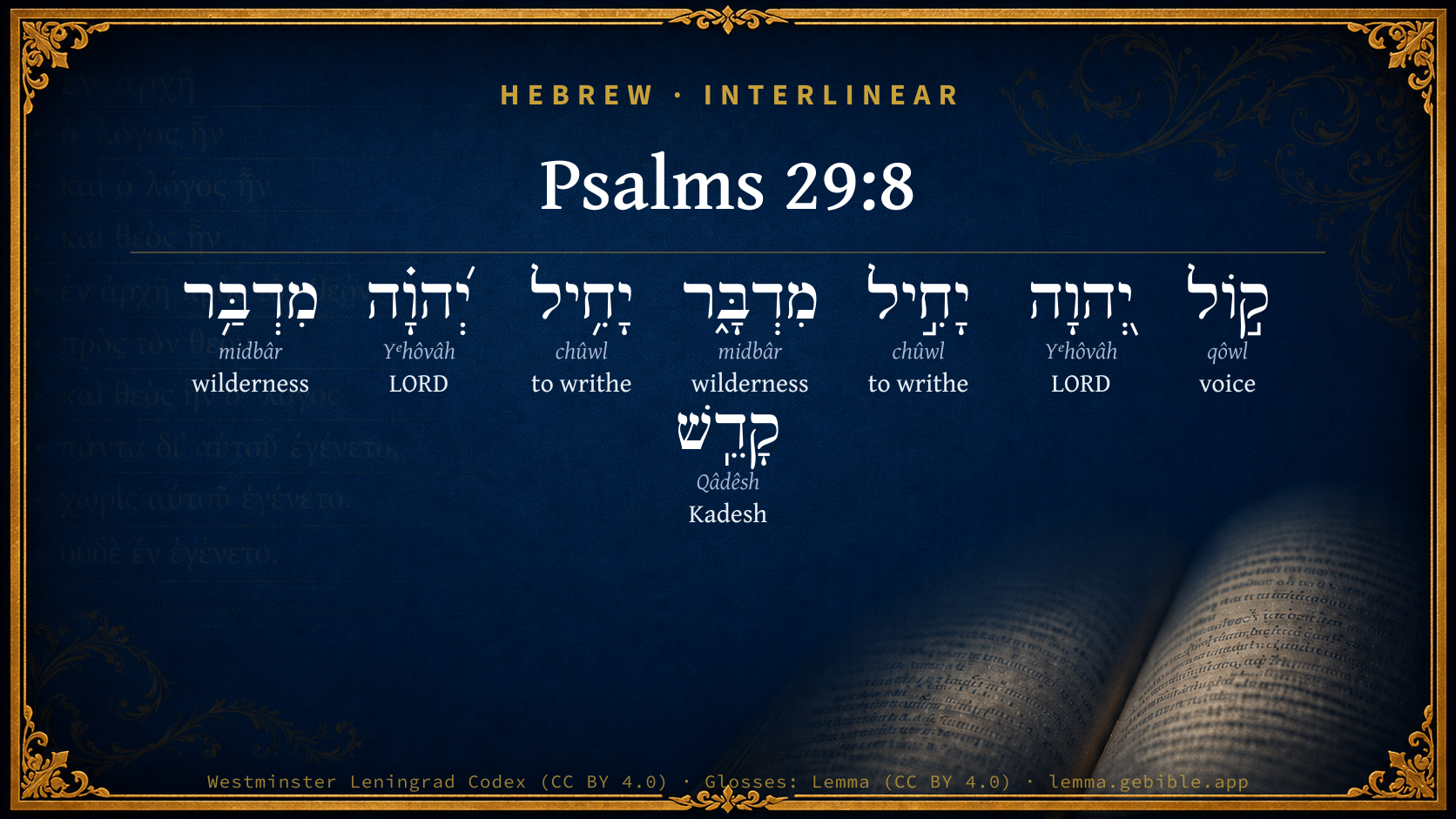
Psalms 29:8

Hebrew (Westminster Leningrad Codex) Psalms 29:8 appears in the Hebrew Old Testament. The text above is from the Westminster Leningrad Codex. Each word links to its Strong’s number, a concise gloss, and parsing drawn from the Open Scriptures Hebrew Bible morphology. Click any word for its full Brown-Driver-Briggs (BDB) entry.
Download image
Cite this verse

Psalms 29:8 (World English Bible). Public Domain. Lemma interlinear Bible study tool, https://lemma.gebible.app/v/psalms/29/8.

Show BibTeX & RIS
BibTeX
RIS
English Translation
Yahweh's voice shakes the wilderness. Yahweh shakes the wilderness of Kadesh.
World English Bible · Public Domain
Download a study sheet

One document with this verse’s original text, its word-by-word gloss line, the meaning frame, cross-references with their text, attributed commentary, and full source and license credits — printable, and it pastes into notes with its structure intact.

This verse Autodidact and up

Study sheet (.html) Plain text (.txt)

A passage Seminary Student

Up to 50 verses in one chapter. A passage sheet keeps up to 6 commentary sources and 12 cross-references per verse, in the order this page ranks them, and says so on the sheet whenever that leaves anything out. Ask for a single verse and you get the Autodidact verse sheet above.

Everything on this page stays free to read, with no account — the sheet is a download of what is already on screen, not access to it.

Want to remove ads? Support Godless Engineer
Compare translations 3

The same verse in 3 English versions, stacked beneath the original-language interlinear above. Click any original word for its lexicon entry.

Each is an independent rendering of the whole verse — the interlinear is not word-aligned to these translations.

Highlighted words mark where these versions differ — a whole-verse word diff, not a word-by-word alignment.

  • World English Bible Public Domain
    Yahweh's voice shakes the wilderness. Yahweh shakes the wilderness of Kadesh.
  • King James Version Public Domain
    The voice of the LORD shaketh the wilderness; the LORD shaketh the wilderness of Kadesh.
  • unfoldingWord Literal Text CC BY-SA 4.0
    The voice of Yahweh shakes the wilderness; Yahweh shakes the wilderness of Kadesh.

unfoldingWord Literal Text — © unfoldingWord, licensed CC BY-SA 4.0. Word-aligned USFM3 via Door43 (git.door43.org/unfoldingWord/en_ult).

Versions to compare (up to 4)

3 of 4 selected

Show all 18 translations

Every available English version of this verse, each an independent rendering of the whole verse.

  • World English Bible Public Domain
    Yahweh's voice shakes the wilderness. Yahweh shakes the wilderness of Kadesh.
  • Berean Standard Bible Public Domain
    The voice of the LORD shakes the wilderness; the LORD shakes the Wilderness of Kadesh.
  • Majority Standard Bible Public Domain
    The voice of the LORD shakes the wilderness; the LORD shakes the Wilderness of Kadesh.
  • King James Version Public Domain
    The voice of the LORD shaketh the wilderness; the LORD shaketh the wilderness of Kadesh.
  • American Standard Version (1901) Public Domain
    The voice of Jehovah shaketh the wilderness; Jehovah shaketh the wilderness of Kadesh.
  • Revised Version (1885) Public Domain
    The voice of the LORD shaketh the wilderness; the LORD shaketh the wilderness of Kadesh.
  • Geneva Bible (1599) Public Domain
    The voice of the Lord maketh the wildernes to tremble: the Lord maketh the wildernes of Kadesh to tremble.
  • Douay-Rheims (1899) Public Domain
    The voice of the Lord shaketh the desert: and the Lord shall shake the desert of Cades.
  • Young's Literal Translation Public Domain
    The voice of Jehovah paineth a wilderness, Jehovah paineth the wilderness of Kadesh.
  • Literal Standard Version CC BY-SA 4.0
    The voice of YHWH pains a wilderness, || YHWH pains the wilderness of Kadesh.
  • Unlocked Literal Bible CC BY-SA 4.0
    The voice of Yahweh shakes the wilderness; Yahweh shakes the wilderness of Kadesh.
  • unfoldingWord Literal Text CC BY-SA 4.0
    The voice of Yahweh shakes the wilderness; Yahweh shakes the wilderness of Kadesh.
  • Darby Bible Public Domain
    The voice of Jehovah shaketh the wilderness; Jehovah shaketh the wilderness of Kadesh.
  • World Messianic Bible Public Domain
    The LORD’s voice shakes the wilderness. The LORD shakes the wilderness of Kadesh.
  • Webster's Bible Public Domain
    The voice of the LORD shaketh the wilderness; the LORD shaketh the wilderness of Kadesh.
  • Free Bible Version CC BY-SA 4.0
    The Lord's voice causes an earthquake in the desert; the desert of Kadesh shakes.
  • Bible in Basic English Public Domain
    At the voice of the Lord there is a shaking in the waste land, even a shaking in the waste land of Kadesh.
  • JPS Tanakh (1917) Public Domain
    The voice of the LORD shaketh the wilderness; the LORD shaketh the wilderness of Kadesh.

Literal Standard Version (2020), Covenant Press — licensed CC BY-SA 4.0. Text via the HelloAO Bible API (eBible.org). Unlocked Literal Bible (unfoldingWord) — licensed CC BY-SA 4.0. Text via the HelloAO Bible API (eBible.org). unfoldingWord Literal Text — © unfoldingWord, licensed CC BY-SA 4.0. Word-aligned USFM3 via Door43 (git.door43.org/unfoldingWord/en_ult). Free Bible Version, Dr. Jonathan Gallagher — licensed CC BY-SA 4.0. Text via the HelloAO Bible API (eBible.org).

Word by word

More ways to search: Search by grammar → Find every occurrence → Compare this word →

Practice this passage: Drill this verse → Learn its vocabulary →

About this verse

These counts appear in no published source. They are computed here, from the morphology-tagged text and Lemma’s own curated glosses. What Lemma adds →

8
words
5
distinct lemmas
Wisdom
section

Notable vocabulary

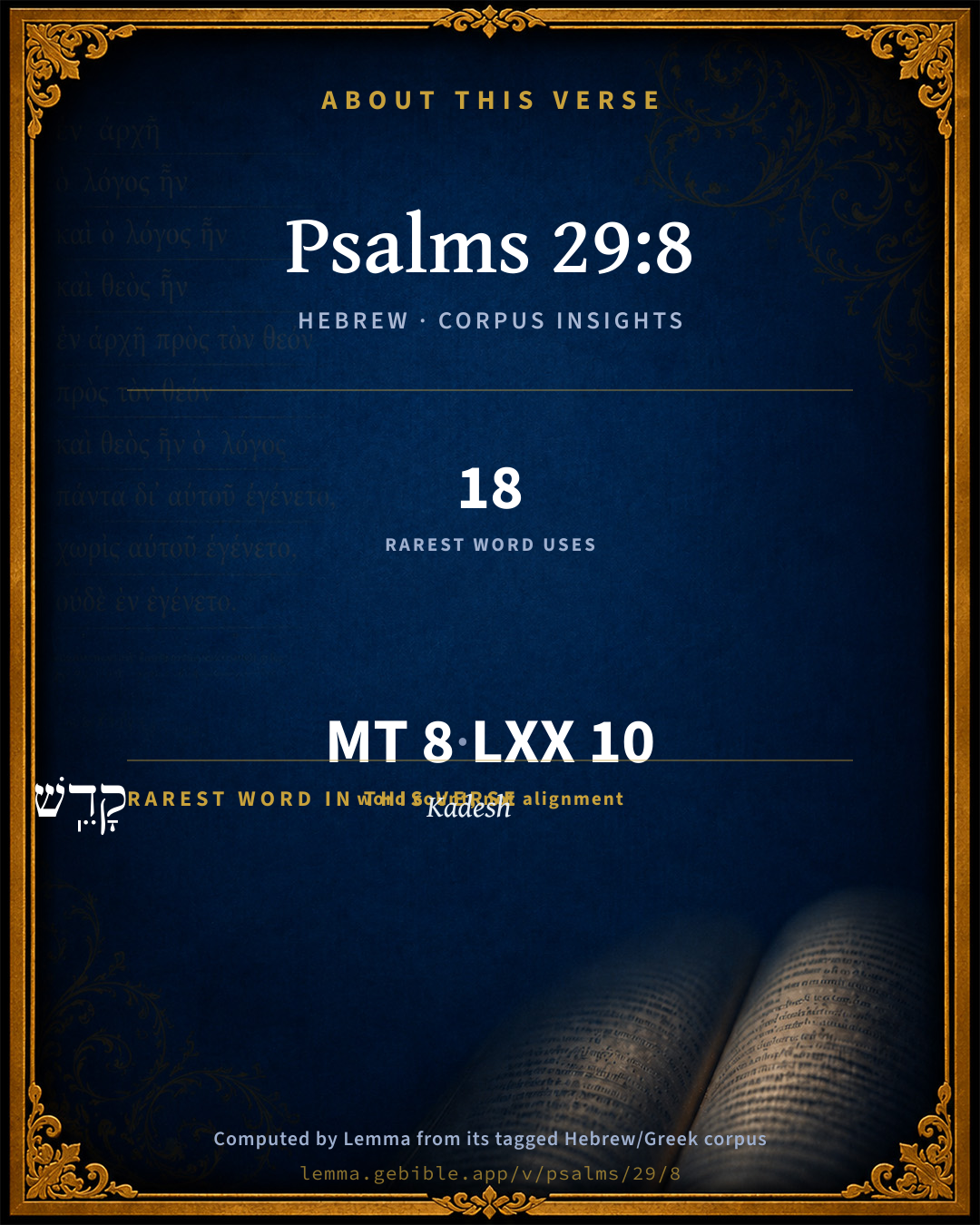
The rarest word here is קָדֵֽשׁ Kadesh H6946 — appearing just 18 times in the whole Hebrew Bible.

Shared distinctive vocabulary

קָדֵֽשׁ Kadesh H6946 occurs in 18 verses of the Hebrew Bible. Also found in:

Grammatical profile

  • 2 verbs
  • 6 nouns

Verb forms

  • יָחִ֣יל Hiphil · Imperfect
  • יָחִ֥יל Hiphil · Imperfect

Repetition

Words recur within this verse — often emphatic in Hebrew:

  • יְ֭הוָה LORD H3068 ×2
  • יָחִ֣יל to writhe H2342 ×2
  • מִדְבָּ֑ר wilderness H4057 ×2

Hebrew & Septuagint length

In English translation the verse runs 11 words from the Hebrew and 17 from the Septuagint (LXX English) — closely comparable.

A rough comparison of the two English renderings, which tokenize alike — not a word-level alignment.

Word counts can differ between the Hebrew and the Greek without any difference in meaning — e.g. the Hebrew direct-object marker אֵת has no separate Greek word, and Greek often adds the article ὁ.

In the original languages it is 8 Hebrew tokens and 10 Greek tokens — but the two are counted differently (Hebrew bundles its prefixes and suffixes into one token; the Greek is in lemma form), so that isn’t a like-for-like length.

Cross-references

9

Topical passages linked to Psalms 29:8 in the Treasury of Scripture Knowledge — connected by theme and wording, ordered by reader-vote popularity; previews shown in the World English Bible.

  • Numbers 13:26 They went and came to Moses, and to Aaron, and to all the congregation of the children of Israel, to the wilderness of Paran, to Kadesh; and brought back word to them, and to all the congregation, and shown them the fruit of the land.
  • Job 9:6 Who shakes the earth out of its place; The pillars of it tremble;
  • Psalms 18:7 Then the earth shook and trembled. The foundations also of the mountains quaked and were shaken, Because he was angry.
  • Psalms 46:3 Though the waters of it roar and are troubled, Though the mountains tremble with their swelling. Selah.
  • Isaiah 13:13 Therefore I will make the heavens to tremble, and the earth shall be shaken out of its place, in the wrath of Yahweh of hosts, and in the day of his fierce anger.
  • Joel 3:16 Yahweh will roar from Zion, And thunder from Jerusalem; And the heavens and the earth will shake; But Yahweh will be a refuge to his people, And a stronghold to the children of Israel.
  • Haggai 2:6 For this is what Yahweh of Hosts says: 'Yet once, it is a little while, and I will shake the heavens, the earth, the sea, and the dry land;
  • Haggai 2:21 "Speak to Zerubbabel, governor of Judah, saying, 'I will shake the heavens and the earth.
  • Hebrews 12:26 whose voice shook the earth, then, but now he has promised, saying, "Yet once more I will shake not only the earth, but also the heavens."

Cross-references courtesy of OpenBible.info (CC BY 4.0).

Hebrew and Greek witnesses Masoretic Hebrew ↔ Greek Septuagint

The same verse in the two great witnesses to the Old Testament, shown verse-for-verse.

You’re reading Greek Psalm 28 (Hebrew Psalm 29). The Septuagint counts the superscription, so verse numbers can differ from the Hebrew — chapter-level alignment, not verse-by-verse. Numbering follows Rahlfs.

These are two independent witnesses, not word-aligned to each other, and the Septuagint is shown in lemma (dictionary) form.

Hebrew Psalms 29:8 Masoretic · Westminster Leningrad Codex

ק֣וֹל יְ֭הוָה יָחִ֣יל מִדְבָּ֑ר יָחִ֥יל יְ֝הוָ֗ה מִדְבַּ֥ר קָדֵֽשׁ

Yahweh's voice shakes the wilderness. Yahweh shakes the wilderness of Kadesh.

World English Bible · Public Domain

Greek LXX Greek Psalm 28:8 Septuagint · lemma form

φωνή κύριος συνσείω ἔρημος καί συνσείω κύριος ὁ ἔρημος καδης

A voice of the Lord who shakes the wilderness; the Lord will shake the wilderness of Cades.

LXX2012 (modern English Septuagint) · Public Domain

Hebrew: Westminster Leningrad Codex (CC BY 4.0). Greek: Septuagint (public domain); English from LXX2012 (modern English Septuagint) (Public Domain). How the Septuagint differs from the Hebrew →

Commentary

Notes on Psalms 29:8 from classic Christian and Jewish commentators (each source and its license shown beneath its notes). The classic Christian expositions comment on the surrounding passage and are grouped to its opening verse, so a note may address several verses; the Jewish commentaries on the Tanakh (Rashi and others) are per-verse, so they appear only where the commentator wrote on this verse.

Lemma curates 59 commentaries, every one of them public domain or Creative Commons licensed, each selected and text-cleaned for this edition rather than reprinted as found. About our sources →

Trapp's Complete Commentary

John Trapp

Psa 29:8 The voice of the LORD shaketh the wilderness; the LORD shaketh the wilderness of Kadesh.

Ver. 8. The voice of the Lord shaketh the wilderness] i.e. The beasts abiding in the wildernesses; the most savage creatures, those that lie in woods, and are most fearless of men, are put to pain by thunder, and made to travail with trembling.

The Lord shaketh the wilderness of Kadesh] Through which the Israelites passed into Canaan, Num 13:27, the beasts whereof were cruel, Deu 8:15; Deu 32:10. Animalia quantumvis horrifica (Jun.). Beza paraphraseth, et Arabum tesqua succutit, it shaketh the cottages of the Arabians.

John Trapp, A Commentary or Exposition upon All the Books of the Old and New Testament (1647–1656) — public domain. Text from a community e-Sword module.

J. A. Alexander on Psalms

Joseph Addison Alexander

8. (Psa 29:8) The voice of Jehovah is about to shake the wilderness; Jehovah will shake wilderness of Kadesh. This is equivalent to saying that he can do so, the Hebrew verb having no distinct potential form. The verb translated shake is stronger, meaning properly to cause to tremble. Having spoken of God's power as exerted on the mountains, he now says the same thing of the desert; and as the mountains which he specified were on the northern frontier, so the wilderness which he selects is that which bounded Palestine upon the south, the northern portion of the great Arabian desert, with which the Israelites had many strong associations, founded partly in their personal experience, but still more in their national history. See Deu 1:19; Deu 8:15; Deu 32:10. It is in this point of view, and not simply as a plain, which it is not in its whole extent, that the wilderness of Kadesh is here added to Mount Lebanon.

Joseph Addison Alexander, The Psalms Translated and Explained (1850) — public domain. Text from a community e-Sword module.

Tyndale Open Study Notes

Tyndale Open Resources

29:8 The wilderness of Kadesh was located south of Judah. God’s voice can be heard throughout the land, from the north (29:6) to the south.

Tyndale Open Study Notes — © Tyndale Open Resources, licensed CC BY-SA 4.0. Text via the HelloAO Bible API.

Geneva Bible (1599)

Geneva Bible translators

In places most desolate, whereas seemeth there is no presence of God.

Geneva Bible (1599) marginal notes — public domain. Text via Bolls.life.

Jamieson, Fausset & Brown

Robert Jamieson, A. R. Fausset & David Brown

the wilderness--especially Kadesh, south of Judea, is selected as another scene of this display of divine power, as a vast and desolate region impresses the mind, like mountains, with images of grandeur.

Jamieson, Fausset & Brown — Commentary Critical and Explanatory on the Whole Bible (1871) — public domain (CC PDM 1.0). Text via the HelloAO Bible API.

Adam Clarke's Commentary

Verse 8. The wilderness of Kadesh.] This was on the frontiers of Idumea and Paran. There may be a reference to some terrible thunder-storm and earthquake which had occurred in that place.

Adam Clarke's Commentary on the Bible (1810–1826) — public domain. Text from a community e-Sword/MySword module.

Ellicott's Commentary for English Readers

(8) The voice of the Lord shaketh.—Literally, maketh to tremble. The allusion is, doubtless, to the effect of the storm on the sands of the desert. The tempest has moved southward over Palestine, and spends its last fury on the southern wilderness, and the poet seizes on what is one of the most striking phenomena of a storm in such a district—the whirlwind of sand. “But soon Red Sea and all were lost in a sandstorm, which lasted the whole day. Imagine all distant objects entirely lost to view, the sheets of sand fleeting along the surface of the desert like streams of water, the whole air filled, though invisibly, with a tempest of sand, driving in your face like sleet” (Stanley, Sinai and Palestine, p. 67). For Kadesh, see Num_13:26. Here the term appears to be used in a large and general sense for the whole southern desert.

A Bible Commentary for English Readers, edited by Charles John Ellicott (1878–1897) — public domain. Text from a community e-Sword module.

The Cambridge Bible for Schools and Colleges

gen. ed. J. J. S. Perowne

8. shaketh the wilderness] Or, maketh the wilderness tremble. Cp. Psa_96:9; Psa_97:4; Psa_114:7.

the Lord … the wilderness of Kadesh] Again with poetical effect emphasising and specialising the idea of the previous line. The storm sweeps down to the desert in the far south. Kadesh, famous in the history of Israel’s wanderings, was the eastern part of the desert toward the border of Edom (Num_20:16), though its exact position is disputed.

The Cambridge Bible for Schools and Colleges (gen. ed. J. J. S. Perowne; Cambridge University Press, 1878–1918) — public domain. Text from a community e-Sword module.

John Gill's Exposition

The voice of the Lord shaketh the wilderness,.... The ground of it, the trees in it, and the beasts that harbour there; and causes them to be in pain, and to bring forth their young, as the (g) word signifies, and as it is rendered in Psa 29:9; all which effects thunder produces, and may mystically signify the preaching of the Gospel among the Gentiles, and the consequence of it. The Gentile world may be compared to a wilderness, and is called the wilderness of the people, Eze 20:35; the inhabitants of it being ignorant, barren, and unfruitful; and the conversion of them is expressed by turning a wilderness into a fruitful land, Isa 35:1; and the Gospel being sent thither has been the means of shaking the minds of many with strong and saving convictions; which made them tremble and cry out, what shall we do to be saved?

the Lord shaketh the wilderness of Kadesh; which was the terrible wilderness that the children of Israel passed through to Canaan's land; the same with the wilderness of Zin, Num 33:36; and was called Kadesh from the city of that name, on the borders of Edom, Num 20:1; the Targum paraphrases it,

"The word of the Lord shaketh the wilderness of Rekam;''

in the Targum in the King's Bible it is,

"makes the serpents in the wilderness of Rekam to tremble;''

but that thunder frightens them, I have not met with in any writer.

(g) "parturire faciet", Pagninus, Montanus, Vatablus, Michaelis; "dolore parturientis afflicit", Piscator.

John Gill's Exposition of the Whole Bible (1746–1763) — public domain (CC PDM 1.0). Text via the HelloAO Bible API.

Albert Barnes' Notes on the Bible

Shaketh the wilderness - Causes it to shake or to tremble. The word used here means properly to dance; to be whirled or twisted upon anything; to twist - as with pain - or, to writhe; and then, to tremble, to quake. The forests are made to tremble or quake in the fierceness of the storm - referring still to what the thunder seems to do.

The wilderness of Kadesh - As in referring Psa 29:5-6 to the effect of the storm on lofty trees, the psalmist had given poetic beauty to the description by “specifying” Lebanon and Sirion, so he here refers, for the same purpose, to a particular forest as illustrating the power of the tempest - to wit, the forest or wilderness of “Kadesh.” This wilderness or forest was on the southeastern border of the promised land, toward Edom; and it is memorable as having been the place where the Israelites twice encamped with a view of entering Palestine from that point, but from where they were twice driven back again - the first time in pursuance of the sentence that they should wander forty years in the wilderness - and the second time, from the refusal of the king of Edom to allow them to pass through his territories. It was from Kadesh that the spies entered Palestine. See Num 13:17, Num 13:26; Num 14:40-45; Num 21:1-3; Deu 1:41-46; Jdg 1:7. Kadesh was on the northern border of Edom, and not far from Mount Hor. See Robinson’s Biblical Researches in Palestine, vol. ii. pp. 582, 610, 662; Kitto, Cyclo-Bib. in the article, “Kadesh;” and the Pictorial Bible on Num 20:1. There seems to have been nothing special in regard to this wilderness which led the author of the psalm to select it for his illustration, except that it was well known and commonly spoken of, and that it would thus suggest an image that would be familiar to the Israelites.

Albert Barnes' Notes on the Bible (1834–1885) — public domain. Text from a community e-Sword/MySword module.

Matthew Poole's English Annotations

The wilderness, i.e. either the trees, or rather the beasts of the wilderness, by a metonymy, as before, Psa 29:6. Compare this with the next verse.

Kadesh; which he mentions as an eminent wilderness, vast and terrible, and well known to the Israelites, Num 20:1,16, and wherein possibly they had seen and observed some such effects of thunder as are here mentioned.

Matthew Poole's English Annotations on the Holy Bible (1683–1685) — public domain. Text from a community e-Sword/MySword module.

The Treasury of David

Charles H. Spurgeon

Ver. 8. As the storm travelled, it burst over the desert. The voice of the Lord shaketh the wilderness; the Lord shaketh the wilderness of Kadesh. God courts not the applause of menhis grandest deeds are wrought where man's inquisitive glance is all unknown. Where no sound of man was heard, the voice of God was terribly distinct. The vast and silent plains trembled with affright. Silence did homage to the Almighty voice. Low lying plains must hear the voice of God as well as lofty mountains; the poor as well as the mighty must acknowledge the glory of the Lord. Solitary and barren places are to be gladdened by the gospel's heavenly sound. What a shaking and overturning power there is in the word of God! even the conservative desert quivers into progress when God decrees it.

Ver. 8. The Lord shaketh the wilderness of Kadesh. That Kadesh Naphtali is meant, the geographical position of Lebanon would make us believe, though this is not necessary. And, although Syria is much exposed to earthquakesas, for example, that of Aleppo, in 1822, which was sensibly felt at Damascusyet it does not seem necessary to imagine anything farther than the usual affects of a thunderstorm. The oaks and forests of Ps 29:9, suit well with the description given of the lower limbs of Lebanon, which abound in "thickets of myrtle, woods of fir, walnut trees, carob trees, and Turkish oaks." And the rain torrent of Ps 29:10 is admirably descriptive of the sudden swell of the thousand streams which flow from Lebanon. According to modern travellers, the number of water courses descending from Lebanon is immense; and the suddenness of the rise of these streams may be gathered from the contradictions in their accounts. The Nahr el Sazib is described by one as "a rivulet, though crossed by a bridge of six arches; "by another it is called "a large river." The Damour (the ancient Tamyras), which flows immediately from Lebanon, is "a river, "says Mandrell, "apt to swell much upon sudden rains; in which case, precipitating itself from the mountains with great rapidity, it has been fatal to many a passenger." He mentions a French gentleman, M. Spon, who, a few years before, in attempting to ford it, was hurried down by the stream, and perished in the sea. This is one instance of very many in the mountains of Lebanon, where the brook, which is usually nearly dry, become all at once an impassable torrent. When Volney looked upon the rivers of Syria in summer, he doubted whether they could be called rivers. But had he ventured to cross them after a thunderstorm, his scepticism would no longer have had room or time to exercise itself, and he would have felt the propriety of the psalmist's painting, where he says

"Jehovah sitteth on the rain torrents,

Jehovah sitteth a King for ever."

Robert Murray Macheyne.

Ver. 8. The voice of the Lord shaketh the wilderness. Great God, I have laboured to escape thee! I sought refuge for my remorse in a retreat where nothing might recall me to my God. Far away from the succours of religion, remote from all the channels which bring to me the waters of grace, apart from all whose reproving witness might restrain me from iniquity; yet even there, Great God, where I believed that I had found an asylum inaccessible to thine eternal mercy, wherein I could sin with impunity, even there, in that wilderness, thy voice arrested me and laid me at thy feet. J. B. Massillon.

Ver. 8. The arousing and alarming of godless places by the preaching of the word.

Psalms 29:9*

Charles H. Spurgeon's The Treasury of David (1869–1885) — public domain. Psalms only. Text from a community e-Sword/MySword module.

Whedon's Commentary on the Bible

Daniel D. Whedon

8. Shaketh the wilderness of Kadesh—The describer has now followed the track of the storm from Lebanon in the north to Kadesh in Arabia in the south, about two hundred miles,—through the utmost extent of the Promised Land. This answers to the historic occasion we have assumed for the psalm, when a three years’ famine, as a judgment, had wasted the earth, and it is said: “After that God was entreated for the land.” 2Sa_21:14.

Daniel D. Whedon (gen. ed.), Commentary on the Old and New Testaments (1874–1909) — public domain. Text from a community e-Sword module.

The Pulpit Commentary

The voice of the Lord shaketh the wilderness; yea, the Lord shaketh the wilderness of Kadesh. Kadesh seems to be mentioned as lying at the opposite extremity of Palestine from Lebanon and Hermon, so that the storm is made, by a magnificent hyperbole, to extend over the entire Holy Land, from the far north to the extreme south, and to embrace at once the lofty mountain-chains which are rather Syrian than Palestinian, the hills and valleys of Palestine proper, and the arid region of the south where Judaea merges into Arabia.

The Pulpit Commentary (1880–1919), ed. H.D.M. Spence-Jones & Joseph S. Exell — public domain. Text from a community e-Sword module.

John Wesley's Explanatory Notes

Kadesh - An eminent wilderness, vast and terrible, and well known to the Israelites, and wherein possibly they had seen, and observed some such effects of thunder.

John Wesley, Explanatory Notes Upon the Whole Bible (1754–1765) — public domain. Text via the GEBible commentary corpus.

Rashi

Rabbi Shlomo Yitzchaki (Rashi)

causes the desert to quake Heb. יחיל, an expression of (Jer. 6:24), “pain (חיל) as a woman in travail.”

the Lord causes the desert of Kadesh to quake That is the desert of Sinai, as our Sages said in Tractate Shabbath (89a): It was called by five names: the desert of Sinai, the desert of Zin, the desert of Kadesh, the desert of Kedemoth, the desert of Paran. [It was called] the desert of Kadesh because Israel was sanctified on its account.

Rashi on the Tanakh — English translations: “The Judaica Press complete Tanach with Rashi, translated by A. J. Rosenberg” (CC BY 4.0); “Pentateuch with Rashi's commentary by M. Rosenbaum and A.M. Silbermann, 1929-1934” (public domain); “The Metsudah Tanach series, Lakewood, N.J” (CC BY 4.0); and “The Book of Joshua, Metsudah Publications, 1997” (CC BY 4.0). Text via Sefaria.

Lesson kit

Teaching starters — assembled from the data on this page, not authored interpretation. Every prompt links to the verse data it draws on. Edit before teaching.

Psalms, in the Wisdom, opens this verse with 8 words (5 distinct Hebrew lemmas). Its most distinctive word is Qâdêsh (“Kadesh”). A historical commentator’s framing appears above. Read the whole chapter for the surrounding context.

Discussion questions

  1. How does “Kadesh” (Qâdêsh) shape what this verse is saying?
  2. How does Genesis 14:7, which shares the word «Kadesh», read alongside this verse?
  3. What does the repetition of “LORD” (2× in this one verse) do in this verse?
  4. These translations render this verse differently. What is at stake in choosing one wording over another?
  5. «יָחִ֣יל» is a Hiphil Imperfect verb. How does that grammatical form shape the action described?
  6. Compare how Trapp's Complete Commentary and J. A. Alexander on Psalms read this verse. Where do they agree or differ?

Things to notice

Reading settings

Reading text

Shown beneath each verse's original-language words.

Old Testament
Old Testament edition

Read the OT as the Masoretic Hebrew (MT) or the Greek Septuagint (LXX).

English shown for the Greek Septuagint (in the Hebrew ↔ Greek comparison).

Comparing translations? Open the Compare panel on any verse page to stack up to four side by side.