
Psalms 47:6

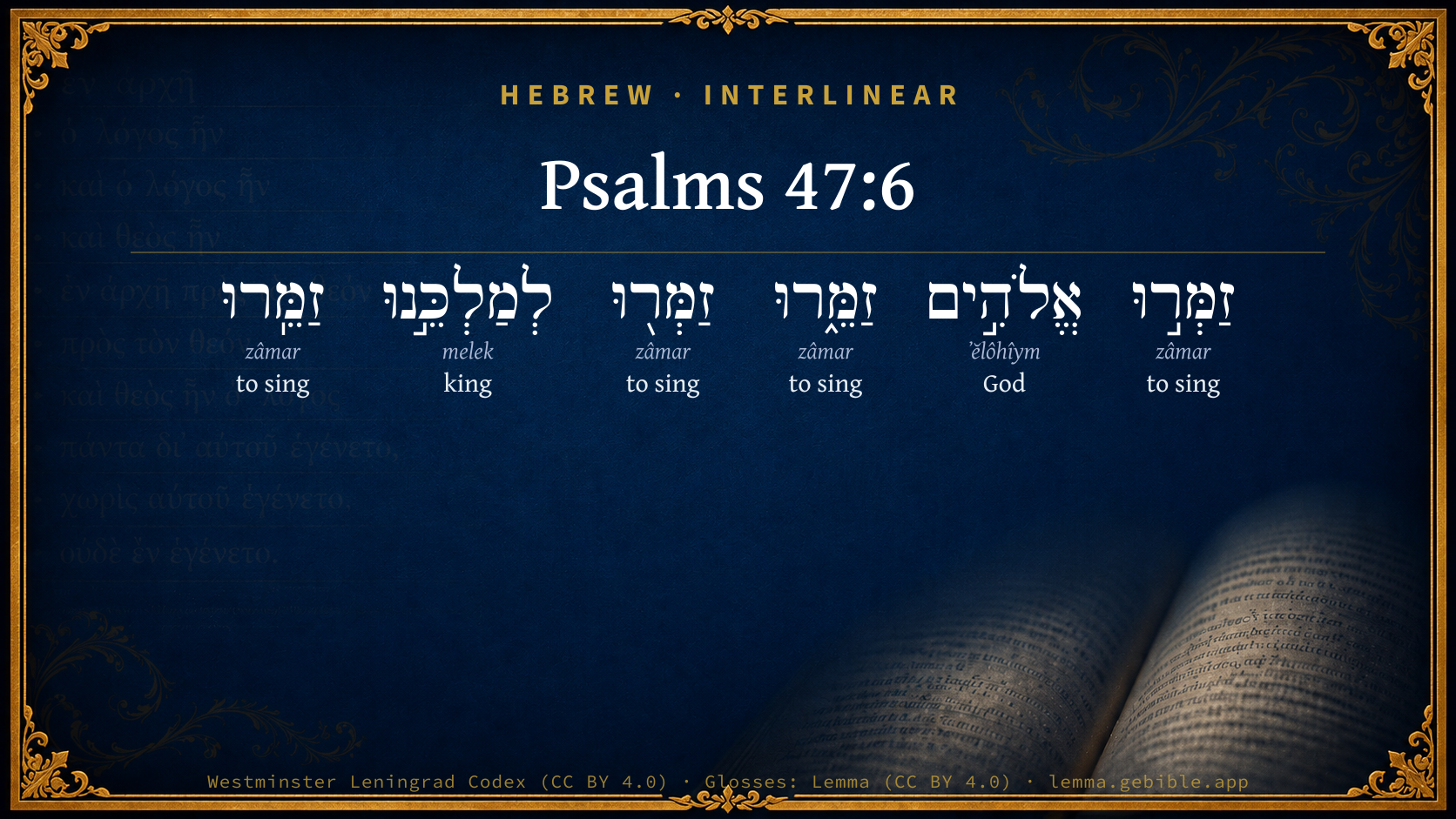
Hebrew (Westminster Leningrad Codex) Psalms 47:6 appears in the Hebrew Old Testament. The text above is from the Westminster Leningrad Codex. Each word links to its Strong’s number, a concise gloss, and parsing drawn from the Open Scriptures Hebrew Bible morphology. Click any word for its full Brown-Driver-Briggs (BDB) entry.
Download image
Cite this verse

Psalms 47:6 (World English Bible). Public Domain. Lemma interlinear Bible study tool, https://lemma.gebible.app/v/psalms/47/6.

Show BibTeX & RIS
BibTeX
RIS
English Translation
Sing praise to God, sing praises. Sing praises to our King, sing praises.
World English Bible · Public Domain
Download a study sheet

One document with this verse’s original text, its word-by-word gloss line, the meaning frame, cross-references with their text, attributed commentary, and full source and license credits — printable, and it pastes into notes with its structure intact.

This verse Autodidact and up

Study sheet (.html) Plain text (.txt)

A passage Seminary Student

Up to 50 verses in one chapter. A passage sheet keeps up to 6 commentary sources and 12 cross-references per verse, in the order this page ranks them, and says so on the sheet whenever that leaves anything out. Ask for a single verse and you get the Autodidact verse sheet above.

Everything on this page stays free to read, with no account — the sheet is a download of what is already on screen, not access to it.

Want to remove ads? Support Godless Engineer
Compare translations 3

The same verse in 3 English versions, stacked beneath the original-language interlinear above. Click any original word for its lexicon entry.

Each is an independent rendering of the whole verse — the interlinear is not word-aligned to these translations.

Highlighted words mark where these versions differ — a whole-verse word diff, not a word-by-word alignment.

  • World English Bible Public Domain
    Sing praise to God, sing praises. Sing praises to our King, sing praises.
  • King James Version Public Domain
    Sing praises to God, sing praises: sing praises unto our King, sing praises.
  • unfoldingWord Literal Text CC BY-SA 4.0
    Sing praise God, sing praise! Sing praise our king, sing praise!

unfoldingWord Literal Text — © unfoldingWord, licensed CC BY-SA 4.0. Word-aligned USFM3 via Door43 (git.door43.org/unfoldingWord/en_ult).

Versions to compare (up to 4)

3 of 4 selected

Show all 18 translations

Every available English version of this verse, each an independent rendering of the whole verse.

  • World English Bible Public Domain
    Sing praise to God, sing praises. Sing praises to our King, sing praises.
  • Berean Standard Bible Public Domain
    Sing praises to God, sing praises; sing praises to our King, sing praises!
  • Majority Standard Bible Public Domain
    Sing praises to God, sing praises; sing praises to our King, sing praises!
  • King James Version Public Domain
    Sing praises to God, sing praises: sing praises unto our King, sing praises.
  • American Standard Version (1901) Public Domain
    Sing praise to God, sing praises: Sing praises unto our King, sing praises.
  • Revised Version (1885) Public Domain
    Sing praises to God, sing praises: sing praises unto our King, sing praises.
  • Geneva Bible (1599) Public Domain
    Sing prayses to God, sing prayses: sing prayses vnto our King, sing prayses.
  • Douay-Rheims (1899) Public Domain
    God is ascended with jubilee, and the Lord with the sound of trumpet.
  • Young's Literal Translation Public Domain
    Praise God -- praise -- give praise to our king, praise.
  • Literal Standard Version CC BY-SA 4.0
    Praise God—praise—give praise to our king, praise.
  • Unlocked Literal Bible CC BY-SA 4.0
    Sing praises to God, sing praises; sing praises to our King, sing praises.
  • unfoldingWord Literal Text CC BY-SA 4.0
    Sing praise God, sing praise! Sing praise our king, sing praise!
  • Darby Bible Public Domain
    Sing psalms of God, sing psalms; sing psalms unto our King, sing psalms!
  • World Messianic Bible Public Domain
    Sing praises to God! Sing praises! Sing praises to our King! Sing praises!
  • Webster's Bible Public Domain
    \\47:5\\God is gone up with a shout, the LORD with the sound of a trumpet.
  • Free Bible Version CC BY-SA 4.0
    Sing praises to God, sing praises; sing praises to our King, sing praises!
  • Bible in Basic English Public Domain
    Give praises to God, make songs of praise; give praises to our King, make songs of praise.
  • JPS Tanakh (1917) Public Domain
    (47-7) Sing praises to God, sing praises; sing praises unto our King, sing praises.

Literal Standard Version (2020), Covenant Press — licensed CC BY-SA 4.0. Text via the HelloAO Bible API (eBible.org). Unlocked Literal Bible (unfoldingWord) — licensed CC BY-SA 4.0. Text via the HelloAO Bible API (eBible.org). unfoldingWord Literal Text — © unfoldingWord, licensed CC BY-SA 4.0. Word-aligned USFM3 via Door43 (git.door43.org/unfoldingWord/en_ult). Free Bible Version, Dr. Jonathan Gallagher — licensed CC BY-SA 4.0. Text via the HelloAO Bible API (eBible.org).

Word by word

More ways to search: Search by grammar → Find every occurrence → Compare this word →

Practice this passage: Drill this verse → Learn its vocabulary →

About this verse

These counts appear in no published source. They are computed here, from the morphology-tagged text and Lemma’s own curated glosses. What Lemma adds →

6
words
3
distinct lemmas
Wisdom
section

Shared distinctive vocabulary

זַמְּר֣וּ to sing H2167 occurs in 41 verses of the Hebrew Bible. Also found in:

Grammatical profile

  • 4 verbs
  • 2 nouns

Verb forms

  • זַמְּר֣וּ Piel · Imperative
  • זַמֵּ֑רוּ Piel · Imperative
  • זַמְּר֖וּ Piel · Imperative
  • זַמֵּֽרוּ Piel · Imperative

Repetition

A word recurs within this verse — often emphatic in Hebrew:

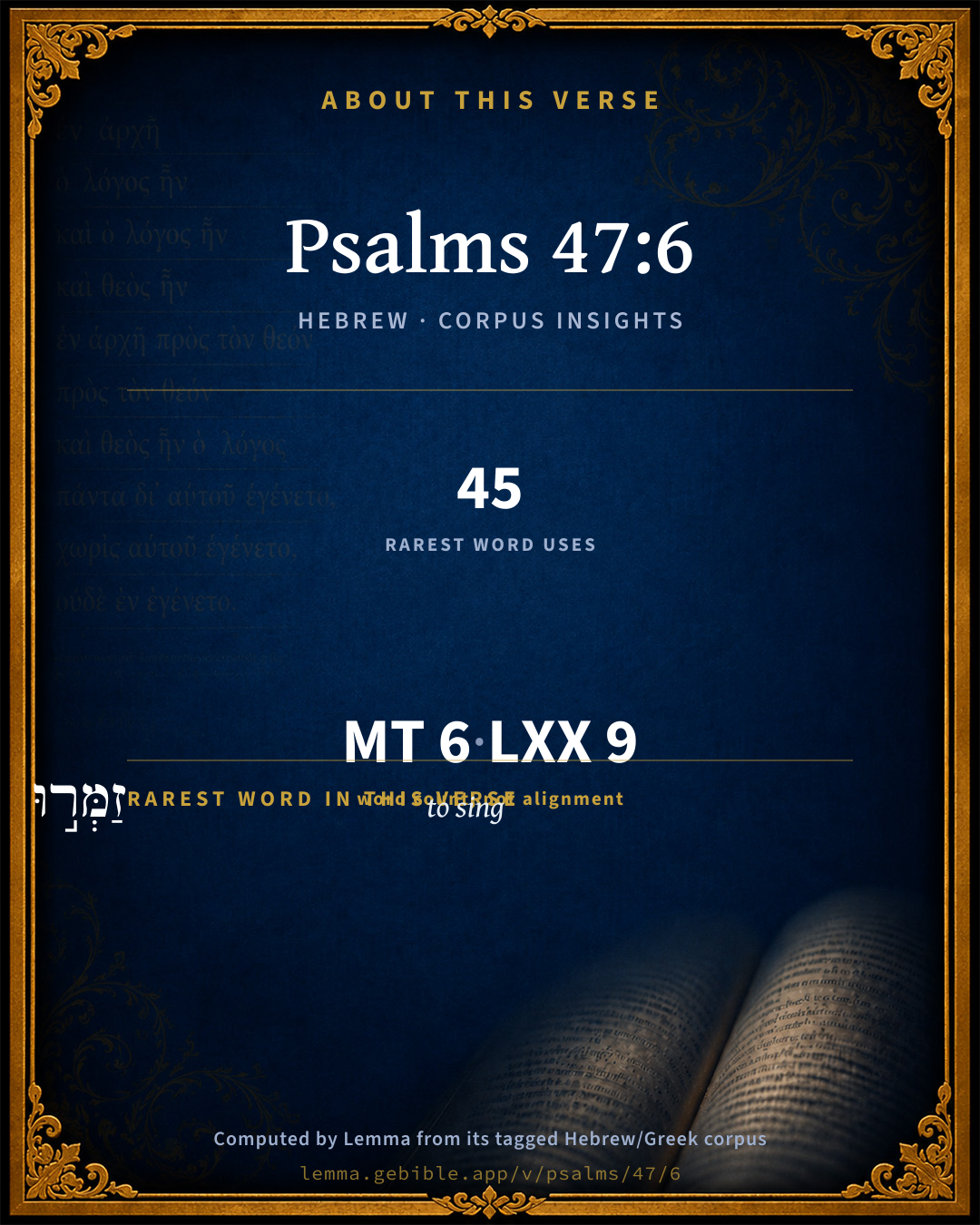
  • זַמְּר֣וּ to sing H2167 ×4

Hebrew & Septuagint length

In English translation the verse runs 13 words from the Hebrew and 14 from the Septuagint (LXX English) — closely comparable.

A rough comparison of the two English renderings, which tokenize alike — not a word-level alignment.

Word counts can differ between the Hebrew and the Greek without any difference in meaning — e.g. the Hebrew direct-object marker אֵת has no separate Greek word, and Greek often adds the article ὁ.

In the original languages it is 6 Hebrew tokens and 9 Greek tokens — but the two are counted differently (Hebrew bundles its prefixes and suffixes into one token; the Greek is in lemma form), so that isn’t a like-for-like length.

Cross-references

14

Topical passages linked to Psalms 47:6 in the Treasury of Scripture Knowledge — connected by theme and wording, ordered by reader-vote popularity; previews shown in the World English Bible.

  • Isaiah 12:4–6 In that day you will say, "Give thanks to Yahweh! Call on his name. Declare his doings among the peoples. Proclaim that his name is exalted!
  • Matthew 25:34 Then the King will tell those on his right hand, 'Come, blessed of my Father, inherit the Kingdom prepared for you from the foundation of the world;
  • Psalms 68:4 Sing to God! Sing praises to his name! Extol him who rides on the clouds: To Yah, his name! Rejoice before him!
  • Psalms 117:1–2 Praise Yahweh, all you nations! Extol him, all you peoples!
  • 1 Chronicles 16:9 Sing to him, sing praises to him; Talk you of all his marvelous works.
  • Psalms 145:1 I will exalt you, my God, the King. I will praise your name forever and ever.
  • Isaiah 33:22 For Yahweh is our judge, Yahweh is our lawgiver, Yahweh is our king; he will save us.
  • Matthew 27:37 They set up over his head the accusation against him written, "THIS IS JESUS, THE KING OF THE JEWS."
  • 1 Chronicles 29:20 David said to all the assembly, Now bless Yahweh your God. All the assembly blessed Yahweh, the God of their fathers, and bowed down their heads, and worshiped Yahweh, and the king.
  • Psalms 89:18 For our shield belongs to Yahweh; Our king to the Holy One of Israel.
  • Psalms 96:1–2 Sing to Yahweh a new song! Sing to Yahweh, all the earth.
  • Psalms 149:1–3 Praise Yahweh! Sing to Yahweh a new song, His praise in the assembly of the saints.
  • Zechariah 9:9 Rejoice greatly, daughter of Zion! Shout, daughter of Jerusalem! Behold, your king comes to you! He is righteous, and having salvation; Lowly, and riding on a donkey, Even on a colt, the foal of a donkey.
  • Exodus 15:21 Miriam answered them, "Sing to Yahweh, for he has triumphed gloriously: The horse and his rider he has thrown into the sea."

Cross-references courtesy of OpenBible.info (CC BY 4.0).

Hebrew and Greek witnesses Masoretic Hebrew ↔ Greek Septuagint

The same verse in the two great witnesses to the Old Testament, shown verse-for-verse.

You’re reading Greek Psalm 46 (Hebrew Psalm 47). The Septuagint counts the superscription, so verse numbers can differ from the Hebrew — chapter-level alignment, not verse-by-verse. Numbering follows Rahlfs.

These are two independent witnesses, not word-aligned to each other, and the Septuagint is shown in lemma (dictionary) form.

Hebrew Psalms 47:6 Masoretic · Westminster Leningrad Codex

זַמְּר֣וּ אֱלֹהִ֣ים זַמֵּ֑רוּ זַמְּר֖וּ לְמַלְכֵּ֣נוּ זַמֵּֽרוּ

Sing praise to God, sing praises. Sing praises to our King, sing praises.

World English Bible · Public Domain

Greek LXX Greek Psalm 46:6 Septuagint · lemma form

ἀναβαίνω ὁ θεός ἐν ἀλαλαγμός κύριος ἐν φωνή σάλπιγξ

Sing praises to our God, sing praises: sing praises to our King, sing praises.

LXX2012 (modern English Septuagint) · Public Domain

Hebrew: Westminster Leningrad Codex (CC BY 4.0). Greek: Septuagint (public domain); English from LXX2012 (modern English Septuagint) (Public Domain). How the Septuagint differs from the Hebrew →

Commentary

Notes on Psalms 47:6 from classic Christian and Jewish commentators (each source and its license shown beneath its notes). The classic Christian expositions comment on the surrounding passage and are grouped to its opening verse, so a note may address several verses; the Jewish commentaries on the Tanakh (Rashi and others) are per-verse, so they appear only where the commentator wrote on this verse.

Lemma curates 59 commentaries, every one of them public domain or Creative Commons licensed, each selected and text-cleaned for this edition rather than reprinted as found. About our sources →

Trapp's Complete Commentary

John Trapp

Psa 47:6 Sing praises to God, sing praises: sing praises unto our King, sing praises.

Ver. 6. Sing praises to God, sing praises] Do it with all alacrity, assiduity, being of that martyr’s mind who said, Should I do nothing else all the days of my life, yea, as long as the days of heaven shall last, but kneel upon my knees, and repeat over David’s psalms to the glory and praise of God, yet should I fall infinitely short of what is my duty to do.

John Trapp, A Commentary or Exposition upon All the Books of the Old and New Testament (1647–1656) — public domain. Text from a community e-Sword module.

Joseph Benson's Commentary

Psa 47:6-7. Sing praises, &c. — These words are repeated four times in this verse, to show how vehemently desirous the psalmist was that God might have his due praise and glory: and of what great necessity and importance it was to men to perform this great, though much neglected duty; unto our king — For so he is in an especial manner. God is King of all the earth — Not only ours, as I now said, but of all the nations of the world: and, therefore, he may well require, and doth highly deserve, all our praises. Sing ye praises with understanding — Not formally and carelessly, but seriously, considering the greatness of this king whom you praise, and what abundant cause you have to praise him.

Joseph Benson's Commentary on the Old and New Testaments (1811–1818) — public domain. Text from a community e-Sword module.

J. A. Alexander on Psalms

Joseph Addison Alexander

7. (Psa 47:6). Sing praises (to) God, sing praises! Sing praises to our King, sing praises! The Hebrew corresponding to sing praises is a single Hebrew word which means to praise musically, both with voice and instrument. See above, on Psa 9:3, (2). God, who is first mentioned as the object of the praise, is then described as our King, the actual King of Israel and the rightful King of all the earth.

Joseph Addison Alexander, The Psalms Translated and Explained (1850) — public domain. Text from a community e-Sword module.

Adam Clarke's Commentary

Verse 6. Sing praises] זמרו zammeru: this word is four times repeated in this short verse, and shows at once the earnestness and happiness of the people. They are the words of exultation and triumph. Feel your obligation to God; express it in thanksgiving: be thankful, be eternally thankful, to God your King.

Adam Clarke's Commentary on the Bible (1810–1826) — public domain. Text from a community e-Sword/MySword module.

Ellicott's Commentary for English Readers

(6) Sing praises.—Better, Strike the harp.

A Bible Commentary for English Readers, edited by Charles John Ellicott (1878–1897) — public domain. Text from a community e-Sword module.

The Cambridge Bible for Schools and Colleges

gen. ed. J. J. S. Perowne

6. Sing praises] The verb from which mizmôr, ‘a psalm,’ is derived. See Introd. p. xix.

The Cambridge Bible for Schools and Colleges (gen. ed. J. J. S. Perowne; Cambridge University Press, 1878–1918) — public domain. Text from a community e-Sword module.

John Gill's Exposition

For God is the King of all the earth,.... Or "the king of all the earth is God" (e); the same that is ascended into heaven, and is King of saints, even Christ Jesus; and so he will appear to be, especially in the latter day; See Gill on Psa 47:2;

sing ye praises with understanding; or, as De Dieu renders it, to him that understandeth, that is, to God the only wise, whose understanding is infinite; even to Christ, who, as God, knows all things; and, as man and Mediator, is of quick understanding, and has all the treasures of wisdom and knowledge in him; so R. Obadiah, "sing of him who understands"; or, "sing ye praises, O everyone that understandeth" (f); that is, how to sing, as everyone does not; this is the sense of Aben Ezra and Kimchi; or "with understanding", as we render it; with understanding of what is sung. The Apostle Paul seems to refer to this passage in Co1 14:15. The Targum renders it, "with a good understanding".

(e) So Junius & Tremellius, Piscator, Cocceius, Michaelis. (f) "canite, intelligens", Montanus; i.e. "unusquisque", Vatablus.

John Gill's Exposition of the Whole Bible (1746–1763) — public domain (CC PDM 1.0). Text via the HelloAO Bible API.

Albert Barnes' Notes on the Bible

Sing praises to God, sing praises - This commences the “second” part of the psalm. The “repetition” shows that the heart was full, or was overflowing with joy. It is a call on all to celebrate the praises of God, especially as he had enabled his people to triumph over their enemies.

Sing praises unto our King - Unto God, who has shown himself to be the King of his people - one who rules in their behalf, and who has interposed for their deliverance in danger.

Albert Barnes' Notes on the Bible (1834–1885) — public domain. Text from a community e-Sword/MySword module.

Matthew Poole's English Annotations

These words are repeated four times in this verse, to show how vehemently desirous the psalmist was that God might have his due praise and glory; and of how great necessity and importance it was to men to perform this great, though much neglected, duty.

Unto our King; for so he is in a special manner.

Matthew Poole's English Annotations on the Holy Bible (1683–1685) — public domain. Text from a community e-Sword/MySword module.

The Treasury of David

Charles H. Spurgeon

Ver. 6. Sing praises. What jubilation is here, when five times over the whole earth is called upon to sing to God! He is worthy, he is Creator, he is goodness itself. Sing praises, keep on with the glad work. Never let the music pause. He never ceases to be good, let us never cease to be grateful. Strange that we should need so much urging to attend to so heavenly an exercise. Sing praises unto our King. Let him have all our praise; no one ought to have even a particle of it. Jesus shall have it all. Let his sovereignty be the fount of gladness. It is a sublime attribute, but full of bliss to the faithful. Let our homage be paid not in groans but songs. He asks not slaves to grace his throne; he is no despot; singing is fit homage for a monarch so blessed and gracious. Let all hearts that own his sceptre sing and sing on for ever, for there is everlasting reason for thanksgiving while we dwell under the shadow of such a throne.

None.

Ver. 6. The importance of holy song. The repetition rebukes our slackness, and implies that earnestness, frequency, delight, and universality should characterise the praises offered.

Psalms 47:7*

Charles H. Spurgeon's The Treasury of David (1869–1885) — public domain. Psalms only. Text from a community e-Sword/MySword module.

The Pulpit Commentary

Sing praises to God, sing praises; sing praises unto our King, sing praises Praise him, i.e. , both as God and King especially as "our King that is, as Israel"s King.

Vers. 6, 7. The faculty and duty of praise.

"Sing praises." Every command of God implies power to obey. True, God often tells us to do what we have no power of ourselves to do; but then he gives power. When Jesus bade the lame Walk, the blind see, the paralytic to take up the bed he lay on, and the very dead to come out of the grave, power went with his word. On the other hand, every faculty or power with which God has endowed us implies some duty in which we are to glorify him. Thus the faculty of praising God in song, and the duty of singing praises with understanding, imply one another.

I THE FACULTY OF PRAISING GOD IN SONG. God might have given speech without song; all the whole world of sound without music. Not a few persons whose sense of hearing is quick and perfect, have no ear for music; they perceive neither melody nor harmony. For them, therefore, it is neither a pleasure nor a duty to sing praises. What is the case with some might have been with all. Music would then have had no existence in our world or in our conceptions. Further, if God had given no more than the ordinary average musical faculty, the wonder and power of music would have remained comparatively unknown. Multitudes can enjoy music, and play or sing, who never could compose a tune. A chosen few must be endowed with that special gift which we call "genius," making them as it were God"s prophets to unfold the secret treasure of music he has stored up in nature, above all, in the human voice. Manifestly it was God"s purpose in this to give delight. Music furnishes one of the most exquisite, elevating, unwearying pleasures of which our nature is capable. But it does much more. Song and music are a language distinct from speech the language of feeling. This language supplies the means by which multitudes may express their thoughts as well as their feelings as with one voice. Let a thousand people speak at once; all thought and feeling are drowned in hubbub. But let them sing together in perfect time and tune; both thought and feeling are raised to a pitch of energy else inconceivable.

II THE DUTY. "Sing ye praises." This duty has an inner spirit as well as an outer embodiment. There is, after all, no melody like "melody in your heart". (Eph_5:19) In the service of God"s Church, music without devotion, a lovely sound void of heartfelt meaning, is not praise, but profanation. Better omit singing from our service altogether, than have the finest music to the praise and glory, not of God, but of the performers. But when the spirit of praise, the heart and soul of worship, inspires our song, can we be too careful in perfecting its form? There is no spirituality in bad music; no piety in singing praises ignorantly, slovenly, untunefully. "Sing ye praises with understanding. " If Timothy was "not to neglect the gift," but to "stir up the gift that was in him," the like exhortation applies to whatever gift God has given us for his service. If only the few can lead, most can follow. The attainment of the art of singing by note, and culture of the voice so as to take part in this delightful part of Christian worship with pleasure to ourselves and profit to others, should he regarded as a far more serious duty than commonly it is. Psalmody is capable of being a most powerful means of religious impression and edification. (Col_3:16) Above all, let us cultivate the spirit of praise; the joyful, thankful, trustful, adoring piety, which finds its natural utterance in song. If prayer claims the principal place in our worship on earth, by reason of sin, weakness, need, sorrow,praise brings us nearest to the worship of heaven. (Rev_5:9-13)

The Pulpit Commentary (1880–1919), ed. H.D.M. Spence-Jones & Joseph S. Exell — public domain. Text from a community e-Sword module.

unfoldingWord translationNotes

Door43 World Missions Community

Sing praises to God, sing praises; sing praises to our King, sing praises

The phrase "sing praises" is repeated for emphasis. You may omit the repetition if it is awkward in your language. AT: "Sing, sing praises to God; sing, sing praises to our King" (See: Parallelism)

translationWords

praise

king

understand

unfoldingWord translationNotes — © Distant Shores Media and the Door43 World Missions Community, licensed CC BY-SA 4.0. Source: git.door43.org/Door43/en_tn.

Ibn Ezra

Rabbi Abraham ibn Ezra

Has gone up - on the chest which is concealed, that he should go up and be seen. And some say the meaning: that God will set the peoples below us, and at that time we shall shout over them with trumpets and the sound of the shofar, God will be gone up from us [יעלה ממנו], and so He is called Elyon [עליון].

Ibn Ezra on the Tanakh — English translations: “Sefaria Community Translation” (CC0 1.0 (public-domain dedication)); “Yalkut, Sifsei Chachomim Chumash, Metsudah Publications, 2009” (CC BY 4.0); and “Commentary of Ibn Ezra on Isaiah - trans. by M. Friedlander, 1873” (public domain). Text via Sefaria.

Lesson kit

Teaching starters — assembled from the data on this page, not authored interpretation. Every prompt links to the verse data it draws on. Edit before teaching.

Psalms, in the Wisdom, opens this verse with 6 words (3 distinct Hebrew lemmas). Its most distinctive word is zâmar (“to sing”). A historical commentator’s framing appears above. Read the whole chapter for the surrounding context.

Discussion questions

  1. How does “to sing” (zâmar) shape what this verse is saying?
  2. How does Judges 5:3, which shares the word «to sing», read alongside this verse?
  3. What does the repetition of “to sing” (4× in this one verse) do in this verse?
  4. These translations render this verse differently. What is at stake in choosing one wording over another?
  5. «זַמְּר֣וּ» is a Piel Imperative verb. How does that grammatical form shape the action described?
  6. Compare how Trapp's Complete Commentary and Joseph Benson's Commentary read this verse. Where do they agree or differ?

Things to notice

Reading settings

Reading text

Shown beneath each verse's original-language words.

Old Testament
Old Testament edition

Read the OT as the Masoretic Hebrew (MT) or the Greek Septuagint (LXX).

English shown for the Greek Septuagint (in the Hebrew ↔ Greek comparison).

Comparing translations? Open the Compare panel on any verse page to stack up to four side by side.