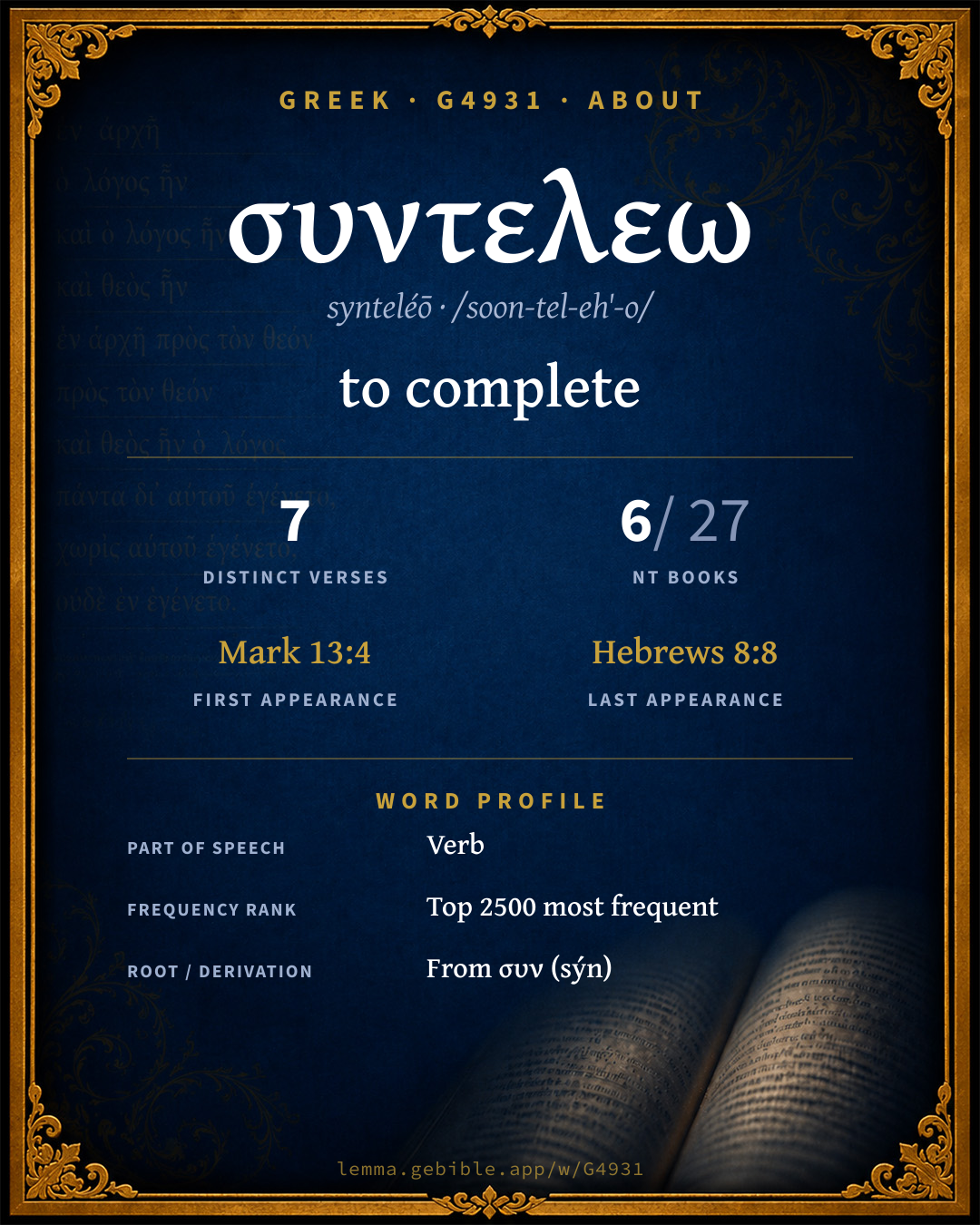
συντελέω
to complete
‘to complete’ is one of 7 main senses fuller range ↓
Full lexicon entry — Thayer's Greek Lexicon
From Thayer's Greek Lexicon
Where this word appears
Grammar key — what these labels mean
Part of speech
- Verb
- An action or state-of-being word.
Tense
- Present
- Ongoing or general action in present time (imperfective aspect).
- Aorist
- Action viewed as a simple whole, without regard to duration — often past (perfective aspect).
- Future
- Action expected in future time.
Voice
- Passive
- The subject receives the action.
- Active
- The subject performs the action.
Mood
- Infinitive
- A verbal noun (“to write”), unmarked for person or number.
- Participle
- A verbal adjective (“writing,” “having written”).
- Indicative
- States a fact or asks a factual question (the mood of reality).
Case
- Nominative
- The case of the subject (and the predicate nominative).
- Genitive
- The case of source, possession, or “of” — answers “whose / from what.”
Person
- 3rd person
- The one spoken about (“he / she / it / they”).
- 1st person
- The speaker (“I / we”).
Gender
- Masculine
- Grammatically masculine.
- Feminine
- Grammatically feminine.
Number
- Singular
- One.
- Plural
- More than one.
Every verse where G4931 appears in the Book of Mark — 1 distinct verse. Click any verse to open its interlinear word-by-word view. Verse text shown in the World English Bible for context — . Each verse’s Greek form is shown with its reference; the English is not keyword-highlighted, since the data carries no word-level English alignment. Use “Compare translations” on any verse to read it across multiple English versions. This concordance covers the Greek New Testament; Septuagint (Greek Old Testament) occurrences of this word are not indexed here.
Mark
About this entry
At a glance — auto-summarized from this page’s data, not written by a person. Every figure links to its source below. This summary describes the numbers; it doesn’t interpret them.
συντελεω (synteléō) is a Greek verb most often rendered “to complete.” Ranging over 7 senses, it is not a single-sense word. The Greek New Testament uses it across 7 verses — uncommon. Luke dominates its distribution — 2 of 7 verses. It first appears in Mark 13:4. The sections below give every sense, occurrence, and version rendering.
Gloss history
Strong's 1890 vs modern scholarship

About this word
Strong's G4931 catalogs a Greek word from the Greek New Testament.
These counts are not copied from any lexicon or concordance. They are computed here, from the morphology-tagged Greek New Testament. What Lemma adds →
- 7
- distinct verses
- The word appears in 7 distinct verses.
- 6 / 27
- NT books
- The word appears in 6 of 27 New Testament books.
- #1,358
- by frequency
- Top 2500 most frequent Greek words (rank 1,358 of 5,347 Greek words by occurrence).
View all 7 occurrences in the concordance →
By section of the New Testament
By traditional corpus
Conventional, traditional groupings — biblical authorship is debated, so this is a traditional corpus grouping, not an authorship claim. Some books belong to more than one corpus (Luke is in both the Gospels and the Lukan corpus, and so on), so these shares overlap and need not total 100%. Each figure is a share of the word’s 7 distinct verses.
- Gospels 4 verses · 57%
- Lukan (Luke–Acts) 3 verses · 43%
- Johannine 1 verse · 14%
- Pauline corpus 1 verse · 14%
- Hebrews 1 verse · 14%
How translations render this word
Counts come from each version’s own published word-to-Strong’s tagging or interlinear alignment — an approximate guide to how each version renders this word, not a word-level alignment the data otherwise carries. Because each total is that version’s own tagged count, the per-version totals vary from one another and need not match the appearance or distinct-verse counts above. These counts may also differ from a printed concordance because Lemma counts each distinctly tagged rendering and does not collapse phrase taggings into a single head-word total. This is a fixed set of word-tagged versions (KJV, ASV, BSB, ULT) and does not change with the reading translation you choose elsewhere. Each version’s license is shown beside its name below (and on Sources).
- King James Version: Had ended 2×
- American Standard Version: About to be accomplished 1×, Completed 1×, Finishing 1×
- Berean Standard Bible: Be fulfilled 1×, Had ended 1×, Had finished 1×
- unfoldingWord Literal Text: Be completed 1×, Be finished 1×, Finishing 1×
King James Version Public Domain
Renders G4931 across 7 tagged occurrences — most commonly:
Plus 5 renderings that appear only once — usually multi-word phrases or single function words the recovered tagging swept in, not distinct renderings.
American Standard Version Public Domain
Renders G4931 across 7 tagged occurrences — most commonly:
Berean Standard Bible Public Domain
Renders G4931 across 6 tagged occurrences — most commonly:
unfoldingWord Literal Text CC BY-SA 4.0
Renders G4931 across 8 tagged occurrences — most commonly:
7 senses in Thayer's, in lexicon order
The 7 senses Thayer's distinguishes for this word, in lexicon order (not ranked by frequency or importance). The full entry — with sub-senses — is in the Lexicon Entry tab.
- to end together or at the same time
- bring to an end, finish, complete
- to accomplish, bring to fulfilment
- to effect, make, (conclude)
- to make an end of
- to bring to an end
- destroy
Word origin
Derived from συν (sýn) (G4862) — with.
Forms in the corpus
The 6 distinct written forms G4931 takes in the Greek New Testament, most frequent first — each parse links to that tense’s occurrences in the concordance.
| Form | Parsing | Example | Uses |
|---|---|---|---|
| συντελεῖσθαι synteleîsthai | Verb, Present, Passive, Infinitive | Mark 13:4 | 2 |
| συνετελέσθη synetelésthē | Verb, Aorist, Passive, Indicative, 3rd person, Singular | John 2:3 | 1 |
| συντελέσας syntelésas | Verb, Aorist, Active, Participle, Nominative, Singular, Masculine | Luke 4:13 | 1 |
| συντελέσω syntelésō | Verb, Future, Active, Indicative, 1st person, Singular | Hebrews 8:8 | 1 |
| συντελεσθεισῶν syntelestheisō̂n | Verb, Aorist, Passive, Participle, Genitive, Plural, Feminine | Luke 4:2 | 1 |
| συντελῶν syntelō̂n | Verb, Present, Active, Participle, Nominative, Singular, Masculine | Romans 9:28 | 1 |
Same root — word family
Other Thayer's entries built from the same root as G4931, grouped by Strong’s listed origin. These share a root / origin per the lexicon — not necessarily a shared meaning. Each links to that word’s own entry.
Derives from
Shares the same root
- κοινος koinós G2839 common
- συγγενης syngenḗs G4773 related by blood
- συγγνωμη syngnṓmē G4774 pardon
- συγκαθημαι synkáthēmai G4775 to sit together
- συγκαθιζω synkathízō G4776 to sit together
- συγκακοπαθεω synkakopathéō G4777 to suffer together
- συγκακουχεω synkakouchéō G4778 to be ill-treated together
- συγκαλεω synkaléō G4779 to call together
- συγκαλυπτω synkalýptō G4780 to cover completely
- συγκαμπτω synkámptō G4781 to bend together
- συγκαταβαινω synkatabaínō G4782 to go down with
- συγκατατιθεμαι synkatatíthemai G4784 to deposit together
- συγκαταψηφιζω synkatapsēphízō G4785 to vote against
- συγκεραννυμι synkeránnymi G4786 to mix together
- συγκλειω synkleíō G4788 to shut up
- συγκληρονομος synklēronómos G4789 joint heir
- συγκοινωνεω synkoinōnéō G4790 to share together
- συγκοινωνος synkoinōnós G4791 joint partner
- συγκομιζω synkomízō G4792 to collect together
- συγκρινω synkrínō G4793 to join together
- συγκυπτω synkýptō G4794 to bend together
- συγκυρια synkyría G4795 by chance
- συγχαιρω synchaírō G4796 to rejoice with
- συγχεω synchéō G4797 to disturb
+125 more words share this root (not shown).
Derived from this word
Compare all same-root words → Showing 4 of 152 — not the complete family. They share a root, not necessarily a meaning.
Septuagint usage
The same Greek word συντελεω appears 154 times in the Greek Old Testament (Septuagint), across 148 verses in 30 books.
- 154
- LXX occurrences
- Tagged occurrences of this Greek word in the Septuagint.
- 148
- verses
- Distinct Septuagint verses containing this word.
- 30 / 39
- OT books
- The word appears in 30 of the 39 Old Testament books.
Sample Septuagint occurrences
- Genesis 2:1 συντελέω
- Exodus 5:13 συντελέω
- Leviticus 16:20 συντελέω
- Numbers 4:15 συντελέω
- Deuteronomy 26:12 συντελέω
- Joshua 3:17 συντελέω
- Judges 3:18 συντελέω
- Ruth 2:23 συντελέω
- 1 Samuel 10:13 συντελέω
- 2 Samuel 6:18 συντελέω
- 1 Kings 1:41 συντελέω
- 2 Kings 10:25 συντελέω
Septuagint occurrences (same lexeme)
Every verse where the same Strong’s number (G4931) appears in the Greek Septuagint — showing the first 50 of 148. Verse text shown in the World English Bible for context; the Greek form is the matched word — the English is not keyword-highlighted.
- Genesis 2:1 συντελέω The heavens and the earth were finished, and all the host of them.
- Genesis 2:2 συντελέω On the seventh day God finished his work which he had made; and he rested on the seventh day from all his work which he had made.
- Genesis 6:16 συντελέω You shall make a roof in the ark, and to a cubit shall you finish it upward. You shall set the door of the ark in the side of it. You shall make it with lower, second, and third levels.
- Genesis 17:22 συντελέω When he finished talking with him, God went up from Abraham.
- Genesis 18:21 συντελέω I will go down now, and see whether they have done altogether according to the cry of it, which is come to me. If not, I will know."
- Genesis 24:15 συντελέω It happened, before he had done speaking, that behold, Rebekah came out, who was born to Bethuel the son of Milcah, the wife of Nahor, Abraham's brother, with her pitcher on her shoulder.
- Genesis 24:45 συντελέω Before I had done speaking in my heart, behold, Rebekah came forth with her pitcher on her shoulder. She went down to the spring, and drew. I said to her, 'Please let me drink.'
- Genesis 29:27 συντελέω Fulfill the week of this one, and we will give you the other also for the service which you will serve with me yet seven other years."
- Genesis 43:2 συντελέω It happened, when they had eaten up the grain which they had brought out of Egypt, their father said to them, "Go again, buy us a little more food."
- Genesis 44:5 συντελέω Isn't this that from which my lord drinks, and by which he indeed divines? You have done evil in so doing.'"
- Genesis 49:5 συντελέω "Simeon and Levi are brothers; Weapons of violence are their swords.
- Exodus 5:13 συντελέω The taskmasters were urgent saying, "Fulfill your work quota daily, as when there was straw!"
- Exodus 5:14 συντελέω The officers of the children of Israel, whom Pharaoh's taskmasters had set over them, were beaten, and demanded, "Why haven't you fulfilled your quota both yesterday and today, in making brick as before?"
- Exodus 36:2 συντελέω Moses called Bezalel and Oholiab, and every wise-hearted man, in whose heart Yahweh had put wisdom, even everyone whose heart stirred him up to come to the work to do it:
- Exodus 40:30 συντελέω He set the basin between the tent of meeting and the altar, and put water therein, with which to wash.
- Leviticus 16:20 συντελέω "When he has made an end of atoning for the Holy Place, the Tent of Meeting, and the altar, he shall present the live goat.
- Leviticus 19:9 συντελέω "'When you reap the harvest of your land, you shall not wholly reap the corners of your field, neither shall you gather the gleanings of your harvest.
- Leviticus 23:22 συντελέω "'When you reap the harvest of your land, you shall not wholly reap into the corners of your field, neither shall you gather the gleanings of your harvest: you shall leave them for the poor, and for the foreigner. I am Yahweh your God.'"
- Leviticus 23:39 συντελέω "'So on the fifteenth day of the seventh month, when you have gathered in the fruits of the land, you shall keep the feast of Yahweh seven days: on the first day shall be a solemn rest, and on the eighth day shall be a solemn rest.
- Numbers 4:15 συντελέω "When Aaron and his sons have finished covering the sanctuary, and all the furniture of the sanctuary, as the camp moves forward; after that, the sons of Kohath shall come to carry it: but they shall not touch the sanctuary, lest they die. These things are the burden of the sons of Kohath in the Tent of Meeting.
- Numbers 7:1 συντελέω It happened on the day that Moses had finished setting up the tabernacle, and had anointed it and sanctified it, with all its furniture, and the altar with all its vessels, and had anointed and sanctified them;
- Deuteronomy 26:12 συντελέω When you have made an end of tithing all the tithe of your increase in the third year, which is the year of tithing, then you shall give it to the Levite, to the foreigner, to the fatherless, and to the widow, that they may eat within your gates, and be filled.
- Deuteronomy 31:1 συντελέω Moses went and spoke these words to all Israel.
- Deuteronomy 31:24 συντελέω It happened, when Moses had made an end of writing the words of this law in a book, until they were finished,
- Deuteronomy 32:23 συντελέω I will heap evils on them; I will spend my arrows on them:
- Deuteronomy 32:45 συντελέω Moses made an end of speaking all these words to all Israel;
- Deuteronomy 34:8 συντελέω The children of Israel wept for Moses in the plains of Moab thirty days: so the days of weeping in the mourning for Moses were ended.
- Joshua 3:17 συντελέω The priests who bore the ark of the covenant of Yahweh stood firm on dry ground in the midst of the Jordan; and all Israel passed over on dry ground, until all the nation were passed clean over the Jordan.
- Joshua 4:1 συντελέω It happened, when all the nation were clean passed over the Jordan, that Yahweh spoke to Joshua, saying,
- Joshua 4:10 συντελέω For the priests who bore the ark stood in the midst of the Jordan, until everything was finished that Yahweh commanded Joshua to speak to the people, according to all that Moses commanded Joshua: and the people hurried and passed over.
- Joshua 4:11 συντελέω It happened, when all the people had completely passed over, that the ark of Yahweh passed over, with the priests, in the presence of the people.
- Joshua 21:42 συντελέω These cities were every one with their suburbs round about them: thus it was with all these cities.
- Judges 3:18 συντελέω When he had made an end of offering the tribute, he sent away the people who bore the tribute.
- Ruth 2:23 συντελέω So she kept fast by the maidens of Boaz, to glean to the end of barley harvest and of wheat harvest; and she lived with her mother-in-law.
- Ruth 3:3 συντελέω Wash yourself therefore, and anoint you, and put your clothing on you, and get you down to the threshing floor, but don't make yourself known to the man, until he shall have done eating and drinking.
- 1 Samuel 10:13 συντελέω When he had made an end of prophesying, he came to the high place.
- 1 Samuel 13:10 συντελέω It came to pass that as soon as he had made an end of offering the burnt offering, behold, Samuel came; and Saul went out to meet him, that he might greet him.
- 1 Samuel 15:18 συντελέω and Yahweh sent you on a journey, and said, 'Go, and utterly destroy the sinners the Amalekites, and fight against them until they are consumed.'
- 1 Samuel 20:7 συντελέω If he says, 'It is well;' your servant shall have peace: but if he be angry, then know that evil is determined by him.
- 1 Samuel 20:9 συντελέω Jonathan said, Far be it from you; for if I should at all know that evil were determined by my father to come on you, then wouldn't I tell you that?
- 1 Samuel 20:33 συντελέω Saul cast his spear at him to strike him. By this Jonathan knew that his father was determined to put David to death.
- 1 Samuel 20:34 συντελέω So Jonathan arose from the table in fierce anger, and ate no food the second day of the month; for he was grieved for David, because his father had done him shame.
- 1 Samuel 24:17 συντελέω He said to David, You are more righteous than I; for you have rendered to me good, whereas I have rendered to you evil.
- 1 Samuel 25:17 συντελέω Now therefore know and consider what you will do; for evil is determined against our master, and against all his house: for he is such a worthless fellow that one can't speak to him.
- 2 Samuel 6:18 συντελέω When David had made an end of offering the burnt offering and the peace-offerings, he blessed the people in the name of Yahweh of Hosts.
- 2 Samuel 11:19 συντελέω and he charged the messenger, saying, "When you have made an end of telling all the things concerning the war to the king,
- 2 Samuel 13:36 συντελέω It happened, as soon as he had made an end of speaking, that behold, the king's sons came, and lifted up their voice, and wept: and the king also and all his servants wept very sore.
- 2 Samuel 21:5 συντελέω They said to the king, The man who consumed us, and who devised against us, [that] we should be destroyed from remaining in any of the borders of Israel,
- 2 Samuel 22:38 συντελέω I have pursued my enemies, and destroyed them; Neither did I turn again until they were consumed.
- 1 Kings 1:41 συντελέω Adonijah and all the guests who were with him heard it as they had made an end of eating. When Joab heard the sound of the trumpet, he said, Why is this noise of the city being in an uproar?
These are occurrences of the same Greek lexeme (G4931) in the Septuagint — not a translation of any one Hebrew word. The store carries no word-level Hebrew↔Greek alignment, so no Hebrew original is asserted here. Counts come from the recovered LXX Strong's tagging — high-frequency vocabulary is well covered, while rare or late forms may be untagged — so they reflect tagged occurrences and may slightly undercount.