Psalms 115:7

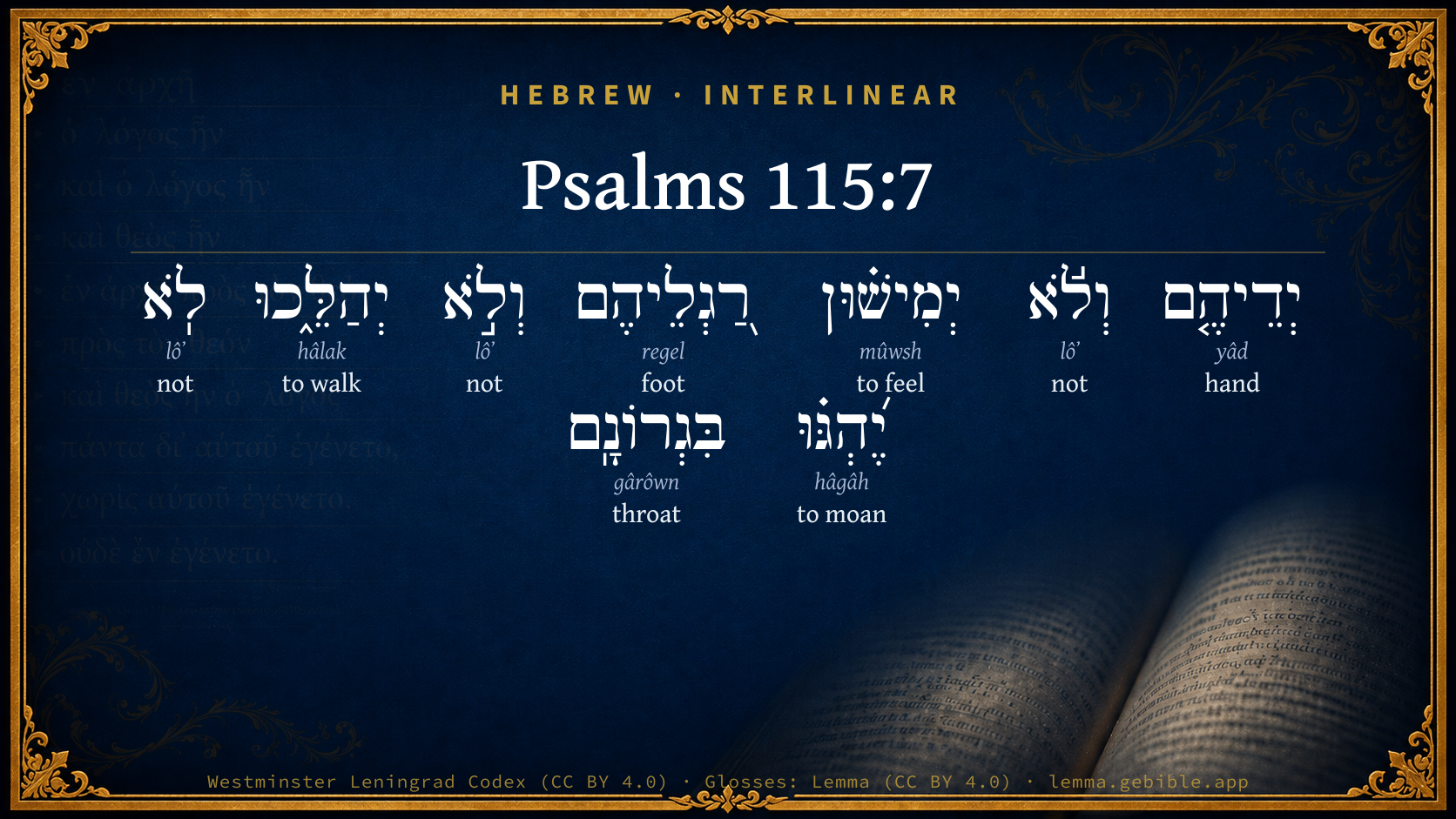
Hebrew (Westminster Leningrad Codex) Psalms 115:7 appears in the Hebrew Old Testament. The text above is from the Westminster Leningrad Codex. Each word links to its Strong’s number, a concise gloss, and parsing drawn from the Open Scriptures Hebrew Bible morphology. Click any word for its full Brown-Driver-Briggs (BDB) entry.
Download image
Cite this verse

Psalms 115:7 (World English Bible). Public Domain. Lemma interlinear Bible study tool, https://lemma.gebible.app/v/psalms/115/7.

Show BibTeX & RIS
BibTeX
RIS
English Translation
They have hands, but they don't feel; They have feet, but they don't walk; Neither do they speak through their throat.
World English Bible · Public Domain
Download a study sheet

One document with this verse’s original text, its word-by-word gloss line, the meaning frame, cross-references with their text, attributed commentary, and full source and license credits — printable, and it pastes into notes with its structure intact.

This verse Autodidact and up

Study sheet (.html) Plain text (.txt)

A passage Seminary Student

Up to 50 verses in one chapter. A passage sheet keeps up to 6 commentary sources and 12 cross-references per verse, in the order this page ranks them, and says so on the sheet whenever that leaves anything out. Ask for a single verse and you get the Autodidact verse sheet above.

Everything on this page stays free to read, with no account — the sheet is a download of what is already on screen, not access to it.

Want to remove ads? Support Godless Engineer
Compare translations 3

The same verse in 3 English versions, stacked beneath the original-language interlinear above. Click any original word for its lexicon entry.

Each is an independent rendering of the whole verse — the interlinear is not word-aligned to these translations.

Highlighted words mark where these versions differ — a whole-verse word diff, not a word-by-word alignment.

  • World English Bible Public Domain
    They have hands, but they don't feel; They have feet, but they don't walk; Neither do they speak through their throat.
  • King James Version Public Domain
    They have hands, but they handle not: feet have they, but they walk not: neither speak they through their throat.
  • unfoldingWord Literal Text CC BY-SA 4.0
    Their hands, but they do not feel; their feet, but they cannot walk; they do not murmur in their throats.

unfoldingWord Literal Text — © unfoldingWord, licensed CC BY-SA 4.0. Word-aligned USFM3 via Door43 (git.door43.org/unfoldingWord/en_ult).

Versions to compare (up to 4)

3 of 4 selected

Show all 18 translations

Every available English version of this verse, each an independent rendering of the whole verse.

  • World English Bible Public Domain
    They have hands, but they don't feel; They have feet, but they don't walk; Neither do they speak through their throat.
  • Berean Standard Bible Public Domain
    they have hands, but cannot feel; they have feet, but cannot walk; they cannot even clear their throats.
  • Majority Standard Bible Public Domain
    they have hands, but cannot feel; they have feet, but cannot walk; they cannot even clear their throats.
  • King James Version Public Domain
    They have hands, but they handle not: feet have they, but they walk not: neither speak they through their throat.
  • American Standard Version (1901) Public Domain
    They have hands, but they handle not; Feet have they, but they walk not; Neither speak they through their throat.
  • Revised Version (1885) Public Domain
    They have hands, but they handle not; feet have they, but they walk not; neither speak they through their throat.
  • Geneva Bible (1599) Public Domain
    They haue handes and touche not: they haue feete and walke not: neither make they a sound with their throte.
  • Douay-Rheims (1899) Public Domain
    Turn, O my soul, into thy rest: for the Lord hath been bountiful to thee.
  • Young's Literal Translation Public Domain
    Their hands, but they handle not, Their feet, and they walk not;
  • Literal Standard Version CC BY-SA 4.0
    Their hands, but they do not handle, || Their feet, and they do not walk;
  • Unlocked Literal Bible CC BY-SA 4.0
    Those idols have hands, but do not feel; they have feet, but they cannot walk; nor do they speak from their mouths.
  • unfoldingWord Literal Text CC BY-SA 4.0
    Their hands, but they do not feel; their feet, but they cannot walk; they do not murmur in their throats.
  • Darby Bible Public Domain
    They have hands, and they handle not; feet have they, and they walk not; they give no sound through their throat.
  • World Messianic Bible Public Domain
    They have hands, but they don’t feel. They have feet, but they don’t walk, neither do they speak through their throat.
  • Webster's Bible Public Domain
    They have hands, but they handle not: feet have they, but they walk not: neither speak they through their throat.
  • Free Bible Version CC BY-SA 4.0
    They have hands, but can't feel. They have feet, but can't walk. No sound comes from their throats.
  • Bible in Basic English Public Domain
    They have hands without feeling, and feet without power of walking; and no sound comes from their throat.
  • JPS Tanakh (1917) Public Domain
    They have hands, but they handle not; feet have they, but they walk not; neither speak they with their throat.

Literal Standard Version (2020), Covenant Press — licensed CC BY-SA 4.0. Text via the HelloAO Bible API (eBible.org). Unlocked Literal Bible (unfoldingWord) — licensed CC BY-SA 4.0. Text via the HelloAO Bible API (eBible.org). unfoldingWord Literal Text — © unfoldingWord, licensed CC BY-SA 4.0. Word-aligned USFM3 via Door43 (git.door43.org/unfoldingWord/en_ult). Free Bible Version, Dr. Jonathan Gallagher — licensed CC BY-SA 4.0. Text via the HelloAO Bible API (eBible.org).

Word by word

More ways to search: Search by grammar → Find every occurrence → Compare this word →

Practice this passage: Drill this verse → Learn its vocabulary →

יְמִישׁ֗וּן
mûwsh
H4184
“to feel”
Verb, Hiphil, Imperfect, 3rd Person, Masculine, Plural + Suffix, n
Part of Speech
Verb
Stem
Hiphil
Form
Imperfect
Person
3rd Person
Gender
Masculine
Number
Plural
Full BDB Definition

Origin: a primitive root

TWOT: 1168

to feel - (Qal) to feel - (Hiphil) to feel
  1. יְדֵיהֶ֤ם yâd H3027 “hands · their” Noun, Common, Both, Dual, Construct + Suffix, Personal, 3rd Person, Masculine, Plural
  2. וְלֹ֬א lôʼ H3808 “and · not” Conjunction + Particle, Negative
  3. רַ֭גְלֵיהֶם regel H7272 “feet · their” Noun, Common, Feminine, Dual, Construct + Suffix, Personal, 3rd Person, Masculine, Plural
  4. וְלֹ֣א lôʼ H3808 “and · not” Conjunction + Particle, Negative
  5. יְהַלֵּ֑כוּ hâlak H1980 “to walk” Verb, Piel, Imperfect, 3rd Person, Masculine, Plural
  6. לֹֽא lôʼ H3808 “not” Particle, Negative
  7. יֶ֝הְגּ֗וּ hâgâh H1897 “to moan” Verb, Qal, Imperfect, 3rd Person, Masculine, Plural
  8. בִּגְרוֹנָֽם gârôwn H1627 “in/at · throat · their” Preposition + Noun, Common, Masculine, Singular, Construct + Suffix, Personal, 3rd Person, Masculine, Plural

About this verse

These counts appear in no published source. They are computed here, from the morphology-tagged text and Lemma’s own curated glosses. What Lemma adds →

9
words
7
distinct lemmas
Wisdom
section

Notable vocabulary

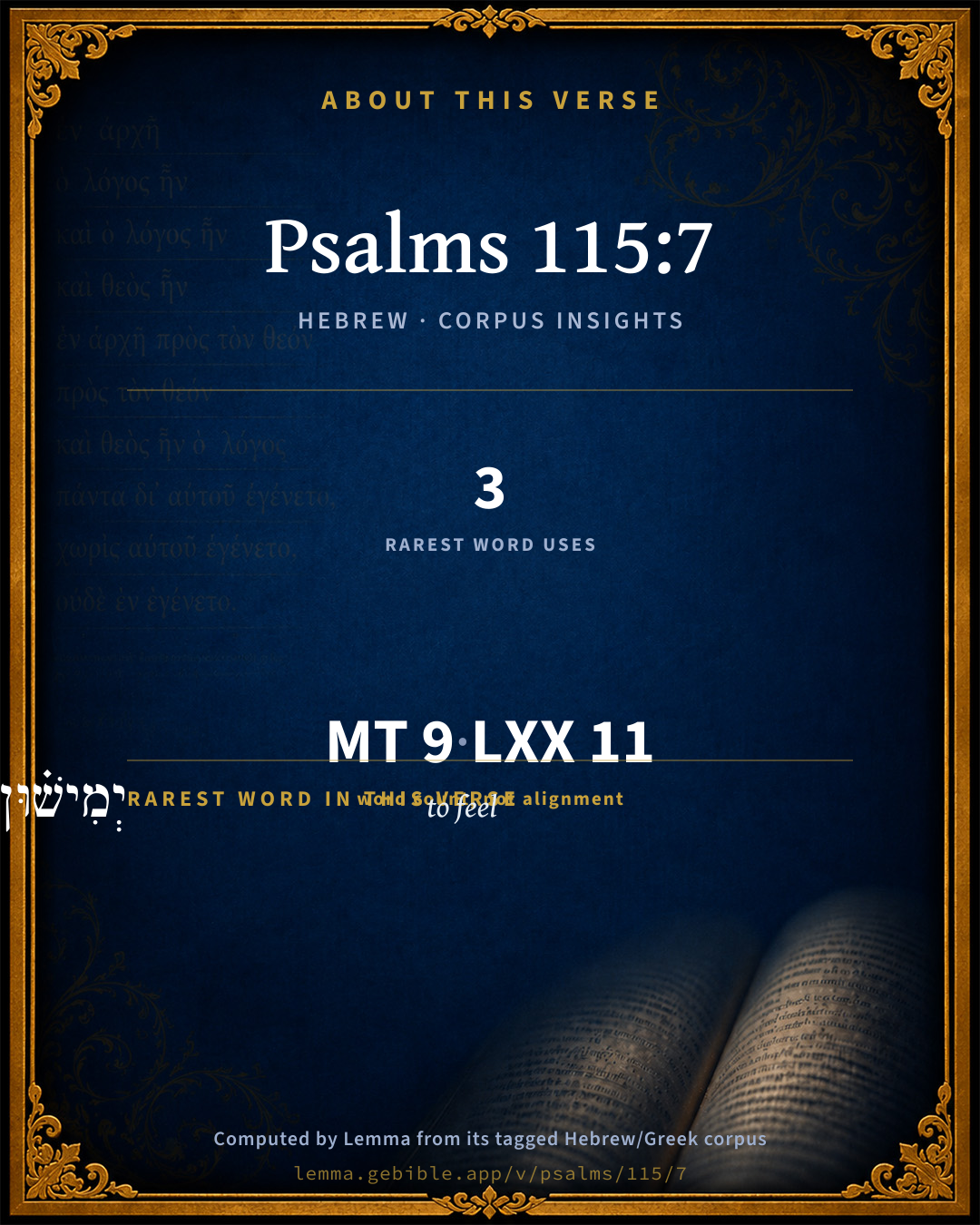
The rarest word here is יְמִישׁ֗וּן to feel H4184 — appearing just 3 times in the whole Hebrew Bible.

Shared distinctive vocabulary

יְמִישׁ֗וּן to feel H4184 occurs in 3 verses of the Hebrew Bible. Also found in:

Grammatical profile

  • 3 verbs
  • 3 nouns
  • 3 particles

Verb forms

  • יְמִישׁ֗וּן Hiphil · Imperfect
  • יְהַלֵּ֑כוּ Piel · Imperfect
  • יֶ֝הְגּ֗וּ Qal · Imperfect

Repetition

A word recurs within this verse — often emphatic in Hebrew:

  • וְלֹ֬א not H3808 ×3

Hebrew & Septuagint length

In English translation the verse runs 21 words from the Hebrew and 17 from the Septuagint (LXX English) — closely comparable.

A rough comparison of the two English renderings, which tokenize alike — not a word-level alignment.

Word counts can differ between the Hebrew and the Greek without any difference in meaning — e.g. the Hebrew direct-object marker אֵת has no separate Greek word, and Greek often adds the article ὁ.

In the original languages it is 9 Hebrew tokens and 11 Greek tokens — but the two are counted differently (Hebrew bundles its prefixes and suffixes into one token; the Greek is in lemma form), so that isn’t a like-for-like length.

Hebrew and Greek witnesses Masoretic Hebrew ↔ Greek Septuagint

The same verse in the two great witnesses to the Old Testament, shown verse-for-verse.

You’re reading Greek Psalm 113 (Hebrew Psalm 115). The Septuagint counts the superscription, so verse numbers can differ from the Hebrew — chapter-level alignment, not verse-by-verse. Numbering follows Rahlfs.

These are two independent witnesses, not word-aligned to each other, and the Septuagint is shown in lemma (dictionary) form.

Hebrew Psalms 115:7 Masoretic · Westminster Leningrad Codex

יְדֵיהֶ֤ם וְלֹ֬א יְמִישׁ֗וּן רַ֭גְלֵיהֶם וְלֹ֣א יְהַלֵּ֑כוּ לֹֽא יֶ֝הְגּ֗וּ בִּגְרוֹנָֽם

They have hands, but they don't feel; They have feet, but they don't walk; Neither do they speak through their throat.

World English Bible · Public Domain

Greek LXX Greek Psalm 113:7 Septuagint · lemma form

ἀπό πρόσωπον κύριος σαλεύω ὁ γῆ ἀπό πρόσωπον ὁ θεός ἰακώβ

The earth trembled at the presence of the Lord, at the presence of the God of Jacob;

LXX2012 (modern English Septuagint) · Public Domain

On this verse, Whedon's Commentary on the Bible discusses the Septuagint’s reading. Read the note in Commentary ↓

Hebrew: Westminster Leningrad Codex (CC BY 4.0). Greek: Septuagint (public domain); English from LXX2012 (modern English Septuagint) (Public Domain). How the Septuagint differs from the Hebrew →

Commentary

Notes on Psalms 115:7 from classic Christian and Jewish commentators (each source and its license shown beneath its notes). The classic Christian expositions comment on the surrounding passage and are grouped to its opening verse, so a note may address several verses; the Jewish commentaries on the Tanakh (Rashi and others) are per-verse, so they appear only where the commentator wrote on this verse.

Lemma curates 59 commentaries, every one of them public domain or Creative Commons licensed, each selected and text-cleaned for this edition rather than reprinted as found. About our sources →

Trapp's Complete Commentary

John Trapp

Psa 115:7 They have hands, but they handle not: feet have they, but they walk not: neither speak they through their throat.

Ver. 7. They have hands, but they handle not] Curious and artificial (for art is Nature’s ape), but useless, and for show only. If Esculapius, or the lady of Loretto, restore the lame or the blind, it is the devil with his lying wonders, 2Th 2:9

Feet have they, but they walk not] As those pictures in Plato made by Daedalus, which, if they were not bound, would fly away; or Vulcan’s three-footed stools in Homer, which are feigned to have run on wheels of their own accord, to the meeting of the gods, and after that to return in like sort back again. The Tyrians besieged by Alexander chained up their god Hercules, that he might not go from them in that calamnity, and yet they were not delivered.

Neither speak they through their throat] They do not so much as chatter like a crane, or mourn as a dove, Isa 38:14, but are dumb idols, as the apostle calleth them. These are things commonly known, but profitably thus inculcated, for the shaming of senseless idolaters; who yet are so bewitched that they will needs dote upon these gods of their own making. O vanas hominum mentes, &c., Oh the spirit of fornication, &c.

John Trapp, A Commentary or Exposition upon All the Books of the Old and New Testament (1647–1656) — public domain. Text from a community e-Sword module.

J. A. Alexander on Psalms

Joseph Addison Alexander

7. (Psa 115:7) They have hands, and feel not; they have feet, and walk not; they do not mutter in their throat. The sameness of this long enumeration, the force of which is logical and not poetical, is partially relieved by a change in the form of the original, which cannot well be imitated in translation. Their hands, and they feel not; their feet, and they walk not. Some make the first words in each clause nominatives absolute; their hands—they feel not; their feet—they walk not. But in the preceding parts of the description, the verbs relate not to the particular members, but to the whole person. It is better, therefore, to supply a verb—their hands (are there), and (yet) they feel not—their feet (are there), and (yet) they go not. The English feel is to be taken in its physical and outward sense, corresponding to the Latin palpo, here used by the Vulgate and Jerome. A less equivocal translation would be touch. The other verb denotes all progressive movements of the body, comprehended in the English go. See above, on Psa 104:8. The meaning of the last clause is, that they cannot even make the faintest and most inarticulate guttural noise, like the lower animals; much less speak as men do. See above, on Psa 35:28; Psa 71:24.

Joseph Addison Alexander, The Psalms Translated and Explained (1850) — public domain. Text from a community e-Sword module.

Geneva Bible (1599)

Geneva Bible translators

He showeth what great vanity it is to ask help of them, which not only have no help in them, but lack sense and reason.

Geneva Bible (1599) marginal notes — public domain. Text via Bolls.life.

Ellicott's Commentary for English Readers

(7) Neither speak they.—The Hebrew implies not only the want of articulate speech, but of utterance at all.

A Bible Commentary for English Readers, edited by Charles John Ellicott (1878–1897) — public domain. Text from a community e-Sword module.

John Gill's Exposition

They have hands, but they handle not,.... So as to feel any thing that is put into their hands; they cannot make use of their hands to stretch them out, and receive anything from their worshippers; nor can they give anything to them: but our God receives and accepts the sacrifices of his people, their prayers and their praises; and opens his hand, and liberally supplies their wants, both in providence and grace.

Feet have they, but they walk not; cannot stir from the place where they are, to the assistance of those that call unto them, Isa 46:7 but our God walks upon the wings of the wind, and is a present help in times of trouble; a God at hand and afar off, and makes haste to the relief of his people in distress.

Neither speak they through their throat; or make a mournful voice as a dove, as the word is used in Isa 38:14 or chirp as a bird, or chatter as a crane; or warble out any note through the throat, as birds do; and much less form any articulate sound, or utter any proper word, that may be understood.

John Gill's Exposition of the Whole Bible (1746–1763) — public domain (CC PDM 1.0). Text via the HelloAO Bible API.

Matthew Poole's English Annotations

Speak, or mutter, or make a noise, as this word signifies, Isa 10:14. They are so far from speaking with their throat and other instruments of speech as men do, that they cannot make such an inarticulate and senseless sound with them as the beasts do.

Matthew Poole's English Annotations on the Holy Bible (1683–1685) — public domain. Text from a community e-Sword/MySword module.

The Treasury of David

Charles H. Spurgeon

Ver. 7. They have hands, but they handle not. Looking lower down upon the images, the Psalmist says, "They have hands, but they handle not, "they cannot receive that which is handed to them, they cannot grasp the sceptre of power or the sword of vengeance, they can neither distribute benefits nor dispense judgments, and the most trifling act they are utterly unable to perform. An infant's hand excels them in power.

Feet have they, but they walk not. They must be lifted into their places or they would never reach their shrines; they must be fastened in their shrines or they would fall; they must be carried or they could never move; they cannot come to the rescue of their friends, nor escape the iconoclasm of their foes. The meanest insect has more power of locomotion than the greatest heathen god.

Neither speak they through their throats. They cannot even reach so far as the guttural noise of the lowest order of beasts; neither a grunt, nor a growl, nor a groan, nor so much as a mutter, can come from them. Their priests asserted that the images of the gods upon special occasions uttered hollow sounds, but it was a mere pretence, or a crafty artifice: images of gold or silver are incapable of living sounds. Thus has the Psalmist surveyed the idol from head to foot, looked in its face, and sounded its throat, and he writes it down as utterly contemptible.

Ver. 7. They have hands, but they handle not. Even their artist therefore surpasses them, since he had the faculty of moulding them by the motion and functions of his limbs; though thou wouldest be ashamed to worship that artist. Even you surpass them, though thou hast not made these things, since thou doest what they cannot do. Augustine.

Ver. 7. Neither speak they through their throat. Yehgu;not so much as the low faint moaning of a dove. Isa 38:14. William Kay.

Ver. 7. Speak, or, as the Hebrew word likewise signifies, breathe. They are not only irrational, but also inanimate. Thomas Fenton.

Psalms 115:8*

Charles H. Spurgeon's The Treasury of David (1869–1885) — public domain. Psalms only. Text from a community e-Sword/MySword module.

Whedon's Commentary on the Bible

Daniel D. Whedon

7. Neither speak they through their throat—The speaking through the throat seems here to be contrasted with speaking with the tongue. Compare Psa_35:28. The latter was open, articulate speech; the former, low, whispering, and often inarticulate—a muttering. See Isa_8:19; Isa_59:3. The word rendered “speak,” here, is sometimes rendered meditate, (see Jos_1:8; Psa_77:12,) because meditating is an inward speaking to one’s self, often accompanied with low, half inarticulate sounds. See on Psa_90:9. The idea of the text seems to be, that these idols could not make even a breathlike, inarticulate sound. The psalmist had already denied their power of enunciating words, or of speech proper, in Psa_115:5, where another word is used. A satirical allusion may also be here intended to the custom of the heathen priests and necromancers of uttering their magical formulas in a low, guttural tone.

See Isa_8:19. The Septuagint calls them, those who speak, or make a sound, from the belly, ventriloquists.

Daniel D. Whedon (gen. ed.), Commentary on the Old and New Testaments (1874–1909) — public domain. Text from a community e-Sword module.

unfoldingWord translationNotes

Door43 World Missions Community

Those idols have hands

The idols do not have real hands, feet, or mouths. Rather, people made them with the likeness of hands, feet, and mouths. The writer is emphasizing that these idols are not really alive. You can make this implicit information clear. AT: "People have given hands to those idols" (See: Assumed Knowledge and Implicit Information)

but do not feel

"but those hands do not feel"

Those who make them are like them, as is everyone who trusts in them

Those who make and worship idols become lifeless and powerless, just like those idols. The full meaning of this statement can be made clear. AT: "Those who make them become lifeless like they are, as does everyone who trusts in them" (See: Assumed Knowledge and Implicit Information)

translationWords

like

trust

unfoldingWord translationNotes — © Distant Shores Media and the Door43 World Missions Community, licensed CC BY-SA 4.0. Source: git.door43.org/Door43/en_tn.

Rashi

Rabbi Shlomo Yitzchaki (Rashi)

but they do not feel Heb. ימישון, an expression of (Gen. 27:12): “Perhaps my father will feel me (ימשני).”

Rashi on the Tanakh — English translations: “The Judaica Press complete Tanach with Rashi, translated by A. J. Rosenberg” (CC BY 4.0); “Pentateuch with Rashi's commentary by M. Rosenbaum and A.M. Silbermann, 1929-1934” (public domain); “The Metsudah Tanach series, Lakewood, N.J” (CC BY 4.0); and “The Book of Joshua, Metsudah Publications, 1997” (CC BY 4.0). Text via Sefaria.

Lesson kit

Teaching starters — assembled from the data on this page, not authored interpretation. Every prompt links to the verse data it draws on. Edit before teaching.

Psalms, in the Wisdom, opens this verse with 9 words (7 distinct Hebrew lemmas). Its most distinctive word is mûwsh (“to feel”). A historical commentator’s framing appears above. Read the whole chapter for the surrounding context.

Discussion questions

  1. What does “to feel” (mûwsh) contribute to the verse as a whole?
  2. Genesis 27:21 shares the word «to feel» with this verse. How do the two illuminate each other?
  3. “not” occurs 3× in this one verse. What is the effect of the repetition?
  4. These translations render this verse differently. What is at stake in choosing one wording over another?
  5. The verb «יְמִישׁ֗וּן» is Hiphil Imperfect. How does its form color the action?
  6. Reading how Trapp's Complete Commentary and J. A. Alexander on Psalms read this verse, where do the two commentators agree and where do they part?

Things to notice

Reading settings

Reading text

Shown beneath each verse's original-language words.

Old Testament
Old Testament edition

Read the OT as the Masoretic Hebrew (MT) or the Greek Septuagint (LXX).

English shown for the Greek Septuagint (in the Hebrew ↔ Greek comparison).

Comparing translations? Open the Compare panel on any verse page to stack up to four side by side.