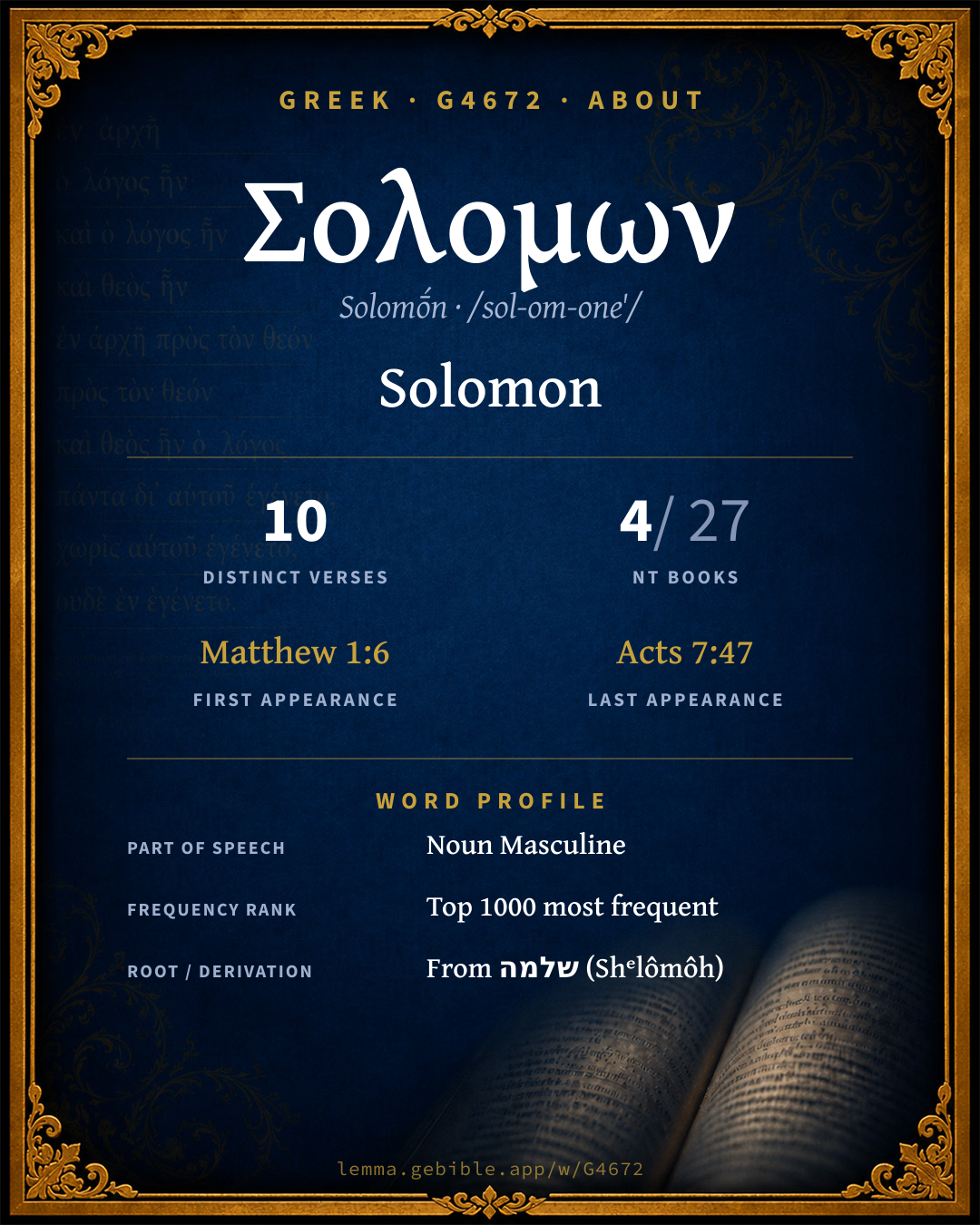
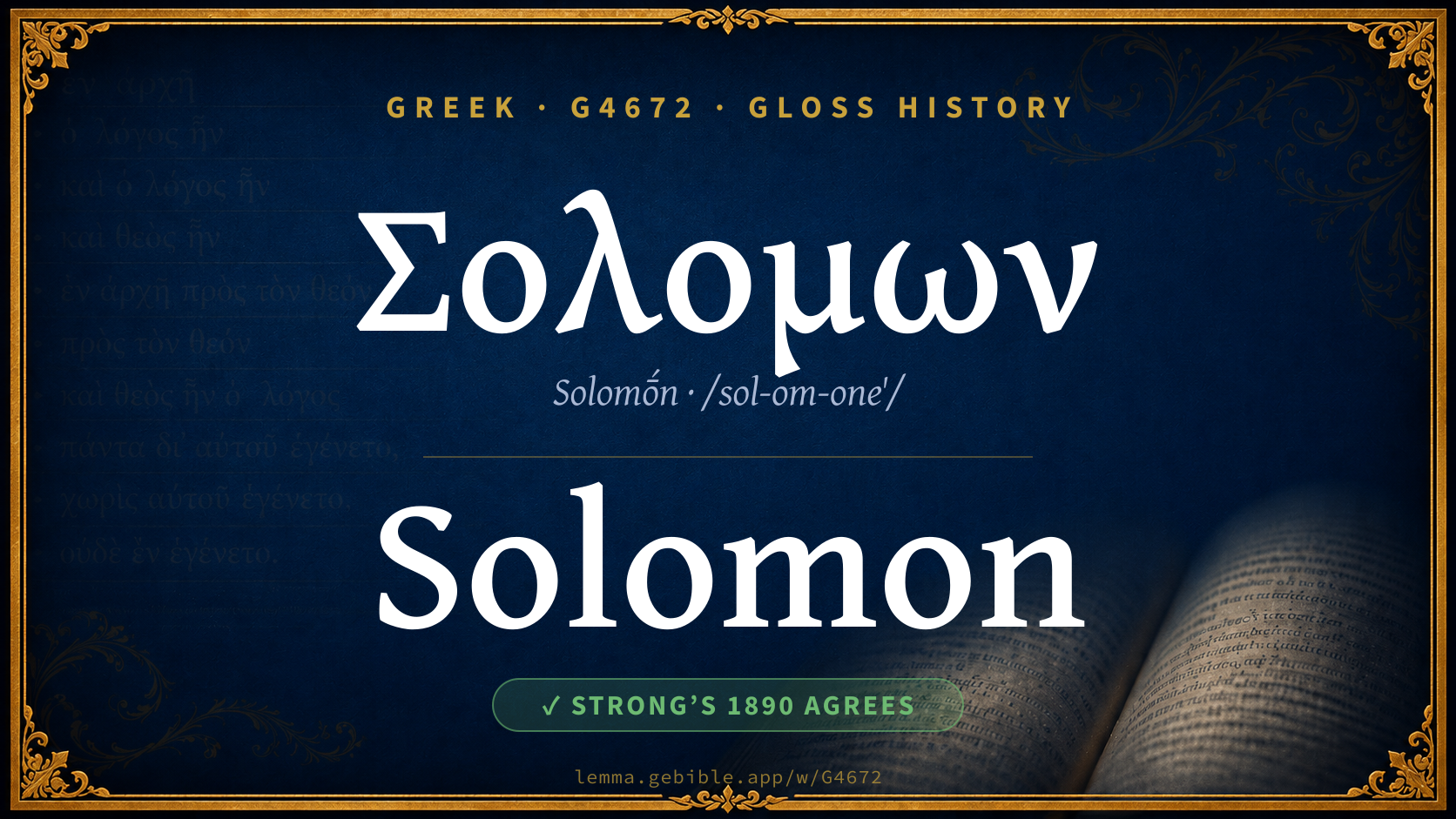
Σολομων
Solomon
Thayer's lists 2 entries for ‘Solomon’ fuller range ↓
Full lexicon entry — Thayer's Greek Lexicon
From Thayer's Greek Lexicon
Where this word appears
See every Nominative-case word in the Greek New Testament →
Grammar key — what these labels mean
Part of speech
- Noun
- A naming word — a person, place, thing, or idea.
Case
- Genitive
- The case of source, possession, or “of” — answers “whose / from what.”
- Nominative
- The case of the subject (and the predicate nominative).
- Accusative
- The case of the direct object and of extent.
Gender
- Masculine
- Grammatically masculine.
Number
- Singular
- One.
2 verses where G4672 appears in the Nominative case in the Book of Matthew. Filtered view — show all forms. Click any verse to open its interlinear word-by-word view. Verse text shown in the World English Bible for context — . Each verse’s Greek form is shown with its reference; the English is not keyword-highlighted, since the data carries no word-level English alignment. Use “Compare translations” on any verse to read it across multiple English versions. This concordance covers the Greek New Testament; Septuagint (Greek Old Testament) occurrences of this word are not indexed here.
Matthew
About this entry
At a glance — auto-summarized from this page’s data, not written by a person. Every figure links to its source below. This summary describes the numbers; it doesn’t interpret them.
At its core, Σολομων (Solomṓn) means “Solomon.” It first appears in Matthew 1:6. Spanning 10 verses in 4 books, it ranks among the uncommon words of the Greek New Testament. Its uses concentrate in Matthew (40% of all occurrences). Each statement above links to its evidence; the full detail follows below.
Gloss history
Strong's 1890 vs modern scholarship
About this word
Strong's G4672 catalogs a Greek word from the Greek New Testament.
These counts are not copied from any lexicon or concordance. They are computed here, from the morphology-tagged Greek New Testament. What Lemma adds →
- 10
- distinct verses
- The word appears in 10 distinct verses.
- 4 / 27
- NT books
- The word appears in 4 of 27 New Testament books.
- #904
- by frequency
- Top 1000 most frequent Greek words (rank 904 of 5,347 Greek words by occurrence).
View all 10 occurrences in the concordance →
By section of the New Testament
By traditional corpus
Conventional, traditional groupings — biblical authorship is debated, so this is a traditional corpus grouping, not an authorship claim. Some books belong to more than one corpus (Luke is in both the Gospels and the Lukan corpus, and so on), so these shares overlap and need not total 100%. Each figure is a share of the word’s 10 distinct verses.
- Gospels 7 verses · 70%
- Lukan (Luke–Acts) 5 verses · 50%
- Johannine 1 verse · 10%
How translations render this word
Counts come from each version’s own published word-to-Strong’s tagging or interlinear alignment — an approximate guide to how each version renders this word, not a word-level alignment the data otherwise carries. Because each total is that version’s own tagged count, the per-version totals vary from one another and need not match the appearance or distinct-verse counts above. These counts may also differ from a printed concordance because Lemma counts each distinctly tagged rendering and does not collapse phrase taggings into a single head-word total. This is a fixed set of word-tagged versions (KJV, ASV, BSB, ULT) and does not change with the reading translation you choose elsewhere. Each version’s license is shown beside its name below (and on Sources).
- King James Version: Solomon 9×, Solomon's 3×
- American Standard Version: Solomon 10×, Than solomon 2×
- Berean Standard Bible: Solomon 8×, Solomon’s 3×
- unfoldingWord Literal Text: Solomon 11×
King James Version Public Domain
Renders G4672 across 12 tagged occurrences — most commonly:
American Standard Version Public Domain
Renders G4672 across 13 tagged occurrences — most commonly:
Plus 1 rendering that appears only once — usually multi-word phrases or single function words the recovered tagging swept in, not distinct renderings.
Berean Standard Bible Public Domain
Renders G4672 across 12 tagged occurrences — most commonly:
Plus 1 rendering that appears only once — usually multi-word phrases or single function words the recovered tagging swept in, not distinct renderings.
unfoldingWord Literal Text CC BY-SA 4.0
Renders G4672 across 12 tagged occurrences — most commonly:
Plus 1 rendering that appears only once — usually multi-word phrases or single function words the recovered tagging swept in, not distinct renderings.
Senses in Thayer's
The 2 senses Thayer's distinguishes for this word, in lexicon order (not ranked by frequency or importance). The full entry — with sub-senses — is in the Lexicon Entry tab.
- Solomon = "peaceful"
- the son of David and was the wisest and richest king that ever lived
Word origin
Derived from שלמה (Shᵉlômôh) (H8010) — Solomon.
Of hebrew origin [ H8010 ]; Solomon (that is Shelomoh ) the son of David : - Solomon.
— Strong’s Exhaustive Concordance (1890), public domain.
Forms in the corpus
The 5 distinct written forms G4672 takes in the Greek New Testament, most frequent first — each parse links to that case’s occurrences in the concordance.
| Form | Parsing | Example | Uses |
|---|---|---|---|
| Σολομῶνος Solomō̂nos | Noun, Genitive, Singular, Masculine | Matthew 12:42 | 5 |
| Σολομὼν Solomṑn | Noun, Nominative, Singular, Masculine | Matthew 1:7 | 3 |
| Σολομῶντος Solomō̂ntos | Noun, Genitive, Singular, Masculine | Acts 3:11 | 2 |
| Σαλωμῶν Salōmō̂n | Noun, Nominative, Singular, Masculine | Acts 7:47 | 1 |
| Σολομῶνα Solomō̂na | Noun, Accusative, Singular, Masculine | Matthew 1:6 | 1 |
Bible dictionary
Public-domain dictionary articles matched to this entry by name (Solomon). A biblical name can be shared by more than one person or place, so an article may treat several.
Easton's Bible Dictionary · M. G. Easton, 1897
Peaceful, (Heb. Shelomoh), David's second son by Bathsheba, i.e., the first after their legal marriage (2 Sam. 12). He was probably born about B.C. 1035 (1 Chr. 22:5; 29:1). He succeeded his father on the throne in early manhood, probably about sixteen or eighteen years of age. Nathan, to whom his education was intrusted, called him Jedidiah, i.e., "beloved of the Lord" (2 Sam. 12:24, 25). He was the first king of Israel "born in the purple." His father chose him as his successor, passing over the claims of his elder sons: "Assuredly Solomon my son shall reign after me." His history is recorded in 1 Kings 1-11 and 2 Chr. 1-9. His elevation to the throne took place before his father's death, and was hastened on mainly by Nathan and Bathsheba, in consequence of the rebellion of Adonijah (1 Kings 1:5-40). During his long reign of forty years the Hebrew monarchy gained its highest splendour. This period has well been called the "Augustan age" of the Jewish annals. The first half of his reign was, however, by far the brighter and more prosperous; the latter half was clouded by the idolatries into which he fell, mainly from his heathen intermarriages (1 Kings 11:1-8; 14:21, 31).
Before his death David gave parting instructions to his son (1 Kings 2:1-9; 1 Chr. 22:7-16; 28). As soon as he had settled himself in his kingdom, and arranged the affairs of his extensive empire, he entered into an alliance with Egypt by the marriage of the daughter of Pharaoh (1 Kings 3:1), of whom, however, nothing further is recorded. He surrounded himself with all the luxuries and the external grandeur of an Eastern monarch, and his government prospered. He entered into an alliance with Hiram, king of Tyre, who in many ways greatly assisted him in his numerous undertakings. (See HIRAM.)
For some years before his death David was engaged in the active work of collecting materials (1 Chr. 29:6-9; 2 Chr. 2:3-7) for building a temple in Jerusalem as a permanent abode for the ark of the covenant. He was not permitted to build the house of God (1 Chr. 22:8); that honour was reserved to his son Solomon. (See TEMPLE.)
After the completion of the temple, Solomon engaged in the erection of many other buildings of importance in Jerusalem and in other parts of his kingdom. For the long space of thirteen years he was engaged in the erection of a royal palace on Ophel (1 Kings 7:1-12). It was 100 cubits long, 50 broad, and 30 high. Its lofty roof was supported by forty-five cedar pillars, so that the hall was like a forest of cedar wood, and hence probably it received the name of "The House of the Forest of Lebanon." In front of this "house" was another building, which was called the Porch of Pillars, and in front of this again was the "Hall of Judgment," or Throne-room (1 Kings 7:7; 10:18-20; 2 Chr. 9:17-19), "the King's Gate," where he administered justice and gave audience to his people. This palace was a building of great magnificence and beauty. A portion of it was set apart as the residence of the queen consort, the daughter of Pharaoh. From the palace there was a private staircase of red and scented sandal wood which led up to the temple.
Solomon also constructed great works for the purpose of securing a plentiful supply of water for the city (Eccl. 2:4-6). He then built Millo (LXX., "Acra") for the defence of the city, completing a line of ramparts around it (1 Kings 9:15, 24; 11:27). He erected also many other fortifications for the defence of his kingdom at various points where it was exposed to the assault of enemies (1 Kings 9:15-19; 2 Chr. 8:2-6). Among his great undertakings must also be mentioned the building of Tadmor (q.v.) in the wilderness as a commercial depot, as well as a military outpost.
During his reign Palestine enjoyed great commercial prosperity. Extensive traffic was carried on by land with Tyre and Egypt and Arabia, and by sea with Spain and India and the coasts of Africa, by which Solomon accumulated vast stores of wealth and of the produce of all nations (1 Kings 9:26-28; 10:11, 12; 2 Chr. 8:17, 18; 9:21). This was the "golden age" of Israel. The royal magnificence and splendour of Solomon's court were unrivalled. He had seven hundred wives and three hundred concubines, an evidence at once of his pride, his wealth, and his sensuality. The maintenance of his household involved immense expenditure. The provision required for one day was "thirty measures of fine flour, and threescore measures of meal, ten fat oxen, and twenty oxen out of the pastures, and an hundred sheep, beside harts, and roebucks, and fallow-deer, and fatted fowl" (1 Kings 4:22, 23).
Solomon's reign was not only a period of great material prosperity, but was equally remarkable for its intellectual activity. He was the leader of his people also in this uprising amongst them of new intellectual life. "He spake three thousand proverbs: and his songs were a thousand and five. And he spake of trees, from the cedar tree that is in Lebanon even unto the hyssop that springeth out of the wall: he spake also of beasts, and of fowl, and of creeping things, and of fishes" (1 Kings 4:32, 33).
His fame was spread abroad through all lands, and men came from far and near "to hear the wisdom of Solomon." Among others thus attracted to Jerusalem was "the queen of the south" (Matt. 12:42), the queen of Sheba, a country in Arabia Felix. "Deep, indeed, must have been her yearning, and great his fame, which induced a secluded Arabian queen to break through the immemorial custom of her dreamy land, and to put forth the energy required for braving the burdens and perils of so long a journey across a wilderness. Yet this she undertook, and carried it out with safety." (1 Kings 10:1-13; 2 Chr. 9:1-12.) She was filled with amazement by all she saw and heard: "there was no more spirit in her." After an interchange of presents she returned to her native land.
But that golden age of Jewish history passed away. The bright day of Solomon's glory ended in clouds and darkness. His decline and fall from his high estate is a sad record. Chief among the causes of his decline were his polygamy and his great wealth. "As he grew older he spent more of his time among his favourites. The idle king living among these idle women, for 1,000 women, with all their idle and mischievous attendants, filled the palaces and pleasure-houses which he had built (1 Kings 11:3), learned first to tolerate and then to imitate their heathenish ways. He did not, indeed, cease to believe in the God of Israel with his mind. He did not cease to offer the usual sacrifices in the temple at the great feasts. But his heart was not right with God; his worship became merely formal; his soul, left empty by the dying out of true religious fervour, sought to be filled with any religious excitement which offered itself. Now for the first time a worship was publicly set up amongst the people of the Lord which was not simply irregular or forbidden, like that of Gideon (Judg. 8:27), or the Danites (Judg. 18:30, 31), but was downright idolatrous." (1 Kings 11:7; 2 Kings 23:13.)
This brought upon him the divine displeasure. His enemies prevailed against him (1 Kings 11:14-22, 23-25, 26-40), and one judgment after another fell upon the land. And now the end of all came, and he died, after a reign of forty years, and was buried in the city of David, and "with him was buried the short-lived glory and unity of Israel." "He leaves behind him but one weak and worthless son, to dismember his kingdom and disgrace his name."
"The kingdom of Solomon," says Rawlinson, "is one of the most striking facts in the Biblical history. A petty nation, which for hundreds of years has with difficulty maintained a separate existence in the midst of warlike tribes, each of which has in turn exercised dominion over it and oppressed it, is suddenly raised by the genius of a soldier-monarch to glory and greatness. An empire is established which extends from the Euphrates to the borders of Egypt, a distance of 450 miles; and this empire, rapidly constructed, enters almost immediately on a period of peace which lasts for half a century. Wealth, grandeur, architectural magnificence, artistic excellence, commercial enterprise, a position of dignity among the great nations of the earth, are enjoyed during this space, at the end of which there is a sudden collapse. The ruling nation is split in twain, the subject-races fall off, the pre-eminence lately gained being wholly lost, the scene of struggle, strife, oppression, recovery, inglorious submission, and desperate effort, re-commences.", Historical Illustrations.
Smith's Bible Dictionary · William Smith, 1863
(peaceful). I. Early life and occasion to the throne .--Solomon was the child of David's old age, the last born of all his sons. (1 Chronicles 3:5) The yearnings of the "man of war" led him to give to the new-horn infant the name of Solomon (Shelomoth, the peaceful one). Nathan, with a marked reference to the meaning of the king's own name (David, the darling, the beloved one), calls the infant Jedidiah (Jedid'yah), that is, the darling of the Lord. (2 Samuel 11:24,25) He was placed under the care of Nathan from his earliest infancy. At first, apparently, there was no distinct purpose to make him the heir. Absalom was still the king's favorite son, (2 Samuel 13:37; 18:33) and was looked on by the people as the destined successor. (2 Samuel 14:13; 15:1-6) The death of Absalom when Solomon was about ten years old left the place vacant, and David pledged his word in secret to Bath-sheba that he, and no other, should be the heir. (1 Kings 1:13) The words which were spoken somewhat later express, doubtless, the purpose which guided him throughout. (1 Chronicles 28:9; 20) His son's life should not he as his own had been, one of hardships and wars, dark crimes and passionate repentance, but, from first to last, be pure, blameless, peaceful, fulfilling the ideal of glory and of righteousness after which he himself had vainly striven. The glorious visions of (Psalms 72:1) ... may be looked on as the prophetic expansion of these hopes of his old age. So far, all was well. Apparently his influence over his son's character was one exclusively for good. Nothing that we know of Bath-sheba lends us to think of her as likely to mould her son's mind and heart to the higher forms of goodness. Under these influences the boy grew up. At the age of ten or eleven he must have passed through the revolt of Absalom, and shared his father's exile. (2 Samuel 15:16) He would be taught all that priests or Levites or prophets had to teach. When David was old and feeble, Adonijah, Solomon's older brother attempted to gain possession of the throne; but he was defeated, and Solomon went down to Gihon and was proclaimed and anointed king. A few months more and Solomon found himself, by his father's death, the sole occupant of the throne. The position to which he succeeded was unique. Never before, and never after, did the kingdom of Israel take its place among the great monarchies of the East. Large treasures, accumulated through many years, were at his disposal. II. Personal appearance .--Of Solomon's personal appearance we have no direct description, as we have of the earlier kings. There are, however, materials for filling up the gap. Whatever higher mystic meaning may be latent in (Psalms 45:1) ... or the Song of Songs, we are all but compelled to think of them us having had at least a historical starting-point. They tell of one who was, in the eyes of the men of his own time, "fairer than the children of men," the face "bright, and ruddy" as his father's, (Song of Solomon 5:10; 1 Samuel 17:42) bushy locks, dark as the raven's wing, yet not without a golden glow, the eyes soft as "the eyes of cloves," the "countenance as Lebanon excellent as the cedars," "the chiefest among ten thousand, the altogether lovely." (Song of Solomon 5:13-18) Add to this all gifts of a noble, far-reaching intellect large and ready sympathies, a playful and genial humor, the lips "full of grace," and the soul "anointed" as "with the oil of gladness," (Psalms 45:1) ... and we may form some notion of what the king was like in that dawn of his golden prime. III. Reign .--All the data for a continuous history that we have of Solomon's reign are-- (a) The duration of the reign, forty sears, B.C. 1015-975. (1 Kings 11:4) (b) The commencement of the temple in the fourth, its completion in the eleventh, year of his reign. (1 Kings 6:1,37,38) (c) The commencement of his own palace in the seventh, its completion in the twentieth, year. (1 Kings 7:1; 2 Chronicles 8:1) (d) The conquest of Hamath-zobah, and the consequent foundation of cities in the region of north Palestine after the twentieth year. (2 Chronicles 8:1-6) IV. Foreign policy .--
+ Egypt. The first act of the foreign policy of the new reign must have been to most Israelites a very startling one. He made affinity with Pharaoh, king of Egypt, by marrying his daughter (1 Kings 3:1) The immediate results were probably favorable enough. The new queen brought with her as a dowry the frontier city of Gezer. But the ultimate issue of alliance showed that it was hollow and impolitic. + Tyre. The alliance with the Phoenician king rested on a somewhat different footing. It had been a part of David's policy from the beginning of his reign. Hiram had been "ever a lover of David." As soon as he heard of Solomon's accession he sent ambassadors to salute him. A correspondence passed between the two kings, which ended in a treaty of commerce. The opening of Joppa as a port created a new coasting-trade, and the materials from Tyre were conveyed to that city on floats, and thence to Jerusalem. (2 Chronicles 2:16) In return for these exports, the Phoenicians were only too glad to receive the corn and oil of Solomon's territory. The results of the alliance did not end here. Now, for the first time in the history of the Jews, they entered on a career as a commercial people. + The foregoing were the two most important to Babylon alliances. The absence of any reference to Babylon and Assyria, and the fact that the Euphrates was recognized as the boundary of Solomon's kingdom, (2 Chronicles 9:26) suggests the inference that the Mesopotamian monarchies were at this time comparatively feeble. Other neighboring nations were content to pay annual tribute in the form of gifts. (2 Chronicles 9:28) + The survey of the influence exercised by Solomon on surrounding nations would be incomplete if we were to pass over that which was more directly personal the fame of his glory and his wisdom. Wherever the ships of Tarshish went, they carried with them the report, losing nothing in its passage, of what their crews had seen and heard. The journey of the queen of Sheba, though from its circumstances the most conspicuous, did not stand alone. V. Internal history .-- + The first prominent scene in Solomon's reign is one which presents his character in its noblest aspect. God in a vision having offered him the choice of good things he would have, he chose wisdom in preference to riches or honor or long life. The wisdom asked for was given in large measure, and took a varied range. The wide world of nature, animate and inanimate, the lives and characters of men, lay before him, and he took cognizance of all but the highest wisdom was that wanted for the highest work, for governing and guiding, and the historian hastens to give an illustration of it. The pattern-instance is, in all its circumstances, thoroughly Oriental. (1 Kings 3:16-28) + In reference to the king's finances, the first impression of the facts given us is that of abounding plenty. Large quantities of the precious metals were imported from Ophir and Tarshish. (1 Kings 9:28) All the kings and princes of the subject provinces paid tribute in the form of gifts, in money and in kind, "at a fixed rate year by year." (1 Kings 10:25) Monopolies of trade contributed to the king's treasury. (1 Kings 10:28,29) The total amount thus brought into the treasury in gold, exclusive of all payments in kind, amounted to 666 talents. (1 Kings 10:14) + It was hardly possible, however, that any financial system could bear the strain of the king's passion for magnificence. The cost of the temple was, it is true, provided for by David's savings and the offerings of the people; but even while that was building, yet more when it was finished one structure followed on another with ruinous rapidity. All the equipment of his court, the "apparel" of his servants was on the same scale. A body-guard attended him, "threescore valiant men," tallest and handsomest of the sons of Israel. Forty thousand stalls of horses for his chariots, and twelve thousand horsemen made up the measure of his magnificence. (1 Kings 4:26) As the treasury became empty, taxes multiplied and monopolies became more irksome. + A description of the temple erected by Solomon is given elsewhere. After seven years and the work was completed and the day came to which all Israelites looked back as the culminating glory of their nation. + We cannot ignore the fact that even now there were some darker shades in the picture. He reduced the "strangers" in the land, the remnant of the Canaanite races, to the state of helots, and made their life "bitter with all hard bondage." One hundred and fifty-three thousand, with wives and children in proportion, were torn from their homes and sent off to the quarries and the forests of Lebanon. (1 Kings 5:15; 2 Chronicles 2:17,18) And the king soon fell from the loftiest height of his religious life to the lowest depth. Before long the priests and prophets had to grieve over rival temples to Molech, Chemosh, Ashtaroth and forms of ritual not idolatrous only, but cruel, dark, impure. This evil came as the penalty of another. (1 Kings 11:1-8) He gave himself to "strange women." He found himself involved in a fascination which led to the worship of strange gods. Something there was perhaps in his very "largeness of heart," so far in advance of the traditional knowledge of his age, rising to higher and wider thoughts of God, which predisposed him to it. In recognizing what was true in other forms of faith, he might lose his horror at what was false. With this there may have mingled political motives. He may have hoped, by a policy of toleration, to conciliate neighboring princes, to attract larger traffic. But probably also there was another influence less commonly taken into account. The widespread belief of the East in the magic arts of Solomon is not, it is believed, without its foundation of truth. Disasters followed before long as the natural consequence of what was politically a blunder as well as religiously a sin. VI. His literary works.--little remains out of the songs, proverbs, treatises, of which the historian speaks. (1 Kings 4:32,33) Excerpts only are given from the three thousand proverbs. Of the thousand and five songs we know absolutely nothing. His books represent the three stages of his life. The Song of Songs brings before us the brightness of his -youth. Then comes in the book of Proverbs, the stage of practical, prudential thought. The poet has become the philosopher, the mystic has passed into the moralist; but the man passed through both stages without being permanently the better for either. They were to him but phases of his life which he had known and exhausted, (Ecclesiastes 1:1; Ecclesiastes 2:1) ... and therefore there came, its in the confessions of the preacher, the great retribution.
Hitchcock's Bible Names Dictionary · Roswell D. Hitchcock, 1869
peaceable; perfect; one who recompenses
Classic public-domain reference works; full attribution on Sources.
Septuagint usage
The same Greek word Σολομων appears 318 times in the Greek Old Testament (Septuagint), across 253 verses in 11 books.
- 318
- LXX occurrences
- Tagged occurrences of this Greek word in the Septuagint.
- 253
- verses
- Distinct Septuagint verses containing this word.
- 11 / 39
- OT books
- The word appears in 11 of the 39 Old Testament books.
Sample Septuagint occurrences
- 2 Samuel 5:14 σαλωμών
- 1 Kings 1:10 σαλωμών
- 2 Kings 21:7 σαλωμών
- 1 Chronicles 2:51 σαλωμών
- 2 Chronicles 1:1 σαλωμών
- Ezra 17:57 σαλωμών
- Psalms 71:1 σαλωμών
- Proverbs 1:1 σαλωμῶν
- Song of Solomon 1:5 σαλωμών
- Jeremiah 52:20 σαλωμών
- Amos 1:6 σαλωμών
Septuagint occurrences (same lexeme)
Every verse where the same Strong’s number (G4672) appears in the Greek Septuagint — showing the first 50 of 253. Verse text shown in the World English Bible for context; the Greek form is the matched word — the English is not keyword-highlighted.
- 2 Samuel 5:14 σαλωμών These are the names of those who were born to him in Jerusalem: Shammua, and Shobab, and Nathan, and Solomon,
- 2 Samuel 8:7 σολομών David took the shields of gold that were on the servants of Hadadezer, and brought them to Jerusalem.
- 2 Samuel 8:8 σαλωμών From Betah and from Berothai, cities of Hadadezer, king David took exceeding much brass.
- 2 Samuel 12:24 σαλωμών David comforted Bathsheba his wife, and went in to her, and lay with her: and she bore a son, and he called his name Solomon. Yahweh loved him;
- 2 Samuel 14:27 σαλωμών To Absalom there were born three sons, and one daughter, whose name was Tamar: she was a woman of a beautiful face.
- 2 Samuel 24:25 σαλωμών David built there an altar to Yahweh, and offered burnt offerings and peace-offerings. So Yahweh was entreated for the land, and the plague was stayed from Israel.
- 1 Kings 1:10 σαλωμών but Nathan the prophet, and Benaiah, and the mighty men, and Solomon his brother, he didn't call.
- 1 Kings 1:11 σαλωμών Then Nathan spoke to Bathsheba the mother of Solomon, saying, Haven't you heard that Adonijah the son of Haggith reigns, and David our lord doesn't know it?
- 1 Kings 1:12 σαλωμών Now therefore come, please let me give you counsel, that you may save your own life, and the life of your son Solomon.
- 1 Kings 1:13 σαλωμών Go and get you in to king David, and tell him, Didn't you, my lord, king, swear to your handmaid, saying, Assuredly Solomon your son shall reign after me, and he shall sit on my throne? why then does Adonijah reign?
- 1 Kings 1:17 σαλωμών She said to him, My lord, you swore by Yahweh your God to your handmaid, [saying], Assuredly Solomon your son shall reign after me, and he shall sit on my throne.
- 1 Kings 1:19 σαλωμών and he has slain oxen and fatlings and sheep in abundance, and has called all the sons of the king, and Abiathar the priest, and Joab the captain of the host; but he hasn't called Solomon your servant.
- 1 Kings 1:21 σαλωμών Otherwise it will happen, when my lord the king shall sleep with his fathers, that I and my son Solomon shall be counted offenders.
- 1 Kings 1:26 σαλωμών But he hasn't called me, even me your servant, and Zadok the priest, and Benaiah the son of Jehoiada, and your servant Solomon.
- 1 Kings 1:30 σαλωμών most assuredly as I swore to you by Yahweh, the God of Israel, saying, Assuredly Solomon your son shall reign after me, and he shall sit on my throne in my place; most assuredly so will I do this day.
- 1 Kings 1:33 σαλωμών The king said to them, Take with you the servants of your lord, and cause Solomon my son to ride on my own mule, and bring him down to Gihon:
- 1 Kings 1:34 σαλωμών and let Zadok the priest and Nathan the prophet anoint him there king over Israel; and blow you the trumpet, and say, [Long] live king Solomon.
- 1 Kings 1:37 σαλωμών As Yahweh has been with my lord the king, even so be he with Solomon, and make his throne greater than the throne of my lord king David.
- 1 Kings 1:38 σαλωμών So Zadok the priest, and Nathan the prophet, and Benaiah the son of Jehoiada, and the Cherethites and the Pelethites, went down, and caused Solomon to ride on king David's mule, and brought him to Gihon.
- 1 Kings 1:39 σαλωμών Zadok the priest took the horn of oil out of the Tent, and anointed Solomon. They blew the trumpet; and all the people said, [Long] live king Solomon.
- 1 Kings 1:43 σαλωμών Jonathan answered Adonijah, Most assuredly our lord king David has made Solomon king:
- 1 Kings 1:46 σαλωμών Also Solomon sits on the throne of the kingdom.
- 1 Kings 1:47 σαλωμών Moreover the king's servants came to bless our lord king David, saying, Your God make the name of Solomon better than your name, and make his throne greater than your throne: and the king bowed himself on the bed.
- 1 Kings 1:50 σαλωμών Adonijah feared because of Solomon; and he arose, and went, and caught hold on the horns of the altar.
- 1 Kings 1:51 σαλωμών It was told Solomon, saying, Behold, Adonijah fears king Solomon; for, behold, he has laid hold on the horns of the altar, saying, Let king Solomon swear to me first that he will not kill his servant with the sword.
- 1 Kings 1:52 σαλωμών Solomon said, If he shall show himself a worthy man, there shall not a hair of him fall to the earth; but if wickedness be found in him, he shall die.
- 1 Kings 1:53 σαλωμών So king Solomon sent, and they brought him down from the altar. He came and did obeisance to king Solomon; and Solomon said to him, Go to your house.
- 1 Kings 2:1 σαλωμών Now the days of David drew near that he should die; and he charged Solomon his son, saying,
- 1 Kings 2:12 σαλωμών Solomon sat on the throne of David his father; and his kingdom was established greatly.
- 1 Kings 2:13 σαλωμών Then Adonijah the son of Haggith came to Bathsheba the mother of Solomon. She said, Come you peaceably? He said, Peaceably.
- 1 Kings 2:17 σαλωμών He said, Please speak to Solomon the king (for he will not tell you 'no'), that he give me Abishag the Shunammite as wife.
- 1 Kings 2:19 σαλωμών Bathsheba therefore went to king Solomon, to speak to him for Adonijah. The king rose up to meet her, and bowed himself to her, and sat down on his throne, and caused a throne to be set for the king's mother; and she sat on his right hand.
- 1 Kings 2:22 σαλωμών King Solomon answered his mother, Why do you ask Abishag the Shunammite for Adonijah? ask for him the kingdom also; for he is my elder brother; even for him, and for Abiathar the priest, and for Joab the son of Zeruiah.
- 1 Kings 2:23 σαλωμών Then king Solomon swore by Yahweh, saying, God do so to me, and more also, if Adonijah has not spoken this word against his own life.
- 1 Kings 2:25 σαλωμών King Solomon sent by Benaiah the son of Jehoiada; and he fell on him, so that he died.
- 1 Kings 2:27 σαλωμών So Solomon thrust out Abiathar from being priest to Yahweh, that he might fulfill the word of Yahweh, which he spoke concerning the house of Eli in Shiloh.
- 1 Kings 2:28 σαλωμών The news came to Joab; for Joab had turned after Adonijah, though he didn't turn after Absalom. Joab fled to the Tent of Yahweh, and caught hold on the horns of the altar.
- 1 Kings 2:29 σαλωμών It was told king Solomon, Joab is fled to the Tent of Yahweh, and, behold, he is by the altar. Then Solomon sent Benaiah the son of Jehoiada, saying, Go, fall on him.
- 1 Kings 2:35 σαλωμών The king put Benaiah the son of Jehoiada in his room over the host; and Zadok the priest did the king put in the room of Abiathar.
- 1 Kings 2:41 σαλωμών It was told Solomon that Shimei had gone from Jerusalem to Gath, and was come again.
- 1 Kings 2:45 σαλωμών But king Solomon shall be blessed, and the throne of David shall be established before Yahweh forever.
- 1 Kings 2:46 σαλωμών So the king commanded Benaiah the son of Jehoiada; and he went out, and fell on him, so that he died. The kingdom was established in the hand of Solomon.
- 1 Kings 3:3 σαλωμών Solomon loved Yahweh, walking in the statutes of David his father: only he sacrificed and burnt incense in the high places.
- 1 Kings 3:4 σαλωμών The king went to Gibeon to sacrifice there; for that was the great high place: a thousand burnt offerings did Solomon offer on that altar.
- 1 Kings 3:5 σαλωμών In Gibeon Yahweh appeared to Solomon in a dream by night; and God said, Ask what I shall give you.
- 1 Kings 3:6 σαλωμών Solomon said, You have shown to your servant David my father great loving kindness, according as he walked before you in truth, and in righteousness, and in uprightness of heart with you; and you have kept for him this great loving kindness, that you have given him a son to sit on his throne, as it is this day.
- 1 Kings 3:10 σαλωμών The speech pleased the Lord, that Solomon had asked this thing.
- 1 Kings 3:15 σαλωμών Solomon awoke; and, behold, it was a dream: and he came to Jerusalem, and stood before the ark of the covenant of Yahweh, and offered up burnt offerings, and offered peace-offerings, and made a feast to all his servants.
- 1 Kings 4:1 σαλωμών King Solomon was king over all Israel.
- 1 Kings 4:7 σαλωμών Solomon had twelve officers over all Israel, who provided food for the king and his household: each man had to make provision for a month in the year.
These are occurrences of the same Greek lexeme (G4672) in the Septuagint — not a translation of any one Hebrew word. The store carries no word-level Hebrew↔Greek alignment, so no Hebrew original is asserted here. Counts come from the recovered LXX Strong's tagging — high-frequency vocabulary is well covered, while rare or late forms may be untagged — so they reflect tagged occurrences and may slightly undercount.