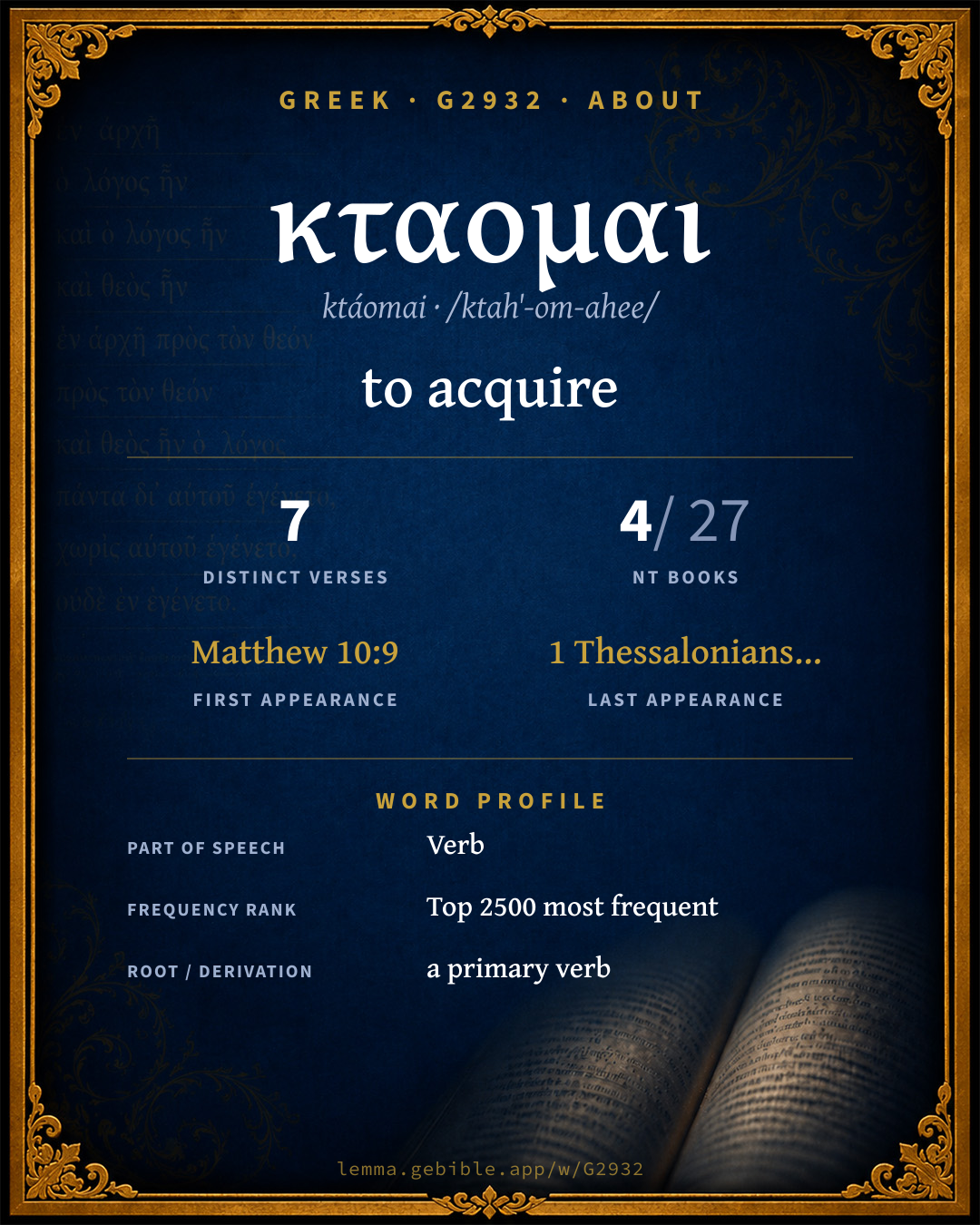
κτάομαι
to acquire
Full lexicon entry — Thayer's Greek Lexicon
From Thayer's Greek Lexicon
Where this word appears
See every Aorist-tense verb in the Greek New Testament →
Grammar key — what these labels mean
Part of speech
- Verb
- An action or state-of-being word.
Tense
- Present
- Ongoing or general action in present time (imperfective aspect).
- Aorist
- Action viewed as a simple whole, without regard to duration — often past (perfective aspect).
Voice
- Middle or Passive deponent
- Middle/passive in form but active in meaning.
- Middle deponent
- Middle in form but active in meaning.
Mood
- Infinitive
- A verbal noun (“to write”), unmarked for person or number.
- Indicative
- States a fact or asks a factual question (the mood of reality).
- Imperative
- Expresses a command or request.
- Subjunctive
- Expresses probability, purpose, or possibility (the mood of contingency).
Person
- 1st person
- The speaker (“I / we”).
- 3rd person
- The one spoken about (“he / she / it / they”).
- 2nd person
- The one addressed (“you”).
Number
- Singular
- One.
- Plural
- More than one.
1 verse where G2932 appears in the Present tense in the Book of Luke. Filtered view — show all forms. Click any verse to open its interlinear word-by-word view. Verse text shown in the World English Bible for context — . Each verse’s Greek form is shown with its reference; the English is not keyword-highlighted, since the data carries no word-level English alignment. Use “Compare translations” on any verse to read it across multiple English versions. This concordance covers the Greek New Testament; Septuagint (Greek Old Testament) occurrences of this word are not indexed here.
Luke
About this entry
At a glance — auto-summarized from this page’s data, not written by a person. Every figure links to its source below. This summary describes the numbers; it doesn’t interpret them.
At its core, κταομαι (ktáomai) means “to acquire.” First canonically at Matthew 10:9, it enters the text early. With 7 verses in 4 books, it is an uncommon word in the Greek New Testament. Its uses concentrate in Acts (43% of all occurrences). From the same root come κτημα, κτηνος and κτητωρ. Each statement above links to its evidence; the full detail follows below.
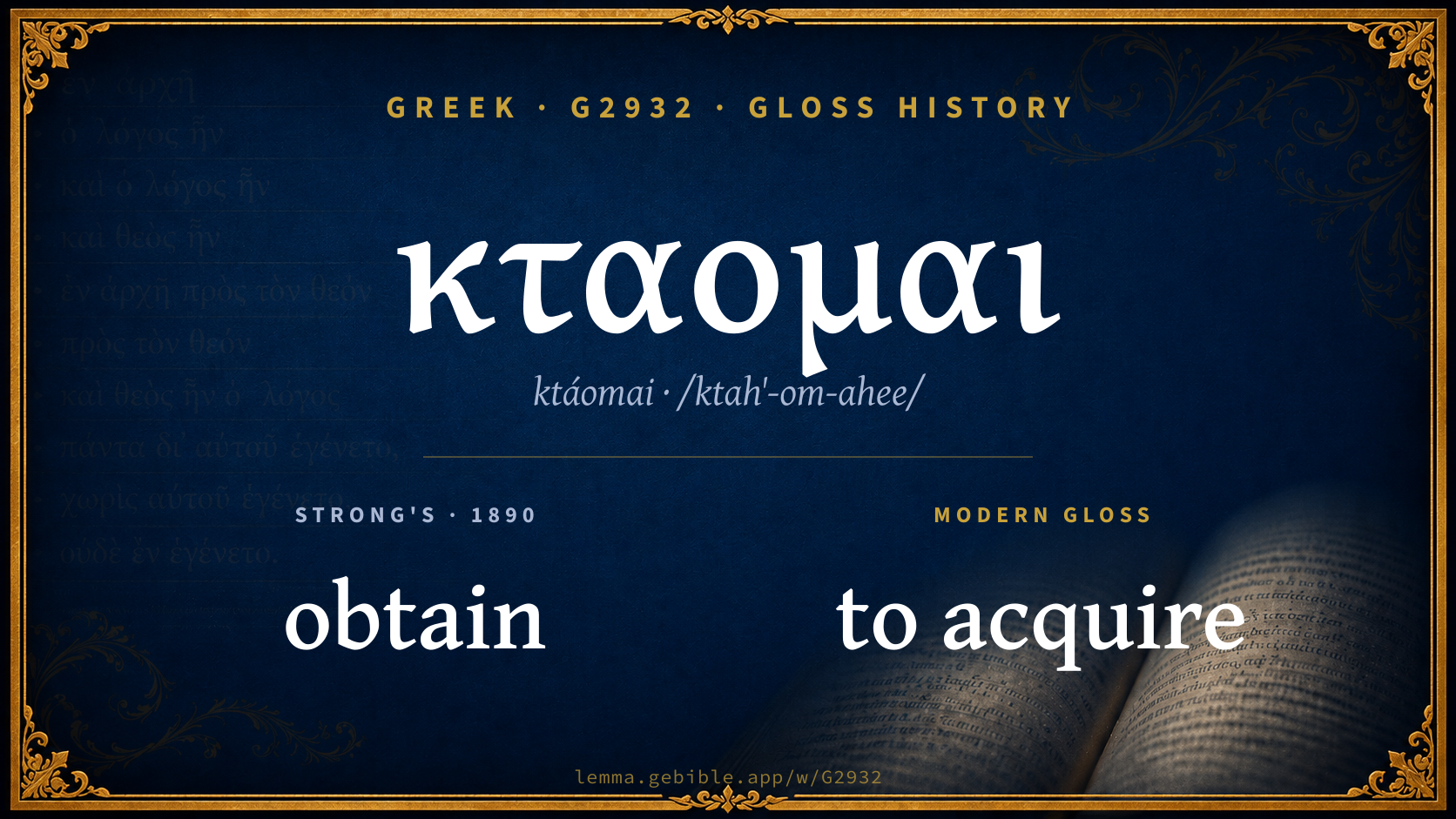
Gloss history
Strong's 1890 vs modern scholarship
About this word
Strong's G2932 catalogs a Greek word from the Greek New Testament.
These counts are not copied from any lexicon or concordance. They are computed here, from the morphology-tagged Greek New Testament. What Lemma adds →
- 7
- distinct verses
- The word appears in 7 distinct verses.
- 4 / 27
- NT books
- The word appears in 4 of 27 New Testament books.
- #1,358
- by frequency
- Top 2500 most frequent Greek words (rank 1,358 of 5,347 Greek words by occurrence).
View all 7 occurrences in the concordance →
By section of the New Testament
By traditional corpus
Conventional, traditional groupings — biblical authorship is debated, so this is a traditional corpus grouping, not an authorship claim. Some books belong to more than one corpus (Luke is in both the Gospels and the Lukan corpus, and so on), so these shares overlap and need not total 100%. Each figure is a share of the word’s 7 distinct verses.
- Lukan (Luke–Acts) 5 verses · 71%
- Gospels 3 verses · 43%
- Pauline corpus 1 verse · 14%
How translations render this word
Counts come from each version’s own published word-to-Strong’s tagging or interlinear alignment — an approximate guide to how each version renders this word, not a word-level alignment the data otherwise carries. Because each total is that version’s own tagged count, the per-version totals vary from one another and need not match the appearance or distinct-verse counts above. These counts may also differ from a printed concordance because Lemma counts each distinctly tagged rendering and does not collapse phrase taggings into a single head-word total. This is a fixed set of word-tagged versions (KJV, ASV, BSB, ULT) and does not change with the reading translation you choose elsewhere. Each version’s license is shown beside its name below (and on Sources).
- King James Version: How to possess 1×, I possess 1×, May be purchased 1×
- American Standard Version: Obtained 2×
- Berean Standard Bible: Bought 1×, Control 1×, I acquire 1×
- unfoldingWord Literal Text: Bought 2×
King James Version Public Domain
Renders G2932 across 7 tagged occurrences — most commonly:
American Standard Version Public Domain
Renders G2932 across 8 tagged occurrences — most commonly:
Plus 6 renderings that appear only once — usually multi-word phrases or single function words the recovered tagging swept in, not distinct renderings.
Berean Standard Bible Public Domain
Renders G2932 across 7 tagged occurrences — most commonly:
unfoldingWord Literal Text CC BY-SA 4.0
Renders G2932 across 8 tagged occurrences — most commonly:
Plus 6 renderings that appear only once — usually multi-word phrases or single function words the recovered tagging swept in, not distinct renderings.
Senses in Thayer's
The 1 sense Thayer's distinguishes for this word, in lexicon order (not ranked by frequency or importance). The full entry — with sub-senses — is in the Lexicon Entry tab.
- to acquire, get, or procure a thing for one's self, to possess
Word origin
Origin: a primary verb
A primary verb; to get that is acquire (by any means; own ): - obtain possess provide purchase.
— Strong’s Exhaustive Concordance (1890), public domain.
Forms in the corpus
The 6 distinct written forms G2932 takes in the Greek New Testament, most frequent first — each parse links to that tense’s occurrences in the concordance.
| Form | Parsing | Example | Uses |
|---|---|---|---|
| κτᾶσθαι ktâsthai | Verb, Present, Middle or Passive deponent, Infinitive | Acts 8:20 | 2 |
| κτήσασθε ktḗsasthe | Verb, Aorist, Middle deponent, Imperative, 2nd person, Plural | Luke 21:19 | 1 |
| κτήσησθε ktḗsēsthe | Verb, Aorist, Middle deponent, Subjunctive, 2nd person, Plural | Matthew 10:9 | 1 |
| κτῶμαι ktō̂mai | Verb, Present, Middle or Passive deponent, Indicative, 1st person, Singular | Luke 18:12 | 1 |
| ἐκτήσατο ektḗsato | Verb, Aorist, Middle deponent, Indicative, 3rd person, Singular | Acts 1:18 | 1 |
| ἐκτησάμην ektēsámēn | Verb, Aorist, Middle deponent, Indicative, 1st person, Singular | Acts 22:28 | 1 |
Same root — word family
Other Thayer's entries built from the same root as G2932, grouped by Strong’s listed origin. These share a root / origin per the lexicon — not necessarily a shared meaning. Each links to that word’s own entry.
Derived from this word
- κτημα ktēma G2933 possession
- κτηνος ktēnos G2934 beast
- κτητωρ ktḗtōr G2935 possessor
- κτιζω ktízō G2936 to create
Compare all same-root words → Showing 4 of 5 — not the complete family. They share a root, not necessarily a meaning.
Septuagint usage
The same Greek word κταομαι appears 81 times in the Greek Old Testament (Septuagint), across 76 verses in 18 books.
- 81
- LXX occurrences
- Tagged occurrences of this Greek word in the Septuagint.
- 76
- verses
- Distinct Septuagint verses containing this word.
- 18 / 39
- OT books
- The word appears in 18 of the 39 Old Testament books.
Sample Septuagint occurrences
- Genesis 4:1 κτάομαι
- Exodus 15:16 κτάομαι
- Leviticus 22:11 κτάομαι
- Deuteronomy 28:68 κτάομαι
- Joshua 24:32 κτάομαι
- Ruth 4:4 κτάομαι
- 2 Samuel 12:3 κτάομαι
- 1 Kings 16:24 κτάομαι
- 2 Kings 12:13 κτάομαι
- Ezra 15:8 κτάομαι
- Psalms 73:2 κτάομαι
- Proverbs 1:5 κτάομαι
Septuagint occurrences (same lexeme)
Every verse where the same Strong’s number (G2932) appears in the Greek Septuagint — showing the first 50 of 76. Verse text shown in the World English Bible for context; the Greek form is the matched word — the English is not keyword-highlighted.
- Genesis 4:1 κτάομαι The man knew Eve his wife. She conceived, and gave birth to Cain, and said, "I have gotten a man with Yahweh's help."
- Genesis 12:5 κτάομαι Abram took Sarai his wife, Lot his brother's son, all their substance that they had gathered, and the souls who they had gotten in Haran; and they went forth to go into the land of Canaan. Into the land of Canaan they came.
- Genesis 25:10 κτάομαι the field which Abraham purchased of the children of Heth. There was Abraham buried, with Sarah his wife.
- Genesis 33:19 κτάομαι He bought the parcel of ground, where he had spread his tent, at the hand of the children of Hamor, Shechem's father, for one hundred pieces of money.
- Genesis 36:6 κτάομαι Esau took his wives, his sons, his daughters, and all the members of his household, with his cattle, all his animals, and all his possessions, which he had gathered in the land of Canaan, and went into a land away from his brother Jacob.
- Genesis 39:1 κτάομαι Joseph was brought down to Egypt. Potiphar, an officer of Pharaoh's, the captain of the guard, an Egyptian, bought him from the hand of the Ishmaelites that had brought him down there.
- Genesis 46:6 κτάομαι They took their cattle, and their goods, which they had gotten in the land of Canaan, and came into Egypt-- Jacob, and all his seed with him,
- Genesis 47:19 κτάομαι Why should we die before your eyes, both we and our land? Buy us and our land for bread, and we and our land will be servants to Pharaoh. Give us seed, that we may live, and not die, and that the land won't be desolate."
- Genesis 47:20 κτάομαι So Joseph bought all the land of Egypt for Pharaoh, for the Egyptians sold every man his field, because the famine was severe on them, and the land became Pharaoh's.
- Genesis 47:22 κτάομαι Only he didn't buy the land of the priests, for the priests had a portion from Pharaoh, and ate their portion which Pharaoh gave them. That is why they didn't sell their land.
- Genesis 47:23 κτάομαι Then Joseph said to the people, "Behold, I have bought you and your land today for Pharaoh. Behold, here is seed for you, and you shall sow the land.
- Genesis 49:30 κτάομαι in the cave that is in the field of Machpelah, which is before Mamre, in the land of Canaan, which Abraham bought with the field from Ephron the Hittite as a burial place.
- Genesis 50:13 κτάομαι for his sons carried him into the land of Canaan, and buried him in the cave of the field of Machpelah, which Abraham bought with the field, for a possession of a burying-place, from Ephron the Hittite, before Mamre.
- Exodus 15:16 κτάομαι Terror and dread falls on them. By the greatness of your arm they are as still as a stone; Until your people pass over, Yahweh, Until the people pass over who you have purchased.
- Exodus 21:2 κτάομαι If you buy a Hebrew servant, he shall serve six years and in the seventh he shall go out free without paying anything.
- Leviticus 22:11 κτάομαι But if a priest buys a slave, purchased by his money, he shall eat of it; and such as are born in his house, they shall eat of his bread.
- Leviticus 25:14 κτάομαι "'If you sell anything to your neighbor, or buy from your neighbor, you shall not wrong one another.
- Leviticus 25:15 κτάομαι According to the number of years after the Jubilee you shall buy from your neighbor. According to the number of years of the crops he shall sell to you.
- Leviticus 25:28 κτάομαι But if he isn't able to get it back for himself, then what he has sold shall remain in the hand of him who has bought it until the Year of Jubilee: and in the Jubilee it shall be released, and he shall return to his propery.
- Leviticus 25:30 κτάομαι If it isn't redeemed within the space of a full year, then the house that is in the walled city shall be made sure in perpetuity to him who bought it, throughout his generations. It shall not be released in the Jubilee.
- Leviticus 25:44 κτάομαι "'As for your male and your female slaves, whom you may have; of the nations that are around you, from them you may buy male and female slaves.
- Leviticus 25:45 κτάομαι Moreover of the children of the strangers who sojourn among you, of them you may buy, and of their families who are with you, which they have conceived in your land; and they will be your property.
- Leviticus 25:50 κτάομαι He shall reckon with him who bought him from the year that he sold himself to him to the Year of Jubilee: and the price of his sale shall be according to the number of years; according to the time of a hired servant shall he be with him.
- Leviticus 27:22 κτάομαι "'If he dedicates to Yahweh a field which he has bought, which is not of the field of his possession,
- Leviticus 27:24 κτάομαι In the Year of Jubilee the field shall return to him from whom it was bought, even to him to whom the possession of the land belongs.
- Deuteronomy 28:68 κτάομαι Yahweh will bring you into Egypt again with ships, by the way of which I said to you, You shall see it no more again: and there you shall sell yourselves to your enemies for bondservants and for bondmaids, and no man shall buy you.
- Deuteronomy 32:6 κτάομαι Do you thus requite Yahweh, Foolish people and unwise? Isn't he your father who has bought you? He has made you, and established you.
- Joshua 24:32 κτάομαι The bones of Joseph, which the children of Israel brought up out of Egypt, buried they in Shechem, in the parcel of ground which Jacob bought of the sons of Hamor the father of Shechem for a hundred pieces of money: and they became the inheritance of the children of Joseph.
- Ruth 4:4 κτάομαι I thought to disclose it to you, saying, Buy it before those who sit here, and before the elders of my people. If you will redeem it, redeem it: but if you will not redeem it, then tell me, that I may know; for there is none to redeem it besides you; and I am after you. He said, I will redeem it.
- Ruth 4:5 κτάομαι Then said Boaz, What day you buy the field of the hand of Naomi, you must buy it also of Ruth the Moabitess, the wife of the dead, to raise up the name of the dead on his inheritance.
- Ruth 4:8 κτάομαι So the near kinsman said to Boaz, Buy it for yourself. He drew off his shoe.
- Ruth 4:9 κτάομαι Boaz said to the elders, and to all the people, You are witnesses this day, that I have bought all that was Elimelech's, and all that was Chilion's and Mahlon's, of the hand of Naomi.
- Ruth 4:10 κτάομαι Moreover Ruth the Moabitess, the wife of Mahlon, have I purchased to be my wife, to raise up the name of the dead on his inheritance, that the name of the dead not be cut off from among his brothers, and from the gate of his place: you are witnesses this day.
- 2 Samuel 12:3 κτάομαι but the poor man had nothing, except one little ewe lamb, which he had bought and raised. It grew up together with him, and with his children. It ate of his own food, drank of his own cup, and lay in his bosom, and was to him like a daughter.
- 2 Samuel 24:21 κτάομαι Araunah said, Why is my lord the king come to his servant? David said, To buy the threshing floor of you, to build an altar to Yahweh, that the plague may be stayed from the people.
- 2 Samuel 24:24 κτάομαι The king said to Araunah, No; but I will most assuredly buy it of you at a price. Neither will I offer burnt-offerings to Yahweh my God which cost me nothing. So David bought the threshing floor and the oxen for fifty shekels of silver.
- 1 Kings 16:24 κτάομαι He bought the hill Samaria of Shemer for two talents of silver; and he built on the hill, and called the name of the city which he built, after the name of Shemer, the owner of the hill, Samaria.
- 2 Kings 12:13 κτάομαι But there were not made for the house of Yahweh cups of silver, snuffers, basins, trumpets, any vessels of gold, or vessels of silver, of the money that was brought into the house of Yahweh;
- 2 Kings 22:6 κτάομαι to the carpenters, and to the builders, and to the masons, and for buying timber and hewn stone to repair the house.
- Ezra 15:8 κτάομαι
- Ezra 15:16 κτάομαι
- Psalms 73:2 κτάομαι But as for me, my feet were almost gone. My steps had nearly slipped.
- Psalms 77:54 κτάομαι
- Psalms 138:13 κτάομαι
- Proverbs 1:5 κτάομαι That the wise man may hear, and increase in learning; That the man of understanding may attain to sound counsel:
- Proverbs 1:14 κτάομαι You shall cast your lot among us. We'll all have one purse."
- Proverbs 3:31 κτάομαι Don't envy the man of violence. Choose none of his ways.
- Proverbs 16:18 κτάομαι Pride goes before destruction, And a haughty spirit before a fall.
- Proverbs 17:16 κτάομαι Why is there money in the hand of a fool to buy wisdom, Seeing he has no understanding?
- Proverbs 17:21 κτάομαι He who becomes the father of a fool grieves. The father of a fool has no joy.
These are occurrences of the same Greek lexeme (G2932) in the Septuagint — not a translation of any one Hebrew word. The store carries no word-level Hebrew↔Greek alignment, so no Hebrew original is asserted here. Counts come from the recovered LXX Strong's tagging — high-frequency vocabulary is well covered, while rare or late forms may be untagged — so they reflect tagged occurrences and may slightly undercount.