Luke 21:19

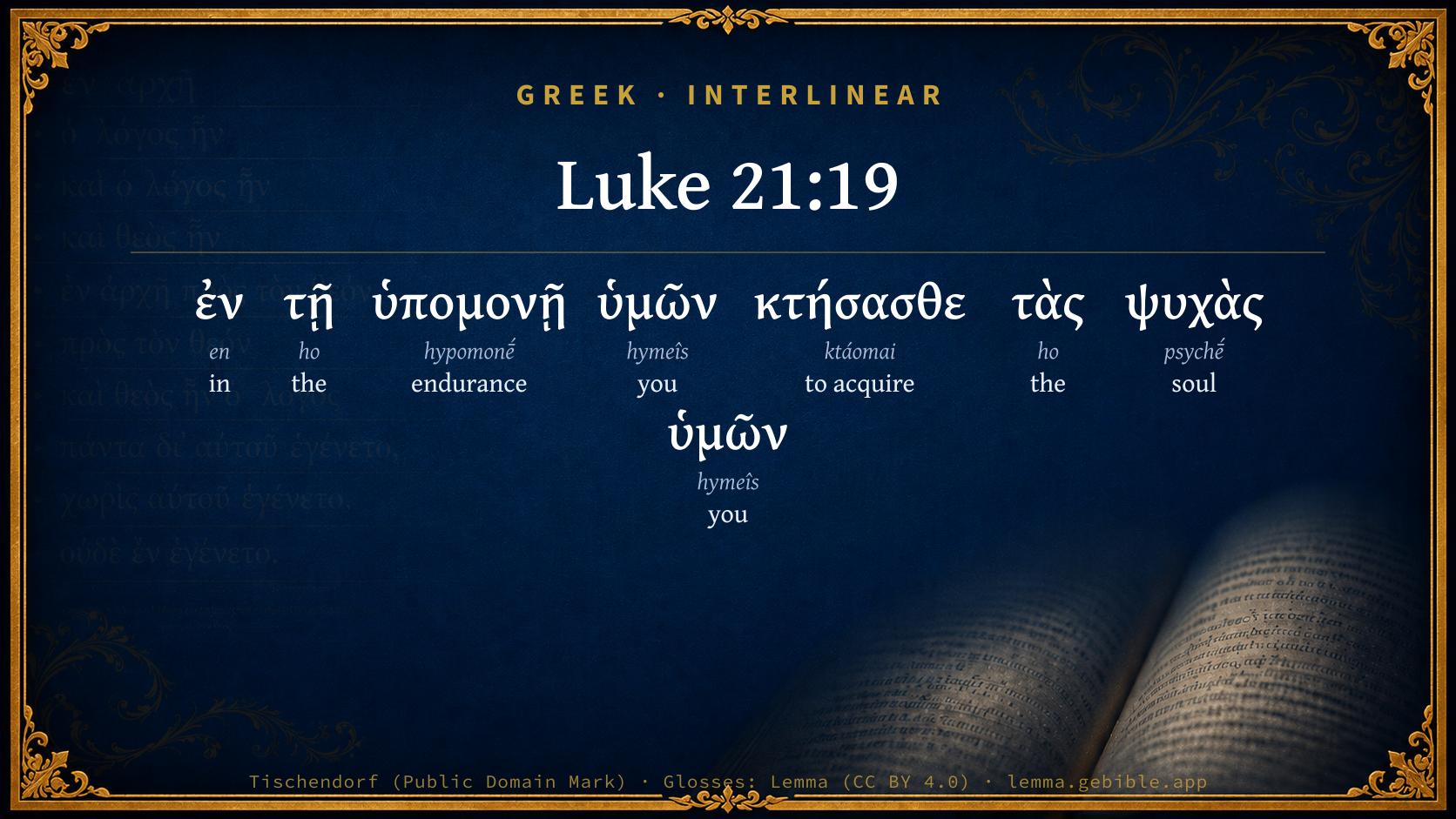
Greek (Tischendorf 8th ed.) Luke 21:19 appears in the Greek New Testament. The text above is from the Tischendorf 8th edition. Each word links to its Strong’s number and a concise gloss. Click any word for its full Thayer’s Greek Lexicon entry.
Download image
Cite this verse

Luke 21:19 (World English Bible). Public Domain. Lemma interlinear Bible study tool, https://lemma.gebible.app/v/luke/21/19.

Show BibTeX & RIS
BibTeX
RIS
English Translation
By your endurance you will win your lives.
World English Bible · Public Domain
Download a study sheet

One document with this verse’s original text, its word-by-word gloss line, the meaning frame, cross-references with their text, attributed commentary, and full source and license credits — printable, and it pastes into notes with its structure intact.

This verse Autodidact and up

Study sheet (.html) Plain text (.txt)

A passage Seminary Student

Up to 50 verses in one chapter. A passage sheet keeps up to 6 commentary sources and 12 cross-references per verse, in the order this page ranks them, and says so on the sheet whenever that leaves anything out. Ask for a single verse and you get the Autodidact verse sheet above.

Everything on this page stays free to read, with no account — the sheet is a download of what is already on screen, not access to it.

Want to remove ads? Support Godless Engineer
Compare translations 3

The same verse in 3 English versions, stacked beneath the original-language interlinear above. Click any original word for its lexicon entry.

Each is an independent rendering of the whole verse — the interlinear is not word-aligned to these translations.

Highlighted words mark where these versions differ — a whole-verse word diff, not a word-by-word alignment.

  • World English Bible Public Domain
    By your endurance you will win your lives.
  • King James Version Public Domain
    In your patience possess ye your souls.
  • unfoldingWord Literal Text CC BY-SA 4.0
    By your endurance, you will gain your souls.

unfoldingWord Literal Text — © unfoldingWord, licensed CC BY-SA 4.0. Word-aligned USFM3 via Door43 (git.door43.org/unfoldingWord/en_ult).

Versions to compare (up to 4)

3 of 4 selected

Show all 19 translations

Every available English version of this verse, each an independent rendering of the whole verse.

  • World English Bible Public Domain
    By your endurance you will win your lives.
  • Berean Standard Bible Public Domain
    By your patient endurance you will gain your souls.
  • Majority Standard Bible Public Domain
    By your patient endurance you will gain your souls.
  • King James Version Public Domain
    In your patience possess ye your souls.
  • American Standard Version (1901) Public Domain
    In your patience ye shall win your souls.
  • Revised Version (1885) Public Domain
    In your patience ye shall win your souls.
  • Geneva Bible (1599) Public Domain
    By your patience possesse your soules.
  • Douay-Rheims (1899) Public Domain
    In your patience you shall possess your souls.
  • Young's Literal Translation Public Domain
    in your patience possess ye your souls.
  • Literal Standard Version CC BY-SA 4.0
    in your patience possess your souls.
  • Unlocked Literal Bible CC BY-SA 4.0
    In your endurance you will gain your souls.
  • unfoldingWord Literal Text CC BY-SA 4.0
    By your endurance, you will gain your souls.
  • Darby Bible Public Domain
    By your patient endurance gain your souls.
  • World Messianic Bible Public Domain
    “By your endurance you will win your lives.
  • Webster's Bible Public Domain
    In your patience possess ye your souls.
  • Free Bible Version CC BY-SA 4.0
    By standing firm you will gain your lives.
  • Bible in Basic English Public Domain
    By going through all these things, you will keep your lives.
  • Text-Critical English NT CC BY 4.0
    You must gain your lives by your patient endurance.
  • Tyndale New Testament (1534) Public Domain
    With youre pacience possesse youre soules.

Literal Standard Version (2020), Covenant Press — licensed CC BY-SA 4.0. Text via the HelloAO Bible API (eBible.org). Unlocked Literal Bible (unfoldingWord) — licensed CC BY-SA 4.0. Text via the HelloAO Bible API (eBible.org). unfoldingWord Literal Text — © unfoldingWord, licensed CC BY-SA 4.0. Word-aligned USFM3 via Door43 (git.door43.org/unfoldingWord/en_ult). Free Bible Version, Dr. Jonathan Gallagher — licensed CC BY-SA 4.0. Text via the HelloAO Bible API (eBible.org).

Word by word

More ways to search: Search by grammar → Find every occurrence → Compare this word →

Practice this passage: Drill this verse → Learn its vocabulary →

About this verse

These counts appear in no published source. They are computed here, from the morphology-tagged text and Lemma’s own curated glosses. What Lemma adds →

8
words
6
distinct lemmas
Gospels
section

Notable vocabulary

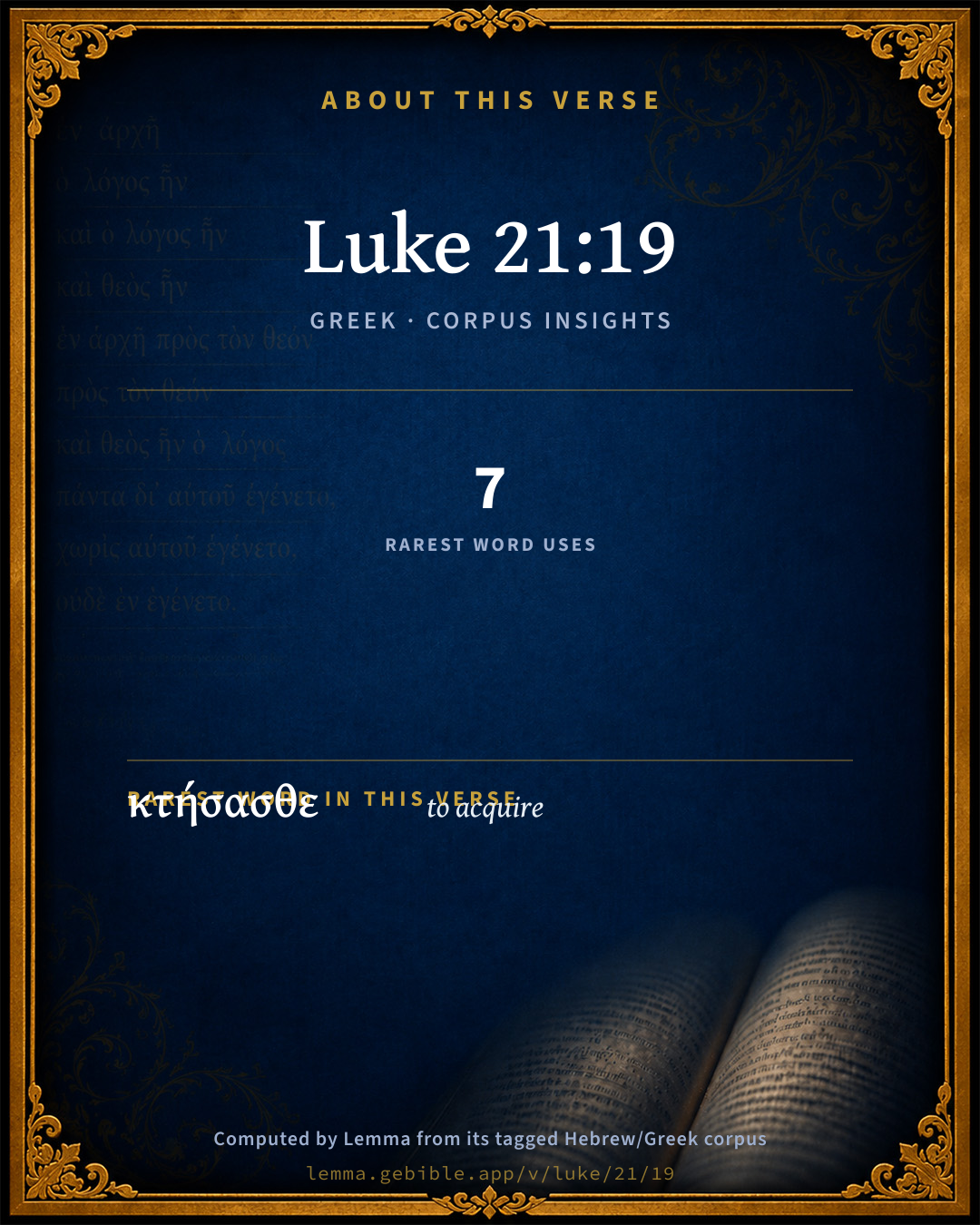
The rarest word here is κτήσασθε to acquire G2932 — appearing just 7 times in the whole Greek New Testament.

Shared distinctive vocabulary

κτήσασθε to acquire G2932 occurs in 7 verses of the Greek New Testament. Also found in:

Repetition

Words recur within this verse:

Cross-references

22

Topical passages linked to Luke 21:19 in the Treasury of Scripture Knowledge — connected by theme and wording, ordered by reader-vote popularity; previews shown in the World English Bible.

  • Hebrews 10:36 For you need endurance so that, having done the will of God, you may receive the promise.
  • Matthew 10:22 You will be hated by all men for my name's sake, but he who endures to the end will be saved.
  • James 1:3 knowing that the testing of your faith produces endurance.
  • Romans 5:3 Not only this, but we also rejoice in our sufferings, knowing that suffering works perseverance;
  • Revelation 3:10 Because you kept my command to endure, I also will keep you from the hour of testing, which is to come on the whole world, to test those who dwell on the earth.
  • Romans 2:7 to those who by patience in well-doing seek for glory and honor and incorruptibility, eternal life;
  • Revelation 13:10 If anyone has captivity, he will go. If anyone is with the sword, he must be killed. Here is the endurance and the faith of the saints.
  • Psalms 37:7 Rest in Yahweh, and wait patiently for him. Don't fret because of him who prospers in his way, Because of the man who makes wicked plots happen.
  • Revelation 14:12 Here is the patience of the saints, those who keep the commandments of God, and the faith of Jesus."
  • Hebrews 6:11 We desire that each one of you may show the same diligence to the fullness of hope even to the end,
  • Matthew 24:13 But he who endures to the end, the same will be saved.
  • Romans 8:25 But if we hope for that which we don't see, we wait for it with patience.
  • 1 Thessalonians 1:3 remembering without ceasing your work of faith and labor of love and patience of hope in our Lord Jesus Christ, before our God and Father.
  • Hebrews 6:15 Thus, having patiently endured, he obtained the promise.
  • James 5:7–11 Be patient therefore, brothers, until the coming of the Lord. Behold, the farmer waits for the precious fruit of the earth, being patient over it, until it receives the early and late rain.
  • Revelation 2:2–3 "I know your works, and your toil and perseverance, and that you can't tolerate evil men, and have tested those who call themselves apostles, and they are not, and found them false.
  • Psalms 40:1 I waited patiently for Yahweh. He turned to me, and heard my cry.
  • 2 Thessalonians 3:5 May the Lord direct your hearts into the love of God, and into the patience of Christ.
  • Luke 8:15 That in the good ground, these are such as in an honest and good heart, having heard the word, hold it tightly, and bring forth fruit with patience.
  • Revelation 1:9 I John, your brother and partner with you in oppression, Kingdom, and perseverance in Christ Jesus, was on the isle that is called Patmos because of God's Word and the testimony of Jesus Christ.
  • Psalms 27:13–14 I am still confident of this: I will see the goodness of Yahweh in the land of the living.
  • Romans 15:4 For whatever things were written before were written for our learning, that through patience and through encouragement of the Scriptures we might have hope.

Cross-references courtesy of OpenBible.info (CC BY 4.0).

Commentary

Notes on Luke 21:19 from classic Christian and Jewish commentators (each source and its license shown beneath its notes). The classic Christian expositions comment on the surrounding passage and are grouped to its opening verse, so a note may address several verses; the Jewish commentaries on the Tanakh (Rashi and others) are per-verse, so they appear only where the commentator wrote on this verse.

Lemma curates 59 commentaries, every one of them public domain or Creative Commons licensed, each selected and text-cleaned for this edition rather than reprinted as found. About our sources →

MacLaren's Expositions of Holy Scripture

Alexander MacLaren

Matthew

TWO FORMS OF ONE SAYING

Mat 24:13. - Luk 21:19.

These two sayings, different as they sound in our Version, are probably divergent representations of one original. The reasons for so supposing are manifold and obvious on a little consideration. In the first place, the two sayings occur in the Evangelists’ reports of the same prophecy and at the same point therein. In the second place, the verbal resemblance is much greater than appears in our Authorised Version, because the word rendered ‘patience’ in Luke is derived from that translated ‘endureth’ in Matthew; and the true connection between the two versions of the saying would have been more obvious if we had had a similar word in both, reading in the one ‘he that endureth,’ and in the other ‘in your endurance.’ In the third place, the difference between these two sayings presented in our Version, in that the one is a promise and the other a command, is due to an incorrect reading of St. Luke’s words. The Revised Version substitutes for the imperative ‘possess’ the promise ‘ye shall possess,’ and with that variation the two sayings are brought a good deal nearer each other. In both endurance is laid down as the condition, which in both is followed by a promise. Then, finally, there need be no difficulty in seeing that ‘possessing,’ or, more literally, ‘gaining your souls,’ is an exact equivalent of the other expression, ‘ye shall be saved.’ One cannot but remember our Lord’s solemn antithetical phrase about a man ‘losing his own soul.’ To ‘win one’s soul’ is to be saved; to be saved is to win one’s soul.

So I think I have made out my thesis that the two sayings are substantially one. They carry a great weight of warning, of exhortation, and of encouragement to us all. Let us try now to reap some of that harvest.

I. First, then, notice the view of our condition which underlies these sayings.

It is a sad and a somewhat stern one, but it is one to which, I think, most men’s hearts will respond, if they give themselves leisure to think; and if they ‘see life steadily, and see it whole.’ For howsoever many days are bright, and howsoever all days are good, yet, on the whole, ‘man is a soldier, and life is a fight.’ For some of us it is simple endurance; for all of us it has sometimes been agony; for all of us, always, it presents resistance to every kind of high and noble career, and especially to the Christian one. Easy-going optimists try to skim over these facts, but they are not to be so lightly set aside. You have only to look at the faces that you meet in the street to be very sure that it is always a grave and sometimes a bitter thing to live. And so our two texts presuppose that life on the whole demands endurance, whatever may be included in that great word.

Think of the inward resistance and outward hindrances to every lofty life. The scholar, the man of culture, the philanthropist-all who would live for anything else than the present, the low, and the sensual-find that there is a banded conspiracy, as it were, against them, and that they have to fight their way by continual antagonism, by continual persistence, as well as by continual endurance. Within, weakness, torpor, weariness, levity, inconstant wills, bright purposes clouding over, and all the cowardice and animalism of our nature war continually against the better, higher self. And without, there is a down-dragging, as persistent as the force of gravity, coming from the whole assemblage of external things that solicit, and would fain seduce us. The old legends used to tell us how, whensoever a knight set out upon any great and lofty quest, his path was beset on either side by voices, sometimes whispering seductions, and sometimes shrieking maledictions, but always seeking to withdraw him from his resolute march onwards to his goal. And every one of us, if we have taken on us the orders of any lofty chivalry, and especially if we have sworn ourselves knights of the Cross, have to meet the same antagonism. Then, too, there are golden apples rolled upon our path, seeking to draw us away from our steadfast endurance.

Besides the hindrances in every noble path, the hindrances within and the hindrances without, the weight of self and the drawing of earth, there come to us all-in various degrees no doubt, and in various shapes-but to all of us there come the burdens of sorrows and cares, and anxieties and trials. Wherever two or three are gathered together, even if they gather for a feast, there will be some of them who carry a sorrow which they know well will never be lifted off their shoulders and their hearts, until they lay down all their burdens at the grave’s mouth; and it is weary work to plod on the path of life with a weight that cannot be shifted, with a wound that can never be stanched.

Oh, brethren, rosy-coloured optimism is all a dream. The recognition of the good that is in the evil is the devout man’s talisman, but there is always need for the resistance and endurance which my texts prescribe. And the youngest of us, the gladdest of us, the least experienced of us, the most frivolous of us, if we will question our own hearts, will hear their Amen to the stern, sad view of the facts of earthly life which underlies this text.

Though it has many other aspects, the world seems to me sometimes to be like that pool at Jerusalem in the five porches of which lay, groaning under various diseases, but none of them without an ache, a great multitude of impotent folk, halt and blind. Astronomers tell us that one, at any rate, of the planets rolls on its orbit swathed in clouds and moisture. The world moves wrapped in a mist of tears. God only knows them all, but each heart knows its own bitterness and responds to the words, ‘Ye have need of patience.’

II. Now, secondly, mark the victorious temper.

That is referred to in the one saying by ‘he that endureth,’ and in the other ‘in your endurance.’ Now, it is very necessary for the understanding of many places in Scripture to remember that the notion either of patience or of endurance by no means exhausts the power of this noble Christian word. For these are passive virtues, and however excellent and needful they may be, they by no means sum up our duty in regard to the hindrances and sorrows, the burdens and weights, of which I have been trying to speak. For you know it is only ‘what cannot be cured’ that ‘must be endured,’ and even incurable things are not merely to be endured, but they ought to be utilised. It is not enough that we should build up a dam to keep the floods of sorrow and trial from overflowing our fields; we must turn the turbid waters into our sluices, and get them to drive our mills. It is not enough that we should screw ourselves up to lie unresistingly under the surgeon’s knife; though God knows that it is as much as we can manage sometimes, and we have to do as convicts under the lash do, get a bit of lead or a bullet into our mouths, and bite at it to keep ourselves from crying out. But that is not all our duty in regard to our trials and difficulties. There is required something more than passive endurance.

This noble word of my texts does mean a great deal more than that. It means active persistence as well as patient submission. It is not enough that we should stand and bear the pelting of the pitiless storm, unmurmuring and unbowed by it; but we are bound to go on our course, bearing up and steering right onwards. Persistent perseverance in the path that is marked out for us is especially the virtue that our Lord here enjoins. It is well to sit still unmurmuring; it is better to march on undiverted and unchecked. And when we are able to keep straight on in the path which is marked out for us, and especially in the path that leads us to God, notwithstanding all opposing voices, and all inward hindrances and reluctances; when we are able to go to our tasks of whatever sort they are and to do them, though our hearts are beating like sledge-hammers; when we say to ourselves, ‘It does not matter a bit whether I am sad or glad, fresh or wearied, helped or hindered by circumstances, this one thing I do,’ then we have come to understand and to practise the grace that our Master here enjoins. The endurance which wins the soul, and leads to salvation, is no mere passive submission, excellent and hard to attain as that often is; but it is brave perseverance in the face of all difficulties, and in spite of all enemies.

Mark how emphatically our Lord here makes the space within which that virtue has to be exercised conterminous with the whole duration of our lives. I need not discuss what ‘the end’ was in the original application of the words; that would take us too far afield. But this I desire to insist upon, that right on to the very close of life we are to expect the necessity of putting forth the exercise of the very same persistence by which the earlier stages of any noble career must necessarily be marked. In other departments of life there may be relaxation, as a man goes on through the years; but in the culture of our characters, and in the deepening of our faith, and in the drawing near to our God, there must be no cessation or diminution of earnestness and of effort right up to the close.

There are plenty of people, and I dare say that I address some of them now, who began their Christian career full of vigour and with a heat that was too hot to last. But, alas, in a year or two all the fervency was past, and they settled down into the average, easygoing, unprogressive Christian, who is a wet blanket to the devotion and work of a Christian church. I wonder how many of us would scarcely know our own former selves if we could see them. Christian people, to how many of us should the word be rung in our ears: ‘Ye did run well; what did hinder you’? The answer is-Myself.

But may I say that this emphatic ‘to the end’ has a special lesson for us older people, who, as natural strength abates and enthusiasm cools down, are apt to be but the shadows of our old selves in many things? But there should be fire within the mountain, though there may be snow on its crest. Many a ship has been lost on the harbour bar; and there is no excuse for the captain leaving the bridge, or the engineer coming up from the engine-room, stormy as the one position and stifling as the other may be, until the anchor is down, and the vessel is moored and quiet in the desired haven. The desert, with its wild beasts and its Bedouin, reaches right up to the city gates, and until we are within these we need to keep our hands on our sword-hilts and be ready for conflict. ‘He that endureth to the end, the same shall be saved.’

III. Lastly, note the crown which endurance wins.

Now, I need not spend or waste your time in mere verbal criticism, but I wish to point out that that word ‘soul’ in one of our two texts means both the soul and the life of which it is the seat; and also to remark that the being saved and the winning of the life or the soul has distinct application, in our Lord’s words, primarily to corporeal safety and preservation in the midst of dangers; and, still further, to note the emphatic ‘in your patience,’ as suggesting not only a future but a present acquisition of one’s own soul, or life, as the result of such persevering endurance and enduring perseverance. All which things being kept in view, I may expand the great promise that lies in my text, as follows:- First, by such persevering persistence in the Christian path, we gain ourselves. Self-surrender is self-possession. We never own ourselves till we have given up owning ourselves, and yielded ourselves to that Lord who gives us back saints to ourselves. Self-control is self-possession. We do not own ourselves as long as it is possible for any weakness in flesh, sense, or spirit to gain dominion over us and hinder us from doing what we know to be right. We are not our own masters then. ‘Whilst they promise them liberty, they themselves are the bond-slaves of corruption.’ It is only when we have the bit well into the jaws of the brutes, and the reins tight in our hands, so that a finger-touch can check or divert the course, that we are truly lords of the chariot in which we ride and of the animals that impel it.

And such self-control which is the winning of ourselves is, as I believe, thoroughly realised only when, by self-surrender of ourselves to Jesus Christ, we get His help to govern ourselves and so become lords of ourselves. Some little petty Rajah, up in the hills, in a quasi-independent State in India, is troubled by mutineers whom he cannot subdue; what does he do? He sends a message down to Lahore or Calcutta, and up come English troops that consolidate his dominion, and he rules securely, when he has consented to become a feudatory, and recognise his overlord. And so you and I, by continual repetition, in the face of self and sin, of our acts of self-surrender, bring Christ into the field; and then, when we have said, ‘Lord, take me; I live, yet not I, but Christ liveth in me’; and when we daily, in spite of hindrances, stand to the surrender and repeat the consecration, then ‘in our perseverance we acquire our souls.’

Again, such persistence wins even the bodily life, whether it preserves it or loses it. I have said that the words of our texts have an application to bodily preservation in the midst of the dreadful dangers of the siege and destruction of Jerusalem. But so regarded they are a paradox. For hear how the Master introduces them: ‘Some of you shall they cause to be put to death, but there shall not a hair of your heads perish. In your perseverance ye shall win your lives.’ ‘Some of you they will put to death,’ but ye ‘shall win your lives,’-a paradox which can only be solved by experience. Whether this bodily life be preserved or lost, it is gained when it is used as a means of attaining the higher life of union with God. Many a martyr had the promise, ‘Not a hair of your head shall perish,’ fulfilled at the very moment when the falling axe shore his locks in twain, and severed his head from his body.

Finally, full salvation, the true possession of himself, and the acquisition of the life which really is life, comes to a man who perseveres to the end, and thus passes to the land where he will receive the recompense of the reward. The one moment the runner, with flushed cheek and forward swaying body, hot, with panting breath, and every muscle strained, is straining to the winning-post; and the next moment, in utter calm, he is wearing the crown.

‘To the end,’ and what a contrast the next moment will be! Brethren, may it be true of you and of me that ‘we are not of them that draw back unto perdition, but of them that believe to the winning of their souls!’

Alexander MacLaren, Expositions of Holy Scripture (1904–1910) — public domain. Text from a community e-Sword module.

Bengel's Gnomon

Johann Albrecht Bengel

Luk 21:19. Ὑπομονῇ ὑμῶν) in your patience, to which ye have been called. A Paradox. The world tries to obtain the safety of its followers’ souls by repelling force with force. Not so the saints: Rev 13:10 [“He that killeth with the sword must be killed with the sword.” But, “Here is the faith and patience of the saints”].—κτήσεσθε) ye shall obtain (ensure) the safety of (Mat 24:13 [He that shall endure unto the end, the same shall be saved]), with enjoyment and lasting advantage to yourselves.[224]—ψυχὰς, your souls) Even though ye should lose all other things. [Patient endurance is the most conducive of all things. By struggling and kicking back against (the pricks) we consult worst for our true interest.—V. g.]

[224] Κτήσεσθε is the reading of AB Origen 1,295d: ‘possidebitis’ in a and Vulg.: ‘acquirers’ in c. Κτήσασθε (‘adquirite,’ gain or ensure the safety of; not possess as Engl. Vers., which would be κέκτησθε) is the reading of Dd and Rec. Text. Bengel’s words are “cum usufructi vestri,” literally, with the usufruct of yourselves.—E. and T.

Bengel's Gnomon of the New Testament — English translation (T&T Clark, Edinburgh, 1860) — public domain. Text from a community e-Sword module.

Expositor's Greek Testament

ed. W. Robertson Nicoll

Luk 21:19 . κτήσεσθε or κτήσασθε , ye shall win, or win ye; sense the same. Similar various readings in Rom 5:1 , ἔχωμεν or ἔχομεν .

The Expositor's Greek Testament, edited by W. Robertson Nicoll (1897–1910) — public domain. Text from a community e-Sword module.

Geneva Bible (1599)

Geneva Bible translators

Though you are compassed about on all sides with many miseries, yet notwithstanding be valiant and courageous, and bear out these things manfully.

Geneva Bible (1599) marginal notes — public domain. Text via Bolls.life.

Adam Clarke's Commentary

Verse 19. In your patience] Rather, your perseverance, your faithful continuance in my word and doctrine. Ye will preserve your souls. Ye shall escape the Roman sword, and not one of you shall perish in the destruction of Jerusalem. Instead of κτησασθε, possess, or preserve ye, I read κτησεσθε, ye shall preserve. This reading is supported by AB-B, five others; both the Syriac, all the Arabic, AEthiopic, Vulgate, all the Itala except two, Origen, Macarius, and Tertullian.

Adam Clarke's Commentary on the Bible (1810–1826) — public domain. Text from a community e-Sword/MySword module.

Ellicott's Commentary for English Readers

(19) In your patience possess ye your souls.—Better, By your endurance gain ye your lives. The verb, unless used in the perfect tense, always involves the idea of “acquiring” rather than “possessing,” and the command so understood answers to the promise, “He that endureth to the end, the same shall be saved,” in Mat_23:13, Mar_13:13. Some of the best MSS., indeed, give this also as a promise, “By your endurance ye shall gain.”

A Bible Commentary for English Readers, edited by Charles John Ellicott (1878–1897) — public domain. Text from a community e-Sword module.

The Cambridge Bible for Schools and Colleges

gen. ed. J. J. S. Perowne

19. In your patience possess ye your souls] Rather, with the better reading, By your patience ye shall gain your souls or lives. Mar_13:13. The need of patience and endurance to the end is very prominently inculcated in the N. T., Rom_5:3; 2Th_3:4; Heb_10:36; Jas_1:4, &c. Endurance, not violence, is the Christian’s protection, and shall save the soul, and the true life, even if it loses all else.

The Cambridge Bible for Schools and Colleges (gen. ed. J. J. S. Perowne; Cambridge University Press, 1878–1918) — public domain. Text from a community e-Sword module.

John Gill's Exposition

But woe unto them that are with-child,.... See Gill on Mat 24:19.

For there shall be great distress in the land; of Judea. The Greek word here used, properly signifies "necessity", but here intends afflictions and distress; in which sense it is often used by the Septuagint, as in Psa 107:6 and it is also by the Targumists adopted into their language, and used in the same sense (d): and indeed, the distress was very great, and such a time of tribulation, as was never known since the beginning of the world, nor never will be the like; what with the enemy without, and their seditions and divisions within, the robberies, murders, and famine, which prevailed and abounded, their miseries are not to be expressed:

and wrath upon this people; of the Jews; even the wrath of God, as well as of man, which came upon them to the uttermost; and their own historian observes, that God, who had condemned the people, turned every way of salvation to their destruction (e).

(d) Vid. Targum in Gen xxii. 14. & xxxviii. 25. & Targum Sheni in Esth. v. 1. (e) Joseph. de Bello Jud. l. 6. c. 15.

John Gill's Exposition of the Whole Bible (1746–1763) — public domain (CC PDM 1.0). Text via the HelloAO Bible API.

Trapp's Complete Commentary

John Trapp

19 In your patience possess ye your souls.

Ver. 19. In your patience possess] That is, enjoy yourselves, however the world goes with you. He that cannot have patience had need made up his pack and get out of the world, for here is no being for him. Burleigh, lord treasurer, was wont to say that he overcame envy more by patience than pertinace.

John Trapp, A Commentary or Exposition upon All the Books of the Old and New Testament (1647–1656) — public domain. Text from a community e-Sword module.

Haydock's Catholic Bible Commentary

In your patience, &c. We then truly possess our souls, when we live in all things perfect, and from the citadel of virtue command and control all the motions of the mind and heart. (St. Gregory, Mag. Moral. v. chap. 13.)

George Leo Haydock (1774–1849), Haydock's Catholic Family Bible and Commentary, 1859 edition — public domain. Excludes Psalms (Douay-Rheims chapter numbering differs from Protestant) and Deuterocanonical books (Catholic canon only).

Matthew Poole's English Annotations

Patience is either passive, seen in a quiet, free, and courageous suffering those evils which God will please in his providence to order us for our portion; or active, seen in a quiet believing, waiting for, and expectation of what God hath promised.

Possess your souls, that is, yourselves; do not decline suffering for my name’s sake, but live in the exercise of Christian courage and fortitude until the Lord will please to release you. In this sense James expounds this prase, Jam 1:4, But let patience have her perfect work, that ye may be perfect and entire, wanting nothing. Others say, possess your souls is the same with save your souls. So it seems to be expounded by Mat 24:13, and Mar 8:13, But he that shall endure to the end shall be saved.

Matthew Poole's English Annotations on the Holy Bible (1683–1685) — public domain. Text from a community e-Sword/MySword module.

The Pulpit Commentary

In your patience possess ye your souls. Quiet, brave patience in all difficulty, perplexity, and danger, was the attitude pressed upon the believers of the first days by the inspired teachers. St. Paul constantly strikes this note.

The Pulpit Commentary (1880–1919), ed. H.D.M. Spence-Jones & Joseph S. Exell — public domain. Text from a community e-Sword module.

John Wesley's Explanatory Notes

In your patience possess ye your souls - Be calm and serene, masters of yourselves, and superior to all irrational and disquieting passions. By keeping the government of your spirits, you will both avoid much misery, and guard the better against all dangers.

John Wesley, Explanatory Notes Upon the Whole Bible (1754–1765) — public domain. Text via the GEBible commentary corpus.

Cambridge Greek Testament for Schools and Colleges

19. κτήσασθε is the reading of אDL Elz. and Ti[357] κτήσεσθε is read by AB La[358] W. H[359]

[357] Ti. Tischendorf.

[358] La. Lachmann.

[359] W. H. Westcott and Hort.

19. ἐν τῇ ὑπομονῇ ὑμῶν κτήσασθε. On the verb κτῶμαι comp. Luk 18:12; 1Th 4:4. With the better reading it means ‘By your patience ye shall gain your souls’ or ‘lives.’ Mar 13:13. The need of patience and endurance to the end is prominently inculcated in the N.T., Rom 5:3; Heb 10:36; Jas 1:4, &c.

Cambridge Greek Testament for Schools and Colleges (Cambridge University Press, 1896; 21 vols, various authors incl. Carr, Maclear, Plummer, Farrar, Lumby, Moule, M. R. James, Simcox) — public domain. Text from a community e-Sword module.

Alford’s Greek Testament

Henry Alford

19.] By your endurance (of all these things), ye shall acquire (not, possess, which is only the sense of the perf. κέκτημαι) your souls: this endurance being God’s appointed way, ἐν (in and by) which your salvation is to be put in your possession.

κτήσ. as εὑρήσει, Mat 16:25—σῶσαι, ch. 9:24.

Henry Alford, The Greek Testament (1849–1861) — public domain. Text from a community e-Sword module.

International Critical Commentary

19. ἐν τῇ ὑπομονῇ ὑμῶν. “In your endurance” of suffering without giving way; whereas μακροθυμία is patience of injuries without paying back. See Trench, Syn. liii.; Lft. on Col 1:11, Col 1:3:12; Wsctt on Heb 6:12. The Latin Versions often confuse the two words.

Here we have patientia (e f ff2 i q r s Vulg.), tolerantia (a), sufferentia (d). These three translations are found also 8:15. In no other Gospel does ὑπομονή occur; and in no Gospel does μακροθυμία occur.

κτήσεσθε τὰς ψυχὰς ὑμῶν. “Ye shall win your souls,” or “your lives.” This confirms the interpretation given above of ver. 18. There the loss of eternal salvation is spoken of as death. Here the gaining of it is called winning one’s life. See on 9:25 and 17:33 In Mt. (24:13, 10:22) and Mk. (13:13) this saying is represented by “He that endureth (ὑπομείνας) to the end, the same shall be saved.” Neither Lk. nor Jn. use ὑπομένειν in this sense.

The reading is uncertain as regards the verb. A B some cursives, Latt. Syr. Arm. Aeth. and best MSS. of Bob., Tert. Orig. support κτήσεσθε, which is adopted by Treg. WH. RV. and Weiss; while א D L R X G D etc., some MSS. of Bob., Const-Apost Bas. support κτήσασθε, which is adopted by Tisch. Neither reading justifies “possess your souls,” a meaning confined to the perf. Cov. has “holde fast” but nearly all others have “possess,” following in verb, though not in tense, the possidebitis of Vulg. Other Lat. texts have adquiretis (c ff2 l) or adquirite (d i). See last now on 18:12.

International Critical Commentary — older volumes (1896–1929), various authors — public domain. Text from a community e-Sword module.

Vincent's Word Studies in the New Testament

Marvin R. Vincent

Possess ye [κτησεσθε] . Wrong. See on ch. Luk 18:12. Rev. rightly, ye shall win.

20 - 36. Compare Mt 24:15 - 42. Mr 13:14 - 37.

Marvin R. Vincent, Word Studies in the New Testament (1887–1900) — public domain. Text from a community e-Sword/MySword module.

Lesson kit

Teaching starters — assembled from the data on this page, not authored interpretation. Every prompt links to the verse data it draws on. Edit before teaching.

Luke, in the Gospels, opens this verse with 8 words (6 distinct Greek lemmas). Its most distinctive word is ktáomai (“to acquire”). A historical commentator’s framing appears above. Read the whole chapter for the surrounding context.

Discussion questions

  1. What does “to acquire” (ktáomai) contribute to the verse as a whole?
  2. Matthew 10:9 shares the word «to acquire» with this verse. How do the two illuminate each other?
  3. “the” occurs 2× in this one verse. What is the effect of the repetition?
  4. These translations render this verse differently; the difference is in the English rendering, not the original. What questions does that raise?
  5. Reading how MacLaren's Expositions of Holy Scripture and Bengel's Gnomon read this verse, where do the two commentators agree and where do they part?

Things to notice

  • These translations choose different wording for 9 words in this verse.
  • “the” occurs 2× in this single verse.
  • 6 distinct Greek lemmas span 8 words in this verse.

Reading settings

Reading text

Shown beneath each verse's original-language words.

Old Testament
Old Testament edition

Read the OT as the Masoretic Hebrew (MT) or the Greek Septuagint (LXX).

English shown for the Greek Septuagint (in the Hebrew ↔ Greek comparison).

Comparing translations? Open the Compare panel on any verse page to stack up to four side by side.