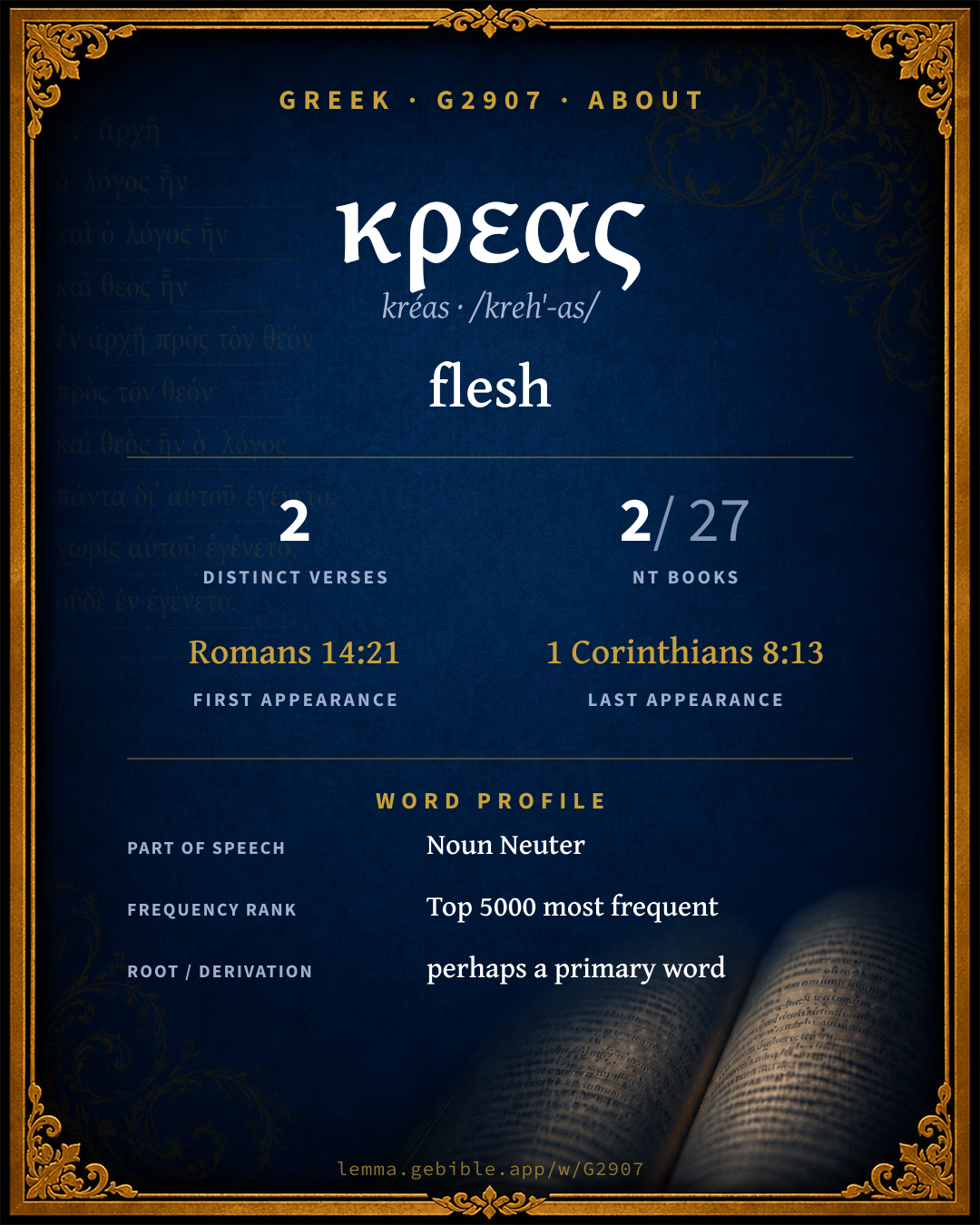
κρέας
flesh
Full lexicon entry — Thayer's Greek Lexicon
From Thayer's Greek Lexicon
Where this word appears
Grammar key — what these labels mean
Part of speech
- Noun
- A naming word — a person, place, thing, or idea.
Case
- Accusative
- The case of the direct object and of extent.
Gender
- Neuter
- Grammatically neuter.
Number
- Plural
- More than one.
Every verse where G2907 appears in the Book of Romans — 1 distinct verse. Click any verse to open its interlinear word-by-word view. Verse text shown in the World English Bible for context — . Each verse’s Greek form is shown with its reference; the English is not keyword-highlighted, since the data carries no word-level English alignment. Use “Compare translations” on any verse to read it across multiple English versions. This concordance covers the Greek New Testament; Septuagint (Greek Old Testament) occurrences of this word are not indexed here.
Romans
About this entry
At a glance — auto-summarized from this page’s data, not written by a person. Every figure links to its source below. This summary describes the numbers; it doesn’t interpret them.
The Greek noun κρεας centers on the idea of “flesh.” It is rare — just 2 verses in the entire Greek New Testament. The word gravitates to Romans (50%), then 1 Corinthians. Its earliest occurrence is Romans 14:21. Dig into 2-verse concordance and the renderings breakdown below.
Gloss history
Strong's 1890 vs modern scholarship
About this word
Strong's G2907 catalogs a Greek word from the Greek New Testament.
These counts are not copied from any lexicon or concordance. They are computed here, from the morphology-tagged Greek New Testament. What Lemma adds →
- 2
- distinct verses
- The word appears in 2 distinct verses.
- 2 / 27
- NT books
- The word appears in 2 of 27 New Testament books.
- #2,678
- by frequency
- Top 5000 most frequent Greek words (rank 2,678 of 5,347 Greek words by occurrence).
View all 2 occurrences in the concordance →
Most concentrated in
- Romans 1 verse 50%
- 1 Corinthians 1 verse 50%
By section of the New Testament
By traditional corpus
Conventional, traditional groupings — biblical authorship is debated, so this is a traditional corpus grouping, not an authorship claim. Some books belong to more than one corpus (Luke is in both the Gospels and the Lukan corpus, and so on), so these shares overlap and need not total 100%. Each figure is a share of the word’s 2 distinct verses.
- Pauline corpus 2 verses · 100%
How translations render this word
Counts come from each version’s own published word-to-Strong’s tagging or interlinear alignment — an approximate guide to how each version renders this word, not a word-level alignment the data otherwise carries. Because each total is that version’s own tagged count, the per-version totals vary from one another and need not match the appearance or distinct-verse counts above. These counts may also differ from a printed concordance because Lemma counts each distinctly tagged rendering and does not collapse phrase taggings into a single head-word total. This is a fixed set of word-tagged versions (KJV, ASV, BSB, ULT) and does not change with the reading translation you choose elsewhere. Each version’s license is shown beside its name below (and on Sources).
- King James Version: Flesh 2×
- American Standard Version: Flesh 2×
- Berean Standard Bible: Meat 2×
- unfoldingWord Literal Text: Meat 2×
King James Version Public Domain
Renders G2907 across 2 tagged occurrences — most commonly:
American Standard Version Public Domain
Renders G2907 across 2 tagged occurrences — most commonly:
Berean Standard Bible Public Domain
Renders G2907 across 2 tagged occurrences — most commonly:
unfoldingWord Literal Text CC BY-SA 4.0
Renders G2907 across 2 tagged occurrences — most commonly:
Senses in Thayer's
The 1 sense Thayer's distinguishes for this word, in lexicon order (not ranked by frequency or importance). The full entry — with sub-senses — is in the Lexicon Entry tab.
- (the) flesh (of a sacrificed animal)
Word origin
Origin: perhaps a primary word
Perhaps a primary word; (butcher´ s) meat : - flesh.
— Strong’s Exhaustive Concordance (1890), public domain.
Septuagint usage
The same Greek word κρεας appears 80 times in the Greek Old Testament (Septuagint), across 71 verses in 19 books.
- 80
- LXX occurrences
- Tagged occurrences of this Greek word in the Septuagint.
- 71
- verses
- Distinct Septuagint verses containing this word.
- 19 / 39
- OT books
- The word appears in 19 of the 39 Old Testament books.
Sample Septuagint occurrences
- Genesis 9:4 κρέας
- Exodus 12:8 κρέας
- Leviticus 6:20 κρέας
- Numbers 11:4 κρέας
- Deuteronomy 12:15 κρέας
- Judges 6:19 κρέας
- 1 Samuel 2:13 κρέας
- 1 Kings 17:6 κρέας
- Job 10:11 κρέας
- Psalms 49:13 κρέας
- Proverbs 23:20 κρέας
- Isaiah 22:13 κρέας
Septuagint occurrences (same lexeme)
Every verse where the same Strong’s number (G2907) appears in the Greek Septuagint — showing the first 50 of 71. Verse text shown in the World English Bible for context; the Greek form is the matched word — the English is not keyword-highlighted.
- Genesis 9:4 κρέας But flesh with the life of it, the blood of it, you shall not eat.
- Exodus 12:8 κρέας They shall eat the flesh in that night, roasted with fire, and unleavened bread. They shall eat it with bitter herbs.
- Exodus 12:46 κρέας In one house shall it be eaten; you shall not carry forth anything of the flesh abroad out of the house; neither shall you break a bone of it.
- Exodus 16:3 κρέας and the children of Israel said to them, "We wish that we had died by the hand of Yahweh in the land of Egypt, when we sat by the flesh-pots, when we ate our fill of bread, for you have brought us out into this wilderness, to kill this whole assembly with hunger."
- Exodus 16:8 κρέας Moses said, "Now Yahweh shall give you meat to eat in the evening, and in the morning bread to satisfy you; because Yahweh hears your murmurings which you murmur against him. And who are we? Your murmurings are not against us, but against Yahweh."
- Exodus 16:12 κρέας "I have heard the murmurings of the children of Israel. Speak to them, saying, 'At evening you shall eat meat, and in the morning you shall be filled with bread: and you shall know that I am Yahweh your God.'"
- Exodus 21:28 κρέας "If a bull gores a man or a woman to death, the bull shall surely be stoned, and its flesh shall not be eaten; but the owner of the bull shall not be held responsible.
- Exodus 22:30 κρέας You shall do likewise with your oxen and with your sheep. Seven days it shall be with its mother, then on the eighth day you shall give it me.
- Exodus 29:14 κρέας But the flesh of the bull, and its skin, and its dung, you shall burn with fire outside of the camp: it is a sin-offering.
- Exodus 29:31 κρέας "You shall take the ram of consecration, and boil its flesh in a holy place.
- Exodus 29:32 κρέας Aaron and his sons shall eat the flesh of the ram, and the bread that is in the basket, at the door of the tent of meeting.
- Exodus 29:34 κρέας If anything of the flesh of the consecration, or of the bread, remains to the morning, then you shall burn the remainder with fire: it shall not be eaten, because it is holy.
- Leviticus 6:20 κρέας "This is the offering of Aaron and of his sons, which they shall offer to Yahweh in the day when he is anointed: the tenth part of an ephah of fine flour for a meal offering perpetually, half of it in the morning, and half of it in the evening.
- Leviticus 7:15 κρέας The flesh of the sacrifice of his peace offerings for thanksgiving shall be eaten on the day of his offering. He shall not leave any of it until the morning.
- Leviticus 7:17 κρέας but what remains of the flesh of the sacrifice on the third day shall be burned with fire.
- Leviticus 7:18 κρέας If any of the flesh of the sacrifice of his peace offerings is eaten on the third day, it will not be accepted, neither shall it be imputed to him who offers it. It will be an abomination, and the soul who eats any of it will bear his iniquity.
- Leviticus 7:19 κρέας "'The flesh that touches any unclean thing shall not be eaten. It shall be burned with fire. As for the flesh, everyone who is clean may eat it;
- Leviticus 7:20 κρέας but the soul who eats of the flesh of the sacrifice of peace offerings, that belongs to Yahweh, having his uncleanness on him, that soul shall be cut off from his people.
- Leviticus 7:21 κρέας When anyone touches any unclean thing, the uncleanness of man, or an unclean animal, or any unclean abomination, and eats some of the flesh of the sacrifice of peace offerings, which belong to Yahweh, that soul shall be cut off from his people.'"
- Leviticus 8:17 κρέας But the bull, and its skin, and its flesh, and its dung, he burned with fire outside the camp; as Yahweh commanded Moses.
- Leviticus 8:31 κρέας Moses said to Aaron and to his sons, "Boil the flesh at the door of the Tent of Meeting, and there eat it and the bread that is in the basket of consecration, as I commanded, saying, 'Aaron and his sons shall eat it.'
- Leviticus 8:32 κρέας What remains of the flesh and of the bread you shall burn with fire.
- Leviticus 9:11 κρέας The flesh and the skin he burned with fire outside the camp.
- Leviticus 11:8 κρέας Of their flesh you shall not eat, and their carcasses you shall not touch; they are unclean to you.
- Leviticus 11:11 κρέας and you detest them. You shall not eat of their flesh, and you shall detest their carcasses.
- Leviticus 16:27 κρέας The bull for the sin offering, and the goat for the sin offering, whose blood was brought in to make atonement in the Holy Place, shall be carried forth outside the camp; and they shall burn their skins, their flesh, and their dung with fire.
- Leviticus 22:30 κρέας It shall be eaten on the same day; you shall leave none of it until the morning. I am Yahweh.
- Numbers 11:4 κρέας The mixed multitude that was among them lusted exceedingly: and the children of Israel also wept again, and said, Who shall give us flesh to eat?
- Numbers 11:13 κρέας Whence should I have flesh to give to all this people? for they weep to me, saying, Give us flesh, that we may eat.
- Numbers 11:18 κρέας Say you to the people, Sanctify yourselves against tomorrow, and you shall eat flesh; for you have wept in the ears of Yahweh, saying, Who shall give us flesh to eat? for it was well with us in Egypt: therefore Yahweh will give you flesh, and you shall eat.
- Numbers 11:21 κρέας Moses said, The people, among whom I am, are six hundred thousand footmen; and you have said, I will give them flesh, that they may eat a whole month.
- Numbers 11:33 κρέας While the flesh was yet between their teeth, before it was chewed, the anger of Yahweh was kindled against the people, and Yahweh struck the people with a very great plague.
- Numbers 18:18 κρέας The flesh of them shall be your, as the wave-breast and as the right thigh, it shall be yours.
- Numbers 19:5 κρέας One shall burn the heifer in his sight; her skin, and her flesh, and her blood, with her dung, shall he burn:
- Deuteronomy 12:15 κρέας Notwithstanding, you may kill and eat flesh within all your gates, after all the desire of your soul, according to the blessing of Yahweh your God which he has given you: the unclean and the clean may eat of it, as of the gazelle, and as of the hart.
- Deuteronomy 12:20 κρέας When Yahweh your God shall enlarge your border, as he has promised you, and you shall say, I will eat flesh, because your soul desires to eat flesh; you may eat flesh, after all the desire of your soul.
- Deuteronomy 12:23 κρέας Only be sure that you don't eat the blood: for the blood is the life; and you shall not eat the life with the flesh.
- Deuteronomy 12:27 κρέας and you shall offer your burnt offerings, the flesh and the blood, on the altar of Yahweh your God; and the blood of your sacrifices shall be poured out on the altar of Yahweh your God; and you shall eat the flesh.
- Deuteronomy 14:8 κρέας The pig, because it has a split hoof but doesn't chew the cud, is unclean to you: of their flesh you shall not eat, and their carcasses you shall not touch.
- Deuteronomy 16:4 κρέας There shall be no yeast seen with you in all your borders seven days; neither shall any of the flesh, which you sacrifice the first day at even, remain all night until the morning.
- Deuteronomy 28:53 κρέας You shall eat the fruit of your own body, the flesh of your sons and of your daughters, whom Yahweh your God has given you, in the siege and in the distress with which your enemies shall distress you.
- Deuteronomy 32:42 κρέας I will make my arrows drunk with blood, My sword shall devour flesh; With the blood of the slain and the captives, From the head of the leaders of the enemy.
- Judges 6:19 κρέας Gideon went in, and made ready a kid, and unleavened cakes of an ephah of meal: the flesh he put in a basket, and he put the broth in a pot, and brought it out to him under the oak, and presented it.
- Judges 6:20 κρέας The angel of God said to him, Take the flesh and the unleavened cakes, and lay them on this rock, and pour out the broth. He did so.
- Judges 6:21 κρέας Then the angel of Yahweh put forth the end of the staff that was in his hand, and touched the flesh and the unleavened cakes; and there went up fire out of the rock, and consumed the flesh and the unleavened cakes; and the angel of Yahweh departed out of his sight.
- 1 Samuel 2:13 κρέας The custom of the priests with the people was that when any man offered sacrifice, the priest's servant came, while the flesh was boiling, with a flesh-hook of three teeth in his hand;
- 1 Samuel 2:15 κρέας Yes, before they burnt the fat, the priest's servant came, and said to the man who sacrificed, Give flesh to roast for the priest; for he will not have boiled flesh of you, but raw.
- 1 Kings 17:6 κρέας The ravens brought him bread and flesh in the morning, and bread and flesh in the evening; and he drank of the brook.
- Job 10:11 κρέας You have clothed me with skin and flesh, And knit me together with bones and sinews.
- Psalms 49:13 κρέας This is the destiny of those who are foolish, And of those who approve their sayings. Selah.
These are occurrences of the same Greek lexeme (G2907) in the Septuagint — not a translation of any one Hebrew word. The store carries no word-level Hebrew↔Greek alignment, so no Hebrew original is asserted here. Counts come from the recovered LXX Strong's tagging — high-frequency vocabulary is well covered, while rare or late forms may be untagged — so they reflect tagged occurrences and may slightly undercount.