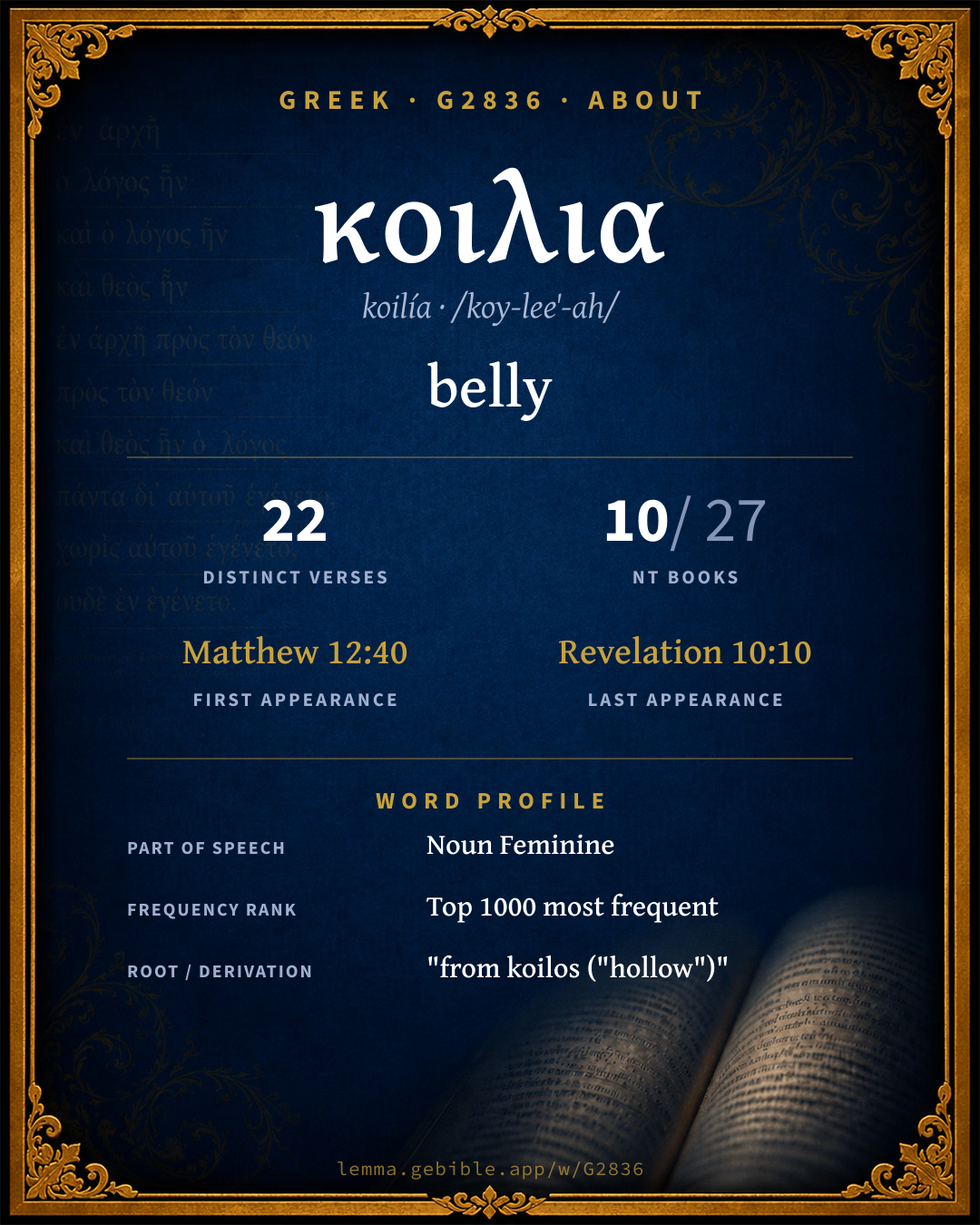
κοιλία
belly
‘belly’ is one of 5 main senses fuller range ↓
Full lexicon entry — Thayer's Greek Lexicon
From Thayer's Greek Lexicon
Where this word appears
See every Dative-case word in the Greek New Testament →
Grammar key — what these labels mean
Part of speech
- Noun
- A naming word — a person, place, thing, or idea.
Case
- Genitive
- The case of source, possession, or “of” — answers “whose / from what.”
- Dative
- The case of the indirect object, means, or location — “to / for / with / in.”
- Accusative
- The case of the direct object and of extent.
- Nominative
- The case of the subject (and the predicate nominative).
Gender
- Feminine
- Grammatically feminine.
Number
- Singular
- One.
- Plural
- More than one.
Every verse where G2836 appears in the Book of 1 Corinthians — 1 distinct verse. Click any verse to open its interlinear word-by-word view. Verse text shown in the World English Bible for context — . Each verse’s Greek form is shown with its reference; the English is not keyword-highlighted, since the data carries no word-level English alignment. Use “Compare translations” on any verse to read it across multiple English versions. This concordance covers the Greek New Testament; Septuagint (Greek Old Testament) occurrences of this word are not indexed here.
1 Corinthians
About this entry
At a glance — auto-summarized from this page’s data, not written by a person. Every figure links to its source below. This summary describes the numbers; it doesn’t interpret them.
At its core, κοιλια (koilía) means “belly.” Catalogued under 5 senses, its meaning is not single-sense. Spanning 22 verses in 10 books, it ranks among the uncommon words of the Greek New Testament. Its uses concentrate in Luke (36% of all occurrences). Scripture first uses it in Matthew 12:40. Dig into 22-verse concordance and the renderings breakdown below.
Gloss history
Strong's 1890 vs modern scholarship
About this word
Strong's G2836 catalogs a Greek word from the Greek New Testament.
These counts are not copied from any lexicon or concordance. They are computed here, from the morphology-tagged Greek New Testament. What Lemma adds →
- 22
- distinct verses
- The word appears in 22 distinct verses.
- 10 / 27
- NT books
- The word appears in 10 of 27 New Testament books.
- #563
- by frequency
- Top 1000 most frequent Greek words (rank 563 of 5,347 Greek words by occurrence).
View all 22 occurrences in the concordance →
By section of the New Testament
By traditional corpus
Conventional, traditional groupings — biblical authorship is debated, so this is a traditional corpus grouping, not an authorship claim. Some books belong to more than one corpus (Luke is in both the Gospels and the Lukan corpus, and so on), so these shares overlap and need not total 100%. Each figure is a share of the word’s 22 distinct verses.
- Gospels 14 verses · 64%
- Lukan (Luke–Acts) 10 verses · 45%
- Johannine 4 verses · 18%
- Pauline corpus 4 verses · 18%
- Revelation 2 verses · 9%
How translations render this word
Counts come from each version’s own published word-to-Strong’s tagging or interlinear alignment — an approximate guide to how each version renders this word, not a word-level alignment the data otherwise carries. Because each total is that version’s own tagged count, the per-version totals vary from one another and need not match the appearance or distinct-verse counts above. These counts may also differ from a printed concordance because Lemma counts each distinctly tagged rendering and does not collapse phrase taggings into a single head-word total. This is a fixed set of word-tagged versions (KJV, ASV, BSB, ULT) and does not change with the reading translation you choose elsewhere. Each version’s license is shown beside its name below (and on Sources).
- King James Version: Belly 10×, Womb 10×
- American Standard Version: Belly 9×, 's womb 5×, Womb 3×
- Berean Standard Bible: Womb 7×, Stomach 5×, Belly 3×
- unfoldingWord Literal Text: Womb 11×, Stomach 8×, Belly 2×
King James Version Public Domain
Renders G2836 across 23 tagged occurrences — most commonly:
Plus 3 renderings that appear only once — usually multi-word phrases or single function words the recovered tagging swept in, not distinct renderings.
American Standard Version Public Domain
Renders G2836 across 22 tagged occurrences — most commonly:
Plus 5 renderings that appear only once — usually multi-word phrases or single function words the recovered tagging swept in, not distinct renderings.
Berean Standard Bible Public Domain
Renders G2836 across 20 tagged occurrences — most commonly:
Plus 3 renderings that appear only once — usually multi-word phrases or single function words the recovered tagging swept in, not distinct renderings. Not rendered by a distinct English word in 2 further occurrences.
unfoldingWord Literal Text CC BY-SA 4.0
Renders G2836 across 24 tagged occurrences — most commonly:
Plus 3 renderings that appear only once — usually multi-word phrases or single function words the recovered tagging swept in, not distinct renderings.
Senses in Thayer's
The 5 senses Thayer's distinguishes for this word, in lexicon order (not ranked by frequency or importance). The full entry — with sub-senses — is in the Lexicon Entry tab.
- the whole belly, the entire cavity
- the lower belly, the lower region, the receptacle of the excrement
- to be given up to the pleasures of the palate, to gluttony
- the womb, the place where the foetus is conceived and nourished until birth
- the innermost part of a man, the soul, heart as the seat of thought, feeling, choice
Word origin
Origin: "from koilos ("hollow")"
From κοῖλος koilos (hollow); a cavity that is (specifically) the abdomen ; by implication the matrix ; figuratively the heart : - belly womb.
— Strong’s Exhaustive Concordance (1890), public domain.
Forms in the corpus
The 5 distinct written forms G2836 takes in the Greek New Testament, most frequent first — each parse links to that case’s occurrences in the concordance.
| Form | Parsing | Example | Uses |
|---|---|---|---|
| κοιλίας koilías | Noun, Genitive, Singular, Feminine | Matthew 19:12 | 7 |
| κοιλίᾳ koilía | Noun, Dative, Singular, Feminine | Matthew 12:40 | 6 |
| κοιλίαν koilían | Noun, Accusative, Singular, Feminine | Matthew 15:17 | 5 |
| κοιλία koilía | Noun, Nominative, Singular, Feminine | Luke 11:27 | 4 |
| κοιλίαι koilíai | Noun, Nominative, Plural, Feminine | Luke 23:29 | 1 |
Septuagint usage
The same Greek word κοιλια appears 89 times in the Greek Old Testament (Septuagint), across 84 verses in 23 books.
- 89
- LXX occurrences
- Tagged occurrences of this Greek word in the Septuagint.
- 84
- verses
- Distinct Septuagint verses containing this word.
- 23 / 39
- OT books
- The word appears in 23 of the 39 Old Testament books.
Sample Septuagint occurrences
- Genesis 3:14 κοιλία
- Exodus 29:13 κοιλία
- Leviticus 3:3 κοιλία
- Numbers 5:21 κοιλία
- Deuteronomy 7:13 κοιλία
- Judges 3:21 κοιλία
- Ruth 1:11 κοιλία
- 2 Samuel 7:12 κοιλία
- 1 Chronicles 17:11 κοιλία
- 2 Chronicles 21:15 κοιλία
- Job 1:21 κοιλία
- Psalms 21:11 κοιλία
Septuagint occurrences (same lexeme)
Every verse where the same Strong’s number (G2836) appears in the Greek Septuagint — showing the first 50 of 84. Verse text shown in the World English Bible for context; the Greek form is the matched word — the English is not keyword-highlighted.
- Genesis 3:14 κοιλία Yahweh God said to the serpent, "Because you have done this, cursed are you above all cattle, and above every animal of the field. On your belly shall you go, and you shall eat dust all the days of your life.
- Genesis 25:23 κοιλία Yahweh said to her, Two nations are in your womb, Two peoples will be separated from your body. The one people will be stronger than the other people. The elder will serve the younger.
- Genesis 25:24 κοιλία When her days to be delivered were fulfilled, behold, there were twins in her womb.
- Genesis 30:2 κοιλία Jacob's anger was kindled against Rachel, and he said, "Am I in God's place, who has withheld from you the fruit of the womb?"
- Genesis 41:21 κοιλία and when they had eaten them up, it couldn't be known that they had eaten them, but they were still ill-favored, as at the beginning. So I awoke.
- Exodus 29:13 κοιλία You shall take all the fat that covers the innards, the cover of the liver, the two kidneys, and the fat that is on them, and burn them on the altar.
- Exodus 29:22 κοιλία Also you shall take some of the ram's fat, the fat tail, the fat that covers the innards, the cover of the liver, the two kidneys, the fat that is on them, and the right thigh (for it is a ram of consecration),
- Leviticus 3:3 κοιλία He shall offer of the sacrifice of peace offerings an offering made by fire to Yahweh; the fat that covers the innards, and all the fat that is on the innards,
- Leviticus 3:9 κοιλία He shall offer from the sacrifice of peace offerings an offering made by fire to Yahweh; its fat, the entire tail fat, he shall take away close to the backbone; and the fat that covers the inwards, and all the fat that is on the inwards,
- Leviticus 3:14 κοιλία He shall offer from it as his offering, an offering made by fire to Yahweh; the fat that covers the innards, and all the fat that is on the innards,
- Leviticus 4:11 κοιλία The bull's skin, all its flesh, with its head, and with its legs, its innards, and its dung,
- Leviticus 8:21 κοιλία He washed the innards and the legs with water; and Moses burned the whole ram on the altar. It was a burnt offering for a sweet savor. It was an offering made by fire to Yahweh; as Yahweh commanded Moses.
- Leviticus 8:25 κοιλία He took the fat, and the fat tail, and all the fat that was on the innards, and the cover of the liver, and the two kidneys, and their fat, and the right thigh;
- Leviticus 9:14 κοιλία He washed the innards and the legs, and burned them on the burnt offering on the altar.
- Leviticus 9:19 κοιλία and the fat of the ox and of the ram, the fat tail, and that which covers the innards, and the kidneys, and the cover of the liver:
- Leviticus 11:42 κοιλία Whatever goes on its belly, and whatever goes on all fours, or whatever has many feet, even all creeping things that creep on the earth, them you shall not eat; for they are an abomination.
- Numbers 5:21 κοιλία then the priest shall cause the woman to swear with the oath of cursing, and the priest shall tell the woman, 'Yahweh make you a curse and an oath among your people, when Yahweh allows your thigh to fall away, and your body to swell;
- Numbers 5:22 κοιλία and this water that brings a curse will go into your bowels, and make your body swell, and your thigh fall away.' The woman shall say, 'Amen, Amen.'
- Numbers 5:27 κοιλία When he has made her drink the water, then it shall happen, if she is defiled, and has committed a trespass against her husband, that the water that causes the curse will enter into her and become bitter, and her body will swell, and her thigh will fall away: and the woman will be a curse among her people.
- Deuteronomy 7:13 κοιλία and he will love you, and bless you, and multiply you; he will also bless the fruit of your body and the fruit of your ground, your grain and your new wine and your oil, the increase of your cattle and the young of your flock, in the land which he swore to your fathers to give you.
- Deuteronomy 28:4 κοιλία Blessed shall be the fruit of your body, and the fruit of your ground, and the fruit of your animals, the increase of your cattle, and the young of your flock.
- Deuteronomy 28:11 κοιλία Yahweh will make you plenteous for good, in the fruit of your body, and in the fruit of your cattle, and in the fruit of your ground, in the land which Yahweh swore to your fathers to give you.
- Deuteronomy 28:18 κοιλία Cursed shall be the fruit of your body, and the fruit of your ground, the increase of your cattle, and the young of your flock.
- Deuteronomy 28:53 κοιλία You shall eat the fruit of your own body, the flesh of your sons and of your daughters, whom Yahweh your God has given you, in the siege and in the distress with which your enemies shall distress you.
- Deuteronomy 30:9 κοιλία Yahweh your God will make you plenteous in all the work of your hand, in the fruit of your body, and in the fruit of your cattle, and in the fruit of your ground, for good: for Yahweh will again rejoice over you for good, as he rejoiced over your fathers;
- Judges 3:21 κοιλία Ehud put forth his left hand, and took the sword from his right thigh, and thrust it into his body:
- Judges 3:22 κοιλία and the haft also went in after the blade; and the fat closed on the blade, for he didn't draw the sword out of his body; and it came out behind.
- Judges 13:5 κοιλία for, behold, you shall conceive, and bear a son; and no razor shall come on his head; for the child shall be a Nazirite to God from the womb: and he shall begin to save Israel out of the hand of the Philistines.
- Judges 16:17 κοιλία He told her all his heart, and said to her, "No razor has ever come on my head; for I have been a Nazirite to God from my mother's womb. If I am shaved, then my strength will go from me, and I will become weak, and be like any other man."
- Ruth 1:11 κοιλία Naomi said, Turn again, my daughters: why will you go with me? have I yet sons in my womb, that they may be your husbands?
- 2 Samuel 7:12 κοιλία When your days are fulfilled, and you shall sleep with your fathers, I will set up your seed after you, who shall proceed out of your bowels, and I will establish his kingdom.
- 2 Samuel 16:11 κοιλία David said to Abishai, and to all his servants, Behold, my son, who came forth from my bowels, seeks my life: how much more [may] this Benjamite now [do it]? let him alone, and let him curse; for Yahweh has invited him.
- 2 Samuel 20:10 κοιλία But Amasa took no heed to the sword that was in Joab's hand: so he struck him therewith in the body, and shed out his bowels to the ground, and didn't strike him again; and he died. Joab and Abishai his brother pursued after Sheba the son of Bichri.
- 1 Chronicles 17:11 κοιλία It shall happen, when your days are fulfilled that you must go to be with your fathers, that I will set up your seed after you, who shall be of your sons; and I will establish his kingdom.
- 2 Chronicles 21:15 κοιλία and you shall have great sickness by disease of your bowels, until your bowels fall out by reason of the sickness, day by day.
- 2 Chronicles 21:18 κοιλία After all this Yahweh struck him in his bowels with an incurable disease.
- 2 Chronicles 21:19 κοιλία It happened, in process of time, at the end of two years, that his bowels fell out by reason of his sickness, and he died of sore diseases. His people made no burning for him, like the burning of his fathers.
- 2 Chronicles 32:21 κοιλία Yahweh sent an angel, who cut off all the mighty men of valor, and the leaders and captains, in the camp of the king of Assyria. So he returned with shame of face to his own land. When he was come into the house of his god, those who came forth from his own bowels killed him there with the sword.
- Job 1:21 κοιλία He said, "Naked I came out of my mother's womb, and naked shall I return there. Yahweh gave, and Yahweh has taken away. Blessed be the name of Yahweh."
- Job 2:9 κοιλία Then his wife said to him, "Do you still maintain your integrity? Renounce God, and die."
- Job 3:11 κοιλία "Why didn't I die from the womb? Why didn't I give up the spirit when my mother bore me?
- Job 10:18 κοιλία "'Why, then, have you brought me forth out of the womb? I wish I had given up the spirit, and no eye had seen me.
- Job 15:35 κοιλία They conceive mischief, and bring forth iniquity. Their heart prepares deceit."
- Job 30:27 κοιλία My heart is troubled, and doesn't rest. Days of affliction have come on me.
- Job 31:15 κοιλία Didn't he who made me in the womb make him? Didn't one fashion us in the womb?
- Job 38:8 κοιλία "Or who shut up the sea with doors, When it broke forth from the womb,
- Psalms 21:11 κοιλία For they intended evil against you. They plotted evil against you which cannot succeed.
- Psalms 21:15 κοιλία
- Psalms 39:9 κοιλία I was mute. I didn't open my mouth, Because you did it.
- Psalms 70:6 κοιλία
These are occurrences of the same Greek lexeme (G2836) in the Septuagint — not a translation of any one Hebrew word. The store carries no word-level Hebrew↔Greek alignment, so no Hebrew original is asserted here. Counts come from the recovered LXX Strong's tagging — high-frequency vocabulary is well covered, while rare or late forms may be untagged — so they reflect tagged occurrences and may slightly undercount.