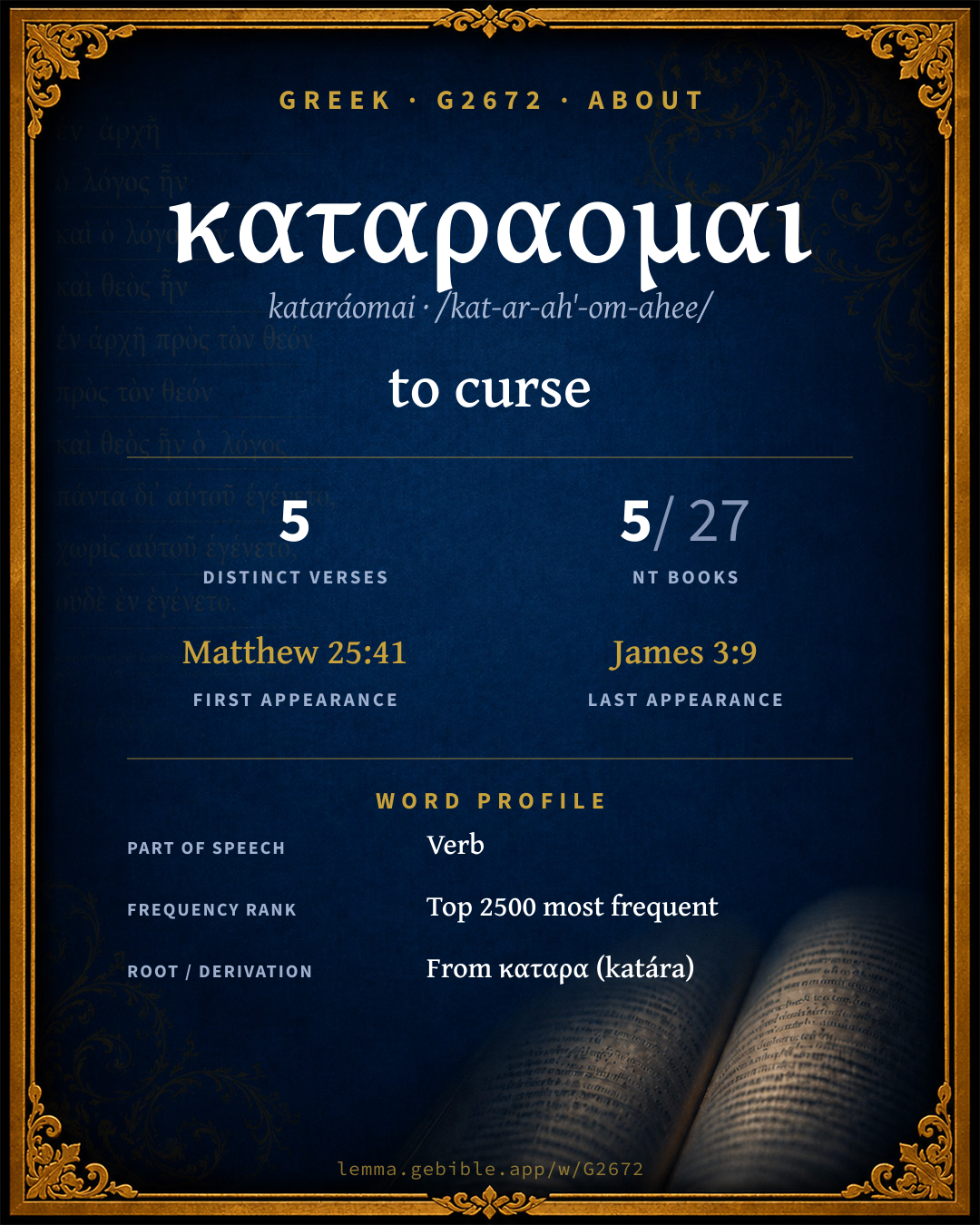
καταράομαι
to curse
Full lexicon entry — Thayer's Greek Lexicon
From Thayer's Greek Lexicon
Where this word appears
See every Present-tense verb in the Greek New Testament →
Grammar key — what these labels mean
Part of speech
- Verb
- An action or state-of-being word.
Tense
- Aorist
- Action viewed as a simple whole, without regard to duration — often past (perfective aspect).
- Present
- Ongoing or general action in present time (imperfective aspect).
- Perfect
- A completed past action with continuing present results.
Voice
- Middle deponent
- Middle in form but active in meaning.
- Middle or Passive deponent
- Middle/passive in form but active in meaning.
- Passive
- The subject receives the action.
Mood
- Indicative
- States a fact or asks a factual question (the mood of reality).
- Imperative
- Expresses a command or request.
- Participle
- A verbal adjective (“writing,” “having written”).
Case
- Accusative
- The case of the direct object and of extent.
- Nominative
- The case of the subject (and the predicate nominative).
Person
- 2nd person
- The one addressed (“you”).
- 1st person
- The speaker (“I / we”).
Gender
- Masculine
- Grammatically masculine.
Number
- Singular
- One.
- Plural
- More than one.
Grammatical forms
- Verb, Aorist, Middle deponent, Indicative, 2nd person, Singular 1 time (20%)
- Verb, Present, Middle or Passive deponent, Indicative, 1st person, Plural 1 time (20%)
- Verb, Present, Middle or Passive deponent, Imperative, 2nd person, Plural 1 time (20%)
- Verb, Present, Middle or Passive deponent, Participle, Accusative, Plural, Masculine 1 time (20%)
- Verb, Perfect, Passive, Participle, Nominative, Plural, Masculine 1 time (20%)
Parsed forms decoded from the imported morphology (Robinson–Tischendorf, public domain), counted across 5 parsed occurrences — not distinct verses.
Every verse where G2672 appears — 5 distinct verses across 5 books. Click any verse to open its interlinear word-by-word view. Verse text shown in the World English Bible for context — . Each verse’s Greek form is shown with its reference; the English is not keyword-highlighted, since the data carries no word-level English alignment. Use “Compare translations” on any verse to read it across multiple English versions. This concordance covers the Greek New Testament; Septuagint (Greek Old Testament) occurrences of this word are not indexed here.
Matthew 1 verse
Mark 1 verse
Luke 1 verse
Romans 1 verse
James 1 verse
About this entry
At a glance — auto-summarized from this page’s data, not written by a person. Every figure links to its source below. This summary describes the numbers; it doesn’t interpret them.
“to curse” is the headline sense of the Greek verb καταραομαι (kataráomai). A scarce word — 5 verses in all of the Greek New Testament. First canonically at Matthew 25:41, it enters the text early. See the sense tree, 5-verse concordance, and the renderings breakdown below.
Gloss history
Strong's 1890 vs modern scholarship

About this word
Strong's G2672 catalogs a Greek word from the Greek New Testament.
These counts are not copied from any lexicon or concordance. They are computed here, from the morphology-tagged Greek New Testament. What Lemma adds →
- 5
- distinct verses
- The word appears in 5 distinct verses.
- 5 / 27
- NT books
- The word appears in 5 of 27 New Testament books.
- #1,648
- by frequency
- Top 2500 most frequent Greek words (rank 1,648 of 5,347 Greek words by occurrence).
View all 5 occurrences in the concordance →
By section of the New Testament
By traditional corpus
Conventional, traditional groupings — biblical authorship is debated, so this is a traditional corpus grouping, not an authorship claim. Some books belong to more than one corpus (Luke is in both the Gospels and the Lukan corpus, and so on), so these shares overlap and need not total 100%. Each figure is a share of the word’s 5 distinct verses.
- Gospels 3 verses · 60%
- Lukan (Luke–Acts) 1 verse · 20%
- Pauline corpus 1 verse · 20%
- General (Catholic) Epistles 1 verse · 20%
How translations render this word
Counts come from each version’s own published word-to-Strong’s tagging or interlinear alignment — an approximate guide to how each version renders this word, not a word-level alignment the data otherwise carries. Because each total is that version’s own tagged count, the per-version totals vary from one another and need not match the appearance or distinct-verse counts above. These counts may also differ from a printed concordance because Lemma counts each distinctly tagged rendering and does not collapse phrase taggings into a single head-word total. This is a fixed set of word-tagged versions (KJV, ASV, BSB, ULT) and does not change with the reading translation you choose elsewhere. Each version’s license is shown beside its name below (and on Sources).
- King James Version: Curse 3×
- American Standard Version: Curse 2×
- Berean Standard Bible: Curse 2×
- unfoldingWord Literal Text: Curse 1×, Cursing 1×, Do 1×
King James Version Public Domain
Renders G2672 across 6 tagged occurrences — most commonly:
Plus 3 renderings that appear only once — usually multi-word phrases or single function words the recovered tagging swept in, not distinct renderings.
American Standard Version Public Domain
Renders G2672 across 5 tagged occurrences — most commonly:
Plus 3 renderings that appear only once — usually multi-word phrases or single function words the recovered tagging swept in, not distinct renderings.
Berean Standard Bible Public Domain
Renders G2672 across 5 tagged occurrences — most commonly:
Plus 3 renderings that appear only once — usually multi-word phrases or single function words the recovered tagging swept in, not distinct renderings.
unfoldingWord Literal Text CC BY-SA 4.0
Renders G2672 across 6 tagged occurrences — most commonly:
Senses in Thayer's
The 1 sense Thayer's distinguishes for this word, in lexicon order (not ranked by frequency or importance). The full entry — with sub-senses — is in the Lexicon Entry tab.
- to curse, doom, imprecate evil upon
Word origin
Derived from καταρα (katára) (G2671) — curse.
Middle voice from G2671 ; to execrate ; by analogy to doom : - curse.
— Strong’s Exhaustive Concordance (1890), public domain.
Forms in the corpus
The 5 distinct written forms G2672 takes in the Greek New Testament, most frequent first — each parse links to that tense’s occurrences in the concordance.
| Form | Parsing | Example | Uses |
|---|---|---|---|
| καταρωμένους katarōménous | Verb, Present, Middle or Passive deponent, Participle, Accusative, Plural, Masculine | Luke 6:28 | 1 |
| καταρώμεθα katarṓmetha | Verb, Present, Middle or Passive deponent, Indicative, 1st person, Plural | James 3:9 | 1 |
| καταρᾶσθε katarâsthe | Verb, Present, Middle or Passive deponent, Imperative, 2nd person, Plural | Romans 12:14 | 1 |
| κατηράσω katērásō | Verb, Aorist, Middle deponent, Indicative, 2nd person, Singular | Mark 11:21 | 1 |
| κατηραμένοι katēraménoi | Verb, Perfect, Passive, Participle, Nominative, Plural, Masculine | Matthew 25:41 | 1 |
Septuagint usage
The same Greek word καταραομαι appears 69 times in the Greek Old Testament (Septuagint), across 58 verses in 16 books.
- 69
- LXX occurrences
- Tagged occurrences of this Greek word in the Septuagint.
- 58
- verses
- Distinct Septuagint verses containing this word.
- 16 / 39
- OT books
- The word appears in 16 of the 39 Old Testament books.
Sample Septuagint occurrences
- Genesis 5:29 καταἀράομαι
- Leviticus 24:11 καταἀράομαι
- Numbers 5:18 καταἀράομαι
- Deuteronomy 21:23 καταἀράομαι
- Judges 5:23 καταἀράομαι
- 1 Samuel 17:23 καταἀράομαι
- 2 Samuel 16:5 καταἀράομαι
- 1 Kings 2:8 καταἀράομαι
- 2 Kings 2:24 καταἀράομαι
- Ezra 20:30 καταἀράομαι
- Job 3:2 καταἀράομαι
- Psalms 36:22 καταἀράομαι
Septuagint occurrences (same lexeme)
Every verse where the same Strong’s number (G2672) appears in the Greek Septuagint — showing the first 50 of 58. Verse text shown in the World English Bible for context; the Greek form is the matched word — the English is not keyword-highlighted.
- Genesis 5:29 καταἀράομαι and he named him Noah, saying, "This same will comfort us in our work and in the toil of our hands, because of the ground which Yahweh has cursed."
- Genesis 8:21 καταἀράομαι Yahweh smelled the sweet savor. Yahweh said in his heart, "I will not again curse the ground any more for man's sake, because the imagination of man's heart is evil from his youth; neither will I ever again strike everything living, as I have done.
- Genesis 12:3 καταἀράομαι I will bless those who bless you, and I will curse him who curses you. In you will all of the families of the earth be blessed."
- Genesis 27:29 καταἀράομαι Let peoples serve you, Nations bow down to you. Be lord over your brothers, Let your mother's sons bow down to you. Cursed be everyone who curses you, Blessed be everyone who blesses you."
- Leviticus 24:11 καταἀράομαι The son of the Israelite woman blasphemed the Name, and cursed; and they brought him to Moses. His mother's name was Shelomith, the daughter of Dibri, of the tribe of Dan.
- Leviticus 24:14 καταἀράομαι "Bring out of the camp him who cursed; and let all who heard him lay their hands on his head, and let all the congregation stone him.
- Leviticus 24:15 καταἀράομαι You shall speak to the children of Israel, saying, 'Whoever curses his God shall bear his sin.
- Leviticus 24:23 καταἀράομαι Moses spoke to the children of Israel; and they brought forth him who had cursed out of the camp, and stoned him with stones. The children of Israel did as Yahweh commanded Moses.
- Numbers 5:18 καταἀράομαι The priest shall set the woman before Yahweh, and let the hair of the woman's head go loose, and put the meal offering of memorial in her hands, which is the meal offering of jealousy. The priest shall have in his hand the water of bitterness that brings a curse.
- Numbers 5:19 καταἀράομαι The priest shall cause her to swear, and shall tell the woman, 'If no man has lain with you, and if you haven't gone aside to uncleanness, being under your husband, be free from this water of bitterness that brings a curse.
- Numbers 5:22 καταἀράομαι and this water that brings a curse will go into your bowels, and make your body swell, and your thigh fall away.' The woman shall say, 'Amen, Amen.'
- Numbers 5:23 καταἀράομαι "The priest shall write these curses in a book, and he shall blot them out into the water of bitterness.
- Numbers 5:24 καταἀράομαι He shall make the woman drink the water of bitterness that causes the curse; and the water that causes the curse shall enter into her and become bitter.
- Numbers 5:27 καταἀράομαι When he has made her drink the water, then it shall happen, if she is defiled, and has committed a trespass against her husband, that the water that causes the curse will enter into her and become bitter, and her body will swell, and her thigh will fall away: and the woman will be a curse among her people.
- Numbers 22:6 καταἀράομαι Please come now therefore curse me this people; for they are too mighty for me: peradventure I shall prevail, that we may strike them, and that I may drive them out of the land; for I know that he whom you bless is blessed, and he whom you curse is cursed.
- Numbers 22:12 καταἀράομαι God said to Balaam, You shall not go with them; you shall not curse the people; for they are blessed.
- Numbers 22:17 καταἀράομαι for I will promote you to very great honor, and whatever you say to me I will do. Please come therefore, and curse this people for me.
- Numbers 23:7 καταἀράομαι He took up his parable, and said, From Aram has Balak brought me, The king of Moab from the mountains of the East: Come, curse me Jacob, Come, defy Israel.
- Numbers 23:8 κατααράομαικαταἀράομαι How shall I curse, whom God has not cursed? How shall I defy, whom Yahweh has not defied?
- Numbers 23:13 καταἀράομαι Balak said to him, Please come with me to another place, from whence you may see them; you shall see but the utmost part of them, and shall not see them all: and curse me them from there.
- Numbers 23:25 καταἀράομαι Balak said to Balaam, Neither curse them at all, nor bless them at all.
- Numbers 23:27 καταἀράομαι Balak said to Balaam, Come now, I will take you to another place; peradventure it will please God that you may curse me them from there.
- Numbers 24:9 καταἀράομαι He couched, he lay down as a lion, As a lioness; who shall rouse him up? Blessed be everyone who blesses you, Cursed be everyone who curses you.
- Numbers 24:10 καταἀράομαι Balak's anger was kindled against Balaam, and he struck his hands together; and Balak said to Balaam, I called you to curse my enemies, and, behold, you have altogether blessed them these three times.
- Deuteronomy 21:23 καταἀράομαι his body shall not remain all night on the tree, but you shall surely bury him the same day; for he who is hanged is accursed of God; that you don't defile your land which Yahweh your God gives you for an inheritance.
- Deuteronomy 23:5 καταἀράομαι Nevertheless Yahweh your God wouldn't listen to Balaam; but Yahweh your God turned the curse into a blessing to you, because Yahweh your God loved you.
- Judges 5:23 καταἀράομαι Curse you Meroz, said the angel of Yahweh. Curse you bitterly the inhabitants of it, Because they didn't come to the help of Yahweh, To the help of Yahweh against the mighty.
- Judges 9:27 καταἀράομαι They went out into the field, and gathered their vineyards, and trod [the grapes], and held festival, and went into the house of their god, and did eat and drink, and cursed Abimelech.
- 1 Samuel 17:23 καταἀράομαι As he talked with them, behold, there came up the champion, the Philistine of Gath, Goliath by name, out of the ranks of the Philistines, and spoke according to the same words: and David heard them.
- 2 Samuel 16:5 καταἀράομαι When king David came to Bahurim, behold, a man of the family of the house of Saul came out, whose name was Shimei, the son of Gera. He came out, and cursed still as he came.
- 2 Samuel 16:7 καταἀράομαι Thus said Shimei when he cursed, Be gone, be gone, you man of blood, and base fellow:
- 2 Samuel 16:9 καταἀράομαι Then said Abishai the son of Zeruiah to the king, "Why should this dead dog curse my lord the king? Please let me go over and take off his head."
- 2 Samuel 16:10 καταἀράομαι The king said, What have I to do with you, you sons of Zeruiah? Because he curses, and because Yahweh has said to him, Curse David; who then shall say, Why have you done so?
- 2 Samuel 16:11 καταἀράομαι David said to Abishai, and to all his servants, Behold, my son, who came forth from my bowels, seeks my life: how much more [may] this Benjamite now [do it]? let him alone, and let him curse; for Yahweh has invited him.
- 2 Samuel 19:22 καταἀράομαι David said, What have I to do with you, you sons of Zeruiah, that you should this day be adversaries to me? shall there any man be put to death this day in Israel? for don't I know that I am this day king over Israel?
- 1 Kings 2:8 καταἀράομαι Behold, there is with you Shimei the son of Gera, the Benjamite, of Bahurim, who cursed me with a grievous curse in the day when I went to Mahanaim; but he came down to meet me at the Jordan, and I swore to him by Yahweh, saying, I will not put you to death with the sword.
- 1 Kings 2:35 καταἀράομαι The king put Benaiah the son of Jehoiada in his room over the host; and Zadok the priest did the king put in the room of Abiathar.
- 2 Kings 2:24 καταἀράομαι He looked behind him and saw them, and cursed them in the name of Yahweh. There came forth two she-bears out of the wood, and mauled forty-two lads of them.
- 2 Kings 9:34 καταἀράομαι When he was come in, he ate and drink; and he said, See now to this cursed woman, and bury her; for she is a king's daughter.
- Ezra 20:30 καταἀράομαι
- Ezra 23:2 καταἀράομαι
- Ezra 23:25 καταἀράομαι
- Job 3:2 καταἀράομαι Job answered:
- Job 3:6 καταἀράομαι As for that night, let thick darkness seize on it. Let it not rejoice among the days of the year. Let it not come into the number of the months.
- Job 3:8 καταἀράομαικαταράομαι Let them curse it who curse the day, Who are ready to rouse up leviathan.
- Job 24:18 καταἀράομαι "They are foam on the surface of the waters. Their portion is cursed in the earth: They don't turn into the way of the vineyards.
- Psalms 36:22 καταἀράομαι
- Psalms 61:5 καταἀράομαι For you, God, have heard my vows. You have given me the heritage of those who fear your name.
- Psalms 108:28 καταἀράομαι
- Psalms 151:6 καταἀράομαι
These are occurrences of the same Greek lexeme (G2672) in the Septuagint — not a translation of any one Hebrew word. The store carries no word-level Hebrew↔Greek alignment, so no Hebrew original is asserted here. Counts come from the recovered LXX Strong's tagging — high-frequency vocabulary is well covered, while rare or late forms may be untagged — so they reflect tagged occurrences and may slightly undercount.