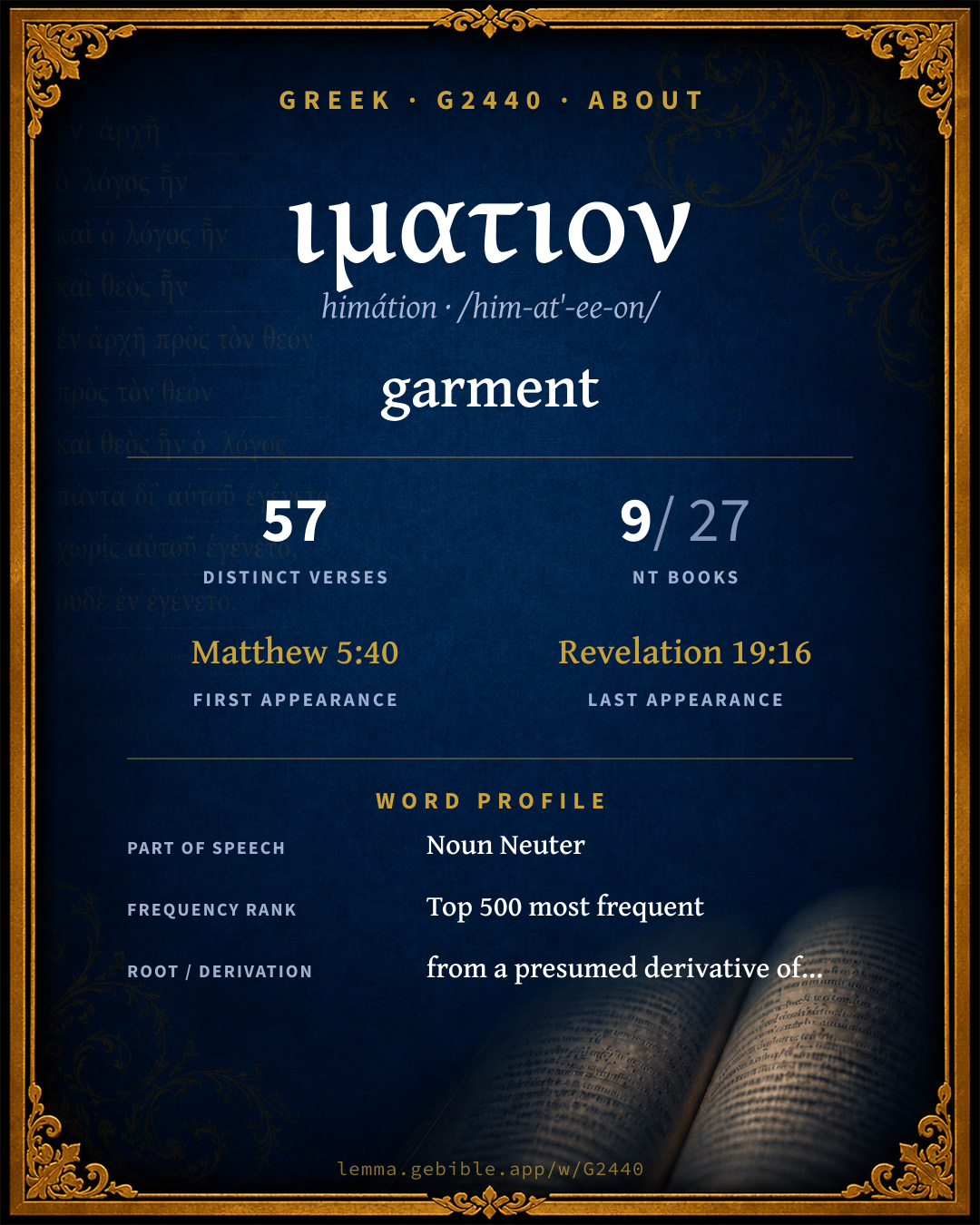
ἱμάτιον
garment
‘garment’ is one of 2 main senses fuller range ↓
Full lexicon entry — Thayer's Greek Lexicon
From Thayer's Greek Lexicon
Where this word appears
See every Accusative-case word in the Greek New Testament →
Grammar key — what these labels mean
Part of speech
- Noun
- A naming word — a person, place, thing, or idea.
Case
- Accusative
- The case of the direct object and of extent.
- Genitive
- The case of source, possession, or “of” — answers “whose / from what.”
- Dative
- The case of the indirect object, means, or location — “to / for / with / in.”
- Nominative
- The case of the subject (and the predicate nominative).
Gender
- Neuter
- Grammatically neuter.
Number
- Plural
- More than one.
- Singular
- One.
7 verses where G2440 appears in the Accusative case in the Book of Mark. Filtered view — show all forms. Click any verse to open its interlinear word-by-word view. Verse text shown in the World English Bible for context — . Each verse’s Greek form is shown with its reference; the English is not keyword-highlighted, since the data carries no word-level English alignment. Use “Compare translations” on any verse to read it across multiple English versions. This concordance covers the Greek New Testament; Septuagint (Greek Old Testament) occurrences of this word are not indexed here.
Mark
- Mark 2:21 ἱμάτιον n acc sg neut No one sews a piece of unshrunk cloth on an old garment, or else the patch shrinks and the new tears away from the old, and a worse hole is made.
- Mark 10:50 ἱμάτιον n acc sg neut He, casting away his cloak, sprang up, and came to Jesus.
- Mark 11:7 ἱμάτια n acc pl neut They brought the young donkey to Jesus, and threw their garments on it, and Jesus sat on it.
- Mark 11:8 ἱμάτια n acc pl neut Many spread their garments on the way, and others were cutting down branches from the trees, and spreading them on the road.
- Mark 13:16 ἱμάτιον n acc sg neut Let him who is in the field not return back to take his cloak.
- Mark 15:20 ἱμάτια n acc pl neut When they had mocked him, they took the purple off of him, and put his own garments on him. They led him out to crucify him.
- Mark 15:24 ἱμάτια n acc pl neut Crucifying him, they parted his garments among them, casting lots on them, what each should take.
About this entry
At a glance — auto-summarized from this page’s data, not written by a person. Every figure links to its source below. This summary describes the numbers; it doesn’t interpret them.
“garment” is the headline sense of the Greek noun ιματιον (himátion). Its English rendering has broadened — “garments” classically, “cloak” (Berean Standard Bible) in modern versions; see the renderings breakdown. The Greek New Testament uses it across 57 verses — moderately common. Its earliest occurrence is Matthew 5:40. Lexicons map it across 2 senses. See the sense tree, 57-verse concordance, and the renderings breakdown below.
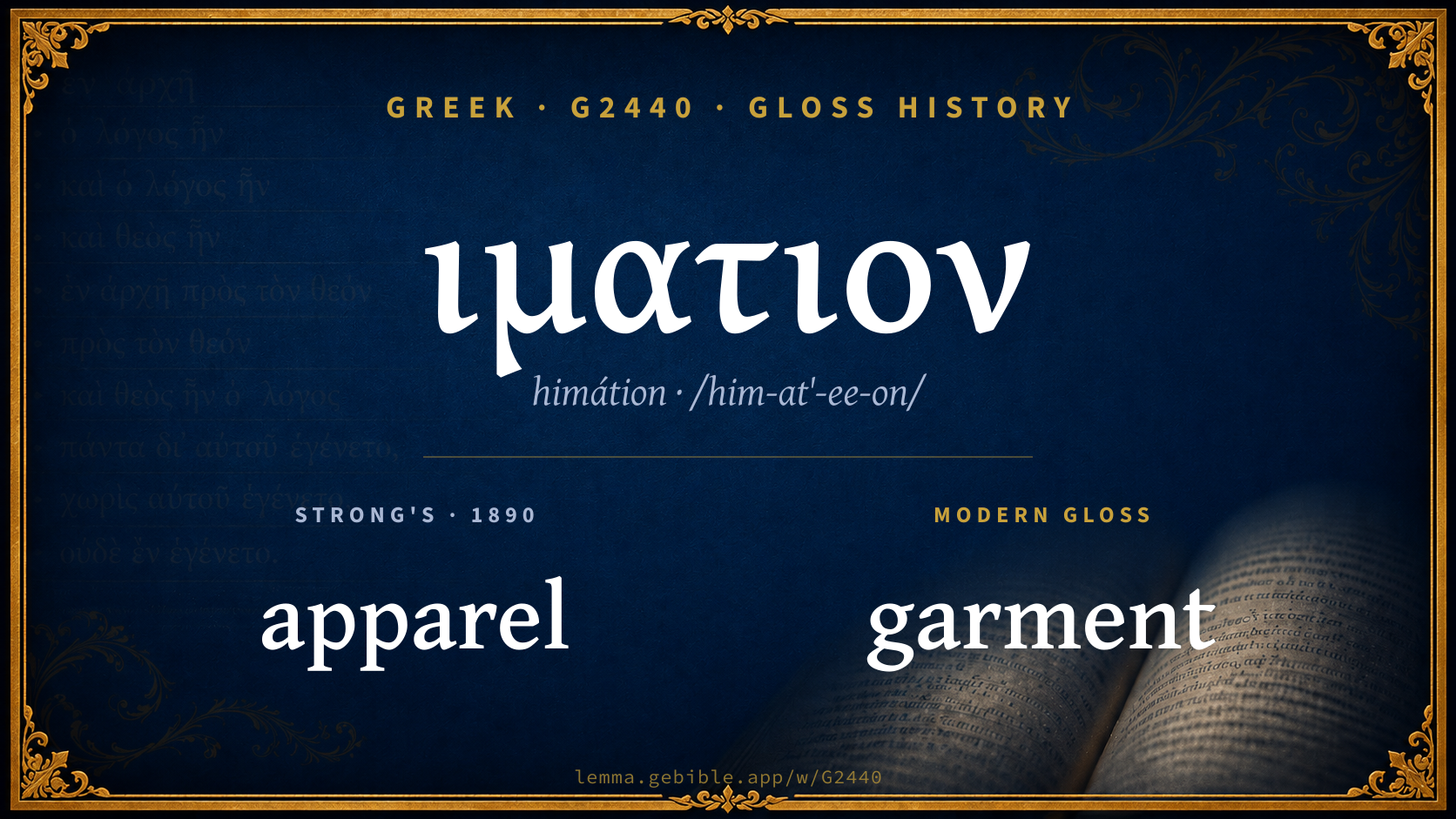
Gloss history
Strong's 1890 vs modern scholarship
About this word
Strong's G2440 catalogs a Greek word from the Greek New Testament.
These counts are not copied from any lexicon or concordance. They are computed here, from the morphology-tagged Greek New Testament. What Lemma adds →
- 57
- distinct verses
- The word appears in 57 distinct verses.
- 9 / 27
- NT books
- The word appears in 9 of 27 New Testament books.
- #275
- by frequency
- Top 500 most frequent Greek words (rank 275 of 5,347 Greek words by occurrence).
View all 57 occurrences in the concordance →
By section of the New Testament
By traditional corpus
Conventional, traditional groupings — biblical authorship is debated, so this is a traditional corpus grouping, not an authorship claim. Some books belong to more than one corpus (Luke is in both the Gospels and the Lukan corpus, and so on), so these shares overlap and need not total 100%. Each figure is a share of the word’s 57 distinct verses.
- Gospels 39 verses · 68%
- Lukan (Luke–Acts) 17 verses · 30%
- Johannine 13 verses · 23%
- Revelation 7 verses · 12%
- General (Catholic) Epistles 2 verses · 4%
- Hebrews 1 verse · 2%
How translations render this word
Counts come from each version’s own published word-to-Strong’s tagging or interlinear alignment — an approximate guide to how each version renders this word, not a word-level alignment the data otherwise carries. Because each total is that version’s own tagged count, the per-version totals vary from one another and need not match the appearance or distinct-verse counts above. These counts may also differ from a printed concordance because Lemma counts each distinctly tagged rendering and does not collapse phrase taggings into a single head-word total. This is a fixed set of word-tagged versions (KJV, ASV, BSB, ULT) and does not change with the reading translation you choose elsewhere. Each version’s license is shown beside its name below (and on Sources).
- King James Version: Garments 15×, Garment 14×, Clothes 12×
- American Standard Version: Garments 33×, Garment 17×, Cloak 5×
- Berean Standard Bible: Cloak 12×, Garments 12×, Clothes 8×
- unfoldingWord Literal Text: Garments 12×, Garment 11×, Cloak 9×
King James Version Public Domain
Renders G2440 across 62 tagged occurrences — most commonly:
Plus 3 renderings that appear only once — usually multi-word phrases or single function words the recovered tagging swept in, not distinct renderings.
American Standard Version Public Domain
Renders G2440 across 64 tagged occurrences — most commonly:
Plus 3 renderings that appear only once — usually multi-word phrases or single function words the recovered tagging swept in, not distinct renderings.
Berean Standard Bible Public Domain
Renders G2440 across 56 tagged occurrences — most commonly:
Plus 3 renderings that appear only once — usually multi-word phrases or single function words the recovered tagging swept in, not distinct renderings. Not rendered by a distinct English word in 4 further occurrences.
unfoldingWord Literal Text CC BY-SA 4.0
Renders G2440 across 69 tagged occurrences — most commonly:
Plus 5 renderings that appear only once — usually multi-word phrases or single function words the recovered tagging swept in, not distinct renderings.
Senses in Thayer's
The 2 senses Thayer's distinguishes for this word, in lexicon order (not ranked by frequency or importance). The full entry — with sub-senses — is in the Lexicon Entry tab.
- garments, i.e. the cloak or mantle and the tunic
- the upper garment, the cloak or mantle
Word origin
Origin: from a presumed derivative of ennumi (to put on)
Neuter of a presumed derivative of ἕννυμι hennumi (to put on ); a dress (inner or outer): - apparel cloke clothes garment raiment robe vesture.
— Strong’s Exhaustive Concordance (1890), public domain.
Forms in the corpus
The 8 distinct written forms G2440 takes in the Greek New Testament, most frequent first — each parse links to that case’s occurrences in the concordance.
| Form | Parsing | Example | Uses |
|---|---|---|---|
| ἱμάτια himátia | Noun, Accusative, Plural, Neuter | Matthew 21:7 | 28 |
| ἱμάτιον himátion | Noun, Accusative, Singular, Neuter | Matthew 5:40 | 14 |
| ἱματίου himatíou | Noun, Genitive, Singular, Neuter | Matthew 9:16 | 8 |
| ἱματίοις himatíois | Noun, Dative, Plural, Neuter | Luke 7:25 | 3 |
| ἱματίων himatíōn | Noun, Genitive, Plural, Neuter | Mark 5:28 | 3 |
| ἱμάτιά himátiá | Noun, Accusative, Plural, Neuter | John 19:24 | 1 |
| ἱμάτιόν himátión | Noun, Accusative, Singular, Neuter | Acts 12:8 | 1 |
| ἱματίῳ himatíō | Noun, Dative, Singular, Neuter | Matthew 9:16 | 1 |
Same root — word family
Other Thayer's entries built from the same root as G2440, grouped by Strong’s listed origin. These share a root / origin per the lexicon — not necessarily a shared meaning. Each links to that word’s own entry.
Derived from this word
Compare all same-root words → They share a root, not necessarily a meaning.
Septuagint usage
The same Greek word ιματιον appears 193 times in the Greek Old Testament (Septuagint), across 183 verses in 27 books.
- 193
- LXX occurrences
- Tagged occurrences of this Greek word in the Septuagint.
- 183
- verses
- Distinct Septuagint verses containing this word.
- 27 / 39
- OT books
- The word appears in 27 of the 39 Old Testament books.
Sample Septuagint occurrences
- Genesis 9:23 ἱμάτιον
- Exodus 12:34 ἱμάτιον
- Leviticus 6:20 ἱμάτιον
- Numbers 4:6 ἱμάτιον
- Deuteronomy 8:4 ἱμάτιον
- Joshua 7:6 ἱμάτιον
- Judges 8:25 ἱμάτιον
- 1 Samuel 4:12 ἱμάτιον
- 2 Samuel 1:2 ἱμάτιον
- 1 Kings 1:1 ἱμάτιον
- 2 Kings 2:12 ἱμάτιον
- 2 Chronicles 34:19 ἱμάτιον
Septuagint occurrences (same lexeme)
Every verse where the same Strong’s number (G2440) appears in the Greek Septuagint — showing the first 50 of 183. Verse text shown in the World English Bible for context; the Greek form is the matched word — the English is not keyword-highlighted.
- Genesis 9:23 ἱμάτιον Shem and Japheth took a garment, and laid it on both their shoulders, went in backwards, and covered the nakedness of their father. Their faces were backwards, and they didn't see their father's nakedness.
- Genesis 27:27 ἱμάτιον He came near, and kissed him. He smelled the smell of his clothing, and blessed him, and said, "Behold, the smell of my son Is as the smell of a field which Yahweh has blessed.
- Genesis 28:20 ἱμάτιον Jacob vowed a vow, saying, "If God will be with me, and will keep me in this way that I go, and will give me bread to eat, and clothing to put on,
- Genesis 37:29 ἱμάτιον Reuben returned to the pit; and saw that Joseph wasn't in the pit; and he tore his clothes.
- Genesis 37:34 ἱμάτιον Jacob tore his clothes, and put sackcloth on his loins, and mourned for his son many days.
- Genesis 38:14 ἱμάτιον She took off of her the garments of her widowhood, and covered herself with her veil, and wrapped herself, and sat in the gate of Enaim, which is by the way to Timnah; for she saw that Shelah was grown up, and she wasn't given to him as a wife.
- Genesis 38:19 ἱμάτιον She arose, and went away, and put off her veil from her, and put on the garments of her widowhood.
- Genesis 39:12 ἱμάτιον She caught him by his garment, saying, "Lie with me!" He left his garment in her hand, and ran outside.
- Genesis 39:13 ἱμάτιον It happened, when she saw that he had left his garment in her hand, and had run outside,
- Genesis 39:15 ἱμάτιον It happened, when he heard that I lifted up my voice and cried, that he left his garment by me, and ran outside."
- Genesis 39:16 ἱμάτιον She laid up his garment by her, until his master came home.
- Genesis 39:18 ἱμάτιον and it happened, as I lifted up my voice and cried, that he left his garment by me, and ran outside."
- Genesis 44:13 ἱμάτιον Then they tore their clothes, and loaded every man his donkey, and returned to the city.
- Exodus 12:34 ἱμάτιον The people took their dough before it was leavened, their kneading-troughs being bound up in their clothes on their shoulders.
- Exodus 19:10 ἱμάτιον Yahweh said to Moses, "Go to the people, and sanctify them today and tomorrow, and let them wash their garments,
- Exodus 19:14 ἱμάτιον Moses went down from the mountain to the people, and sanctified the people; and they washed their clothes.
- Exodus 22:8 ἱμάτιον If the thief isn't found, then the master of the house shall come near to God, to find out if he hasn't put his hand to his neighbor's goods.
- Exodus 22:25 ἱμάτιον "If you lend money to any of my people with you who is poor, you shall not be to him as a creditor; neither shall you charge him interest.
- Exodus 22:26 ἱμάτιον If you take your neighbor's garment as collateral, you shall restore it to him before the sun goes down,
- Leviticus 6:20 ἱμάτιον "This is the offering of Aaron and of his sons, which they shall offer to Yahweh in the day when he is anointed: the tenth part of an ephah of fine flour for a meal offering perpetually, half of it in the morning, and half of it in the evening.
- Leviticus 10:6 ἱμάτιον Moses said to Aaron, and to Eleazar and to Ithamar, his sons, "Don't let the hair of your heads go loose, neither tear your clothes; that you don't die, and that he not be angry with all the congregation: but let your brothers, the whole house of Israel, bewail the burning which Yahweh has kindled.
- Leviticus 11:25 ἱμάτιον Whoever carries any part of their carcass shall wash his clothes, and be unclean until the evening.
- Leviticus 11:28 ἱμάτιον He who carries their carcass shall wash his clothes, and be unclean until the evening. They are unclean to you.
- Leviticus 11:32 ἱμάτιον On whatever any of them falls when they are dead, it shall be unclean; whether it is any vessel of wood, or clothing, or skin, or sack, whatever vessel it is, with which any work is done, it must be put into water, and it shall be unclean until the evening; then it will be clean.
- Leviticus 11:40 ἱμάτιον He who eats of its carcass shall wash his clothes, and be unclean until the evening. He also who carries its carcass shall wash his clothes, and be unclean until the evening.
- Leviticus 13:6 ἱμάτιον The priest shall examine him again on the seventh day; and, behold, if the plague has faded, and the plague hasn't spread in the skin, then the priest shall pronounce him clean. It is a scab. He shall wash his clothes, and be clean.
- Leviticus 13:34 ἱμάτιον On the seventh day, the priest shall examine the itch; and, behold, if the itch hasn't spread in the skin, and its appearance isn't deeper than the skin, then the priest shall pronounce him clean. He shall wash his clothes, and be clean.
- Leviticus 13:45 ἱμάτιον "The leper in whom the plague is shall wear torn clothes, and the hair of his head shall hang loose. He shall cover his upper lip, and shall cry, 'Unclean! Unclean!'
- Leviticus 13:47 ἱμάτιον "The garment also that the plague of leprosy is in, whether it is a woolen garment, or a linen garment;
- Leviticus 13:49 ἱμάτιον if the plague is greenish or reddish in the garment, or in the skin, or in the warp, or in the woof, or in anything made of skin; it is the plague of leprosy, and shall be shown to the priest.
- Leviticus 13:51 ἱμάτιον He shall examine the plague on the seventh day. If the plague has spread in the garment, either in the warp, or in the woof, or in the skin, whatever use the skin is used for, the plague is a destructive mildew. It is unclean.
- Leviticus 13:52 ἱμάτιον He shall burn the garment, whether the warp or the woof, in wool or in linen, or anything of skin, in which the plague is: for it is a destructive mildew. It shall be burned in the fire.
- Leviticus 13:53 ἱμάτιον "If the priest examines it, and, behold, the plague hasn't spread in the garment, either in the warp, or in the woof, or in anything of skin;
- Leviticus 13:55 ἱμάτιον Then the priest shall examine it, after the plague is washed; and, behold, if the plague hasn't changed its color, and the plague hasn't spread, it is unclean; you shall burn it in the fire. It is a mildewed spot, whether the bareness is inside or outside.
- Leviticus 13:56 ἱμάτιον If the priest looks, and, behold, the plague has faded after it is washed, then he shall tear it out of the garment, or out of the skin, or out of the warp, or out of the woof:
- Leviticus 13:57 ἱμάτιον and if it appears again in the garment, either in the warp, or in the woof, or in anything of skin, it is spreading. You shall burn with fire that in which the plague is.
- Leviticus 13:58 ἱμάτιον The garment, either the warp, or the woof, or whatever thing of skin it is, which you shall wash, if the plague has departed from them, then it shall be washed the second time, and it will be clean."
- Leviticus 13:59 ἱμάτιον This is the law of the plague of mildew in a garment of wool or linen, either in the warp, or the woof, or in anything of skin, to pronounce it clean, or to pronounce it unclean.
- Leviticus 14:8 ἱμάτιον "He who is to be cleansed shall wash his clothes, and shave off all his hair, and bathe himself in water; and he shall be clean. After that he shall come into the camp, but shall dwell outside his tent seven days.
- Leviticus 14:9 ἱμάτιον It shall be on the seventh day, that he shall shave all his hair off his head and his beard and his eyebrows, even all his hair he shall shave off. He shall wash his clothes, and he shall bathe his body in water, then he shall be clean.
- Leviticus 14:47 ἱμάτιον He who lies down in the house shall wash his clothes; and he who eats in the house shall wash his clothes.
- Leviticus 14:55 ἱμάτιον and for the destructive mildew of a garment, and for a house,
- Leviticus 15:5 ἱμάτιον Whoever touches his bed shall wash his clothes, and bathe himself in water, and be unclean until the evening.
- Leviticus 15:6 ἱμάτιον He who sits on anything whereon the man who has the discharge sat shall wash his clothes, and bathe himself in water, and be unclean until the evening.
- Leviticus 15:7 ἱμάτιον "'He who touches the body of him who has the discharge shall wash his clothes, and bathe himself in water, and be unclean until the evening.
- Leviticus 15:8 ἱμάτιον "'If he who has the discharge spits on him who is clean, then he shall wash his clothes, and bathe himself in water, and be unclean until the evening.
- Leviticus 15:10 ἱμάτιον Whoever touches anything that was under him shall be unclean until the evening. He who carries those things shall wash his clothes, and bathe himself in water, and be unclean until the evening.
- Leviticus 15:11 ἱμάτιον "'Whoever he who has the discharge touches, without having rinsed his hands in water, he shall wash his clothes, and bathe himself in water, and be unclean until the evening.
- Leviticus 15:13 ἱμάτιον "'When he who has a discharge is cleansed of his discharge, then he shall count to himself seven days for his cleansing, and wash his clothes; and he shall bathe his flesh in running water, and shall be clean.
- Leviticus 15:17 ἱμάτιον Every garment, and every skin, whereon the semen is, shall be washed with water, and be unclean until the evening.
These are occurrences of the same Greek lexeme (G2440) in the Septuagint — not a translation of any one Hebrew word. The store carries no word-level Hebrew↔Greek alignment, so no Hebrew original is asserted here. Counts come from the recovered LXX Strong's tagging — high-frequency vocabulary is well covered, while rare or late forms may be untagged — so they reflect tagged occurrences and may slightly undercount.