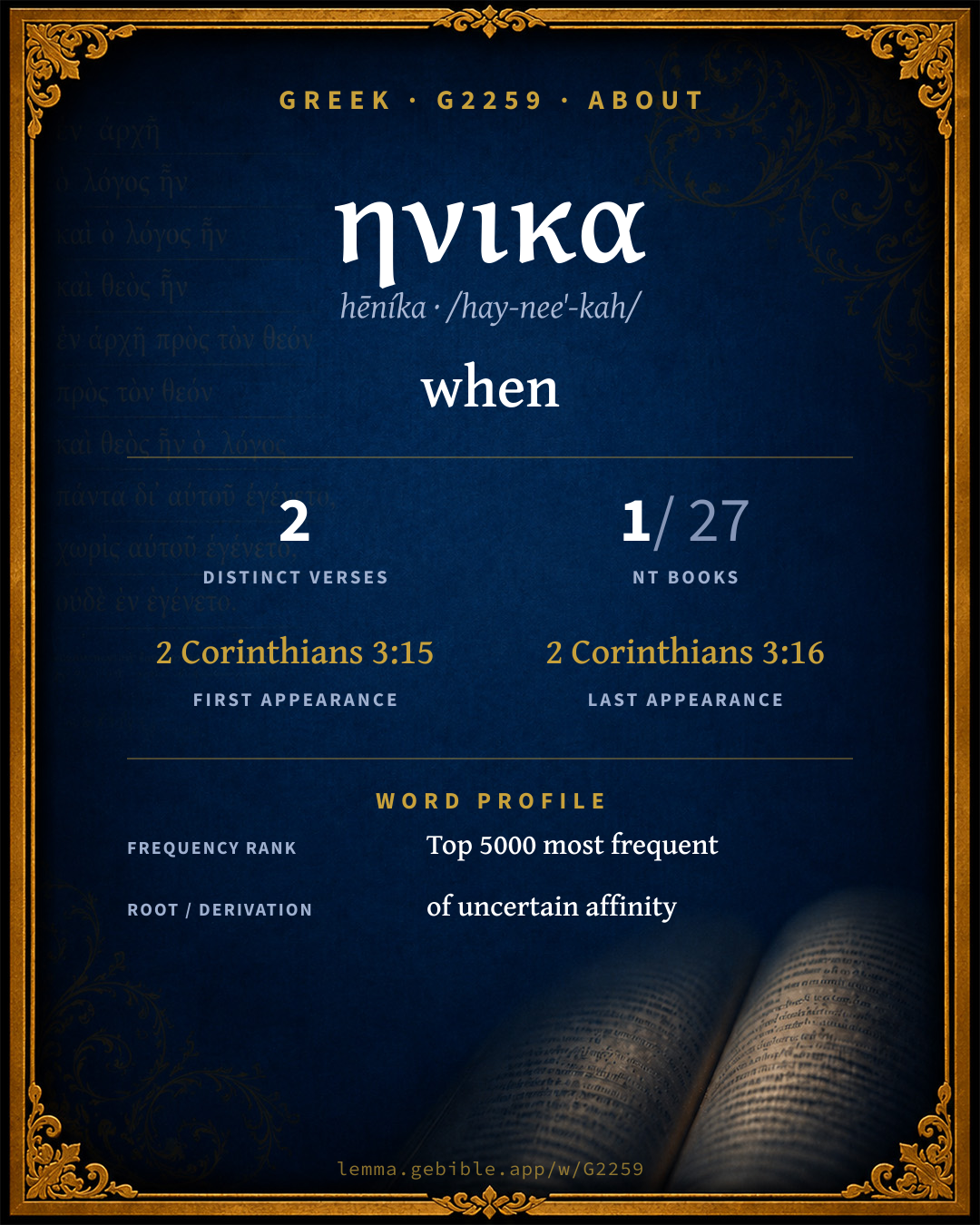
ἡνίκα
when
‘when’ is one of 2 main senses fuller range ↓
Full lexicon entry — Thayer's Greek Lexicon
From Thayer's Greek Lexicon
Where this word appears
Grammar key — what these labels mean
Part of speech
- Adverb
- A word that modifies a verb, adjective, or other adverb.
Every verse where G2259 appears — 2 distinct verses across 1 book. Click any verse to open its interlinear word-by-word view. Verse text shown in the World English Bible for context — . Each verse’s Greek form is shown with its reference; the English is not keyword-highlighted, since the data carries no word-level English alignment. Use “Compare translations” on any verse to read it across multiple English versions. This concordance covers the Greek New Testament; Septuagint (Greek Old Testament) occurrences of this word are not indexed here.
2 Corinthians 2 verses
About this entry
At a glance — auto-summarized from this page’s data, not written by a person. Every figure links to its source below. This summary describes the numbers; it doesn’t interpret them.
At its core, ηνικα (hēníka) means “when.” It is rare — just 2 verses in the entire Greek New Testament. The word gravitates to 2 Corinthians (100%). First canonically at 2 Corinthians 3:15, it enters the text early. Catalogued under 2 senses, its meaning is not single-sense. Dig into 2-verse concordance and the renderings breakdown below.
Gloss history
Strong's 1890 vs modern scholarship
About this word
Strong's G2259 catalogs a Greek word from the Greek New Testament.
These counts are not copied from any lexicon or concordance. They are computed here, from the morphology-tagged Greek New Testament. What Lemma adds →
- 2
- distinct verses
- The word appears in 2 distinct verses.
- 1 / 27
- NT books
- The word appears in 1 of 27 New Testament books.
- #2,678
- by frequency
- Top 5000 most frequent Greek words (rank 2,678 of 5,347 Greek words by occurrence).
View all 2 occurrences in the concordance →
Most concentrated in
- 2 Corinthians 2 verses 100%
By section of the New Testament
By traditional corpus
Conventional, traditional groupings — biblical authorship is debated, so this is a traditional corpus grouping, not an authorship claim. Some books belong to more than one corpus (Luke is in both the Gospels and the Lukan corpus, and so on), so these shares overlap and need not total 100%. Each figure is a share of the word’s 2 distinct verses.
- Pauline corpus 2 verses · 100%
How translations render this word
Counts come from each version’s own published word-to-Strong’s tagging or interlinear alignment — an approximate guide to how each version renders this word, not a word-level alignment the data otherwise carries. Because each total is that version’s own tagged count, the per-version totals vary from one another and need not match the appearance or distinct-verse counts above. These counts may also differ from a printed concordance because Lemma counts each distinctly tagged rendering and does not collapse phrase taggings into a single head-word total. This is a fixed set of word-tagged versions (KJV, ASV, BSB, ULT) and does not change with the reading translation you choose elsewhere. Each version’s license is shown beside its name below (and on Sources).
- King James Version: When 2×
- American Standard Version: Whensoever 2×
- Berean Standard Bible: When 1×, Whenever 1×
- unfoldingWord Literal Text: Whenever 2×
King James Version Public Domain
Renders G2259 across 2 tagged occurrences — most commonly:
American Standard Version Public Domain
Renders G2259 across 2 tagged occurrences — most commonly:
Berean Standard Bible Public Domain
Renders G2259 across 2 tagged occurrences — most commonly:
unfoldingWord Literal Text CC BY-SA 4.0
Renders G2259 across 2 tagged occurrences — most commonly:
Senses in Thayer's
The 2 senses Thayer's distinguishes for this word, in lexicon order (not ranked by frequency or importance). The full entry — with sub-senses — is in the Lexicon Entry tab.
- at which time, when
- whenever, at length when
Word origin
Origin: of uncertain affinity
Of uncertain affinity; at which time : - when.
— Strong’s Exhaustive Concordance (1890), public domain.
Septuagint usage
The same Greek word ηνικα appears 95 times in the Greek Old Testament (Septuagint), across 95 verses in 15 books.
- 95
- LXX occurrences
- Tagged occurrences of this Greek word in the Septuagint.
- 95
- verses
- Distinct Septuagint verses containing this word.
- 15 / 39
- OT books
- The word appears in 15 of the 39 Old Testament books.
Sample Septuagint occurrences
- Genesis 6:1 ἡνίκα
- Exodus 1:10 ἡνίκα
- Leviticus 5:23 ἡνίκα
- Numbers 9:17 ἡνίκα
- Deuteronomy 7:12 ἡνίκα
- Joshua 10:12 ἡνίκα
- Judges 3:18 ἡνίκα
- 2 Samuel 12:21 ἡνίκα
- 2 Kings 4:18 ἡνίκα
- Ezra 13:33 ἡνίκα
- Psalms 50:2 ἡνίκα
- Proverbs 1:26 ἡνίκα
Septuagint occurrences (same lexeme)
Every verse where the same Strong’s number (G2259) appears in the Greek Septuagint — showing the first 50 of 95. Verse text shown in the World English Bible for context; the Greek form is the matched word — the English is not keyword-highlighted.
- Genesis 6:1 ἡνίκα It happened, when men began to multiply on the surface of the ground, and daughters were born to them,
- Genesis 12:11 ἡνίκα It happened, when he was come near to enter into Egypt, that he said to Sarai his wife, "See now, I know that you are a beautiful woman to look on.
- Genesis 12:14 ἡνίκα It happened that when Abram had come into Egypt, the Egyptians saw that the woman was very beautiful.
- Genesis 16:16 ἡνίκα Abram was eighty-six years old, when Hagar bore Ishmael to Abram.
- Genesis 17:24 ἡνίκα Abraham was ninety-nine years old, when he was circumcised in the flesh of his foreskin.
- Genesis 17:25 ἡνίκα Ishmael, his son, was thirteen years old when he was circumcised in the flesh of his foreskin.
- Genesis 19:15 ἡνίκα When the morning arose, then the angels hurried Lot, saying, "Arise, take your wife, and your two daughters who are here, lest you be consumed in the iniquity of the city."
- Genesis 19:17 ἡνίκα It came to pass, when they had taken them out, that he said, "Escape for your life! Don't look behind you, neither stay anywhere in the plain. Escape to the mountain, lest you be consumed!"
- Genesis 20:13 ἡνίκα It happened, when God caused me to wander from my father's house, that I said to her, 'This is your kindness which you shall show to me. Everywhere that we go, say of me, "He is my brother."'"
- Genesis 21:5 ἡνίκα Abraham was one hundred years old when his son, Isaac, was born to him.
- Genesis 24:11 ἡνίκα He made the camels kneel down outside the city by the well of water at the time of evening, the time that women go out to draw water.
- Genesis 24:22 ἡνίκα It happened, as the camels had done drinking, that the man took a golden ring of half a shekel weight, and two bracelets for her hands of ten shekels weight of gold,
- Genesis 24:30 ἡνίκα It happened, when he saw the ring, and the bracelets on his sister's hands, and when he heard the words of Rebekah his sister, saying, "This is what the man said to me," that he came to the man. Behold, he was standing by the camels at the spring.
- Genesis 24:41 ἡνίκα Then will you be clear from my oath, when you come to my relatives. If they don't give her to you, you shall be clear from my oath.'
- Genesis 27:34 ἡνίκα When Esau heard the words of his father, he cried with an exceeding great and bitter cry, and said to his father, "Bless me, even me also, my father."
- Genesis 27:40 ἡνίκα By your sword will you live, and you will serve your brother. It will happen, when you will break loose, That you shall shake his yoke from off your neck."
- Genesis 30:42 ἡνίκα but when the flock were feeble, he didn't put them in. So the feebler were Laban's, and the stronger Jacob's.
- Genesis 31:10 ἡνίκα It happened at the time that the flock conceive, that I lifted up my eyes, and saw in a dream, and behold, the male goats which leaped on the flock were streaked, speckled, and grizzled.
- Genesis 32:3 ἡνίκα Jacob sent messengers in front of him to Esau, his brother, to the land of Seir, the field of Edom.
- Genesis 32:32 ἡνίκα Therefore the children of Israel don't eat the sinew of the hip, which is on the hollow of the thigh, to this day, because he touched the hollow of Jacob's thigh in the sinew of the hip.
- Genesis 35:16 ἡνίκα They traveled from Bethel. There was still some distance to come to Ephrath, and Rachel travailed. She had hard labor.
- Genesis 35:22 ἡνίκα It happened, while Israel lived in that land, that Reuben went and lay with Bilhah, his father's concubine, and Israel heard of it. Now the sons of Jacob were twelve.
- Genesis 37:23 ἡνίκα It happened, when Joseph came to his brothers, that they stripped Joseph of his coat, the coat of many colors that was on him;
- Genesis 38:5 ἡνίκα She yet again bore a son, and named him Shelah: and he was at Chezib, when she bore him.
- Genesis 38:27 ἡνίκα It happened in the time of her travail, that behold, twins were in her womb.
- Genesis 39:10 ἡνίκα It happened that as she spoke to Joseph day by day, that he didn't listen to her, to lie by her, or to be with her.
- Genesis 43:2 ἡνίκα It happened, when they had eaten up the grain which they had brought out of Egypt, their father said to them, "Go again, buy us a little more food."
- Genesis 43:21 ἡνίκα and it happened, when we came to the lodging-place, that we opened our sacks, and, behold, every man's money was in the mouth of his sack, our money in full weight. We have brought it again in our hand.
- Genesis 44:24 ἡνίκα It happened when we came up to your servant my father, we told him the words of my lord.
- Genesis 45:1 ἡνίκα Then Joseph couldn't control himself before all those who stood before him, and he cried, "Cause every man to go out from me!" There stood no man with him, while Joseph made himself known to his brothers.
- Genesis 48:7 ἡνίκα As for me, when I came from Paddan, Rachel died by me in the land of Canaan in the way, when there was still some distance to come to Ephrath, and I buried her there in the way to Ephrath (the same is Bethlehem)."
- Exodus 1:10 ἡνίκα Come, let us deal wisely with them, lest they multiply, and it happen that when any war breaks out, they also join themselves to our enemies, and fight against us, and escape out of the land."
- Exodus 7:7 ἡνίκα Moses was eighty years old, and Aaron eighty-three years old, when they spoke to Pharaoh.
- Exodus 12:27 ἡνίκα that you shall say, 'It is the sacrifice of Yahweh's Passover, who passed over the houses of the children of Israel in Egypt, when he struck the Egyptians, and spared our houses.'" The people bowed their heads and worshiped.
- Exodus 13:5 ἡνίκα It shall be, when Yahweh shall bring you into the land of the Canaanite, and the Hittite, and the Amorite, and the Hivite, and the Jebusite, which he swore to your fathers to give you, a land flowing with milk and honey, that you shall keep this service in this month.
- Exodus 13:15 ἡνίκα and it happened, when Pharaoh would hardly let us go, that Yahweh killed all the firstborn in the land of Egypt, both the firstborn of man, and the firstborn of animal. Therefore I sacrifice to Yahweh all that opens the womb, being males; but all the firstborn of my sons I redeem.'
- Exodus 16:10 ἡνίκα It happened, as Aaron spoke to the whole congregation of the children of Israel, that they looked toward the wilderness, and, behold, the glory of Yahweh appeared in the cloud.
- Exodus 16:21 ἡνίκα They gathered it morning by morning, everyone according to his eating. When the sun grew hot, it melted.
- Exodus 31:18 ἡνίκα He gave to Moses, when he finished speaking with him on Mount Sinai, the two tablets of the testimony, stone tablets, written with God's finger.
- Exodus 32:19 ἡνίκα It happened, as soon as he came near to the camp, that he saw the calf and the dancing: and Moses' anger grew hot, and he threw the tablets out of his hands, and broke them beneath the mountain.
- Exodus 33:8 ἡνίκα It happened that when Moses went out to the Tent, that all the people rose up, and stood, everyone at their tent door, and watched Moses, until he had gone into the Tent.
- Exodus 33:22 ἡνίκα It will happen, while my glory passes by, that I will put you in a cleft of the rock, and will cover you with my hand until I have passed by;
- Exodus 34:24 ἡνίκα For I will drive out nations before you and enlarge your borders; neither shall any man desire your land when you go up to appear before Yahweh, your God, three times in the year.
- Exodus 34:34 ἡνίκα But when Moses went in before Yahweh to speak with him, he took the veil off, until he came out; and he came out, and spoke to the children of Israel that which he was commanded.
- Exodus 40:33 ἡνίκα He raised up the court around the tent and the altar, and set up the screen of the gate of the court. So Moses finished the work.
- Leviticus 5:23 ἡνίκα
- Leviticus 10:9 ἡνίκα "Drink no wine nor strong drink, you, nor your sons with you, when you go into the Tent of Meeting, that you don't die: it shall be a statute forever throughout your generations:
- Leviticus 26:35 ἡνίκα As long as it lies desolate it shall have rest, even the rest which it didn't have in your sabbaths, when you lived on it.
- Numbers 9:17 ἡνίκα Whenever the cloud was taken up from over the Tent, then after that the children of Israel traveled; and in the place where the cloud remained, there the children of Israel encamped.
- Deuteronomy 7:12 ἡνίκα It shall happen, because you listen to these ordinances, and keep and do them, that Yahweh your God will keep with you the covenant and the loving kindness which he swore to your fathers:
These are occurrences of the same Greek lexeme (G2259) in the Septuagint — not a translation of any one Hebrew word. The store carries no word-level Hebrew↔Greek alignment, so no Hebrew original is asserted here. Counts come from the recovered LXX Strong's tagging — high-frequency vocabulary is well covered, while rare or late forms may be untagged — so they reflect tagged occurrences and may slightly undercount.