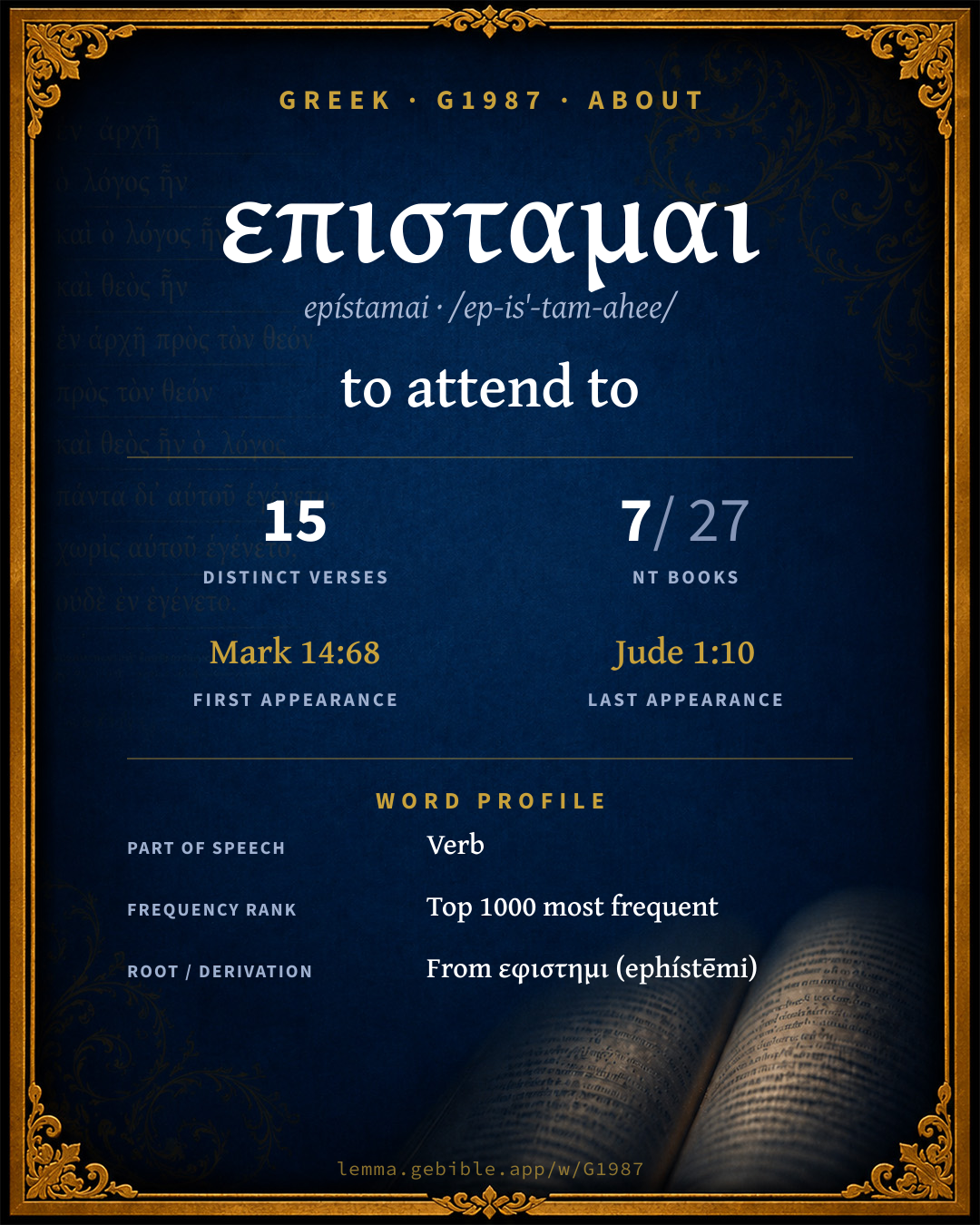
ἐπίσταμαι
to attend to
Full lexicon entry — Thayer's Greek Lexicon
From Thayer's Greek Lexicon
Where this word appears
Grammar key — what these labels mean
Part of speech
- Verb
- An action or state-of-being word.
Tense
- Present
- Ongoing or general action in present time (imperfective aspect).
Voice
- Middle or Passive deponent
- Middle/passive in form but active in meaning.
Mood
- Indicative
- States a fact or asks a factual question (the mood of reality).
- Participle
- A verbal adjective (“writing,” “having written”).
Case
- Nominative
- The case of the subject (and the predicate nominative).
Person
- 2nd person
- The one addressed (“you”).
- 1st person
- The speaker (“I / we”).
- 3rd person
- The one spoken about (“he / she / it / they”).
Gender
- Masculine
- Grammatically masculine.
Number
- Plural
- More than one.
- Singular
- One.
Grammatical forms
- Verb, Present, Middle or Passive deponent, Indicative, 2nd person, Plural 5 times (33%)
- Verb, Present, Middle or Passive deponent, Participle, Nominative, Singular, Masculine 4 times (27%)
- Verb, Present, Middle or Passive deponent, Indicative, 1st person, Singular 2 times (13%)
- Verb, Present, Middle or Passive deponent, Indicative, 3rd person, Plural 2 times (13%)
- Verb, Present, Middle or Passive deponent, Indicative, 3rd person, Singular 2 times (13%)
Parsed forms decoded from the imported morphology (Robinson–Tischendorf, public domain), counted across 15 parsed occurrences — not distinct verses.
Every verse where G1987 appears — 15 distinct verses across 7 books. Click any verse to open its interlinear word-by-word view. Verse text shown in the World English Bible for context — . Each verse’s Greek form is shown with its reference; the English is not keyword-highlighted, since the data carries no word-level English alignment. Use “Compare translations” on any verse to read it across multiple English versions. This concordance covers the Greek New Testament; Septuagint (Greek Old Testament) occurrences of this word are not indexed here.
Mark 1 verse
Acts 9 verses
- Acts 10:28 ἐπίστασθε pres mid/pass.dep ind 2pl He said to them, "You yourselves know how it is an unlawful thing for a man who is a Jew to join himself or come to one of another nation, but God has shown me that I shouldn't call any man unholy or unclean.
- Acts 15:7 ἐπίστασθε pres mid/pass.dep ind 2pl When there had been much discussion, Peter rose up and said to them, "Brothers, you know that a good while ago God made choice among you, that by my mouth the Gentiles should hear the word of the Gospel, and believe.
- Acts 18:25 ἐπιστάμενος pres mid/pass.dep ptcp nom sg masc This man had been instructed in the way of the Lord; and being fervent in spirit, he spoke and taught accurately the things concerning Jesus, although he knew only the baptism of John.
- Acts 19:15 ἐπίσταμαι pres mid/pass.dep ind 1sg The evil spirit answered, "Jesus I know, and Paul I know, but who are you?"
- Acts 19:25 ἐπίστασθε pres mid/pass.dep ind 2pl whom he gathered together, with the workmen of like occupation, and said, "Sirs, you know that by this business we have our wealth.
- Acts 20:18 ἐπίστασθε pres mid/pass.dep ind 2pl When they had come to him, he said to them, "You yourselves know, from the first day that I set foot in Asia, how I was with you all the time,
- Acts 22:19 ἐπίστανται pres mid/pass.dep ind 3pl I said, 'Lord, they themselves know that I imprisoned and beat in every synagogue those who believed in you.
- Acts 24:10 ἐπιστάμενος pres mid/pass.dep ptcp nom sg masc When the governor had beckoned to him to speak, Paul answered, "Because I know that you have been a judge of this nation for many years, I cheerfully make my defense,
- Acts 26:26 ἐπίσταται pres mid/pass.dep ind 3sg For the king knows of these things, to whom also I speak freely. For I am persuaded that none of these things is hidden from him, for this has not been done in a corner.
1 Thessalonians 1 verse
1 Timothy 1 verse
Hebrews 1 verse
James 1 verse
Jude 1 verse
About this entry
At a glance — auto-summarized from this page’s data, not written by a person. Every figure links to its source below. This summary describes the numbers; it doesn’t interpret them.
επισταμαι — transliterated epístamai — is a Greek verb carrying the sense “to attend to.” More than half of its appearances fall in Acts. It appears 15 verses across 7 books of the Greek New Testament, among its uncommon vocabulary. Debuting at Mark 14:68, it then recurs through the corpus. Related forms include εφιστημι and επιστημων. See the sense tree, 15-verse concordance, and the renderings breakdown below.
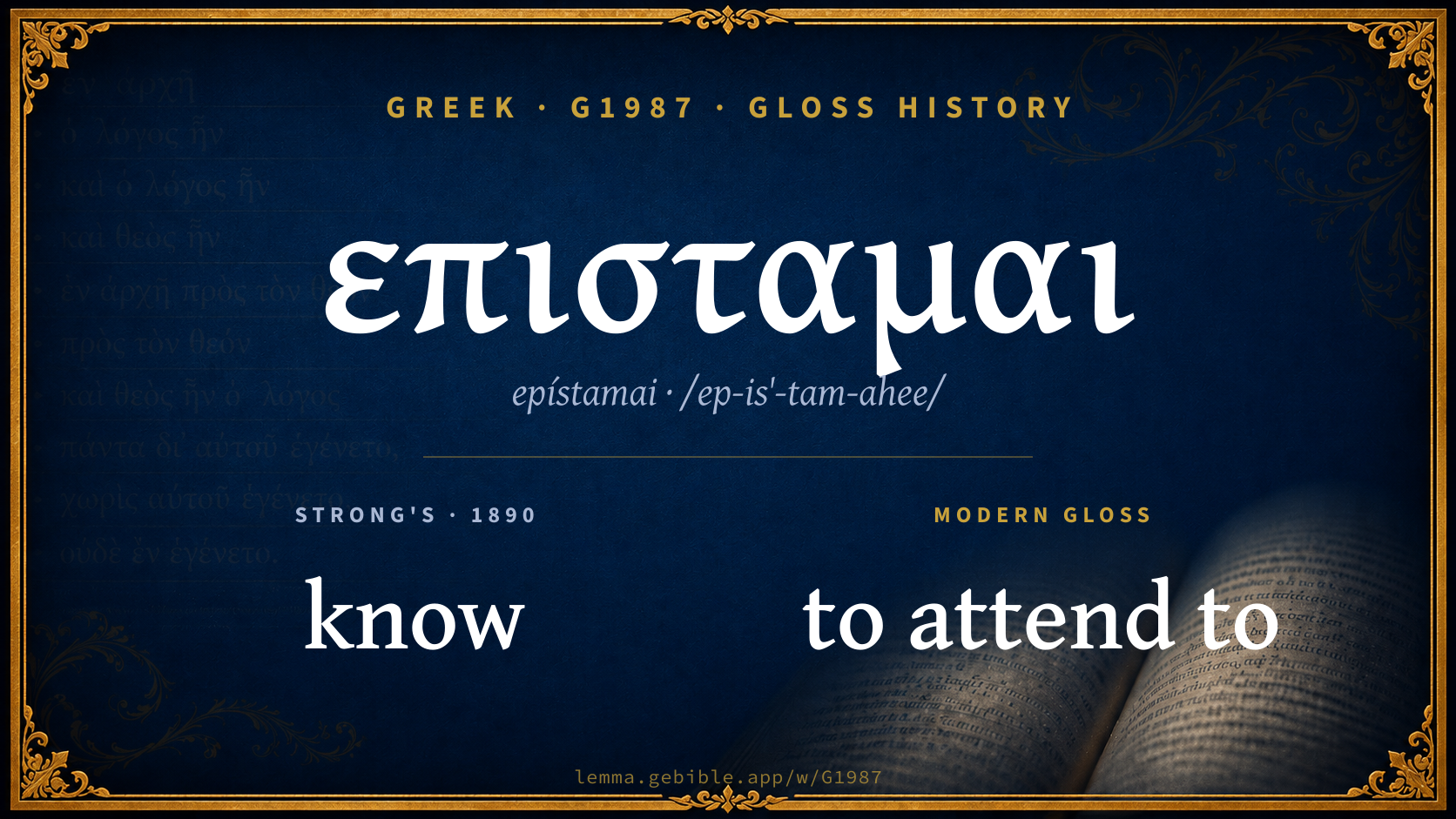
Gloss history
Strong's 1890 vs modern scholarship
About this word
Strong's G1987 catalogs a Greek word from the Greek New Testament.
These counts are not copied from any lexicon or concordance. They are computed here, from the morphology-tagged Greek New Testament. What Lemma adds →
- 15
- distinct verses
- The word appears in 15 distinct verses.
- 7 / 27
- NT books
- The word appears in 7 of 27 New Testament books.
- #768
- by frequency
- Top 1000 most frequent Greek words (rank 768 of 5,347 Greek words by occurrence).
View all 15 occurrences in the concordance →
Most concentrated in
- Acts 9 verses 60%
- Mark 1 verse 7%
- 1 Thessalonians 1 verse 7%
By section of the New Testament
By traditional corpus
Conventional, traditional groupings — biblical authorship is debated, so this is a traditional corpus grouping, not an authorship claim. Some books belong to more than one corpus (Luke is in both the Gospels and the Lukan corpus, and so on), so these shares overlap and need not total 100%. Each figure is a share of the word’s 15 distinct verses.
- Lukan (Luke–Acts) 9 verses · 60%
- Pauline corpus 2 verses · 13%
- General (Catholic) Epistles 2 verses · 13%
- Gospels 1 verse · 7%
- Hebrews 1 verse · 7%
How translations render this word
Counts come from each version’s own published word-to-Strong’s tagging or interlinear alignment — an approximate guide to how each version renders this word, not a word-level alignment the data otherwise carries. Because each total is that version’s own tagged count, the per-version totals vary from one another and need not match the appearance or distinct-verse counts above. These counts may also differ from a printed concordance because Lemma counts each distinctly tagged rendering and does not collapse phrase taggings into a single head-word total. This is a fixed set of word-tagged versions (KJV, ASV, BSB, ULT) and does not change with the reading translation you choose elsewhere. Each version’s license is shown beside its name below (and on Sources).
- King James Version: Know 4×, Knowing 3×, Ye know 2×
- American Standard Version: Knowing 2×, Ye know 2×, Yourselves know 2×
- Berean Standard Bible: Know 3×
- unfoldingWord Literal Text: Know 5×, Knowing 2×, You 2×
King James Version Public Domain
Renders G1987 across 14 tagged occurrences — most commonly:
Plus 5 renderings that appear only once — usually multi-word phrases or single function words the recovered tagging swept in, not distinct renderings.
American Standard Version Public Domain
Renders G1987 across 14 tagged occurrences — most commonly:
Plus 8 renderings that appear only once — usually multi-word phrases or single function words the recovered tagging swept in, not distinct renderings.
Berean Standard Bible Public Domain
Renders G1987 across 14 tagged occurrences — most commonly:
Plus 11 renderings that appear only once — usually multi-word phrases or single function words the recovered tagging swept in, not distinct renderings.
unfoldingWord Literal Text CC BY-SA 4.0
Renders G1987 across 21 tagged occurrences — most commonly:
Plus 12 renderings that appear only once — usually multi-word phrases or single function words the recovered tagging swept in, not distinct renderings.
Senses in Thayer's
The 1 sense Thayer's distinguishes for this word, in lexicon order (not ranked by frequency or importance). The full entry — with sub-senses — is in the Lexicon Entry tab.
- to put one's attention on, fix one's thoughts on, to turn one's self or one's mind to, put one's thought upon a thing
Word origin
Derived from εφιστημι (ephístēmi) (G2186) — to place upon.
Forms in the corpus
The 5 distinct written forms G1987 takes in the Greek New Testament, most frequent first — each parse links to that tense’s occurrences in the concordance.
| Form | Parsing | Example | Uses |
|---|---|---|---|
| ἐπίστασθε epístasthe | Verb, Present, Middle or Passive deponent, Indicative, 2nd person, Plural | Acts 10:28 | 5 |
| ἐπιστάμενος epistámenos | Verb, Present, Middle or Passive deponent, Participle, Nominative, Singular, Masculine | Acts 18:25 | 4 |
| ἐπίσταμαι epístamai | Verb, Present, Middle or Passive deponent, Indicative, 1st person, Singular | Mark 14:68 | 2 |
| ἐπίστανται epístantai | Verb, Present, Middle or Passive deponent, Indicative, 3rd person, Plural | Acts 22:19 | 2 |
| ἐπίσταται epístatai | Verb, Present, Middle or Passive deponent, Indicative, 3rd person, Singular | Acts 26:26 | 2 |
Same root — word family
Other Thayer's entries built from the same root as G1987, grouped by Strong’s listed origin. These share a root / origin per the lexicon — not necessarily a shared meaning. Each links to that word’s own entry.
Derives from
Derived from this word
Compare all same-root words → They share a root, not necessarily a meaning.
Septuagint usage
The same Greek word επισταμαι appears 46 times in the Greek Old Testament (Septuagint), across 45 verses in 11 books.
- 46
- LXX occurrences
- Tagged occurrences of this Greek word in the Septuagint.
- 45
- verses
- Distinct Septuagint verses containing this word.
- 11 / 39
- OT books
- The word appears in 11 of the 39 Old Testament books.
Sample Septuagint occurrences
- Genesis 47:5 ἐπίσταμαι
- Exodus 4:14 ἐπίσταμαι
- Numbers 20:14 ἐπίσταμαι
- Deuteronomy 20:20 ἐπίσταμαι
- Joshua 2:5 ἐπίσταμαι
- 2 Chronicles 2:6 ἐπίσταμαι
- Job 9:35 ἐπιἵσταμαι
- Proverbs 9:13 ἐπιἵσταμαι
- Isaiah 29:11 ἐπίσταμαι
- Jeremiah 1:5 ἐπίσταμαι
- Ezekiel 37:3 ἐπίσταμαι
Septuagint occurrences (same lexeme)
Every verse where the same Strong’s number (G1987) appears in the Greek Septuagint. Verse text shown in the World English Bible for context; the Greek form is the matched word — the English is not keyword-highlighted.
- Genesis 47:5 ἐπίσταμαι Pharaoh spoke to Joseph, saying, "Your father and your brothers have come to you.
- Exodus 4:14 ἐπίσταμαι The anger of Yahweh was kindled against Moses, and he said, "What about Aaron, your brother, the Levite? I know that he can speak well. Also, behold, he comes forth to meet you. When he sees you, he will be glad in his heart.
- Exodus 9:30 ἐπίσταμαι But as for you and your servants, I know that you don't yet fear Yahweh God."
- Numbers 20:14 ἐπίσταμαι Moses sent messengers from Kadesh to the king of Edom, Thus says your brother Israel, You know all the travail that has happened to us:
- Numbers 22:34 ἐπίσταμαι Balaam said to the angel of Yahweh, I have sinned; for I didn't know that you stood in the way against me: now therefore, if it displease you, I will get me back again.
- Numbers 24:16 ἐπίσταμαι He says, who hears the words of God, Knows the knowledge of the Most High, Who sees the vision of the Almighty, Falling down, and having his eyes open:
- Numbers 32:11 ἐπίσταμαι Surely none of the men who came up out of Egypt, from twenty years old and upward, shall see the land which I swore to Abraham, to Isaac, and to Jacob; because they have not wholly followed me:
- Deuteronomy 20:20 ἐπίσταμαι Only the trees of which you know that they are not trees for food, you shall destroy and cut them down; and you shall build bulwarks against the city that makes war with you, until it fall.
- Deuteronomy 22:2 ἐπίσταμαι If your brother isn't near to you, or if you don't know him, then you shall bring it home to your house, and it shall be with you until your brother seek after it, and you shall restore it to him.
- Deuteronomy 28:33 ἐπίσταμαι The fruit of your ground, and all your labors, shall a nation which you don't know eat up; and you shall be only oppressed and crushed always;
- Deuteronomy 28:36 ἐπίσταμαι Yahweh will bring you, and your king whom you shall set over you, to a nation that you have not known, you nor your fathers; and there shall you serve other gods, wood and stone.
- Deuteronomy 28:64 ἐπίσταμαι Yahweh will scatter you among all peoples, from the one end of the earth even to the other end of the earth; and there you shall serve other gods, which you have not known, you nor your fathers, even wood and stone.
- Deuteronomy 29:25 ἐπίσταμαι Then men shall say, Because they forsook the covenant of Yahweh, the God of their fathers, which he made with them when he brought them forth out of the land of Egypt,
- Deuteronomy 31:27 ἐπίσταμαι For I know your rebellion, and your stiff neck: behold, while I am yet alive with you this day, you have been rebellious against Yahweh; and how much more after my death?
- Joshua 2:5 ἐπίσταμαι and it happened about the time of the shutting of the gate, when it was dark, that the men went out; where the men went I don't know: pursue after them quickly; for you will overtake them.
- Joshua 2:9 ἐπίσταμαι and she said to the men, I know that Yahweh has given you the land, and that the fear of you is fallen on us, and that all the inhabitants of the land melt away before you.
- Joshua 3:4 ἐπίσταμαι Yet there shall be a space between you and it, about two thousand cubits by measure: don't come near to it, that you may know the way by which you must go; for you have not passed this way heretofore.
- Joshua 14:6 ἐπίσταμαι Then the children of Judah drew near to Joshua in Gilgal: and Caleb the son of Jephunneh the Kenizzite said to him, You know the thing that Yahweh spoke to Moses the man of God concerning me and concerning you in Kadesh-barnea.
- 2 Chronicles 2:6 ἐπίσταμαι But who is able to build him a house, seeing heaven and the heaven of heavens can't contain him? who am I then, that I should build him a house, save only to burn incense before him?
- 2 Chronicles 2:11 ἐπίσταμαι Then Huram the king of Tyre answered in writing, which he sent to Solomon, Because Yahweh loves his people, he has made you king over them.
- Job 9:35 ἐπιἵσταμαι Then I would speak, and not fear him, For I am not so in myself.
- Job 13:2 ἐπίσταμαι What you know, I know also. I am not inferior to you.
- Job 14:21 ἐπίσταμαι His sons come to honor, and he doesn't know it; They are brought low, but he doesn't perceive it of them.
- Job 19:27 ἐπιἵσταμαι Whom I, even I, shall see on my side. My eyes shall see, and not as a stranger. "My heart is consumed within me.
- Job 32:22 ἐπίσταμαι For I don't know how to give flattering titles; Or else my Maker would soon take me away.
- Job 37:16 ἐπίσταμαι Do you know the workings of the clouds, The wondrous works of him who is perfect in knowledge?
- Job 38:4 ἐπίσταμαι "Where were you when I laid the foundations of the earth? Declare, if you have understanding.
- Job 38:20 ἐπίσταμαι That you should take it to the bound of it, That you should discern the paths to the house of it?
- Job 38:33 ἐπίσταμαι Do you know the laws of the heavens? Can you establish the dominion of it over the earth?
- Proverbs 9:13 ἐπιἵσταμαι The foolish woman is loud, Undisciplined, and knows nothing.
- Proverbs 10:21 ἐπιἵσταμαι The lips of the righteous feed many, But the foolish die for lack of understanding.
- Proverbs 14:22 ἐπιἵσταμαι Don't they go astray who plot evil? But love and faithfulness belong to those who plan good.
- Proverbs 15:2 ἐπιἵσταμαι The tongue of the wise commends knowledge, But the mouth of fools gush out folly.
- Proverbs 29:7 ἐπιἵσταμαι The righteous care about justice for the poor. The wicked aren't concerned about knowledge.
- Isaiah 29:11 ἐπίσταμαι All vision is become to you as the words of a book that is sealed, which men deliver to one who is learned, saying, Read this, I pray you; and he says, I can't, for it is sealed:
- Isaiah 29:12 ἐπίσταμαι and the book is delivered to him who is not learned, saying, Read this, I pray you; and he says, I am not learned.
- Isaiah 37:28 ἐπίσταμαι But I know your sitting down, and your going out, and your coming in, and your raging against me.
- Isaiah 48:8 ἐπίσταμαι Yes, you didn't hear; yes, you didn't know; yes, from of old your ear was not opened: for I knew that you did deal very treacherously, and was called a transgressor from the womb.
- Isaiah 55:5 ἐπίσταμαι Behold, you shall call a nation that you don't know; and a nation that didn't know you shall run to you, because of Yahweh your God, and for the Holy One of Israel; for he has glorified you.
- Isaiah 66:18 ἐπίσταμαι For I [know] their works and their thoughts: [the time] comes, that I will gather all nations and languages; and they shall come, and shall see my glory.
- Jeremiah 1:5 ἐπίσταμαι Before I formed you in the belly I knew you, and before you came forth out of the womb I sanctified you; I have appointed you a prophet to the nations.
- Jeremiah 1:6 ἐπίσταμαι Then said I, Ah, Lord Yahweh! behold, I don't know how to speak; for I am a child.
- Jeremiah 2:8 ἐπίσταμαι The priests didn't say, Where is Yahweh? and those who handle the law didn't know me: the rulers also transgressed against me, and the prophets prophesied by Baal, and walked after things that do not profit.
- Jeremiah 17:16 ἐπίσταμαι As for me, I have not hurried from being a shepherd after you; neither have I desired the woeful day; you know: that which came out of my lips was before your face.
- Ezekiel 37:3 ἐπίσταμαι He said to me, Son of man, can these bones live? I answered, Lord Yahweh, you know.
These are occurrences of the same Greek lexeme (G1987) in the Septuagint — not a translation of any one Hebrew word. The store carries no word-level Hebrew↔Greek alignment, so no Hebrew original is asserted here. Counts come from the recovered LXX Strong's tagging — high-frequency vocabulary is well covered, while rare or late forms may be untagged — so they reflect tagged occurrences and may slightly undercount.