
Isaiah 37:28

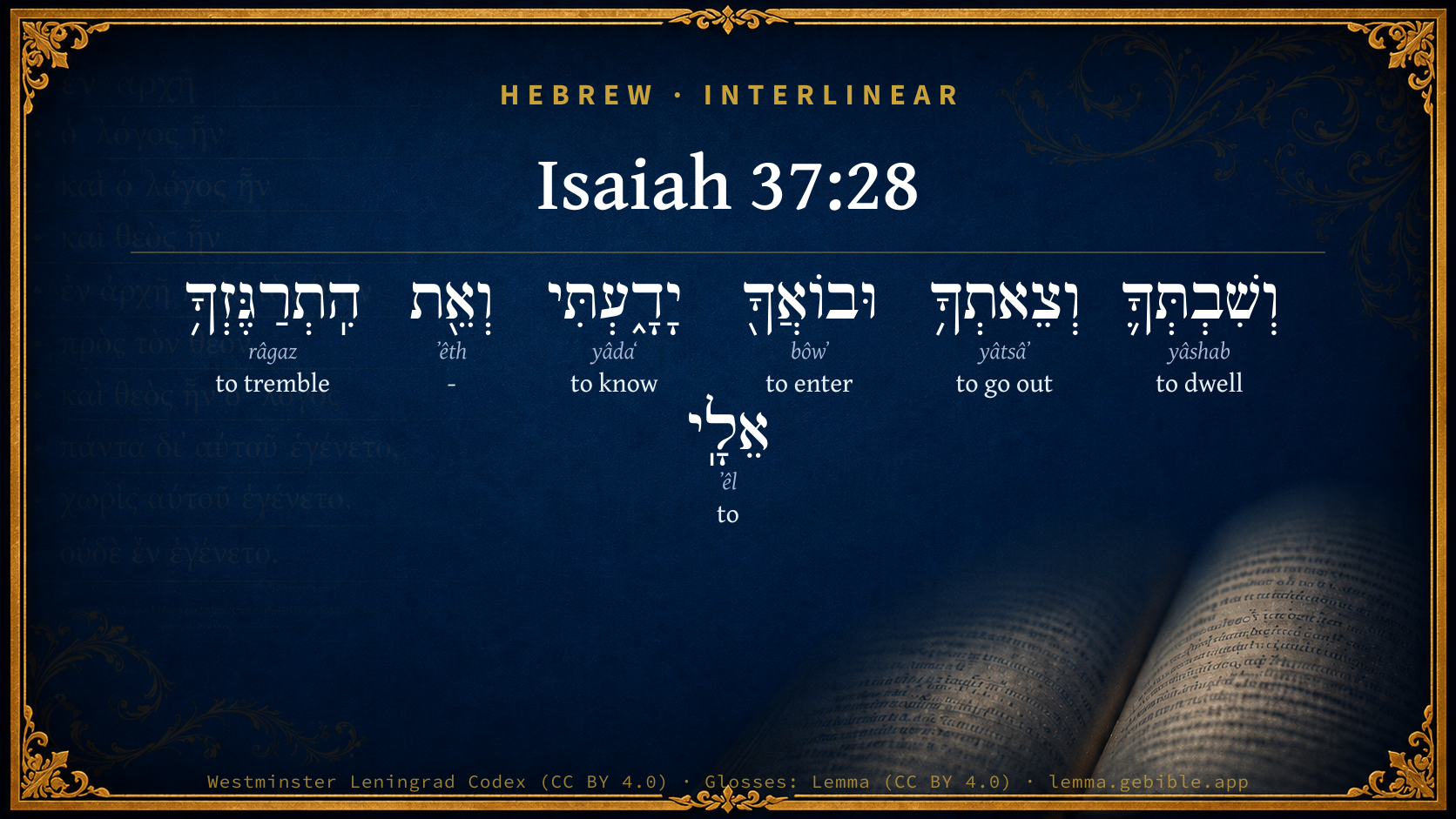
Hebrew (Westminster Leningrad Codex) Isaiah 37:28 appears in the Hebrew Old Testament. The text above is from the Westminster Leningrad Codex. Each word links to its Strong’s number, a concise gloss, and parsing drawn from the Open Scriptures Hebrew Bible morphology. Click any word for its full Brown-Driver-Briggs (BDB) entry.
Download image
Cite this verse

Isaiah 37:28 (World English Bible). Public Domain. Lemma interlinear Bible study tool, https://lemma.gebible.app/v/isaiah/37/28.

Show BibTeX & RIS
BibTeX
RIS
English Translation
But I know your sitting down, and your going out, and your coming in, and your raging against me.
World English Bible · Public Domain
Download a study sheet

One document with this verse’s original text, its word-by-word gloss line, the meaning frame, cross-references with their text, attributed commentary, and full source and license credits — printable, and it pastes into notes with its structure intact.

This verse Autodidact and up

Study sheet (.html) Plain text (.txt)

A passage Seminary Student

Up to 50 verses in one chapter. A passage sheet keeps up to 6 commentary sources and 12 cross-references per verse, in the order this page ranks them, and says so on the sheet whenever that leaves anything out. Ask for a single verse and you get the Autodidact verse sheet above.

Everything on this page stays free to read, with no account — the sheet is a download of what is already on screen, not access to it.

Want to remove ads? Support Godless Engineer
Compare translations 3

The same verse in 3 English versions, stacked beneath the original-language interlinear above. Click any original word for its lexicon entry.

Each is an independent rendering of the whole verse — the interlinear is not word-aligned to these translations.

Highlighted words mark where these versions differ — a whole-verse word diff, not a word-by-word alignment.

  • World English Bible Public Domain
    But I know your sitting down, and your going out, and your coming in, and your raging against me.
  • King James Version Public Domain
    But I know thy abode, and thy going out, and thy coming in, and thy rage against me.
  • unfoldingWord Literal Text CC BY-SA 4.0
    But I know your dwelling and your going out and your coming in and your raging against me.

unfoldingWord Literal Text — © unfoldingWord, licensed CC BY-SA 4.0. Word-aligned USFM3 via Door43 (git.door43.org/unfoldingWord/en_ult).

Versions to compare (up to 4)

3 of 4 selected

Show all 18 translations

Every available English version of this verse, each an independent rendering of the whole verse.

  • World English Bible Public Domain
    But I know your sitting down, and your going out, and your coming in, and your raging against me.
  • Berean Standard Bible Public Domain
    But I know your sitting down, your going out and coming in, and your raging against Me.
  • Majority Standard Bible Public Domain
    But I know your sitting down, your going out and coming in, and your raging against Me.
  • King James Version Public Domain
    But I know thy abode, and thy going out, and thy coming in, and thy rage against me.
  • American Standard Version (1901) Public Domain
    But I know thy sitting down, and thy going out, and thy coming in, and thy raging against me.
  • Revised Version (1885) Public Domain
    But I know thy sitting down, and thy going out, and thy coming in, and thy raging against me.
  • Geneva Bible (1599) Public Domain
    But I know thy dwelling, and thy going out, and thy comming in, and thy fury against me.
  • Douay-Rheims (1899) Public Domain
    I know thy dwelling, and thy going out, and thy coming in, and thy rage against me.
  • Young's Literal Translation Public Domain
    And thy sitting down, and thy going out, And thy coming in, I have known, And thy anger towards Me.
  • Literal Standard Version CC BY-SA 4.0
    And your sitting down, and your going out, || And your coming in, I have known, || And your anger toward Me.
  • Unlocked Literal Bible CC BY-SA 4.0
    But I know your sitting down, your going out, your coming in, and your raging against me.
  • unfoldingWord Literal Text CC BY-SA 4.0
    But I know your dwelling and your going out and your coming in and your raging against me.
  • Darby Bible Public Domain
    But I know thine abode, and thy going out, and thy coming in, and thy raging against me.
  • World Messianic Bible Public Domain
    But I know your sitting down, your going out, your coming in, and your raging against me.
  • Webster's Bible Public Domain
    But I know thy abode, and thy going out, and thy coming in, and thy rage against me.
  • Free Bible Version CC BY-SA 4.0
    But I know you very well—where you live, when you come in, when you leave, and your furious anger against me.
  • Bible in Basic English Public Domain
    But I have knowledge of your getting up and your resting, of your going out and your coming in.
  • JPS Tanakh (1917) Public Domain
    But I know thy sitting down, and thy going out, and thy coming in, and thy raging against Me.

Literal Standard Version (2020), Covenant Press — licensed CC BY-SA 4.0. Text via the HelloAO Bible API (eBible.org). Unlocked Literal Bible (unfoldingWord) — licensed CC BY-SA 4.0. Text via the HelloAO Bible API (eBible.org). unfoldingWord Literal Text — © unfoldingWord, licensed CC BY-SA 4.0. Word-aligned USFM3 via Door43 (git.door43.org/unfoldingWord/en_ult). Free Bible Version, Dr. Jonathan Gallagher — licensed CC BY-SA 4.0. Text via the HelloAO Bible API (eBible.org).

Word by word

More ways to search: Search by grammar → Find every occurrence → Compare this word →

Practice this passage: Drill this verse → Learn its vocabulary →

הִֽתְרַגֶּזְךָ֥
râgaz
H7264
“to tremble · you”
Verb, Hithpael, Infinitive Construct + Suffix, Personal, 2nd Person, Masculine, Singular
Part of Speech
Verb
Stem
Hithpael
Form
Infinitive Construct
Full BDB Definition

Origin: a primitive root

TWOT: 2112

tremble, quake, rage, quiver, be agitated, be excited, be perturbed - (Qal) to quake, be disquieted, be excited, be perturbed - (Hiphil) to cause to quake, disquiet, enrage, disturb - (Hithpael) to excite oneself
  1. וְשִׁבְתְּךָ֛ yâshab H3427 “and · to dwell · you” Conjunction + Verb, Qal, Infinitive Construct + Suffix, Personal, 2nd Person, Masculine, Singular
  2. וְצֵאתְךָ֥ yâtsâʼ H3318 “and · to go out · you” Conjunction + Verb, Qal, Infinitive Construct + Suffix, Personal, 2nd Person, Masculine, Singular
  3. וּבוֹאֲךָ֖ bôwʼ H935 “and · to enter · you” Conjunction + Verb, Qal, Infinitive Construct + Suffix, Personal, 2nd Person, Masculine, Singular
  4. יָדָ֑עְתִּי yâdaʻ H3045 “to know” Verb, Qal, Perfect, 1st Person, Common, Singular
  5. וְאֵ֖ת ʼêth H853 “and · -” Conjunction + Particle, Direct Object
  6. אֵלָֽי ʼêl H413 “to · me” Preposition + Suffix, Personal, 1st Person, Common, Singular

About this verse

These counts appear in no published source. They are computed here, from the morphology-tagged text and Lemma’s own curated glosses. What Lemma adds →

7
words
7
distinct lemmas
Prophets
section

Shared distinctive vocabulary

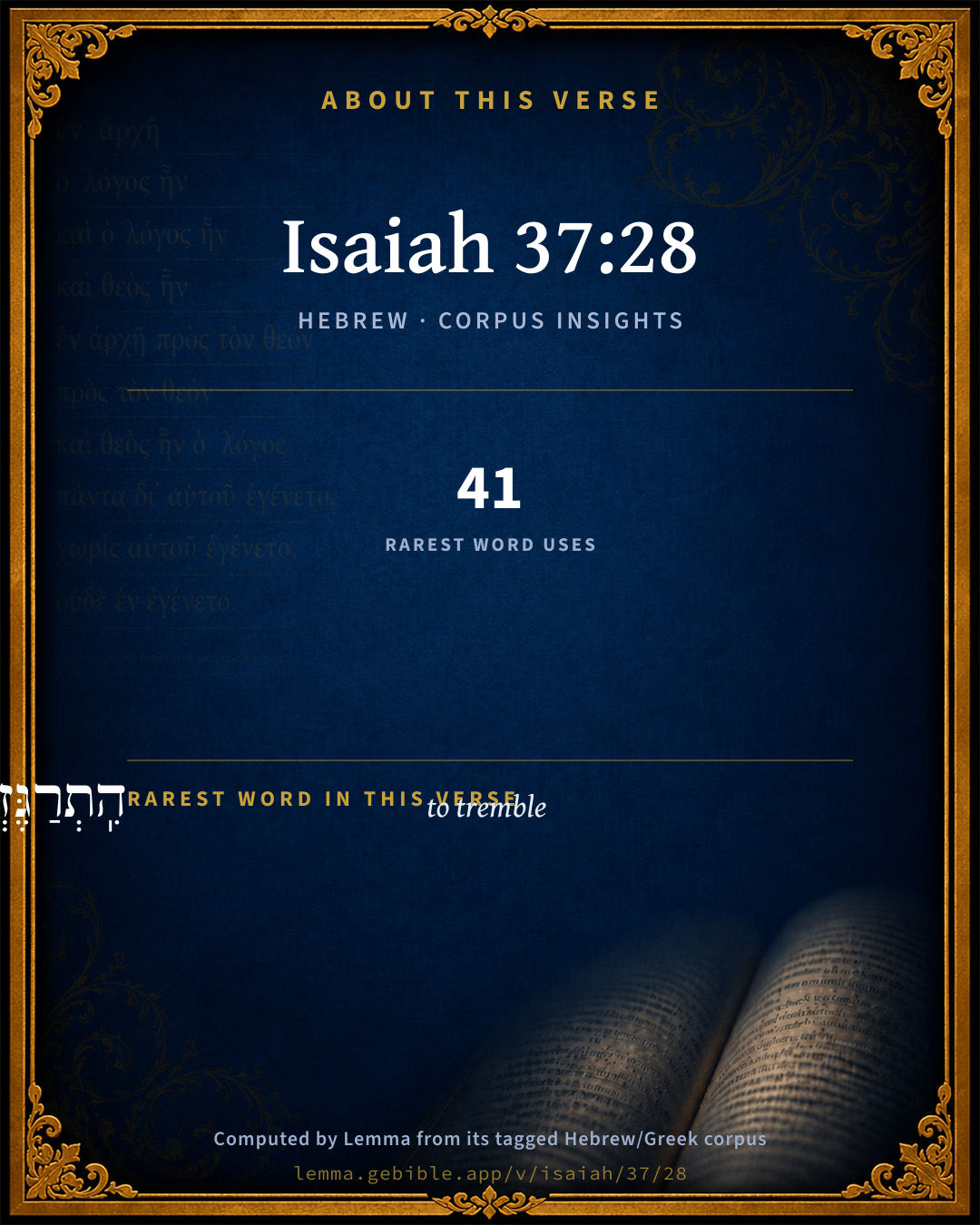
הִֽתְרַגֶּזְךָ֥ to tremble H7264 occurs in 40 verses of the Hebrew Bible. Also found in:

Grammatical profile

  • 5 verbs
  • 1 preposition
  • 1 particle

Verb forms

  • וְשִׁבְתְּךָ֛ Qal · Infinitive Construct
  • וְצֵאתְךָ֥ Qal · Infinitive Construct
  • וּבוֹאֲךָ֖ Qal · Infinitive Construct
  • יָדָ֑עְתִּי Qal · Perfect
  • הִֽתְרַגֶּזְךָ֥ Hithpael · Infinitive Construct

Hebrew & Septuagint length

In English translation the verse runs 19 words from the Hebrew and 14 from the Septuagint (LXX English) — closely comparable.

A rough comparison of the two English renderings, which tokenize alike — not a word-level alignment.

Word counts can differ between the Hebrew and the Greek without any difference in meaning — e.g. the Hebrew direct-object marker אֵת has no separate Greek word, and Greek often adds the article ὁ.

Cross-references

5

Topical passages linked to Isaiah 37:28 in the Treasury of Scripture Knowledge — connected by theme and wording, ordered by reader-vote popularity; previews shown in the World English Bible.

  • Psalms 139:1–11 Yahweh, you have searched me, And you know me.
  • Revelation 2:13 "I know your works and where you dwell, where Satan's throne is. You hold firmly to my name, and didn't deny my faith in the days of Antipas my witness, my faithful one, who was killed among you, where Satan dwells.
  • Proverbs 5:21 For the ways of man are before the eyes of Yahweh. He examines all his paths.
  • Proverbs 15:3 Yahweh's eyes are everywhere, Keeping watch on the evil and the good.
  • Jeremiah 23:23–24 Am I a God at hand, says Yahweh, and not a God afar off?

Cross-references courtesy of OpenBible.info (CC BY 4.0).

Hebrew and Greek witnesses Masoretic Hebrew ↔ Greek Septuagint

The same verse in the two great witnesses to the Old Testament, shown verse-for-verse.

These are two independent witnesses, not word-aligned to each other, and the Septuagint is shown in lemma (dictionary) form.

Hebrew Isaiah 37:28 Masoretic · Westminster Leningrad Codex

וְשִׁבְתְּךָ֛ וְצֵאתְךָ֥ וּבוֹאֲךָ֖ יָדָ֑עְתִּי וְאֵ֖ת הִֽתְרַגֶּזְךָ֥ אֵלָֽי

But I know your sitting down, and your going out, and your coming in, and your raging against me.

World English Bible · Public Domain

Greek LXX Isaiah 37:28 Septuagint · lemma form

νῦν δέ ὁ ἀνάπαυσις σύ καί ὁ ἔξοδος σύ καί ὁ εἴσοδος σύ ἐγώ ἐπίσταμαι

But now I know your rest, and your going out, and your coming in.

LXX2012 (modern English Septuagint) · Public Domain

Hebrew: Westminster Leningrad Codex (CC BY 4.0). Greek: Septuagint (public domain); English from LXX2012 (modern English Septuagint) (Public Domain). How the Septuagint differs from the Hebrew →

Targum (Aramaic paraphrase)

1

The Targum is the ancient Jewish Aramaic paraphrase of the Hebrew Scriptures — an interpretive translation, not the Hebrew text itself. Onkelos (literal) and Pseudo-Jonathan (expansive) render the Torah, and Jonathan the Prophets. Coverage is partial: where no permissively-licensed English translation exists for a verse, only the Aramaic is shown. This is verse-level text, not a word-by-word alignment to the Hebrew.

  1. Targum Jonathan Prophets (Joshua–Malachi)
    וּמַתְבָךְ בְעֵיצָה וּמַקְפָךְ לְבָרָא לְאַגָחָא קְרָבָא וּמֵיתְיָךְ לְאַרְעָא דְיִשְׂרָאֵל גְלֵי קֳדָמַי וְיַת דְאַרְגֵיזְתָּא קֳדָמַי גְלֵי:

    And thy sitting down in counsel, and thy going forth to wage war, and thy coming into the land of Israel is known to me, and that thou art enraged is known to me.

    Targum Jonathan — Aramaic: “Mikraot Gedolot” (public domain). English: “Sefaria Community Translation” (CC0 1.0 (public-domain dedication)); “London "Chaldee Paraphrase," 1871” (public domain). Text via Sefaria.

Commentary

Notes on Isaiah 37:28 from classic Christian and Jewish commentators (each source and its license shown beneath its notes). The classic Christian expositions comment on the surrounding passage and are grouped to its opening verse, so a note may address several verses; the Jewish commentaries on the Tanakh (Rashi and others) are per-verse, so they appear only where the commentator wrote on this verse.

Lemma curates 59 commentaries, every one of them public domain or Creative Commons licensed, each selected and text-cleaned for this edition rather than reprinted as found. About our sources →

The Cambridge Bible for Schools and Colleges

gen. ed. J. J. S. Perowne

28, 29. All the acts of the Assyrian are under the strict surveillance of Jehovah, who will shew His power over him by dragging him back, like a wild beast, to his place. If the emendation of Wellhausen (see on Isa_37:27) be accepted, Isa_37:28 would read: Before me is thy rising up and thy sitting down (cf. Psa_139:2), and thy going out and thy coming in I know, and thy raging against me.

The Cambridge Bible for Schools and Colleges (gen. ed. J. J. S. Perowne; Cambridge University Press, 1878–1918) — public domain. Text from a community e-Sword module.

Tyndale Open Study Notes

Tyndale Open Resources

37:28 you have raged against me: Assyria was utterly hostile to the Lord, which brought them even greater condemnation.

Tyndale Open Study Notes — © Tyndale Open Resources, licensed CC BY-SA 4.0. Text via the HelloAO Bible API.

Geneva Bible (1599)

Geneva Bible translators

Meaning, his counsels and enterprises.

Geneva Bible (1599) marginal notes — public domain. Text via Bolls.life.

Jamieson, Fausset & Brown

Robert Jamieson, A. R. Fausset & David Brown

abode--rather, "sitting down" (Psa 139:2). The expressions here describe a man's whole course of life (Deu 6:7; Deu 28:6; Kg1 3:7; Psa 121:8). There is also a special reference to Sennacherib's first being at home, then going forth against Judah and Egypt, and raging against Jehovah (Isa 37:4).

Jamieson, Fausset & Brown — Commentary Critical and Explanatory on the Whole Bible (1871) — public domain (CC PDM 1.0). Text via the HelloAO Bible API.

Ellicott's Commentary for English Readers

(28) Thy abode . . .—The three words include, in the common speech of the Hebrews, the whole of human life in every form of activity (Psa_121:8; Psa_139:2).

A Bible Commentary for English Readers, edited by Charles John Ellicott (1878–1897) — public domain. Text from a community e-Sword module.

John Gill's Exposition

And this shall be a sign unto thee,.... Not to Sennacherib, but to Hezekiah; for here the Lord turns himself from the former, and directs his speech to the latter, in order to comfort him under the dreadful apprehensions he had of the Assyrian monarch, and his army; assuring him of deliverance; giving him a sign or token of it, and which was a wonder, as the word sometimes signifies, and was no less marvellous than the deliverance itself:

ye shall eat this year such as groweth of itself: and the second year that which springeth of the same: and in the third year sow ye, and reap and plant vineyards, and eat the fruit thereof: all which was very wonderful; for whereas, either through the invasion of the land, and the siege of the city, they could not till their land as they had used to do, or what was upon it was destroyed or eaten up by the Assyrian army; and yet, through the wonderful providence of God, the earth of its own accord yielded that very year a sufficiency for them; and though the second year was, as it is thought, a sabbatical year, when the land had rest, and by the law was not to be tilled, yet it also produced of itself what was sufficient for their support; and then the third year being entirely free from the enemy, and all fears of his return, they go about their business as formerly, to sowing and reaping corn, and planting vineyards, and enjoying the fruit of their labours; all which falling out according to this prediction, must greatly confirm the mind of Hezekiah, and make him easy as to any future attempt upon him he might fear. The Vulgate Latin version renders the second clause, "ye shall eat apples the second year"; and so Symmachus, but without foundation.

John Gill's Exposition of the Whole Bible (1746–1763) — public domain (CC PDM 1.0). Text via the HelloAO Bible API.

Albert Barnes' Notes on the Bible

But I know - The language of God. ‘I am well acquainted with all that pertains to you. You neither go out to war, nor return, nor abide in your capital without my providential direction’ (see the notes at Isa 10:5-7).

Thy abode - Margin, ‘Sitting.’ Among the Hebrews, sitting down, rising up, and going out, were phrases to describe the whole of a man’s life and actions (compare Deu 6:7; Deu 28:6; 1Ki 3:7; Psa 121:8). God here says that he knew the place where he dwelt, and he was able to return him again to it Isa 37:29.

And thy rage against me - (See Isa 37:4).

Albert Barnes' Notes on the Bible (1834–1885) — public domain. Text from a community e-Sword/MySword module.

Whedon's Commentary on the Bible

Daniel D. Whedon

28. The expressions, thy abode… going out… coming in, are commonly agreed to mean all the actions of life. Psa_139:2. These, Jehovah says to the Assyrian general, he has always known.

Daniel D. Whedon (gen. ed.), Commentary on the Old and New Testaments (1874–1909) — public domain. Text from a community e-Sword module.

The Pulpit Commentary

I know thy abode; literally, thy down-sitting. (comp. Psa_139:2) The meaning is that God has, and has had, his eye on Sennacherib throughout all his career, seeing to and watching over his performance of his will. The phrase, going out, and coming in, is a Hebrew idiom for a man"s doings. (see Num_27:17 Deu_28:6 Deu_31:2 1Sa_18:13, 16 2Sa_3:25 1Ki_3:7, etc.) Thy rage against me. As shown in the message sent by Rab-shakeh, (Isa_36:7) in Rabshakeh"s speech to the "men on the wall", (Isa_36:15-20) and in the letter sent to Hezekiah from Lachish. (Isa_37:10)

Vers. 28, 29. God"s agents are never beyond his restrainings.

He used Assyria, but he holds Assyria in with bit and bridle. The horse may plunge, and rear, and trample, and seem to be beyond all restraint; but God never looses the rein, and draws it in when he pleases. The figures used are even more striking. He puts "a hook in the nose," which Michaelis explains in this way: "The Orientals make use of a contrivance for curbing their work-beasts, which is not adopted among us. They bore the nose through both sides, and put a ring through it, to which they fasten two cords. When a beast becomes unruly, they have only to draw the cord on one side, which, by stopping his breath, punishes him so effectually that, after a few repetitions, he fails not to become quite tractable, whenever he begins to feel it. To this contrivance the Arabian poets often allude." It illustrates two points.

I THE ANXIETIES WE SUFFER WHEN WE FIX OUR GAZE ON SECOND CAUSES.

II THE RESTFULNESS WE GAIN WHEN WE LOOK, BEHIND AND WITHIN, TO THE GREAT, OVERRULING FIRST CAUSE. R.T.

The Pulpit Commentary (1880–1919), ed. H.D.M. Spence-Jones & Joseph S. Exell — public domain. Text from a community e-Sword module.

Keil & Delitzsch

C. F. Keil & F. Delitzsch

Asshur is Jehovah's chosen instrument while thus casting down the nations, which are "short-handed against him," i.e., incapable of resisting him. But Jehovah afterwards places this lion under firm restraint; and before it has reached the goal set before it, He leads it back into its own land, as if with a ring through its nostril. Fifth turn, "And thy sitting down, and thy going out, and thy entering in, I know; and thy heating thyself against me. On account of thy heating thyself against me, and because thy self-confidence has risen up into mine ears, I put my ring into thy nose, and my muzzle into thy lips, and lead thee back by the way by which thou hast come." Sitting down and rising up (Psa 139:2), going out and coming in (Psa 121:8), denote every kind of human activity. All the thoughts and actions, the purposes and undertakings of Sennacherib, more especially with regard to the people of Jehovah, were under divine control. יען is followed by the infinitive, which is then continued in the finite verb, just as in Isa 30:12. שׁאננך (another reading, שׁאננך) is used as a substantive, and denotes the Assyrians' complacent and scornful self-confidence (Psa 123:4), and has nothing to do with שׁאון (Targum, Abulw., Rashi, Kimchi, Rosenmller, Luzzatto). The figure of the leading away with a nose-ring (chachı̄ with a latent dagesh, חא to prick, hence chōach, Arab. chōch, chōcha, a narrow slit, literally means a cut or aperture) is repeated in Eze 38:4. Like a wild beast that had been subdued by force, the Assyrian would have to return home, without having achieved his purpose with Judah (or with Egypt).

Keil & Delitzsch — Biblical Commentary on the Old Testament (1861–1891) — public domain (CC PDM 1.0). Text via the HelloAO Bible API. (Old Testament only.)

J. A. Alexander on Isaiah

Joseph Addison Alexander

“And thy sitting down, and thy going out, and thy coming in, I have known, and thy raging (or provoking of thyself) against me.” These phrases are combined to signify all the actions of his life, like sitting down and rising up in Psa 139:2, going out and coming in (Deu 28:6; 1Ki 3:7), and elsewhere, the latter especially in reference to military movements (1Sa 18:16; 2Sa 5:2).

Joseph Addison Alexander, The Prophecies of Isaiah (1846–1847; New York: Scribner, 1870–1878) — public domain. Text from a community e-Sword module.

unfoldingWord translationNotes

Door43 World Missions Community

General Information:

This continues Yahweh's message to the king of Assyria.

But I know your sitting down, your going out, your coming in

This refers to all activities of life. AT: "I know everything you do" (See: Merism)

and your raging against me

The word "raging" can be expressed as a verb. AT: "how you rage against me" (See: Abstract Nouns)

your arrogance

Here the king's "arrogance" refers to his arrogant speech. AT: "your arrogant speech" (See: Metonymy)

your arrogance has reached my ears

This speaks of Yahweh hearing the king's speech as if the king's speech were something that traveled to his ear. AT: "I have heard you speaking arrogantly" (See: Metaphor)

I will put my hook in your nose, and my bit in your mouth

A person uses a hook and bit to lead an animal around. This speaks of Yahweh controlling the king as if the king were an animal Yahweh controlled with a bit and hook. AT: "I will control you like a man controls his animal by place a hook in its nose and a bit in its mouth" (See: Metaphor)

I will turn you back the way you came

This refers to causing the king to return to his own home country. The meaning of this can be made clear. AT: "I will force you to return to your own country" (See: Assumed Knowledge and Implicit Information)

translationWords

rage

arrogant

turn

unfoldingWord translationNotes — © Distant Shores Media and the Door43 World Missions Community, licensed CC BY-SA 4.0. Source: git.door43.org/Door43/en_tn.

Rashi

Rabbi Shlomo Yitzchaki (Rashi)

And your sitting and your going out and your coming I know Jonathan paraphrased: And your sitting in counsel, and your going out to wage war, and your coming to the land of Israel, is revealed to Me. When the thought entered your mind, and you took counsel to destroy My house, I knew it.

Rashi on the Tanakh — English translations: “The Judaica Press complete Tanach with Rashi, translated by A. J. Rosenberg” (CC BY 4.0); “Pentateuch with Rashi's commentary by M. Rosenbaum and A.M. Silbermann, 1929-1934” (public domain); “The Metsudah Tanach series, Lakewood, N.J” (CC BY 4.0); and “The Book of Joshua, Metsudah Publications, 1997” (CC BY 4.0). Text via Sefaria.

Lesson kit

Teaching starters — assembled from the data on this page, not authored interpretation. Every prompt links to the verse data it draws on. Edit before teaching.

Isaiah, in the Prophets, opens this verse with 7 words (7 distinct Hebrew lemmas). Its most distinctive word is râgaz (“to tremble”). A historical commentator’s framing appears above. Read the whole chapter for the surrounding context.

Discussion questions

  1. How does “to tremble” (râgaz) shape what this verse is saying?
  2. How does Genesis 45:24, which shares the word «to tremble», read alongside this verse?
  3. These translations render this verse differently; the difference is in the English rendering, not the original. What questions does that raise?
  4. «וְשִׁבְתְּךָ֛» is a Qal Infinitive Construct verb. How does that grammatical form shape the action described?
  5. Compare how The Cambridge Bible for Schools and Colleges and Tyndale Open Study Notes read this verse. Where do they agree or differ?

Things to notice

Reading settings

Reading text

Shown beneath each verse's original-language words.

Old Testament
Old Testament edition

Read the OT as the Masoretic Hebrew (MT) or the Greek Septuagint (LXX).

English shown for the Greek Septuagint (in the Hebrew ↔ Greek comparison).

Comparing translations? Open the Compare panel on any verse page to stack up to four side by side.