
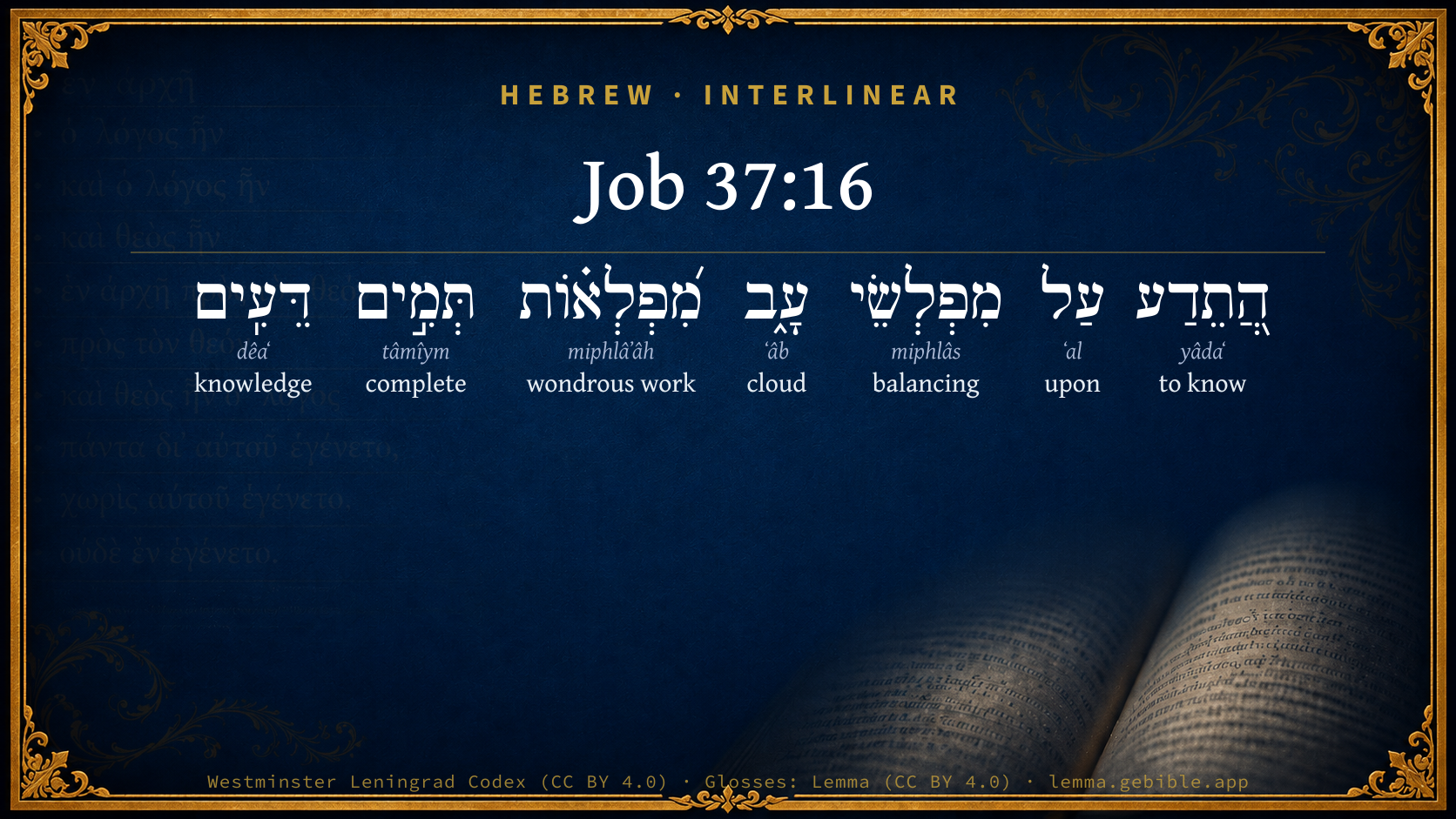
Job 37:16

Hebrew (Westminster Leningrad Codex) Job 37:16 appears in the Hebrew Old Testament. The text above is from the Westminster Leningrad Codex. Each word links to its Strong’s number, a concise gloss, and parsing drawn from the Open Scriptures Hebrew Bible morphology. Click any word for its full Brown-Driver-Briggs (BDB) entry.
Download image
Cite this verse

Job 37:16 (World English Bible). Public Domain. Lemma interlinear Bible study tool, https://lemma.gebible.app/v/job/37/16.

Show BibTeX & RIS
BibTeX
RIS
English Translation
Do you know the workings of the clouds, The wondrous works of him who is perfect in knowledge?
World English Bible · Public Domain
Highlights
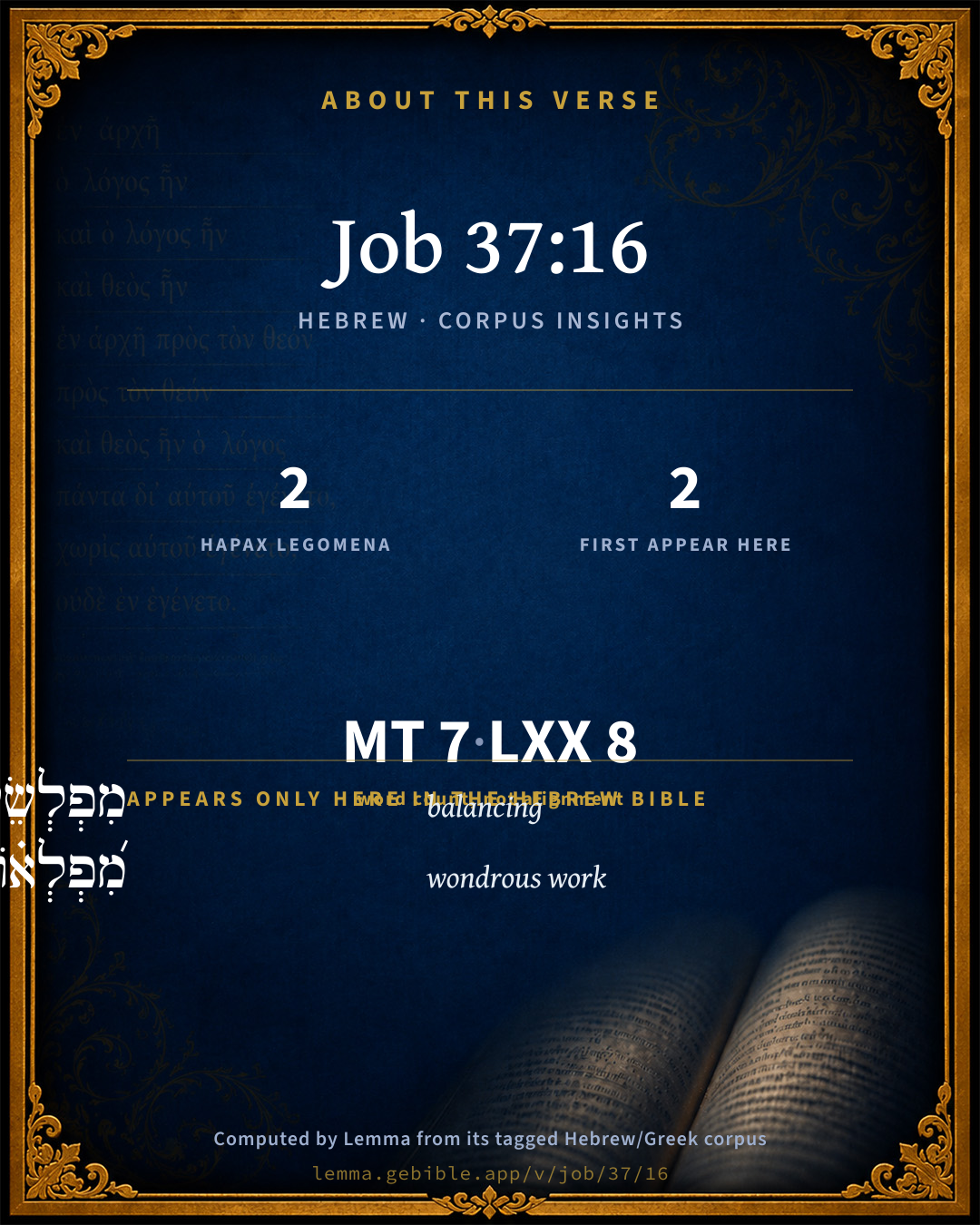
  • 2 hapax legomena — only here in the Hebrew Bible
  • 2 first appearances in the Hebrew Bible
Full analysis ↓
Download a study sheet

One document with this verse’s original text, its word-by-word gloss line, the meaning frame, cross-references with their text, attributed commentary, and full source and license credits — printable, and it pastes into notes with its structure intact.

This verse Autodidact and up

Study sheet (.html) Plain text (.txt)

A passage Seminary Student

Up to 50 verses in one chapter. A passage sheet keeps up to 6 commentary sources and 12 cross-references per verse, in the order this page ranks them, and says so on the sheet whenever that leaves anything out. Ask for a single verse and you get the Autodidact verse sheet above.

Everything on this page stays free to read, with no account — the sheet is a download of what is already on screen, not access to it.

Want to remove ads? Support Godless Engineer
Compare translations 3

The same verse in 3 English versions, stacked beneath the original-language interlinear above. Click any original word for its lexicon entry.

Each is an independent rendering of the whole verse — the interlinear is not word-aligned to these translations.

Highlighted words mark where these versions differ — a whole-verse word diff, not a word-by-word alignment.

  • World English Bible Public Domain
    Do you know the workings of the clouds, The wondrous works of him who is perfect in knowledge?
  • King James Version Public Domain
    Dost thou know the balancings of the clouds, the wondrous works of him which is perfect in knowledge?
  • unfoldingWord Literal Text CC BY-SA 4.0
    Do you know about the balancing of the cloud, the wonders of the perfect in knowledges?

unfoldingWord Literal Text — © unfoldingWord, licensed CC BY-SA 4.0. Word-aligned USFM3 via Door43 (git.door43.org/unfoldingWord/en_ult).

Versions to compare (up to 4)

3 of 4 selected

Show all 18 translations

Every available English version of this verse, each an independent rendering of the whole verse.

  • World English Bible Public Domain
    Do you know the workings of the clouds, The wondrous works of him who is perfect in knowledge?
  • Berean Standard Bible Public Domain
    Do you understand how the clouds float, those wonders of Him who is perfect in knowledge?
  • Majority Standard Bible Public Domain
    Do you understand how the clouds float, those wonders of Him who is perfect in knowledge?
  • King James Version Public Domain
    Dost thou know the balancings of the clouds, the wondrous works of him which is perfect in knowledge?
  • American Standard Version (1901) Public Domain
    Dost thou know the balancings of the clouds, The wondrous works of him who is perfect in knowledge?
  • Revised Version (1885) Public Domain
    Dost thou know the balancings of the clouds, the wondrous works of him which is perfect in knowledge?
  • Geneva Bible (1599) Public Domain
    Hast thou knowen the varietie of the cloude, and the wonderous workes of him, that is perfite in knowledge?
  • Douay-Rheims (1899) Public Domain
    Knowest thou the great paths of the clouds, and the perfect knowledges?
  • Young's Literal Translation Public Domain
    Dost thou know the balancings of a cloud? The wonders of the Perfect in knowledge?
  • Literal Standard Version CC BY-SA 4.0
    Do you know the balancings of a cloud? The wonders of the Perfect in knowledge?
  • Unlocked Literal Bible CC BY-SA 4.0
    Do you understand the floating of the clouds, the marvelous deeds of God, who is perfect in knowledge?
  • unfoldingWord Literal Text CC BY-SA 4.0
    Do you know about the balancing of the cloud, the wonders of the perfect in knowledges?
  • Darby Bible Public Domain
    Dost thou know about the balancings of the clouds, the wondrous works of him that is perfect in knowledge?
  • World Messianic Bible Public Domain
    Do you know the workings of the clouds, the wondrous works of him who is perfect in knowledge?
  • Webster's Bible Public Domain
    Dost thou know the balancings of the clouds, the wondrous works of him who is perfect in knowledge?
  • Free Bible Version CC BY-SA 4.0
    Do you know how clouds float in the sky—the wonderful work of him who knows everything.
  • Bible in Basic English Public Domain
    Have you knowledge of the balancings of the clouds, the wonders of him who has all wisdom?
  • JPS Tanakh (1917) Public Domain
    Dost thou know the balancings of the clouds, the wondrous works of Him who is perfect in knowledge?

Literal Standard Version (2020), Covenant Press — licensed CC BY-SA 4.0. Text via the HelloAO Bible API (eBible.org). Unlocked Literal Bible (unfoldingWord) — licensed CC BY-SA 4.0. Text via the HelloAO Bible API (eBible.org). unfoldingWord Literal Text — © unfoldingWord, licensed CC BY-SA 4.0. Word-aligned USFM3 via Door43 (git.door43.org/unfoldingWord/en_ult). Free Bible Version, Dr. Jonathan Gallagher — licensed CC BY-SA 4.0. Text via the HelloAO Bible API (eBible.org).

Word by word

More ways to search: Search by grammar → Find every occurrence → Compare this word →

Practice this passage: Drill this verse → Learn its vocabulary →

About this verse

These counts appear in no published source. They are computed here, from the morphology-tagged text and Lemma’s own curated glosses. What Lemma adds →

7
words
7
distinct lemmas
Wisdom
section

Notable vocabulary

2 hapax legomena — words that appear only here in the entire Hebrew Bible:

  • מִפְלְשֵׂי balancing H4657
  • מִ֝פְלְא֗וֹת wondrous work H4652

First appearance in Scripture

These words make their first canonical appearance in the Hebrew Bible here:

  • מִפְלְשֵׂי balancing H4657
  • מִ֝פְלְא֗וֹת wondrous work H4652

Shared distinctive vocabulary

דֵּעִֽים knowledge H1843 occurs in 5 verses of the Hebrew Bible. Also found in:

Grammatical profile

  • 1 verb
  • 4 nouns
  • 1 adjective
  • 1 preposition

Verb forms

  • הֲ֭תֵדַע Qal · Imperfect

Hebrew & Septuagint length

In English translation the verse runs 18 words from the Hebrew and 15 from the Septuagint (LXX English) — closely comparable.

A rough comparison of the two English renderings, which tokenize alike — not a word-level alignment.

Word counts can differ between the Hebrew and the Greek without any difference in meaning — e.g. the Hebrew direct-object marker אֵת has no separate Greek word, and Greek often adds the article ὁ.

In the original languages it is 7 Hebrew tokens and 8 Greek tokens — but the two are counted differently (Hebrew bundles its prefixes and suffixes into one token; the Greek is in lemma form), so that isn’t a like-for-like length.

Cross-references

9

Topical passages linked to Job 37:16 in the Treasury of Scripture Knowledge — connected by theme and wording, ordered by reader-vote popularity; previews shown in the World English Bible.

  • Job 36:4 For truly my words are not false. One who is perfect in knowledge is with you.
  • Job 36:29 Yes, can any understand the spreading of the clouds, And the thunderings of his pavilion?
  • Proverbs 3:19–20 By wisdom Yahweh founded the earth. By understanding, he established the heavens.
  • Isaiah 40:22 [It is] he who sits above the circle of the earth, and the inhabitants of it are as grasshoppers; who stretches out the heavens as a curtain, and spreads them out as a tent to dwell in;
  • Jeremiah 10:12–13 He has made the earth by his power, he has established the world by his wisdom, and by his understanding has he stretched out the heavens:
  • Job 26:8 He binds up the waters in his thick clouds, And the cloud is not burst under them.
  • Psalms 104:2–3 He covers himself with light as with a garment. He stretches out the heavens like a curtain.
  • Psalms 104:24 Yahweh, how many are your works! In wisdom have you made them all. The earth is full of your riches.
  • Psalms 147:5 Great is our Lord, and mighty in power. His understanding is infinite.

Cross-references courtesy of OpenBible.info (CC BY 4.0).

Hebrew and Greek witnesses Masoretic Hebrew ↔ Greek Septuagint

The same verse in the two great witnesses to the Old Testament, shown verse-for-verse.

These are two independent witnesses, not word-aligned to each other, and the Septuagint is shown in lemma (dictionary) form.

Hebrew Job 37:16 Masoretic · Westminster Leningrad Codex

הֲ֭תֵדַע עַל מִפְלְשֵׂי עָ֑ב מִ֝פְלְא֗וֹת תְּמִ֣ים דֵּעִֽים

Do you know the workings of the clouds, The wondrous works of him who is perfect in knowledge?

World English Bible · Public Domain

Greek LXX Job 37:16 Septuagint · lemma form

ἐπίσταμαι δέ διάκρισις νέφος ἐξαίσιος δέ πτῶμα πονηρός

And he knows the divisions of the clouds, and the signal overthrows of the ungodly.

LXX2012 (modern English Septuagint) · Public Domain

Hebrew: Westminster Leningrad Codex (CC BY 4.0). Greek: Septuagint (public domain); English from LXX2012 (modern English Septuagint) (Public Domain). How the Septuagint differs from the Hebrew →

Commentary

Notes on Job 37:16 from classic Christian and Jewish commentators (each source and its license shown beneath its notes). The classic Christian expositions comment on the surrounding passage and are grouped to its opening verse, so a note may address several verses; the Jewish commentaries on the Tanakh (Rashi and others) are per-verse, so they appear only where the commentator wrote on this verse.

Lemma curates 59 commentaries, every one of them public domain or Creative Commons licensed, each selected and text-cleaned for this edition rather than reprinted as found. About our sources →

Trapp's Complete Commentary

John Trapp

Job 37:16 Dost thou know the balancings of the clouds, the wondrous works of him which is perfect in knowledge?

Ver. 16. Dost thou know the balancings of the clouds?] i.e. How they are hung up even in the air, like Architas’ or Archimedes’ pigeon, equally poised with their own weight. But how they are upheld, and why they fall here, and now, we know not, and wonder. Some naturalists tell us that the clouds are upheld by the heat of the sun but that is more than they can tell, and there is much to be said against it. Wherefore it is better for men to confess their ignorance than so peremptorily to pronounce things they know not. Let it be proper to God to be perfect in knowledge. It was too much that some ascribed to Tertullian, to Jerome, to Tostatus, and some others, that they knew all that was knowable.

John Trapp, A Commentary or Exposition upon All the Books of the Old and New Testament (1647–1656) — public domain. Text from a community e-Sword module.

The Biblical Illustrator

Joseph S. Exell

Job_37:16

Dost thou know the balancings of the clouds?

Clouds

Note, in the address of Elihu, his close observation of Gods works in nature, and the admirable use he makes of them.

I. The fact in nature. Wonderful creations of God are the clouds, well deserving our admiration and our study. What a beautiful fact is the balancing of the clouds! Think of the material of which the cloud is composed. There it is, a fleece asleep on the bosom of the blue. Can we explain the balancing? How the hard ice or heavy water turns into light steam, or how the steam condenses into water, or hardens into ice again? Why it is that one day may frown with the storms of winter, and the next smile with the light of spring? Heat, gravitation, electricity, are useful names for the facts we observe, but how much explanation do they give?

II. The fact in experience. Elihus words were intended to carry the thoughts of Job beyond the clouds of heaven: for the Book of Job is not a treatise of natural philosophy, but of moral and spiritual truth. Are there no clouds in our sky? Is all bright--without a single shadow? Such a sky would he more than we could bear. Our heads are too weak to stand it. Blessed be God for clouds! They temper the scorching sky, and make the atmosphere more sweet, more healthy. They open a new field for the exhibition of the Divine attributes; they present masses for the light of His character to irradiate and glorify. And is there no balancing of our clouds? Does a single affliction ever gather over us which God does not weigh and measure and control? Infinite Wisdom is at work to determine the form and degree of our earthly trials; and He will not suffer us to be tempted above what we are able to bear. Still, how little we know about it! We see the purpose of some of our sorrows; the evil they lead us to correct, the danger they teach us to avoid; but, for anything we can tell, God has many other purposes in them, of which we shall never know till they are revealed to us in heaven. (F. Tucker, B. A.)

Which is perfect in knowledge.

Of the omniscience of God

These words are a declaration of that Divine attribute, the perfection of knowledge.

I. God is a Being indeed with perfect knowledge.

1. Knowledge is a perfection without which the foregoing attributes are no perfections at all, and without which those which follow can have no foundation. Where there is no knowledge, eternity and immensity are as nothing; and justice, goodness, mercy, and wisdom can have no place.

2. That God must be a Being indeed with perfect knowledge, appears from His having communicated certain degrees of that perfection. For whatever perfection is in any effect, must of necessity have been much more in the cause that produced it. Nothing can give to another that which it hath not in itself. Though nothing can give what it has not, yet any cause may forbear to give all that it has.

3. From the immensity and omnipresence of God may the same truth be likewise clearly evinced. Wherever Himself is, His knowledge is, which is inseparable from His being, and must therefore be infinite.

II. The particular nature and circumstances of the Divine knowledge.

1. The object of this knowledge. It is a knowledge of all things absolutely. Our knowledge is short as our duration, and limited as our extent. The knowledge of God is a knowledge of all the actions of men; of all their thoughts and intents; and even of future and contingent events. Even the most contingent futurities, the actions of free agents, cannot be conceived to be hidden from his foresight. How can foreknowledge in God be consistent with liberty of action in men? Premise that our infinite understandings are not able to comprehend all the ways of infinite knowledge, and that the question is not whether mens actions are free, but how that freedom of action which makes men to be men, can be consistent with foreknowledge of such actions. If these two things were really inconsistent, and could not be reconciled, it would follow, not that mens actions were not free (for that would destroy all religion), but that such free actions as mens are, were not the objects of the Divine foreknowledge. Foreknowledge does not cause things to be. The futurity of free actions is exactly the same, whether they can, or could not, be foreknown.

2. The manner of this Divine knowledge. We cannot, in particular, explain all the ways, manners, and circumstances of infinite knowledge. We can only make a few general observations. The Divine knowledge is not, as ours and the angels, a knowledge of things by degrees and parts. It is a perfect comprehension of everything, in all possible respects at a time, and in all possible circumstances together. It is not, as ours, only a superficial and external knowledge, but an intimate and thorough prospect of their very inmost nature and essence. It is not, as ours, confused and general, but a clear, distinct, and particular knowledge of every, even the minutest, thing or circumstance. It is not, as ours, acquired with difficulty, consideration, attention, and study, but a knowledge necessarily and perpetually arising of itself.

3. The certainty of this Divine knowledge. It is absolutely infallible, without the least possibility of any degree of being deceived.

III. A few practical inferences.

1. If the Divine knowledge is perfect, it is a proper object of our admiration and honour.

2. If God knows all, even our most secret actions; then ought we to live under the power of this conviction, in all holy and godly conversation, both publicly and in private.

3. Learn the folly of all hypocrisy; the obligation to purity of heart.

4. If God knows all future events, we may safely depend and trust on His providence, without being over-solicitous for the time to come.

5. See the folly of pretending to foreknow things.

6. If God alone knoweth the thoughts of men, we ought not to be forward in judging others. (S. Clarke, D. D.)

The Biblical Illustrator, edited by Joseph S. Exell (c. 1880s–1900s) — public domain. Text from a community e-Sword module.

Joseph Benson's Commentary

Job 37:16-17. Dost thou know the balancings of the clouds? — How God doth, as it were, weigh the clouds in balances; so that, although they are full of water, and heavy, yet they are by his power suspended in the thin air, and kept from falling down upon us in spouts and floods, as sometimes they have done, and generally would do, if not governed by a higher Providence. The works of him who is perfect in knowledge — These are effects and evidences of his infinite power and knowledge. How thy garments are warm — How and why thy garments keep thee warm; or whence it comes, that the air grows mild when the south wind blows.

Joseph Benson's Commentary on the Old and New Testaments (1811–1818) — public domain. Text from a community e-Sword module.

Geneva Bible (1599)

Geneva Bible translators

Which is sometimes changed into rain, or snow, hail, or such like.

Geneva Bible (1599) marginal notes — public domain. Text via Bolls.life.

Jamieson, Fausset & Brown

Robert Jamieson, A. R. Fausset & David Brown

Hebrew, "Hast thou understanding of the balancings," &c., how the clouds are poised in the air, so that their watery gravity does not bring them to the earth? The condensed moisture, descending by gravity, meets a warmer temperature, which dissipates it into vapor (the tendency of which is to ascend) and so counteracts the descending force.

perfect in knowledge--God; not here in the sense that Elihu uses it of himself (Job 36:4).

dost thou know--how, &c.

Jamieson, Fausset & Brown — Commentary Critical and Explanatory on the Whole Bible (1871) — public domain (CC PDM 1.0). Text via the HelloAO Bible API.

Adam Clarke's Commentary

Verse 16. Dost thou know the balancings of the clouds] How are the clouds suspended in the atmosphere? Art thou so well acquainted with the nature of evaporation, and the gravity of the air at different heights, to support different weights of aqueous vapour, so as to keep them floating for a certain portion of time, and then let them down to water the earth; dost thou know these things so as to determine the laws by which they are regulated?

Wondrous works of him which is perfect in knowledge] This is a paraphrase. Mr. Good's translation is much better: -

"Wonders, perfections of wisdom!"

Adam Clarke's Commentary on the Bible (1810–1826) — public domain. Text from a community e-Sword/MySword module.

Ellicott's Commentary for English Readers

(16) The balancings of the clouds.—How they are poised and suspended in the sky. “Ye clouds, that far above me float and pause.”—Coleridge.

A Bible Commentary for English Readers, edited by Charles John Ellicott (1878–1897) — public domain. Text from a community e-Sword module.

The Cambridge Bible for Schools and Colleges

gen. ed. J. J. S. Perowne

16. the balancings] That is, how the clouds are poised in the heavens (comp. ch. Job_26:8), which Elihu regards as an unspeakable marvel.

The Cambridge Bible for Schools and Colleges (gen. ed. J. J. S. Perowne; Cambridge University Press, 1878–1918) — public domain. Text from a community e-Sword module.

John Gill's Exposition

Dost thou know the balancings of the clouds?.... How those ponderous bodies, as some of them are very weighty, full of water, are poised, and hang in the air, without turning this way or the other, or falling on the earth;

the wondrous works of him which is perfect in knowledge; of God, who is a God of knowledge, of knowledges, Sa1 2:3; who knows himself and all his works, all creatures and things whatever, see Job 36:4; and this is another of his wondrous works, which none but he, whose knowledge is perfect, and is the author and giver of knowledge, can know, even the poising and balancing of the clouds in the air; we see they are balanced, but we know not how it is done.

John Gill's Exposition of the Whole Bible (1746–1763) — public domain (CC PDM 1.0). Text via the HelloAO Bible API.

Albert Barnes' Notes on the Bible

Dost thou know the balancings of the clouds? - That is, Dost thou know how the clouds are poised and suspended in the air? The difficulty to be explained was, that the clouds, so full of water, did not fail to the earth, but remained suspended in the atmosphere. They were poised and moved about by some unseen hand. Elihu asks what kept them there; what prevented their falling to the earth; what preserved the equilibrium so that they did not all roll together. The phenomena of the clouds would be among the first that would attract the attention of man, and in the early times of Job it is not to be supposed that the subject could be explained. Elihu assumes that they were held in the sky by the power of God, but what was the nature of his agency, he says, man could not understand, and hence, he infers that God should be regarded with profound veneration. We know more of the facts and laws respecting the clouds than was understood then, but our knowledge in this, as in all other things, is fitted only to exalt our conceptions of the Deity, and to change blind wonder into intelligent adoration.

The causes of the suspension of the clouds are thus stated in the Edinburgh Encyclopedia, Art. Meteorology: “When different portions of the atmosphere are intermixed so as to produce a deposition of moisture;” (compare the notes at Job 38:28), “the consequence will be the formation of a cloud. This cloud, from its increased specific gravity, will have a tendency to sink downward; and were the lower strata of the air of the same temperature with the cloud, and saturated with moisture, it would continue to descend until it reached the surface of the earth - in the form of rain, or what is commonly called mist. In general, however, the cloud in its descent passes through a warmer region, when the condensed moisture again passes into a vapor, and consequently ascends until it reaches a temperature sufficiently low to recondense it, when it will begin again to sink. This oscillation will continue until the cloud settles at the point where the temperature and humidity are such as that the condensed moisture begins to be dissipated, and which is found on an average to be between two and three miles above the surface of the earth.” By such laws the “balancing” of the clouds is secured, and thus is shown the wisdom of Him that is “perfect in knowledge.”

The wondrous works of him that is perfect in knowledge - Particularly in the matter under consideration. He who can command the lightning, and hold the clouds suspended in the air, Elihu infers must be perfect in knowledge. To a Being who can do this, everything must be known. The reasoning of Elihu here is well-founded, and is not less forcible now than it was in the time of Job.

Albert Barnes' Notes on the Bible (1834–1885) — public domain. Text from a community e-Sword/MySword module.

Haydock's Catholic Bible Commentary

Paths. Hebrew, "the balancing of the clouds, the wondrous works of Him whose knowledge is perfect?" chap. xxxvi. 4. Dost thou know what suspends the heavy clouds in the air? (Calmet)

George Leo Haydock (1774–1849), Haydock's Catholic Family Bible and Commentary, 1859 edition — public domain. Excludes Psalms (Douay-Rheims chapter numbering differs from Protestant) and Deuterocanonical books (Catholic canon only).

Matthew Poole's English Annotations

The balancings; how God doth as it were weigh and suspend the clouds in balances; so that although they are ponderous and flail of water, yet they are by his power kept up in the thin air from falling down upon us in spouts and floods, as sometimes they have done, and generally would do, if not overruled by a higher Providence.

Which is perfect in knowledge; who exactly knows the weight. These are effects and evidences of his infinite power and knowledge.

Matthew Poole's English Annotations on the Holy Bible (1683–1685) — public domain. Text from a community e-Sword/MySword module.

Whedon's Commentary on the Bible

Daniel D. Whedon

16. The balancings of the clouds — The suspension of the clouds in the atmosphere, especially those freighted with rain, has not yet been satisfactorily explained. Dr. Samuel Clarke has a sermon in loc. on the “Omniscience of God.”

Daniel D. Whedon (gen. ed.), Commentary on the Old and New Testaments (1874–1909) — public domain. Text from a community e-Sword module.

The Pulpit Commentary

Dost thou know the balancings of the clouds? i.e. "how they are poised and suspended in the sky" (Stanley Loathes). The wondrous works of him which is perfect in knowledge. (comp. Job_36:5)

The Pulpit Commentary (1880–1919), ed. H.D.M. Spence-Jones & Joseph S. Exell — public domain. Text from a community e-Sword module.

John Wesley's Explanatory Notes

Balancings - How God doth as it were weigh the clouds in balances, so that although they are full of water, yet they are kept up by the thin air.

John Wesley, Explanatory Notes Upon the Whole Bible (1754–1765) — public domain. Text via the GEBible commentary corpus.

unfoldingWord translationNotes

Door43 World Missions Community

Do you understand the floating of the clouds, the marvelous deeds of God, who is perfect in knowledge?

Elihu asks this question to emphasize that Job does not know these things. AT: "You do not understand the floating of the clouds, the marvelous deeds of God, who is perfect in knowledge." (See: Rhetorical Question)

the floating of the clouds

"how the clouds float"

the marvelous deeds of God

The verb may be supplied from the previous phrase. AT: "or do you understand the marvelous deeds of God" or "and you do not understand the marvelous deeds of God" (See: Ellipsis)

Do you understand how your garments become hot ... from the south?

Elihu asks this question to emphasize that Job does not know these things. AT: "You do not understand how your garments become hot ... from the south." (See: Rhetorical Question)

how your garments become hot

"how you become hot in your clothes" or "how you sweat in your clothes"

because the wind comes from the south

In Israel, hot winds blow in across the desert from the south and cause hot temperatures. AT: "because of the hot, dry wind blowing in from the south" (See: Assumed Knowledge and Implicit Information)

translationWords

understand

perfect

know

unfoldingWord translationNotes — © Distant Shores Media and the Door43 World Missions Community, licensed CC BY-SA 4.0. Source: git.door43.org/Door43/en_tn.

Rashi

Rabbi Shlomo Yitzchaki (Rashi)

the revelations of the clouds Heb. מפלשי, the revelation of the clouds, an expression of an open (מפלש) alley, i.e., to the length and the width of the clouds.

Do you know concerning them, the wonders of Him Who is perfect in knowledge?

Rashi on the Tanakh — English translations: “The Judaica Press complete Tanach with Rashi, translated by A. J. Rosenberg” (CC BY 4.0); “Pentateuch with Rashi's commentary by M. Rosenbaum and A.M. Silbermann, 1929-1934” (public domain); “The Metsudah Tanach series, Lakewood, N.J” (CC BY 4.0); and “The Book of Joshua, Metsudah Publications, 1997” (CC BY 4.0). Text via Sefaria.

Lesson kit

Teaching starters — assembled from the data on this page, not authored interpretation. Every prompt links to the verse data it draws on. Edit before teaching.

Job, in the Wisdom, opens this verse with 7 words (7 distinct Hebrew lemmas). Its most distinctive word is miphlâs (“balancing”). A historical commentator’s framing appears above. Read the whole chapter for the surrounding context.

Discussion questions

  1. How does “balancing” (miphlâs) shape what this verse is saying?
  2. This verse holds 2 words here found nowhere else in the Hebrew Bible. What might the rare words draw attention to?
  3. 2 words here appear for the first time in Scripture. What is being introduced at this debut?
  4. Job 32:6 shares the word «knowledge» with this verse. How do the two illuminate each other?
  5. These translations render this verse differently; the difference is in the English rendering, not the original. What questions does that raise?
  6. The verb «הֲ֭תֵדַע» is Qal Imperfect. How does its form color the action?
  7. Reading how Trapp's Complete Commentary and The Biblical Illustrator read this verse, where do the two commentators agree and where do they part?

Things to notice

Reading settings

Reading text

Shown beneath each verse's original-language words.

Old Testament
Old Testament edition

Read the OT as the Masoretic Hebrew (MT) or the Greek Septuagint (LXX).

English shown for the Greek Septuagint (in the Hebrew ↔ Greek comparison).

Comparing translations? Open the Compare panel on any verse page to stack up to four side by side.