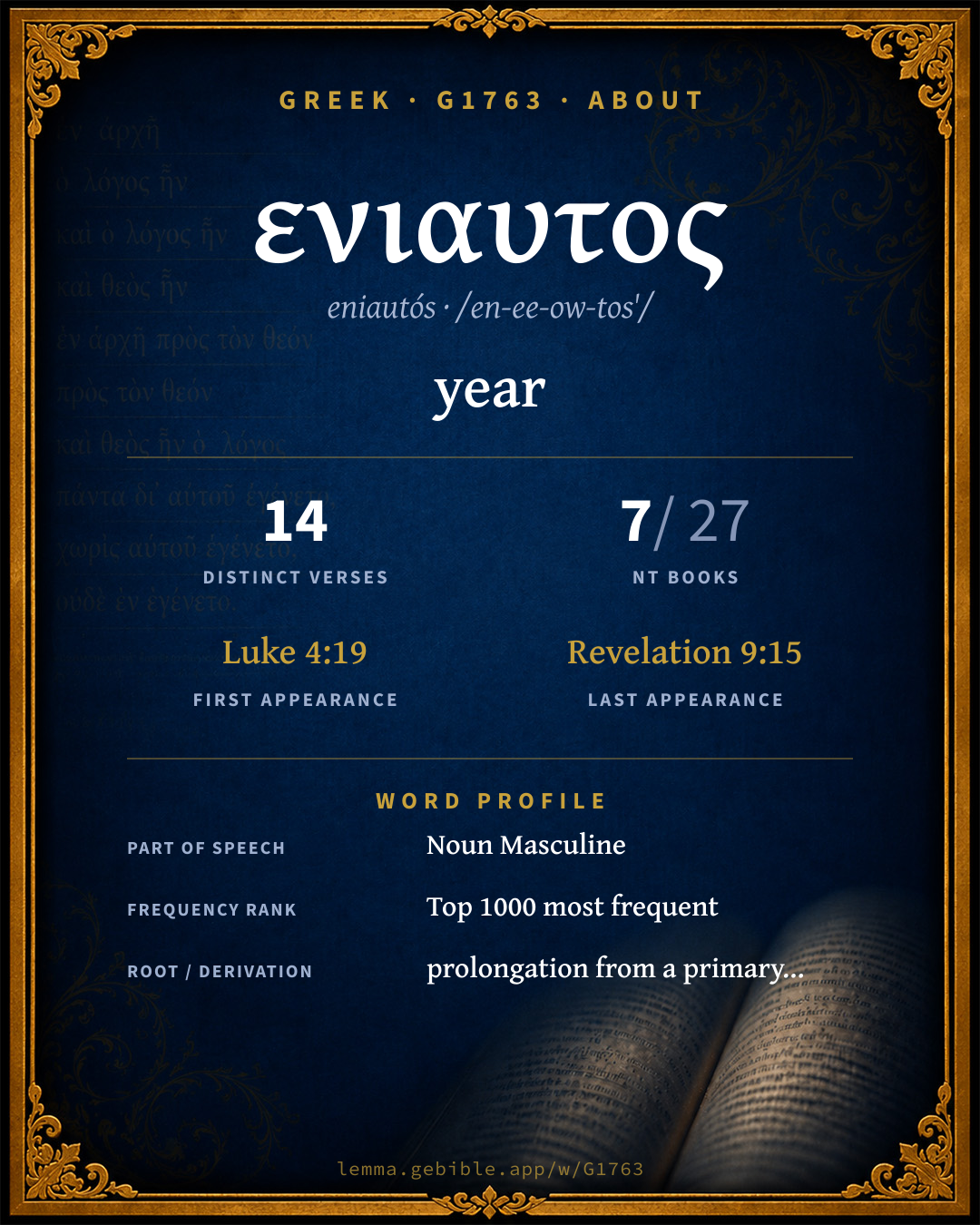
ἐνιαυτός
year
Full lexicon entry — Thayer's Greek Lexicon
From Thayer's Greek Lexicon
Where this word appears
Grammar key — what these labels mean
Part of speech
- Noun
- A naming word — a person, place, thing, or idea.
Case
- Accusative
- The case of the direct object and of extent.
- Genitive
- The case of source, possession, or “of” — answers “whose / from what.”
Gender
- Masculine
- Grammatically masculine.
Number
- Singular
- One.
- Plural
- More than one.
Every verse where G1763 appears in the Book of James — 2 distinct verses. Click any verse to open its interlinear word-by-word view. Verse text shown in the World English Bible for context — . Each verse’s Greek form is shown with its reference; the English is not keyword-highlighted, since the data carries no word-level English alignment. Use “Compare translations” on any verse to read it across multiple English versions. This concordance covers the Greek New Testament; Septuagint (Greek Old Testament) occurrences of this word are not indexed here.
James
- James 4:13 ἐνιαυτὸν n acc sg masc Come now, you who say, "Today or tomorrow let's go into this city, and spend a year there, trade, and make a profit."
- James 5:17 ἐνιαυτοὺς n acc pl masc Elijah was a man with a nature like ours, and he prayed earnestly that it might not rain, and it didn't rain on the earth for three years and six months.
About this entry
At a glance — auto-summarized from this page’s data, not written by a person. Every figure links to its source below. This summary describes the numbers; it doesn’t interpret them.
At its core, ενιαυτος (eniautós) means “year.” Its earliest occurrence is Luke 4:19. It turns up in 14 verses across 7 books, an uncommon footprint. The word gravitates to Hebrews (29%), then John and Acts. Each statement above links to its evidence; the full detail follows below.
Gloss history
Strong's 1890 vs modern scholarship
About this word
Strong's G1763 catalogs a Greek word from the Greek New Testament.
These counts are not copied from any lexicon or concordance. They are computed here, from the morphology-tagged Greek New Testament. What Lemma adds →
- 14
- distinct verses
- The word appears in 14 distinct verses.
- 7 / 27
- NT books
- The word appears in 7 of 27 New Testament books.
- #814
- by frequency
- Top 1000 most frequent Greek words (rank 814 of 5,347 Greek words by occurrence).
View all 14 occurrences in the concordance →
By section of the New Testament
By traditional corpus
Conventional, traditional groupings — biblical authorship is debated, so this is a traditional corpus grouping, not an authorship claim. Some books belong to more than one corpus (Luke is in both the Gospels and the Lukan corpus, and so on), so these shares overlap and need not total 100%. Each figure is a share of the word’s 14 distinct verses.
- Gospels 4 verses · 29%
- Johannine 4 verses · 29%
- Hebrews 4 verses · 29%
- Lukan (Luke–Acts) 3 verses · 21%
- General (Catholic) Epistles 2 verses · 14%
- Pauline corpus 1 verse · 7%
- Revelation 1 verse · 7%
How translations render this word
Counts come from each version’s own published word-to-Strong’s tagging or interlinear alignment — an approximate guide to how each version renders this word, not a word-level alignment the data otherwise carries. Because each total is that version’s own tagged count, the per-version totals vary from one another and need not match the appearance or distinct-verse counts above. These counts may also differ from a printed concordance because Lemma counts each distinctly tagged rendering and does not collapse phrase taggings into a single head-word total. This is a fixed set of word-tagged versions (KJV, ASV, BSB, ULT) and does not change with the reading translation you choose elsewhere. Each version’s license is shown beside its name below (and on Sources).
- King James Version: Year 10×, Years 2×
- American Standard Version: Year 12×, Years 2×
- Berean Standard Bible: Year 10×, Years 2×
- unfoldingWord Literal Text: Year 12×, For 2×, Years 2×
King James Version Public Domain
Renders G1763 across 13 tagged occurrences — most commonly:
Plus 1 rendering that appears only once — usually multi-word phrases or single function words the recovered tagging swept in, not distinct renderings. Not rendered by a distinct English word in 1 further occurrence.
American Standard Version Public Domain
Renders G1763 across 14 tagged occurrences — most commonly:
Berean Standard Bible Public Domain
Renders G1763 across 13 tagged occurrences — most commonly:
Plus 1 rendering that appears only once — usually multi-word phrases or single function words the recovered tagging swept in, not distinct renderings. Not rendered by a distinct English word in 1 further occurrence.
unfoldingWord Literal Text CC BY-SA 4.0
Renders G1763 across 18 tagged occurrences — most commonly:
Plus 2 renderings that appear only once — usually multi-word phrases or single function words the recovered tagging swept in, not distinct renderings.
Senses in Thayer's
The 1 sense Thayer's distinguishes for this word, in lexicon order (not ranked by frequency or importance). The full entry — with sub-senses — is in the Lexicon Entry tab.
- a year, in a wider sense, for some fixed definite period of time
Word origin
Origin: prolongation from a primary enos (a year)
Prolonged from a primary word ἔνος enos (a year ); a year : - year.
— Strong’s Exhaustive Concordance (1890), public domain.
Forms in the corpus
The 5 distinct written forms G1763 takes in the Greek New Testament, most frequent first — each parse links to that case’s occurrences in the concordance.
| Form | Parsing | Example | Uses |
|---|---|---|---|
| ἐνιαυτὸν eniautòn | Noun, Accusative, Singular, Masculine | Luke 4:19 | 6 |
| ἐνιαυτοῦ eniautoû | Noun, Genitive, Singular, Masculine | John 11:49 | 4 |
| ἐνιαυτόν eniautón | Noun, Accusative, Singular, Masculine | Hebrews 10:3 | 2 |
| ἐνιαυτούς eniautoús | Noun, Accusative, Plural, Masculine | Galatians 4:10 | 1 |
| ἐνιαυτοὺς eniautoùs | Noun, Accusative, Plural, Masculine | James 5:17 | 1 |
Septuagint usage
The same Greek word ενιαυτος appears 127 times in the Greek Old Testament (Septuagint), across 108 verses in 22 books.
- 127
- LXX occurrences
- Tagged occurrences of this Greek word in the Septuagint.
- 108
- verses
- Distinct Septuagint verses containing this word.
- 22 / 39
- OT books
- The word appears in 22 of the 39 Old Testament books.
Sample Septuagint occurrences
- Genesis 1:14 ἐνιαυτός
- Exodus 12:2 ἐνιαυτός
- Leviticus 16:34 ἐνιαυτός
- Numbers 10:11 ἐνιαυτός
- Deuteronomy 11:12 ἐνιαυτός
- Joshua 5:12 ἐνιαυτός
- Judges 11:40 ἐνιαυτός
- 1 Samuel 1:7 ἐνιαυτός
- 2 Samuel 11:1 ἐνιαυτός
- 1 Kings 2:35 ἐνιαυτός
- 2 Kings 8:26 ἐνιαυτός
- 1 Chronicles 27:1 ἐνιαυτός
Septuagint occurrences (same lexeme)
Every verse where the same Strong’s number (G1763) appears in the Greek Septuagint — showing the first 50 of 108. Verse text shown in the World English Bible for context; the Greek form is the matched word — the English is not keyword-highlighted.
- Genesis 1:14 ἐνιαυτός God said, "Let there be lights in the expanse of sky to divide the day from the night; and let them be for signs, and for seasons, and for days and years;
- Genesis 17:21 ἐνιαυτός But my covenant I establish with Isaac, whom Sarah will bear to you at this set time in the next year."
- Genesis 26:12 ἐνιαυτός Isaac sowed in that land, and reaped in the same year one hundred times what he planted. Yahweh blessed him.
- Genesis 47:17 ἐνιαυτός They brought their cattle to Joseph, and Joseph gave them bread in exchange for the horses, and for the flocks, and for the herds, and for the donkeys: and he fed them with bread in exchange for all their cattle for that year.
- Genesis 47:28 ἐνιαυτός Jacob lived in the land of Egypt seventeen years. So the days of Jacob, the years of his life, were one hundred forty-seven years.
- Exodus 12:2 ἐνιαυτός "This month shall be to you the beginning of months. It shall be the first month of the year to you.
- Exodus 23:14 ἐνιαυτός "You shall observe a feast to me three times a year.
- Exodus 23:16 ἐνιαυτός And the feast of harvest, the first fruits of your labors, which you sow in the field: and the feast of harvest, at the end of the year, when you gather in your labors out of the field.
- Exodus 23:17 ἐνιαυτός Three times in the year all your males shall appear before the Lord Yahweh.
- Exodus 23:29 ἐνιαυτός I will not drive them out from before you in one year, lest the land become desolate, and the animals of the field multiply against you.
- Exodus 30:10 ἐνιαυτός Aaron shall make atonement on its horns once in the year; with the blood of the sin offering of atonement once in the year he shall make atonement for it throughout your generations. It is most holy to Yahweh."
- Exodus 34:22 ἐνιαυτός You shall observe the feast of weeks with the first fruits of wheat harvest, and the feast of harvest at the year's end.
- Exodus 34:23 ἐνιαυτός Three times in the year all your males shall appear before the Lord Yahweh, the God of Israel.
- Exodus 34:24 ἐνιαυτός For I will drive out nations before you and enlarge your borders; neither shall any man desire your land when you go up to appear before Yahweh, your God, three times in the year.
- Leviticus 16:34 ἐνιαυτός "This shall be an everlasting statute for you, to make atonement for the children of Israel once in the year because of all their sins." It was done as Yahweh commanded Moses.
- Leviticus 23:41 ἐνιαυτός You shall keep it a feast to Yahweh seven days in the year: it is a statute forever throughout your generations; you shall keep it in the seventh month.
- Leviticus 25:5 ἐνιαυτός What grows of itself in your harvest you shall not reap, and the grapes of your undressed vine you shall not gather. It shall be a year of solemn rest for the land.
- Leviticus 25:10 ἐνιαυτός You shall make the fiftieth year holy, and proclaim liberty throughout the land to all its inhabitants. It shall be a jubilee to you; and each of you shall return to his own property, and each of you shall return to his family.
- Leviticus 25:11 ἐνιαυτός That fiftieth year shall be a jubilee to you. In it you shall not sow, neither reap that which grows of itself, nor gather from the undressed vines.
- Leviticus 25:15 ἐνιαυτός According to the number of years after the Jubilee you shall buy from your neighbor. According to the number of years of the crops he shall sell to you.
- Leviticus 25:29 ἐνιαυτός "'If a man sells a dwelling house in a walled city, then he may redeem it within a whole year after it has been sold. For a full year he shall have the right of redemption.
- Leviticus 25:30 ἐνιαυτός If it isn't redeemed within the space of a full year, then the house that is in the walled city shall be made sure in perpetuity to him who bought it, throughout his generations. It shall not be released in the Jubilee.
- Leviticus 25:50 ἐνιαυτός He shall reckon with him who bought him from the year that he sold himself to him to the Year of Jubilee: and the price of his sale shall be according to the number of years; according to the time of a hired servant shall he be with him.
- Leviticus 25:52 ἐνιαυτός If there remain but a few years to the year of jubilee, then he shall reckon with him; according to his years of service he shall give back the price of his redemption.
- Leviticus 25:53 ἐνιαυτός As a servant hired year by year shall he be with him: he shall not rule with harshness over him in your sight.
- Leviticus 27:17 ἐνιαυτός If he dedicates his field from the Year of Jubilee, according to your valuation it shall stand.
- Leviticus 27:18 ἐνιαυτός But if he dedicates his field after the Jubilee, then the priest shall reckon to him the money according to the years that remain to the Year of Jubilee; and an abatement shall be made from your valuation.
- Leviticus 27:23 ἐνιαυτός then the priest shall reckon to him the worth of your valuation up to the Year of Jubilee; and he shall give your valuation on that day, as a holy thing to Yahweh.
- Leviticus 27:24 ἐνιαυτός In the Year of Jubilee the field shall return to him from whom it was bought, even to him to whom the possession of the land belongs.
- Numbers 10:11 ἐνιαυτός It happened in the second year, in the second month, on the twentieth day of the month, that the cloud was taken up from over the tent of the testimony.
- Numbers 14:34 ἐνιαυτός After the number of the days in which you spied out the land, even forty days, for every day a year, shall you bear your iniquities, even forty years, and you shall know my alienation.
- Numbers 28:14 ἐνιαυτός Their drink-offerings shall be half a hin of wine for a bull, and the third part of a hin for the ram, and the fourth part of a hin for a lamb: this is the burnt offering of every month throughout the months of the year.
- Deuteronomy 11:12 ἐνιαυτός a land which Yahweh your God cares for: the eyes of Yahweh your God are always on it, from the beginning of the year even to the end of the year.
- Deuteronomy 14:22 ἐνιαυτός You shall surely tithe all the increase of your seed, that which comes forth from the field year by year.
- Deuteronomy 14:28 ἐνιαυτός At the end of every three years you shall bring forth all the tithe of your increase in the same year, and shall lay it up within your gates:
- Deuteronomy 15:20 ἐνιαυτός You shall eat it before Yahweh your God year by year in the place which Yahweh shall choose, you and your household.
- Deuteronomy 16:16 ἐνιαυτός Three times in a year shall all your males appear before Yahweh your God in the place which he shall choose: in the feast of unleavened bread, and in the feast of weeks, and in the feast of tents; and they shall not appear before Yahweh empty:
- Deuteronomy 24:5 ἐνιαυτός When a man takes a new wife, he shall not go out in the host, neither shall he be charged with any business: he shall be free at home one year, and shall cheer his wife whom he has taken.
- Deuteronomy 31:10 ἐνιαυτός Moses commanded them, saying, At the end of [every] seven years, in the set time of the year of release, in the feast of tents,
- Joshua 5:12 ἐνιαυτός The manna ceased on the next day, after they had eaten of the produce of the land; neither had the children of Israel manna any more; but they ate of the fruit of the land of Canaan that year.
- Judges 11:40 ἐνιαυτός that the daughters of Israel went yearly to celebrate the daughter of Jephthah the Gileadite four days in a year.
- 1 Samuel 1:7 ἐνιαυτός [as] he did so year by year, when she went up to the house of Yahweh, so she provoked her; therefore she wept, and did not eat.
- 1 Samuel 7:16 ἐνιαυτός He went from year to year in circuit to Bethel and Gilgal, and Mizpah; and he judged Israel in all those places.
- 2 Samuel 11:1 ἐνιαυτός It happened, at the return of the year, at the time when kings go out [to battle], that David sent Joab, and his servants with him, and all Israel; and they destroyed the children of Ammon, and besieged Rabbah. But David stayed at Jerusalem.
- 2 Samuel 21:1 ἐνιαυτός There was a famine in the days of David three years, year after year; and David sought the face of Yahweh. Yahweh said, It is for Saul, and for his bloody house, because he put to death the Gibeonites.
- 1 Kings 2:35 ἐνιαυτός The king put Benaiah the son of Jehoiada in his room over the host; and Zadok the priest did the king put in the room of Abiathar.
- 1 Kings 4:7 ἐνιαυτός Solomon had twelve officers over all Israel, who provided food for the king and his household: each man had to make provision for a month in the year.
- 1 Kings 5:25 ἐνιαυτός
- 1 Kings 6:1 ἐνιαυτός It happened in the four hundred and eightieth year after the children of Israel were come out of the land of Egypt, in the fourth year of Solomon's reign over Israel, in the month Ziv, which is the second month, that he began to build the house of Yahweh.
- 1 Kings 10:14 ἐνιαυτός Now the weight of gold that came to Solomon in one year was six hundred sixty-six talents of gold,
These are occurrences of the same Greek lexeme (G1763) in the Septuagint — not a translation of any one Hebrew word. The store carries no word-level Hebrew↔Greek alignment, so no Hebrew original is asserted here. Counts come from the recovered LXX Strong's tagging — high-frequency vocabulary is well covered, while rare or late forms may be untagged — so they reflect tagged occurrences and may slightly undercount.