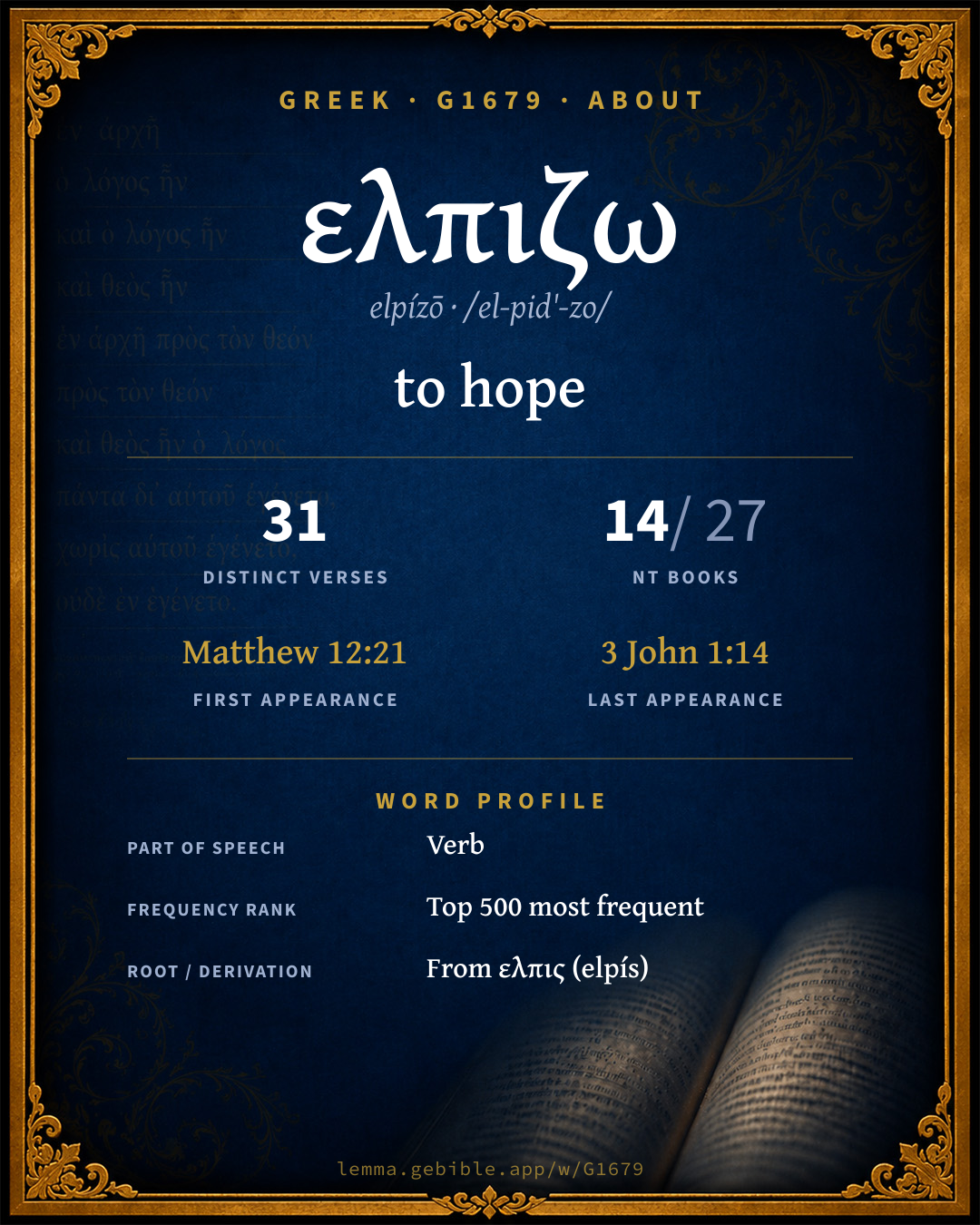
ἐλπίζω
to hope
‘to hope’ is one of 2 main senses fuller range ↓
Full lexicon entry — Thayer's Greek Lexicon
From Thayer's Greek Lexicon
Where this word appears
See every Present-tense verb in the Greek New Testament →
Grammar key — what these labels mean
Part of speech
- Verb
- An action or state-of-being word.
Tense
- Present
- Ongoing or general action in present time (imperfective aspect).
- Future
- Action expected in future time.
- Perfect
- A completed past action with continuing present results.
- Aorist
- Action viewed as a simple whole, without regard to duration — often past (perfective aspect).
- Imperfect
- Continuous or repeated action in past time (“was writing”).
Voice
- Active
- The subject performs the action.
- Passive
- The subject receives the action.
Mood
- Indicative
- States a fact or asks a factual question (the mood of reality).
- Participle
- A verbal adjective (“writing,” “having written”).
- Imperative
- Expresses a command or request.
- Infinitive
- A verbal noun (“to write”), unmarked for person or number.
Case
- Nominative
- The case of the subject (and the predicate nominative).
- Genitive
- The case of source, possession, or “of” — answers “whose / from what.”
Person
- 1st person
- The speaker (“I / we”).
- 3rd person
- The one spoken about (“he / she / it / they”).
- 2nd person
- The one addressed (“you”).
Gender
- Masculine
- Grammatically masculine.
- Feminine
- Grammatically feminine.
Number
- Singular
- One.
- Plural
- More than one.
Grammatical forms 17 distinct
- Verb, Present, Active, Indicative, 1st person, Singular 10 times (32%)
- Verb, Present, Active, Indicative, 3rd person, Singular 3 times (10%)
- Verb, Future, Active, Indicative, 3rd person, Plural, Attic form 2 times (6%)
- Verb, Present, Active, Participle, Nominative, Singular, Masculine 2 times (6%)
- Verb, Perfect, Active, Indicative, 1st person, Plural 2 times (6%)
- Verb, Aorist, Active, Indicative, 1st person, Plural 1 time (3%)
- Verb, Aorist, Active, Imperative, 2nd person, Plural 1 time (3%)
- Verb, Imperfect, Active, Indicative, 1st person, Plural 1 time (3%)
+9 more forms (9 occurrences)
Parsed forms decoded from the imported morphology (Robinson–Tischendorf, public domain), counted across 31 parsed occurrences — not distinct verses.
Every verse where G1679 appears — 31 distinct verses across 14 books. Click any verse to open its interlinear word-by-word view. Verse text shown in the World English Bible for context — . Each verse’s Greek form is shown with its reference; the English is not keyword-highlighted, since the data carries no word-level English alignment. Use “Compare translations” on any verse to read it across multiple English versions. This concordance covers the Greek New Testament; Septuagint (Greek Old Testament) occurrences of this word are not indexed here.
Matthew 1 verse
Luke 3 verses
- Luke 6:34 ἐλπίζετε pres act ind 2pl If you lend to those from whom you hope to receive, what credit is that to you? Even sinners lend to sinners, to receive back as much.
- Luke 23:8 ἤλπιζέν impf act ind 3sg Now when Herod saw Jesus, he was exceedingly glad, for he had wanted to see him for a long time, because he had heard many things about him. He hoped to see some miracle done by him.
- Luke 24:21 ἠλπίζομεν impf act ind 1pl But we were hoping that it was he who would redeem Israel. Yes, and besides all this, it is now the third day since these things happened.
John 1 verse
Acts 2 verses
- Acts 24:26 ἐλπίζων pres act ptcp nom sg masc Meanwhile, he also hoped that money would be given to him by Paul, that he might release him. Therefore also he sent for him more often, and talked with him.
- Acts 26:7 ἐλπίζει pres act ind 3sg which our twelve tribes, earnestly serving night and day, hope to attain. Concerning this hope I am accused by the Jews, King Agrippa!
Romans 4 verses
- Romans 8:24 ἐλπίζει pres act ind 3sg For we were saved in hope, but hope that is seen is not hope. For who hopes for that which he sees?
- Romans 8:25 ἐλπίζομεν pres act ind 1pl But if we hope for that which we don't see, we wait for it with patience.
- Romans 15:12 ἐλπιοῦσιν fut act ind 3pl attic Again, Isaiah says, "There will be the root of Jesse, He who arises to rule over the Gentiles; On him will the Gentiles hope."
- Romans 15:24 ἐλπίζω pres act ind 1sg whenever I journey to Spain, I will come to you. For I hope to see you on my journey, and to be helped on my way there by you, if first I may enjoy your company for a while.
1 Corinthians 3 verses
- 1 Corinthians 13:7 ἐλπίζει pres act ind 3sg bears all things, believes all things, hopes all things, endures all things.
- 1 Corinthians 15:19 ἠλπικότες perf act ptcp nom pl masc If we have only hoped in Christ in this life, we are of all men most pitiable.
- 1 Corinthians 16:7 ἐλπίζω pres act ind 1sg For I do not wish to see you now in passing, but I hope to stay a while with you, if the Lord permits.
2 Corinthians 5 verses
- 2 Corinthians 1:10 ἠλπίκαμεν perf act ind 1pl who delivered us out of so great a death, and does deliver; on whom we have set our hope that he will also still deliver us;
- 2 Corinthians 1:13 ἐλπίζω pres act ind 1sg For we write no other things to you, than what you read or even acknowledge, and I hope you will acknowledge to the end;
- 2 Corinthians 5:11 ἐλπίζω pres act ind 1sg Knowing therefore the fear of the Lord, we persuade men, but we are revealed to God; and I hope that we are revealed also in your consciences.
- 2 Corinthians 8:5 ἠλπίσαμεν aor act ind 1pl This was not as we had hoped, but first they gave their own selves to the Lord, and to us through the will of God.
- 2 Corinthians 13:6 ἐλπίζω pres act ind 1sg But I hope that you will know that we aren't disqualified.
Philippians 2 verses
1 Timothy 4 verses
- 1 Timothy 3:14 ἐλπίζων pres act ptcp nom sg masc These things I write to you, hoping to come to you shortly;
- 1 Timothy 4:10 ἠλπίκαμεν perf act ind 1pl For to this end we both labor and suffer reproach, because we have set our trust in the living God, who is the Savior of all men, especially of those who believe.
- 1 Timothy 5:5 ἤλπικεν perf act ind 3sg Now she who is a widow indeed, and desolate, has her hope set on God, and continues in petitions and prayers night and day.
- 1 Timothy 6:17 ἠλπικέναι perf act inf Charge those who are rich in this present world that they not be haughty, nor have their hope set on the uncertainty of riches, but on the living God, who richly provides us with everything to enjoy;
Philemon 1 verse
Hebrews 1 verse
1 Peter 2 verses
- 1 Peter 1:13 ἐλπίσατε aor act impv 2pl Therefore, prepare your minds for action, be sober and set your hope fully on the grace that will be brought to you at the revelation of Jesus Christ--
- 1 Peter 3:5 ἐλπίζουσαι pres act ptcp nom pl fem For this is how the holy women before, who hoped in God, also adorned themselves, being in subjection to their own husbands:
2 John 1 verse
3 John 1 verse
About this entry
At a glance — auto-summarized from this page’s data, not written by a person. Every figure links to its source below. This summary describes the numbers; it doesn’t interpret them.
“to hope” is the headline sense of the Greek verb ελπιζω (elpízō). Translators differ — “i trust” in the King James Version, then “i hope” (Berean Standard Bible), as the renderings breakdown shows. With 31 verses in 14 books, it is a moderately common word in the Greek New Testament. First canonically at Matthew 12:21, it enters the text early. Lexicons map it across 2 senses. The sections below give every sense, occurrence, and version rendering.
Gloss history
Strong's 1890 vs modern scholarship
About this word
Strong's G1679 catalogs a Greek word from the Greek New Testament.
These counts are not copied from any lexicon or concordance. They are computed here, from the morphology-tagged Greek New Testament. What Lemma adds →
- 31
- distinct verses
- The word appears in 31 distinct verses.
- 14 / 27
- NT books
- The word appears in 14 of 27 New Testament books.
- #448
- by frequency
- Top 500 most frequent Greek words (rank 448 of 5,347 Greek words by occurrence).
View all 31 occurrences in the concordance →
Most concentrated in
- 2 Corinthians 5 verses 16%
- Romans 4 verses 13%
- 1 Timothy 4 verses 13%
By section of the New Testament
By traditional corpus
Conventional, traditional groupings — biblical authorship is debated, so this is a traditional corpus grouping, not an authorship claim. Some books belong to more than one corpus (Luke is in both the Gospels and the Lukan corpus, and so on), so these shares overlap and need not total 100%. Each figure is a share of the word’s 31 distinct verses.
- Pauline corpus 19 verses · 61%
- Gospels 5 verses · 16%
- Lukan (Luke–Acts) 5 verses · 16%
- General (Catholic) Epistles 4 verses · 13%
- Johannine 3 verses · 10%
- Hebrews 1 verse · 3%
How translations render this word
Counts come from each version’s own published word-to-Strong’s tagging or interlinear alignment — an approximate guide to how each version renders this word, not a word-level alignment the data otherwise carries. Because each total is that version’s own tagged count, the per-version totals vary from one another and need not match the appearance or distinct-verse counts above. These counts may also differ from a printed concordance because Lemma counts each distinctly tagged rendering and does not collapse phrase taggings into a single head-word total. This is a fixed set of word-tagged versions (KJV, ASV, BSB, ULT) and does not change with the reading translation you choose elsewhere. Each version’s license is shown beside its name below (and on Sources).
- King James Version: I trust 9×, Trust 4×, He hoped 2×
- American Standard Version: I hope 8×, Hope 4×, Hoped 3×
- Berean Standard Bible: I hope 11×, Will put their hope 2×
- unfoldingWord Literal Text: I hope 8×, Hope 4×, Hoping 3×
King James Version Public Domain
Renders G1679 across 34 tagged occurrences — most commonly:
Plus 11 renderings that appear only once — usually multi-word phrases or single function words the recovered tagging swept in, not distinct renderings. Not rendered by a distinct English word in 1 further occurrence.
American Standard Version Public Domain
Renders G1679 across 33 tagged occurrences — most commonly:
Plus 14 renderings that appear only once — usually multi-word phrases or single function words the recovered tagging swept in, not distinct renderings.
Berean Standard Bible Public Domain
Renders G1679 across 31 tagged occurrences — most commonly:
Plus 18 renderings that appear only once — usually multi-word phrases or single function words the recovered tagging swept in, not distinct renderings.
unfoldingWord Literal Text CC BY-SA 4.0
Renders G1679 across 33 tagged occurrences — most commonly:
Plus 16 renderings that appear only once — usually multi-word phrases or single function words the recovered tagging swept in, not distinct renderings.
Senses in Thayer's
The 2 senses Thayer's distinguishes for this word, in lexicon order (not ranked by frequency or importance). The full entry — with sub-senses — is in the Lexicon Entry tab.
- in a religious sense, to wait for salvation with joy and full confidence
- hopefully to trust in
Word origin
Derived from ελπις (elpís) (G1680) — hope.
From G1680 ; to expect or confide : - (have thing) hope (-d) (for) trust.
— Strong’s Exhaustive Concordance (1890), public domain.
Forms in the corpus
The 18 distinct written forms G1679 takes in the Greek New Testament, most frequent first — each parse links to that tense’s occurrences in the concordance.
Septuagint usage
The same Greek word ελπιζω appears 96 times in the Greek Old Testament (Septuagint), across 92 verses in 12 books.
- 96
- LXX occurrences
- Tagged occurrences of this Greek word in the Septuagint.
- 92
- verses
- Distinct Septuagint verses containing this word.
- 12 / 39
- OT books
- The word appears in 12 of the 39 Old Testament books.
Sample Septuagint occurrences
- Genesis 4:26 ἐλπίζω
- Judges 9:26 ἐλπίζω
- 2 Kings 18:5 ἐλπίζω
- 1 Chronicles 5:20 ἐλπίζω
- 2 Chronicles 13:18 ἐλπίζω
- Job 24:23 ἐλπίζω
- Psalms 4:6 ἐλπίζω
- Isaiah 11:10 ἐλπίζω
- Jeremiah 13:25 ἐλπίζω
- Daniel 3:95 ἐλπίζω
- Hosea 10:13 ἐλπίζω
- Micah 7:5 ἐλπίζω
Septuagint occurrences (same lexeme)
Every verse where the same Strong’s number (G1679) appears in the Greek Septuagint — showing the first 50 of 92. Verse text shown in the World English Bible for context; the Greek form is the matched word — the English is not keyword-highlighted.
- Genesis 4:26 ἐλπίζω There was also born a son to Seth, and he named him Enosh. Then men began to call on Yahweh's name.
- Judges 9:26 ἐλπίζω Gaal the son of Ebed came with his brothers, and went over to Shechem; and the men of Shechem put their trust in him.
- Judges 20:36 ἐλπίζω So the children of Benjamin saw that they were struck; for the men of Israel gave place to Benjamin, because they trusted to the liers-in-wait whom they had set against Gibeah.
- 2 Kings 18:5 ἐλπίζω He trusted in Yahweh, the God of Israel; so that after him was none like him among all the kings of Judah, nor [among them] that were before him.
- 2 Kings 18:24 ἐλπίζω How then can you turn away the face of one captain of the least of my master's servants, and put your trust on Egypt for chariots and for horsemen?
- 1 Chronicles 5:20 ἐλπίζω They were helped against them, and the Hagrites were delivered into their hand, and all who were with them; for they cried to God in the battle, and he was entreated of them, because they put their trust in him.
- 2 Chronicles 13:18 ἐλπίζω Thus the children of Israel were brought under at that time, and the children of Judah prevailed, because they relied on Yahweh, the God of their fathers.
- Job 24:23 ἐλπίζω God gives them security, and they rest in it. His eyes are on their ways.
- Psalms 4:6 ἐλπίζω Many say, "Who will show us any good?" Yahweh, let the light of your face shine on us.
- Psalms 5:12 ἐλπίζω For you will bless the righteous. Yahweh, you will surround him with favor as with a shield.
- Psalms 7:2 ἐλπίζω Lest they tear apart my soul like a lion, Ripping it in pieces, while there is none to deliver.
- Psalms 9:11 ἐλπίζω Sing praises to Yahweh, who dwells in Zion, And declare among the people what he has done.
- Psalms 12:6 ἐλπίζω The words of Yahweh are flawless words, As silver refined in a clay furnace, purified seven times.
- Psalms 15:1 ἐλπίζω Yahweh, who shall dwell in your sanctuary? Who shall live on your holy hill?
- Psalms 16:7 ἐλπίζω I will bless Yahweh, who has given me counsel. Yes, my heart instructs me in the night seasons.
- Psalms 17:3 ἐλπίζω You have proved my heart; you have visited me in the night; You have tried me, and found nothing; I have resolved that my mouth shall not disobey.
- Psalms 17:31 ἐλπίζω
- Psalms 20:8 ἐλπίζω They are bowed down and fallen, But we rise up, and stand upright.
- Psalms 21:5 ἐλπίζω His glory is great in your salvation. You lay honor and majesty on him.
- Psalms 21:6 ἐλπίζω For you make him most blessed forever. You make him glad with joy in your presence.
- Psalms 21:9 ἐλπίζω You will make them as a fiery furnace in the time of your anger. Yahweh will swallow them up in his wrath. The fire shall devour them.
- Psalms 24:20 ἐλπίζω
- Psalms 25:1 ἐλπίζω To you, Yahweh, do I lift up my soul.
- Psalms 26:3 ἐλπίζω For your loving kindness is before my eyes. I have walked in your truth.
- Psalms 27:7 ἐλπίζω Hear, Yahweh, when I cry with my voice. Have mercy also on me, and answer me.
- Psalms 30:2 ἐλπίζω Yahweh my God, I cried to you, And you have healed me.
- Psalms 30:7 ἐλπίζω You, Yahweh, when you favored me, made my mountain to stand strong. But when you hid your face, I was troubled.
- Psalms 30:15 ἐλπίζω
- Psalms 30:20 ἐλπίζω
- Psalms 30:25 ἐλπίζω
- Psalms 31:10 ἐλπίζω For my life is spent with sorrow, My years with sighing. My strength fails because of my iniquity. My bones are wasted away.
- Psalms 32:18 ἐλπίζω
- Psalms 32:21 ἐλπίζω
- Psalms 32:22 ἐλπίζω
- Psalms 33:9 ἐλπίζω For he spoke, and it was done. He commanded, and it stood firm.
- Psalms 33:23 ἐλπίζω
- Psalms 35:8 ἐλπίζω Let destruction come on him unawares. Let his net that he has hidden catch himself. Let him fall into that destruction.
- Psalms 36:3 ἐλπίζω The words of his mouth are iniquity and deceit. He has ceased to be wise and to do good.
- Psalms 36:5 ἐλπίζω Your loving kindness, Yahweh, is in the heavens. Your faithfulness reaches to the skies.
- Psalms 36:40 ἐλπίζω
- Psalms 37:16 ἐλπίζω Better is a little that the righteous has, Than the abundance of many wicked.
- Psalms 40:10 ἐλπίζω I have not hidden your righteousness within my heart. I have declared your faithfulness and your salvation. I have not concealed your loving kindness and your truth from the great assembly.
- Psalms 41:6 ἐλπίζω If he comes to see me, he speaks falsehood. His heart gathers iniquity to itself. When he goes abroad, he tells it.
- Psalms 41:12 ἐλπίζω As for me, you uphold me in my integrity, And set me in your presence forever.
- Psalms 42:5 ἐλπίζω Why are you in despair, my soul? Why are you disturbed within me? Hope in God! For I shall still praise him for the saving help of his presence.
- Psalms 43:7 ἐλπίζω
- Psalms 51:10 ἐλπίζω Create in me a clean heart, O God. Renew a right spirit within me.
- Psalms 54:24 ἐλπίζω
- Psalms 55:4 ἐλπίζω My heart is severely pained within me. The terrors of death have fallen on me.
- Psalms 55:5 ἐλπίζω Fearfulness and trembling have come on me. Horror has overwhelmed me.
These are occurrences of the same Greek lexeme (G1679) in the Septuagint — not a translation of any one Hebrew word. The store carries no word-level Hebrew↔Greek alignment, so no Hebrew original is asserted here. Counts come from the recovered LXX Strong's tagging — high-frequency vocabulary is well covered, while rare or late forms may be untagged — so they reflect tagged occurrences and may slightly undercount.