Psalms 12:6

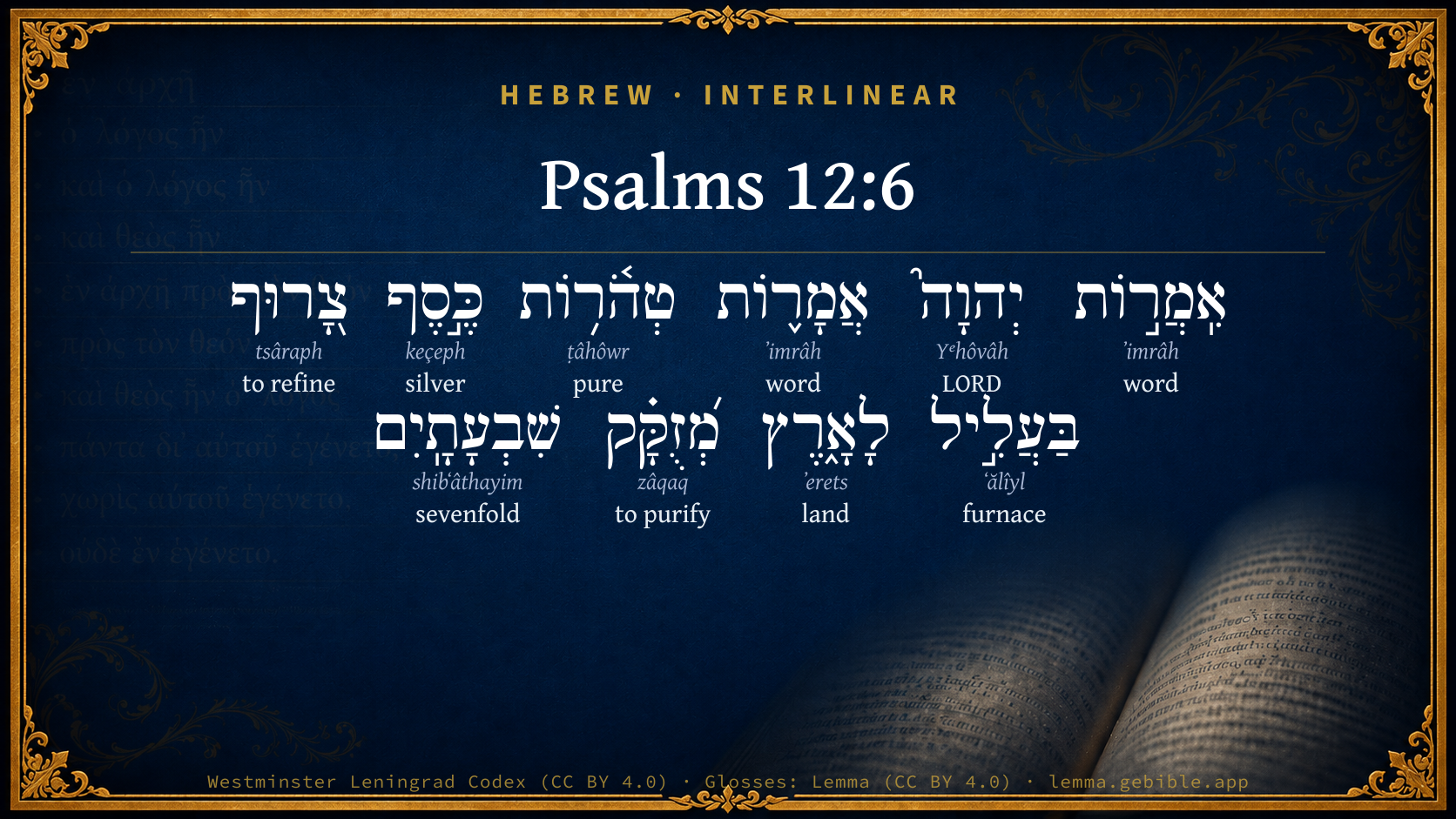
Hebrew (Westminster Leningrad Codex) Psalms 12:6 appears in the Hebrew Old Testament. The text above is from the Westminster Leningrad Codex. Each word links to its Strong’s number, a concise gloss, and parsing drawn from the Open Scriptures Hebrew Bible morphology. Click any word for its full Brown-Driver-Briggs (BDB) entry.
Download image
Cite this verse

Psalms 12:6 (World English Bible). Public Domain. Lemma interlinear Bible study tool, https://lemma.gebible.app/v/psalms/12/6.

Show BibTeX & RIS
BibTeX
RIS
English Translation
The words of Yahweh are flawless words, As silver refined in a clay furnace, purified seven times.
World English Bible · Public Domain
Highlights
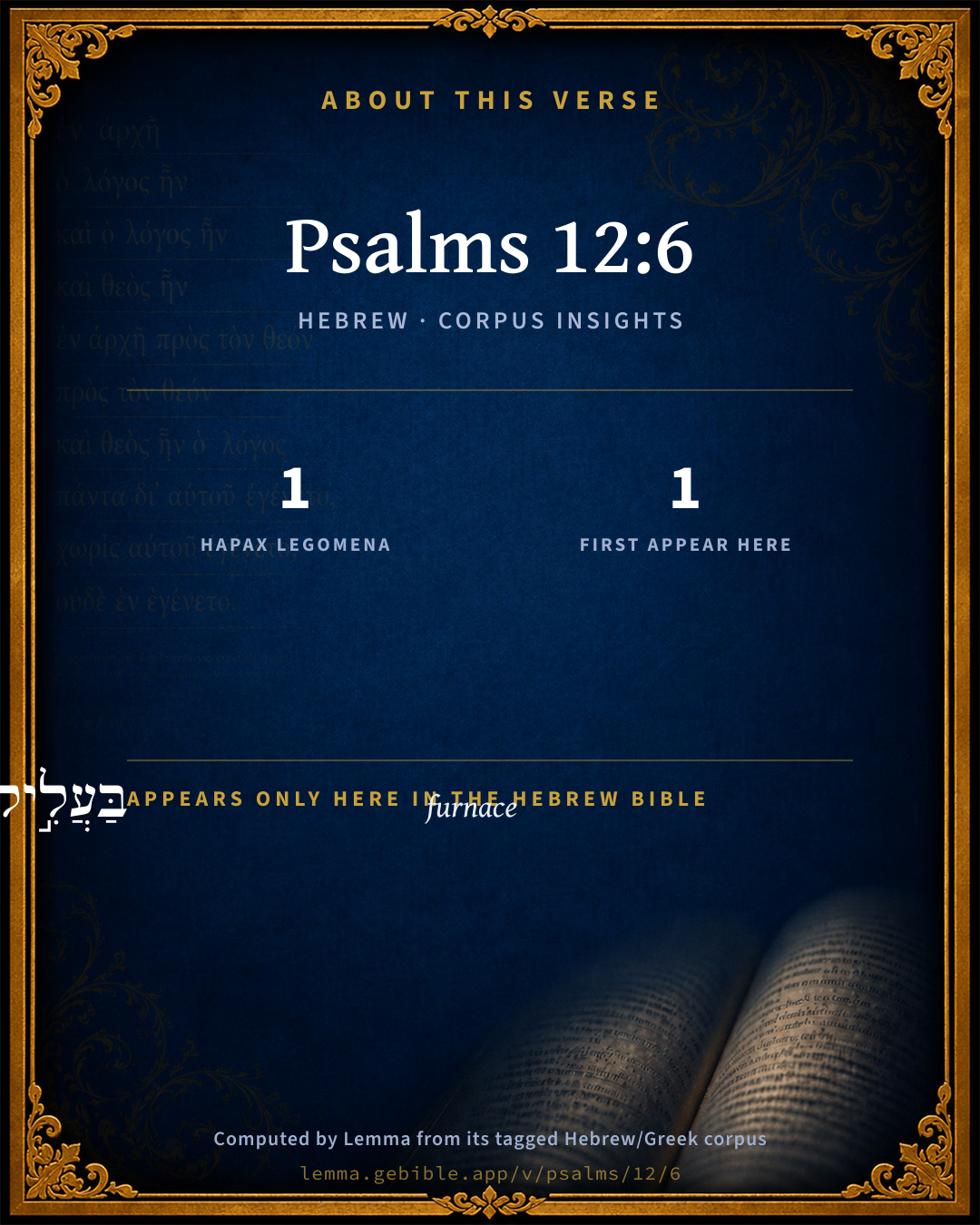
  • 1 hapax legomenon — only here in the Hebrew Bible
  • 1 first appearance in the Hebrew Bible
Full analysis ↓
Download a study sheet

One document with this verse’s original text, its word-by-word gloss line, the meaning frame, cross-references with their text, attributed commentary, and full source and license credits — printable, and it pastes into notes with its structure intact.

This verse Autodidact and up

Study sheet (.html) Plain text (.txt)

A passage Seminary Student

Up to 50 verses in one chapter. A passage sheet keeps up to 6 commentary sources and 12 cross-references per verse, in the order this page ranks them, and says so on the sheet whenever that leaves anything out. Ask for a single verse and you get the Autodidact verse sheet above.

Everything on this page stays free to read, with no account — the sheet is a download of what is already on screen, not access to it.

Want to remove ads? Support Godless Engineer
Compare translations 3

The same verse in 3 English versions, stacked beneath the original-language interlinear above. Click any original word for its lexicon entry.

Each is an independent rendering of the whole verse — the interlinear is not word-aligned to these translations.

Highlighted words mark where these versions differ — a whole-verse word diff, not a word-by-word alignment.

  • World English Bible Public Domain
    The words of Yahweh are flawless words, As silver refined in a clay furnace, purified seven times.
  • King James Version Public Domain
    The words of the LORD are pure words: as silver tried in a furnace of earth, purified seven times.
  • unfoldingWord Literal Text CC BY-SA 4.0
    words of Yahweh pure words, silver refined in a furnace on the ground, purified seven.

unfoldingWord Literal Text — © unfoldingWord, licensed CC BY-SA 4.0. Word-aligned USFM3 via Door43 (git.door43.org/unfoldingWord/en_ult).

Versions to compare (up to 4)

3 of 4 selected

Show all 18 translations

Every available English version of this verse, each an independent rendering of the whole verse.

  • World English Bible Public Domain
    The words of Yahweh are flawless words, As silver refined in a clay furnace, purified seven times.
  • Berean Standard Bible Public Domain
    The words of the LORD are flawless, like silver refined in a furnace, like gold purified sevenfold.
  • Majority Standard Bible Public Domain
    The words of the LORD are flawless, like silver refined in a furnace, like gold purified sevenfold.
  • King James Version Public Domain
    The words of the LORD are pure words: as silver tried in a furnace of earth, purified seven times.
  • American Standard Version (1901) Public Domain
    The words of Jehovah are pure words; As silver tried in a furnace on the earth, Purified seven times.
  • Revised Version (1885) Public Domain
    The words of the LORD are pure words; as silver tried in a furnace on the earth, purified seven times.
  • Geneva Bible (1599) Public Domain
    The wordes of the Lord are pure wordes, as the siluer, tried in a fornace of earth, fined seuen folde.
  • Douay-Rheims (1899) Public Domain
    By reason of the misery of the needy, and the groans of the poor, now will I arise, saith the Lord. I win set him in safety; I will deal confidently in his regard.
  • Young's Literal Translation Public Domain
    Sayings of Jehovah `are' pure sayings; Silver tried in a furnace of earth refined sevenfold.
  • Literal Standard Version CC BY-SA 4.0
    Sayings of YHWH [are] pure sayings—Silver tried in a furnace of earth, refined sevenfold.
  • Unlocked Literal Bible CC BY-SA 4.0
    The words of Yahweh are pure words, like silver purified in a furnace on the earth, refined seven times.
  • unfoldingWord Literal Text CC BY-SA 4.0
    words of Yahweh pure words, silver refined in a furnace on the ground, purified seven.
  • Darby Bible Public Domain
    The words of Jehovah are pure words, silver tried in the furnace of earth, purified seven times.
  • World Messianic Bible Public Domain
    The LORD’s words are flawless words, as silver refined in a clay furnace, purified seven times.
  • Webster's Bible Public Domain
    \\12:5\\For the oppression of the poor, for the sighing of the needy, now will I arise, saith the LORD; I will set him in safety from him that puffeth at him.
  • Free Bible Version CC BY-SA 4.0
    What the Lord says is trustworthy, as pure as silver refined seven times in a furnace.
  • Bible in Basic English Public Domain
    The words of the Lord are true words: like silver tested by fire and burned clean seven times.
  • JPS Tanakh (1917) Public Domain
    (12-7) The words of the LORD are pure words, as silver tried in a crucible on the earth, refined seven times.

Literal Standard Version (2020), Covenant Press — licensed CC BY-SA 4.0. Text via the HelloAO Bible API (eBible.org). Unlocked Literal Bible (unfoldingWord) — licensed CC BY-SA 4.0. Text via the HelloAO Bible API (eBible.org). unfoldingWord Literal Text — © unfoldingWord, licensed CC BY-SA 4.0. Word-aligned USFM3 via Door43 (git.door43.org/unfoldingWord/en_ult). Free Bible Version, Dr. Jonathan Gallagher — licensed CC BY-SA 4.0. Text via the HelloAO Bible API (eBible.org).

Word by word

More ways to search: Search by grammar → Find every occurrence → Compare this word →

Practice this passage: Drill this verse → Learn its vocabulary →

בַּעֲלִ֣יל
ʻălîyl
H5948
“in/at · furnace”
Preposition + Noun, Common, Masculine, Singular, Absolute
Part of Speech
Preposition + Noun
Type
Common
Gender
Masculine
Number
Singular
State
Absolute
Full BDB Definition

Origin: from H5953 in the sense of completing

TWOT: 1628b

furnace, crucible
  1. אִֽמֲר֣וֹת ʼimrâh H565 “words of” Noun, Common, Feminine, Plural, Construct
  2. יְהוָה֮ Yᵉhôvâh H3068 “LORD” Noun, Proper
  3. אֲמָר֪וֹת ʼimrâh H565 “words” Noun, Common, Feminine, Plural, Absolute
  4. טְהֹ֫ר֥וֹת ṭâhôwr H2889 “pure” Adjective, Adjective, Feminine, Plural, Absolute
  5. כֶּ֣סֶף keçeph H3701 “silver” Noun, Common, Masculine, Singular, Absolute
  6. צָ֭רוּף tsâraph H6884 “refined” Verb, Qal, Participle Passive, Masculine, Singular, Absolute
  7. לָאָ֑רֶץ ʼerets H776 “to/for the · land” Preposition, Determined + Noun, Common, Both, Singular, Absolute
  8. מְ֝זֻקָּ֗ק zâqaq H2212 “purified” Verb, Pual, Participle Passive, Masculine, Singular, Absolute
  9. שִׁבְעָתָֽיִם shibʻâthayim H7659 “sevenfold” Adjective, Cardinal number, Feminine, Dual, Absolute

About this verse

These counts appear in no published source. They are computed here, from the morphology-tagged text and Lemma’s own curated glosses. What Lemma adds →

10
words
9
distinct lemmas
Wisdom
section

Notable vocabulary

1 hapax legomenon — a word that appears only here in the entire Hebrew Bible:

  • בַּעֲלִ֣יל furnace H5948

First appearance in Scripture

This word makes its first canonical appearance in the Hebrew Bible here:

  • בַּעֲלִ֣יל furnace H5948

Shared distinctive vocabulary

שִׁבְעָתָֽיִם sevenfold H7659 occurs in 6 verses of the Hebrew Bible. Also found in:

Grammatical profile

  • 2 verbs
  • 6 nouns
  • 2 adjectives

Verb forms

  • צָ֭רוּף Qal · Participle Passive
  • מְ֝זֻקָּ֗ק Pual · Participle Passive

Repetition

A word recurs within this verse — often emphatic in Hebrew:

  • אִֽמֲר֣וֹת word H565 ×2

Hebrew & Septuagint length

In English translation the verse runs 17 words from the Hebrew and 23 from the Septuagint (LXX English) — closely comparable.

A rough comparison of the two English renderings, which tokenize alike — not a word-level alignment.

Word counts can differ between the Hebrew and the Greek without any difference in meaning — e.g. the Hebrew direct-object marker אֵת has no separate Greek word, and Greek often adds the article ὁ.

Cross-references

6

Topical passages linked to Psalms 12:6 in the Treasury of Scripture Knowledge — connected by theme and wording, ordered by reader-vote popularity; previews shown in the World English Bible.

  • Proverbs 30:5 "Every word of God is flawless. He is a shield to those who take refuge in him.
  • Psalms 18:30 As for God, his way is perfect. The word of Yahweh is tried. He is a shield to all those who take refuge in him.
  • 2 Samuel 22:31 As for God, his way is perfect: The word of Yahweh is tried; He is a shield to all those who take refuge in him.
  • Psalms 19:8 Yahweh's precepts are right, rejoicing the heart. Yahweh's commandment is pure, enlightening the eyes.
  • Psalms 66:10 For you, God, have tested us. You have refined us, as silver is refined.
  • Psalms 119:140 Your promises have been thoroughly tested, And your servant loves them.

Cross-references courtesy of OpenBible.info (CC BY 4.0).

Hebrew and Greek witnesses Masoretic Hebrew ↔ Greek Septuagint

The same verse in the two great witnesses to the Old Testament, shown verse-for-verse.

You’re reading Greek Psalm 11 (Hebrew Psalm 12). The Septuagint counts the superscription, so verse numbers can differ from the Hebrew — chapter-level alignment, not verse-by-verse. Numbering follows Rahlfs.

These are two independent witnesses, not word-aligned to each other, and the Septuagint is shown in lemma (dictionary) form.

Hebrew Psalms 12:6 Masoretic · Westminster Leningrad Codex

אִֽמֲר֣וֹת יְהוָה֮ אֲמָר֪וֹת טְהֹ֫ר֥וֹת כֶּ֣סֶף צָ֭רוּף בַּעֲלִ֣יל לָאָ֑רֶץ מְ֝זֻקָּ֗ק שִׁבְעָתָֽיִם

The words of Yahweh are flawless words, As silver refined in a clay furnace, purified seven times.

World English Bible · Public Domain

Greek LXX Greek Psalm 11:6 Septuagint · lemma form

ἀπό ὁ ταλαιπωρία ὁ πτωχός καί ἀπό ὁ στεναγμός ὁ πένης νῦν ἀναἵστημι λέγω κύριος τίθημι ἐν σωτηρία παρρησιάζομαι ἐν αὐτός

The oracles of the Lord are pure oracles; as silver tried in the fire, proved in a furnace of earth, purified seven times.

LXX2012 (modern English Septuagint) · Public Domain

Hebrew: Westminster Leningrad Codex (CC BY 4.0). Greek: Septuagint (public domain); English from LXX2012 (modern English Septuagint) (Public Domain). How the Septuagint differs from the Hebrew →

Commentary

Notes on Psalms 12:6 from classic Christian and Jewish commentators (each source and its license shown beneath its notes). The classic Christian expositions comment on the surrounding passage and are grouped to its opening verse, so a note may address several verses; the Jewish commentaries on the Tanakh (Rashi and others) are per-verse, so they appear only where the commentator wrote on this verse.

Lemma curates 59 commentaries, every one of them public domain or Creative Commons licensed, each selected and text-cleaned for this edition rather than reprinted as found. About our sources →

Trapp's Complete Commentary

John Trapp

Psa 12:6 The words of the LORD [are] pure words: [as] silver tried in a furnace of earth, purified seven times.

Ver. 6. The words of the Lord are pure words] Free from all insincerity or falsehood; and not like those of Saul’s flatterers, vile and vicious. All God’s promises are infallible, and such as a man may write upon, as they say. They are yea and Amen, 2Co 1:20, that is, truth and assurance. God hath hitherto kept promise with nights and days, that they shall one succeed another, Jer 33:20; Jer 33:25, therefore much more will he keep promise with his people.

As silver tried in a furnace] In a sublimatory or crucible. The Greeks call it δοκιμιον, St Peter’s word, 1Pe 1:7.

Purifed seven times] That is, sufficiently. Alchemy gold, as it will not pass the seventh fire, so it doth not comfort the heart, as true gold will.

John Trapp, A Commentary or Exposition upon All the Books of the Old and New Testament (1647–1656) — public domain. Text from a community e-Sword module.

The Biblical Illustrator

Joseph S. Exell

Psa_12:6

The words of the Lord are pure words: as silver tried in a furnace of earth, purified seven times.

The excellence of the Holy Scriptures

I. The holy description of the sacred writings here given. It tells of--

1. Their high authority. The men who wrote these books say, The Spirit of God spoke by me, and His Word was upon my tongue, Thus saith the Lord, and so on. Thus they claim high authority. But you may ask, How are we to know it? Therefore note--

2. Their inherent sanctity. The words of the Lord are pure words. And are they not so? Some say the book is immoral because it records immoral actions. But could the Scriptures have given a faithful account of human nature without such records? Those who study the Bible most are those who most of all live and practise all the public and social virtues. Modern infidels are not so candid as those of the former century. Rousseau could say, I will confess that, the majority of the Scriptures strike me with admiration, as the purity of the Gospel hath its influence on my heart. Peruse the works of our philosophers, with all their pomp of diction: how mean, how contemptible are they compared with the Scriptures! Is it possible that a book at once so simple and sublime should be merely the work of man?

3. Their intrinsic worth. In our text they are compared to the finest silver and gold. And in Psa_119:1-176. And this eulogy is deserved, because they speak of God and man reasonably and in harmony with our experience. They satisfy man upon the most anxious questions.

II. The scrutiny they have endured. Tried in the furnace, purified seven times. The reference is to the searching process of the refiner, by which he detects the presence of any alloy and removes it. And the Word of God has passed under a scrutiny like that of fire: It is not accepted on mere hearsay and because of the teachings of priests.

1. It has been thoroughly investigated. Josephus gives his testimony to the sacred books of the Jews. Hence the Old Testament is evidently not a book of yesterday. And from the testimony of the Fathers we know that the books of the New Testament have existed from the time they profess. The ancient versions confirm this. The entire New Testament might be collated out of the quotations made by the Fathers.

2. Then there has been antiquarian and scientific research. And these do homage to the testimony of revelation.

3. Philosophical and moral discoveries likewise bear their testimony in the philosophies of China and India, and yet others, have been searched, and they have been found poor and unsatisfactory, like the glimmer of gas lights at noonday, compared with the Scriptures. That eminent Oriental scholar, Sir William Jones, says, The Scriptures contain, independently of a Divine origin, more true sublimity, more exquisite beauty, purer morality, more important history, and finer strains, both of poetry and eloquence, than could be collected within the same compass from all other books that were ever composed in any age or in any tongue. Now these are not the testimonies of priests, but of laymen, learned, travelled, and who have become acquainted with the literature of all nations. And should any be disposed to trifle with the Bible, let me quote to him two lines from a poem penned by one of the greatest geniuses that has ever adorned our empire, and whose intellectual light has been just lost to us--

Better he had neer been born

Who reads to doubt, who reads to scorn.

(J. Blackburn.)

Testing the truth

The Psalmist is telling of the Word of God, and contrasting it with the words of men. He tells of those who speak vanity. With flattering lips and a double heart do they speak. He wants something better, and finds it in the Word of the Lord. For in contrast with mans weakness and falsehood there was the Divine promise immediately made, For the oppression of the poor, for the sighing of the needy, now, etc. May that be depended upon! May we take heart? Yes, For the words of the Lord are pure words, etc. So then, we may apply this text to the Bible.

I. By the prolonged and severe conflict it has had with all the evil of our world. There are two great forces in the moral world, that of evil--the world, the flesh, and the devil, and that of good--in truth, in holiness, and in love. And God is the source of all this good. Now, if the words are of God they will be like Him; which is just what they are. And they will occupy His place, bitter against nothing but evil, enamoured of nothing but good. And they will do His work. So they do, have done everywhere and always, under all circumstances and amid all conditions.

II. By all the contradictions of unbelief. Concerning Him it is said, He endured the contradiction of sinners against Himself. Just so it has been with the Word of God, and is so now. They have heated the furnace to the intensest heat, and cast the Bible in, and the result is that it has lost nothing but the tinsel of mans folly or the bonds wherewith mens authority sought to bind it.

III. By the evil consequences of the conduct of false professors. We complain of the unfair dealing of unbelief. Naturally. But there are others who deserve our indignation far more, and these are those who profess to be, but are not, friends of the Gospel or of the words of God. Worldly men, who have determined to make it a political engine. Hence it has been encumbered with ceremonies and dogmas; kept back from the people; mans own interpretations fastened upon it, as if they were the words of God Himself.

IV. The infirmities and inconsistencies of its real friends. Many of you here profess to be its real friends. Some of you hold prominent positions, and, like Peter and John, you bid men look on you and see what your religion can do. And men do look on you and judge the Word of God by you. And they see very soon where there are inconsistencies in you; whilst, on the other hand, there is nothing so awes the world as the spirituality, unselfishness, and devotedness of earnest holiness. But who of us can profess fitly to represent the Word of God? How imperfect are the best of men.

V. By the spiritual discernment of all sanctified men. In one sense the Word of God tries a man, for according as he acts towards it so does he reveal his spiritual state. On the other hand, all holy souls test the living Word. My sheep hear My voice, said the Saviour, but a stranger will they not follow.

VI. By the personal experience of both saints and sinners. VII. by those, most of all, who have most thoroughly lived in it and worked hardest for it. If I want to know the sustaining qualities of any particular kind of food I observe those who live most on it, yet do the greatest amount of work, and with the greatest ease, and, nevertheless, show the most robust health. And so, would I know what the Word of God can do, I turn to those who are such as I have described. See Paul. Hear him say, I can do all things through Christ, who strengthened me. All of you who hear the Word, bind it to your hearts, and let it be your holy resolve, God helping you, to live as well as speak His Word. (John Aldis.)

The Word of God tested and proven

The fable that there were animals that lived in the fire, called Salamanders, came from the glowing brilliance of some metals that, when they are heated to a white heat, acquire a supernatural splendour, and apparently a new and mysterious life. The metal seems now to live, breathe, heave, move at every new expansion and contraction; a hundred hues, indescribably brilliant and radiant, play around the molten surface. Of all books, the Word of God is the only one with Salamander qualities. The flames of persecution and hostile criticism, instead of effecting its destruction, have but added to its lustre and strengthened its claims to be indeed the Word of the Lord that endureth forever. (A. T. Pierson D. D.)

.

Psa_13:1-6

The Biblical Illustrator, edited by Joseph S. Exell (c. 1880s–1900s) — public domain. Text from a community e-Sword module.

Joseph Benson's Commentary

Psa 12:6. The words of the Lord are pure — Without the least mixture of falsehood, and therefore shall be infallibly fulfilled. Men often speak rashly, and promise what they cannot perform, and deceitfully, what they never intend to perform. But God’s words are different; they are pure from all manner of dross; from all folly, or fraud, or uncertainty. “Often have they been put to the test, in the trials of the faithful, like silver committed to the furnace in an earthen crucible; but, like silver in its most refined and exalted purity, found to contain no dross. The words of Jehovah are holy in his precepts, just in his laws, gracious in his promises, significant in his institutions, true in his narrations, and infallible in his predictions. What are thousands of gold and silver, compared to the treasures of the sacred page?” — Horne.

Joseph Benson's Commentary on the Old and New Testaments (1811–1818) — public domain. Text from a community e-Sword module.

J. A. Alexander on Psalms

Joseph Addison Alexander

7. (Psa 12:6). The sayings of Jehovah are pure sayings, silver purged in a fur nace of earth, refined seven times. The Psalmist does not use the term commonly translated words, but one derived from the verb to say, with obvious allusion to the use of the verb itself in the preceding verse. What Jehovah there says, the promises there given, are here declared to be true, without any mixture of mistake or falsehood. This is expressed by the favourite figure of pure metallic ore. The idea of extreme or perfect purity is conveyed by the idiomatic phrase, purified seven times, i.e. repeatedly, or sevenfold, i.e. completely. Compare Dan 3:19. The general meaning of the verse is clear, but it contains one phrase which is among the most doubtful and disputed in the whole book. This is the phrase lylfb, Crxl. To the common version above given, in a furnace of earth, and to another somewhat like it, purged in a furnace as to (i. e. from) the earth, or earthy particles, it has been objected, that Crx never means earth as a material. Some avoid this difficulty by translating, in a furnace on the earth (or ground), or, in the workshop (laboratory) of the earth, i.e. the mine; but this is not the place where ores are purified. It is further objected to all these translations, that they attach a supposititious meaning to the noun lylf. It is therefore explained by some as a variation of lfb, lord or master, and the whole clause made to mean, purified silver of a lord of the earth, i.e. refined not for ordinary use, but for that of some great prince or noble. The obscurity which overhangs the meaning of this clause is less to be regretted, as the main idea must, on any supposition, still be that of unusual and perfect purity.

Joseph Addison Alexander, The Psalms Translated and Explained (1850) — public domain. Text from a community e-Sword module.

Tyndale Open Study Notes

Tyndale Open Resources

12:6 The godly can rely on the Lord’s promises, but not on the lies of the wicked (12:2-4). • Seven times means totally or completely.

Tyndale Open Study Notes — © Tyndale Open Resources, licensed CC BY-SA 4.0. Text via the HelloAO Bible API.

Jamieson, Fausset & Brown

Robert Jamieson, A. R. Fausset & David Brown

The words--literally, "saying of" (Psa 12:5).

seven times--thoroughly (Dan 3:19).

Jamieson, Fausset & Brown — Commentary Critical and Explanatory on the Whole Bible (1871) — public domain (CC PDM 1.0). Text via the HelloAO Bible API.

Adam Clarke's Commentary

Verse 6. The words of the Lord are pure words] None of his promises shall fall to the ground; the salvation which he has promised shall be communicated.

Silver tried in a furnace of earth] A reference to the purification of silver by the cupel. This is a sort of instrument used in the purification of silver. It may be formed out of a strong iron ring or hoop, adjusted in width and depth to the quantum of silver to be purified, and rammed full of well pulverized calcined bone. The metal to be purified must be mingled with lead, and laid on the cupel, and exposed to a strong heat in an air furnace. The impurities of the metal will be partly absorbed, and partly thrown off in fume. The metal will continue in a state of agitation till all the impurities are thrown off; it will then become perfectly still, no more motion appearing, which is the token that the process is completed, or, according to the words of the text, is seven times, that is, perfectly purified.

Adam Clarke's Commentary on the Bible (1810–1826) — public domain. Text from a community e-Sword/MySword module.

John Calvin's Commentaries

6. The words of Jehovah. The Psalmist now declares, that God is sure, faithful, and steadfast in his promises. But the insertion by the way of this commendation of the word of God would be to no purpose, if he had not first called himself, and other believers, to meditate on God’s promises in their afflictions. Accordingly, the order of the Psalmist is to be attended to, namely, that, after telling us how God gives to his servants the hope of speedy deliverance, even in their deepest distresses, he now adds, to support their faith and hope, that God promises nothing in vain, or for the purpose of disappointing man. This, at first sight, seems a matter of small importance; but if any person consider more closely and attentively how prone the minds of men are to distrust and ungodly doubtings, he will easily perceive how requisite it is for our faith to be supported by this assurance, that God is not deceitful, that he does not delude or beguile us with empty words, and that he does not magnify beyond all measure either his power or his goodness, but that whatever he promises in word he will perform in deed. There is no man, it is true, who will not frankly confess that he entertains the same conviction which David here records, that the words of Jehovah are pure; but those who while lying in the shade and living at their ease liberally extol by their praises the truth of God’s word, when they come to struggle with adversity in good earnest, although they may not venture openly to pour forth blasphemies against God, often charge him with not keeping his word. Whenever he delays his assistance, we call in question his fidelity to his promises and murmur just as if he had deceived us. There is no truth which is more generally received among men than that God is true; but there are few who frankly give him credit for this when they are in adversity. It is, therefore, highly necessary for us to cut off the occasion of our distrust; and whenever any doubt respecting the faithfulness of God’s promises steals in upon us, we ought immediately to lift up against it this shield, that the words of the Lord are pure. The similitude of silver, which the Psalmist subjoins, is indeed far below the dignity and excellence of so great a subject; but it is very well adapted to the measure of our limited and imperfect understanding. Silver, if thoroughly refined, is valued at a high price amongst us. But we are far from manifesting for the word of God, the price of which is inestimable, an equal regard; and its purity is of less account with us than that of a corruptible metal. Yea, a great many coin mere dross in their own brain, by which to efface or obscure the brightness which shines in the word of God. The word בעליל, baälil, which we have translated crucible, is interpreted by many prince, or lord, as if it were a simple word. According to them, the meaning would be, that the word of God is like the purest silver, from which the dross has been completely removed with the greatest art and care, not for common use, but for the service of a great lord or prince of some country. I, however, rather agree with others who consider that בעליל, baälil, is a word compounded of the letter ב, beth, which signifies in, and the noun עליל, alil, which signifies a clean or well polished vessel or crucible.

John Calvin's Commentaries (1540-1563) — public domain. Text from the Calvin Translation Society English edition (1840s-50s) via the Christian Classics Ethereal Library (ccel.org). Calvin's coverage is partial (roughly two-thirds of the Bible); uncommented books and verses are honest gaps, never fabricated. The 19th-century editor's footnotes and remarks are omitted so the notes are faithfully Calvin's own voice.

Ellicott's Commentary for English Readers

(6) As silver.—This solemn promise of Jehovah may be relied on, for His words are not like those of deceitful men—alloyed with self and falsehood—but are pure as silver seven times smelted.

In a furnace.—Either a “workshop” or a “crucible,” according as derived.

Of earth.—These words are difficult; they must mean either in earth, referring to the ashes in which the smelted silver falls, or as to earth, i.e., as to the alloy, or as we say, purified of the alloy.

But erets is never else used for the material, earth, and Hitzig’s emendation, rats = bar, or piece (Psa_68:30), “melted into a bar from the crucible,” is almost convincing in its simplicity and aptness.

A Bible Commentary for English Readers, edited by Charles John Ellicott (1878–1897) — public domain. Text from a community e-Sword module.

The Cambridge Bible for Schools and Colleges

gen. ed. J. J. S. Perowne

6. A general truth with direct application to the promise of the preceding verse. In Jehovah’s words there is no dross of flattery or insincerity or falsehood. Unlike the words of men, they are wholly to be relied on.

as silver tried] Omit as. Silver is a natural emblem of purity and preciousness. The metaphor underlies the language of Psa_18:30, Psa_119:140, Pro_30:5.

in a furnace of earth] The precise meaning is doubtful. Either (1) in a furnace on the earth (R.V.), i.e. a furnace built on the ground, the point of which is not obvious: or (2) silver refined in a furnace (flowing down) to the earth may be meant to picture the bright stream of pure metal flowing from the furnace, shewing that the process of refining has done its work.

purified seven times] Again and again till no trace of dross is left. Seven is the number of completeness and perfection. Cp. Psa_79:12; Pro_6:31; Isa_30:16.

The Cambridge Bible for Schools and Colleges (gen. ed. J. J. S. Perowne; Cambridge University Press, 1878–1918) — public domain. Text from a community e-Sword module.

John Gill's Exposition

The words of the Lord are pure words,.... This observation the psalmist makes in reference to what is just now said in Psa 12:5,, and in opposition to the words of wicked men in Psa 12:2; which are deceitful, sinful, and impure. The Scriptures are the words of God; and they are pure and holy, free from all human mixtures, and from all fraud and deceit; they are the Scriptures of truth. The promises are the words of God, and they are firm and stable, and always to be depended on, and are ever fulfilled, being yea and amen in Christ Jesus. The Gospel, and the doctrines of it, are the words of God; that is the sincere milk of the word, pure and incorrupt; as it is in itself, and as it is dispensed by the faithful ministers of it; and they are all according to godliness, and tend to encourage and promote purity and holiness of heart and life; See Pro 30:5;

as silver tried in a furnace of earth; they are as "silver" for worth and value; yea, they are more valuable than silver or gold, Psa 19:10. The Bible is a mine of rich treasure, and to be searched into as for it; the promises in it are exceeding precious; they are like apples of gold in pictures of silver, and yield more joy than the finding a great spoil. The doctrines of the Gospel are comparable to gold and silver and precious stones, and to be bought at any rate, but to be sold at none: and they are as silver "tried", which is pure, and free from dross. The words of men, of false teachers, are as dross and reprobate silver; but the words of the Lord are tried, and are pure, and free from all the dross of error and falsehood, Psa 18:30. And they are as silver tried "in a furnace of earth", which some (o) render "by the Lord of the earth"; but the word rather signifies a furnace, or an refinery, in which metal is melted and purified; and may be applied to the Lord Jesus Christ in human nature, in whom are all the treasures of wisdom and knowledge, and who came full fraught with the doctrines of the Gospel; and in whom they have been "tried", by his sufferings and death, and are found to be pure, solid, and substantial: or to the ministers of the Gospel, who have this treasure in earthen vessels, whose works and words and ministry are tried by many fiery trials, and abide: or to all the people of God in general, who dwelt in earthly tabernacles; and who, in the midst of various afflictions, have a comfortable and confirming evidence of the purity and truth of the words of God, of the promises of his covenant, and the doctrines of the Gospel;

purified seven times; that is, many times, Pro 24:16; and so completely and perfectly pure, and clear of all dross whatsoever, as silver so many times tried must needs be: and so the words of God are not only pure, but very pure, exceeding pure, Psa 119:140.

(o) Vid. Jarchi, Kimchi, & Ben Melech in loc. so some in David de Pomis, Lexic. fol. 11. 1. taking in to be radical, and doubled as if it was

John Gill's Exposition of the Whole Bible (1746–1763) — public domain (CC PDM 1.0). Text via the HelloAO Bible API.

Albert Barnes' Notes on the Bible

The words of the Lord - In contrast with the words of the persons referred to in Psa 12:2-4. Their words were vanity, flattery, and falsehood; and no reliance could be placed on them. In contrast with these words, the words of the Lord were pure. They were to be relied on. All his sayings were true and faithful. The design is to bring his words into contrast with the sayings of such men, and to show how much more safety there is in relying on his promises than on the promises made by such men. Man failed, but God would not. Reliance could not be placed on the words of even the professedly “godly” and “faithful” Psa 12:1, but entire confidence might be placed in the words of Yahweh. All his words were true, pure, faithful, so that even when his own professed friends failed, and confidence could be placed in them, yet there was still reason for unwavering confidence in God himself.

Are pure words - That is, they are without any mixture of falsehood - for this idea is implied in the comparison which the psalmist makes when he says that they are like silver purified in the furnace, that is, from which all the dross has been removed.

As silver tried in a furnace of earth - The word here rendered “furnace” properly means a workshop. Perhaps it corresponds nearly with our word “laboratory,” as the term is now used by chemists. It evidently refers to some place where the metal was tried and purified. The words rendered “of earth” literally mean “on the earth,” or “in the earth?” The language does not mean that the “furnace” was “made” of earth, as would seem to be implied in our version, but that the “furnace” or laboratory was erected on the earth, or in the earth. It may refer to something like a crucible placed on the ground, around which a fire of intense heat could be made. It is probable that some such structure would be made near the mines where ore was obtained, and that the ore would be thus purified from dross before it was removed.

Purified seven times - By passing it seven times - that is, very often - through the fire. The word “seven” in the Scriptures denotes a complete or perfect number, and is often used to denote frequency. The idea here would seem to be that the process was repeated until the silver became entirely pure. The sense is, that the words of the Lord are “perfectly pure.” There is no admixture of falsehood in his statements; there is no deception in his promises; there is no flattery in what he says. This was the ground of confidence on the part of the psalmist - that while men (even those who professed to be good men) so failed that no reliance could be placed on their statements, the most perfect trust could be reposed on all the statements of God.

Albert Barnes' Notes on the Bible (1834–1885) — public domain. Text from a community e-Sword/MySword module.

Matthew Poole's English Annotations

Pure; or, sincere; without the least mixture of vanity or falsehood; and therefore shall infallibly be fulfilled. This he seems to add to answer an objection which might arise in some men’s minds concerning what was last said. You tell us, The, Lord saith, I will set him in safety, &c.; but saying and doing are two things. They are so indeed in men, who oft speak rashly what they cannot perform, and deceitfully what they never intend: but all God’s words are pure from all manner of dross; from all folly, or fraud, or uncertainty; he is holy and true in all his doctrines, threatenings, predictions, and promises.

Tried in a furnace of earth, i.e. made of such earth or clay as was proper for and then usual in that work. See 1Ki 7:46.

Matthew Poole's English Annotations on the Holy Bible (1683–1685) — public domain. Text from a community e-Sword/MySword module.

The Treasury of David

Charles H. Spurgeon

Ver. 6. The words of the Lord are pure words, etc. How beautifully is this verse introduced, by way of contrast to what was said before concerning! Do sinners talk of vanity? let saints then speak of Jesus and his gospel. Do they talk impure words? then let the faithful use the pure words of God, which like silver, the more used, the more melted in the fire, the more precious will they be. It is true, indeed, despisers will esteem both God and his word as trifling; but oh, what an unknown treasure doth the word, the promises, the covenant relation of the divine things of Jesus contain! They are more to be desired than gold, yea, than pure gold; sweeter also than honey and the honeycomb. Robert Hawker.

Ver. 6. The words of the Lord are pure words, etc. They that purify silver to the purpose, use to put it in the fire again and again, that it may be thoroughly tried. So is the truth of God; there is scarce any truth but hath been tried over and over again, and still if any dross happens to mingle with it, then God calls it in question again. If in former times there have been Scriptures alleged that have not been pertinent to prove it, that truth shall into the fire again, that what is dross may be burnt up; the Holy Ghost is so curious, so delicate, so exact, he cannot bear that falsehood should be mingled with the truths of the gospel. This is the reason, therefore, why that God doth still, age after age, call former things in question, because that there is still some dross one way or other mingled with them; either in the stating the opinions themselves, or else in the Scriptures that are brought and alleged for them, that have passed for current, for he will never leave till he have purified them. The doctrine of God's free grace hath been tried over and over, and over again. Pelagius begins, and he mingles his dross with it: he saith, grace is nothing but nature in man. Well, his doctrine was purified, and a great deal of dross purged out. Then come the semi Pelagians, and they part stakes; they say, nature can do nothing without grace, but they make nature to concur with grace, and to have an influence as well as grace; and the dross of that was burnt up. The Papists, they take up the same quarrel, but will neither be Pelagians nor semi Pelagians, yet still mingle dross. The Arminians, they come, and they refine popery in that point anew; still they mingle dross. God will have this truth tried seven times in the fire, until he hath brought it forth as pure as pure may be. And I say it is because that truth is thus precious. Thomas Goodwin.

Ver. 6. The Scripture is the sun; the church is the clock. The sun we know to be sure, and regularly constant in his motions; the clock, as it may fall out, may go too fast or too slow. As then, we should condemn him of folly that should profess to trust the clock rather than the sun, so we cannot but justly tax the credulity of those who would rather trust to the church than to the Scripture. Bishop Hall.

Ver. 6. The words of the Lord are pure words. Men may inspect detached portions of the Book, and please themselves with some things, which at first view, have the semblance of conniving at what is wrong. But let them read it, let them read the whole of it; let them carry along in their minds the character of the persons to which the different portions of it were addressed; the age of the world, and the circumstances under which the different parts of it were written, and the particular objects which even those portions of it have in view, which to an infidel mind appear the most exceptionable; and they may be rationally convinced that, instead of originating in the bosom of an impostor, it owes its origin to men who wrote "as they were moved by the Holy Ghost." Let them scrutinise it with as much severity as they please; only let their scrutiny be well informed, wisely directed, and with a fair and ingenuous mind, and we have no fears for the issue. There are portions of it on which ignorance and folly have put constructions that are forced and unnatural, and which impure minds have viewed in shadows reflected from their own impurity. Montesquieu said of Voltaire, Lorsque Voltaire lit un livre, il le fait, puis il ecrit contre ce qu'il a fait: "When Voltaire reads a book, he makes it what he pleases, and then writes against what he has made." It is no difficult matter to besmear and blot its pages and then impute the foul stains that men of corrupt minds have cast upon it, to its stainless Author. But if we honestly look at it as it is, we shall find that like its Author, it is without blemish and without spot. Gardiner Spring, D.D.

Ver. 6. The words of the Lord are pure words: as silver tried in a furnace of earth, purified seven times. The expression may import two things: first, the infallible certainty of the word; and, secondly, the exact purity. First, the infallible certainty of the word, as gold endureth in the fire when the dross is consumed. Vain conceits comfort us not in a time of trouble: but the word of God, the more it is tried, the more you will find the excellency of itthe promise is tried, as well as we are tried, in deep afflictions; but when it is so, it will be found to be most pure. "The word of the Lord is tried; he is a buckler to all those who trust in him" (Pr 30:5); as pure gold suffers no loss by the fire, so the promises suffer no loss when they are tried, but stand to us in our greatest troubles. Secondly, it notes the exact perfection of the word: there is no dross in silver and gold that hath been often refined; so there is no defect in the word of God. Thomas Manton.

Ver. 6. Fry thus translates this verse:

The words of Jehovah are pure words Silver refined in the crucible Gold, seven times washed from the earth.

(qqzm) though sometimes applied to express the purity of silver, is more strictly an epithet of gold, from the peculiar method made use of in separating it from the soil by repeated washings and decantations.

John Fry, in loc.

Ver. 6. Seven times. I cannot but admit that there may be a mystic meaning in the expression "seven times, "in allusion to the seven periods of the church, or to that perfection, implied in the figure seven, to which it is to be brought at the revelation of Jesus Christ. This will be more readily allowed by those who admit of the prophetic interpretation of the seven epistles of the Book of Revelation. W. Wilson, D.D., in loc.

Ver. 6. The purity, trial, and permanency of the words of the Lord.

Seven crucibles in which believers try the word. A little thought will suggest these.

Psalms 12:7*

Charles H. Spurgeon's The Treasury of David (1869–1885) — public domain. Psalms only. Text from a community e-Sword/MySword module.

Whedon's Commentary on the Bible

Daniel D. Whedon

6. The words of the Lord are pure words—The sayings of Jehovah are pure sayings. From the lying lips and perverse speeches of the wicked already noticed, by which they thought to compass their ends, the psalmist turns with adoring delight to the pure and perfect words of God, by which, and not by the falsehood and arrogance of man, the world shall be governed.

Furnace of earth—The word עליל, (aleel,) furnace, which occurs nowhere else in Scripture, has been translated workshop, from the root idea, to work, perform, accomplish: and of earth has been understood as denoting, as to earth, thus making the passage read, Silver tried in a workshop, (as to earth,) that is, purged from its earthy particles, its dross, scoria. Others more naturally understand it of a furnace, crucible, or melting pot made of earth, which gives a better construction, and one more in harmony with the figure. It is no objection to this latter view, that it takes “earth” in the unusual sense of element, or material.

Seven times—A proverbial phrase for perfectly, completely.

Daniel D. Whedon (gen. ed.), Commentary on the Old and New Testaments (1874–1909) — public domain. Text from a community e-Sword module.

The Pulpit Commentary

The words of the Lord are pure words. There is no base alloy in them: therefore they may be trusted. What God promises, he will perform. As silver tried in a furnace of earth; rather, perhaps, silver assayed in a crucible on earth (Kay). Purified seven times. (comp. Psa_18:30 Psa_19:8 Psa_119:140 Pro_30:5)

The preciousness of the Word.

"The words of the Lord," etc. Thus the Bible bears witness to itself. We read often in Scripture of "the word of the Lord not so often of "the words" of the Lord. By "the Word of the Lord" is meant sometimes a particular command, promise, or prediction; but frequently and usually in the New Testament the substance or sum-total of Divine truth. (Psa_119:9, e.g. ) But this phrase, "the words of the Lord," calls attention to the actual utterances in which this truth is recorded for us. So our Lord distinguishes (Joh_8:43) between his "speech," the particular form or method of his teaching, and his "Word," his doctrine.

I THE INSPIRATION AND AUTHORITY OF THE SCRIPTURES. "The words of the Lord." We must guard against such narrow, mechanical views of inspiration as would confine it to the Hebrew and Greek words in which it was written, so that one who reads a good translation would not have "the words of the Lord." "The meaning of Scripture," says Tyndale, "is Scripture." Inspiration is the Holy Spirit working in men and by men not as machines, but as living, reasonable beings. We ought not to speak of "the human element" and "the Divine element" as separable or hostile. A great picture is but paint and canvas, informed, vivified by the thought and genius of the artist. You cannot say, "This part is paint, and that part is genius." So in the Bible. "Men of God spake there is the human element they were moved by the Holy Ghost there is the Divine. (comp. 2Ti_3:16, where, had the Revisers followed the analogy of their own rendering in 2Ti_4:4, they would have retained the rendering they have transferred to the margin)

II ITS TRIED AND PROVED TRUTH. The similitude is drawn from precious metal, whose worth and purity have been proved in the furnace, which separated the dross from the pure ore. The idea is not that we are to distinguish, in Scripture, dross from gold and silver, but that God has done so. He gives us not rough ore, but pure metal. But we may apply the image to the tests to which the Bible has been and daily is submitted.

1. The experience of those who have trusted it and gone by it. Those who have done this longest, most practically, with fullest faith, are the very persons most convinced of the truth and worth of the Bible.

2. Hostile criticism. For the last hundred years this has been especially fierce, learned, elaborate, determined, skilful. Had the Word not been pure gold, it must have perished in this fierce furnace. The result has been to shed a flood of light on the letter of Scripture, and to bring to light a mass of new and powerful evidence, bearing witness to its truth and genuineness. It stands both tests. (1Pe_1:23-25)

III ITS PRECIOUSNESS. It is worth all the care and trouble God has bestowed, by his providence and inspiration, on its composition and preservation; all the help and illumination which the Holy Spirit continually grants to those who read it with faith and earnest prayer; all the study given to it by friends and foes. (Psa_119:72)

CONCLUSION. Is it precious to you? Is this the witness of your own experience? If not, it must be because you have not really tried it.

The Pulpit Commentary (1880–1919), ed. H.D.M. Spence-Jones & Joseph S. Exell — public domain. Text from a community e-Sword module.

John Wesley's Explanatory Notes

Pure - Without the least mixture of falsehood; and therefore shall infallibly be fulfilled.

John Wesley, Explanatory Notes Upon the Whole Bible (1754–1765) — public domain. Text via the GEBible commentary corpus.

unfoldingWord translationNotes

Door43 World Missions Community

like silver purified in a furnace on the earth, refined seven times

Yahweh's words are compared to silver that has been purified. AT: "they are without any imperfection" (See: Simile)

You keep them

"You keep the righteous people safe"

walk on every side

"surround us"

when evil is exalted among the children of mankind

This can be stated in active form. AT: "when people everywhere are praising evil" (See: Active or Passive)

children of mankind

"human beings" or "people"

translationWords

Yahweh

pure

generation

eternity

walk

exalt

unfoldingWord translationNotes — © Distant Shores Media and the Door43 World Missions Community, licensed CC BY-SA 4.0. Source: git.door43.org/Door43/en_tn.

Rashi

Rabbi Shlomo Yitzchaki (Rashi)

Because of the plunder of the poor Because of the plunder of the poor who are robbed by you for example, I myself and my men and the priests of Nob and because of the cry of the needy, the Lord shall say, “Now I will rise to their help.”

I will grant them salvation, He shall speak I will grant them salvation, He will speak concerning them.

יפיח is an expression of speech. There are many [examples] in the Book of Proverbs, and in Habakkuk (2:3): “and He shall speak (יפח) of the end, and it shall not fail.” However, Menachem (p. 141), interpreted it as an expression of a snare, as (below 124:7) “the snare (הפח) broke.”

Rashi on the Tanakh — English translations: “The Judaica Press complete Tanach with Rashi, translated by A. J. Rosenberg” (CC BY 4.0); “Pentateuch with Rashi's commentary by M. Rosenbaum and A.M. Silbermann, 1929-1934” (public domain); “The Metsudah Tanach series, Lakewood, N.J” (CC BY 4.0); and “The Book of Joshua, Metsudah Publications, 1997” (CC BY 4.0). Text via Sefaria.

Lesson kit

Teaching starters — assembled from the data on this page, not authored interpretation. Every prompt links to the verse data it draws on. Edit before teaching.

Psalms, in the Wisdom, opens this verse with 10 words (9 distinct Hebrew lemmas). Its most distinctive word is ʻălîyl (“furnace”). A historical commentator’s framing appears above. Read the whole chapter for the surrounding context.

Discussion questions

  1. How does “furnace” (ʻălîyl) shape what this verse is saying?
  2. 1 word here appears nowhere else in the Hebrew Bible. Why might the author reach for such rare wording?
  3. This is the first place “furnace” appears in Scripture (first appears here). What does its debut here establish?
  4. How does Genesis 4:15, which shares the word «sevenfold», read alongside this verse?
  5. What does the repetition of “word” (2× in this one verse) do in this verse?
  6. These translations render this verse differently; the difference is in the English rendering, not the original. What questions does that raise?
  7. «צָ֭רוּף» is a Qal Participle Passive verb. How does that grammatical form shape the action described?
  8. Compare how Trapp's Complete Commentary and The Biblical Illustrator read this verse. Where do they agree or differ?

Things to notice

  • 1 word in this verse appears nowhere else in the Hebrew Bible.
  • 1 word makes its first canonical appearance in Scripture here.
  • These translations choose different wording for 10 words in this verse.
  • “word” occurs 2× in this single verse.
  • 9 distinct Hebrew lemmas span 10 words in this verse.

Reading settings

Reading text

Shown beneath each verse's original-language words.

Old Testament
Old Testament edition

Read the OT as the Masoretic Hebrew (MT) or the Greek Septuagint (LXX).

English shown for the Greek Septuagint (in the Hebrew ↔ Greek comparison).

Comparing translations? Open the Compare panel on any verse page to stack up to four side by side.