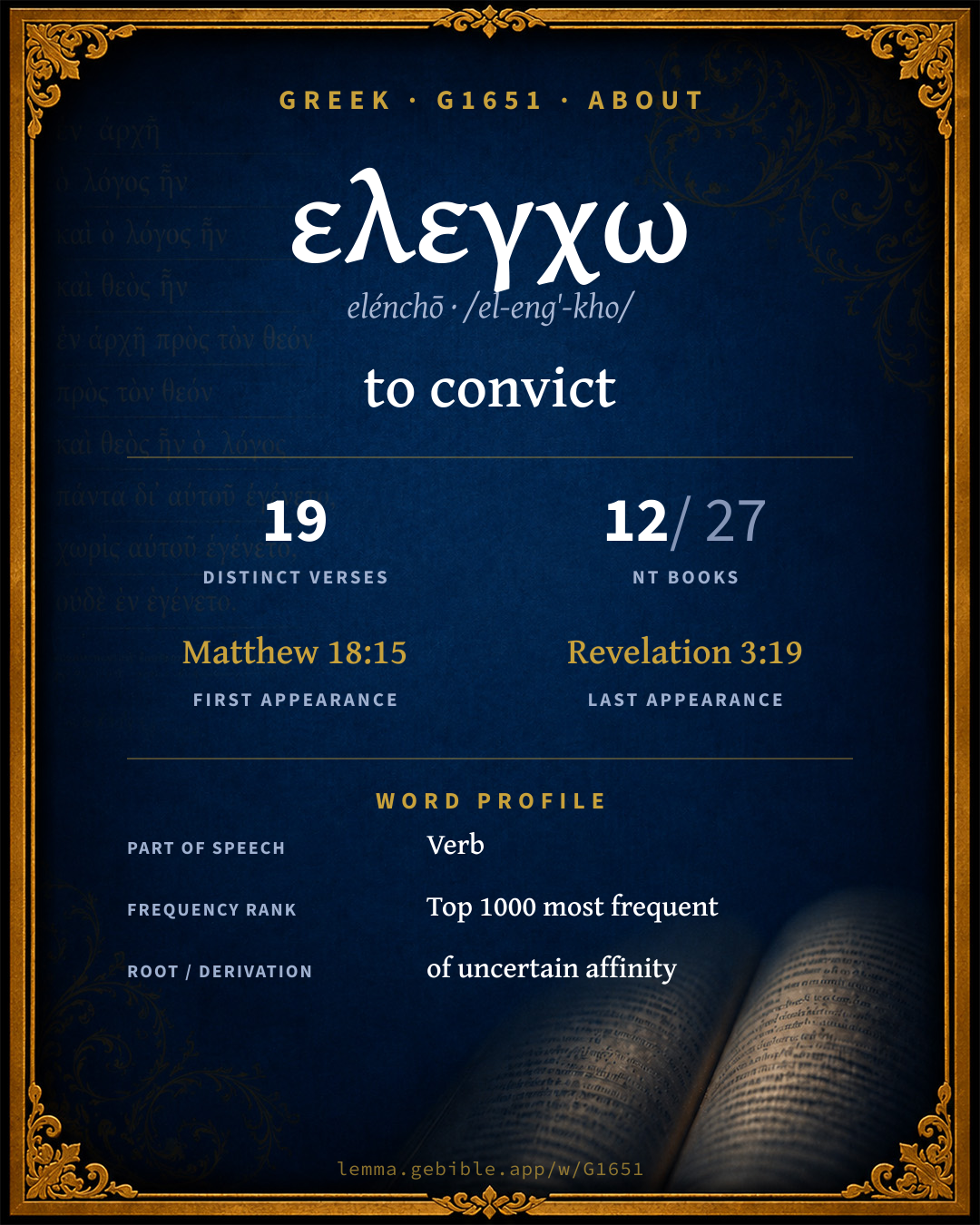
ἐλέγχω
to convict
also: refute, confute fuller range ↓
Full lexicon entry — Thayer's Greek Lexicon
From Thayer's Greek Lexicon
Where this word appears
See every Present-tense verb in the Greek New Testament →
Grammar key — what these labels mean
Part of speech
- Verb
- An action or state-of-being word.
Tense
- Present
- Ongoing or general action in present time (imperfective aspect).
- Aorist
- Action viewed as a simple whole, without regard to duration — often past (perfective aspect).
- Future
- Action expected in future time.
Voice
- Active
- The subject performs the action.
- Passive
- The subject receives the action.
Mood
- Imperative
- Expresses a command or request.
- Participle
- A verbal adjective (“writing,” “having written”).
- Infinitive
- A verbal noun (“to write”), unmarked for person or number.
- Subjunctive
- Expresses probability, purpose, or possibility (the mood of contingency).
- Indicative
- States a fact or asks a factual question (the mood of reality).
Case
- Nominative
- The case of the subject (and the predicate nominative).
Person
- 2nd person
- The one addressed (“you”).
- 3rd person
- The one spoken about (“he / she / it / they”).
- 1st person
- The speaker (“I / we”).
Gender
- Masculine
- Grammatically masculine.
- Neuter
- Grammatically neuter.
Number
- Singular
- One.
- Plural
- More than one.
Grammatical forms 13 distinct
- Verb, Present, Active, Imperative, 2nd person, Singular 3 times (16%)
- Verb, Aorist, Active, Imperative, 2nd person, Singular 2 times (11%)
- Verb, Present, Active, Imperative, 2nd person, Plural 2 times (11%)
- Verb, Present, Passive, Participle, Nominative, Plural, Masculine 2 times (11%)
- Verb, Present, Passive, Participle, Nominative, Singular, Masculine 2 times (11%)
- Verb, Aorist, Active, Infinitive 1 time (5%)
- Verb, Aorist, Passive, Subjunctive, 3rd person, Singular 1 time (5%)
- Verb, Future, Active, Indicative, 3rd person, Singular 1 time (5%)
+5 more forms (5 occurrences)
Parsed forms decoded from the imported morphology (Robinson–Tischendorf, public domain), counted across 19 parsed occurrences — not distinct verses.
Every verse where G1651 appears — 19 distinct verses across 12 books. Click any verse to open its interlinear word-by-word view. Verse text shown in the World English Bible for context — . Each verse’s Greek form is shown with its reference; the English is not keyword-highlighted, since the data carries no word-level English alignment. Use “Compare translations” on any verse to read it across multiple English versions. This concordance covers the Greek New Testament; Septuagint (Greek Old Testament) occurrences of this word are not indexed here.
Matthew 1 verse
Luke 1 verse
John 4 verses
- John 3:20 ἐλεγχθῇ aor pass subj 3sg For everyone who does evil hates the light, and doesn't come to the light, lest his works would be exposed.
- John 8:9 ἐλεγχόμενοι pres pass ptcp nom pl masc They, when they heard it, being convicted by their conscience, went out one by one, beginning from the oldest, even to the last. Jesus was left alone with the woman where she was, in the middle.
- John 8:46 ἐλέγχει pres act ind 3sg Which of you convicts me of sin? If I tell the truth, why do you not believe me?
- John 16:8 ἐλέγξει fut act ind 3sg When he has come, he will convict the world about sin, about righteousness, and about judgment;
1 Corinthians 1 verse
Ephesians 2 verses
1 Timothy 1 verse
2 Timothy 1 verse
Titus 3 verses
- Titus 1:9 ἐλέγχειν pres act inf holding to the faithful word which is according to the teaching, that he may be able to exhort in the sound doctrine, and to convict those who contradict him.
- Titus 1:13 ἔλεγχε pres act impv 2sg This testimony is true. For this cause, reprove them sharply, that they may be sound in the faith,
- Titus 2:15 ἔλεγχε pres act impv 2sg Say these things and exhort and reprove with all authority. Let no man despise you.
Hebrews 1 verse
James 1 verse
Jude 2 verses
- Jude 1:15 ἐλέγξαι aor act inf to execute judgment on all, and to convict all the ungodly of all their works of ungodliness which they have done in an ungodly way, and of all the hard things which ungodly sinners have spoken against him."
- Jude 1:22 ἐλέγχετε pres act impv 2pl On some have compassion, making a distinction,
Revelation 1 verse
About this entry
At a glance — auto-summarized from this page’s data, not written by a person. Every figure links to its source below. This summary describes the numbers; it doesn’t interpret them.
At its core, ελεγχω (elénchō) means “to convict.” It first appears in Matthew 18:15. It turns up in 19 verses across 12 books, an uncommon footprint. Ranging over 2 senses, its meaning includes “refute” and “confute”. It clusters with ελεγξις and ελεγχος under a shared root. Each statement above links to its evidence; the full detail follows below.
Gloss history
Strong's 1890 vs modern scholarship
About this word
Strong's G1651 catalogs a Greek word from the Greek New Testament.
These counts are not copied from any lexicon or concordance. They are computed here, from the morphology-tagged Greek New Testament. What Lemma adds →
- 19
- distinct verses
- The word appears in 19 distinct verses.
- 12 / 27
- NT books
- The word appears in 12 of 27 New Testament books.
- #644
- by frequency
- Top 1000 most frequent Greek words (rank 644 of 5,347 Greek words by occurrence).
View all 19 occurrences in the concordance →
By section of the New Testament
By traditional corpus
Conventional, traditional groupings — biblical authorship is debated, so this is a traditional corpus grouping, not an authorship claim. Some books belong to more than one corpus (Luke is in both the Gospels and the Lukan corpus, and so on), so these shares overlap and need not total 100%. Each figure is a share of the word’s 19 distinct verses.
- Pauline corpus 8 verses · 42%
- Gospels 6 verses · 32%
- Johannine 5 verses · 26%
- General (Catholic) Epistles 3 verses · 16%
- Lukan (Luke–Acts) 1 verse · 5%
- Hebrews 1 verse · 5%
- Revelation 1 verse · 5%
How translations render this word
Counts come from each version’s own published word-to-Strong’s tagging or interlinear alignment — an approximate guide to how each version renders this word, not a word-level alignment the data otherwise carries. Because each total is that version’s own tagged count, the per-version totals vary from one another and need not match the appearance or distinct-verse counts above. These counts may also differ from a printed concordance because Lemma counts each distinctly tagged rendering and does not collapse phrase taggings into a single head-word total. This is a fixed set of word-tagged versions (KJV, ASV, BSB, ULT) and does not change with the reading translation you choose elsewhere. Each version’s license is shown beside its name below (and on Sources).
- King James Version: Rebuke 4×, Reprove 2×
- American Standard Version: Reprove 5×
- Berean Standard Bible: Rebuke 2×
- unfoldingWord Literal Text: Rebuke 6×, Reprove 2×
King James Version Public Domain
Renders G1651 across 18 tagged occurrences — most commonly:
Plus 12 renderings that appear only once — usually multi-word phrases or single function words the recovered tagging swept in, not distinct renderings.
American Standard Version Public Domain
Renders G1651 across 17 tagged occurrences — most commonly:
Plus 12 renderings that appear only once — usually multi-word phrases or single function words the recovered tagging swept in, not distinct renderings.
Berean Standard Bible Public Domain
Renders G1651 across 17 tagged occurrences — most commonly:
Plus 15 renderings that appear only once — usually multi-word phrases or single function words the recovered tagging swept in, not distinct renderings.
unfoldingWord Literal Text CC BY-SA 4.0
Renders G1651 across 19 tagged occurrences — most commonly:
Plus 11 renderings that appear only once — usually multi-word phrases or single function words the recovered tagging swept in, not distinct renderings.
Senses in Thayer's
The 2 senses Thayer's distinguishes for this word, in lexicon order (not ranked by frequency or importance). The full entry — with sub-senses — is in the Lexicon Entry tab.
- to convict, refute, confute
- to find fault with, correct
Word origin
Origin: of uncertain affinity
Of uncertain affinity; to confute admonish : - convict convince tell a fault rebuke reprove.
— Strong’s Exhaustive Concordance (1890), public domain.
Forms in the corpus
The 13 distinct written forms G1651 takes in the Greek New Testament, most frequent first — each parse links to that tense’s occurrences in the concordance.
Same root — word family
Other Thayer's entries built from the same root as G1651, grouped by Strong’s listed origin. These share a root / origin per the lexicon — not necessarily a shared meaning. Each links to that word’s own entry.
Derived from this word
Compare all same-root words → They share a root, not necessarily a meaning.
Septuagint usage
The same Greek word ελεγχω appears 49 times in the Greek Old Testament (Septuagint), across 48 verses in 15 books.
- 49
- LXX occurrences
- Tagged occurrences of this Greek word in the Septuagint.
- 48
- verses
- Distinct Septuagint verses containing this word.
- 15 / 39
- OT books
- The word appears in 15 of the 39 Old Testament books.
Sample Septuagint occurrences
- Genesis 21:25 ἐλέγχω
- Leviticus 5:24 ἐλέγχω
- 2 Samuel 7:14 ἐλέγχω
- 1 Chronicles 12:18 ἐλέγχω
- 2 Chronicles 26:20 ἐλέγχω
- Job 5:17 ἐλέγχω
- Psalms 6:2 ἐλέγχω
- Proverbs 3:11 ἐλέγχω
- Isaiah 2:4 ἐλέγχω
- Jeremiah 2:19 ἐλέγχω
- Ezekiel 3:26 ἐλέγχω
- Hosea 4:4 ἐλέγχω
Septuagint occurrences (same lexeme)
Every verse where the same Strong’s number (G1651) appears in the Greek Septuagint. Verse text shown in the World English Bible for context; the Greek form is the matched word — the English is not keyword-highlighted.
- Genesis 21:25 ἐλέγχω Abraham complained to Abimelech because of a water well, which Abimelech's servants had violently taken away.
- Genesis 31:37 ἐλέγχω Now that you have felt around in all my stuff, what have you found of all your household stuff? Set it here before my relatives and your relatives, that they may judge between us two.
- Genesis 31:42 ἐλέγχω Unless the God of my father, the God of Abraham, and the fear of Isaac, had been with me, surely now you would have sent me away empty. God has seen my affliction and the labor of my hands, and rebuked you last night."
- Leviticus 5:24 ἐλέγχω
- Leviticus 19:17 ἐλέγχω "'You shall not hate your brother in your heart. You shall surely rebuke your neighbor, and not bear sin because of him.
- 2 Samuel 7:14 ἐλέγχω I will be his father, and he shall be my son: if he commit iniquity, I will chasten him with the rod of men, and with the stripes of the children of men;
- 1 Chronicles 12:18 ἐλέγχω Then the Spirit came on Amasai, who was chief of the thirty, [and he said], "We are yours, David, and on your side, you son of Jesse: peace, peace be to you, and peace be to your helpers; for your God helps you." Then David received them, and made them captains of the band.
- 1 Chronicles 16:21 ἐλέγχω He allowed no man to do them wrong; Yes, he reproved kings for their sakes,
- 2 Chronicles 26:20 ἐλέγχω Azariah the chief priest, and all the priests, looked on him, and, behold, he was leprous in his forehead, and they thrust him out quickly from there; yes, himself hurried also to go out, because Yahweh had struck him.
- Job 5:17 ἐλέγχω "Behold, happy is the man whom God corrects: Therefore do not despise the chastening of the Almighty.
- Job 9:33 ἐλέγχω There is no umpire between us, That might lay his hand on us both.
- Job 13:3 ἐλέγχω "Surely I would speak to the Almighty. I desire to reason with God.
- Job 13:10 ἐλέγχω He will surely reprove you If you secretly show partiality.
- Job 13:15 ἐλέγχω Behold, he will kill me; I have no hope. Nevertheless, I will maintain my ways before him.
- Job 15:3 ἐλέγχω Should he reason with unprofitable talk, Or with speeches with which he can do no good?
- Job 15:6 ἐλέγχω Your own mouth condemns you, and not I; Yes, your own lips testify against you.
- Job 22:4 ἐλέγχω Is it for your piety that he reproves you, That he enters with you into judgment?
- Job 32:12 ἐλέγχω Yes, I gave you my full attention, But there was no one who convinced Job, Or who answered his words, among you.
- Job 33:19 ἐλέγχω He is chastened also with pain on his bed, With continual strife in his bones;
- Job 40:2 ἐλέγχω "Shall he who argues contend with the Almighty? He who argues with God, let him answer it."
- Job 40:4 ἐλέγχω "Behold, I am of small account. What shall I answer you? I lay my hand on my mouth.
- Psalms 6:2 ἐλέγχω Have mercy on me, Yahweh, for I am faint. Yahweh, heal me, for my bones are troubled.
- Psalms 37:2 ἐλέγχω For they shall soon be cut down like the grass, And wither like the green herb.
- Psalms 49:8 ἐλέγχω For the redemption of their life is costly, No payment is ever enough,
- Psalms 49:21 ἐλέγχω
- Psalms 93:10 ἐλέγχω
- Psalms 104:14 ἐλέγχω He causes the grass to grow for the cattle, And plants for man to cultivate, That he may bring forth food out of the earth:
- Psalms 140:5 ἐλέγχω The proud have hidden a snare for me, They have spread the cords of a net by the path. They have set traps for me. Selah.
- Proverbs 3:11 ἐλέγχω My son, don't despise Yahweh's discipline, Neither be weary of his reproof:
- Proverbs 9:7 ἐλέγχω He who corrects a mocker invites insult. He who reproves a wicked man invites abuse.
- Proverbs 9:8 ἐλέγχω Don't reprove a scoffer, lest he hate you. Reprove a wise man, and he will love you.
- Proverbs 10:10 ἐλέγχω One winking with the eye causes sorrow, But a chattering fool will fall.
- Proverbs 15:12 ἐλέγχω A scoffer doesn't love to be reproved; He will not go to the wise.
- Proverbs 18:17 ἐλέγχω He who pleads his cause first seems right; Until another comes and questions him.
- Proverbs 19:25 ἐλέγχω Flog a scoffer, and the simple will learn prudence; Rebuke one who has understanding, and he will gain knowledge.
- Proverbs 24:25 ἐλέγχω But it will go well with those who convict the guilty, And a rich blessing will come on them.
- Proverbs 28:23 ἐλέγχω One who rebukes a man will afterward find more favor Than one who flatters with the tongue.
- Proverbs 30:6 ἐλέγχω Don't you add to his words, Lest he reprove you, and you be found a liar.
- Isaiah 2:4 ἐλέγχω He will judge between the nations, And will decide concerning many peoples; And they shall beat their swords into plowshares, And their spears into pruning-hooks. Nation shall not lift up sword against nation, Neither shall they learn war any more.
- Isaiah 11:3 ἐλέγχω His delight shall be in the fear of Yahweh; and he shall not judge after the sight of his eyes, neither decide after the hearing of his ears;
- Isaiah 11:4 ἐλέγχω but with righteousness shall he judge the poor, and decide with equity for the humble of the earth; and he shall strike the earth with the rod of his mouth; and with the breath of his lips shall he kill the wicked.
- Isaiah 29:21 ἐλέγχω that make a man an offender in [his] cause, and lay a snare for him who reproves in the gate, and turn aside the just with a thing of nothing.
- Jeremiah 2:19 ἐλέγχω Your own wickedness shall correct you, and your backsliding shall reprove you: know therefore and see that it is an evil thing and a bitter, that you have forsaken Yahweh your God, and that my fear is not in you, says the Lord, Yahweh of Hosts.
- Ezekiel 3:26 ἐλέγχω and I will make your tongue cleave to the roof of your mouth, that you shall be mute, and shall not be to them a reprover; for they are a rebellious house.
- Hosea 4:4 ἐλέγχω "Yet let no man bring a charge, neither let any man accuse; For your people are like those who bring charges against a priest.
- Amos 5:10 ἐλέγχω They hate him who reproves in the gate, And they abhor him who speaks blamelessly.
- Habakkuk 1:12 ἐλέγχω Aren't you from everlasting, Yahweh my God, my Holy One? We will not die. Yahweh, you have appointed him for judgment. You, Rock, have established him to punish.
- Haggai 2:14 ἐλέγχω Then Haggai answered, "'So is this people, and so is this nation before me,' says Yahweh; 'and so is every work of their hands. That which they offer there is unclean.
These are occurrences of the same Greek lexeme (G1651) in the Septuagint — not a translation of any one Hebrew word. The store carries no word-level Hebrew↔Greek alignment, so no Hebrew original is asserted here. Counts come from the recovered LXX Strong's tagging — high-frequency vocabulary is well covered, while rare or late forms may be untagged — so they reflect tagged occurrences and may slightly undercount.