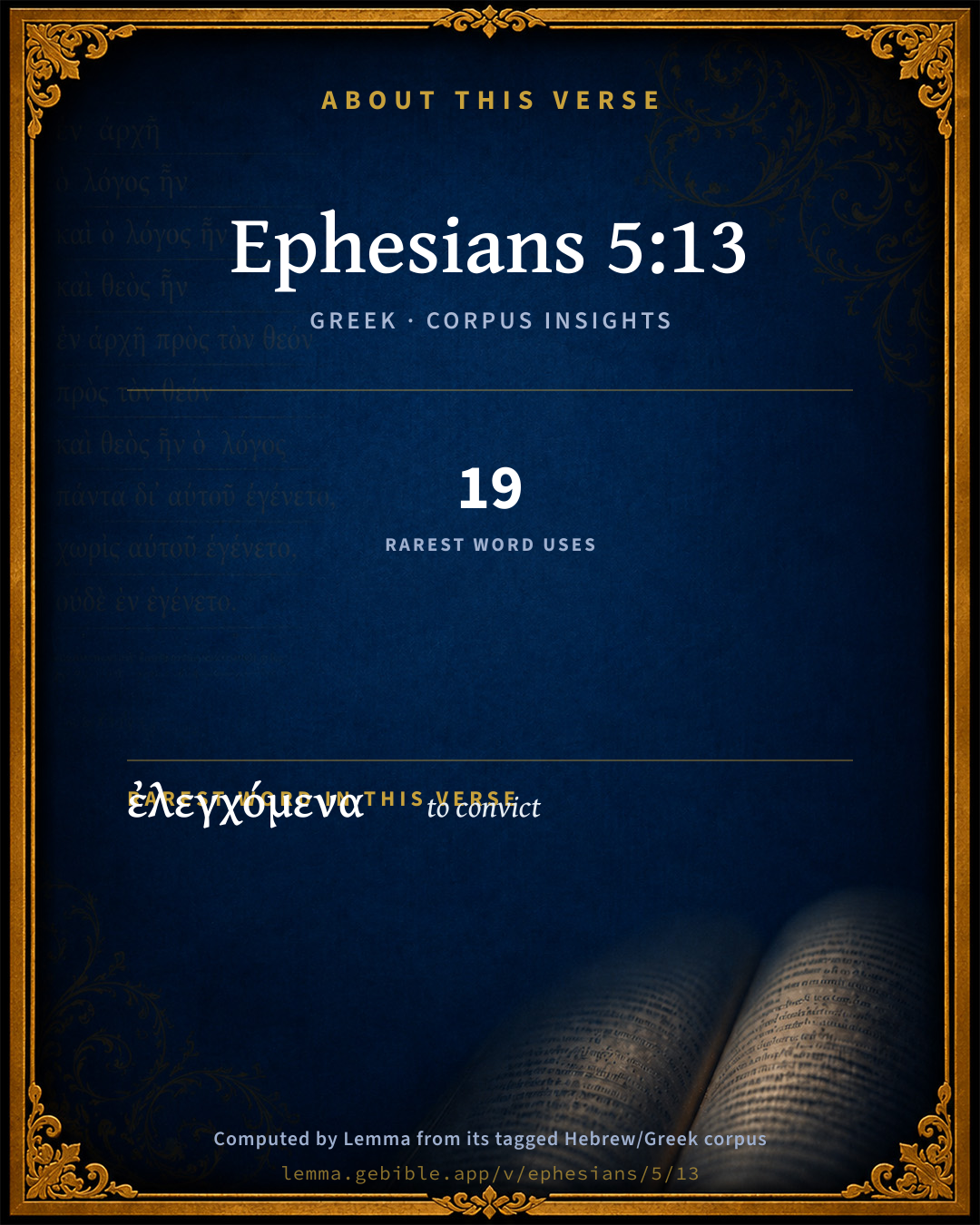
Ephesians 5:13

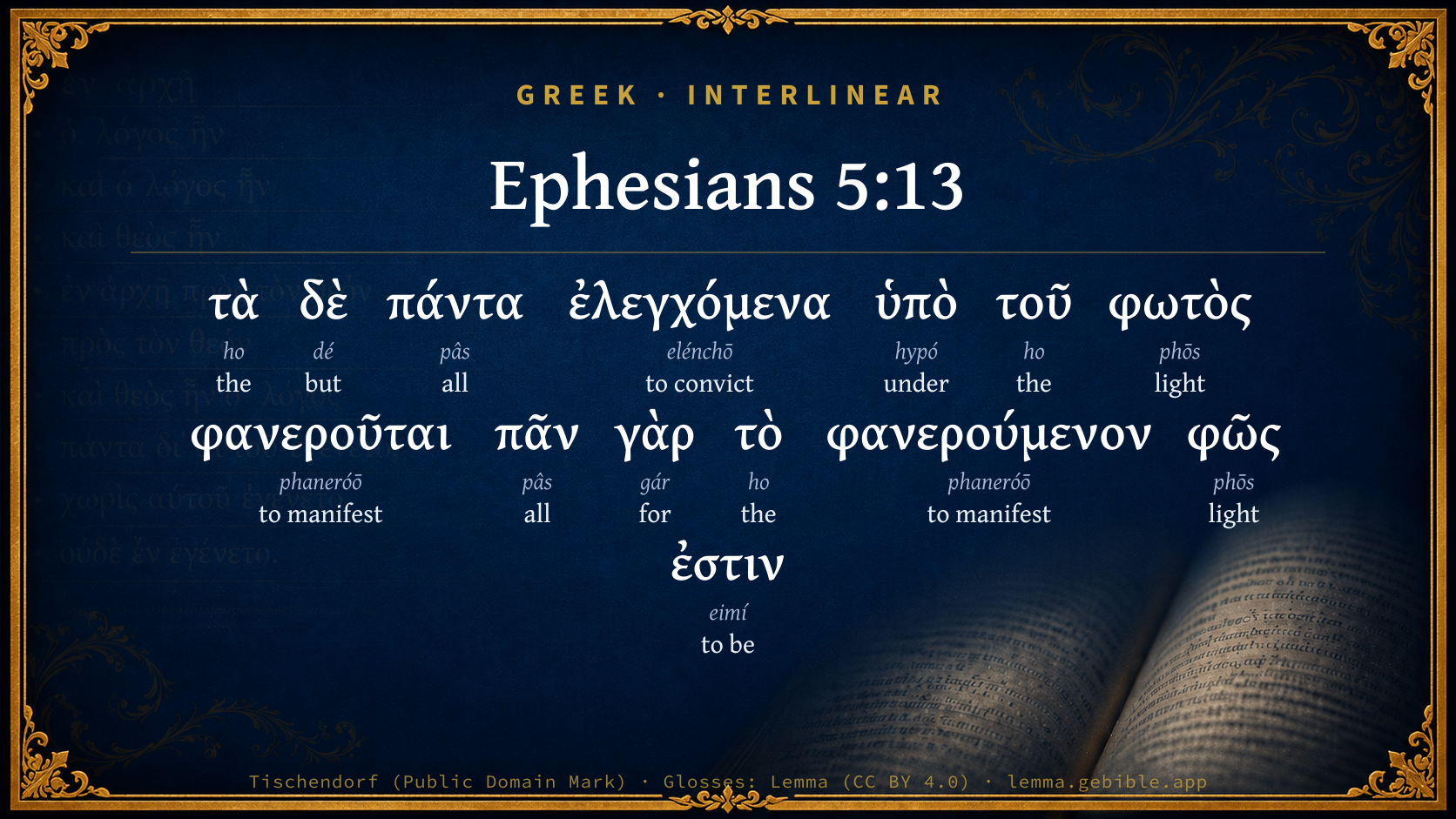
Greek (Tischendorf 8th ed.) Ephesians 5:13 appears in the Greek New Testament. The text above is from the Tischendorf 8th edition. Each word links to its Strong’s number and a concise gloss. Click any word for its full Thayer’s Greek Lexicon entry.
Download image
Cite this verse

Ephesians 5:13 (World English Bible). Public Domain. Lemma interlinear Bible study tool, https://lemma.gebible.app/v/ephesians/5/13.

Show BibTeX & RIS
BibTeX
RIS
English Translation
But all things, when they are reproved, are revealed by the light, for everything that is revealed is light.
World English Bible · Public Domain
Download a study sheet

One document with this verse’s original text, its word-by-word gloss line, the meaning frame, cross-references with their text, attributed commentary, and full source and license credits — printable, and it pastes into notes with its structure intact.

This verse Autodidact and up

Study sheet (.html) Plain text (.txt)

A passage Seminary Student

Up to 50 verses in one chapter. A passage sheet keeps up to 6 commentary sources and 12 cross-references per verse, in the order this page ranks them, and says so on the sheet whenever that leaves anything out. Ask for a single verse and you get the Autodidact verse sheet above.

Everything on this page stays free to read, with no account — the sheet is a download of what is already on screen, not access to it.

Want to remove ads? Support Godless Engineer
Compare translations 3

The same verse in 3 English versions, stacked beneath the original-language interlinear above. Click any original word for its lexicon entry.

Each is an independent rendering of the whole verse — the interlinear is not word-aligned to these translations.

Highlighted words mark where these versions differ — a whole-verse word diff, not a word-by-word alignment.

  • World English Bible Public Domain
    But all things, when they are reproved, are revealed by the light, for everything that is revealed is light.
  • King James Version Public Domain
    But all things that are reproved are made manifest by the light: for whatsoever doth make manifest is light.
  • unfoldingWord Literal Text CC BY-SA 4.0
    But everything exposed by the light is revealed, for everything that is revealed is light.

unfoldingWord Literal Text — © unfoldingWord, licensed CC BY-SA 4.0. Word-aligned USFM3 via Door43 (git.door43.org/unfoldingWord/en_ult).

Versions to compare (up to 4)

3 of 4 selected

Show all 19 translations

Every available English version of this verse, each an independent rendering of the whole verse.

  • World English Bible Public Domain
    But all things, when they are reproved, are revealed by the light, for everything that is revealed is light.
  • Berean Standard Bible Public Domain
    But everything exposed by the light becomes visible, for everything that is illuminated becomes a light itself.
  • Majority Standard Bible Public Domain
    But everything exposed by the light becomes visible, for everything that is illuminated becomes a light itself.
  • King James Version Public Domain
    But all things that are reproved are made manifest by the light: for whatsoever doth make manifest is light.
  • American Standard Version (1901) Public Domain
    But all things when they are reproved are made manifest by the light: for everything that is made manifest is light.
  • Revised Version (1885) Public Domain
    But all things when they are reproved are made manifest by the light: for everything that is made manifest is light.
  • Geneva Bible (1599) Public Domain
    But all thinges when they are reproued of the light, are manifest: for it is light that maketh all things manifest.
  • Douay-Rheims (1899) Public Domain
    But all things that are reproved, are made manifest by the light; for all that is made manifest is light.
  • Young's Literal Translation Public Domain
    and all the things reproved by the light are manifested, for everything that is manifested is light;
  • Literal Standard Version CC BY-SA 4.0
    and all the things reproved by the light are revealed, for everything that is revealed is light;
  • Unlocked Literal Bible CC BY-SA 4.0
    But when anything is illuminated by the light, it becomes visible.
  • unfoldingWord Literal Text CC BY-SA 4.0
    But everything exposed by the light is revealed, for everything that is revealed is light.
  • Darby Bible Public Domain
    But all things having their true character exposed by the light are made manifest; for that which makes everything manifest is light.
  • World Messianic Bible Public Domain
    But all things, when they are reproved, are revealed by the light, for everything that reveals is light.
  • Webster's Bible Public Domain
    But all things that are reproved, are made manifest by the light: for whatever doth make manifest is light.
  • Free Bible Version CC BY-SA 4.0
    but when anything is exposed by the light then it's revealed as it is. Light makes everything visible.
  • Bible in Basic English Public Domain
    But all things, when their true quality is seen, are made clear by the light: because everything which is made clear is light.
  • Text-Critical English NT CC BY 4.0
    But everything exposed by the light becomes illuminated, and everything that is illuminated becomes a light.
  • Tyndale New Testament (1534) Public Domain
    but all thinges when they are rebuked of the light are manifest. For whatsoever is manifest that same is light.

Literal Standard Version (2020), Covenant Press — licensed CC BY-SA 4.0. Text via the HelloAO Bible API (eBible.org). Unlocked Literal Bible (unfoldingWord) — licensed CC BY-SA 4.0. Text via the HelloAO Bible API (eBible.org). unfoldingWord Literal Text — © unfoldingWord, licensed CC BY-SA 4.0. Word-aligned USFM3 via Door43 (git.door43.org/unfoldingWord/en_ult). Free Bible Version, Dr. Jonathan Gallagher — licensed CC BY-SA 4.0. Text via the HelloAO Bible API (eBible.org).

Word by word

More ways to search: Search by grammar → Find every occurrence → Compare this word →

Practice this passage: Drill this verse → Learn its vocabulary →

ἐλεγχόμενα
elénchō
G1651
“to convict”
Verb, Present, Passive, Participle, Nominative, Plural, Neuter
Part of Speech
Verb
Tense
Present
Voice
Passive
Mood
Participle
Case
Nominative
Number
Plural
Gender
Neuter
Full Thayer's Definition

Origin: of uncertain affinity

TDNT: 09:53,2

1. to convict, refute, confute a. generally with a suggestion of shame of the person convicted b. by conviction to bring to the light, to expose 2. to find fault with, correct a. by word 1. to reprehend severely, chide, admonish, reprove 2. to call to account, show one his fault, demand an explanation b. by deed 1. to chasten, to punish
  1. τὰ ho G3588 “the” Article, Accusative, Plural, Neuter
  2. δὲ dé G1161 “but” Conjunction
  3. πάντα pâs G3956 “all” Adjective, Accusative, Plural, Neuter
  4. ὑπὸ hypó G5259 “under” Preposition
  5. τοῦ ho G3588 “the” Article, Genitive, Singular, Neuter
  6. φωτὸς phōs G5457 “light” Noun, Genitive, Singular, Neuter
  7. φανεροῦται phaneróō G5319 “to manifest” Verb, Present, Passive, Indicative, 3rd person, Singular
  8. πᾶν pâs G3956 “all” Adjective, Nominative, Singular, Neuter
  9. γὰρ gár G1063 “for” Conjunction
  10. τὸ ho G3588 “the” Article, Nominative, Singular, Neuter
  11. φανερούμενον phaneróō G5319 “to manifest” Verb, Present, Passive, Participle, Nominative, Singular, Neuter
  12. φῶς phōs G5457 “light” Noun, Nominative, Singular, Neuter
  13. ἐστιν eimí G1510 “to be” Verb, Present, Active, Indicative, 3rd person, Singular

About this verse

These counts appear in no published source. They are computed here, from the morphology-tagged text and Lemma’s own curated glosses. What Lemma adds →

14
words
9
distinct lemmas
Pauline Epistles
section

Notable vocabulary

The rarest word here is ἐλεγχόμενα to convict G1651 — appearing just 19 times in the whole Greek New Testament.

Shared distinctive vocabulary

ἐλεγχόμενα to convict G1651 occurs in 19 verses of the Greek New Testament. Also found in:

Repetition

Words recur within this verse:

  • πάντα all G3956 ×2
  • φωτὸς light G5457 ×2
  • φανεροῦται to manifest G5319 ×2
  • τὰ the G3588 ×3

Cross-references

6

Topical passages linked to Ephesians 5:13 in the Treasury of Scripture Knowledge — connected by theme and wording, ordered by reader-vote popularity; previews shown in the World English Bible.

  • John 3:20–21 For everyone who does evil hates the light, and doesn't come to the light, lest his works would be exposed.
  • 1 Corinthians 4:5 Therefore judge nothing before the time, until the Lord comes, who will both bring to light the hidden things of darkness, and reveal the counsels of the hearts. Then each man will get his praise from God.
  • Hosea 2:10 Now I will uncover her lewdness in the sight of her lovers, And no one will deliver her out of my hand.
  • Hosea 7:1 When I would heal Israel, Then the iniquity of Ephraim is uncovered, Also the wickedness of Samaria; For they commit falsehood, And the thief enters in, And the gang of robbers ravages outside.
  • Micah 7:9 I will bear the indignation of Yahweh, Because I have sinned against him, Until he pleads my case, and executes judgment for me. He will bring me forth to the light. I will see his righteousness.
  • Lamentations 2:14 Your prophets have seen for you false and foolish visions; They have not uncovered your iniquity, to bring back your captivity, But have seen for you false oracles and causes of banishment.

Cross-references courtesy of OpenBible.info (CC BY 4.0).

Commentary

Notes on Ephesians 5:13 from classic Christian and Jewish commentators (each source and its license shown beneath its notes). The classic Christian expositions comment on the surrounding passage and are grouped to its opening verse, so a note may address several verses; the Jewish commentaries on the Tanakh (Rashi and others) are per-verse, so they appear only where the commentator wrote on this verse.

Lemma curates 59 commentaries, every one of them public domain or Creative Commons licensed, each selected and text-cleaned for this edition rather than reprinted as found. About our sources →

The Biblical Illustrator

Joseph S. Exell

Eph_5:13

But all things that are reproved are made manifest by the light.

The light of Christianity reproving the world

In the text we have--

1. An assertion--But all things that are reproved are made manifest by the light.

2. The proof of it--For whatsoever doth make manifest is light.

1. An assertion or proposition, where two things are to be considered.

(1) Something supposed; that the doctrine of Christianity is the true light or test by which things are to be judged. The way of heathenism being compared with it showeth this is light--Thy word is a lamp to my feet, and a light to my path (Psa_119:105; so Pro_6:23; Pro_15:31).

(2) That which is asserted is, that all things which are reproved and disallowed are made manifest by the light. The light discovereth itself, and all things that differ from it; that which discovereth truth doth also discover error and falsehood; that which manifests what is right doth also manifest what is wrong.

2. The proof is taken from the common nature of all light, natural and sensible, or spiritual and intellectual--Whatever doth make manifest is light. Natural light maketh manifest things proper to it; so doth spiritual light things that belong to its sphere, things morally good or evil. That the light of Christianity, shining forth in the Word of God and the lives and actions of Christians, is a great means of reproving and convincing the world. That this light shineth forth both in their words and deeds.

(1) The doctrine which they profess, hold fast, and adhere to. There is a light in Gods Word which doth not only show the right way to everlasting life and true happiness, but disproves any contrary course.

(2) Holiness of life. Light hath its power as it is held forth in our words, but much more as it shineth in our lives for the illumination and conviction of the world (Mat_5:16).

3. This then is that which we are to make conscience of, that our light may be a reproving light to the wicked and carnal world; and that for these reasons--

(1) Because of our many and great obligations.

(2) Because of the many benefits which come thereby.

It informeth us of divers truths.

1. That though by the light of nature we have some sense of the turpitude of sin, yet we have not a perfect knowledge of it; the light of Christianity giveth us that.

2. It informeth us that some general sense of the shamefulness of sin will not break the power and force of it. To persuade us to get light. It is a shame to be ignorant of our necessary duty. If a man be asked whether he can paint or carve, he may answer without shame, I am ignorant; that skill is not necessary; but if he be ignorant how to love and please and serve God, then he is brutish, like the horse or mule, that hath no understanding. (T. Manton, D. D.)

Light reproves sin

A colonial governor of the Bahamas, who was about to return to England, offered to use his good offices to procure from the Home Government any favour the colonists might desire. The unanimous reply was as startling as the demand for the head of John the Baptist in a charger: Tell them to tear down the lighthouses; they are ruining the prosperity of this colony. (The people were wreckers.) (W. C. Church.)

The Biblical Illustrator, edited by Joseph S. Exell (c. 1880s–1900s) — public domain. Text from a community e-Sword module.

Joseph Benson's Commentary

Eph 5:13-14. But all things that are reproved — Or, discovered, or confuted, as ελεγχομενα may be properly rendered; are made manifest — Have their iniquity laid open to the actors themselves, as well as to others; by the light — Of divine truth; or, as Whitby interprets the clause, “being discovered by the light, they are made manifest.” For whatsoever doth make any thing of a moral or immoral nature manifest, is light — That is, nothing can make any thing in men’s spirit or conduct manifest but light, yea, light from heaven; “and therefore the gospel well deserves that name, as teaching those who are instructed in it to judge rightly concerning the moral nature of actions, and inculcating such general principles, as will be of use to them in every particular case that can possibly arise.” Wherefore he saith — Namely, God, in the general tenor of his word, to all who are still in darkness; Awake thou that sleepest — In ignorance of God, of thyself, and of his will concerning thee, and in a state of stupid insensibility respecting invisible and eternal things; and arise from the dead — From thy state of spiritual death, a state of alienation from the life of God here, and obnoxiousness to eternal death hereafter. See on Eph 2:5. And Christ shall give thee light — Spiritual and divine light, knowledge, wisdom, holiness, and happiness, the light of grace and glory.

Joseph Benson's Commentary on the Old and New Testaments (1811–1818) — public domain. Text from a community e-Sword module.

Tyndale Open Study Notes

Tyndale Open Resources

5:13-14 “Awake, O sleeper”: This might be a fragment from an unknown Christian song, perhaps based on texts in Isaiah (cp. Isa 26:19; 52:1; 60:1). It calls on God’s people to turn from their sinful darkness and live in the full light of Christ.

Tyndale Open Study Notes — © Tyndale Open Resources, licensed CC BY-SA 4.0. Text via the HelloAO Bible API.

Bengel's Gnomon

Johann Albrecht Bengel

Eph 5:13. Δὲ) but; although those things cannot be spoken of or named.—ἐλεγχόμενα, reproved) by you, Eph 5:11.—ὑπὸ τοῦ φωτὸς φανεροῦται, are made manifest by the light) φάος, φανερός, are conjugates.—φανεροῦται, are made manifest) that their shamefulness may be known, whether those who have been guilty of doing them treat their reprovers with scorn or repent of them.—πᾶν, everything) The abstract for the concrete; for the subject here is the man himself; comp. the following verse, wherefore [He saith, Awake, etc., which proves that the πᾶν here refers to the man reproved].—γὰρ, for) For makes an emphatic addition [Epitasis[81]] in a gradation.—τὸ φανερούμενον, an Antanaclasis [the same word in a twofold sense], for φανεροῦται is passive; φανερούμενον is middle,[82] what does not avoid being made manifest; comp. afterwards ἔγειραι, and ἀνάστα.—φῶς, light) a Metonymy, as Eph 5:8.[83]—ἔστι, is) becomes, and afterwards is light.

[81] Πάντα virtually repeated in πᾶν with the Epitasis of γὰρ added to the latter, so forming a gradation.—ED.

[82] Everything which allows itself to be made manifest. Not as Eng. V., which takes it actively, Whatsoever doth make manifest.—ED.

[83] Abstract for the concrete—is light, for, is luminous—is a child of the light.—ED.

Bengel's Gnomon of the New Testament — English translation (T&T Clark, Edinburgh, 1860) — public domain. Text from a community e-Sword module.

Meyer's Critical & Exegetical Commentary

Heinrich August Wilhelm Meyer

Eph_5:13. The assigning of grounds for that precept, μᾶλλον δὲ καὶ ἐλέγχετε, is continued,being attached by means of the contradistinguishing δέ,inasmuch as there is pointed out the salutary action of the Christian light which is brought to bear by means of the required ἐλέγχειν upon all those secret deeds of shame: But everything (all those secret sins), when it is reproved, when you carry that ἐλέγχετε into effect upon it, is by the light (ὑπὸ τοῦ φωτός has the emphasis) made manifest, is laid bare in its real moral character, unveiled and brought into distinctness before the moral consciousness by the light of Christian truth which is at work in your ἐλέγχεν; by the light, I say, it is made manifest, forin order to ἐλέγχειν prove by a general proposition that this cannot come otherwise than from the lightall that which is made manifest, which is brought forth from concealment and is laid open in its true nature, is light, has ceased thereby to have the nature of darkness, and is now of the essence of light. This demonstrative proposition is based upon the inference: Quod est in effectu (φῶς ἐστι), id debet esse in causa (ὑπὸ τοῦ φωτός). If thus there is warrant for the general πᾶν τὸ φανερούμ. φῶς ἐστι, so must there also be warrant for what was previously said in the Christian sense, ὑπὸ τοῦ φωτὸς φανεροῦται. From this simple explanation of the words it becomes at once clear that we have not, with most expositors (including Baumgarten-Crusius and de Wette), to attach ὑπὸ τοῦ φ. to ἐλεγχόμενα, but to φανεροῦται (Castalio, Zanchius, Zeger, Erasmus Schmid, Estius, Bengel, Meier, Harless, Olshausen, Schenkel, Bleek), to which it is emphatically prefixed; and further, that φανερούμενον is not to be taken as middle, in which case again various explanations have been brought out, namely, either: Lux enim illud est, quod omnia facit manifesta (Beza; so Calvin, Grotius, Calovius, and others, as also Bleek, who in place of φανερούμενον conjectures: φανεροῦν τό), or: Omne enim illud, quod manifesta facit alia, lux est (Erasmus Schmid; so also Cajetanus, Estius, Michaelis, and others), or: Quilibet autem [γάρ!], qui alios docet, est lux, … eo ipso declarat, se esse verum Christianum, Kuinoel in Velthusen, etc., Commentatt. III. p. 173 ff., or: he who does not refuse to be made manifest, becomes an enlightened one, Bengel,against which interpretations not only the immediately preceding passive φανεροῦται is decisive, but also linguistic usage, in accordance with which φανεροῦμαι is always passive.[262] And if we adhere to the view of φανερούμ. as passive, we must exclude every explanation, in which a quid pro quo is perpetrated or something is imported, or γάρ is either neglected or incorrectly taken. We have therefore to set aside(1) the explanation given by Eisner and Wolf, that Paul says: hominum scelera in tenebris patrata, a fidelibus, qui lux sunt, improbata, non modo protrahi in lucem, verum etiam homines, illis sceleribus inquinatos, rubore suffundi increpitos convictosque, et ipsos quoque φῶς fieri hac ratione, emendatis vitiis tenebrisque in novae vitae lucem conversis; (2) that of Zachariae: Everything which is sharply tested according to the light of the doctrine of Christ and holds its ground, one has no need to keep secret; … all, however, which one can perform openly and before every ones eyes … is itself light, and strikes every one as good and praiseworthy; (3) that of Storr: Quisquis ea, quae monitus est a luce, audit, is patefit, emergit e tenebris; quisquis autem patefactus est, is luce collustratus est; (4) that of Koppe (comp. Cramer): for what is itself enlightened, must he also a light for others; (5) that of Rückert, who would refer γάρ to a conclusion tacitly drawn from what precedes (ye are light, consequently it is also your business ἐλέγχειν τὰ ἐκείνων ἔργα): for all that is made manifest, that is, or by that very fact becomes, light, from which again the suppressed conclusion is to be drawn: consequently it may be hoped that those also will become light, when they are convinced of the reprobate character of their action; (6) that of Meier and Olshausen: for all that is enlightened by the light, is itself light (Olshausen), which according to Meier is equivalent to: becomes itself transparent and pure as light, according to Olshausen: becomes changed into the nature of light. (7) Nearest to our interpretation comes that of Harless, followed in part by Schenkel. Harless, however, finds expressed from τὰ δὲ πάντα onward the necessity of the ἐλέγχειν, which is rather implied in Eph_5:12, to which in Eph_5:13 the salutariness of the ἐλέγχειν attaches itself; he explains φανερούμ., moreover, as if it were praeterite, and does not retain πᾶν γὰρ τὸ φανερούμ. κ.τ.λ. in its generality as locus communis, inasmuch as he takes φῶς ἐστιν: is no longer a secret work of darkness, but is light.

According to Baur, p. 435, the proposition πᾶν τὸ φανερ. φῶς ἐστι belongs to the Gnostic theory of light (all development takes place only through that which in itself already exists becoming manifest for the consciousness), and has been introduced into its present connection out of this quite different sphere of ideas. But the state of the case is exactly the converse; the Valentinians laid hold of this utterance of the apostle as supporting their doctrine, and expressly cited it (τοῦτο δὲ ὁ Παῦλος λέγει κ.τ.λ., in Iren. i. 8. 5), and consequently took it away from the connection in which he used it so as to favour their own theory.

[262] The article before φῶς might (this we remark in opposition to Olshausen) be dispensed with even in Bezas explanation, so that φῶς ἐστι would have to be translated: is light-essence, has the nature of light. If, however,which is not the case,

φανερούμ. were really to be translated as active, the simplest rendering, and the one most in keeping with the context, would be: for it is the light making everything manifest.

Meyer — Critical and Exegetical Commentary on the New Testament — English translation by Peter Christie, edited by Frederick Crombie (T&T Clark, 1880) — public domain. Text from a community e-Sword module.

Expositor's Greek Testament

ed. W. Robertson Nicoll

Eph 5:13 . τὰ δὲ πάντα ἐλεγχόμενα ὑπὸ τοῦ φωτὸς φανεροῦται , πᾶν γὰρ τὸ φανερούμενον φῶς ἐστί : but all, when they are reproved, are made manifest by the light: for everything that is made manifest is light . Both the connection and the import of some of the words here are difficult to determine, and various interpretations have been proposed. The RV renders it “but all things when they are reproved are made manifest,” treating it as a general statement. But the point and the harmony of the whole verse are best seen if the phrase τὰ πάντα is taken to refer to the secret practices which have been immediately in view, = “all of them,” “all these things”. The ἐλεγχόμενα , again, must have its proper sense of reproved or rebuked , and cannot be dealt with as synonymous with πεφανεροῦται . The anarthrous participle will express the manner or the time of the action in question, and is not = “all things which are reproved” (Vulg., AV, etc.), but is = “all these things when they are reproved”. The πᾶν must be accepted as a neuter, there being no reason for taking it (with Bengel) as abstract for concrete and so = “every man ”. Further, the φανερούμενον and the φανεροῦται are naturally to be taken as of the same Voice. That the former cannot have the force of the Middle, “that which makes manifest,” appears from the fact that there does not appear to be any instance of φανεροῦσθαι being anything else than a pure passive in the NT, although it occurs some fifty times there. Two particular difficulties remain, viz. , ( a ) the connection of ὑπὸ τοῦ φωτός , and ( b ) the sense of φῶς in the two clauses. As to ( a ), some attach the words to the ἐλεγχόμενα , = “when they are reproved by the light” (Syr., Copt., etc.). But, as the ἐλέγχετε (Eph 5:11 ) was introduced without any specification of the agent, it is most natural to connect the ὑπὸ τοῦ φωτός here not with the participle but with the fin. verb, and the best sense is got thereby. As to ( b ), it is held by some ( e.g. , Ell.) that the term φῶς must have the same sense in both clauses, whether the primary sense or the metaphorical. But it is difficult to get a clear and consistent sense for the statement on that supposition, neither is it necessary that the τοῦ φωτός in the first clause should have identically the same sense as φῶς in the second. In point of fact in the former the idea of the Christian light, the light of the Christian truth previously referred to, seems to be in view; while in the latter clause, which gives a general statement in support of the preceding particular affirmation, φῶς has its primary sense. It should be added that, if φανερούμενον is part of the statement of a general truth, the objection taken by some ( e.g. , Abb.) to the interpretation that deals with it as a true passive, viz. , that it should then be πεφανερωμένον , falls to the ground. These considerations, therefore, negative all such interpretations as these (1) “he who does not refuse to be made manifest, becomes an enlightened one” (Beng.); (2) “for all that is enlightened by the light, is itself light” (Olsh.); (3) “all things which are tested by the light of the doctrine of Christ, one has no need to keep secret; all, however, which one can perform openly is itself light”; (4) all those constructions which give φανερούμενον the Middle sense, e.g., omne enim illud, quod manifesta facit alia, lux est (Erasm.); lux enim illud est quod omnia facit manifesta (Beza; similarly Calv., Bleek, etc.); (5) and all that make the light the agent of the ἐλέγχειν (De Wette, etc.). The sense, therefore, is this “all these shameful things which are done by them in secret, when they are subjected to the open rebuke which Christians ought to give them, are laid bare by the light of the Christian truth acting in their reproof, so that the doers of them are made to see them in the odiousness of their real nature; for everything that is disclosed in its real colours ceases to be secret and becomes of the nature of light”. So substantially Mey., Ell., etc. The δέ also has its proper, adversative force, as if = “these things indeed are done in secret; but (or yet ) they are made manifest and displayed in their true character, when you reprove them in the power of Christian truth”. Thus, the whole sentence becomes a further reason, derived from the effects of the act, for practising the ἐλέγχειν ; and the second clause confirms the particular power ascribed to the Christian φῶς by reference to the general statement of the connection between manifestation and light .

The Expositor's Greek Testament, edited by W. Robertson Nicoll (1897–1910) — public domain. Text from a community e-Sword module.

Hodge's Commentary on Romans, Ephesians & First Corinthians

Charles Hodge

Eph_5:13

Vile however as those sins are, they are capable of being corrected. They are not beyond cure. Reprove them. Let in the light of divine truth upon them, and they will be corrected or healed. For the truth is divinely efficacious. It is the organon of God; that through which he exerts his power in the sanctification and salvation of men. Such seems to be the general meaning of this difficult verse.

It is connected with the preceding verse, and is designed to enforce the command, ἐλέγχετε, reprove. Reprove the things done in secret by the wicked for though they are too bad to be even named, yet being reproved, they are made manifest by the light, and thereby corrected, for everything made manifest, i.e. revealed in its true nature by divine light, becomes light; that is, is reformed. This interpretation gives a simple and consistent sense, assumes no unusual signification of the terms employed, nor any forced construction, and is suited to the context. It supposes

1. That τὰ πάντα ἐλεγχόμενα refers to τὰ κρυφῇ γινόμενα of Eph_5:12. The things done in secret are the all things, which being reproved, are manifested.

2. The words ὑπὸ τοῦ φωτός are not to be connected with ἐλεγχόμενα, as though the sense were, being reproved by the light; but with φανερούται, so that the sense is, are made manifest by the light. This construction is required by the following clause.

3. Φανερούμενον is passive, and not middle with an active sense. The meaning is, Whatever is manifested; not whatever makes manifest.

As the word φανερούται just before is passive, it is unnatural to make φανερούμενον active. Besides, the apostle is not speaking of the nature of spiritual light, but of its effects. It illuminates or turns into light all it touches, or wherever it penetrates.

If φανερούμενον be taken as active, as is done by Calvin and many others, and by our translators, the sense would be, Reprove these things; it is your office to do so, for you are light, and light is that which makes manifest. This however is not what Paul says. He does not say Reprove evil, for you are light, but, Reprove evil, for evil when reproved by light is manifest, and when manifest, it is light, that is, it is changed into light, or corrected. In Eph_5:8, he had said, Ye are light; so here he says, what is illuminated by the truth becomes light. The sense is the same in both cases. The penetration of spiritual light, or divine truth, carries with it such power, that it illuminates and sanctifies all in whom it dwells. Hence the apostle elsewhere prays that the word of God may dwell in the hearts of believers in all wisdom and spiritual understanding. According to the apostle, the relation between truth and holiness is analogous to that between light and vision. Light cannot create the eye, or give to a blind eye the power of vision. But it is essential to its exercise. Wherever it penetrates, it dissipates darkness and brings everything into view and causes it to produce its appropriate effect. So truth cannot regenerate, or impart the principle of spiritual life. But it is essential to all holy exercises. And wherever the truth penetrates, it dissipates the clouds of error, and brings everything to view, so that when spiritually discerned it produces its proper effect on the soul. Truth being thus essential, it is the duty of Christians to bring it to bear upon all those who are ignorant and on all the works of darkness.

Charles Hodge — Commentary on Romans (1835), First Corinthians (1857), and Ephesians (1856) — public domain. Text from a community e-Sword module.

Jamieson, Fausset & Brown

Robert Jamieson, A. R. Fausset & David Brown

that are reproved--rather, "when they are reproved," namely, by you (Eph 5:11).

whatsoever doth make manifest--rather, "everything that is (that is, suffers itself to be) made manifest (or 'shone upon,' namely, by your 'reproving,' Eph 5:11) is (thenceforth no longer 'darkness,' Eph 5:8, but) light." The devil and the wicked will not suffer themselves to be made manifest by the light, but love darkness, though outwardly the light shines round them. Therefore, "light" has no transforming effect on them, so that they do not become light (Joh 3:19-20). But, says the apostle, you being now light yourselves (Eph 5:8), by bringing to light through reproof those who are in darkness, will convert them to light. Your consistent lives and faithful reproofs will be your "armor of light" (Rom 13:12) in making an inroad on the kingdom of darkness.

Jamieson, Fausset & Brown — Commentary Critical and Explanatory on the Whole Bible (1871) — public domain (CC PDM 1.0). Text via the HelloAO Bible API.

Adam Clarke's Commentary

Verse 13. But all things that are reproved] Dr. Macknight paraphrases this verse as follows: "Now all these reprovable actions, ελεγχομενα, which are practised in celebrating these mysteries, are made manifest as sinful by the Gospel; and, seeing every thing which discovers the true nature of actions is light, the Gospel, which discovers the evil nature of the actions performed in these mysteries, is light."

The apostle speaks against these mysteries as he speaks against fornication, uncleanness, and covetousness; but by no means either borrows expression or similitude from them to illustrate Divine truths; for, as it would be a shame even to speak of those things, surely it would be an abomination to allude to them in the illustration of the doctrines of the Gospel.

Adam Clarke's Commentary on the Bible (1810–1826) — public domain. Text from a community e-Sword/MySword module.

John Calvin's Commentaries

13. But when all things are reproved. As the participle, (φανερούμενον,) which is translated, that which doth make manifest, is in the middle voice, it admits either of a passive or active signification. It may be either rendered, that which is made manifest, or that which doth make manifest. If the passive signification, which is followed by the ancient translator, be preferred, the word light will denote, as formerly, that which gives light, and the meaning will be, that evil works, which had been concealed, will stand out to public view, when they have been made manifest by the word of God: If the participle be taken actively, there will still be two ways of expounding it: 1. Whatever manifests is light; 2. That which manifests anything or all things, is light; taking the singular as put for the plural number. There is no difficulty, as Erasmus dreaded, about the article; for the apostles are not in the habit of adhering very strictly to rule about placing every article, and even among elegant writers this mode of using it would be allowable. The context appears to me to shew clearly that this is Paul’s meaning. He had exhorted them to reprove the evil works of unbelievers, and thus to drag them out of darkness; and he now adds, that what he enjoins upon them is the proper business of light — to make manifest It is Light, he says, which makes all things manifest; and hence it followed that they were unworthy of the name, if they did not bring to light what was involved in darkness.

John Calvin's Commentaries (1540-1563) — public domain. Text from the Calvin Translation Society English edition (1840s-50s) via the Christian Classics Ethereal Library (ccel.org). Calvin's coverage is partial (roughly two-thirds of the Bible); uncommented books and verses are honest gaps, never fabricated. The 19th-century editor's footnotes and remarks are omitted so the notes are faithfully Calvin's own voice.

Ellicott's Commentary for English Readers

(13) But all things that are reproved are made manifest by the light.—This should properly be rendered, But all things, when reproved, are illuminated by the light. The translation “are made manifest” is indeed fully in accordance with the common usage of the word. But the whole context shows that St. Paul is here using it in what is indeed its more proper etymological sense, for “are illumined.” For the mere “being made manifest” is implied in the “being reproved;” whereas he is certainly passing on here to a fresh idea, and, moreover, to one which will bear the inference of the last clause of the verse. To “reprove” after the Christian manner is to bring into the full light of Christ’s truth; and the effect of this is not merely to reprove, but to illumine by the inherent power of the light. Exactly with the same distinction of sense St. John uses both words (Joh_3:20-21).

For whatsoever doth make manifest is light.—That this translation (suggested, perhaps, by the difficulty of the passage when rightly rendered) is nevertheless certainly wrong, is shown both by the usage of the original word and by the genius of the whole context. It should be, for everything which is illuminated is light. St. Paul here explains still more clearly what he means by illumination. It implies the catching the light and reflecting it, so as to become a new source of light. It must be noted that the subject of the sentence is not “the works of darkness,” but “all things” in general. Hence the whole process is described, with almost scientific accuracy, as three-fold. First, the things, or persons, are dragged out of darkness into light; then they are illuminated; lastly, they become light in themselves and to others. There are, no doubt, exceptions to this, the right and normal process, in the case of the utterly reprobate, who have lost all power of reflecting light, and are therefore dark still in the blaze of noon; but the next verse shows that St. Paul is not contemplating these; and even these may be beacons of warning to others. The whole metaphor is more and more striking to us as modern science enlarges our knowledge of the manifold effects of light, not only to illuminate, but to change and to vivify.

A Bible Commentary for English Readers, edited by Charles John Ellicott (1878–1897) — public domain. Text from a community e-Sword module.

The Cambridge Bible for Schools and Colleges

gen. ed. J. J. S. Perowne

13. all things that are reproved] More lit., all things, when being reproved, or convicted.

doth make manifest] Render, certainly, is made manifest, or more precisely, is being manifested. So the Lat. versions, and, with verbal variations, all the older English Versions except the Genevan (1557), which has, loosely, “it is light that discovereth all things.” The Gr. is decisive against this and the A.V.

The drift of this somewhat difficult verse, suggested by the context, seems to be; “You are light in the Lord; use this character upon the surrounding moral darkness, in order to the rescue of its victims, that they also may become light. Nothing but light will do this work; no conquest over darkness, literal or spiritual, is possible except to light. And one evidence of this is that every such real conquest results in the subjects of darkness becoming now subjects of light, becoming lights.” More briefly; “You are light; keep pure then, but shine far into the dark. And then other men, as already you, shall become light in the Lord.”

The Cambridge Bible for Schools and Colleges (gen. ed. J. J. S. Perowne; Cambridge University Press, 1878–1918) — public domain. Text from a community e-Sword module.

John Gill's Exposition

See then that ye walk circumspectly,.... The Alexandrian copy and the Vulgate Latin version read, "see then, brethren", it being an exhortation to the saints at Ephesus, upon the foregoing discourse and citation, to take heed to their walk: the believer's walk is both inward and outward; his inward walk is by faith on Christ; his outward walk is his conversation among men: this supposes life; requires strength and prudence; denotes continuance and progression; with patience and courage: this walk should be seen to, and watched over; a man should see to it that he does walk, and to the way in which he walks, and how he walks; that he walks circumspectly, with his eyes about him; that he walks with diligence, caution, accuracy, and exactness, to the uttermost of his strength and power; and with wisdom and prudence, looking well to his going:

not as fools, but as wise; such walk like fools, whose eyes are not upon their ways; who walk in their own ways, which are crooked, and ways of darkness, and lead to destruction; who walk after the flesh, and naked, without the garments of a holy life and conversation; and with lamps, but no oil in them: and such walk as wise men, who walk according to the rule of God's word, make Christ their pattern, have the Spirit for their guide, and walk as becomes the Gospel of Christ; inoffensively to all men, in wisdom towards them that are without, and in love to them that are within; and as pilgrims and strangers in this world, looking for a better country; and so as to promote the glory of God, and the good of souls.

John Gill's Exposition of the Whole Bible (1746–1763) — public domain (CC PDM 1.0). Text via the HelloAO Bible API.

Trapp's Complete Commentary

John Trapp

13 But all things that are reproved are made manifest by the light: for whatsoever doth make manifest is light.

Ver. 13. But all things that are, &c.] Or, But all these things, viz. these unfruitful works of darkness, while they are reproved or discovered by the light (viz. of the word, as 1Co 14:24; Heb 4:12), are made manifest; so that thereby they grow abashed and abased before God and men.

John Trapp, A Commentary or Exposition upon All the Books of the Old and New Testament (1647–1656) — public domain. Text from a community e-Sword module.

Albert Barnes' Notes on the Bible

But all things that are reproved - Margin, discovered. The word used here properly means proved, demonstrated, reproved, or convicted (see the notes on Joh 16:8); but it seems here to be used in the sense of disclosed, or discovered. The sense is, that “its true nature is demonstrated;” that is, it is made known.

Are made manifest by the light - The sense is, “light is the means of seeing what things are. We discern their form, nature, appearance, by it. So it is with the gospel - the light of the world. It enables us to see the true nature of actions. They are done in darkness, and are like objects in the dark. Their form and nature cannot then be known; but, when the light shines, we see what they are;” compare notes on Joh 3:20-21.

For whatsoever doth make manifest is light - “Anything which will show the real form and nature of an object, deserves to be called light.” Of the truth of this, no one can doubt. The meaning in this connection is, that that system which discloses the true nature of what is done by the pagan, deserves to be considered as “light;” and that the gospel which does this, should be regarded as a system of light and truth. It discloses their odiousness and vileness, and it stands thus in strong contrast with all the false and abominable systems which have upheld or produced those vices.

Albert Barnes' Notes on the Bible (1834–1885) — public domain. Text from a community e-Sword/MySword module.

Matthew Poole's English Annotations

But all things; or all those things, viz. those unfruitful works of darkness, which are to be reproved.

Are made manifest; i.e. in the minds and consciences of the sinners themselves.

By the light; the light of doctrine in verbal reproofs, and of a holy life in real and practical ones.

For whatsoever doth make manifest is light; or, it is the light which manifests every thing, viz. which was before in the dark. The apostle argues from the nature and office of light; q.d. It is the property of light to discover and manifest what before was not seen, and therefore it becomes you who are light in the Lord to shine as lights in the world, Phi 2:15, that ye may by your holy conversation convince wicked men of their wickedness, and deeds of darkness, which they did not before perceive in themselves.

Matthew Poole's English Annotations on the Holy Bible (1683–1685) — public domain. Text from a community e-Sword/MySword module.

Whedon's Commentary on the Bible

Daniel D. Whedon

13. But—The reverse of this dark concealment. All things, including those lurking depravities that are reproved, that is, truly detected by you, who are truly the light, are made manifest in their true enormity of character.

For whatsoever doth make manifest—More correctly, whatsoever is made manifest, is no longer a lurking obscurity, a darkness, but it becomes in truth a light. On which difficult passage we may note:—

1. Scholars are now mostly agreed that the Greek word for doth make manifest, is not active, but passive; is being made manifest. Ellicott says that it occurs in the New Testament fifty times, but never with an active meaning.

2. By the manifested things becoming light, is not meant that the men become converted, for it is not the men, but their licentious things that are the subject. Their base darknesses and seducing problems, by being detected and light-penetrated, become light.

The dark falsehood becomes luminous truth. And all the more is the previous darkness of the problem made evident and abominable.

3. Differing from our English translation, and from Alford and others, who connect by the light with manifest, we refer it to reproved. The direction is: Do you, the light, reprove them; for whatever is by the light reproved is manifest in its true character. The required end is not that it may be manifest by the light, but simply, that it may be made manifest; and to this end it is duty that they should be reproved by the light. Moreover, manifest should come immediately before for, as being the term for which the for introduces the explanation. This keeps in view the imperative reprove of Eph_5:11, for which Eph_5:12 renders the imperative reason.

Daniel D. Whedon (gen. ed.), Commentary on the Old and New Testaments (1874–1909) — public domain. Text from a community e-Sword module.

The Pulpit Commentary

But all things when they are reproved are made manifest by the light. As, for instance, when our Lord reproved the hypocrisy of the Pharisees their practices had not seemed to the disciples very evil before, but when Christ threw on them the pure light of truth, they were made manifest in their true character they appeared and they still appear, odious. A just reproof places evil in a light that shows its true character. For everything which is made manifest is light. Literally, this is a truism; anything shone on is no longer dark, but light. The nearest approach to this, morally, is that light has a transforming power; when the light of the gospel shines on anything dark or evil, it transforms it into what is light or good. This is not uniformly true; all the light of heaven turned on hell would not make it morally light; but it is the general property and tendency of moral light to transform. The exhortation would thus mean Use your light to reprove what is evil or dark, for not only will the true character of the evil thereby be made apparent, but your light will have a transforming power. But if this were the meaning, we should expect in the end of the verse, not fwv ejsti, but fwv ginetai, to denote this transformation. The rendering of A.V, giving to faneroumenon an active meaning ("whatsoever doth make manifest is light"), is rejected by most grammarians, as not being consistent with the usage of the word. The meaning which that rendering gives is this: "Light is the element which makes all clear." We should thus have in the latter clause a proposition, affirming as universal what in the former clause is affirmed of one particular case; "things reproved are made manifest by the light, for it is only light that makes things clear." The exhortation to reprove would thus be confirmed by the consideration that the only way of making immoral things appear in their proper character is to let in on them the light of the gospel. The great practical point is that Christians ought to let in and diffuse the light.

The Pulpit Commentary (1880–1919), ed. H.D.M. Spence-Jones & Joseph S. Exell — public domain. Text from a community e-Sword module.

John Wesley's Explanatory Notes

But all things which are reproved, are thereby dragged out into the light, and made manifest - Shown in their proper colours, by the light. For whatsoever doth make manifest is light - That is, for nothing but light, yea, light from heaven, can make anything manifest.

John Wesley, Explanatory Notes Upon the Whole Bible (1754–1765) — public domain. Text via the GEBible commentary corpus.

The People's New Testament

B. W. Johnson

13. But all things that are reproved. These works of darkness are to be reproved by Christians (verse 11) that their true character may be brought to light. If the light is thrown upon them they will be seen. Everything that is made manifest is light. Whatever is brought to light is light. Even if wicked, when it is brought to light it enlightens men by revealing its real nature.

B. W. Johnson's The People's New Testament with Notes (1889–1891) — public domain. Electronic text from the Christian Classics Ethereal Library (CCEL) ThML edition.

unfoldingWord translationNotes

Door43 World Missions Community

General Information:

It is unknown if this quotation is a combination of quotations from the prophet Isaiah or a quotation from a hymn sung by the believers.

anything that becomes visible is light

"people can clearly see everything that comes into the light." Paul makes this general statement in order to imply that God's Word shows people's actions to be good or bad. The Bible often speaks of God's truth as if it were light that could reveal the character of something. (See: Metaphor)

Awake, you sleeper, and arise from the dead

Possible meanings are 1) Paul is addressing unbelievers who need to wake up from being dead spiritually just as a person who has died must come alive again in order to respond, or 2) Paul is addressing the Ephesian believers and using death as a metaphor for their spiritual weakness. (See: Apostrophe and Metaphor)

from the dead

From among all those who have died. This expression describes all dead people together in the underworld. To arise from among them speaks of becoming alive again.

you sleeper ... shine on you

These instances of "you" refer to the "sleeper" and are singular. (See: Forms of You)

Christ will shine on you

Christ will enable an unbeliever to understand how evil his deeds are and how Christ will forgive him and give him new life, just as light shows what actually is there that darkness hid. (See: Metaphor)

translationWords

light

die

Christ

unfoldingWord translationNotes — © Distant Shores Media and the Door43 World Missions Community, licensed CC BY-SA 4.0. Source: git.door43.org/Door43/en_tn.

Cambridge Greek Testament for Schools and Colleges

13. τὰ πάντα here must be taken quite generally. It is in strong contrast to τὰ κρυφῇ γινόμενα. St Paul does not mean that Gentile abominations become edifying by being dragged into the light. They are sheer darkness and vanish before the light. But everything that can stand the light is manifested in its true nature as God made it under the searching action of the light. The light judges, no doubt, but it does not destroy. It reveals and quickens. However painful the work of reproving may be there is hope in it.

πᾶν γὰρ τὸ φανερούμενου φῶς ἐστὶν. ‘In fact everything that is made manifest is light.’

γὰρ here as often in St Paul is best translated ‘in fact.’ See Shilleto on Thuc. I. 25, 4. What St Paul says is obviously true in the physical sphere. Everything substantial will bear the light, and becomes visible by reflecting it. His argument asserts that it is true also in the spiritual sphere. Here also whatever will bear the light becomes itself a source of light. The logical connexion may be variously interpreted. The clause explains the fruitfulness of the light, in itself and in every heart in which it finds a home. This whole passage should be carefully compared with Joh 3:20 f..

Cambridge Greek Testament for Schools and Colleges (Cambridge University Press, 1896; 21 vols, various authors incl. Carr, Maclear, Plummer, Farrar, Lumby, Moule, M. R. James, Simcox) — public domain. Text from a community e-Sword module.

Alford’s Greek Testament

Henry Alford

13.] but (opposition to τὰ κρυφῆ γιν.) all things (not only, all the κρυφῆ γινόμενα, as Ellic. after Jer. al.: the Apostle is treating of the general detecting power of light, as is evident by the resumption of the πᾶν in the next clause) being reproved, are made manifest by the light: for every thing which is made manifest is light (the meaning being, ‘the light of your Christian life, which will be by your reproof shed upon these deeds of darkness, will bring them out of the category of darkness into light’ (ἐπειδὰν φανερωθῇ, γίνεται φῶς, Chr.). They themselves were thus once darkness,’ but having been ‘reproved’ by God’s Spirit, had become ‘light in the Lord.’ There is in reality no difficulty, nor any occasion for a long note here. The only matters to be insisted on are, 1) ὑπὸ τοῦ φωτός belongs to φανεροῦται, not to ἐλεγχόμενα: for it is not the fact of φανεροῦται that he is insisting on, but the fact that if they reproved the works of darkness, these would become no longer works of darkness, but would be ὑπὸ τοῦ φωτὸς φανερούμενα. And 2) φανερούμενον is passive, not middle, in which sense it is never used in N. T.; ‘every thing which is made manifest, is no longer darkness, but light: and thus you will be, not compromised to these works of darkness, but making an inroad upon the territory of darkness with the ὅπλα τοῦ φωτός.’ And thus the context leads on easily and naturally to the next verse. The objection to this (Eadie) that ‘light does not always exercise this transforming influence, for the devil and all the wicked are themselves condemned by the light, without becoming themselves light,’ is null, being founded on misapprehension of the φῶς ἐστιν. Objectively taken, it is universally true: every thing shone upon is light. Whether this tend to condemnation or otherwise, depends just on whether the transforming influence takes place. The key-text to this is Joh 3:20, πᾶς γὰρ ὁ φαῦλα πράσσων μισεῖ τὸ φῶς, κ. οὐκ ἔρχεται πρὸς τὸ φῶς, ἵνα μὴ ἐλεγχθῇ τὰ ἔργα αὐτοῦ,—His works being thus brought into the light,—made light, and he being thus put to shame. Notice also φανερωθῇ in the next verse, which is the desire of him who ποιεῖ τὴν ἀλήθειαν. The E. V. is doubly wrong—1) in ‘all things that are reproved’ (π. τὰ ἐλεγχόμενα): 2) in ‘whatsoever doth make manifest is light’ (πᾶν τὸ φανεροῦν): besides that such a proposition has absolutely no meaning in the context. The meaning is discussed at length in Harl., Eadie, who however fall into the error of rendering φανερούμενον active (not middle),—Stier, Ellicott,—and best of all, Meyer):

Henry Alford, The Greek Testament (1849–1861) — public domain. Text from a community e-Sword module.

International Critical Commentary

13. τὰ δὲ παντα ἐλεγχόμενα ἡπὸ τοῦ φωτὸς φανεροῦται· πᾶν γὰρ τὸ φανερούμενον φῶς ἐστι. The difficulty in tracing the connexion continues to be felt here. Meyer interprets: But everything ( = those secret sins) when it is reproved is made manifest by the light; that is, by the light of Christian truth which operates in your reproof, it is brought to the light of day in its true moral character; I say, by the light, for—to prove that it can only be by the light—whatever is made manifest is light; it has ceased to have the nature of darkness. Assuming, namely, “quod est in effectu (φῶς ἐστι) id debet esse in causa (ὑπὸ τοῦ φωτός).” This is adopted by Ellicott. But it is open to serious objection: first, ὑπὸ τοῦ φωτός is not emphatic; on the contrary, its position is as unemphatic as possible; secondly, ἐλεγχόμενα is on this view not only superfluous but disturbing; thirdly, the assumption that what is in the effect must be in the cause, is much too recondite a principle to be silently assumed in such a discourse as this; and, lastly, this treats φανερούμενον as if it were πεφανερωμένον. Meyer, in fact, endeavours to obtain, by the help of a hidden metaphysical assumption, the same sense which Eadie and others obtain by taking φανερούμενον as middle (=AV.).

Ellicott adds, “whatever is illumined is light.” But φανερόω does not mean “to illumine,” but to make φανερός. It occurs nearly fifty times in the N.T. and never = φωτίζειν. True, it is allied to φῶς, but not closely, for its nearest connexion is with the stem of φαίνω, viz. φάν, which is already far from φῶς. Again, when it is said by Alford (in reply to Eadie’s objection that the transformation does not always take place) that, “objectively taken, it is universally true: everything shone upon is Light” (whether this tends to condemnation or not depending on whether the transformation takes place or not), this surely is just what is not true. A dark object shone upon does not become lux (the English word is ambiguous). He adds that the key text is Joh 3:20, but in order to fit this in he interprets “brought into light” as “made light.”

Bengel, followed by Stier, takes φανερούμενον as middle, “quod manifestari non refugit; confer mox, ἔγειραι καὶ ἀνάστα”[the correct reading is ἔγειρε]; and on πᾶν, “Abstractum pro concreto nam hic sermo jam est de homine ipso, coll. v. seq. propterea.”

We seem almost driven (with Eadie, after Beza, Calvin, Grotius, etc.) to take φανερούμενον as middle, in this sense, “whatever makes manifest is light.” The examples, indeed, of φανεροῦς θαι as middle, adduced by Eadie, are not quite to the point, viz. such as ἐφανερώθη in Mar 16:12, where the medial sense is much more marked than in the present passage. Bleek thinks it necessary to suppose an active sense here, but he proposes to read φανεροῦν τό. Oltramare interprets: “All the things done in secret, when reproved, are brought into open day by the light [which is salutary], for whatever is so brought out is light.”

International Critical Commentary — older volumes (1896–1929), various authors — public domain. Text from a community e-Sword module.

Vincent's Word Studies in the New Testament

Marvin R. Vincent

All things [τα παντα] . More literally, they all, or all of them; the secret sins just mentioned.

That are reproved [ελεγχομενα] . Lit., being reproved. Rev., when they are reproved. Reproved is to be taken in the same literal sense as in ver. 11, and not metaphorically in the sense of being demonstrated by light, or brought to light, which is almost synonymous with are made manifest. By the light. Connect with are made manifest, not with are reproved. Whatsoever doth make manifest is light [παν το φανερουμενον φως εστιν] . Wrong. The A. V. renders doth make manifest, as in the middle voice, but the verb is in the passive voice. It occurs nearly fifty times in the New Testament, and never as middle. Hence Rev., correctly, everything that is made manifest.

Is light. A general proposition, going to show that manifestation can come only through light. Whatever is revealed in its true essence by light is of the nature of light. It no longer belongs to the category of darkness. Manifestation is a law of good and evil alike. That which is of the truth seeks the light and cometh to the light. That which is evil avoids the light, and loves darkness better than light, but none the less is brought to the light and appears in its own light. See Joh 3:20, 21. This truth is embodied in another form in the parable of the Tares. Growth is manifestation. By suffering the tares to grow, their difference from the wheat, which at first is not apparent, is fully revealed.

Marvin R. Vincent, Word Studies in the New Testament (1887–1900) — public domain. Text from a community e-Sword/MySword module.

Lesson kit

Teaching starters — assembled from the data on this page, not authored interpretation. Every prompt links to the verse data it draws on. Edit before teaching.

Ephesians, in the Pauline Epistles, opens this verse with 14 words (9 distinct Greek lemmas). Its most distinctive word is elénchō (“to convict”). A historical commentator’s framing appears above. Read the whole chapter for the surrounding context.

Discussion questions

  1. How does “to convict” (elénchō) shape what this verse is saying?
  2. How does Matthew 18:15, which shares the word «to convict», read alongside this verse?
  3. What does the repetition of “all” (2× in this one verse) do in this verse?
  4. The translations on this page render this verse differently — a whole-verse word diff, not a word-by-word alignment. What might account for the different wordings?
  5. Compare how The Biblical Illustrator and Joseph Benson's Commentary read this verse. Where do they agree or differ?

Things to notice

Reading settings

Reading text

Shown beneath each verse's original-language words.

Old Testament
Old Testament edition

Read the OT as the Masoretic Hebrew (MT) or the Greek Septuagint (LXX).

English shown for the Greek Septuagint (in the Hebrew ↔ Greek comparison).

Comparing translations? Open the Compare panel on any verse page to stack up to four side by side.