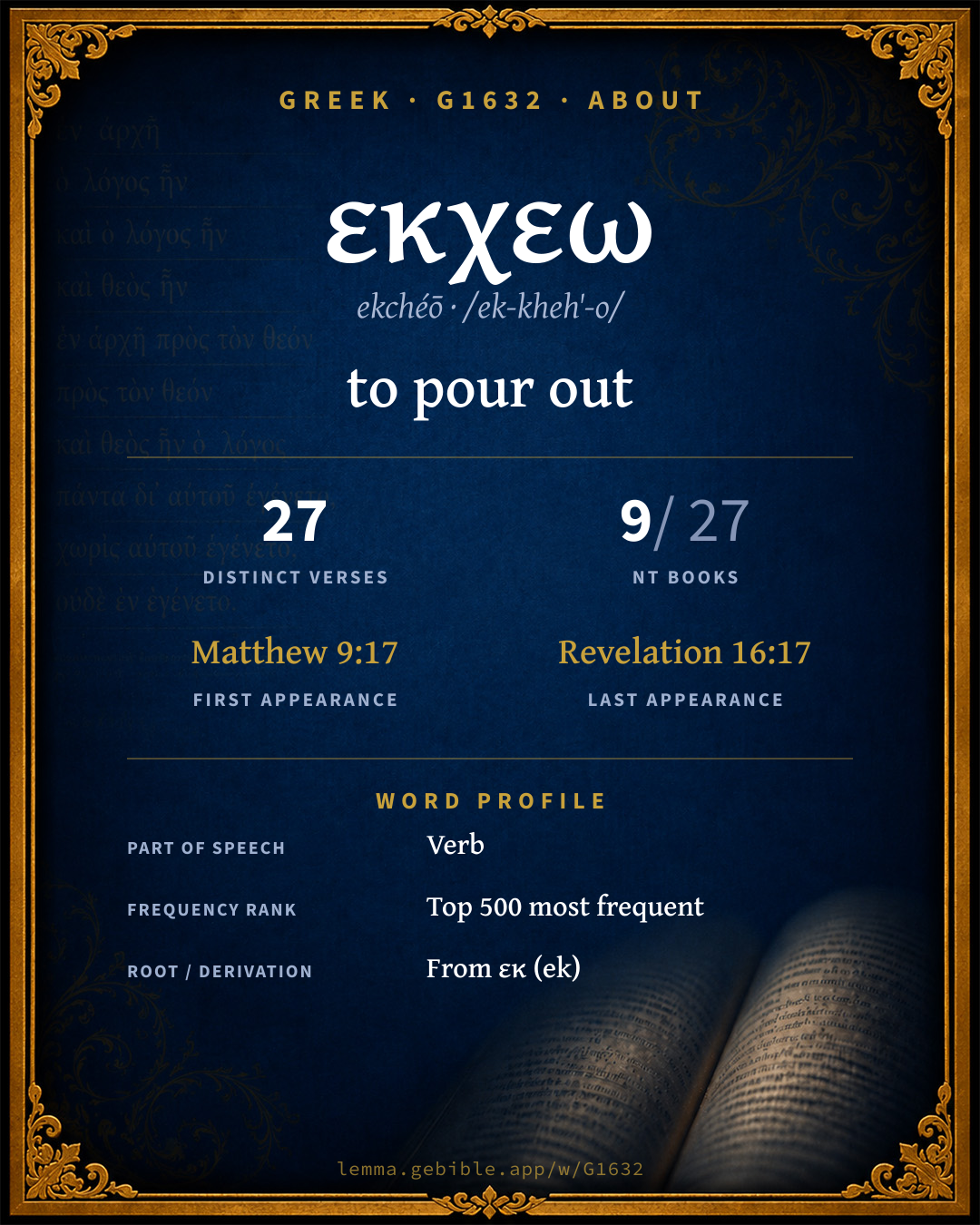
εκχεω
to pour out
‘to pour out’ is one of 2 main senses fuller range ↓
Full lexicon entry — Thayer's Greek Lexicon
From Thayer's Greek Lexicon
Where this word appears
Grammar key — what these labels mean
Part of speech
- Verb
- An action or state-of-being word.
Tense
- Aorist
- Action viewed as a simple whole, without regard to duration — often past (perfective aspect).
- Present
- Ongoing or general action in present time (imperfective aspect).
- Future
- Action expected in future time.
- Perfect
- A completed past action with continuing present results.
- Imperfect
- Continuous or repeated action in past time (“was writing”).
Voice
- Active
- The subject performs the action.
- Passive
- The subject receives the action.
Mood
- Indicative
- States a fact or asks a factual question (the mood of reality).
- Participle
- A verbal adjective (“writing,” “having written”).
- Infinitive
- A verbal noun (“to write”), unmarked for person or number.
- Imperative
- Expresses a command or request.
Case
- Nominative
- The case of the subject (and the predicate nominative).
Person
- 3rd person
- The one spoken about (“he / she / it / they”).
- 1st person
- The speaker (“I / we”).
- 2nd person
- The one addressed (“you”).
Gender
- Neuter
- Grammatically neuter.
Number
- Singular
- One.
- Plural
- More than one.
Every verse where G1632 appears in the Book of John — 1 distinct verse. Click any verse to open its interlinear word-by-word view. Verse text shown in the World English Bible for context — . Each verse’s Greek form is shown with its reference; the English is not keyword-highlighted, since the data carries no word-level English alignment. Use “Compare translations” on any verse to read it across multiple English versions. This concordance covers the Greek New Testament; Septuagint (Greek Old Testament) occurrences of this word are not indexed here.
John
About this entry
At a glance — auto-summarized from this page’s data, not written by a person. Every figure links to its source below. This summary describes the numbers; it doesn’t interpret them.
“to pour out” is the headline sense of the Greek verb εκχεω (ekchéō). Its earliest occurrence is Matthew 9:17. The Greek New Testament uses it across 27 verses — moderately common. More than a third of its appearances fall in Revelation. Lexicons map it across 2 senses. The sections below give every sense, occurrence, and version rendering.
Gloss history
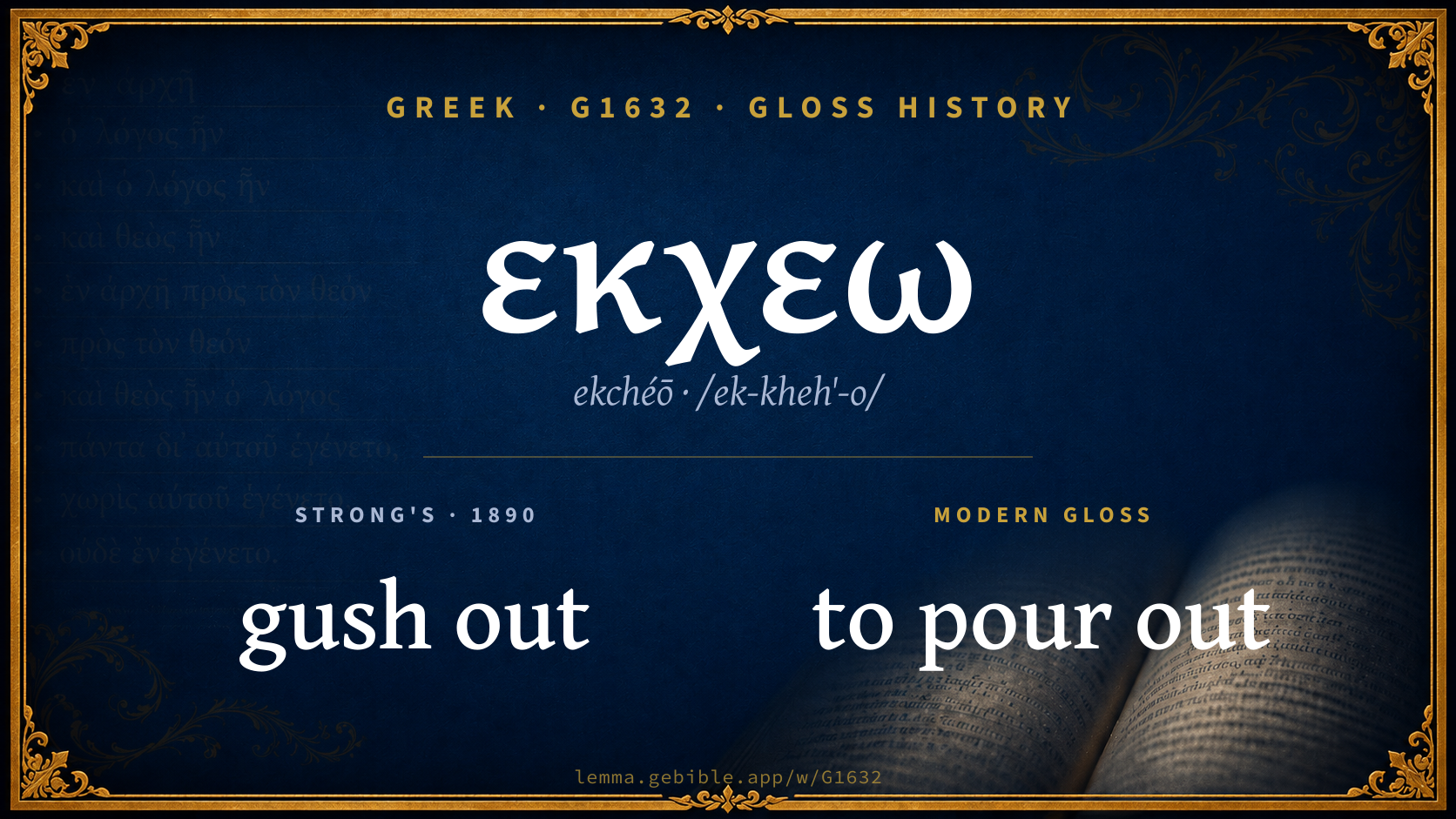
Strong's 1890 vs modern scholarship
About this word
Strong's G1632 catalogs a Greek word from the Greek New Testament.
These counts are not copied from any lexicon or concordance. They are computed here, from the morphology-tagged Greek New Testament. What Lemma adds →
- 27
- distinct verses
- The word appears in 27 distinct verses.
- 9 / 27
- NT books
- The word appears in 9 of 27 New Testament books.
- #500
- by frequency
- Top 500 most frequent Greek words (rank 500 of 5,347 Greek words by occurrence).
View all 27 occurrences in the concordance →
Most concentrated in
- Revelation 9 verses 33%
- Acts 6 verses 22%
- Matthew 3 verses 11%
By section of the New Testament
By traditional corpus
Conventional, traditional groupings — biblical authorship is debated, so this is a traditional corpus grouping, not an authorship claim. Some books belong to more than one corpus (Luke is in both the Gospels and the Lukan corpus, and so on), so these shares overlap and need not total 100%. Each figure is a share of the word’s 27 distinct verses.
- Johannine 10 verses · 37%
- Lukan (Luke–Acts) 9 verses · 33%
- Revelation 9 verses · 33%
- Gospels 8 verses · 30%
- Pauline corpus 3 verses · 11%
- General (Catholic) Epistles 1 verse · 4%
How translations render this word
Counts come from each version’s own published word-to-Strong’s tagging or interlinear alignment — an approximate guide to how each version renders this word, not a word-level alignment the data otherwise carries. Because each total is that version’s own tagged count, the per-version totals vary from one another and need not match the appearance or distinct-verse counts above. These counts may also differ from a printed concordance because Lemma counts each distinctly tagged rendering and does not collapse phrase taggings into a single head-word total. This is a fixed set of word-tagged versions (KJV, ASV, BSB, ULT) and does not change with the reading translation you choose elsewhere. Each version’s license is shown beside its name below (and on Sources).
- King James Version: Poured out 8×, Is shed 3×, I will pour out 2×
- American Standard Version: Is poured 3×, Shed 3×
- Berean Standard Bible: Poured out 7×, Is poured out 3×, Has poured out 2×
- unfoldingWord Literal Text: Poured out 7×, I will pour out 2×, Is being poured out 2×
King James Version Public Domain
Renders G1632 across 28 tagged occurrences — most commonly:
Plus 11 renderings that appear only once — usually multi-word phrases or single function words the recovered tagging swept in, not distinct renderings.
American Standard Version Public Domain
Renders G1632 across 28 tagged occurrences — most commonly:
Plus 22 renderings that appear only once — usually multi-word phrases or single function words the recovered tagging swept in, not distinct renderings.
Berean Standard Bible Public Domain
Renders G1632 across 27 tagged occurrences — most commonly:
Plus 7 renderings that appear only once — usually multi-word phrases or single function words the recovered tagging swept in, not distinct renderings.
unfoldingWord Literal Text CC BY-SA 4.0
Renders G1632 across 28 tagged occurrences — most commonly:
Plus 15 renderings that appear only once — usually multi-word phrases or single function words the recovered tagging swept in, not distinct renderings.
Senses in Thayer's
The 2 senses Thayer's distinguishes for this word, in lexicon order (not ranked by frequency or importance). The full entry — with sub-senses — is in the Lexicon Entry tab.
- to pour out, shed forth
- metaph. to bestow or distribute largely
Word origin
Derived from εκ (ek) (G1537) — from.
From G1537 and χέω cheō (to pour ); to pour forth ; figuratively to bestow : - gush (pour) out run greedily (out) shed (abroad forth) spill.
— Strong’s Exhaustive Concordance (1890), public domain.
Forms in the corpus
The 12 distinct written forms G1632 takes in the Greek New Testament, most frequent first — each parse links to that tense’s occurrences in the concordance.
Same root — word family
Other Thayer's entries built from the same root as G1632, grouped by Strong’s listed origin. These share a root / origin per the lexicon — not necessarily a shared meaning. Each links to that word’s own entry.
Derives from
Shares the same root
- εκβαλλω ekbállō G1544 to cast out
- εκβασις ékbasis G1545 exit
- εκγαμιζω ekgamízō G1547 to give in marriage
- εκγαμισκω ekgamískō G1548 to give in marriage
- εκγονον ékgonon G1549 offspring
- εκδαπαναω ekdapanáō G1550 to spend
- εκδεχομαι ekdéchomai G1551 to receive
- εκδηλος ékdēlos G1552 evident
- εκδημεω ekdēméō G1553 to depart
- εκδιδωμι ekdídōmi G1554 to give out
- εκδιηγεομαι ekdiēgéomai G1555 to relate
- εκδικος ékdikos G1558 without justice
- εκδιωκω ekdiṓkō G1559 to banish
- εκδοτος ékdotos G1560 delivered up
- εκδυω ekdýō G1562 to put off
- εκζητεω ekzētéō G1567 to seek out
- εκθαμβος ékthambos G1569 astonished
- εκθετος ékthetos G1570 exposed
- εκκαθαιρω ekkathaírō G1571 to cleanse
- εκκαιω ekkaíō G1572 to burn
- εκκακεω ekkakéō G1573 to be exhausted
- εκκεντεω ekkentéō G1574 to pierce
- εκκλαω ekkláō G1575 to cut off
- εκκλειω ekkleíō G1576 to shut out
+88 more words share this root (not shown).
Compare all same-root words → Showing 4 of 114 — not the complete family. They share a root, not necessarily a meaning.
Septuagint usage
The same Greek word εκχεω appears 119 times in the Greek Old Testament (Septuagint), across 116 verses in 26 books.
- 119
- LXX occurrences
- Tagged occurrences of this Greek word in the Septuagint.
- 116
- verses
- Distinct Septuagint verses containing this word.
- 26 / 39
- OT books
- The word appears in 26 of the 39 Old Testament books.
Sample Septuagint occurrences
- Genesis 9:6 ἐκχέω
- Exodus 4:9 ἐκχέω
- Leviticus 4:7 ἐκχέω
- Numbers 19:17 ἐκχέω
- Deuteronomy 12:16 ἐκχέω
- Judges 6:20 ἐκχέω
- 1 Samuel 1:15 ἐκχέω
- 2 Samuel 20:10 ἐκχέω
- 1 Kings 2:31 ἐκχέω
- 2 Kings 19:32 ἐκχέω
- 1 Chronicles 22:8 ἐκχέω
- 2 Chronicles 36:5 ἐκχέω
Septuagint occurrences (same lexeme)
Every verse where the same Strong’s number (G1632) appears in the Greek Septuagint — showing the first 50 of 116. Verse text shown in the World English Bible for context; the Greek form is the matched word — the English is not keyword-highlighted.
- Genesis 9:6 ἐκχέω Whoever sheds man's blood, by man will his blood be shed, for in the image of God made he man.
- Genesis 37:22 ἐκχέω Reuben said to them, "Shed no blood. Throw him into this pit that is in the wilderness, but lay no hand on him"-- that he might deliver him out of their hand, to restore him to his father.
- Genesis 38:9 ἐκχέω Onan knew that the seed wouldn't be his; and it happened, when he went in to his brother's wife, that he spilled it on the ground, lest he should give seed to his brother.
- Exodus 4:9 ἐκχέω It will happen, if they will not believe even these two signs, neither listen to your voice, that you shall take of the water of the river, and pour it on the dry land. The water which you take out of the river will become blood on the dry land."
- Exodus 29:12 ἐκχέω You shall take of the blood of the bull, and put it on the horns of the altar with your finger; and you shall pour out all the blood at the base of the altar.
- Exodus 30:18 ἐκχέω "You shall also make a basin of brass, and the base of it of brass, in which to wash. You shall put it between the tent of meeting and the altar, and you shall put water in it.
- Leviticus 4:7 ἐκχέω The priest shall put some of the blood on the horns of the altar of sweet incense before Yahweh, which is in the tent of meeting; and he shall pour out all the blood of the bull out at the base of the altar of burnt offering, which is at the door of the Tent of Meeting.
- Leviticus 4:12 ἐκχέω even the whole bull shall he carry forth outside the camp to a clean place, where the ashes are poured out, and burn it on wood with fire. Where the ashes are poured out it shall be burned.
- Leviticus 4:18 ἐκχέω He shall put some of the blood on the horns of the altar which is before Yahweh, that is in the Tent of Meeting; and the rest of the blood he shall pour out at the base of the altar of burnt offering, which is at the door of the Tent of Meeting.
- Leviticus 4:25 ἐκχέω The priest shall take some of the blood of the sin offering with his finger, and put it on the horns of the altar of burnt offering. He shall pour out the rest of its blood at the base of the altar of burnt offering.
- Leviticus 4:30 ἐκχέω The priest shall take some of its blood with his finger, and put it on the horns of the altar of burnt offering; and the rest of its blood he shall pour out at the base of the altar.
- Leviticus 4:34 ἐκχέω The priest shall take some of the blood of the sin offering with his finger, and put it on the horns of the altar of burnt offering; and all the rest of its blood he shall pour out at the base of the altar.
- Leviticus 8:15 ἐκχέω He killed it; and Moses took the blood, and put it on the horns of the altar round about with his finger, and purified the altar, and poured out the blood at the base of the altar, and sanctified it, to make atonement for it.
- Leviticus 9:9 ἐκχέω The sons of Aaron presented the blood to him; and he dipped his finger in the blood, and put it on the horns of the altar, and poured out the blood at the base of the altar:
- Leviticus 14:41 ἐκχέω and he shall cause the inside of the house to be scraped round about, and they shall pour out the mortar, that they scraped off, outside of the city into an unclean place.
- Leviticus 17:4 ἐκχέω and hasn't brought it to the door of the Tent of Meeting, to offer it as an offering to Yahweh before the tabernacle of Yahweh: blood shall be imputed to that man. He has shed blood; and that man shall be cut off from among his people.
- Leviticus 17:13 ἐκχέω "'Whatever man there is of the children of Israel, or of the strangers who live as foreigners among them, who takes in hunting any animal or bird that may be eaten; he shall pour out its blood, and cover it with dust.
- Numbers 19:17 ἐκχέω For the unclean they shall take of the ashes of the burning of the sin-offering; and running water shall be put thereto in a vessel:
- Numbers 35:33 ἐκχέω So you shall not pollute the land in which you are: for blood, it pollutes the land; and no expiation can be made for the land for the blood that is shed therein, but by the blood of him who shed it.
- Deuteronomy 12:16 ἐκχέω Only you shall not eat the blood; you shall pour it out on the earth as water.
- Deuteronomy 12:24 ἐκχέω You shall not eat it; you shall pour it out on the earth as water.
- Deuteronomy 15:23 ἐκχέω Only you shall not eat its blood; you shall pour it out on the ground as water.
- Deuteronomy 19:10 ἐκχέω that innocent blood not be shed in the midst of your land, which Yahweh your God gives you for an inheritance, and so blood be on you.
- Deuteronomy 21:7 ἐκχέω and they shall answer and say, Our hands have not shed this blood, neither have our eyes seen it.
- Judges 6:20 ἐκχέω The angel of God said to him, Take the flesh and the unleavened cakes, and lay them on this rock, and pour out the broth. He did so.
- Judges 20:37 ἐκχέω The liers-in-wait hurried, and rushed on Gibeah; and the liers-in-wait drew themselves along, and struck all the city with the edge of the sword.
- 1 Samuel 1:15 ἐκχέω Hannah answered, No, my lord, I am a woman of a sorrowful spirit: I have drunk neither wine nor strong drink, but I poured out my soul before Yahweh.
- 1 Samuel 7:6 ἐκχέω They gathered together to Mizpah, and drew water, and poured it out before Yahweh, and fasted on that day, and said there, We have sinned against Yahweh. Samuel judged the children of Israel in Mizpah.
- 1 Samuel 25:31 ἐκχέω that this shall be no grief to you, nor offense of heart to my lord, either that you have shed blood without cause, or that my lord has avenged himself. When Yahweh shall have dealt well with my lord, then remember your handmaid.
- 2 Samuel 20:10 ἐκχέω But Amasa took no heed to the sword that was in Joab's hand: so he struck him therewith in the body, and shed out his bowels to the ground, and didn't strike him again; and he died. Joab and Abishai his brother pursued after Sheba the son of Bichri.
- 2 Samuel 20:15 ἐκχέω They came and besieged him in Abel of Beth Maacah, and they cast up a mound against the city, and it stood against the rampart; and all the people who were with Joab battered the wall, to throw it down.
- 1 Kings 2:31 ἐκχέω The king said to him, Do as he has said, and fall on him, and bury him; that you may take away the blood, which Joab shed without cause, from me and from my father's house.
- 1 Kings 13:3 ἐκχέω He gave a sign the same day, saying, This is the sign which Yahweh has spoken: Behold, the altar shall be torn, and the ashes that are on it shall be poured out.
- 1 Kings 13:5 ἐκχέω The altar also was torn, and the ashes poured out from the altar, according to the sign which the man of God had given by the word of Yahweh.
- 2 Kings 19:32 ἐκχέω Therefore thus says Yahweh concerning the king of Assyria, He shall not come to this city, nor shoot an arrow there, neither shall he come before it with shield, nor cast up a mound against it.
- 2 Kings 21:16 ἐκχέω Moreover Manasseh shed innocent blood very much, until he had filled Jerusalem from one end to another; besides his sin with which he made Judah to sin, in doing that which was evil in the sight of Yahweh.
- 2 Kings 24:4 ἐκχέω and also for the innocent blood that he shed; for he filled Jerusalem with innocent blood: and Yahweh would not pardon.
- 1 Chronicles 22:8 ἐκχέω But the word of Yahweh came to me, saying, You have shed blood abundantly, and have made great wars: you shall not build a house to my name, because you have shed much blood on the earth in my sight.
- 1 Chronicles 28:3 ἐκχέω But God said to me, You shall not build a house for my name, because you are a man of war, and have shed blood.
- 2 Chronicles 36:5 ἐκχέω Jehoiakim was Twenty-five years old when he began to reign; and he reigned eleven years in Jerusalem: and he did that which was evil in the sight of Yahweh his God.
- Job 12:21 ἐκχέω He pours contempt on princes, And loosens the belt of the strong.
- Job 16:13 ἐκχέω His archers surround me. He splits my kidneys apart, and does not spare. He pours out my gall on the ground.
- Job 30:16 ἐκχέω "Now my soul is poured out within me. Days of affliction have taken hold on me.
- Psalms 13:3 ἐκχέω Behold, and answer me, Yahweh, my God. Give light to my eyes, lest I sleep in death;
- Psalms 21:15 ἐκχέω
- Psalms 34:3 ἐκχέω Oh magnify Yahweh with me. Let us exalt his name together.
- Psalms 41:5 ἐκχέω My enemies speak evil against me: "When will he die, and his name perish?"
- Psalms 44:3 ἐκχέω For they didn't get the land in possession by their own sword, Neither did their own arm save them; But your right hand, and your arm, and the light of your face, Because you were favorable to them.
- Psalms 61:9 ἐκχέω
- Psalms 68:25 ἐκχέω The singers went before, the minstrels followed after, In the midst of the ladies playing with tambourines,
These are occurrences of the same Greek lexeme (G1632) in the Septuagint — not a translation of any one Hebrew word. The store carries no word-level Hebrew↔Greek alignment, so no Hebrew original is asserted here. Counts come from the recovered LXX Strong's tagging — high-frequency vocabulary is well covered, while rare or late forms may be untagged — so they reflect tagged occurrences and may slightly undercount.