Revelation 16:17

Greek (Tischendorf 8th ed.) Revelation 16:17 appears in the Greek New Testament. The text above is from the Tischendorf 8th edition. Each word links to its Strong’s number and a concise gloss. Click any word for its full Thayer’s Greek Lexicon entry.
Download image
Cite this verse

Revelation 16:17 (World English Bible). Public Domain. Lemma interlinear Bible study tool, https://lemma.gebible.app/v/revelation/16/17.

Show BibTeX & RIS
BibTeX
RIS
English Translation
The seventh poured out his bowl into the air. A loud voice came forth out of the temple of heaven, from the throne, saying, "It is done!"
World English Bible · Public Domain
Download a study sheet

One document with this verse’s original text, its word-by-word gloss line, the meaning frame, cross-references with their text, attributed commentary, and full source and license credits — printable, and it pastes into notes with its structure intact.

This verse Autodidact and up

Study sheet (.html) Plain text (.txt)

A passage Seminary Student

Up to 50 verses in one chapter. A passage sheet keeps up to 6 commentary sources and 12 cross-references per verse, in the order this page ranks them, and says so on the sheet whenever that leaves anything out. Ask for a single verse and you get the Autodidact verse sheet above.

Everything on this page stays free to read, with no account — the sheet is a download of what is already on screen, not access to it.

Want to remove ads? Support Godless Engineer
Compare translations 3

The same verse in 3 English versions, stacked beneath the original-language interlinear above. Click any original word for its lexicon entry.

Each is an independent rendering of the whole verse — the interlinear is not word-aligned to these translations.

Highlighted words mark where these versions differ — a whole-verse word diff, not a word-by-word alignment.

  • World English Bible Public Domain
    The seventh poured out his bowl into the air. A loud voice came forth out of the temple of heaven, from the throne, saying, "It is done!"
  • King James Version Public Domain
    And the seventh angel poured out his vial into the air; and there came a great voice out of the temple of heaven, from the throne, saying, It is done.
  • unfoldingWord Literal Text CC BY-SA 4.0
    And the seventh poured out his bowl upon the air, and a loud voice came out from the temple from the throne, saying, “It has happened!”

unfoldingWord Literal Text — © unfoldingWord, licensed CC BY-SA 4.0. Word-aligned USFM3 via Door43 (git.door43.org/unfoldingWord/en_ult).

Versions to compare (up to 4)

3 of 4 selected

Show all 19 translations

Every available English version of this verse, each an independent rendering of the whole verse.

  • World English Bible Public Domain
    The seventh poured out his bowl into the air. A loud voice came forth out of the temple of heaven, from the throne, saying, "It is done!"
  • Berean Standard Bible Public Domain
    Then the seventh angel poured out his bowl into the air, and a loud voice came from the throne in the temple, saying, “It is done!”
  • Majority Standard Bible Public Domain
    Then the seventh angel poured out his bowl into the air, and a loud voice came from the throne in the temple of heaven, saying, “It is done!”
  • King James Version Public Domain
    And the seventh angel poured out his vial into the air; and there came a great voice out of the temple of heaven, from the throne, saying, It is done.
  • American Standard Version (1901) Public Domain
    And the seventh poured out his bowl upon the air; and there came forth a great voice out of the temple, from the throne, saying, It is done:
  • Revised Version (1885) Public Domain
    And the seventh poured out his bowl upon the air; and there came forth a great voice out of the temple, from the throne, saying, It is done:
  • Geneva Bible (1599) Public Domain
    And the seuenth Angel powred out his viall into the ayre: and there came a loude voyce out of the Temple of heauen from the throne, saying, It is done.
  • Douay-Rheims (1899) Public Domain
    And the seventh angel poured out his vial upon the air, and there came a great voice out of the temple from the throne, saying: It is done.
  • Young's Literal Translation Public Domain
    And the seventh messenger did pour out his vial to the air, and there came forth a great voice from the sanctuary of the heaven, from the throne, saying, `It hath come!'
  • Literal Standard Version CC BY-SA 4.0
    And the seventh messenger poured out his bowl on the air, and there came forth a great voice from the temple of Heaven, from the throne, saying, “It is done!”
  • Unlocked Literal Bible CC BY-SA 4.0
    Then the seventh angel poured out his bowl into the air. Then a loud voice came out of the temple and from the throne, saying, “It is done!”
  • unfoldingWord Literal Text CC BY-SA 4.0
    And the seventh poured out his bowl upon the air, and a loud voice came out from the temple from the throne, saying, “It has happened!”
  • Darby Bible Public Domain
    And the seventh poured out his bowl on the air; and there came out a great voice from the temple of the heaven, from the throne, saying, It is done.
  • World Messianic Bible Public Domain
    The seventh poured out his bowl into the air. A loud voice came out of the temple of heaven, from the throne, saying, “It is done!”
  • Webster's Bible Public Domain
    And the seventh angel poured out his vial into the air; and there came a great voice out of the temple of heaven, from the throne, saying, It is done.
  • Free Bible Version CC BY-SA 4.0
    The seventh angel poured out his bowl on the air, and a loud voice came from the Temple, from the throne, shouting out, “It's over!”
  • Bible in Basic English Public Domain
    And the seventh let what was in his vessel come out on the air; and there came out a great voice from the house of God, from the high seat, saying, It is done.
  • Text-Critical English NT CC BY 4.0
    The seventh poured out his bowl into the air, and a loud voice came from the throne of the temple of heaven, saying, “It is done!”
  • Tyndale New Testament (1534) Public Domain
    And the seventhe angell poured out his viall in to the ayre. And there came a voyce out of heven from the seate sayinge: it is done.

Literal Standard Version (2020), Covenant Press — licensed CC BY-SA 4.0. Text via the HelloAO Bible API (eBible.org). Unlocked Literal Bible (unfoldingWord) — licensed CC BY-SA 4.0. Text via the HelloAO Bible API (eBible.org). unfoldingWord Literal Text — © unfoldingWord, licensed CC BY-SA 4.0. Word-aligned USFM3 via Door43 (git.door43.org/unfoldingWord/en_ult). Free Bible Version, Dr. Jonathan Gallagher — licensed CC BY-SA 4.0. Text via the HelloAO Bible API (eBible.org).

Word by word

More ways to search: Search by grammar → Find every occurrence → Compare this word →

Practice this passage: Drill this verse → Learn its vocabulary →

ἀέρα
aḗr
G109
“air”
Noun, Accusative, Singular, Masculine
Part of Speech
Noun
Case
Accusative
Number
Singular
Gender
Masculine
Full Thayer's Definition

Origin: "from aemi (to breathe unconsciously, i.e. respire; by analogy, to blow)"

TDNT: 03:45,2

1. the air, particularly the lower and denser air as distinguished from the higher and rarer air 2. the atmospheric region
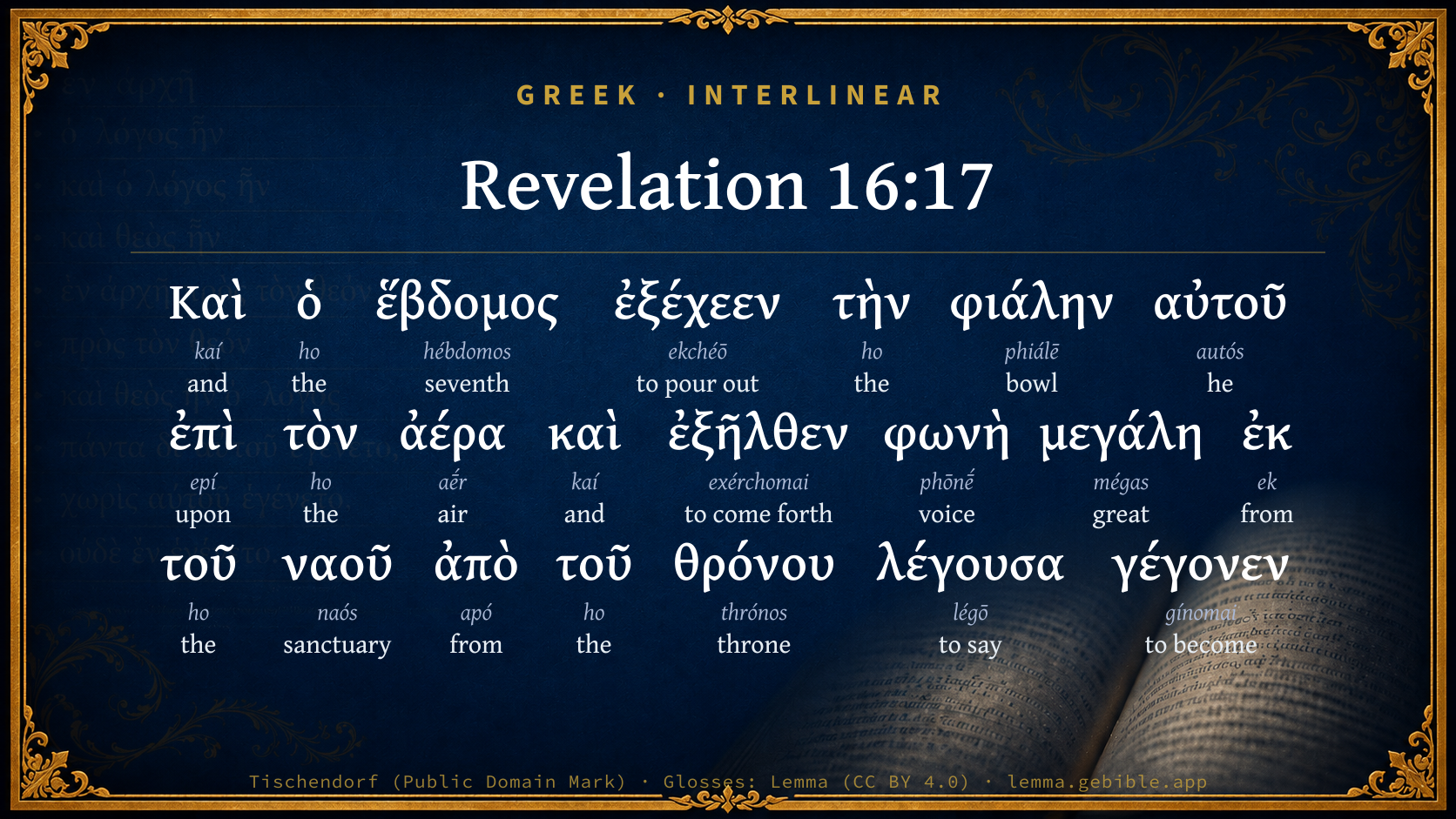
  1. Καὶ kaí G2532 “and” Conjunction
  2. ὁ ho G3588 “the” Article, Nominative, Singular, Masculine
  3. ἕβδομος hébdomos G1442 “seventh” Adjective, Nominative, Singular, Masculine
  4. ἐξέχεεν ekchéō G1632 “to pour out” Verb, Aorist, Active, Indicative, 3rd person, Singular
  5. τὴν ho G3588 “the” Article, Accusative, Singular, Feminine
  6. φιάλην phiálē G5357 “bowl” Noun, Accusative, Singular, Feminine
  7. αὐτοῦ autós G846 “he” Personal pronoun, Genitive, Singular, Masculine
  8. ἐπὶ epí G1909 “upon” Preposition
  9. τὸν ho G3588 “the” Article, Accusative, Singular, Masculine
  10. καὶ kaí G2532 “and” Conjunction
  11. ἐξῆλθεν exérchomai G1831 “to come forth” Verb, Aorist, Active, Indicative, 3rd person, Singular
  12. φωνὴ phōnḗ G5456 “voice” Noun, Nominative, Singular, Feminine
  13. μεγάλη mégas G3173 “great” Adjective, Nominative, Singular, Feminine
  14. ἐκ ek G1537 “from” Preposition
  15. τοῦ ho G3588 “the” Article, Genitive, Singular, Masculine
  16. ναοῦ naós G3485 “sanctuary” Noun, Genitive, Singular, Masculine
  17. ἀπὸ apó G575 “from” Preposition
  18. τοῦ ho G3588 “the” Article, Genitive, Singular, Masculine
  19. θρόνου thrónos G2362 “throne” Noun, Genitive, Singular, Masculine
  20. λέγουσα légō G3004 “to say” Verb, Present, Active, Participle, Nominative, Singular, Feminine
  21. γέγονεν gínomai G1096 “to become” Verb, Perfect, Active, Indicative, 3rd person, Singular

About this verse

These counts appear in no published source. They are computed here, from the morphology-tagged text and Lemma’s own curated glosses. What Lemma adds →

22
words
17
distinct lemmas
Revelation
section

Notable vocabulary

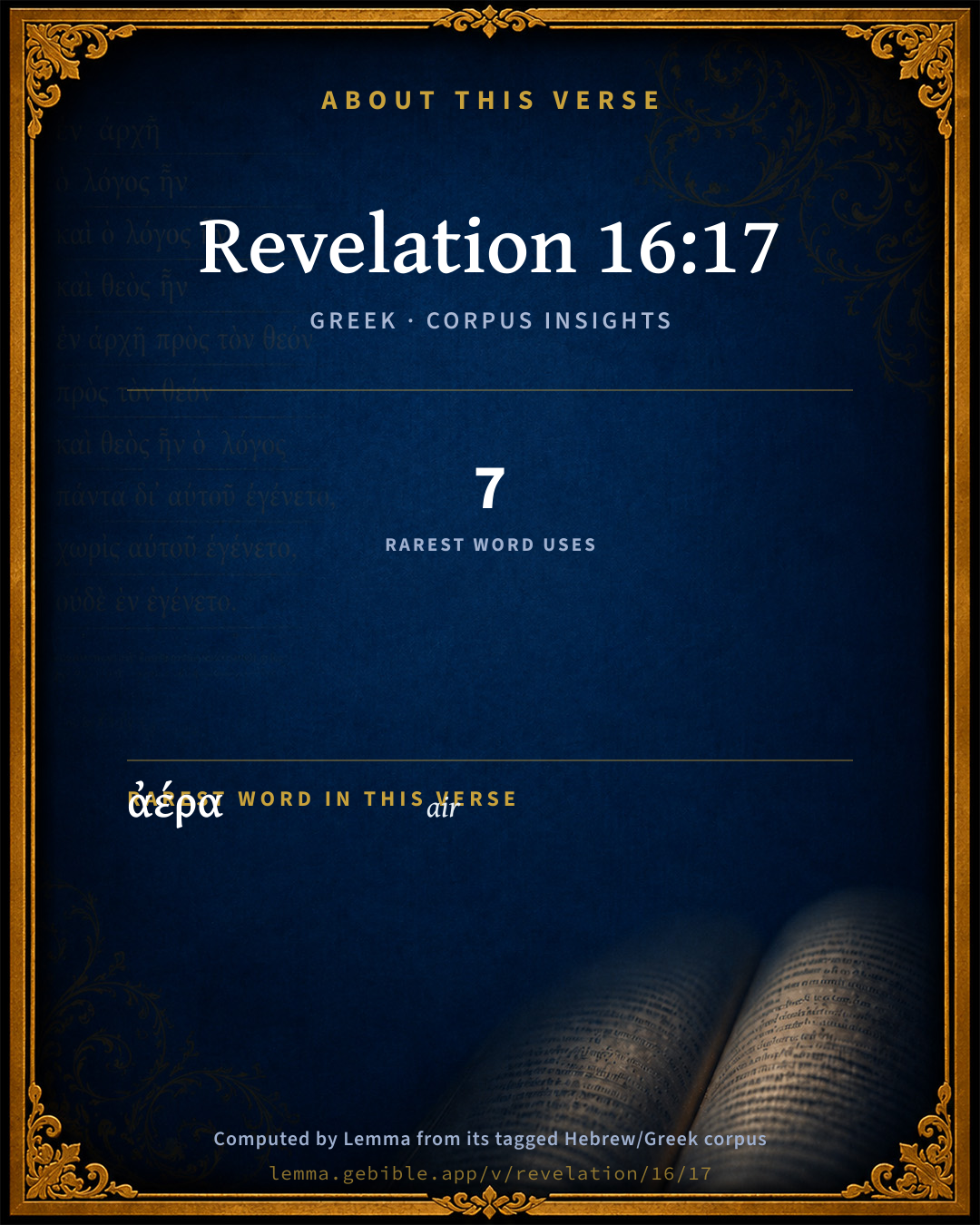
The rarest word here is ἀέρα air G109 — appearing just 7 times in the whole Greek New Testament.

Shared distinctive vocabulary

ἀέρα air G109 occurs in 7 verses of the Greek New Testament. Also found in:

Repetition

Words recur within this verse:

Cross-references

13

Topical passages linked to Revelation 16:17 in the Treasury of Scripture Knowledge — connected by theme and wording, ordered by reader-vote popularity; previews shown in the World English Bible.

  • John 19:30 When Jesus therefore had received the vinegar, he said, "It is finished." He bowed his head, and gave up his spirit.
  • Revelation 21:6 He said to me, "It is done! I am the Alpha and the Omega, the Beginning and the End. I will give freely to him who is thirsty from the spring of the water of life.
  • Ephesians 2:2 in which you once walked according to the course of this world, according to the prince of the powers of the air, the spirit who now works in the children of disobedience;
  • Ephesians 6:12 For our wrestling is not against flesh and blood, but against the principalities, against the powers, against the world's rulers of the darkness of this age, and against the spiritual hosts of wickedness in the heavenly places.
  • Daniel 12:7–13 I heard the man clothed in linen, who was above the waters of the river, when he held up his right hand and his left hand to heaven, and swore by him who lives forever that it shall be for a time, times, and a half; and when they have made an end of breaking in pieces the power of the holy people, all these things shall be finished.
  • Revelation 10:6–7 and swore by him who lives forever and ever, who created heaven and the things that are in it, the earth and the things that are in it, and the sea and the things that are in it, that there will no longer be delay,
  • Revelation 15:5–6 After these things I looked, and the temple of the tabernacle of the testimony in heaven was opened.
  • Revelation 11:15 The seventh angel sounded, and great voices in heaven followed, saying, "The kingdom of the world has become the Kingdom of our Lord, and of his Christ. He will reign forever and ever!"
  • Revelation 11:19 God's temple that is in heaven was opened, and the ark of the Lord's covenant was seen in his temple. Lightnings, sounds, thunders, an earthquake, and great hail followed.
  • Revelation 14:15 Another angel came out from the temple, crying with a loud voice to him who sat on the cloud, "Send forth your sickle, and reap; for the hour to reap has come; for the harvest of the earth is ripe!"
  • Revelation 14:17 Another angel came out from the temple which is in heaven. He also had a sharp sickle.
  • Revelation 16:1 I heard a loud voice out of the temple, saying to the seven angels, "Go and pour out the seven bowls of the wrath of God on the earth!"
  • Revelation 20:1–3 I saw an angel coming down out of heaven, having the key of the abyss and a great chain in his hand.

Cross-references courtesy of OpenBible.info (CC BY 4.0).

Where the printed editions differ

2 variants

Places in this verse where the major printed Greek editions disagree on the wording in a way that affects the translation — a comparison of editions, not a manuscript-by-manuscript collation. The editions are the modern critical texts (Nestlé-Aland 28/27, SBL, Westcott-Hort, Tregelles, Tyndale House) and the traditional texts behind the KJV (the Textus Receptus and the Byzantine/Majority text). It is not a claim about which reading is original.

  1. Extra text
    ἄγγελος

    “angel”

    In TR Not in NA28NA27TynSBLWHTregByz

    ἄγγελος (angelos) 'angel' is only in traditional manuscripts (TR)

  2. Extra text
    τοῦ οὐρανοῦ

    “of the heaven”

    In TRByz Not in NA28NA27TynSBLWHTreg

    τοῦ οὐρανοῦ (tou ouranou) 'of the heaven' is only in traditional manuscripts (TR+Byz)

Textual data: Translators Amalgamated Greek New Testament (STEPBible TAGNT) · CC BY 4.0.

Commentary

Notes on Revelation 16:17 from classic Christian and Jewish commentators (each source and its license shown beneath its notes). The classic Christian expositions comment on the surrounding passage and are grouped to its opening verse, so a note may address several verses; the Jewish commentaries on the Tanakh (Rashi and others) are per-verse, so they appear only where the commentator wrote on this verse.

Lemma curates 59 commentaries, every one of them public domain or Creative Commons licensed, each selected and text-cleaned for this edition rather than reprinted as found. About our sources →

The Cambridge Bible for Schools and Colleges

gen. ed. J. J. S. Perowne

The Seventh Vial. Preliminaries of Judgement, Rev_16:17-21

17. into the air] Lit. upon the air, according to the best reading.

of heaven] Should be omitted, but of course it is the heavenly Temple that is meant. Here it seems that the Throne (that of Rev_4:2) is inside it: but see on Rev_4:6. Though coming from the Throne, this voice is not defined, like that of Rev_21:5, as the voice of Him that sat on it: but comparing Rev_21:6 it is possible we ought to take it so.

It is done] More literally, it is come to pass: but the same word is used in St Luk_14:22, where of course the A. V. is right. God’s great Judgement has not come to pass yet, but everything has been done to prepare for it. “One who had fired a train would say ‘It is done,’ though the explosion had not yet taken place,” and, we may add, might use the same words again when it had, as in Rev_21:6.

The Cambridge Bible for Schools and Colleges (gen. ed. J. J. S. Perowne; Cambridge University Press, 1878–1918) — public domain. Text from a community e-Sword module.

The Biblical Illustrator

Joseph S. Exell

Rev_16:17-21

The seventh angel poured out his vial into the air.

The seventh bowl

I. How much of earths sin must there be for God to witness!

II. Men often ask--why is God silent so long?

III. Whatever may be the trial of faith thus caused, we are certain that God forgets nothing.

IV. God has great purposes to answer in permitting evil to go so long unpunished.

V. At the appointed hour the long-suffering will cease.

VI. Then Babylon the great, with all her sins, shall come up for final beckoning and recompense.

VII. The fact that all is in the hands of God is a guarantee of perfect equity.

VIII. With our God the execution is as certain as the purpose. The seer heard a great voice from the temple, out of the throne, saying, It is done! Note--

1. Amid the perplexity caused by the prevalence and power of evil, let us stay ourselves on God.

2. Let us do right, and wait Gods time.

3. Revenge is never to be any part of our policy.

4. Let us be glad and grateful that believers in God are not left in the dark as to the meaning, aims, and issue of the Divine government of the world. (C. Clemance, D. D.)

Satanic influence

The air which has received the last vial may be considered as the home or seat of the devil and his angels. There is no fancy in this, for you may remember how St. Paul himself describes the devil as the prince of the power of the air. It is, however, of little importance that we determine where fallen angels have their habitation; and perhaps the associating the devil with the air is not so much for the purpose of defining the residence of Satan as to give us information as to the nature of his dominion. We mean that probably we are not hereby taught that the devil dwells in the air--though that also may be the meaning--but rather that he has at his disposal the power of the air; so that he can employ this element in his operations on mankind. And we know of no reason why the power of the devil should be regarded as confined to what we are wont to call spiritual agency, so as never to be employed in the production of physical evil--why the souls and not also the bodies of men should be considered as objects of his attack. Indeed, forasmuch as the soul is the nobler part of man--the more precious and dignified--it would be strange if this alone were exposed to his attack, and the body were altogether exempt. We believe, therefore, that Satan may have a great deal to do with those pains and sicknesses which so abound in the world. It is certainly the representation of Scripture that Satan has much to do with inflicting diseases of the body. The woman who had a spirit of infirmity eighteen years, and was bowed together--what said Christ of her, when the ruler of the synagogue was indignant at her being made whole on the Sabbath day? Ought not this woman, being a daughter of Abraham, whom Satan hath bound, lo! these eighteen years, be loosed from this bond on the Sabbath day? Again, we know not exactly what that thorn in the flesh was from which St. Paul suffered. But the expression makes it seem probable that it was some acute bodily pain, or some oppressive infirmity; and the apostle distinctly calls it a messenger of Satan, sent to buffet him. Do we not seem warranted in inferring from these intimations that Satan is greatly concerned in bringing maladies on mens bodies? And if this be once allowed, we may enter into the meaning of the title, The prince of the power of the air. We are accustomed, and as it would seem with much accuracy, to refer to certain states of the air as producing certain diseases of the body. Without being able precisely to trace the connection, or investigate the cause, we consider that the atmosphere is frequently impregnated with disease and sickness, so that we may be said to inhale death whilst inhaling what is essential to life. Thus we virtually suppose the power of the air to be a power over health and over life; and therefore, that he who possesses that power--and this St. Paul says is the devil--must be one who is greatly instrumental in the inflicting disease. If you add to this that many of the worst calamities, as well as sicknesses with which men are visited, may be traced to the air, you have the materials from which to show that it is assigning to the devil an awful dominion to give him the sovereignty of the air. Again, we remind you that we are fully aware that Satan can do nothing except as he is permitted by God. We speak only of the power which he can wield when the permission has been granted. Never can I hear of a land which is laid waste by plague, and never can I hear of the rushing of the tornado, passing over fertile plains, and leaving them a desert, without the most startling apprehensions of the fearfulness of the enemy who can use this element as his engine, and without also feeling how justly may the final triumph of good over evil be associated with some great deed that shall be wrought in the air, even according to the representation of our text--And the seventh angel poured out his vial into the air; and there came a great voice out of the temple of heaven, from the throne, saying, It is done. We Cannot well doubt that this association of the air with the devil is equally appropriate when the devil is regarded under the more common point of view--that of the assailant of the soul, the instigator to sin in all its varieties of form. It may not be so easy to show the appropriateness in this case; for we cannot make much way when we would endeavour to explain what is generally understood by spiritual agency--the operation of spirit on spirit, whether it be for good, or whether it be for evil. There is nothing more mysterious with our present faculties and capacities than those secret influences to which we are undeniably subjected--influences which employ no visible, tangible instrumentality, but whose sphere is at once the inner man, and which make themselves felt, though we know not how they enter into that hidden world, which each bears within himself. We are not, however, concerned with more than the fact, that the spirit of evil, as well as the spirit of good, has access to our minds, and can bring itself into such association and intimacy with us as to act by and through our own thoughts and feelings. Assuming this fact, it is our business to endeavour to show that our spiritual adversary, as the adversary of our souls, may fitly be described as inhabiting the air. In order to this we would remind you, that whatever is visionary and unstable, whatever is a mere delusion and cheat, this we are accustomed to connect with the air; so that we describe as aerial what we find to be unsubstantial or deceptive. It has undoubtedly been through the putting a cheat on man, that the devil, from the first, has effected his destruction. His endeavour has been too often successful l has been to prevail on man to substitute an imaginary good for a real, the creature for the Creator, and to mock their own capacities for happiness by seeking it in the finite and the perishable. If it be by what we should call a series of optical deceptions that he acts on our race, distorting one thing and magnifying another, and throwing a false colouring on a third, how is he proceeding but so as to avail himself of those strange properties of the air whence spring such phenomena as that of the Egyptian morass, the weary traveller being cheered with the appearance of the blue waters of a lake, on whose margins green trees are waving, but finding as he approaches that there is only the hot sand and no drop of water wherewith to cool his tongue? If, again, it be by crowding the field of view with witching but unsubstantial forms, with gorgeous thrones and splendid pageants, which sweep before the mind and beckon onward to disappointment--if it be thus that Satan retains, undisputed, his dominion over thousands, what can he be truly said to employ so much as the power of the air, weaving those brilliant phantoms which have seemed to hurry to and fro, as though hurrying from cloud to cloud, and causing those strange delusions which have startled the peasant, and made him think the glens into which he was entering tenanted by shadowy and mysterious beings--in short, if it be that Satan tries to deceive mankind by the inconstant and unsubstantial--if the ambitious, and the voluptuous, and the avaricious, be all and each pursuing a beckoning shadow--if the whole apparatus by which the world is lulled into moral slumber, or roused to self-destruction, be made up of the mere imagery of happiness, could any description be more apposite than one which represents the devil as lord of that element in which floats the meteor, and through which glides the spectre, and out of which can be formed nothing that we can grasp, though it may be the vehicle of a thousand deceptions arrayed in beautiful array? We take this subject of discourse because we desire, by every possible means and by all varieties of illustration, to make you aware of the powers, and put you on your guard against the malice of the devil. We are indeed well aware that it is not the devil who destroys man. It must be man who destroys himself. The devil can do nothing against us, except as we afford him opportunity, yielding ourselves to his suggestions and allowing him to lead us captive at his will. But it may at length come to pass, if we persist in walking as children of disobedience, that we quite expel from our breasts the Spirit of God, whose strivings have been resisted and whose admonitions have been despised, and enthrone in His stead that spirit of evil, whose longing and whose labour it is to make us share his own ruin. And then is there as clear a demoniacal possession as when the man was cast into the fire or water through the fearful energies of the indwelling fiend. Every sin which you wilfully commit helps forward the great design of the devil--the design of obtaining such hold on you that he may claim you as his own; and as a strong man armed, he keepeth his goods. Let us look now once more with careful attention to our text and its context. We read in the chapter before us of seven angels, having the seven last plagues, in seven vials, each of which is filled with the wrath of God. These plagues are manifestly those tremendous judgments which are to conclude the present dispensation, and make way for that glorious season when Christianity shall have a home in every land and in every heart. The first six vials are emptied on the earth, or on the waters, or on the sun, and are followed by fearful catastrophes which are preliminary to a more tremendous one which is to close the strange work of vengeance; but it is the seventh vial with which seems associated the final deliverance of the creation--the overthrow of the Lords enemies, and the vindication of all His attributes. For, as you learn from our text, so soon as the seventh angel pours out his vial, there is heard a great voice out of the temple of heaven, from the throne, saying, It is done! as though this were the completion and consummation of a mighty and long-protracted work. Why this triumphant exclamation, It is done! as though the emptying of the seventh vial had finished the extirpation of evil, and made a clear scene for the erection of the kingdom of Jesus. Our whole discourse has turned on this--the vial is emptied into the air. We identify the air with the residence and dominion of Satan, and hence the seventh vial may be considered as containing those judgments which are immediately directed against the devil. The destruction of the devils sovereignty will be the emancipation of the whole creation which has so long groaned and travailed in pain, hence the shout. Not on the land, not in the sea, not in the fountains is the vial poured; it is poured into the air, and fallen angels, who have their abode in that element which they have long polluted and spoiled, are driven down to their heritage of fire. And then the atmosphere has all the blandness and freshness of a new spring, and the lost flowers of Paradise once more cover the earth. (H. Melvill, B. D.)

.

The Biblical Illustrator, edited by Joseph S. Exell (c. 1880s–1900s) — public domain. Text from a community e-Sword module.

Joseph Benson's Commentary

Rev 16:17-21. And the seventh angel poured out his vial into the air — The seat of Satan’s residence, who is emphatically styled, (Eph 2:2,) the prince of the power of the air, and is represented (Rev 16:13,) as a principal actor in these latter scenes; so that this last period will not only complete the ruin of the kingdom of the beast, but will also shake the kingdom of Satan everywhere. Upon the pouring out of this vial, a solemn proclamation is made from the throne of God himself, It is done — In the same sense as the angel before affirmed, Rev 10:7, that in the days of the seventh trumpet the mystery of God should be finished. Of this vial, as indeed of all the former, the completion is gradual; and the immediate effects and consequences are, (Rev 16:18-21,) voices, and thunders, and lightnings, and an earthquake, and great hail — Events portending great calamities. Voices, and thunders, and lightnings, are the usual attendants of the Deity, especially in his judgments. Great earthquakes, in prophetic language, signify great changes and revolutions; and this is such a one as men never felt and experienced before; such as was not since men were upon the earth. Not only the great city is divided into three parts, or factions, but the cities of the nations fall from their obedience to her. Her sins are remembered before God, and, like another Babylon, she will soon be made to drink of the bitter cup of his anger. Nay, not only the works of men, the cities, fall, but even the works of nature; the islands flee away, and the mountains are not found; which is more than was said before, Rev 6:14, that they were moved out of their places; and can import no less than an utter extirpation of idolatry. Great hail, too, often signifies the judgments of God, and these are uncommon judgments. Diodorus, a grave historian, speaketh of hailstones which weighed a pound and more; Philostorgius mentions hail that weighed eight pounds; but these are about the weight of a talent — Or about a hundred pounds; a strong figure, to denote the greatness and severity of these judgments. But still the men continue obstinate, and blaspheme God because of the plague of the hail — They remain incorrigible under the divine judgments, and shall be destroyed before they will be reformed. This vial of consummation was supposed by Mr. Mede to synchronize with the vintage, mentioned Rev 14:18-19, the conclusion of the grand drama of one thousand two hundred and sixty years, the time of the end. — When it shall be poured out, says Faber, “the great controversy of God with the nations will commence; his ancient people will begin to be restored; and the sentence of destruction will go forth against the beast and the false prophet, even while they are in the midst of their temporary success, and while they are vainly flattering themselves with the hope of a complete victory over the church of God. Such being its contents, it is said to be poured out into the air, in allusion to the dreadful storms of political thunder and lightning which it will produce. Four important events are comprehended under it: the earthquake, by which the great city is divided into three parts; the symbolical storm of hail; the overthrow of Babylon, and the battle of Armageddon, to which the kings of the earth had begun to gather themselves together under the preceding vial.” On these particulars we may observe as follows: 1st, The earthquake, by which the great city is divided into three parts, manifestly signifies, according to the usual import of prophetic language, some great revolution by which the Latin empire shall either be divided into three sovereignties, or prefectures, like the ancient Roman empire. But what the precise meaning of this prediction is, and how the city will be divided into three parts, time alone can discover. 2d, The hail-storm seems to denote some northern invasion of the Roman empire. Since the northern incursions of the Gothic nations, under the first trumpet, are typified by a storm of hail, it is only natural to conclude, from analogy, that the hailstorm of this vial, which synchronizes with the time of the end, likewise typifies a northern invasion. 3d, The fall of the spiritual Babylon, described at large in chap. 18., seems to be the same as the destruction of the little horn of Daniel’s fourth beast; they both equally relate to the complete subversion of the Papacy. 4th, Exactly contemporary with the fall of the spiritual Babylon, or the adulterous Church of Rome, will be the overthrow of its supporter, the secular Babylon, or the ten-horned Roman beast. The power of both will be broken in the same battle of Armageddon, which is abundantly manifest from the concurring testimony both of Daniel and St. John. Thus also Fleming, “This vial brings down thunder, lightning, hail, and storms; which, together with a terrible earthquake, destroys all the antichristian nations, and particularly Rome, or mystical Babylon. And as Christ concluded his sufferings on the cross with this voice, It is finished, so the church’s sufferings are concluded with a voice out of the temple of heaven and from the throne of God and Christ there, saying, It is done: and therefore with this the millennium, or thousand years of Christ’s spiritual reign on earth, begins. Now how great and remarkable this last destruction of the Papal antichrist will be, we may guess by the representation given of it Rev 14:19-20, (where see the note,) in which it is set forth under the emblem of the great wine-press of the wrath of God, which can refer to nothing so properly as the event of the seventh vial.”

Joseph Benson's Commentary on the Old and New Testaments (1811–1818) — public domain. Text from a community e-Sword module.

Whedon's Commentary on the Bible

Daniel D. Whedon

e. The seventh vial, on the air—the earthquake, the battle, and BABYLON’S DOWNFALL, Rev_16:17-20.

17. And—The great event is not given in this consecutive order. On the contrary, the tumult of the terrible conflict is reflected in the confusion of the narrative.

A great voice out of the temple—Where the avenging divine Presence is fixed until the downfall. Note on Rev_15:8.

It is done—The catastrophe is, in immediate anticipation, complete. The capital of antichrist is prostrated. Note Rev_18:8.

Daniel D. Whedon (gen. ed.), Commentary on the Old and New Testaments (1874–1909) — public domain. Text from a community e-Sword module.

Tyndale Open Study Notes

Tyndale Open Resources

16:17 When the seventh . . . bowl is poured out, an unexpected event occurs. The enemies of God had assembled themselves for battle, but when the decisive moment arrives, instead of the battle comes the shout, “It is finished!” Jesus uttered these same words from the cross when he had finished his work (John 19:30). No one can ultimately fight God. Therefore, this scene pictures an end to rebellion against God. What remains are various descriptions of the end.

Tyndale Open Study Notes — © Tyndale Open Resources, licensed CC BY-SA 4.0. Text via the HelloAO Bible API.

Meyer's Critical & Exegetical Commentary

Heinrich August Wilhelm Meyer

Rev_16:17-21. The seventh vial poured into the air bringsafter a voice proceeding from the throne of God has proclaimed the endunprecedented plagues upon the chief city of the beast and the entire empire. Yet men continue their blasphemy of God.

ἐπὶ τὸυ ἀέρα. Cf. Rev_16:8.

φωνὴ μεγ. ἀπὸ τοῦ ναοῦ. According to this, the voice of God himself is to be understood just as in Rev_16:1; the further designation ἀπὸ τοῦ θρόνου shows this with still greater certainty. As the command to pour forth the vials was imparted by God himself, so there also comes forth from Gods own mouth the final exclamation comprised in one word: Γέγονεν. This γέγονεν, factum est,[3770] refers to Rev_16:1; now that is done which is there commanded.[3771] Cf. Rev_21:6, where, likewise, a definite determination of the subject results from the connection. Thus the explanation of Eichh., Ewald,[3772] is far out of the way, while that of Grot.,[3773] which recalls the Virgilian: Fuimus Troes, is inapposite.

καὶ ἐγένοντο ἀστραπαὶ, κ.τ.λ. The same signs, only extremely heightened, which also, Rev_11:19, signalize the immediately impending entrance of the actual end; yet the misunderstandingas though in Rev_16:20-21 the end itself were describedis removed by the text itself, because it treats of a particular vial-plague, which, like the preceding, expressly makes known, also in Rev_16:21 (Κ. ἘΒΛΑΣΦ., Κ.Τ.Λ.), its only preparatory significance with respect to the actual final judgment.

Κ. ἘΓΈΝ. Ἠ ΠΌΛΙς Ὴ ΜΕΓΆΛΗ ΕἸς ΤΡΊΑ ΜΈΡΗ, Κ.Τ.Λ. From the connection of ch. 13, as well as from the context, ch. 16, it undoubtedly follows that the great city, which was rent into three parts, is identical with great Babylon,[3774] i.e., the metropolis of the world, which appeared in ch. 13 in the form of the beast from the sea.[3775] In addition to the great city divided into three parts,[3776] the other cities of the nations which fall down are also mentioned. The great city, or great Babylon, is, therefore, heathen Rome,[3777] not Jerusalem.[3778] The heathen metropolis is affected in the same way by the mighty earthquake which the last vial brings,but in a heightened degree,as in Rev_11:13, the city of Jerusalem is by the final visitation in the second woe. But there the last plague, which comes upon Jerusalem before the final judgment,[3779] works repentance in the rest; while in the heathen metropolis, and in the entire realm of the beast, all the plagues, even those which are most dreadful, effect nothing but persevering blasphemy of God.[3780]

ἘΜΝΉΣΘΗ ἙΝΏΠΙΟΝ Τ. Θ., Κ.Τ.Λ. On the expression, cf. Act_10:31; on the thing designated, Psa_10:13.

ΤῸ ΠΟΤΉΡΙΟΝ Τ. ΟἸΝ. Τ. ΘΥΜΟῦ Τῆς ὈΡΓῆς ΑὐΤΟΥ. The expression[3781] is just as full as possible, because it is intended to state how the wrath (ὈΡΓΉ) existing in God operates in its entire force. Vitr. explains ΘΥΜῸς Τῆς ὈΡΓῆς excellently by excandescentia irae.[3782] [See Note LXXXI., p. 426.] On Rev_16:20; cf. Rev_6:14.

Ώς ΤΑΛΑΝΤΙΑΊΑ. The monstrous size of the hail, whereby the plague is rendered so dreadful.[3783] Hailstones of the weight of a mina (μνααῖ αι), Diodor. Sicul., xix. 45, already calls incredibly great; but in this passage hailstones of the weight of a talent, which contains sixty minae, therefore, designates them as so heavy as though thrown, like sling-stones, from catapults.[3784]

κ. εβλασφήμησαν, κ.τ.λ. It dare not be urged[3785] that here also the impenitence is not expressly mentioned, and it is not here stated that this immediately fatal hail left no time for repentance, that the men thus struck by the same could, only when dying, still blaspheme;[3786] for it is scarcely the meaning, that those individuals, who have been struck by the dreadful hail, utter their blasphemies in the very moment of death; but rather, while the hail falls, the men blaspheme, i.e., those not immediately struck by it, who, nevertheless, have before their eyes the plague threatening them every moment. Some fall, struck dead; others blaspheme.

[3770] Vulg.

[3771] Luk_14:22; Beng., De Wette, Hengstenb.

[3772] Actum est, i.e., the end and sure destruction of Rome is at hand.

[3773] Fuit Roma. Cf. also Vitr.

[3774] Cf. Rev_14:8.

[3775] Cf also ch. 17.

[3776] The number three (cf. Rev_8:7-8; Rev_8:11; Rev_8:13) has possibly a reference to the three chief enemies, Rev_16:13 (Ebrard).

[3777] Alcas., Ewald, De Wette, Volkm., Bleek, Hengstenb.

[3778] Andreas, C. a Lap., Beng., Züll., Stern., Ebrard, etc., who increase the confusion by explaining the great city, partly, like Ebrard, in the sense of Rev_11:8; and great Babylon, on the other hand, according to Rev_14:8.

[3779] Cf. Rev_11:15 sqq.

[3780] Rev_16:21. Cf. Rev_16:9; Rev_16:11.

[3781] Cf. Rev_14:10.

[3782] Irascibility of anger.

[3783] Rev_16:21 b.

[3784] Cf. Joseph., B. J., v. 6, Revelation 3 : ταλανταῖοι

οί βαλλόμενοι πέτροι.

[3785] Beng., Hengstenb.

[3786] Hengstenb.

The vial-visions have received an allegorical interpretation in the same way as the seal- and trumpet-visions. As an example the following may be noticed:[3787] Wetst., who in it all saw a representation of the Vitellian war, explained Rev_16:2 of diseases in the army of Vitellius, Rev_16:3 of the treachery of the fleet, Rev_16:19 the τρία μέρη (the three parties), as the Vitellian, the Flavian, and that of the Roman people. The last, Grot. refers to the fact that Totila had demolished the third of the walls of Rome. Nevertheless, the explanation of three classes of men has found most approval.[3788] Vitr. interprets Rev_16:2 as referring to the exposure of the corruption of the Church by the Waldenses; Rev_16:3, to wars between the Popes and the Emperors (10561211); Rev_16:4, to the Churchs thirst for blood, manifested in Castnitz; Rev_16:10 sq., to the obscuring of the Papacy by the Reformation.[3789] Beng. and Hengstenb. repeat their explanations, known already from the former visions, that the earth, Rev_16:2, is Asia; the sea, Rev_16:3, is Europe;[3790] that Rev_16:3 refers to the shedding of blood in war, and Rev_16:4 to the infringement of prosperity.[3791] The islands and mountains, Rev_16:20, are, according to Andr., churches and church-teachers; according to Hengstenb., kingdoms.

[3787] Cf. on Rev_16:12 sqq.

[3788] Beda: The godless state brings war in three ways upon the Church; viz., through the heathen, the Jews, and the heretics. Andr.: Christians, Jews, and Samaritans in Jerusalem. Alcas.: Christians, heathen, and neutrals in Rome during the time of Constantine.

[3789] Cf. Calov., etc.

[3790] Beng.

[3791] Hengstenb.

NOTES BY THE AMERICAN EDITOR

LXXXI. Rev_16:19. τοῦ θυμοῦ τῆς ὀργῆς

Cremer: θυμός denotes the inward excitement, and ὀργή the outward manifestation of it; cf. Deu_29:20; Num_32:14; Isa_9:19; Jos_7:26; 1Sa_28:18. Trench: The general result is, that in θυμός is more of turbulent commotion, the boiling agitation of the feelings, either presently to subside and disappear, or else to settle down into ὀργή, wherein is more of an abiding and settled habit of the mind, with the purpose of revenge. Thayer (Lexicon): θυμός, anger forthwith boiling up, and soon subsiding; ὀργή, on the contrary, denotes indignation which has arisen gradually and become more settled.

Meyer — Critical and Exegetical Commentary on the New Testament — English translation by Peter Christie, edited by Frederick Crombie (T&T Clark, 1880) — public domain. Text from a community e-Sword module.

Expositor's Greek Testament

ed. W. Robertson Nicoll

Rev 16:17 . The temple (Rev 11:19 ) and the throne (Rev 8:3 ) are again blended in one scene. In Isa 66:6 the divine vengeance is heralded by φωνὴ ἐκ ναοῦ , φωνη Κυρίου ἀνταποδιδόντος ἀνταπόδοσιν τοῖς ἀντικειμένοις .

The Expositor's Greek Testament, edited by W. Robertson Nicoll (1897–1910) — public domain. Text from a community e-Sword module.

Geneva Bible (1599)

Geneva Bible translators

That is, Babylon is undone, as is showed verse 16 and in the Chapters following. For the first onset (as I might say) of this denunciation, is described in this Chapter: and the last containing a perfect victory is described in those that follow.

The story of the seventh Angel unto the end of the chapter, in which first is showed by figure and speech, the argument of this plague, in this verse: and then is declared the execution thereof in the verses following.

From whence he might move the heaven above and the earth beneath.

That is, from him that sitteth on the throne, by the figure called Metonymy.

Geneva Bible (1599) marginal notes — public domain. Text via Bolls.life.

Matthew Henry's Commentary

Here we have an account of the seventh and last angel pouring forth his vial, contributing his part towards the accomplishment of the downfall of Babylon, which was the finishing stroke. And here, as before, observe,

I. Where this plague fell - on the air, upon the prince of the power of the air, that is, the devil. His powers were restrained, his policies confounded; he was bound in God's chain: the sword of God was upon his eye and upon his arm; for he, as well as the powers of the earth, is subject to the almighty power of God. He had used all possible means to preserve the antichristian interest, and to prevent the fall of Babylon - all the influence that he has upon the minds of men, blinding their judgments and perverting them, hardening their hearts, raising their enmity to the gospel as high as could be. But now here is a vial poured out upon his kingdom, and he is not able to support his tottering cause and interest any longer.

II. What it produced, 1. A thankful voice from heaven, pronouncing that now the work was done. The church triumphant in heaven saw it, and rejoiced; the church militant on earth saw it, and became triumphant. It is finished. 2. A mighty commotion on the earth - an earthquake, so great as never was before, shaking the very centre, and this ushered in by the usual concomitants of thunder and lightnings. 3. The fall of Babylon, which was divided into three parts, called the cities of the nations (Rev 16:19); having had rule over the nations, and taken in the idolatry of the nations, incorporating into her religion something of the Jewish, something of the pagan, and something of the Christian religion, she was as three cities in one. God now remembered this great and wicked city. Though for some time he seemed to have forgotten her idolatry and cruelty, yet now he gives unto her the cup of the wine of the fierceness of his wrath. And this downfall extended further than to the seat of antichrist; it reached from the centre to the circumference; and every island and every mountain, that seemed by nature and situation the most secured, were carried away in the deluge of this ruin.

III. How the antichristian party were affected with it. Though it fell upon them as a dreadful storm, as if the stones of the city, tossed up into the air, came down upon their heads, like hailstones of a talent weight each, yet they were so far from repenting that they blasphemed that God who thus punished them. Here was a dreadful plague of the heart, a spiritual judgment more dreadful and destructive than all the rest. Observe, 1. The greatest calamities that can befall men will not bring them to repentance without the grace of God working with them. 2. Those that are not made better by the judgments of God are always the worse for them. 3. To be hardened in sin and enmity against God by his righteous judgments is a certain token of utter destruction.

Matthew Henry's Commentary on the Whole Bible (1708–1710) — public domain (CC PDM 1.0). Text via the HelloAO Bible API.

Jamieson, Fausset & Brown

Robert Jamieson, A. R. Fausset & David Brown

angel--so ANDREAS. But A, B, Vulgate, and Syriac omit it.

into--so ANDREAS (Greek, "eis"). But A and B, "upon" (Greek, "epi").

great--so B, Vulgate, Syriac, Coptic, and ANDREAS. But A omits.

of heaven--so B and ANDREAS But A, Vulgate, Syriac, and Coptic omit.

It is done--"It is come to pass." God's voice as to the final consummation, as Jesus' voice on the cross when the work of expiation was completed, "It is finished."

Jamieson, Fausset & Brown — Commentary Critical and Explanatory on the Whole Bible (1871) — public domain (CC PDM 1.0). Text via the HelloAO Bible API.

Adam Clarke's Commentary

Verse 17. Poured out his vial into the air] To signify that this plague was to be widely diffused, and perhaps to intimate that pestilences and various deaths would be the effect of this vial. But possibly air in this place may have some emblematical meaning.

It is done.] It is said, Re 10:7, that in the days of the seventh trumpet the mystery of God should be finished; so here we find it completed. γεγονε All's over! Fuimus Troes! Ilium fuit! Once there were Trojans, and they had a city; but now all are extinct.

Adam Clarke's Commentary on the Bible (1810–1826) — public domain. Text from a community e-Sword/MySword module.

Ellicott's Commentary for English Readers

(17) And the seventh . . .—Translate, And the seventh (angel) poured out his vial upon the air, and there came forth a voice out of the temple, from the throne, saying, It is done. The results of the outpouring of this vial are described in the following verses; but before these are seen, the voice from the throne—God’s own voice (see Rev_16:1)—proclaims, as though rejoicing in the near approach of the happy end, “It is done.” The close of these scenes of sin and suffering is now at hand, for the last of the last plagues has been sent forth.

A Bible Commentary for English Readers, edited by Charles John Ellicott (1878–1897) — public domain. Text from a community e-Sword module.

John Gill's Exposition

And there were voices, and thunders, and lightnings,.... As at the giving of the law, Exo 19:16 and at the sounding of the seventh trumpet; see Gill on Rev 11:15 and may intend either the pure ministry of the Gospel in the spiritual reign, the voices of Christ's ministers, and the effects of them, who will be "Boanergeses", sons of thunder, and will be the means of enlightening the minds of many, as well as of shaking the consciences of men, signified by the earthquake following; or rather, the tremendous and awful judgments of God upon the remains of the antichristian party, as the very great commotions and changes that will be made in the world are expressed in the next clause:

and there was a great earthquake, such as was not since men were upon the earth, so mighty an earthquake, and so great: for as the changes made in the Jewish state, civil and ecclesiastical, are signified by the shaking of the heavens and the earth, and as the fall of Paganism is expressed by an earthquake, and the fall of the tenth part of the city is the effect of another; so the destruction of all the antichristian powers, and the mutations made in the earth thereby, are designed by this; see Heb 12:26 Joe 3:16. Mr. Daubuz applies the whole of this vial to the, Reformation, when such a revolution was made in a short time, as has not been known since the world was, or men became worshippers of the beast; at which time Christendom was divided into three parts, the eastern or Greek church, the western or Latin church, and the reformed churches.

John Gill's Exposition of the Whole Bible (1746–1763) — public domain (CC PDM 1.0). Text via the HelloAO Bible API.

Trapp's Complete Commentary

John Trapp

17 And the seventh angel poured out his vial into the air; and there came a great voice out of the temple of heaven, from the throne, saying, It is done.

Ver. 17. Into the air] The popish air, the kingdom of Satan, Eph 2:2.

Saying, It is done] What is done? The mystery of iniquity is abolished, and the mystery of God is fulfilled. So Cicero when he had slain those of Catiline’s conspiracy, he came to the people, and said, vixerunt, they were alive, but now the world is well rid of them.

John Trapp, A Commentary or Exposition upon All the Books of the Old and New Testament (1647–1656) — public domain. Text from a community e-Sword module.

Albert Barnes' Notes on the Bible

And the seventh angel poured out his vial into the air - This introduces the final catastrophe in regard to the “beast” - his complete and utter overthrow, accompanied with tremendous judgments. Why the vial was poured into the air is not stated. The most probable supposition as to the idea intended to be represented is, that, as storms and tempests seem to be engendered in the air, so this destruction would come from some supernatural cause, as if the whole atmosphere should be filled with wind and storm; and a furious and desolating whirlwind should be aroused by some invisible power.

And there came a great voice out of the temple of heaven - The voice of God. See the notes on Rev 11:19.

From the throne - See the notes on Rev 4:2. This shows that it was the voice of God, and not the voice of an angel.

Saying, It is done - The series of judgments is about to be completed; the dominion of the beast is about to come to an end forever. The meaning here is, that that destruction was so certain, that it might be spoken of as now actually accomplished.

Albert Barnes' Notes on the Bible (1834–1885) — public domain. Text from a community e-Sword/MySword module.

Matthew Poole's English Annotations

And the seventh angel poured out his vial into the air: I take this to be best interpreted (as Mr. Mede doth it) by the power of the air, of which Satan is called the prince, Eph 2:2, that is, upon all the children of the devil, that had so long given disturbance to the church of Christ.

It is done; that is, the work of God is done, his counsels for the destruction of his enemies, and the deliverance of his people, are brought forth in the issue of his providence, not fully yet brought to an issue, but accomplishing.

Matthew Poole's English Annotations on the Holy Bible (1683–1685) — public domain. Text from a community e-Sword/MySword module.

The Pulpit Commentary

And the seventh angel poured out his vial into the air. Omit "angel" as before. Upon the air; perhaps as the typical abode of the spirits of evil; (cf. Eph_2:2, "the prince of the power of the air the seat also, so to speak, of the thunders and lightnings which follow.

And there came a great voice out of the temple of heaven, from the throne, saying, It is done. There are slight variations in the text here. The best authorities omit "of heaven." One manuscript, a, instead of "throne" inserts tou Yeou , "of God." (On the characteristic great voice, see on Rev_6:1, etc.) The same voice as in ver. 1, probably that of God himself, as the words, "from the throne," seem also to show. It is noticeable that here, as in the seal visions and trumpet visions, we are not explicitly informed of the nature of the last vision. We have the accompanying circumstances described in ver. 18, which are always attendant on the last great manifestation, but the end itself is left unrecorded. In the seals, the last vision is described by the silence in heaven; in the trumpets, the nature of the last judgment is only vaguely alluded to in the triumphant heavenly song. So here, only a brief summary is given (vers. 18, 19) of what actually falls as the last extremity of God"s wrath; a fuller account is reserved for Re 19.

Vers. 17-21. The seventh bowl.

The precise identification of "Babylon the great" must be reserved for our study of the next chapter; the paragraph before us shows us what a downfall is awaiting her. For the present it is enough to remember that it is some vast power of the earth, earthy, whose influence and action have been against righteousness and peace. Under the sixth bowl we witnessed the gathering together of great hosts for a final conflict. Now that last conflict is decided. Man has summoned his forces. God brings his also to bear. With man it is the clash of arms. With God the forces are silent as light, potent as lightning, terrible as the earthquake, and, as if to set forth the exhaustless force stored up in heaven"s armoury, we are told that "hailstones" fell, of the weight of a talent. And then, then it is that "Babylon the great" comes up into remembrance before God. Some great, yea, gigantic form of evil, proud as Babylon, lustful as Sodom, cruel as Egypt, which has thriven for long unpunished, comes up for remembrance at last. How far physical convulsions are here intended we do not venture to say, though such may precede the final stroke. It is very clear that judgment in some form or other is intended. And the strong probability is that, as in the cases of the Deluge, Sodom, Canaan, Tyre, Egypt, etc., both physical and moral crises will synchronize. The expression, that "Babylon the great was remembered in the sight of God," is full of deep meaning in its moral bearing, though its temporal and local application it may be, as yet, impossible to decide.

I HOW MUCH OF EARTH"S SIN MUST THERE BE FOR GOD TO WITNESS! In the storehouse of his eternal and infinite mind, all the wrong of which earth has been the theatre and witness is "treasured up." How soon even we can summon up more than we can bear to reflect upon! The Amorites; Sodom; Egypt; Canaan; Babylon; pagan Rome; papal Rome; Mohammedanism; the Bartholomew Massacre; papal England; Madagascar martyrs; the Indian Mutiny; and an indefinite number more of nameless horrors. Together with a measureless amount of sin, and an innumerable multitude of sins that, in every village, town, and city are being committed in the light of day and in the shades of night. All seen, known, infinitely.

II MEN OFTEN ASK WHY IS GOD SILENT SO LONG? There are few trials of faith more severe than this. Why do millions have to endure so much of unnamed suffering without redress? And all this when so many prayers are being offered up to heaven. Why is it? "Our God," cried one in anguish, "is a God that does nothing!" Again and again the cry of the ninety-fourth psalm comes unbidden to the lips.

III WHATEVER MAY BE THE TRIAL OF FAITH THUS CAUSED, WE ARE CERTAIN THAT GOD FORGETS NOTHING. He is neither indifferent, forgetful, nor weak. Not one unrepented sin is forgotten. Not one cry of the humble is unheard. The widow"s moan, the orphan"s tears, the miseries of the slave, and all the horrors connected with that "open sore of the world," are remembered by him.

IV GOD HAS GREAT PURPOSES TO ANSWER IN PERMITTING EVIL TO GO SO LONG UNPUNISHED. We know not all of them. We know none of them fully. But we can, though with fear and trembling, suggest:

1. By suffering sin to come to its uttermost ripeness, he reveals to men what an evil it is. "By their fruits ye shall know them." He knows tendencies; we see issues.

2. When the blackness of evil is seen, the righteousness of God"s judgments will also be manifest. Is it not in this direction that light comes on the text, "The Lord hath made all things for himself; yea, even the wicked for the day of evil?

3. Meanwhile, God is "long suffering not willing that any should perish, but that all should come to repentance.

V AT THE APPOINTED HOUR THE "LONG SUFFERING" WILL CEASE. By this it is not meant that patience, as a Divine attribute, will be exhausted, but that there will come a time when the Divine Being will no longer refrain from inflicting his judgments on sin and sinners. Even now, "because sentence against an evil work is not executed speedily, therefore the heart of the sons of men is fully set in them to do evil." Soon will the Divine will be manifested, and the punishment of sin will be the vindication of the right and the condemnation of the wrong.

VI THEN "BABYLON THE GREAT," WITH ALL HER SINS, SHALL COME UP FOR FINAL RECKONING AND RECOMPENSE. God will "render unto her even as she rendered." "Whatsoever a man soweth," etc.; "We must all be made manifest at the tribunal of Christ;" "God shall bring every work into judgment," etc.; "There is nothing covered, that shall not be revealed;" "With what measure ye mete, it shall be measured to you again;" "Vengeance is mine; I will repay, saith the Lord.

VII THE FACT THAT ALL IS IN THE HANDS OF GOD IS A GUARANTEE OF PERFECT EQUITY. "He will render to every man according to his deeds." In the future retribution there will be no flaw in time or degree; no defect, no excess. The Judge of all the earth will do right; it is "in the sight of God" that great Babylon will be remembered.

VIII WITH OUR GOD THE EXECUTION IS AS CERTAIN AS THE PURPOSE. The seer heard "a great voice from the temple, out of the throne, saying, It is done!" The fulfilment is perceived as well as decreed. Not a word shall fail of all that the Lord hath spoken. His plans can never be frustrated. Our Lord Jesus Christ has all authority in heaven and on earth.

Note:

1. Amid the perplexity caused by the prevalence and power of evil, let us stay ourselves on God. We know what he is, though we often fail to read what he does.

2. Let us do right, and wait God"s time. We are not to shape our course according to expediency, but according to right principle.

3. Revenge is never to be any part of our policy. We are incompetent judges, and we ourselves are too often swayed by passion. God reserves vengeance to himself. Let us, therefore, not take the law into our own hands, but "leave room for the wrath of God.

4. Let us be glad and grateful that believers in God are not left in the dark as to the meaning, aims, and issue of the Divine government of the world. This Book of the Apocalypse is written in parable, doubtless for the same reason that our Lord spake in parables when on earth. (cf. Mt 13) They are so couched that unbelief cannot read them, but that faith can. And is there not infinite wisdom in this? Who would entrust his secrets to one who was known neither to trust nor to be trusty? Jesus did not commit himself to men, because he knew all men. The faith was delivered "once for all to the saints." They only are expected to keep it who love it. Hence to them only is it committed. Those who trust God are trusted by him. His secret is with them. And the contents of that secret are twofold grace in saving, and equity in ruling. These are the pivots on which the Divine government turns. Grace reigns through righteousness; and where grace is refused and heaven is defied, there will yet be pure and unswerving equity.

5. Hence it behoves the righteous to walk this earth with a sense of their dignity, as those who are entrusted with the mysteries of the Divine plans: not, indeed, so minutely as to be inconsistent with the calm and steadfast fulfilment of duty, but yet in broad outline so clearly that for them there is no such thing as "the burden anti mystery of an unintelligible world." That helpless and hopeless perplexity is removed from all those who know that "the Father loveth the Son, and hath given all things into his hand.

6. But, whether in the portentous imagery of the Apocalypse or in the clearer language of the Epistles, it is revealed with an impressive clearness that the man who is trifling with the Divine loving kindness, not knowing that the goodness of God is drawing him with a view to repentance, is but treasuring up to himself wrath against the day of wrath, and of the revelation of the righteous judgment of God! All that is involved in the words, "He must reign till he hath put all enemies beneath his feet.

7. Is it "in the sight of God" that there will be remembrance of peoples hereafter? Then "in the sight of God" the people must fulfil their obligations now. It has been asked if faith in God is essential to the discharge of moral obligation. We answer Loyalty to God is the first of all moral obligations, and none are rightly fulfilled where this is lacking. A striking commentary on all this is that most painful life of George Eliot, who, though living in outrageous defiance of the first duties of social life after she had given up faith in God, sneered at the words"Talk they of morals? O thou bleeding Love! Thou Maker of new morals to mankind! The grand morality is love of thee.

Finally, that which is the law for the individual is the law for the nation and for its rulers, viz. to learn the mind and will of the King of kings and Lord of lords, and then to carry that out irrespectively of human praise or blame. Woe to that nation which applauds a policy that will come in remembrance before God only to be everlastingly disgraced! Woe to the people whose trust is in chariots and horses, in armies and in fleets, in guns and in swords! Ever are we surrounded by men who clamour for glory, for conquest, for annexation, for empire! And this cry must be resisted by all who have learnt the Divine secret that "righteousness alone exalteth a nation," that "sin is a reproach to any people." Every great Babylon is doomed.

The Pulpit Commentary (1880–1919), ed. H.D.M. Spence-Jones & Joseph S. Exell — public domain. Text from a community e-Sword module.

John Wesley's Explanatory Notes

And the seventh poured out his phial upon the air - Which encompasses the whole earth. This is the most weighty phial of all, and seems to take up more time than any of the preceding. It is done - What was commanded, verse 1. chap. xvi, 1 The phials are poured out.

John Wesley, Explanatory Notes Upon the Whole Bible (1754–1765) — public domain. Text via the GEBible commentary corpus.

Scofield Reference Notes

C. I. Scofield

angel

(See Scofield "Heb 1:4").

The Scofield Reference Bible (1917 edition), notes by C. I. Scofield — public domain. Text from a community e-Sword module.

Kretzmann's Popular Commentary

Paul E. Kretzmann

The emptying of the seventh vial:

v. 17. And the seventh angel poured out his vial into the air; and there came a great voice out of the temple of heaven, from the throne, saying, It is done.

v. 18. And there were voices and thunders and lightnings; and there was a great earthquake, such as was not since men were upon the earth, so mighty an earthquake and so great.

v. 19. And the great city was divided into three parts, and the cities of the nations fell; and great Babylon came in remembrance before God to give unto her the cup of the wine of the fierceness of His wrath.

v. 20. And every island fled away, and the mountains were not found.

v. 21. And there fell upon men a great hail out of heaven, every stone about the weight of a talent; and men blasphemed God because of the plague of the hail; for the plague thereof was exceeding great.

This is the climax, the final Judgment, the end. Anti-Christ will be destroyed with the brightness of the Lord’s coming, 2Th 2:8. Of this the seer writes: And the seventh poured out his vial upon the air; and there came a loud voice out of the temple, from the throne, saying, It is done! The Lord Himself declares that with the coming of this last plague all is over. It begins in the air, and it ends in the abyss burning with fire. The triumph of the Lord is assured in advance.

The voice announcing the victory in heaven is echoed on earth, among the creatures: And there occurred lightnings and voices and thunders, and there occurred a great earthquake, the like of which did not occur since man came on the earth, an earthquake of such magnitude. Here is a picture of the disintegration, dissolution, of the world: flashes of lightning, loud blasts, peals of thunder, a terrible, unexampled earthquake. The result of this storm is described: And the great city was divided into three parts, and the cities of the heathen fell; and Babylon the Great was brought to remembrance before God to give her the cup of wine of the wrath of His anger; and every island fled, and mountains were no longer found. Shattered into three parts, the city of Anti-Christ sinks into ruins, followed by the cities of the heathen. And spiritual Babylon, Rome, the seat of Anti-Christ, must now drink the cup of God’s rage to the very dregs, Isa 51:22. The islands are removed, and the mountains sink from sight, for the final Judgment has come, and the end of all things is at hand. This is indicated also in the last verse: And great hail, resembling a talent in size, fell down from heaven upon men, and men blasphemed God for the plague of the hail, for the plague of it is very great. This is the punishment which will destroy all the enemies of the Lord, a hail of God’s wrath which falls from heaven upon the blasphemers and casts them into the lowest hell. And yet the enemies, in the midst of their destruction, blaspheme the Lord, just as they will blaspheme Him throughout eternity, as they are consumed by the torments of hell.

Summary

In the picture of seven plagues, culminating in the final Judgment, the effect of the Gospel proclamation since the Reformation upon, the kingdom of Anti-Christ and upon his adherents and worshipers is depicted.

Paul E. Kretzmann, Popular Commentary of the Bible (1921–1924) — public domain. Text from a community e-Sword module.

Burkitt's Expository Notes on the New Testament

William Burkitt

These words describe and declare unto us the pouring out of the seventh vial by the seventh angel; in which we have observable,

1. The subject upon which it fell, namely, the air; not the elements of air, earth, or water, are to be understood in this chapter literally; for the vials poured forth are vials of wrath, and consequently are poured forth upon the proper objects of God’s displeasure, which the elements are not; but it is the earthly antichristian church which is thought to be here intended, so called in opposition to the heavenly and pure church. So that by the air, here, Mr. Mede understands all the subjects of Satan’s kingdom, who is called the prince of the air; and the pouring out of this vial upon the air denotes the full and final destruction of Satan’s power.

Observe, 2. The adjunct accompanying the pouring out of this vial, namely, a voice out of heaven, saying, It is done; that is, "These last plagues are now finished, the work of God is done, and what in his counsels he designed for the destruction of his enemies, and for the deliverance of his people: this is said to be done, because it was now doing; and accomplished, because it was now accomplishing." God’s threatenings of judgment (except man repent) are as sure when denounced as if they were already executed.

Observe, 3. The direful effects and dreadful consequences of this last vial’s pouring forth, namely,

1. Thunder, lightning, and earthquake: all implying thus much, that the storm of God’s wrath, now coming upon the kingdoms of sin, Satan, and Antichrist, would be very terrible and amazing.

2. The great city was divided into three parts; into three factions, say some, and that Antichrist’s kingdom was now falling by being divided within itself. And the cities of the nations fell, namely, Heathens, nations, and places which withstood Christ and his gospel. For all Christ’s enemies are now to be deposed from public authority. And great Babylon come up in remembrance before God; not that God was ever unmindful of her, either of her impiety towards himself, or of her cruelty towards his people: but as good works are said to be remembered when they are rewarded, so wickedness is then remembered when it is punished. God remembered Babylon, when for the full cup of her sins, he put into her hand a full cup of wine of the fierceness of his wrath. God is never forgetful either of his church’s sufferings, or his enemies’ sins, but will punish the one, and redress the other, in his own appointed time.

3. As another effect of the pouring forth of this vial, it is added, every island fled away and the mountains were not to be found; signifying, say some, that the remotest and strongest places, which owned and maintained Babylon, shall either be converted or confounded. Intimating, say others, that there shall be no place in that day of God’s wrath to flee unto for safety; neither island in the sea, nor mountain on dry land.

Observe lastly, The superadded judgment of unusual hail which God poured forth upon Babylon, as before upon Egypt, Exo 9:19-34 There fell great hail out of heaven, every stone about the weight of a talent. An hyperbolical expression, setting forth the design and purpose of God to pursue Babylon, and the worshippers of the beast, until they be utterly destroyed.

A talent, say some, was an hundred pound weight; if so, these hail-stones were sufficient not only to kill men, but to dash them all in pieces. This heavy hail shows that weighty sins procure heavy judgments yet mark what a bad use these obdurate sinners made of all these tremendous judgments, they blasphemed God.

They were so obstinate in their idolatry, that they stood it out against all God’s judgments; and when they should have humbled themselves under his mighty hand, they opened their mouths in blasphemies against him.

Here note, that in the book of Exodus we do not read that the old Egyptians blasphemed God when the plague of hail was inflicted upon them, nor when they lay under any of the ten plagues; but these idolaters instead of giving glory to God, they blasphemed him, because of the greatness of their plagues. This perhaps is an emblem of what the damned will do at the day of judgment: though their consciences be convinced of the righteousness of their sentence, yet they will not cease to pour out blasphemies against God, upon the account of the severity and eternity of their torments.

But verily then will all the divine attributes be conspicuously glorified, his wonderful clemency sweetly displayed, his exact justice terribly demonstrated, his perfect wisdom clearly unfolded, and all the knotty intricacies of providence wisely resolved, and the injured honour and glory of Almighty God visibly cleared and repaired, to the joyful satisfaction of all good men, and to the dreadful consternation and confusion of all impenitent sinners, who with these worshippers of the beast will gnaw their tongues for anguish, and blaspheme the holy and just God most unjustly, for bringing upon them that destruction which they had deserved, yea, that damnation which they had chosen.

William Burkitt's Expository Notes on the New Testament (1700–1703) — public domain. Text from a community e-Sword module.

The People's New Testament

B. W. Johnson

17–21. And the seventh angel poured out his vial into the air. From Eph. 2:2 we learn that the air is the region of the power of evil The fifth vial was poured upon the seat of the beast; the seventh on the seat of the dragon. Came a great voice. The voice so often heard but not seen. Whether the divine voice or not, it speaks the divine will. It is done. It is finished. The work is complete. The seventh vial brings the work to an end.

B. W. Johnson's The People's New Testament with Notes (1889–1891) — public domain. Electronic text from the Christian Classics Ethereal Library (CCEL) ThML edition.

unfoldingWord translationNotes

Door43 World Missions Community

Connecting Statement:

The seventh angel pours out the seventh bowl of God's wrath.

poured out his bowl

The word "bowl" refers to what is in it. See how you translated this in Revelation 16:2. AT: "poured out the wine from his bowl" or "poured out God's wrath from his bowl" (See: Metonymy)

Then a loud voice came out of the temple and from the throne

This means someone sitting on the throne or someone standing near the throne spoke loudly. It is unclear who is speaking. (See: Metonymy)

flashes of lightning

Use your language's way of describing what lightning looks like each time it appears. See how you translated this in Revelation 4:5.

rumbles, crashes of thunder

These are the loud noises that thunder makes. Use your language's way of describing the sound of thunder. See how you translated this in Revelation 4:5.

The great city was split

This can be stated in active form. AT: "The earthquake split the great city" (See: Active or Passive)

Then God called to mind

"Then God remembered" or "Then God thought of" or "Then God started to pay attention to." This does not mean that God remembered something he had forgotten.

he gave that city the cup filled with the wine made from his furious wrath

The wine is a symbol of his wrath. Making people drink it is a symbol of punishing them. AT: "he made the people of that city drink the wine that represents his wrath" (See: Symbolic Language)

translationWords

angel

voice

temple

throne

nation

mind

Babylon

wine

wrath

unfoldingWord translationNotes — © Distant Shores Media and the Door43 World Missions Community, licensed CC BY-SA 4.0. Source: git.door43.org/Door43/en_tn.

Cambridge Greek Testament for Schools and Colleges

17–21. THE SEVENTH VIAL. PRELIMINARIES OF JUDGEMENT

17. ἐκ τοῦ ναοῦ, ἀπὸ τοῦ θρόνου. א has ἐκ τοῦ ναοῦ τοῦ θεοῦ. Text. Rec[564] with B2 ἀπὸ τοῦ ναοῦ τοῦ οὐρανοῦ ἀπὸ τοῦ θρόνου.

[564] Rec. Textus Receptus as printed by Scrivener.

17. ἐπὶ τὸν ἀέρα. See note on Rev 16:8.

τοῦ ναοῦ, as in Rev 15:5, the heavenly temple. Here it seems that the Throne (that of Rev 4:2) is inside it: but see on Rev 4:6. Though coming from the Throne, see on Rev 16:1, this voice is not defined, like that of Rev 21:5, as the voice of Him that sat on it: but comparing Rev 21:6 it is possible we ought to take it so.

Γέγονεν. More literally, “it has come to pass”: but the same word is used in St Luk 14:22, where of course the A. V[573] is right. God’s great Judgement has not come to pass yet, but everything has been done to prepare for it. “One who had fired a train would say ‘It is done,’ though the explosion had not yet taken place,” and, we may add, might use the same words again when it had, as in Rev 21:6.

[573] Authorised Version.

Cambridge Greek Testament for Schools and Colleges (Cambridge University Press, 1896; 21 vols, various authors incl. Carr, Maclear, Plummer, Farrar, Lumby, Moule, M. R. James, Simcox) — public domain. Text from a community e-Sword module.

Alford’s Greek Testament

Henry Alford

17-21.] And the seventh poured out his vial upon the air (the consequences are presently seen), and there came forth a voice out of the temple from the throne (the voice, as in ver. 1, of God Himself. This is rendered even more certain here by the addition of ἀπὸ τοῦ θρόνου) saying, It is done (the limitation of the meaning of γέγονεν to “that is done which was commanded,” viz. the outpouring of the seven vials, is in fact no limitation: for the plagues are the last plagues: if therefore they are done, all is done. But the declaration is of course proleptically made, and imports that the outpouring of the seventh vial had done that which should accomplish all and bring in the end. One who had fired a train would say, “It is done,” though the explosion had not yet taken place). And there were lightnings and voices and thunders (the usual accompaniments of the close of each series of visions, see ch. 8:5, 11:19. But, as before remarked, these phænomena occur here in rather a different connexion from that in the other two places. Here, they are more the result of the outpouring of the last vial, and they do not conclude, but only begin its effects, which do not cease until the destruction of Babylon and the great overthrow of the antichristian hosts): and there was a great earthquake (this may perhaps be not without connexion with the pouring out of the vial into the air: in the descriptions of earthquakes we read of the darkened and lurid appearance of the air preceding the shock) such as was not from the time when there was a man (not, “since man was:” the generic meaning would more probably be expressed by οἱ ἄνθρωποι ἐγένοντο, as altered in rec.) upon the earth, such (on τηγικοῦτος, see note on ref. Heb.) an earthquake so great. And the great city (Rome: cf. ch. 11:8 and note, 14:8, 17:18, 18:10, 16, 18, &c., 21) became into (i. e. was divided or split, scil. by the earthquake) three parts (see ch. 11:13, where a similar judgment takes place at the end of the episode of the two witnesses. The three parts are supposed by Düsterd. to refer to the three arch-enemies just now mentioned. But this is very uncertain: see on the tripartite division at ch. 8:7), and the cities of the nations fell (not only the greatest city, but other great capitals of nations fell, from the violence and extent of the earthquake. We have its further consequences presently): and Babylon the great (mentioned specially, although really the same (see the places referred to above) with ἡ πόλις ἡ μεγάλη, because of her special adulterous character to be hereafter described, The destruction of the material city of Rome is but the beginning of the execution of vengeance on the mystic Babylon) was remembered before God (reff.), to give her the cup of the wine of the fierceness of His wrath (so E. V. for τοῦ θυμοῦ τῆς ὀργῆς; “excandescentia iræ,” Vitringa. θυμός (θύω) is the outbreak, ὀργή the temper of mind. See on Rom 2:8: and on the figure of the cup, ch. 14:8, note. The sense is, that all these material judgments were but prefatory; the divine intent, in the midst of them, being to make Babylon drink the cup of His wrath in her judgment which follows): and every island fled (the effects of the earthquake are resumed, the mention of Babylon coming into remembrance being parenthetical, and suggested by the great city having been split into three parts. On the sense, as belonging to the imagery of the great day, see ch. 6:14), and there were found no mountains (not as E. V., “the mountains (τὰ ὄρη) were not found.” The expression is far stronger than this: amounting to that in ch. 6:14, that every mountain was removed out of its place and was looked for in vain), and a great hail (see reff. Egypt is again in view) as of a talent in weight (i. e. having each hailstone of that weight. Diod. Sic. xix. 45 speaks of hailstones of a mina each in weight as being enormous: καταῤῥαγόντων ἐξαίφνης μεγάλων ὄμβρων, καὶ χαλάζης ἀπίστου τὸ μέγεθος, μνααῖαι γὰρ ἔπιπτον, ἔστι δʼ ὅτε καὶ μείζους, ὥστε πολλὰς μὲν τῶν οἰκιῶν συμπίπτειν διὰ τὸ βάρος, οὐκ ὀλίγους δὲ καὶ τῶν ἀνθρώπων ἀπόλλυσθαι: and the talent contained sixty minæ. Josephus, in reff., speaks of the stones which were thrown from the machines in the siege of Jerusalem as each of a talent weight) descendeth from heaven on men (τοὺς ἀνθρ. must apparently be generic here: it can hardly mean the men; for the plague is universal. See above on ver. 9): and men blasphemed God by reason of the plague of the hail, because great is the plague of it exceedingly (i. e. mankind in general,—not those who were struck by the hailstones who would instantly die,—so far from repenting at this great and final judgment of God, blasphemed Him and were impenitent. The issue is different from that in ch. 11:13, where the remnant feared and gave glory to God).

Henry Alford, The Greek Testament (1849–1861) — public domain. Text from a community e-Sword module.

Vincent's Word Studies in the New Testament

Marvin R. Vincent

Temple of heaven. Omit of heaven.

Marvin R. Vincent, Word Studies in the New Testament (1887–1900) — public domain. Text from a community e-Sword/MySword module.

Lesson kit

Teaching starters — assembled from the data on this page, not authored interpretation. Every prompt links to the verse data it draws on. Edit before teaching.

Revelation, in the Revelation, opens this verse with 22 words (17 distinct Greek lemmas). Its most distinctive word is aḗr (“air”). A historical commentator’s framing appears above. Read the whole chapter for the surrounding context.

Discussion questions

  1. How does “air” (aḗr) shape what this verse is saying?
  2. Acts 22:23 shares the word «air» with this verse. How do the two illuminate each other?
  3. “the” occurs 5× in this one verse. What is the effect of the repetition?
  4. The translations on this page render this verse differently — a whole-verse word diff, not a word-by-word alignment. What might account for the different wordings?
  5. Reading how The Cambridge Bible for Schools and Colleges and The Biblical Illustrator read this verse, where do the two commentators agree and where do they part?

Things to notice

Reading settings

Reading text

Shown beneath each verse's original-language words.

Old Testament
Old Testament edition

Read the OT as the Masoretic Hebrew (MT) or the Greek Septuagint (LXX).

English shown for the Greek Septuagint (in the Hebrew ↔ Greek comparison).

Comparing translations? Open the Compare panel on any verse page to stack up to four side by side.