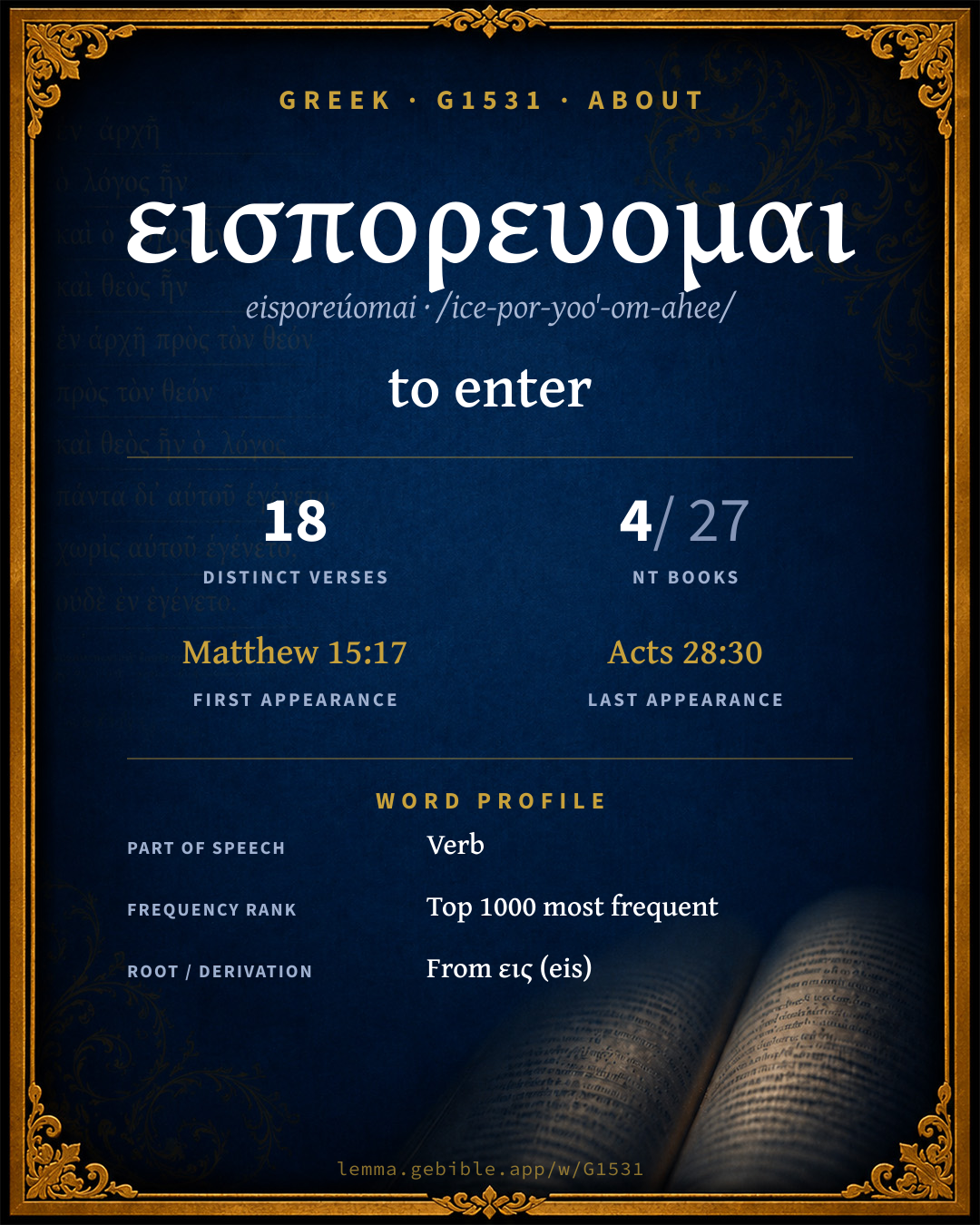
εἰσπορεύομαι
to enter
‘to enter’ is one of 3 main senses fuller range ↓
Full lexicon entry — Thayer's Greek Lexicon
From Thayer's Greek Lexicon
Where this word appears
Grammar key — what these labels mean
Part of speech
- Verb
- An action or state-of-being word.
Tense
- Present
- Ongoing or general action in present time (imperfective aspect).
- Imperfect
- Continuous or repeated action in past time (“was writing”).
Voice
- Middle or Passive deponent
- Middle/passive in form but active in meaning.
Mood
- Participle
- A verbal adjective (“writing,” “having written”).
- Indicative
- States a fact or asks a factual question (the mood of reality).
Case
- Nominative
- The case of the subject (and the predicate nominative).
- Accusative
- The case of the direct object and of extent.
- Genitive
- The case of source, possession, or “of” — answers “whose / from what.”
Person
- 3rd person
- The one spoken about (“he / she / it / they”).
Gender
- Masculine
- Grammatically masculine.
- Neuter
- Grammatically neuter.
- Feminine
- Grammatically feminine.
Number
- Plural
- More than one.
- Singular
- One.
Every verse where G1531 appears in the Book of Matthew — 1 distinct verse. Click any verse to open its interlinear word-by-word view. Verse text shown in the World English Bible for context — . Each verse’s Greek form is shown with its reference; the English is not keyword-highlighted, since the data carries no word-level English alignment. Use “Compare translations” on any verse to read it across multiple English versions. This concordance covers the Greek New Testament; Septuagint (Greek Old Testament) occurrences of this word are not indexed here.
Matthew
About this entry
At a glance — auto-summarized from this page’s data, not written by a person. Every figure links to its source below. This summary describes the numbers; it doesn’t interpret them.
At its core, εισπορευομαι (eisporeúomai) means “to enter.” Scripture first uses it in Matthew 15:17. It appears 18 verses across 4 books of the Greek New Testament, among its uncommon vocabulary. The word gravitates to Mark (44%), then Luke and Acts. Ranging over 3 senses, it is not a single-sense word. Dig into 18-verse concordance and the renderings breakdown below.
Gloss history
Strong's 1890 vs modern scholarship

About this word
Strong's G1531 catalogs a Greek word from the Greek New Testament.
These counts are not copied from any lexicon or concordance. They are computed here, from the morphology-tagged Greek New Testament. What Lemma adds →
- 18
- distinct verses
- The word appears in 18 distinct verses.
- 4 / 27
- NT books
- The word appears in 4 of 27 New Testament books.
- #664
- by frequency
- Top 1000 most frequent Greek words (rank 664 of 5,347 Greek words by occurrence).
View all 18 occurrences in the concordance →
By section of the New Testament
By traditional corpus
Conventional, traditional groupings — biblical authorship is debated, so this is a traditional corpus grouping, not an authorship claim. Some books belong to more than one corpus (Luke is in both the Gospels and the Lukan corpus, and so on), so these shares overlap and need not total 100%. Each figure is a share of the word’s 18 distinct verses.
- Gospels 14 verses · 78%
- Lukan (Luke–Acts) 9 verses · 50%
How translations render this word
Counts come from each version’s own published word-to-Strong’s tagging or interlinear alignment — an approximate guide to how each version renders this word, not a word-level alignment the data otherwise carries. Because each total is that version’s own tagged count, the per-version totals vary from one another and need not match the appearance or distinct-verse counts above. These counts may also differ from a printed concordance because Lemma counts each distinctly tagged rendering and does not collapse phrase taggings into a single head-word total. This is a fixed set of word-tagged versions (KJV, ASV, BSB, ULT) and does not change with the reading translation you choose elsewhere. Each version’s license is shown beside its name below (and on Sources).
- King James Version: Entereth 2×, Entereth in 2×, Entering 2×
- American Standard Version: Goeth 3×, Ye enter 2×
- Berean Standard Bible: Enter 3×, Enters 3×, You enter 2×
- unfoldingWord Literal Text: Entering 5×, Coming in 2×, Enter 2×
King James Version Public Domain
Renders G1531 across 17 tagged occurrences — most commonly:
Plus 11 renderings that appear only once — usually multi-word phrases or single function words the recovered tagging swept in, not distinct renderings.
American Standard Version Public Domain
Renders G1531 across 17 tagged occurrences — most commonly:
Plus 12 renderings that appear only once — usually multi-word phrases or single function words the recovered tagging swept in, not distinct renderings.
Berean Standard Bible Public Domain
Renders G1531 across 18 tagged occurrences — most commonly:
Plus 10 renderings that appear only once — usually multi-word phrases or single function words the recovered tagging swept in, not distinct renderings.
unfoldingWord Literal Text CC BY-SA 4.0
Renders G1531 across 20 tagged occurrences — most commonly:
Plus 7 renderings that appear only once — usually multi-word phrases or single function words the recovered tagging swept in, not distinct renderings.
Senses in Thayer's
The 3 senses Thayer's distinguishes for this word, in lexicon order (not ranked by frequency or importance). The full entry — with sub-senses — is in the Lexicon Entry tab.
- of persons
- of things
- metaph. of affections entering the soul
Word origin
Derived from εις (eis) (G1519) — into.
Forms in the corpus
The 9 distinct written forms G1531 takes in the Greek New Testament, most frequent first — each parse links to that tense’s occurrences in the concordance.
Same root — word family
Other Thayer's entries built from the same root as G1531, grouped by Strong’s listed origin. These share a root / origin per the lexicon — not necessarily a shared meaning. Each links to that word’s own entry.
Derives from
Shares the same root
- εισαγω eiságō G1521 to bring in
- εισακουω eisakoúō G1522 to obey
- εισδεχομαι eisdéchomai G1523 to receive
- εισειμι eíseimi G1524 to go in
- εισερχομαι eisérchomai G1525 to enter
- εισκαλεω eiskaléō G1528 to invite
- εισοδος eísodos G1529 entrance
- εισπηδαω eispēdáō G1530 to rush in
- ειστρεχω eistréchō G1532 to run in
- εισφερω eisphérō G1533 to bring in
- εν en G1722 in
- εσοπτρον ésoptron G2072 mirror
- εσω ésō G2080 within
- σκυβαλον skýbalon G4657 refuse
Compare all same-root words → Showing 4 of 16 — not the complete family. They share a root, not necessarily a meaning.
Septuagint usage
The same Greek word εισπορευομαι appears 141 times in the Greek Old Testament (Septuagint), across 132 verses in 27 books.
- 141
- LXX occurrences
- Tagged occurrences of this Greek word in the Septuagint.
- 132
- verses
- Distinct Septuagint verses containing this word.
- 27 / 39
- OT books
- The word appears in 27 of the 39 Old Testament books.
Sample Septuagint occurrences
- Genesis 6:4 εἰςπορεύομαι
- Exodus 1:1 εἰςπορεύομαι
- Leviticus 10:9 εἰςπορεύομαι
- Numbers 4:3 εἰςπορεύομαι
- Deuteronomy 1:7 εἰςπορεύομαι
- Joshua 2:2 εἰςπορεύομαι
- Judges 7:17 εἰςπορεύομαι
- Ruth 4:11 εἰςπορεύομαι
- 1 Samuel 5:5 εἰςπορεύομαι
- 2 Samuel 15:37 εἰςπορεύομαι
- 1 Kings 14:8 εἰςπορεύομαι
- 2 Kings 3:24 εἰςπορεύομαι
Septuagint occurrences (same lexeme)
Every verse where the same Strong’s number (G1531) appears in the Greek Septuagint — showing the first 50 of 132. Verse text shown in the World English Bible for context; the Greek form is the matched word — the English is not keyword-highlighted.
- Genesis 6:4 εἰςπορεύομαι The Nephilim were in the earth in those days, and also after that, when God's sons came to men's daughters. They bore children to them: the same were the mighty men who were of old, men of renown.
- Genesis 7:16 εἰςπορεύομαι Those who went in, went in male and female of all flesh, as God commanded him; and Yahweh shut him in.
- Genesis 23:10 εἰςπορεύομαι Now Ephron was sitting in the midst of the children of Heth. Ephron the Hittite answered Abraham in the hearing of the children of Heth, even of all who went in at the gate of his city, saying,
- Genesis 23:18 εἰςπορεύομαι to Abraham for a possession in the presence of the children of Heth, before all who went in at the gate of his city.
- Genesis 44:30 εἰςπορεύομαι Now therefore when I come to your servant my father, and the boy is not with us; seeing that his life is bound up in the boy's life;
- Exodus 1:1 εἰςπορεύομαι Now these are the names of the sons of Israel, who came into Egypt (every man and his household came with Jacob):
- Exodus 11:4 εἰςπορεύομαι Moses said, "This is what Yahweh says: 'About midnight I will go out into the midst of Egypt,
- Exodus 14:28 εἰςπορεύομαι The waters returned, and covered the chariots and the horsemen, even all Pharaoh's army that went in after them into the sea. There remained not so much as one of them.
- Exodus 23:27 εἰςπορεύομαι I will send my terror before you, and will confuse all the people to whom you come, and I will make all your enemies turn their backs to you.
- Exodus 28:30 εἰςπορεύομαι You shall put in the breastplate of judgment the Urim and the Thummim; and they shall be on Aaron's heart, when he goes in before Yahweh: and Aaron shall bear the judgment of the children of Israel on his heart before Yahweh continually.
- Exodus 28:43 εἰςπορεύομαι They shall be on Aaron, and on his sons, when they go in to the tent of meeting, or when they come near to the altar to minister in the holy place; that they don't bear iniquity, and die: it shall be a statute forever to him and to his descendants after him.
- Exodus 30:20 εἰςπορεύομαι When they go into the tent of meeting, they shall wash with water, that they not die; or when they come near to the altar to minister, to burn an offering made by fire to Yahweh.
- Exodus 30:21 εἰςπορεύομαι So they shall wash their hands and their feet, that they not die: and it shall be a statute forever to them, even to him and to his descendants throughout their generations."
- Exodus 33:8 εἰςπορεύομαι It happened that when Moses went out to the Tent, that all the people rose up, and stood, everyone at their tent door, and watched Moses, until he had gone into the Tent.
- Exodus 34:12 εἰςπορεύομαι Be careful, lest you make a covenant with the inhabitants of the land where you are going, lest it be for a snare in the midst of you:
- Exodus 34:34 εἰςπορεύομαι But when Moses went in before Yahweh to speak with him, he took the veil off, until he came out; and he came out, and spoke to the children of Israel that which he was commanded.
- Exodus 38:27 εἰςπορεύομαι The one hundred talents of silver were for casting the sockets of the sanctuary, and the sockets of the veil; one hundred sockets for the one hundred talents, a talent for a socket.
- Leviticus 10:9 εἰςπορεύομαι "Drink no wine nor strong drink, you, nor your sons with you, when you go into the Tent of Meeting, that you don't die: it shall be a statute forever throughout your generations:
- Leviticus 14:46 εἰςπορεύομαι "Moreover he who goes into the house while it is shut up shall be unclean until the evening.
- Leviticus 16:2 εἰςπορεύομαι and Yahweh said to Moses, "Tell Aaron your brother, not to come at all times into the Most Holy Place within the veil, before the mercy seat which is on the ark; lest he die: for I will appear in the cloud on the mercy seat.
- Leviticus 16:17 εἰςπορεύομαι There shall be no one in the Tent of Meeting when he enters to make atonement in the Holy Place, until he comes out, and has made atonement for himself and for his household, and for all the assembly of Israel.
- Leviticus 16:23 εἰςπορεύομαι "Aaron shall come into the Tent of Meeting, and shall take off the linen garments, which he put on when he went into the Holy Place, and shall leave them there.
- Numbers 4:3 εἰςπορεύομαι from thirty years old and upward even until fifty years old, all who enter into the service, to do the work in the Tent of Meeting.
- Numbers 4:23 εἰςπορεύομαι from thirty years old and upward until fifty years old shall you number them; all who enter in to wait on the service, to do the work in the Tent of Meeting.
- Numbers 4:30 εἰςπορεύομαι from thirty years old and upward even to fifty years old shall you number them, everyone who enters on the service, to do the work of the Tent of Meeting.
- Numbers 4:35 εἰςπορεύομαι from thirty years old and upward even to fifty years old, everyone who entered into the service, for work in the Tent of Meeting.
- Numbers 4:39 εἰςπορεύομαι from thirty years old and upward even to fifty years old, everyone who entered into the service, for work in the Tent of Meeting,
- Numbers 4:43 εἰςπορεύομαι from thirty years old and upward even to fifty years old, everyone who entered into the service, for work in the Tent of Meeting,
- Numbers 4:47 εἰςπορεύομαι from thirty years old and upward even to fifty years old, everyone who entered in to do the work of service, and the work of bearing burdens in the Tent of Meeting,
- Numbers 7:89 εἰςπορεύομαι When Moses went into the Tent of Meeting to speak with Yahweh, he heard his voice speaking to him from above the mercy seat that was on the ark of the Testimony, from between the two cherubim: and he spoke to him.
- Numbers 13:21 εἰςπορεύομαι So they went up, and spied out the land from the wilderness of Zin to Rehob, to the entrance of Hamath.
- Numbers 15:18 εἰςπορεύομαι Speak to the children of Israel, and tell them, When you come into the land where I bring you,
- Numbers 19:14 εἰςπορεύομαι This is the law when a man dies in a tent: everyone who comes into the tent, and everyone who is in the tent, shall be unclean seven days.
- Numbers 33:40 εἰςπορεύομαι The Canaanite, the king of Arad, who lived in the South in the land of Canaan, heard of the coming of the children of Israel.
- Numbers 34:2 εἰςπορεύομαι Command the children of Israel, and tell them, When you come into the land of Canaan (this is the land that shall fall to you for an inheritance, even the land of Canaan according to the borders of it),
- Numbers 34:8 εἰςπορεύομαι from Mount Hor you shall mark out to the entrance of Hamath; and the goings out of the border shall be at Zedad;
- Deuteronomy 1:7 εἰςπορεύομαι turn you, and take your journey, and go to the hill-country of the Amorites, and to all [the places] near thereunto, in the Arabah, in the hill-country, and in the lowland, and in the South, and by the sea-shore, the land of the Canaanites, and Lebanon, as far as the great river, the river Euphrates.
- Deuteronomy 1:8 εἰςπορεύομαι Behold, I have set the land before you: go in and possess the land which Yahweh swore to your fathers, to Abraham, to Isaac, and to Jacob, to give to them and to their seed after them.
- Deuteronomy 1:22 εἰςπορεύομαι You came near to me everyone of you, and said, Let us send men before us, that they may search the land for us, and bring us word again of the way by which we must go up, and the cities to which we shall come.
- Deuteronomy 4:5 εἰςπορεύομαι Behold, I have taught you statutes and ordinances, even as Yahweh my God commanded me, that you should do so in the midst of the land where you go in to possess it.
- Deuteronomy 4:14 εἰςπορεύομαι Yahweh commanded me at that time to teach you statutes and ordinances, that you might do them in the land where you go over to possess it.
- Deuteronomy 6:1 εἰςπορεύομαι Now this is the commandment, the statutes, and the ordinances, which Yahweh your God commanded to teach you, that you might do them in the land where you go over to possess it;
- Deuteronomy 7:1 εἰςπορεύομαι When Yahweh your God shall bring you into the land where you go to possess it, and shall cast out many nations before you, the Hittite, and the Girgashite, and the Amorite, and the Canaanite, and the Perizzite, and the Hivite, and the Jebusite, seven nations greater and mightier than you;
- Deuteronomy 9:5 εἰςπορεύομαι Not for your righteousness, or for the uprightness of your heart, do you go in to possess their land; but for the wickedness of these nations Yahweh your God does drive them out from before you, and that he may establish the word which Yahweh swore to your fathers, to Abraham, to Isaac, and to Jacob.
- Deuteronomy 10:11 εἰςπορεύομαι Yahweh said to me, Arise, take your journey before the people; and they shall go in and possess the land, which I swore to their fathers to give to them.
- Deuteronomy 11:10 εἰςπορεύομαι For the land, where you go in to possess it, isn't as the land of Egypt, from whence you came out, where you sowed your seed, and watered it with your foot, as a garden of herbs;
- Deuteronomy 11:11 εἰςπορεύομαι but the land, where you go over to possess it, is a land of hills and valleys, [and] drinks water of the rain of the sky,
- Deuteronomy 12:29 εἰςπορεύομαι When Yahweh your God shall cut off the nations from before you, where you go in to dispossess them, and you dispossess them, and dwell in their land;
- Deuteronomy 23:21 εἰςπορεύομαι When you shall vow a vow to Yahweh your God, you shall not be slack to pay it: for Yahweh your God will surely require it of you; and it would be sin in you.
- Deuteronomy 28:6 εἰςπορεύομαι Blessed shall you be when you come in, and blessed shall you be when you go out.
These are occurrences of the same Greek lexeme (G1531) in the Septuagint — not a translation of any one Hebrew word. The store carries no word-level Hebrew↔Greek alignment, so no Hebrew original is asserted here. Counts come from the recovered LXX Strong's tagging — high-frequency vocabulary is well covered, while rare or late forms may be untagged — so they reflect tagged occurrences and may slightly undercount.