
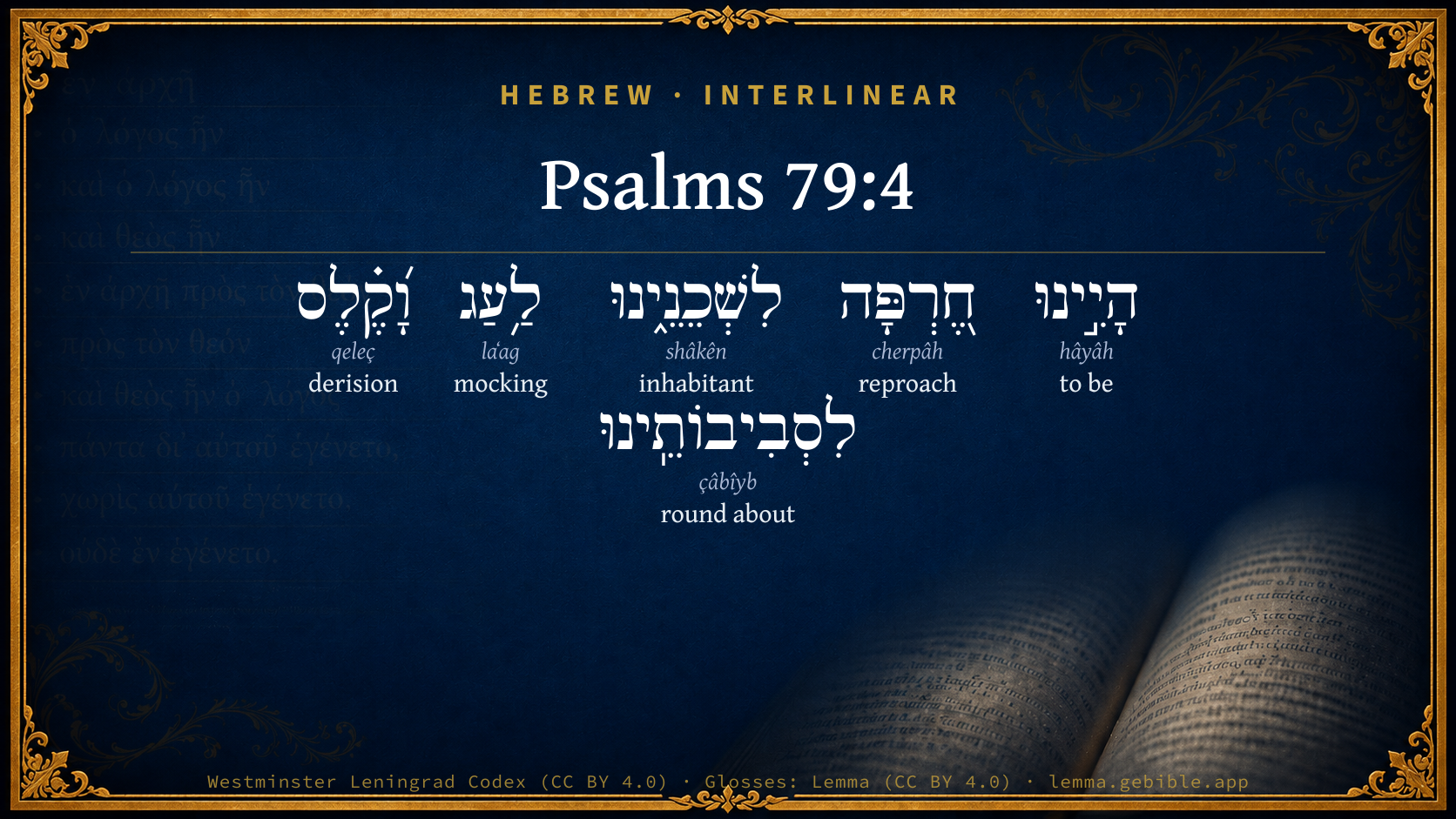
Psalms 79:4

Hebrew (Westminster Leningrad Codex) Psalms 79:4 appears in the Hebrew Old Testament. The text above is from the Westminster Leningrad Codex. Each word links to its Strong’s number, a concise gloss, and parsing drawn from the Open Scriptures Hebrew Bible morphology. Click any word for its full Brown-Driver-Briggs (BDB) entry.
Download image
Cite this verse

Psalms 79:4 (World English Bible). Public Domain. Lemma interlinear Bible study tool, https://lemma.gebible.app/v/psalms/79/4.

Show BibTeX & RIS
BibTeX
RIS
English Translation
We have become a reproach to our neighbors, A scoffing and derision to those who are around us.
World English Bible · Public Domain
Download a study sheet

One document with this verse’s original text, its word-by-word gloss line, the meaning frame, cross-references with their text, attributed commentary, and full source and license credits — printable, and it pastes into notes with its structure intact.

This verse Autodidact and up

Study sheet (.html) Plain text (.txt)

A passage Seminary Student

Up to 50 verses in one chapter. A passage sheet keeps up to 6 commentary sources and 12 cross-references per verse, in the order this page ranks them, and says so on the sheet whenever that leaves anything out. Ask for a single verse and you get the Autodidact verse sheet above.

Everything on this page stays free to read, with no account — the sheet is a download of what is already on screen, not access to it.

Want to remove ads? Support Godless Engineer
Compare translations 3

The same verse in 3 English versions, stacked beneath the original-language interlinear above. Click any original word for its lexicon entry.

Each is an independent rendering of the whole verse — the interlinear is not word-aligned to these translations.

Highlighted words mark where these versions differ — a whole-verse word diff, not a word-by-word alignment.

  • World English Bible Public Domain
    We have become a reproach to our neighbors, A scoffing and derision to those who are around us.
  • King James Version Public Domain
    We are become a reproach to our neighbours, a scorn and derision to them that are round about us.
  • unfoldingWord Literal Text CC BY-SA 4.0
    We have become a reproach to our neighbors, scorn and derision to the ones around us.

unfoldingWord Literal Text — © unfoldingWord, licensed CC BY-SA 4.0. Word-aligned USFM3 via Door43 (git.door43.org/unfoldingWord/en_ult).

Versions to compare (up to 4)

3 of 4 selected

Show all 18 translations

Every available English version of this verse, each an independent rendering of the whole verse.

  • World English Bible Public Domain
    We have become a reproach to our neighbors, A scoffing and derision to those who are around us.
  • Berean Standard Bible Public Domain
    We have become a reproach to our neighbors, a scorn and derision to those around us.
  • Majority Standard Bible Public Domain
    We have become a reproach to our neighbors, a scorn and derision to those around us.
  • King James Version Public Domain
    We are become a reproach to our neighbours, a scorn and derision to them that are round about us.
  • American Standard Version (1901) Public Domain
    We are become a reproach to our neighbors, A scoffing and derision to them that are round about us.
  • Revised Version (1885) Public Domain
    We are become a reproach to our neighbours, a scorn and derision to them that are round about us.
  • Geneva Bible (1599) Public Domain
    Wee are a reproche to our neighbours, euen a scorne and derision vnto them that are round about vs.
  • Douay-Rheims (1899) Public Domain
    We are become a reproach to our neighbours: a scorn and derision to them that are round about us.
  • Young's Literal Translation Public Domain
    We have been a reproach to our neighbours, A scorn and a derision to our surrounders.
  • Literal Standard Version CC BY-SA 4.0
    We have been a reproach to our neighbors, || A scorn and a derision to our surrounders.
  • Unlocked Literal Bible CC BY-SA 4.0
    We have become a reproach for our neighbors, mocking and derision to those who are around us.
  • unfoldingWord Literal Text CC BY-SA 4.0
    We have become a reproach to our neighbors, scorn and derision to the ones around us.
  • Darby Bible Public Domain
    We are become a reproach to our neighbours, a mockery and a derision to them that are round about us.
  • World Messianic Bible Public Domain
    We have become a reproach to our neighbors, a scoffing and derision to those who are around us.
  • Webster's Bible Public Domain
    We have become a reproach to our neighbors, a scorn and derision to them that are around us.
  • Free Bible Version CC BY-SA 4.0
    We have been made a mockery before our neighbors, ridiculed and laughed at by those around us.
  • Bible in Basic English Public Domain
    We are looked down on by our neighbours, we are laughed at and made sport of by those who are round us.
  • JPS Tanakh (1917) Public Domain
    We are become a taunt to our neighbours, a scorn and derision to them that are round about us.

Literal Standard Version (2020), Covenant Press — licensed CC BY-SA 4.0. Text via the HelloAO Bible API (eBible.org). Unlocked Literal Bible (unfoldingWord) — licensed CC BY-SA 4.0. Text via the HelloAO Bible API (eBible.org). unfoldingWord Literal Text — © unfoldingWord, licensed CC BY-SA 4.0. Word-aligned USFM3 via Door43 (git.door43.org/unfoldingWord/en_ult). Free Bible Version, Dr. Jonathan Gallagher — licensed CC BY-SA 4.0. Text via the HelloAO Bible API (eBible.org).

Word by word

More ways to search: Search by grammar → Find every occurrence → Compare this word →

Practice this passage: Drill this verse → Learn its vocabulary →

About this verse

These counts appear in no published source. They are computed here, from the morphology-tagged text and Lemma’s own curated glosses. What Lemma adds →

6
words
6
distinct lemmas
Wisdom
section

Notable vocabulary

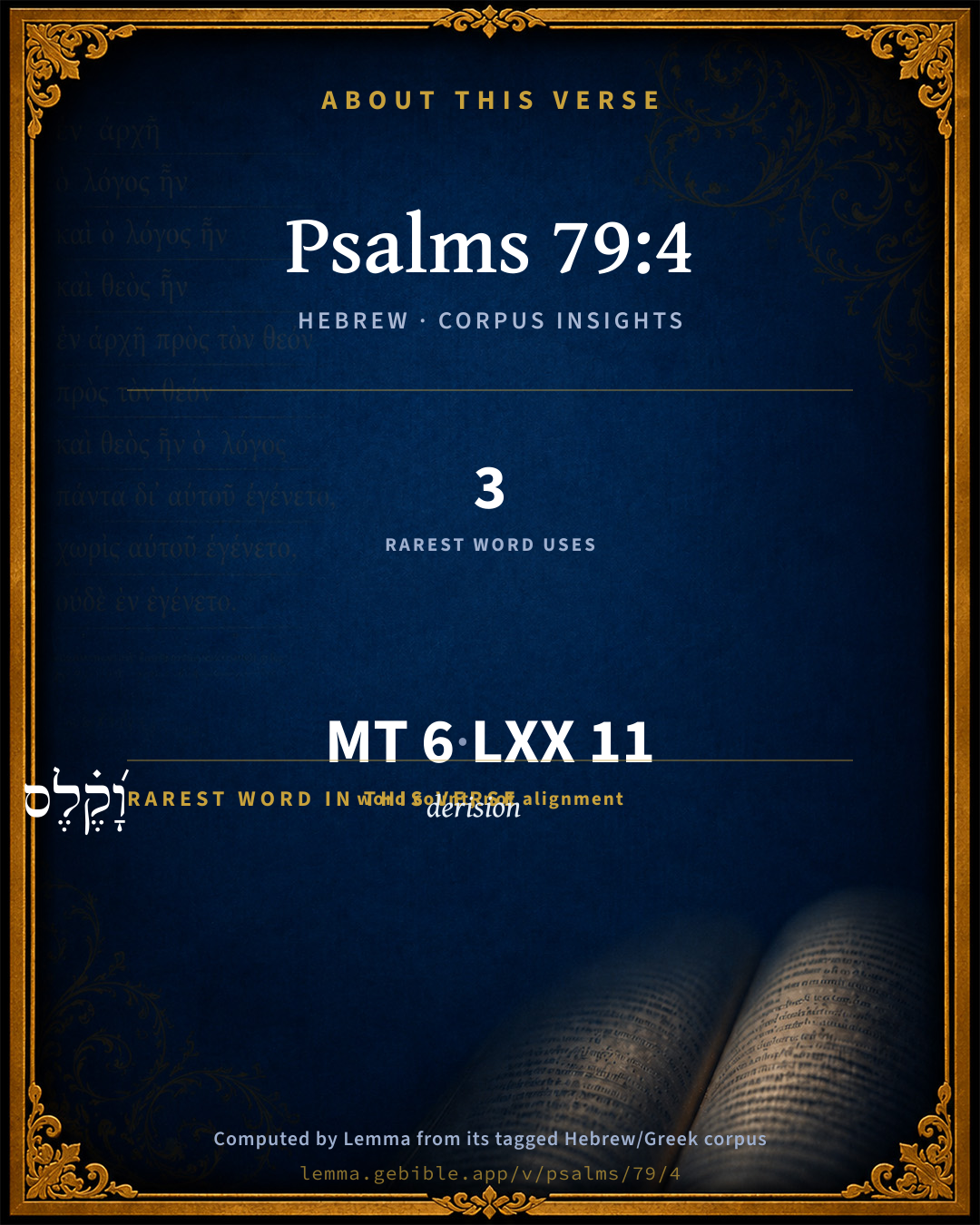
The rarest word here is וָ֝קֶ֗לֶס derision H7047 — appearing just 3 times in the whole Hebrew Bible.

Shared distinctive vocabulary

וָ֝קֶ֗לֶס derision H7047 occurs in 3 verses of the Hebrew Bible. Also found in:

Grammatical profile

  • 1 verb
  • 4 nouns
  • 1 adjective

Verb forms

  • הָיִ֣ינוּ Qal · Perfect

Hebrew & Septuagint length

In English translation the verse runs 18 words from the Hebrew and 19 from the Septuagint (LXX English) — closely comparable.

A rough comparison of the two English renderings, which tokenize alike — not a word-level alignment.

Word counts can differ between the Hebrew and the Greek without any difference in meaning — e.g. the Hebrew direct-object marker אֵת has no separate Greek word, and Greek often adds the article ὁ.

In the original languages it is 6 Hebrew tokens and 11 Greek tokens — but the two are counted differently (Hebrew bundles its prefixes and suffixes into one token; the Greek is in lemma form), so that isn’t a like-for-like length.

Cross-references

16

Topical passages linked to Psalms 79:4 in the Treasury of Scripture Knowledge — connected by theme and wording, ordered by reader-vote popularity; previews shown in the World English Bible.

  • Psalms 80:6 You make us a source of contention to our neighbors. Our enemies laugh among themselves.
  • Psalms 89:41 All who pass by the way rob him. He has become a reproach to his neighbors.
  • Lamentations 5:1 Remember, Yahweh, what has come on us: Look, and see our reproach.
  • Ezekiel 36:15 neither will I let you hear any more the shame of the nations, neither shall you bear the reproach of the peoples any more, neither shall you cause your nation to stumble any more, says the Lord Yahweh.
  • Deuteronomy 28:37 You shall become an astonishment, a proverb, and a byword, among all the peoples where Yahweh shall lead you away.
  • 1 Kings 9:7 then will I cut off Israel out of the land which I have given them; and this house, which I have made holy for my name, will I cast out of my sight; and Israel shall be a proverb and a byword among all peoples.
  • Nehemiah 2:19 But when Sanballat the Horonite, and Tobiah the servant, the Ammonite, and Geshem the Arabian, heard it, they ridiculed us, and despised us, and said, What is this thing that you do? will you rebel against the king?
  • Nehemiah 4:1–4 But it happened that when Sanballat heard that we were building the wall, he was angry, and took great indignation, and mocked the Jews.
  • Psalms 44:13–14 You make us a reproach to our neighbors, A scoffing and a derision to those who are around us.
  • Jeremiah 24:9 I will even give them up to be tossed back and forth among all the kingdoms of the earth for evil; to be a reproach and a proverb, a taunt and a curse, in all places where I shall drive them.
  • Jeremiah 25:18 [to wit], Jerusalem, and the cities of Judah, and the kings of it, and the princes of it, to make them a desolation, an astonishment, a hissing, and a curse, as it is this day;
  • Jeremiah 42:18 For thus says Yahweh of Hosts, the God of Israel: As my anger and my wrath has been poured forth on the inhabitants of Jerusalem, so shall my wrath be poured forth on you, when you shall enter into Egypt; and you shall be an object of horror, and an astonishment, and a curse, and a reproach; and you shall see this place no more.
  • Lamentations 2:15–16 All that pass by clap their hands at you; They hiss and wag their head at the daughter of Jerusalem, [saying], Is this the city that men called The perfection of beauty, The joy of the whole earth?
  • Ezekiel 35:12 You shall know that I, Yahweh, have heard all your insults which you have spoken against the mountains of Israel, saying, They are laid desolate, they are given us to devour.
  • Ezekiel 36:3 therefore prophesy, and say, Thus says the Lord Yahweh: Because, even because they have made you desolate, and swallowed you up on every side, that you might be a possession to the residue of the nations, and you are taken up in the lips of talkers, and the evil report of the people;
  • Daniel 9:16 Lord, according to all your righteousness, let your anger and please let your wrath be turned away from your city Jerusalem, your holy mountain; because for our sins, and for the iniquities of our fathers, Jerusalem and your people are become a reproach to all who are round about us.

Cross-references courtesy of OpenBible.info (CC BY 4.0).

Hebrew and Greek witnesses Masoretic Hebrew ↔ Greek Septuagint

The same verse in the two great witnesses to the Old Testament, shown verse-for-verse.

You’re reading Greek Psalm 78 (Hebrew Psalm 79). The Septuagint counts the superscription, so verse numbers can differ from the Hebrew — chapter-level alignment, not verse-by-verse. Numbering follows Rahlfs.

These are two independent witnesses, not word-aligned to each other, and the Septuagint is shown in lemma (dictionary) form.

Hebrew Psalms 79:4 Masoretic · Westminster Leningrad Codex

הָיִ֣ינוּ חֶ֭רְפָּה לִשְׁכֵנֵ֑ינוּ לַ֥עַג וָ֝קֶ֗לֶס לִסְבִיבוֹתֵֽינוּ

We have become a reproach to our neighbors, A scoffing and derision to those who are around us.

World English Bible · Public Domain

Greek LXX Greek Psalm 78:4 Septuagint · lemma form

γίγνομαι ὄνειδος ὁ γείτων ἐγώ μυκτηρισμός καί χλευασμός ὁ κύκλος ἐγώ

We are become a reproach to our neighbors, a scorn and derision to them that are round about us.

LXX2012 (modern English Septuagint) · Public Domain

Hebrew: Westminster Leningrad Codex (CC BY 4.0). Greek: Septuagint (public domain); English from LXX2012 (modern English Septuagint) (Public Domain). How the Septuagint differs from the Hebrew →

Commentary

Notes on Psalms 79:4 from classic Christian and Jewish commentators (each source and its license shown beneath its notes). The classic Christian expositions comment on the surrounding passage and are grouped to its opening verse, so a note may address several verses; the Jewish commentaries on the Tanakh (Rashi and others) are per-verse, so they appear only where the commentator wrote on this verse.

Lemma curates 59 commentaries, every one of them public domain or Creative Commons licensed, each selected and text-cleaned for this edition rather than reprinted as found. About our sources →

Trapp's Complete Commentary

John Trapp

Psa 79:4 We are become a reproach to our neighbours, a scorn and derision to them that are round about us.

Ver. 4. We are become a reproach to our neighbours] To the Edomites, Philistines, Syrians, Tyrians, &c., who do now compose comedies out of our tragedies.

A scorn and derision to them that are round about us] Quorum opprobriis, ludibriis, et contumeliis sumus expositi. This was more grievous to them than stripes or wounds, saith Chrysostom; because these being inflicted upon the body, are divided after a sort between soul and body; but scorns and reproaches do wound the soul only. Habet quendam aculeum contumelia, they leave a sting behind them, as Cicero observeth, Actio in Ver.

John Trapp, A Commentary or Exposition upon All the Books of the Old and New Testament (1647–1656) — public domain. Text from a community e-Sword module.

Joseph Benson's Commentary

Psa 79:4. We are become a reproach, &c. — We, who were the terror of our neighbours, and whom they stood in awe of, and were afraid to offend, are now neither feared nor pitied, but are become the objects of their scoffs and reproaches. For they study to abuse us and load us with contempt, upbraiding us with our sins and sufferings, and giving the lie to our relation to God, and expectations from him. If God’s professing people degenerate from what themselves and their fathers were, they must expect to be told of it; and it is well if a just reproach will help to bring them to a true repentance. But it has been the lot of the gospel Israel to be unjustly made a reproach and derision. The apostles and evangelists themselves, who were the wisest and best men that ever lived, and the greatest friends and benefactors of the human race, were counted as the filth of the world, and the offscouring of all things.

Joseph Benson's Commentary on the Old and New Testaments (1811–1818) — public domain. Text from a community e-Sword module.

J. A. Alexander on Psalms

Joseph Addison Alexander

4. (Psa 79:4) We have been (or become) a contempt to our neighbours, a scorn and derision to those round about us. See above, on Psa 44:13, where the very same expressions are employed.

Joseph Addison Alexander, The Psalms Translated and Explained (1850) — public domain. Text from a community e-Sword module.

Geneva Bible (1599)

Geneva Bible translators

Whereof some came of Abraham but were degenerate: and others were open enemies to thy religion, but they both laughed at our miseries.

Geneva Bible (1599) marginal notes — public domain. Text via Bolls.life.

Adam Clarke's Commentary

Verse 4. We are become a reproach to our neighbours] The Idumeans, Philistines, Phoenicians, Ammonites, and Moabites, all gloried in the subjugation of this people; and their insults to them were mixed with blasphemies against God.

Adam Clarke's Commentary on the Bible (1810–1826) — public domain. Text from a community e-Sword/MySword module.

John Calvin's Commentaries

4 We have been a reproach to our neighbors. Here another complaint is uttered, to excite the mercy of God. The more proudly the ungodly mock and triumph over us, the more confidently may we expect that our deliverance is near; for God will not bear with their insolence when it breaks forth so audaciously; especially when it redounds to the reproach of his holy name: even as it is said in Isaiah,

“This is the word which the Lord hath spoken concerning him, The virgin, the daughter of Zion hath despised thee, and laughed thee to scorn; the daughter of Jerusalem hath shaken her head at thee. Whom hast thou reproached and blasphemed; and against whom hast thou exalted thy voice, and lifted up thine eyes on high? even against the Holy One of Israel.” (Isaiah 37:22, 23)

And assuredly their neighbors, who were partly apostates, or the degenerate children of Abraham, and partly the avowed enemies of religion, when they molested and reproached this miserable people, did not refrain from blaspheming God. Let us, therefore, remember that the faithful do not here complain of the derision with which they were treated as individuals, but of that which they saw to be indirectly levelled against God and his law. We shall again meet with a similar complaint in the concluding part of the psalm.

John Calvin's Commentaries (1540-1563) — public domain. Text from the Calvin Translation Society English edition (1840s-50s) via the Christian Classics Ethereal Library (ccel.org). Calvin's coverage is partial (roughly two-thirds of the Bible); uncommented books and verses are honest gaps, never fabricated. The 19th-century editor's footnotes and remarks are omitted so the notes are faithfully Calvin's own voice.

Ellicott's Commentary for English Readers

(4) This verse occurs Psa_44:13. Also possibly a Maccabæan psalm. (See Introduction to that psalm.)

The scenes still witnessed by travellers at the Jews’ wailing-place offer a striking illustration of the foregoing verses, showing, as they do, how deep-seated is the love of an ancient place in the Oriental mind. (See a striking description in Porter’s Giant Cities of Bashan.)

A Bible Commentary for English Readers, edited by Charles John Ellicott (1878–1897) — public domain. Text from a community e-Sword module.

The Cambridge Bible for Schools and Colleges

gen. ed. J. J. S. Perowne

4. A repetition of Psa_44:13, with the change of ‘thou makest us’ to ‘we are become.’ Cp. Psa_80:6; Eze_22:4; Eze_25:6 ff. Dan_9:16 combines this verse with Psa_79:8 a.

The Cambridge Bible for Schools and Colleges (gen. ed. J. J. S. Perowne; Cambridge University Press, 1878–1918) — public domain. Text from a community e-Sword module.

John Gill's Exposition

We are become a reproach to our neighbours,.... That is, those that remained; so the Jews were to the Edomites, especially at the time of the Babylonish captivity, Psa 137:7,

a scorn and derision to them that are round about us; as the Christians in all ages have been to the men of the world, and especially will be insulted and triumphed over when the witnesses are slain, Rev 11:10.

John Gill's Exposition of the Whole Bible (1746–1763) — public domain (CC PDM 1.0). Text via the HelloAO Bible API.

Albert Barnes' Notes on the Bible

We are become a reproach to our neighbours - See the language in this verse explained in the notes at Psa 44:13. The words in the Hebrew are the same, and the one seems to have been copied from the other.

Albert Barnes' Notes on the Bible (1834–1885) — public domain. Text from a community e-Sword/MySword module.

Matthew Poole's English Annotations

We, who were their terror and scourge, are now neither feared nor pitied, but become the matter of their scoffs and reproaches. See Psa 80:6; 137:7; Eze 35:2,12, &c.

Matthew Poole's English Annotations on the Holy Bible (1683–1685) — public domain. Text from a community e-Sword/MySword module.

The Treasury of David

Charles H. Spurgeon

Ver. 4. "We are become a reproach to our neighbours." Those who have escaped the common foe make a mockery of us, they fling our disasters into our face, and ask us, "Where is your God?" Pity should be shown to the afflicted, but in too many cases it is not so, for a hard logic argues that those who suffer more than ordinary calamities must have been extraordinary sinners. Neighbours especially are often the reverse of neighbourly; the nearer they dwell the less they sympathize. It is most pitiable it should be so.

"A scorn and a derision to them that are round about us." To find mirth in others' miseries, and to exult over the ills of others, is worthy only of the devil and of those whose father he is. Thus the case is stated before the Lord, and it is a very deplorable one. Asaph was an excellent advocate, for he gave a telling description of calamities which were under his own eyes, and in which he sympathized, but we have a mightier Intercessor above, who never ceases to urge our suit before the eternal throne.

Whole Psalm. See Psalms on "Ps 79:1" for further information.

Ver. 4. "We are become a reproach." If God's professing people degenerate from what themselves and their fathers were, they must expect to be told of it; and it is well if a just reproach will help to bring us to a true repentance. But it has been the lot of the gospel Israel to be made unjustly a reproach and derision; the apostles themselves were "counted as the off scouring of all things." Matthew Henry.

Ver. 4. "A scorn and derision to them that are round about us." This was more grievous to them than stripes or wounds, saith Chrysostom, because these being inflicted upon the body are divided after a sort betwixt soul and body, but scorns and reproaches do wound the soul only. Habet quendam aculeum contumelia, they leave a sting behind them, as Cicero observeth. John Trapp.

Ver. 4. It is the height of reproach a father casts upon his child when he commands his slave to beat him. Of all outward judgments this is the sorest, to have strangers rule over us, as being made up of shame and cruelty. If once the heathen come into God's inheritance, no wonder the church complains that she is "become a reproach to her neighbours, a shame and derision to all round about her." Abraham Wright.

Ver. 4. Saints the subject of derision to sinners. When justly so. When unjustly. What do they see to excite ridicule; what shall we do under the trial; how will it end?

Psalms 79:5*

Charles H. Spurgeon's The Treasury of David (1869–1885) — public domain. Psalms only. Text from a community e-Sword/MySword module.

Whedon's Commentary on the Bible

Daniel D. Whedon

4. We are become a reproach… scorn… derision—This is not the least ingredient in the punishment of sin, (see Psa_44:12-16,) and is here urged to induce God to interfere in mercy, as the reproach was also on his name.

Daniel D. Whedon (gen. ed.), Commentary on the Old and New Testaments (1874–1909) — public domain. Text from a community e-Sword module.

The Pulpit Commentary

We are become a reproach to our neighbours. (comp. Psa_44:13 Lam_2:15 Lam_5:1) The "neighbours" intended are the nations in the vicinity of the Holy Land the Syrians, Moabites, Ammonites, Edomites, etc. Their attitude towards Israel under the circumstances may be gathered from what is related of the Edomites in Psa_137:7. A scorn and derision to them that are round about us. It was not so much the "reproaches" of their enemies that vexed and grieved Israel, as the jeers and scoffs which they heard on every side. (comp. Lam_1:7, 20 2:15 3:62, 63)

The Pulpit Commentary (1880–1919), ed. H.D.M. Spence-Jones & Joseph S. Exell — public domain. Text from a community e-Sword module.

unfoldingWord translationNotes

Door43 World Missions Community

We have become a reproach for our neighbors, mocking and derision to those who are around us

The words "reproach," "mocking," and "derision" are metonyms for those whom others reproach, mock, and deride. AT: "We have become people whom our neighbors reproach; those around us mock and deride us" (See: Metonymy)

We have become

The pronoun "We" refers to God's people.

derision

strong laughter to shame a person

How long will your jealous anger burn like fire?

This can be translated as a statement. AT: "It seems as though your jealous anger will never stop burning like fire." (See: Rhetorical Question)

will your jealous anger burn

The abstract noun "anger" can be stated as "angry." AT: "will you be jealous and angry" (See: Abstract Nouns)

burn like fire

This simile compares the expression of God's anger to a fire that destroys things. AT: "destroy us" (See: Simile and Assumed Knowledge and Implicit Information)

translationWords

reproach

neighbor

mock

Yahweh

anger

eternity

jealous

fire

unfoldingWord translationNotes — © Distant Shores Media and the Door43 World Missions Community, licensed CC BY-SA 4.0. Source: git.door43.org/Door43/en_tn.

Rashi

Rabbi Shlomo Yitzchaki (Rashi)

and derision Heb. וקלס, an expression of speech, to speak of them as for a byword.

Rashi on the Tanakh — English translations: “The Judaica Press complete Tanach with Rashi, translated by A. J. Rosenberg” (CC BY 4.0); “Pentateuch with Rashi's commentary by M. Rosenbaum and A.M. Silbermann, 1929-1934” (public domain); “The Metsudah Tanach series, Lakewood, N.J” (CC BY 4.0); and “The Book of Joshua, Metsudah Publications, 1997” (CC BY 4.0). Text via Sefaria.

Lesson kit

Teaching starters — assembled from the data on this page, not authored interpretation. Every prompt links to the verse data it draws on. Edit before teaching.

Psalms, in the Wisdom, opens this verse with 6 words (6 distinct Hebrew lemmas). Its most distinctive word is qeleç (“derision”). A historical commentator’s framing appears above. Read the whole chapter for the surrounding context.

Discussion questions

  1. What does “derision” (qeleç) contribute to the verse as a whole?
  2. Psalms 44:13 shares the word «derision» with this verse. How do the two illuminate each other?
  3. The translations on this page render this verse differently — a whole-verse word diff, not a word-by-word alignment. What might account for the different wordings?
  4. The verb «הָיִ֣ינוּ» is Qal Perfect. How does its form color the action?
  5. Reading how Trapp's Complete Commentary and Joseph Benson's Commentary read this verse, where do the two commentators agree and where do they part?

Things to notice

Reading settings

Reading text

Shown beneath each verse's original-language words.

Old Testament
Old Testament edition

Read the OT as the Masoretic Hebrew (MT) or the Greek Septuagint (LXX).

English shown for the Greek Septuagint (in the Hebrew ↔ Greek comparison).

Comparing translations? Open the Compare panel on any verse page to stack up to four side by side.