Deuteronomy 28:37

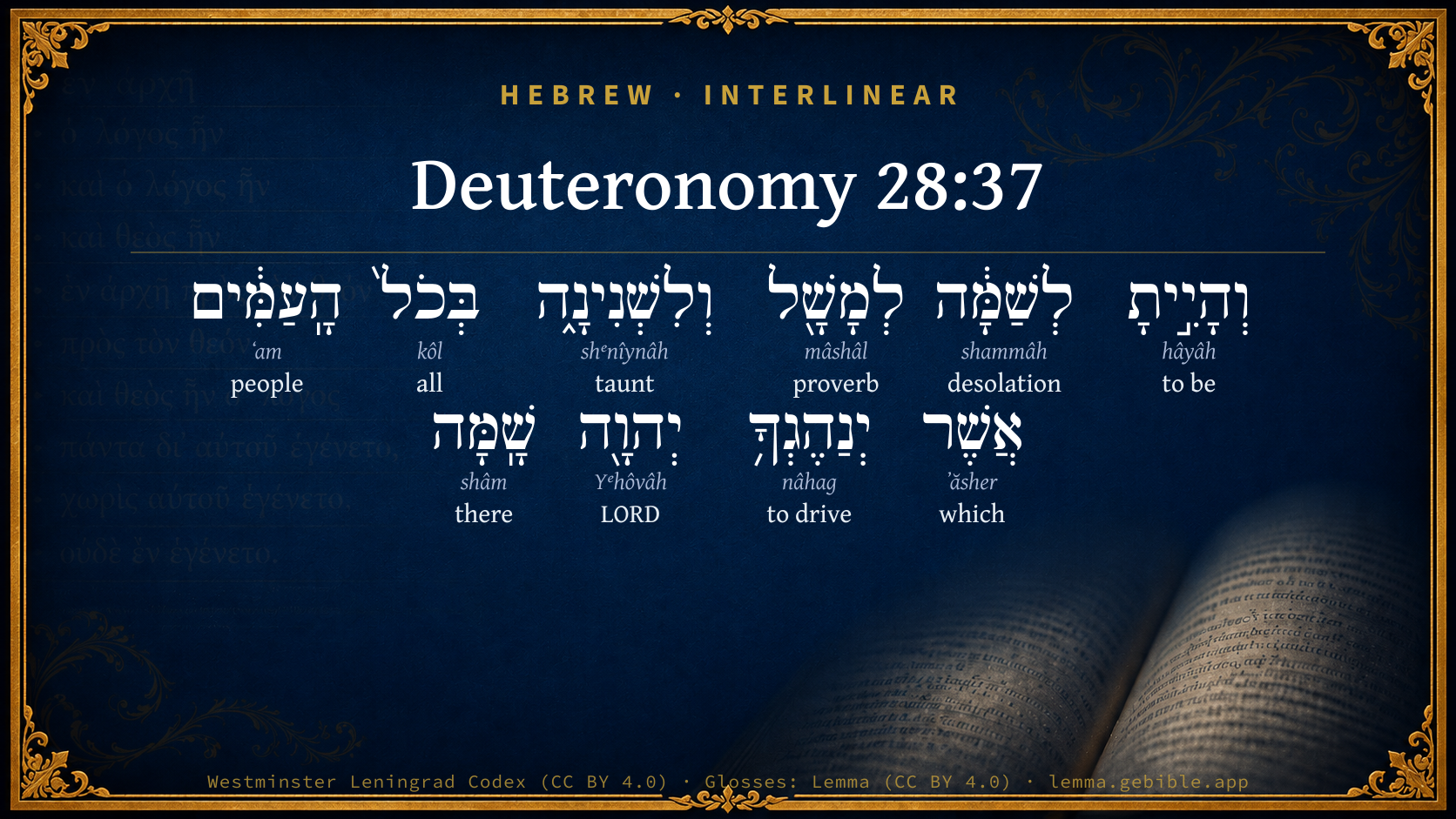
Hebrew (Westminster Leningrad Codex) Deuteronomy 28:37 appears in the Hebrew Old Testament. The text above is from the Westminster Leningrad Codex. Each word links to its Strong’s number, a concise gloss, and parsing drawn from the Open Scriptures Hebrew Bible morphology. Click any word for its full Brown-Driver-Briggs (BDB) entry.
Download image
Cite this verse

Deuteronomy 28:37 (World English Bible). Public Domain. Lemma interlinear Bible study tool, https://lemma.gebible.app/v/deuteronomy/28/37.

Show BibTeX & RIS
BibTeX
RIS
English Translation
You shall become an astonishment, a proverb, and a byword, among all the peoples where Yahweh shall lead you away.
World English Bible · Public Domain
Highlights Full analysis ↓
Download a study sheet

One document with this verse’s original text, its word-by-word gloss line, the meaning frame, cross-references with their text, attributed commentary, and full source and license credits — printable, and it pastes into notes with its structure intact.

This verse Autodidact and up

Study sheet (.html) Plain text (.txt)

A passage Seminary Student

Up to 50 verses in one chapter. A passage sheet keeps up to 6 commentary sources and 12 cross-references per verse, in the order this page ranks them, and says so on the sheet whenever that leaves anything out. Ask for a single verse and you get the Autodidact verse sheet above.

Everything on this page stays free to read, with no account — the sheet is a download of what is already on screen, not access to it.

Want to remove ads? Support Godless Engineer
Compare translations 3

The same verse in 3 English versions, stacked beneath the original-language interlinear above. Click any original word for its lexicon entry.

Each is an independent rendering of the whole verse — the interlinear is not word-aligned to these translations.

Highlighted words mark where these versions differ — a whole-verse word diff, not a word-by-word alignment.

  • World English Bible Public Domain
    You shall become an astonishment, a proverb, and a byword, among all the peoples where Yahweh shall lead you away.
  • King James Version Public Domain
    And thou shalt become an astonishment, a proverb, and a byword, among all nations whither the LORD shall lead thee.
  • unfoldingWord Literal Text CC BY-SA 4.0
    And you will become a horror, a proverb, and a taunt among all the peoples where Yahweh will drive you there.

unfoldingWord Literal Text — © unfoldingWord, licensed CC BY-SA 4.0. Word-aligned USFM3 via Door43 (git.door43.org/unfoldingWord/en_ult).

Versions to compare (up to 4)

3 of 4 selected

Show all 18 translations

Every available English version of this verse, each an independent rendering of the whole verse.

  • World English Bible Public Domain
    You shall become an astonishment, a proverb, and a byword, among all the peoples where Yahweh shall lead you away.
  • Berean Standard Bible Public Domain
    You will become an object of horror, scorn, and ridicule among all the nations to which the LORD will drive you.
  • Majority Standard Bible Public Domain
    You will become an object of horror, scorn, and ridicule among all the nations to which the LORD will drive you.
  • King James Version Public Domain
    And thou shalt become an astonishment, a proverb, and a byword, among all nations whither the LORD shall lead thee.
  • American Standard Version (1901) Public Domain
    And thou shalt become an astonishment, a proverb, and a byword, among all the peoples whither Jehovah shall lead thee away.
  • Revised Version (1885) Public Domain
    And thou shalt become an astonishment, a proverb, and a byword, among all the peoples whither the LORD shall lead thee away.
  • Geneva Bible (1599) Public Domain
    And thou shalt be a wonder, a prouerbe and a common talke among all people, whither the Lord shall carie thee.
  • Douay-Rheims (1899) Public Domain
    And thou shalt be lost, as a proverb and a byword to all people, among whom the Lord shall bring thee in.
  • Young's Literal Translation Public Domain
    and thou hast been for an astonishment, for a simile, and for a byword among all the peoples whither Jehovah doth lead thee.
  • Literal Standard Version CC BY-SA 4.0
    and you have been for an astonishment, for an allegory, and for a byword among all the peoples to where YHWH leads you.
  • Unlocked Literal Bible CC BY-SA 4.0
    You will become a source of horror, a proverb, and a byword, among all the peoples where Yahweh will lead you away.
  • unfoldingWord Literal Text CC BY-SA 4.0
    And you will become a horror, a proverb, and a taunt among all the peoples where Yahweh will drive you there.
  • Darby Bible Public Domain
    And thou shalt become an astonishment, a proverb, and a byword, among all the peoples whither Jehovah shall lead thee.
  • World Messianic Bible Public Domain
    You will become an astonishment, a proverb, and a byword among all the peoples where the LORD will lead you away.
  • Webster's Bible Public Domain
    And thou shalt become an astonishment, a proverb, and a by-word, among all nations whither the LORD shall lead thee.
  • Free Bible Version CC BY-SA 4.0
    You will be something that horrifies all the nations where you've been exiled by the Lord. They will laugh at you and ridicule you.
  • Bible in Basic English Public Domain
    And you will become a wonder and a name of shame among all the nations where the Lord will take you.
  • JPS Tanakh (1917) Public Domain
    And thou shalt become an astonishment, a proverb, and a byword, among all the peoples whither the LORD shall lead thee away.

Literal Standard Version (2020), Covenant Press — licensed CC BY-SA 4.0. Text via the HelloAO Bible API (eBible.org). Unlocked Literal Bible (unfoldingWord) — licensed CC BY-SA 4.0. Text via the HelloAO Bible API (eBible.org). unfoldingWord Literal Text — © unfoldingWord, licensed CC BY-SA 4.0. Word-aligned USFM3 via Door43 (git.door43.org/unfoldingWord/en_ult). Free Bible Version, Dr. Jonathan Gallagher — licensed CC BY-SA 4.0. Text via the HelloAO Bible API (eBible.org).

Word by word

More ways to search: Search by grammar → Find every occurrence → Compare this word →

Practice this passage: Drill this verse → Learn its vocabulary →

וְלִשְׁנִינָ֑ה
shᵉnîynâh
H8148
“and · to/for · taunt”
Conjunction + Preposition + Noun, Common, Feminine, Singular, Absolute
Part of Speech
Conjunction + Preposition + Noun
Type
Common
Gender
Feminine
Number
Singular
State
Absolute
Full BDB Definition

Origin: from H8150

TWOT: 2422b

sharp word, sharp (cutting) word, taunt, gibe
  1. וְהָיִ֣יתָ hâyâh H1961 “and · to be” Conjunction + Verb, Qal, Sequential Perfect, 2nd Person, Masculine, Singular
  2. לְשַׁמָּ֔ה shammâh H8047 “to/for · desolation” Preposition + Noun, Common, Feminine, Singular, Absolute
  3. לְמָשָׁ֖ל mâshâl H4912 “to/for · proverb” Preposition + Noun, Common, Masculine, Singular, Absolute
  4. בְּכֹל֙ kôl H3605 “in/at · all of” Preposition + Noun, Common, Masculine, Singular, Construct
  5. הָֽעַמִּ֔ים ʻam H5971 “the · peoples” Particle, Definite Article + Noun, Common, Masculine, Plural, Absolute
  6. אֲשֶׁר ʼăsher H834 “which” Particle, Relative
  7. יְנַהֶגְךָ֥ nâhag H5090 “to drive · you” Verb, Piel, Imperfect, 3rd Person, Masculine, Singular + Suffix, Personal, 2nd Person, Masculine, Singular
  8. יְהוָ֖ה Yᵉhôvâh H3068 “LORD” Noun, Proper
  9. שָֽׁמָּה shâm H8033 “there · toward” Adverb + Suffix, Demonstrative

About this verse

These counts appear in no published source. They are computed here, from the morphology-tagged text and Lemma’s own curated glosses. What Lemma adds →

10
words
10
distinct lemmas
Pentateuch
section

Notable vocabulary

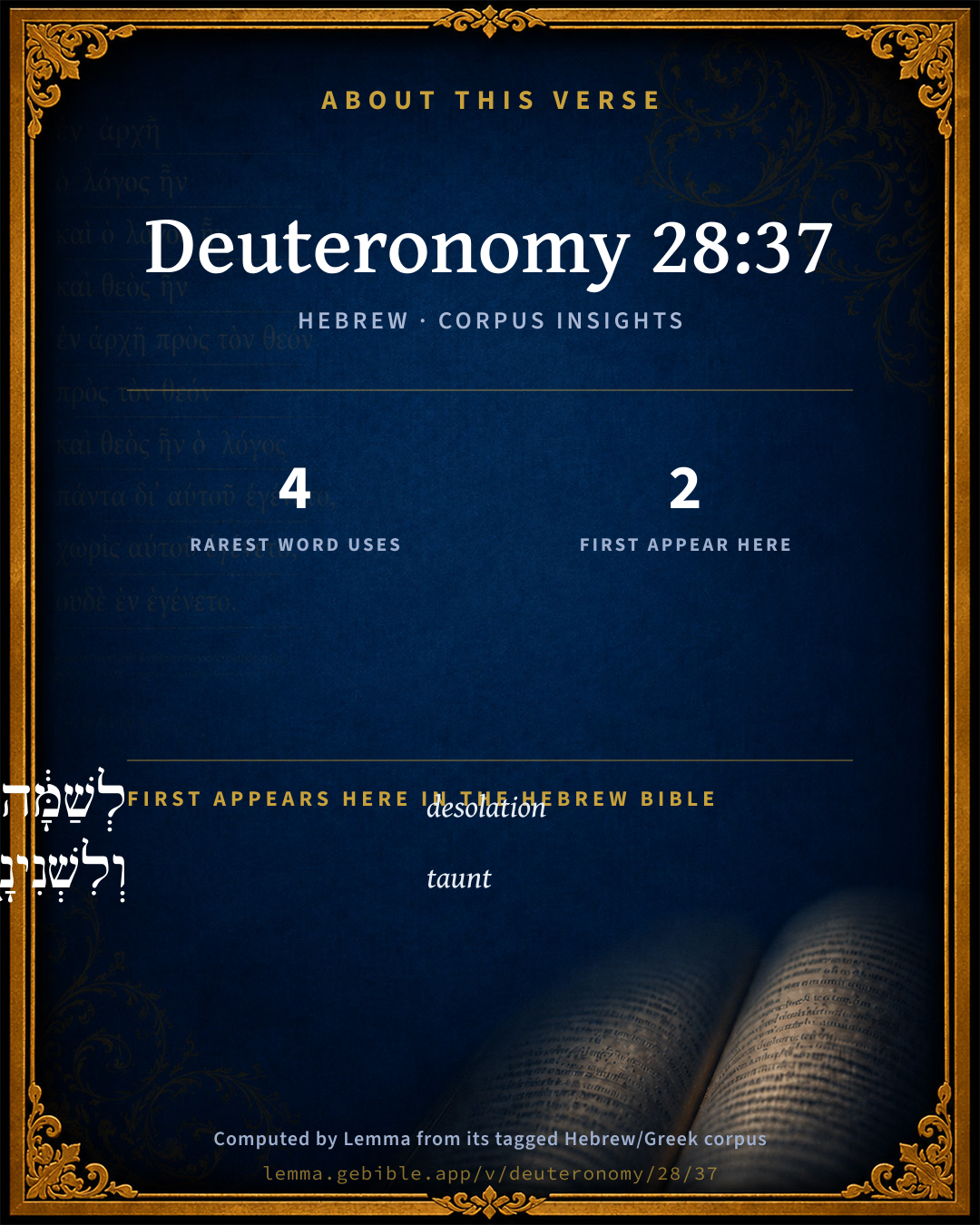
The rarest word here is וְלִשְׁנִינָ֑ה taunt H8148 — appearing just 4 times in the whole Hebrew Bible.

First appearance in Scripture

These words make their first canonical appearance in the Hebrew Bible here:

  • לְשַׁמָּ֔ה desolation H8047
  • וְלִשְׁנִינָ֑ה taunt H8148

Shared distinctive vocabulary

וְלִשְׁנִינָ֑ה taunt H8148 occurs in 4 verses of the Hebrew Bible. Also found in:

Grammatical profile

  • 2 verbs
  • 6 nouns
  • 1 adverb
  • 1 particle

Verb forms

  • וְהָיִ֣יתָ Qal · Sequential Perfect
  • יְנַהֶגְךָ֥ Piel · Imperfect

Hebrew & Septuagint length

In English translation the verse runs 20 words from the Hebrew and 28 from the Septuagint (LXX English) — the Septuagint runs noticeably longer here. See the side-by-side →

A rough comparison of the two English renderings, which tokenize alike — not a word-level alignment.

Word counts can differ between the Hebrew and the Greek without any difference in meaning — e.g. the Hebrew direct-object marker אֵת has no separate Greek word, and Greek often adds the article ὁ.

Cross-references

9

Topical passages linked to Deuteronomy 28:37 in the Treasury of Scripture Knowledge — connected by theme and wording, ordered by reader-vote popularity; previews shown in the World English Bible.

  • 1 Kings 9:7–8 then will I cut off Israel out of the land which I have given them; and this house, which I have made holy for my name, will I cast out of my sight; and Israel shall be a proverb and a byword among all peoples.
  • Jeremiah 24:9 I will even give them up to be tossed back and forth among all the kingdoms of the earth for evil; to be a reproach and a proverb, a taunt and a curse, in all places where I shall drive them.
  • Jeremiah 25:9 behold, I will send and take all the families of the north, says Yahweh, and [I will send] to Nebuchadrezzar the king of Babylon, my servant, and will bring them against this land, and against the inhabitants of it, and against all these nations round about; and I will utterly destroy them, and make them an astonishment, and a hissing, and perpetual desolations.
  • 2 Chronicles 7:20 then will I pluck them up by the roots out of my land which I have given them; and this house, which I have made holy for my name, will I cast out of my sight, and I will make it a proverb and a byword among all peoples.
  • Psalms 44:13–14 You make us a reproach to our neighbors, A scoffing and a derision to those who are around us.
  • Zechariah 8:13 It shall come to pass that, as you were a curse among the nations, house of Judah and house of Israel, so will I save you, and you shall be a blessing. Don't be afraid. Let your hands be strong."
  • Deuteronomy 28:28 Yahweh will strike you with madness, and with blindness, and with astonishment of heart;
  • Deuteronomy 29:22–28 The generation to come, your children who shall rise up after you, and the foreigner who shall come from a far land, shall say, when they see the plagues of that land, and the sicknesses with which Yahweh has made it sick;
  • Joel 2:17 Let the priests, the ministers of Yahweh, weep between the porch and the altar, And let them say, "Spare your people, Yahweh, And don't give your heritage to reproach, That the nations should rule over them. Why should they say among the peoples, 'Where is their God?'"

Cross-references courtesy of OpenBible.info (CC BY 4.0).

Hebrew and Greek witnesses Masoretic Hebrew ↔ Greek Septuagint

The same verse in the two great witnesses to the Old Testament, shown verse-for-verse.

Here the Septuagint runs noticeably longer than the Hebrew — LXX2012 (modern English Septuagint) 28 words vs World English Bible 20. A rough length comparison of the two English translations, not a word-level alignment — read both below.

These are two independent witnesses, not word-aligned to each other, and the Septuagint is shown in lemma (dictionary) form.

Hebrew Deuteronomy 28:37 Masoretic · Westminster Leningrad Codex

וְהָיִ֣יתָ לְשַׁמָּ֔ה לְמָשָׁ֖ל וְלִשְׁנִינָ֑ה בְּכֹל֙ הָֽעַמִּ֔ים אֲשֶׁר יְנַהֶגְךָ֥ יְהוָ֖ה שָֽׁמָּה

You shall become an astonishment, a proverb, and a byword, among all the peoples where Yahweh shall lead you away.

World English Bible · Public Domain

Greek LXX Deuteronomy 28:37 Septuagint · lemma form

καί εἰμί ἐκεῖ ἐν αἴνιγμα καί παραβολή καί διήγημα ἐν πᾶς ὁ ἔθνος εἰς ὅς ἄν ἀποἄγω σύ κύριος ἐκεῖ

And you shall be there for a wonder, and a parable, and a tale, among all the nations, to which the Lord your God shall carry you away.

LXX2012 (modern English Septuagint) · Public Domain

On this verse, Haydock's Catholic Bible Commentary discusses the Septuagint’s reading. Read the note in Commentary ↓

Hebrew: Westminster Leningrad Codex (CC BY 4.0). Greek: Septuagint (public domain); English from LXX2012 (modern English Septuagint) (Public Domain). How the Septuagint differs from the Hebrew →

Targum (Aramaic paraphrase)

2

The Targum is the ancient Jewish Aramaic paraphrase of the Hebrew Scriptures — an interpretive translation, not the Hebrew text itself. Onkelos (literal) and Pseudo-Jonathan (expansive) render the Torah, and Jonathan the Prophets. Coverage is partial: where no permissively-licensed English translation exists for a verse, only the Aramaic is shown. This is verse-level text, not a word-by-word alignment to the Hebrew.

  1. Targum Onkelos Torah (Genesis–Deuteronomy)
    וּתְהֵי לְצָדוּ לִמְתַל וּלְשׁוֹעֵי בְכֹל עַמְמַיָא דִי יִדְבְּרִנָךְ יְיָ לְתַמָן

    (no public-domain English translation for this verse)

    Targum Onkelos — Aramaic: “Onkelos Genesis” (public domain); “Onkelos Exodus” (public domain); “Onkelos Leviticus” (public domain); “Onkelos Numbers” (public domain); “Onkelos Deuteronomy” (public domain). English: “Sefaria Community Translation” (CC0 1.0 (public-domain dedication)); “J.W. Etheridge. The Targums of Onkelos and Jonathan Ben Uzziel on the Pentateuch. London: Longmans, Green, 1862” (public domain). Text via Sefaria.

  2. Targum Pseudo-Jonathan Torah (Genesis–Deuteronomy)
    וְאִין יְהַרְהֵר לִבְּכוֹן לְמִפְלַח לְטַעֲוַותְהוֹן תֶּהֱווֹן לְשַׁעֲמוֹן לְמִתְלִין וְלִתְנוּיָין בֵּינֵי עַמְמַיָא דִי בַּדַר יַתְכוֹן יְיָ לְתַמָן

    .And if the thought of your heart be to worship their idols, you shall be for astonishment, for proverbs and tales, among the sons of the Gentiles where the Lord will have scattered you.

    Targum Pseudo-Jonathan — Aramaic: “Targum Jonathan on Genesis” (public domain); “Targum Jonathan on Exodus” (public domain); “Targum Jonathan on Leviticus” (public domain); “Targum Jonathan on Numbers” (public domain); “Targum Jonathan on Deuteronomy” (public domain). English: “The Targum of Jonathan ben Uzziel, trans. J. W. Etheridge, London, 1862” (public domain). Text via Sefaria.

Commentary

Notes on Deuteronomy 28:37 from classic Christian and Jewish commentators (each source and its license shown beneath its notes). The classic Christian expositions comment on the surrounding passage and are grouped to its opening verse, so a note may address several verses; the Jewish commentaries on the Tanakh (Rashi and others) are per-verse, so they appear only where the commentator wrote on this verse.

Lemma curates 59 commentaries, every one of them public domain or Creative Commons licensed, each selected and text-cleaned for this edition rather than reprinted as found. About our sources →

Trapp's Complete Commentary

John Trapp

Deu 28:37 And thou shalt become an astonishment, a proverb, and a byword, among all nations whither the LORD shall lead thee.

Ver. 37. And thou shalt become.] See on Psa 44:14.

John Trapp, A Commentary or Exposition upon All the Books of the Old and New Testament (1647–1656) — public domain. Text from a community e-Sword module.

Joseph Benson's Commentary

Deu 28:37. Thou shalt become an astonishment, a proverb, and a by-word — “And do we not hear and see this prophecy fulfilled almost every day? Is not the avarice, usury, and hard-heartedness of a Jew grown proverbial? And are not their persons generally odious among all sorts of people? Mohammedans, heathens, and Christians, however they may disagree in other points, yet generally agree in vilifying, abusing, and persecuting the Jews. In most places where they are tolerated, they are obliged to live in a separate quarter by themselves, (as they did in London in the Old Jewry,) and to wear some badge of distinction. Their very countenances commonly distinguish them from the rest of mankind. They are in all respects treated as if they were of another species.” — Bishop Newton.

Joseph Benson's Commentary on the Old and New Testaments (1811–1818) — public domain. Text from a community e-Sword module.

Jamieson, Fausset & Brown

Robert Jamieson, A. R. Fausset & David Brown

And thou shalt become an astonishment, a proverb, and a byword, among all nations whither the Lord shall lead thee, &c.--The annals of almost every nation, for eighteen hundred years, afford abundant proofs that this has been, as it still is, the case--the very name of Jew being a universally recognized term for extreme degradation and wretchedness.

Jamieson, Fausset & Brown — Commentary Critical and Explanatory on the Whole Bible (1871) — public domain (CC PDM 1.0). Text via the HelloAO Bible API.

Ellicott's Commentary for English Readers

(37) And thou shalt become an astonishment, a proverb, and a byword.—This verse is the contrary to Deu_28:10. It was verified in the first captivity, and did not wait for the last dispersion. (See 1Ki_9:7-9, where the threat is repeated; Jer_42:18; Eze_36:20-22.)

A Bible Commentary for English Readers, edited by Charles John Ellicott (1878–1897) — public domain. Text from a community e-Sword module.

The Cambridge Bible for Schools and Colleges

gen. ed. J. J. S. Perowne

37. a proverb] Rather, a taunt.

byword] Only here, Jer_24:9, 1Ki_9:7, 2Ch_7:20; lit. the object of biting remarks.

shall lead thee away] So in Deu_4:27.

The Cambridge Bible for Schools and Colleges (gen. ed. J. J. S. Perowne; Cambridge University Press, 1878–1918) — public domain. Text from a community e-Sword module.

John Gill's Exposition

Thou shalt have olive trees throughout thy coasts,.... In the several parts of the land of Canaan, which is therefore called a land of olive oil, Deu 8:8,

but thou shalt not anoint thyself with the oil; nor any other relations, friends, guests, as was usual at entertainments; see Psa 23:5; for the phrase "thyself" is not in the text. The reason why they should not anoint is, because they would have no oil to anoint with:

for thine olive shall cast his fruit; before it is ripe, by one means or another, as by winds, or blasting and mildew; see Amo 4:9.

John Gill's Exposition of the Whole Bible (1746–1763) — public domain (CC PDM 1.0). Text via the HelloAO Bible API.

Haydock's Catholic Bible Commentary

Lost. Hebrew, "an object of desolation, a fable and a mockery." Septuagint, "thou shalt be a riddle, a parable, and an example," to employ the thoughts and tongues of all nations, who will not be able to comprehend the greatness of thy distress. (Calmet)

George Leo Haydock (1774–1849), Haydock's Catholic Family Bible and Commentary, 1859 edition — public domain. Excludes Psalms (Douay-Rheims chapter numbering differs from Protestant) and Deuterocanonical books (Catholic canon only).

Matthew Poole's English Annotations

All other nations shall wonder to see such calamities befall such a people; and when they would express any dreadful affliction in a proverbial way, they shall make use of thy example: they shall also sport themselves in thy miseries, and say, These are the people of the Lord, the only saints upon earth, &c.

Matthew Poole's English Annotations on the Holy Bible (1683–1685) — public domain. Text from a community e-Sword/MySword module.

The Pulpit Commentary

Vers. 37-42. God, Ruler in nature.

I NATURAL OBJECTS ARE OF HIS CREATION. The Psalmist bids us lift up our eyes to the hills, and seek help from God, "who made heaven and earth". (Psa_121:2) It is this which enables him to help us, and makes it reasonable in us to implore and trust in his assistance; as well as leads us to fear his displeasure. Seed, vineyards, olive trees, are his creatures, and subserve his purposes. He who made can destroy.

II NATURAL AGENCIES ARE UNDER HIS CONTROL. The greater agencies of nature rain (vers. 23, 24), pestilence (ver. 21), diseases (vers. 27, 35). The lesser agencies locusts (vers. 38, 42), worms (ver. 39), "powder and dust" (ver. 24). He marshals these agencies at will, appoints them their work, superintends them in the doing of it. He brings strength out of weakness, making the feeblest creatures the instruments of his most terrible strokes of vengeance.

III THE FRUITFULNESS OF THE EARTH IS DEPENDENT ON HIS BLESSING. He gives, and he can at will withhold. It is a false science which sees only "laws" in the productiveness of nature, and ignores the hand and blessing of a living God. J.O.

The Pulpit Commentary (1880–1919), ed. H.D.M. Spence-Jones & Joseph S. Exell — public domain. Text from a community e-Sword module.

Rashi

Rabbi Shlomo Yitzchaki (Rashi)

לשמה [THOU SHALT] BECOME AN OBJECT OF ASTONISHMENT — This word means the same as תמהון, etourdison in old French, English astonishment. — Whoever will see you will be astonished about you.

למשל [THOU SHALT] BECOME A PROVERB — i.e., when an extraordinary misfortune comes upon a man people will say: “This is like the misfortune that befell Mr. So-and-so!”

ולשנינה AND A BYWORD — This is an expression of the same meaning as (Deuteronomy 6:7) ושננתם, “And thou shalt speak often”. — “And thou shalt become a ״שנינה therefore means: they (people) will talk about you (make you the topic of their conversation). Onkelos, too, renders it thus: ולשועי, which has the meaning of “relating about a matter”, just as ואשתעי is the Targum rendering of ויספר, “and he related”.

Rashi on the Tanakh — English translations: “The Judaica Press complete Tanach with Rashi, translated by A. J. Rosenberg” (CC BY 4.0); “Pentateuch with Rashi's commentary by M. Rosenbaum and A.M. Silbermann, 1929-1934” (public domain); “The Metsudah Tanach series, Lakewood, N.J” (CC BY 4.0); and “The Book of Joshua, Metsudah Publications, 1997” (CC BY 4.0). Text via Sefaria.

Lesson kit

Teaching starters — assembled from the data on this page, not authored interpretation. Every prompt links to the verse data it draws on. Edit before teaching.

Deuteronomy, in the Pentateuch, opens this verse with 10 words (10 distinct Hebrew lemmas). Its most distinctive word is shᵉnîynâh (“taunt”). The Greek Septuagint runs longer here. A historical commentator’s framing appears above. Read the whole chapter for the surrounding context.

Discussion questions

  1. What does “taunt” (shᵉnîynâh) contribute to the verse as a whole?
  2. 2 words make their first appearance in Scripture here. What does this debut establish?
  3. How does 1 Kings 9:7, which shares the word «taunt», read alongside this verse?
  4. The Septuagint runs longer here than the Hebrew. What might account for the difference?
  5. These translations render this verse differently. What is at stake in choosing one wording over another?
  6. «וְהָיִ֣יתָ» is a Qal Sequential Perfect verb. How does that grammatical form shape the action described?
  7. Compare how Trapp's Complete Commentary and Joseph Benson's Commentary read this verse. Where do they agree or differ?

Things to notice

Reading settings

Reading text

Shown beneath each verse's original-language words.

Old Testament
Old Testament edition

Read the OT as the Masoretic Hebrew (MT) or the Greek Septuagint (LXX).

English shown for the Greek Septuagint (in the Hebrew ↔ Greek comparison).

Comparing translations? Open the Compare panel on any verse page to stack up to four side by side.