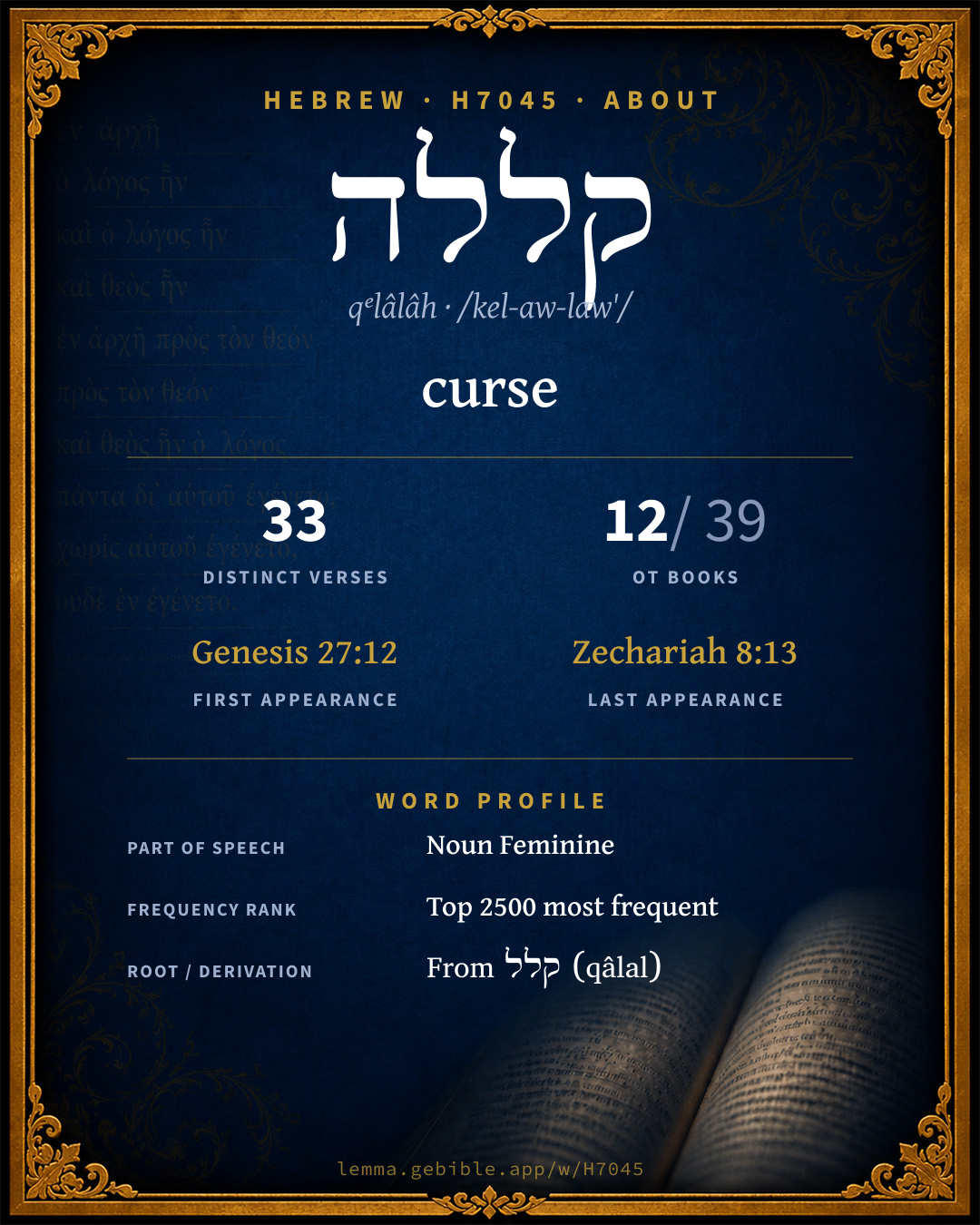
קְלָלָה
curse
Full lexicon entry — Brown-Driver-Briggs (BDB)
From Brown-Driver-Briggs (BDB)
Where this word appears
See every Absolute-state word in the Hebrew Bible →
Grammar key — what these labels mean
Part of speech
- Noun
- A naming word — a person, place, thing, or idea.
Noun type
- Common
- A common noun — a general class of person, place, or thing (“king,” “city,” “water”), not a specific name.
State
- Absolute
- The independent form of a noun, not bound to a following word.
- Construct
- A noun bound to a following noun in a possessive / “of” relationship (the construct chain).
Gender
- Feminine
- Grammatically feminine.
Number
- Singular
- One.
- Plural
- More than one (in Hebrew, generally three or more).
Grammatical forms
- Noun, Common, Feminine, Singular, Absolute 26 times (79%)
- Noun, Common, Feminine, Singular, Construct 5 times (15%)
- Noun, Common, Feminine, Plural, Absolute 2 times (6%)
Parsed forms decoded from the imported morphology (morphhb / Westminster Leningrad Codex — WLC text public domain, morphhb tagging CC BY 4.0), counted across 33 parsed occurrences — not distinct verses.
Every verse where H7045 appears — 33 distinct verses across 12 books. Click any verse to open its interlinear word-by-word view. Verse text shown in the World English Bible for context — . Each verse’s Hebrew form is shown with its reference; the English is not keyword-highlighted, since the data carries no word-level English alignment. Use “Compare translations” on any verse to read it across multiple English versions. This concordance covers the Hebrew Bible; Septuagint (Greek Old Testament) occurrences are not indexed here.
Genesis 2 verses
- Genesis 27:12 קְלָלָ֖ה n c fs What if my father touches me? I will seem to him as a deceiver, and I would bring a curse on myself, and not a blessing."
- Genesis 27:13 קִלְלָתְ/ךָ֖ n c fs cs + sfx pers 2ms His mother said to him, "Let your curse be on me, my son. Only obey my voice, and go get them for me."
Deuteronomy 11 verses
- Deuteronomy 11:26 וּ/קְלָלָֽה conj + n c fs Behold, I set before you this day a blessing and a curse:
- Deuteronomy 11:28 וְ/הַ/קְּלָלָ֗ה conj + ptcl def.art + n c fs and the curse, if you shall not listen to the commandments of Yahweh your God, but turn aside out of the way which I command you this day, to go after other gods, which you have not known.
- Deuteronomy 11:29 הַ/קְּלָלָ֖ה ptcl def.art + n c fs It shall happen, when Yahweh your God shall bring you into the land where you go to possess it, that you shall set the blessing on Mount Gerizim, and the curse on Mount Ebal.
- Deuteronomy 21:23 קִלְלַ֥ת n c fs cs his body shall not remain all night on the tree, but you shall surely bury him the same day; for he who is hanged is accursed of God; that you don't defile your land which Yahweh your God gives you for an inheritance.
- Deuteronomy 23:5 הַ/קְּלָלָ֖ה ptcl def.art + n c fs Nevertheless Yahweh your God wouldn't listen to Balaam; but Yahweh your God turned the curse into a blessing to you, because Yahweh your God loved you.
- Deuteronomy 27:13 הַ/קְּלָלָ֖ה ptcl def.art + n c fs These shall stand on Mount Ebal for the curse: Reuben, Gad, and Asher, and Zebulun, Dan, and Naphtali.
- Deuteronomy 28:15 הַ/קְּלָל֥וֹת ptcl def.art + n c fp But it shall come to pass, if you will not listen to the voice of Yahweh your God, to observe to do all his commandments and his statutes which I command you this day, that all these curses shall come on you, and overtake you.
- Deuteronomy 28:45 הַ/קְּלָל֣וֹת ptcl def.art + n c fp All these curses shall come on you, and shall pursue you, and overtake you, until you are destroyed; because you didn't listen to the voice of Yahweh your God, to keep his commandments and his statutes which he commanded you:
- Deuteronomy 29:27 הַ/קְּלָלָ֔ה ptcl def.art + n c fs therefore the anger of Yahweh was kindled against this land, to bring on it all the curse that is written in this book;
- Deuteronomy 30:1 וְ/הַ/קְּלָלָ֔ה conj + ptcl def.art + n c fs It shall happen, when all these things are come on you, the blessing and the curse, which I have set before you, and you shall call them to mind among all the nations, where Yahweh your God has driven you,
- Deuteronomy 30:19 וְ/הַ/קְּלָלָ֑ה conj + ptcl def.art + n c fs I call heaven and earth to witness against you this day, that I have set before you life and death, the blessing and the curse: therefore choose life, that you may live, you and your seed;
Joshua 1 verse
Judges 1 verse
2 Samuel 1 verse
1 Kings 1 verse
2 Kings 1 verse
Nehemiah 1 verse
Psalms 2 verses
Proverbs 2 verses
Jeremiah 9 verses
- Jeremiah 24:9 וְ/לִ/קְלָלָ֔ה conj + prep + n c fs I will even give them up to be tossed back and forth among all the kingdoms of the earth for evil; to be a reproach and a proverb, a taunt and a curse, in all places where I shall drive them.
- Jeremiah 25:18 וְ/לִ/קְלָלָ֖ה conj + prep + n c fs [to wit], Jerusalem, and the cities of Judah, and the kings of it, and the princes of it, to make them a desolation, an astonishment, a hissing, and a curse, as it is this day;
- Jeremiah 26:6 לִ/קְלָלָ֔ה prep + n c fs then will I make this house like Shiloh, and will make this city a curse to all the nations of the earth.
- Jeremiah 29:22 קְלָלָ֔ה n c fs and of them shall be taken up a curse by all the captives of Judah who are in Babylon, saying, Yahweh make you like Zedekiah and like Ahab, whom the king of Babylon roasted in the fire;
- Jeremiah 42:18 וְ/לִ/קְלָלָ֣ה conj + prep + n c fs For thus says Yahweh of Hosts, the God of Israel: As my anger and my wrath has been poured forth on the inhabitants of Jerusalem, so shall my wrath be poured forth on you, when you shall enter into Egypt; and you shall be an object of horror, and an astonishment, and a curse, and a reproach; and you shall see this place no more.
- Jeremiah 44:8 לִ/קְלָלָ֣ה prep + n c fs in that you provoke me to anger with the works of your hands, burning incense to other gods in the land of Egypt, where you are gone to sojourn; that you may be cut off, and that you may be a curse and a reproach among all the nations of the earth?
- Jeremiah 44:12 וְ/לִ/קְלָלָ֖ה conj + prep + n c fs I will take the remnant of Judah, that have set their faces to go into the land of Egypt to sojourn there, and they shall all be consumed; in the land of Egypt shall they fall; they shall be consumed by the sword and by the famine; they shall die, from the least even to the greatest, by the sword and by the famine; and they shall be an object of horror, [and] an astonishment, and a curse, and a reproach.
- Jeremiah 44:22 וְ/לִ/קְלָלָ֛ה conj + prep + n c fs so that Yahweh could no longer bear, because of the evil of your doings, and because of the abominations which you have committed; therefore is your land become a desolation, and an astonishment, and a curse, without inhabitant, as it is this day.
- Jeremiah 49:13 וְ/לִ/קְלָלָ֖ה conj + prep + n c fs For I have sworn by myself, says Yahweh, that Bozrah shall become an astonishment, a reproach, a waste, and a curse; and all the cities of it shall be perpetual wastes.
Zechariah 1 verse
About this entry
At a glance — auto-summarized from this page’s data, not written by a person. Every figure links to its source below. This summary describes the numbers; it doesn’t interpret them.
At its core, קללה (qᵉlâlâh) means “curse.” Scripture first uses it in Genesis 27:12. It turns up in 33 verses across 12 books, a moderately common footprint. The word gravitates to Deuteronomy (33%), then Jeremiah and Genesis. It shares a root with קלל, קל and קלל. Dig into 33-verse concordance and the renderings breakdown below.
Gloss history
Strong's 1890 vs modern scholarship
About this word
Strong's H7045 catalogs a Hebrew word from the Hebrew Old Testament.
These counts are not copied from any lexicon or concordance. They are computed here, from the morphology-tagged Hebrew Old Testament. What Lemma adds →
- 33
- distinct verses
- The word appears in 33 distinct verses.
- 12 / 39
- OT books
- The word appears in 12 of 39 Old Testament books.
- #1,064
- by frequency
- Top 2500 most frequent Hebrew words (rank 1,064 of 8,640 Hebrew words by occurrence).
View all 33 occurrences in the concordance →
Most concentrated in
- Deuteronomy 11 verses 33%
- Jeremiah 9 verses 27%
- Genesis 2 verses 6%
By section of the Old Testament
By traditional corpus
Conventional, traditional groupings — biblical authorship is debated, so this is a traditional corpus grouping, not an authorship claim. Each share is this word’s portion of its verses in that division of the Hebrew canon. Each figure is a share of the word’s 33 distinct verses.
- Prophets (Nevi'im) 15 verses · 45%
- Torah (Pentateuch) 13 verses · 39%
- Writings (Ketuvim) 5 verses · 15%
How translations render this word
Counts come from each version’s own published word-to-Strong’s tagging or interlinear alignment — an approximate guide to how each version renders this word, not a word-level alignment the data otherwise carries. Because each total is that version’s own tagged count, the per-version totals vary from one another and need not match the appearance or distinct-verse counts above. These counts may also differ from a printed concordance because Lemma counts each distinctly tagged rendering and does not collapse phrase taggings into a single head-word total. This is a fixed set of word-tagged versions (KJV, ASV, BSB, ULT) and does not change with the reading translation you choose elsewhere. Each version’s license is shown beside its name below (and on Sources).
- King James Version: Curse 21×, Cursing 3×
- American Standard Version: Curse 19×, All these curses 2×
- Berean Standard Bible: Curse 15×, Cursing 6×, Curses 4×
- unfoldingWord Literal Text: Curse 15×, Curses 6×, Cursing 3×
King James Version Public Domain
Renders H7045 across 33 tagged occurrences — most commonly:
Plus 9 renderings that appear only once — usually multi-word phrases or single function words the recovered tagging swept in, not distinct renderings.
American Standard Version Public Domain
Renders H7045 across 32 tagged occurrences — most commonly:
Plus 11 renderings that appear only once — usually multi-word phrases or single function words the recovered tagging swept in, not distinct renderings.
Berean Standard Bible Public Domain
Renders H7045 across 32 tagged occurrences — most commonly:
Plus 2 renderings that appear only once — usually multi-word phrases or single function words the recovered tagging swept in, not distinct renderings. Not rendered by a distinct English word in 1 further occurrence.
unfoldingWord Literal Text CC BY-SA 4.0
Renders H7045 across 28 tagged occurrences — most commonly:
Plus 4 renderings that appear only once — usually multi-word phrases or single function words the recovered tagging swept in, not distinct renderings.
Senses in BDB
The 1 sense BDB distinguishes for this word, in lexicon order (not ranked by frequency or importance). The full entry — with sub-senses — is in the Lexicon Entry tab.
- curse, vilification, execration
Word origin
n.f. curse;—abs. ק׳ Gn 27:12 +; cstr. קִלְלַת Ju 9:57 +; sf. קִלְלָֽתְךָ Gn 27:13, קִלְלָתוֹ 2 S 16:12 (van d. H. Kt קללתי, so We Dr Löhr); pl. קְלָלוֹת Dt 28:15, 45;—curse, Gn 27:12, 13 (J); often opp. בְּרָכָה, Dt 11:26, 28; 23:6 = Ne 13:2, + 8 times Dt., Jos 8:34 (D), Ju 9:57 ψ 109:17, 18 Pr 27:14; קִלְלַת חִנָּם Pr 26:2 a groundless curse, cf. 2 S 16:12; קְלָלָה נִמְרֶצֶת 1 K 2:8 a grievous curse; = a formula of cursing Je 29:22; = object of curse, קִלְלַת אֱלֹהִים תָּלוּי Dt 21:23, שַׁמָּה וּקְלָלָה 2 K 22:19, cf. Je 24:9; 25:18 + 6 times Je, Zc 8:13.
— Brown-Driver-Briggs (Oxford 1906, public domain), digitized via Sefaria, supplemented by the OpenScriptures HebrewLexicon (CC BY 4.0). See Sources.
Derived from קלל (qâlal) (H7043) — to be light.
Jastrow Dictionary
A second Hebrew/Aramaic lexicon for comparison, covering Aramaic and post-biblical (Talmudic, Targumic, Midrashic) usage that the biblical-Hebrew BDB does not. Matched by lemma rather than by Strong’s number, so a lemma may carry more than one Jastrow headword (shown separately below), and the entries cover usage well beyond the Bible.
קְלָלָה
- preced.) dishonor; curse. B. Mets. 75ᵇ גורם ק׳ לעצמו brings dishonor upon himself (people believing him to be dishonest). Meg. 15ᵃ, a. e. אל תהי קִלְלַת הדיוט וכ׳ let not the curse of a common man be a slight thing in thy eyes. Ib. 28ᵃ לא עלתה … קללת חבירי the thought of my neighbor’s curse never went to bed with me (v. צְעַר). Sot. 11ᵃ תולה קִלְלָתוֹ וכ׳, v. קָלַל. Yoma 54ᵇ חללו … וקִלְלָתָן ק׳ וכ׳ those whose blessing is blessing, and whose curse is curse (whose blessings and curses are efficacious) are engaged in such things!—Y. Snh. VII, 25ᵃ bot. קיללת השם (usu. ברכת) blasphemy. Ib. מהו לקרוע על קיללת הגוי how about rending one’s garments on hearing blasphemy by a gentile?; a. fr.—Pl. קְלָלוֹת. Meg. 31ᵇ ק׳ שבתורת כהנים the curses in Leviticus (XXVI, 14-43); שבמשנה תורה the curses in Deuteronomy (XXVIII, 15-68). Ib. שתכלה השנה וקִלְלוֹתֶיהָ that the year and its curses my end together. Erub. 100ᵇ עשר ק׳ וכ׳ Eve was cursed with ten curses; a. fr.
A Dictionary of the Targumim, the Talmud Babli and Yerushalmi, and the Midrashic Literature (Marcus Jastrow; London, Luzac, 1903) — Public Domain. Digitized via Sefaria. Digitized via Sefaria. Full attribution on Sources.
Forms in the corpus
The 26 distinct written forms H7045 takes in the Hebrew Bible, most frequent first — each parse links to that state’s occurrences in the concordance. Hebrew forms include their vowel points and cantillation, so a single lemma takes many written forms.
Same root — word family
Other BDB entries built from the same root as H7045, grouped by Strong’s listed origin. These share a root / origin per the lexicon — not necessarily a shared meaning. Each links to that word’s own entry.
Derives from
Shares the same root
Proper names from this root
People and places named from this root — a name, not an additional meaning of the word.
Compare all same-root words → Showing 4 of 6 — not the complete family. 1 of the same-root words is a proper name (a person or place). They share a root, not necessarily a meaning.
Septuagint verse parallels
This word appears in 27 verses that also exist in the Greek Old Testament (Septuagint), out of the 33 Hebrew verses it occurs in. You can read those verses in Greek by switching the Old Testament edition to the Septuagint.
Read these verses in the Septuagint
- Genesis 27:12
- Deuteronomy 11:26
- Judges 9:57
- 2 Samuel 16:12
- 1 Kings 2:8
- 2 Kings 22:19
- Proverbs 26:2
- Jeremiah 24:9
- Zechariah 8:13
This is a verse-level parallel only — the same verses exist in both the Hebrew and Greek Old Testaments. No word-level Hebrew↔Greek correspondence is claimed: the data carries no such alignment, so no Greek word is shown as this Hebrew word’s translation. Coverage is not total — the Septuagint omits the deuterocanon and renumbers the Psalms, so some Hebrew verses have no direct Greek parallel.