
Zechariah 14:9

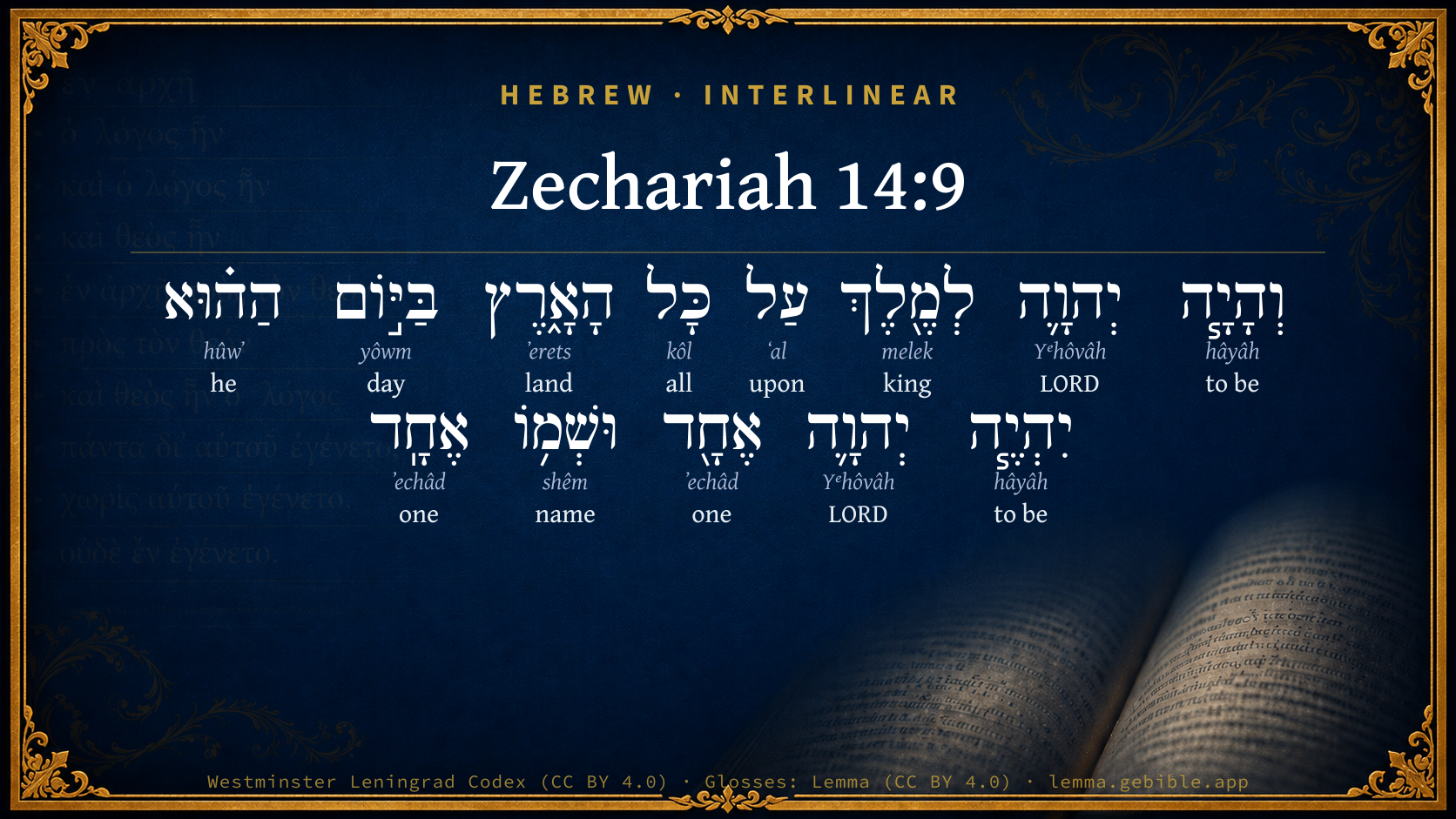
Hebrew (Westminster Leningrad Codex) Zechariah 14:9 appears in the Hebrew Old Testament. The text above is from the Westminster Leningrad Codex. Each word links to its Strong’s number, a concise gloss, and parsing drawn from the Open Scriptures Hebrew Bible morphology. Click any word for its full Brown-Driver-Briggs (BDB) entry.
Download image
Cite this verse

Zechariah 14:9 (World English Bible). Public Domain. Lemma interlinear Bible study tool, https://lemma.gebible.app/v/zechariah/14/9.

Show BibTeX & RIS
BibTeX
RIS
English Translation
Yahweh will be King over all the earth. In that day Yahweh will be one, and his name one.
World English Bible · Public Domain
Download a study sheet

One document with this verse’s original text, its word-by-word gloss line, the meaning frame, cross-references with their text, attributed commentary, and full source and license credits — printable, and it pastes into notes with its structure intact.

This verse Autodidact and up

Study sheet (.html) Plain text (.txt)

A passage Seminary Student

Up to 50 verses in one chapter. A passage sheet keeps up to 6 commentary sources and 12 cross-references per verse, in the order this page ranks them, and says so on the sheet whenever that leaves anything out. Ask for a single verse and you get the Autodidact verse sheet above.

Everything on this page stays free to read, with no account — the sheet is a download of what is already on screen, not access to it.

Want to remove ads? Support Godless Engineer
Compare translations 3

The same verse in 3 English versions, stacked beneath the original-language interlinear above. Click any original word for its lexicon entry.

Each is an independent rendering of the whole verse — the interlinear is not word-aligned to these translations.

Highlighted words mark where these versions differ — a whole-verse word diff, not a word-by-word alignment.

  • World English Bible Public Domain
    Yahweh will be King over all the earth. In that day Yahweh will be one, and his name one.
  • King James Version Public Domain
    And the LORD shall be king over all the earth: in that day shall there be one LORD, and his name one.
  • unfoldingWord Literal Text CC BY-SA 4.0
    Yahweh will be king over all the earth. On that day there will be Yahweh, the one God, and his name alone.

unfoldingWord Literal Text — © unfoldingWord, licensed CC BY-SA 4.0. Word-aligned USFM3 via Door43 (git.door43.org/unfoldingWord/en_ult).

Versions to compare (up to 4)

3 of 4 selected

Show all 18 translations

Every available English version of this verse, each an independent rendering of the whole verse.

  • World English Bible Public Domain
    Yahweh will be King over all the earth. In that day Yahweh will be one, and his name one.
  • Berean Standard Bible Public Domain
    On that day the LORD will become King over all the earth—the LORD alone, and His name alone.
  • Majority Standard Bible Public Domain
    On that day the LORD will become King over all the earth—the LORD alone, and His name alone.
  • King James Version Public Domain
    And the LORD shall be king over all the earth: in that day shall there be one LORD, and his name one.
  • American Standard Version (1901) Public Domain
    And Jehovah shall be King over all the earth: in that day shall Jehovah be one, and his name one.
  • Revised Version (1885) Public Domain
    And the LORD shall be king over all the earth: in that day shall the LORD be one, and his name one.
  • Geneva Bible (1599) Public Domain
    And the Lord shall bee King ouer all the earth: in that day shall there bee one Lord, and his Name shalbe one.
  • Douay-Rheims (1899) Public Domain
    And the Lord shall be king over all the earth: in that day there shall be one Lord, and his name shall be one.
  • Young's Literal Translation Public Domain
    And Jehovah hath become king over all the land, In that day there is one Jehovah, and His name one.
  • Literal Standard Version CC BY-SA 4.0
    And YHWH has become King over all the earth, || In that day YHWH is one, and His Name one.
  • Unlocked Literal Bible CC BY-SA 4.0
    Yahweh will be king over all the earth. On that day there will be Yahweh, the one God, and his name alone.
  • unfoldingWord Literal Text CC BY-SA 4.0
    Yahweh will be king over all the earth. On that day there will be Yahweh, the one God, and his name alone.
  • Darby Bible Public Domain
    And Jehovah shall be king over all the earth: in that day shall there be one Jehovah, and his name one.
  • World Messianic Bible Public Domain
    The LORD will be King over all the earth. In that day the LORD will be one, and his name one.
  • Webster's Bible Public Domain
    And the LORD will be king over all the earth: in that day will there be one LORD, and his name one.
  • Free Bible Version CC BY-SA 4.0
    The Lord will be king over all the earth. On that day there will be one true Lord, and his name the only one.
  • Bible in Basic English Public Domain
    And the Lord will be King over all the earth: in that day there will be one Lord and his name one.
  • JPS Tanakh (1917) Public Domain
    And the LORD shall be King over all the earth; in that day shall the LORD be One, and His name one.

Literal Standard Version (2020), Covenant Press — licensed CC BY-SA 4.0. Text via the HelloAO Bible API (eBible.org). Unlocked Literal Bible (unfoldingWord) — licensed CC BY-SA 4.0. Text via the HelloAO Bible API (eBible.org). unfoldingWord Literal Text — © unfoldingWord, licensed CC BY-SA 4.0. Word-aligned USFM3 via Door43 (git.door43.org/unfoldingWord/en_ult). Free Bible Version, Dr. Jonathan Gallagher — licensed CC BY-SA 4.0. Text via the HelloAO Bible API (eBible.org).

Word by word

More ways to search: Search by grammar → Find every occurrence → Compare this word →

Practice this passage: Drill this verse → Learn its vocabulary →

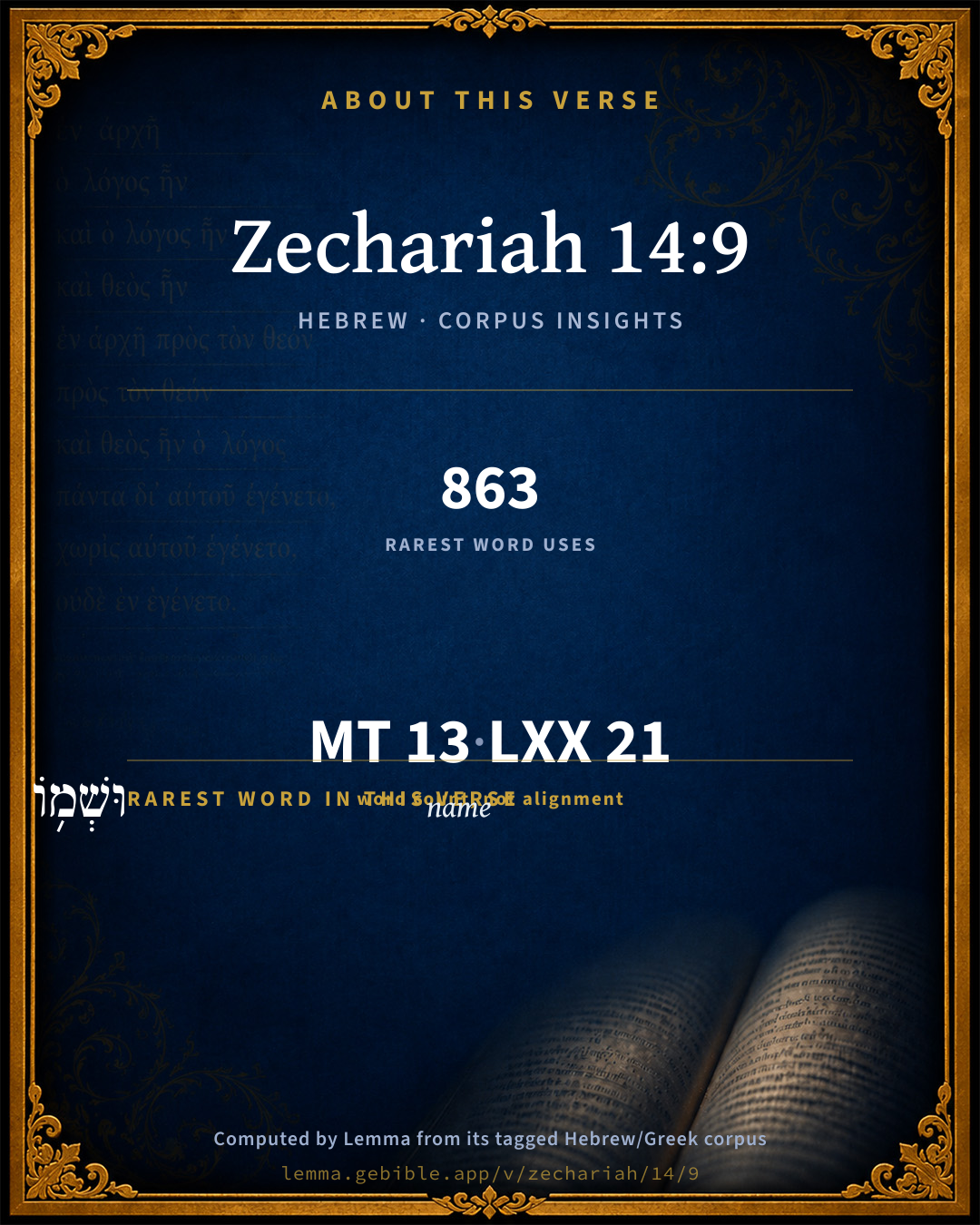
וּשְׁמ֥וֹ
shêm
H8034
“and · name · his”
Conjunction + Noun, Common, Masculine, Singular, Construct + Suffix, Personal, 3rd Person, Masculine, Singular
Part of Speech
Conjunction + Noun
Type
Common
Gender
Masculine
Number
Singular
State
Construct
Full BDB Definition

Origin: a primitive word [perhaps rather from H7760 through the idea of definite and conspicuous position

TWOT: 2405

name - name - reputation, fame, glory - the Name (as designation of God) - memorial, monument
  1. וְהָיָ֧ה hâyâh H1961 “and · to be” Conjunction + Verb, Qal, Sequential Perfect, 3rd Person, Masculine, Singular
  2. יְהוָ֛ה Yᵉhôvâh H3068 “LORD” Noun, Proper
  3. לְמֶ֖לֶךְ melek H4428 “to/for · king” Preposition + Noun, Common, Masculine, Singular, Absolute
  4. עַל ʻal H5921 “upon” Preposition
  5. כָּל kôl H3605 “all of” Noun, Common, Masculine, Singular, Construct
  6. הָאָ֑רֶץ ʼerets H776 “the · land” Particle, Definite Article + Noun, Common, Both, Singular, Absolute
  7. בַּיּ֣וֹם yôwm H3117 “in/at the · day” Preposition, Determined + Noun, Common, Masculine, Singular, Absolute
  8. הַה֗וּא hûwʼ H1931 “the · he” Particle, Definite Article + Pronoun, Personal, 3rd Person, Masculine, Singular
  9. יִהְיֶ֧ה hâyâh H1961 “to be” Verb, Qal, Imperfect, 3rd Person, Masculine, Singular
  10. יְהוָ֛ה Yᵉhôvâh H3068 “LORD” Noun, Proper
  11. אֶחָ֖ד ʼechâd H259 “one” Adjective, Cardinal number, Masculine, Singular, Absolute
  12. אֶחָֽד ʼechâd H259 “one” Adjective, Cardinal number, Masculine, Singular, Absolute

About this verse

These counts appear in no published source. They are computed here, from the morphology-tagged text and Lemma’s own curated glosses. What Lemma adds →

13
words
10
distinct lemmas
Prophets
section

Grammatical profile

  • 2 verbs
  • 7 nouns
  • 2 adjectives
  • 1 pronoun
  • 1 preposition

Verb forms

  • וְהָיָ֧ה Qal · Sequential Perfect
  • יִהְיֶ֧ה Qal · Imperfect

Repetition

Words recur within this verse — often emphatic in Hebrew:

  • וְהָיָ֧ה to be H1961 ×2
  • יְהוָ֛ה LORD H3068 ×2
  • אֶחָ֖ד one H259 ×2

Hebrew & Septuagint length

In English translation the verse runs 19 words from the Hebrew and 22 from the Septuagint (LXX English) — closely comparable.

A rough comparison of the two English renderings, which tokenize alike — not a word-level alignment.

Word counts can differ between the Hebrew and the Greek without any difference in meaning — e.g. the Hebrew direct-object marker אֵת has no separate Greek word, and Greek often adds the article ὁ.

In the original languages it is 13 Hebrew tokens and 21 Greek tokens — but the two are counted differently (Hebrew bundles its prefixes and suffixes into one token; the Greek is in lemma form), so that isn’t a like-for-like length.

Cross-references

29

Topical passages linked to Zechariah 14:9 in the Treasury of Scripture Knowledge — connected by theme and wording, ordered by reader-vote popularity; previews shown in the World English Bible.

  • Ephesians 4:5–6 one Lord, one faith, one baptism,
  • Revelation 11:15 The seventh angel sounded, and great voices in heaven followed, saying, "The kingdom of the world has become the Kingdom of our Lord, and of his Christ. He will reign forever and ever!"
  • Daniel 7:27 The kingdom and the dominion, and the greatness of the kingdoms under the whole the sky, shall be given to the people of the saints of the Most High: his kingdom is an everlasting kingdom, and all dominions shall serve and obey him.
  • Isaiah 2:2–4 It shall happen in the latter days, that the mountain of Yahweh's house shall be established on the top of the mountains, And shall be raised above the hills; And all nations shall flow to it.
  • Deuteronomy 6:4 Hear, Israel: Yahweh is our God; Yahweh is one:
  • Daniel 2:44–45 In the days of those kings shall the God of heaven set up a kingdom which shall never be destroyed, nor shall the sovereignty of it be left to another people; but it shall break in pieces and consume all these kingdoms, and it shall stand forever.
  • Zephaniah 3:9 For then I will purify the lips of the peoples, that they may all call on the name of Yahweh, to serve him shoulder to shoulder.
  • Isaiah 45:22–25 Look to me, and be you saved, all the ends of the earth; for I am God, and there is none else.
  • Jeremiah 23:6 In his days Judah shall be saved, and Israel shall dwell safely; and this is his name by which he shall be called: Yahweh our righteousness.
  • Psalms 72:17 His name endures forever. His name continues as long as the sun. Men shall be blessed by him. All nations will call him blessed.
  • Psalms 22:27–31 All the ends of the earth shall remember and turn to Yahweh. All the relatives of the nations shall worship before you.
  • Isaiah 49:6–7 yes, he says, It is too light a thing that you should be my servant to raise up the tribes of Jacob, and to restore the preserved of Israel: I will also give you for a light to the Gentiles, that you may be my salvation to the end of the earth.
  • Isaiah 54:5 For your Maker is your husband; Yahweh of Hosts is his name: and the Holy One of Israel is your Redeemer; the God of the whole earth shall he be called.
  • Isaiah 60:12–14 For that nation and kingdom that will not serve you shall perish; yes, those nations shall be utterly wasted.
  • Matthew 1:23 "Behold, the virgin shall be with child, And shall bring forth a son. They shall call his name Immanuel;" Which is, being interpreted, "God with us."
  • Ephesians 3:14–15 For this cause, I bow my knees to the Father of our Lord Jesus Christ,
  • Psalms 2:6–8 "Yet I have set my king on my holy hill of Zion."
  • Matthew 28:19 Therefore go, and make disciples of all nations, baptizing them in the name of the Father and of the Son and of the Holy Spirit,
  • Psalms 86:9 All nations you have made will come and worship before you, Lord. They shall glorify your name.
  • Micah 4:1–3 But in the latter days, It will happen that the mountain of Yahweh's temple will be established on the top of the mountains, And it will be exalted above the hills; And peoples will stream to it.
  • Zechariah 14:16–17 It will happen that everyone who is left of all the nations that came against Jerusalem will go up from year to year to worship the King, Yahweh of Hosts, and to keep the feast of tents.
  • Psalms 47:2–9 For Yahweh Most High is awesome. He is a great King over all the earth.
  • Psalms 67:4 Oh let the nations be glad and sing for joy, For you will judge the peoples with equity, And govern the nations on earth. Selah.
  • Psalms 72:8–11 He shall have dominion also from sea to sea, From the River to the ends of the earth.
  • Zechariah 8:20–23 Thus says Yahweh of Hosts: "Many peoples, and the inhabitants of many cities will yet come;
  • Genesis 49:10 The scepter will not depart from Judah, Nor the ruler's staff from between his feet, Until he comes to whom it belongs. To him will the obedience of the peoples be.
  • 1 Samuel 2:10 Those who strive with Yahweh shall be broken to pieces; Against them will he thunder in the sky: Yahweh will judge the ends of the earth; He will give strength to his king, Exalt the horn of his anointed.
  • Amos 9:12 that they may possess the remnant of Edom, and all the nations who are called by my name," says Yahweh who does this.
  • Micah 5:4 He shall stand, and shall shepherd in the strength of Yahweh, In the majesty of the name of Yahweh his God: And they will live, for then he will be great to the ends of the earth.

Cross-references courtesy of OpenBible.info (CC BY 4.0).

Hebrew and Greek witnesses Masoretic Hebrew ↔ Greek Septuagint

The same verse in the two great witnesses to the Old Testament, shown verse-for-verse.

These are two independent witnesses, not word-aligned to each other, and the Septuagint is shown in lemma (dictionary) form.

Hebrew Zechariah 14:9 Masoretic · Westminster Leningrad Codex

וְהָיָ֧ה יְהוָ֛ה לְמֶ֖לֶךְ עַל כָּל הָאָ֑רֶץ בַּיּ֣וֹם הַה֗וּא יִהְיֶ֧ה יְהוָ֛ה אֶחָ֖ד וּשְׁמ֥וֹ אֶחָֽד

Yahweh will be King over all the earth. In that day Yahweh will be one, and his name one.

World English Bible · Public Domain

Greek LXX Zechariah 14:9 Septuagint · lemma form

καί εἰμί κύριος εἰς βασιλεύς ἐπί πᾶς ὁ γῆ ἐν ὁ ἡμέρα ἐκεῖνος εἰμί κύριος εἷς καί ὁ ὄνομα αὐτός εἷς

And the Lord shall be king over all the earth: in that day there shall be one Lord, and his name one,

LXX2012 (modern English Septuagint) · Public Domain

Hebrew: Westminster Leningrad Codex (CC BY 4.0). Greek: Septuagint (public domain); English from LXX2012 (modern English Septuagint) (Public Domain). How the Septuagint differs from the Hebrew →

Targum (Aramaic paraphrase)

1

The Targum is the ancient Jewish Aramaic paraphrase of the Hebrew Scriptures — an interpretive translation, not the Hebrew text itself. Onkelos (literal) and Pseudo-Jonathan (expansive) render the Torah, and Jonathan the Prophets. Coverage is partial: where no permissively-licensed English translation exists for a verse, only the Aramaic is shown. This is verse-level text, not a word-by-word alignment to the Hebrew.

  1. Targum Jonathan Prophets (Joshua–Malachi)
    וְתִתְגְלֵי מַלְכוּתָא דַייָ עַל כָּל יַתְבֵי אַרְעָא בְּעִדָנָא הַהִיא יִפְלְחוּן קֳדָם יְיָ כְּתֵף חַד אֲרֵי שְׁמֵיהּ יַצִיב בְּעַלְמָא וְלֵית בַּר מִנֵיהּ:

    וְתִתְגְלֵי מַלְכוּתָא דַייָ עַל כָּל יַתְבֵי אַרְעָא בְּעִדָנָא הַהִיא יִפְלְחוּן קֳדָם יְיָ כְּתֵף חַד אֲרֵי שְׁמֵיהּ יַצִיב בְּעַלְמָא וְלֵית בַּר מִנֵיהּ:

    Targum Jonathan — Aramaic: “Mikraot Gedolot” (public domain). English: “Sefaria Community Translation” (CC0 1.0 (public-domain dedication)); “London "Chaldee Paraphrase," 1871” (public domain). Text via Sefaria.

Commentary

Notes on Zechariah 14:9 from classic Christian and Jewish commentators (each source and its license shown beneath its notes). The classic Christian expositions comment on the surrounding passage and are grouped to its opening verse, so a note may address several verses; the Jewish commentaries on the Tanakh (Rashi and others) are per-verse, so they appear only where the commentator wrote on this verse.

Lemma curates 59 commentaries, every one of them public domain or Creative Commons licensed, each selected and text-cleaned for this edition rather than reprinted as found. About our sources →

Trapp's Complete Commentary

John Trapp

Zec 14:9 And the LORD shall be king over all the earth: in that day shall there be one LORD, and his name one.

Ver. 9. And the Lord shall be king over all the earth] At the sounding of the seventh angel the kingdoms of this world shall become the kingdoms of our Lord and of his Christ; and he shall reign for ever and over, Rev 11:15; Rev 11:17. Cosmographers tell us that if we divide all the known world into 30 parts, the heathen’s part is as 19 of this 30; the Mahometans’ as six, the Christians’ as five only. And of those that profess the name of Christ, three parts, at least, of those five are possessed by idolatrous Papists; who say they believe in one only true God, but indeed set up many he saints and she saints, whom they adore with divine worship; and therein are no better than Pagans. Hence they are called Gentiles, Rev 11:2, and are said to worship devils, Rev 9:20 cf. 1Co 10:20. Cardinal Bembus saith of their St Francis, that he was in numerum Deorum ab Ecclesia Rom. relatus. At Rureround, in Gelderland, a play was acted by the Jesuits, A. D. 1622, under the title of the apotheosis of St Ignatius, the founder of that order. In the year 610 Boniface IV ordained the feast of All-saints, after that he had obtained of the emperor the idol temple at Rome, called the Pantheon; wherein he placed the Virgin Mary in the place of Cybele, the mother of the heathen gods. Now the time is yet to come (and oh that it were come!) that, all false worship laid aside and abandoned, the fulness of the Gentiles shall be brought in; and from the Jews, as some gather from this text compared with others, shall the gospel go out to all nations of the world, Isa 2:3, who with one consent shall submit themselves to Christ. Asshur and Egypt, all those large and vast countries, the whole tract of the east and of the south, shall embrace the faith of Christ and be converted, Isa 19:23-25; Isa 27:12-13 Mic 7:11-12 Psa 68:31; Psa 72:9-11 Rev 21:14. O dieculam illam! O for a short time. Neither need we think it incredible; God can hiss for them and fetch them in suddenly; he can cause a nation to conceive and bring forth in one day, Isa 66:8-9. A text that Cardinal Pole, in a letter to Pope Julius III, abused, by applying it to the bringing in of Popery again so umversally and suddenly in Queen Mary’s days.

Shall there be one Lord] Be the gods of the heathen good fellows, saith one, the true God is a jealous God, and will not share his glory with another. Be it that to Pagans and Papagans {a} there are gods many and lords many; to us there is but one God, and but one Mediator between God and man, the man Christ Jesus. As for all others, say we of them, as that heathen once did, Contemno minutos istos Deos modo Iovem propitium habeam, I care not for those petty deities, so long as Jehovah favoureth me. Hear, O Israel, saith Moses, Deu 6:4, Jehovah, thy God, Jehovah is one. The Hebrew word there used for one hath Daleth, the last letter, which also stands in number for four, extraordinary great in the original; {Hebrew Text Note} to signify, say the Jewish doctors, that this one God shall be worshipped in the four corners of the earth.

And his name one] That is, one way of worship; all superstitions being abolished, see Mic 4:5. Or, "his name," that is, his glory, as Psa 8:1, his transcendant excellency shall be super eminent; he shall have a name above all names, that at the name of Jesus every knee may bow. Thus the word "name" is used both in divine and human authors, Gen 6:1-4. Men of name, that is, of renown; so Num 1:16; Num 16:2 Act 1:15, the number of names, that is, of the chieftains that were fit to act in the election. Contrary whereunto is men without name, Job 30:8, men written in the earth, Jer 17:13, shrouded in the sheet of shame, and whose happiness it is to be forgotten in the city, Ecc 8:10. - ingloria vita recedit. So the poets call eminent and famous men Nomina, as Ovid doth Augustus:

“ Vive tibi, et longe Nomina magna fuge. ”

And speaking of some famous person, he

saith,

“ Claros inter habens nomina clara viros. ”

{a} A hostile formation:= Papist, Popish (with allusion to pagan). ŒD

John Trapp, A Commentary or Exposition upon All the Books of the Old and New Testament (1647–1656) — public domain. Text from a community e-Sword module.

The Biblical Illustrator

Joseph S. Exell

Zec_14:9

The Lord shall be King over all the earth

The Second Advent of Christ

That the passage Job_19:25-27 has reference to Jesus Christ, and to His coming to judgment at the last great day, I think there can be no dispute.

Unless, then, we look to the reappearing of the Son of Man upon this earth, we stultify the expectation of the patriarch, we impugn the inspiration of his prophecy, virtually esteeming his declaration as little better than words of a mere sound. That we may arrive at some knowledge of wherein the reward of the Son, after having made His soul an offering for sin, consists, let us search the Scriptures. In Psa_2:1-12 Jesus is invested with supreme and absolute authority in the administration of His inalienable sovereignty. But has Jesus, the Son of Man, ever occupied the earth as here represented? His own received Him not. Has He ever dashed in pieces like a potters vessel the heathen, either the baptized or unbaptized portion of them? It may be said that, in His spiritual dominion, He may be said to occupy the earth by subjugating the hearts of His people, making them willing in the day of His power. We need not make light of Christs spiritual government; but we are compelled to look for something more than a spiritual sovereignty as the result of the Fathers grant, even to the personal occupation of the earth as the seat of His kingly power. And the attitude of expectation naturally excites watchfulness, watchfulness producing prayer, and prayer holiness. (M. J. Taylor, M. A.)

Meat out of the Eater

One day; one entire period and joint of providence. Described by its beginning and progress; and by its end and close. The comfort and happiness of this glorious evening is set forth in three things. The propagation of the Gospel; the reign of Christ; the unity of the Churches. Doctrine--That in the latter days there shall be great unity in the Church of God. And that this unity shall spring from their acknowledging of the right Lord and the right way. As to the unity, observe--

1. This will suit best with the quiet and happy estate of those times. God will usher in the glorious and everlasting estate by some preparative degrees.

2. God will then make some visible provision against the scandal of dissensions.

3. The misery of these times doth seem to enforce the greater unity. For use of consolation, consider your hopes; and know the reason of such providences. For use of exhortation. It serveth to exhort and press you to hasten, and set on these hopes. Promises do not exclude action, but engage to it. The promises hold forth unity; strive after it, by prayers, and by endeavours. Let everyone of us mortify such ill affections as may any way engage us to a disturbance and vexatious bitterness. Keep yourselves pure from ill opinions. You must as carefully avoid an error in judgment as a vice in conversation. Do not impropriate Christ to any one party or sort of professors. Never serve a faction or party to the prejudice and detriment of truth and religion. As far as truth and conscience will give leave, there should be a profession of brotherhood, a condescension and yielding to one another in love; a walking together, or at least, a Christian forbearance. Abstain from reproaches and undue provocations, and dispense all civil respects with meekness. Let me entreat you to mind a few things. Beware of passion in your own interests; though they may be much shaken and endamaged in the present controversies, yet self-denying patience will be the best way to settle them. Press doctrines of Christ, and the main things of religion. When you deal with the errors of the time, do it with a great deal of caution and wariness. Take heed of aggravating and greatening matters, making them of more importance than indeed they are. Former ages were possessed with this spirit, every lesser dissent and mistake was made a heresy or error in the faith. Let me entreat you to improve your interests for brotherly and friendly collations. Rational and friendly conviction will do much, at least it will beget a sweet and brotherly correspondence, and it is to be hoped we shall find more meekness where things are not carried in the way of a set disputation. (T. Manton.)

The coming moral reign of God on the earth

Physically, God reigns everywhere. Morally, His reign depends upon the will of men, and that will is hostile. The coming moral reign is--

I. To be extensive. All the earth, or land, may mean the land of Judea, but we are authorised to believe that He will one day reign over all the earth, that all souls will bow to His influence, as the ripened fields of autumn to the winds of heaven.

II. To be exclusive. He will be regarded as the one King whose laws all study and obey. The great question of all souls will be, Lord, what wilt Thou have me to do? No other power will rule the soul where He becomes the moral monarch.

III. It will be beneficent. All the land shall be turned as a plain from Geba to Rimmon south of Jerusalem. Taking Zec_14:10; Zec_11:1-17, we gather at least two beneficent results of His moral reign.

1. The removal of all obstructions to the river of truth. The land shall be turned as a plain from Geba to Rimmon, etc. That is from the northern to the southern boundary of Judea. The levelling of this land would not only leave Jerusalem conspicuous but allow the living waters to have free flow.

2. The elevation and establishment of the good. Jerusalem is here represented not only as being razed and made conspicuous, but as settling down and dwelling securely. It shall be lifted up and inhabited in her place. There shall be no more utter destruction, Jerusalem shall be safely inhabited. Conclusion: Who will not pray, Let Thy kingdom come and Thy will be done on earth as it is in heaven? (Homilist.)

The kingdom of Christ upon the earth

I. The incalculable importance of this prophecy.

1. To the world at large.

2. To the Church in particular.

3. To every individual of mankind.

II. The blessedness of the period to which it refers.

1. It will be a season of temporal prosperity.

2. Spiritual blessings will most richly abound. It will be a season when God will manifest Himself on earth. Then

(1) Seek the establishment of Christs kingdom in your own souls; and

(2) Seek to promote its establishment throughout the world. (C. Simeon, M. A.)

One heart and one way

The Lord forewarns His people of greater sufferings that they were to undergo in the last times. Here we have the judgment itself denounced. A description of their miserable condition at this time. The assurance of deliverance, and that by divers agents. Though the trial were sharp, it should be short. The issue should be happy for the evening should be light. The author of their deliverance shall be Jehovah. As to the manner of doing it, God will make it appear to be His work. Look at the glorious condition of this Church after this deliverance, and that in these particulars--after this Jerusalem shall be made eminent and honourable. Jerusalem shall be exalted, as the mother Church. The blessed and glorious government of this state after this deliverance. Here is the fruit and consequence of this government, Jehovah shall be one, and His name one. The name of God is diversely taken in Scripture; but here is meant the religion that God has set forth in His Word, and the worship that He hath set up in the Church. The meaning of the promise seems to be this, whereas before they worshipped many gods, now they should turn from dead idols and serve only the living God. The Lord promises that as all the idols shall be taken away, so all idolatrous and superstitious worship also. Jehovah one, the rule of His worship one, and His worship according to that rule one. Doctrine--When a people turn to God by repentance, and He returns to them in mercy, He will give unto them one name, that is, He will free them from all superstitions, and human mixtures in His worship.

1. In all ages it hath been the main labour of Satan and all the enemies of the Church, when they could not root out the worship of God wholly, then to corrupt the simplicity of it by human inventions, traditions, and superstitious mixtures.

2. When they turn unto God, and God unto them, He will free them from all these. (W. Strong.)

The Biblical Illustrator, edited by Joseph S. Exell (c. 1880s–1900s) — public domain. Text from a community e-Sword module.

Tyndale Open Study Notes

Tyndale Open Resources

14:9 the Lord will be king: Zechariah envisions the ultimate fulfillment of many psalms (see Pss 47–48, 93, 97-99). • there will be one Lord: This promise reaffirms Israel’s creed (Deut 6:4) and signals a final end of all idolatry.

Tyndale Open Study Notes — © Tyndale Open Resources, licensed CC BY-SA 4.0. Text via the HelloAO Bible API.

Geneva Bible (1599)

Geneva Bible translators

All idolatry and superstition shall be abolished, and there shall be one God, one faith, and one religion.

Geneva Bible (1599) marginal notes — public domain. Text via Bolls.life.

Jamieson, Fausset & Brown

Robert Jamieson, A. R. Fausset & David Brown

king over all . . . earth-- Isa 54:5 implies that this is to be the consequence of Israel being again recognized by God as His own people (Dan 2:44; Rev 11:15).

one Lord . . . name one--Not that He is not so already, but He shall then be recognized by all unanimously as "One." Now there are "gods many and lords many." Then Jehovah alone shall be worshipped. The manifestation of the unity of the Godhead shall be simultaneous with that of the unity of the Church. Believers are one in spirit already, even as God is one (Eph 4:3-6). But externally there are sad divisions. Not until these disappear, shall God reveal fully His unity to the world (Joh 17:21, Joh 17:23). Then shall there be "a pure language, that all may call upon the name of the Lord with one consent" (Zep 3:9). The Son too shall at last give up His mediatorial kingdom to the Father, when the purposes for which it was established shall have been accomplished, "that God may be all in all" (Co1 15:24).

Jamieson, Fausset & Brown — Commentary Critical and Explanatory on the Whole Bible (1871) — public domain (CC PDM 1.0). Text via the HelloAO Bible API.

Adam Clarke's Commentary

Verse 9. And the Lord shall be King] When this universal diffusion of Divine knowledge shall take place. Wherever it goes, the laws of God shall be acknowledged; and, consequently, he shall be King over the whole earth.

One Lord, and his name one.] There shall be in those blessed days, only one religion, and one form of religion. There shall not be gods many, and lords many. All mankind shall be of one religion, the essence of which is, "Thou shalt love the Lord thy God with all thy heart, soul, mind, and strength; and thy NEIGHBOUR as thyself."

Adam Clarke's Commentary on the Bible (1810–1826) — public domain. Text from a community e-Sword/MySword module.

John Calvin's Commentaries

Here the prophet shows more clearly, and without using a figurative language, what might otherwise be more obscure: he says, that Jehovah would be king. Here Zechariah compares the kingdom of Christ with those periods of misery and calamities which had preceded, and which had continued till the coming of Christ. We indeed know that there had been the most dreadful scattering through the whole land, since the time the ten tribes separated from the family of David; for since the body of the people ceased to be one, they wilfully contrived ruin for themselves. When therefore the Israelites fought against Judah, the wrath of God appeared, the fruit of their defection. We indeed know that David was not made king by the suffrages of men, but was chosen by the decree of God. Hence when the kingdom of Israel departed from the son of David, it was the same as though they had refused to bear the authority of God himself, according to what he said to Samuel,

“Thee have they not despised, but me, that I should not reign over them.” (1 Samuel 8:7.)

And yet Samuel was only a governor for a time over the people; but when the people through a foolish zeal wished a king to be given then, God complains that he was despised in not being allowed to reign over them alone. This was more fully completed, when the ten tribes separated themselves from the lawful kingdom which God himself had established and had commanded to be inviolable. From that time then God was not their king. This is one thing.

Afterwards we know that the kings of Israel joined themselves with the kings of Syria to overthrow the kingdom of Judah, and that the Jews also sent for aid to the Assyrians, and afterwards had recourse to the Egyptians. At length the kingdom of Israel was cut off; then the kingdom of Judah, and the city was destroyed and the temple burnt, so that the worship of God for a time ceased. They afterwards returned; but we know they were ever oppressed by hard and cruel tyranny: when they perceived that they were unprotected, because they had refused to take shelter under the wings of God. Though he had so often told them that they would be safe and secure under his protection, they yet refused that favor. Therefore the Jews then found to their great loss that God was not their king.

Hence when Zechariah now speaks of the restoration of the Church, he rightly says, that Jehovah would be king; that is, though the Jews had been torn asunder and pillaged by tyrants, though they had suffered many reproaches and wrongs, yet God would become again their king, that He might defend them against all unjust violence and keep them under His protection. Nothing indeed can be more blessed than to live under the reigns of God; and this highest happiness is ever promised to the faithful.

We now understand the Prophet’s meaning as to this part; but he shows immediately after that this cannot be hoped for, except the Jews really attended to true religion and worshipped God aright and cast away their superstitions. Hence he joins together these two things, — that the condition of the people would be a happy one, because God would undertake the care of them and perform the office of a king, — and then, that God would be their king, in order that he might be rightly and sincerely worshipped by them: there shall be, he says, one Jehovah. Here the Prophet briefly shows that the legitimate worship of God cannot be set up, unless superstition be abolished. We indeed know that God is jealous, as he calls himself, so that he cannot bear rivals: for when we devise for ourselves any sort of deity, we instantly take from God what is his own. The Prophet then teaches us, that God cannot be truly worshipped, except he shines alone as the supreme, so that our religion may be pure and sound. In short, he indirectly condemns here those superstitions by which the earth had been corrupted and polluted, and also the superstitions by which true religion had been adulterated and the worship under the law had been violated. For this reason he says, that Jehovah would be one

He expresses this still clearer by saying, that his name would be one. This second clause may indeed appear useless; for whatever can be said of God is comprehended in his oneness. But as we are wont by various artifices to cover superstitions, and ever devise new excuses and new disguises, by which our impiety may seem specious and plausible, the Prophet expressly adds here, that God’s name is one; as though he had said, “It is not enough for men to declare that they acknowledge one true God or one supreme deity, except also they agree in some true and simple faith, so that the name of this one true God may be celebrated on the earth.” But the idea of the Prophet will become more clear if we notice the difference between the one true God and the name of the only true God, or the one name of God. All the philosophers with one mouth teach, that there are not many gods, but some supreme deity, who is the source of divinity: and this is what has been believed by all heathen nations. But in course of time they began to imagine that from this source many gods have emanated; and hence has come a multitude of false gods, so that some worshipped Jupiter, others Mercury, others Apollo; not because they thought that there are many gods partaking of original divinity; but because they imagined that gods have proceeded from the supreme fountain. As then the Jews might have sought subterfuges, and excused themselves by saying that they did not in heart worship many gods, the Prophet adds the second clause, — that the name of God is one; which means, that there is a certain way in which God is to be worshipped, that there is a certain fixed rule, so that no one is to follow what he himself may imagine to be right, and that the majesty of God ought not to be profaned by various errors, nor should men be lost each in his own notion, but that all ought to attend to the voice of God, and to hear what he testifies of himself.

We now then understand what the Prophet means: he says first, that things would be in a happy state in Judea, when God would be regarded as one, that is, when the whole land had been cleansed from its defilements, and when true religion again prevailed: but as this purity would not easily obtain footing in the world, and as men easily decline from it, he adds, that the name of God would be one, in order that the Jews might understand that God cannot be rightly worshipped except he be alone worshipped; and that it cannot be one, unless there be one faith, prescribed and certain, and not alternating between diverse opinions, like that of the heathens, whose religion is no other than to follow what they themselves imagine or what they have derived from their ancestors.

Now this is a remarkable passage: God distinguishes himself from all idols and his worship from all superstitions; and the more attentively we ought to consider what the Prophet teaches us, because our inclinations, as I have said, to vanity, is so great, and this is what experience itself sufficiently shows, and we also see how easily superstition, like a whirlwind, carries us away, and not only one superstition, but innumerable kinds of superstition. The more then it behaves us to notice this truth, so that the one name of God may prevail among us, and that no one may allow himself the liberty of imagining anything he pleases; but that we may know what God ought to be worshipped by us. And Christ also condemns for this reason all the forms of worship which prevailed in the world, by saying to the woman of Samaria,

“Ye know not what ye worship, we Jews alone,” he says, “know this.” (John 4:22.)

We hence see that this one thing is sufficient to condemn all superstitions, that is, when men follow their own fancies, and observe not a fixed and unchangeable rule, which cannot deceive. It follows —

John Calvin's Commentaries (1540-1563) — public domain. Text from the Calvin Translation Society English edition (1840s-50s) via the Christian Classics Ethereal Library (ccel.org). Calvin's coverage is partial (roughly two-thirds of the Bible); uncommented books and verses are honest gaps, never fabricated. The 19th-century editor's footnotes and remarks are omitted so the notes are faithfully Calvin's own voice.

Ellicott's Commentary for English Readers

(9) All the earth.—In accordance with the context, we can only understand this in the sense of “all the land” (Zec_13:8). But though this is undoubtedly the meaning of the prophet, there is no reason why his words may not have a wider application than he himself ever contemplated.

Shall there be one Lord.—Better, Jehovah shall be One: i.e., “God shall be all in all.”

And his name one.—i.e., and He alone shall be worshipped as God.

A Bible Commentary for English Readers, edited by Charles John Ellicott (1878–1897) — public domain. Text from a community e-Sword module.

The Cambridge Bible for Schools and Colleges

gen. ed. J. J. S. Perowne

9. the earth] Rather, the land, as in Zec_14:10. The wider scope is virtually included, but is not here directly under consideration.

shall there be one Lord, &c.] Rather, Jehovah shall be one, &c., i.e. He shall be one in the recognition and worship of men, as He is unchangeably in His essence and in fact.

and his name one] i. e., as Calvin who discusses this clause at length points out, not only shall one supreme God and fountain as it were of Deity be acknowledged—for many even of the heathen acknowledged that—but His manifold revelations of Himself shall no longer be regarded as so many distinct and inferior deities, but as parts and aspects of the one sole Name by which He makes Himself known to men. Even the Three Persons of the blessed Trinity are included in the One Name. Mat_28:19.

The Cambridge Bible for Schools and Colleges (gen. ed. J. J. S. Perowne; Cambridge University Press, 1878–1918) — public domain. Text from a community e-Sword module.

John Gill's Exposition

And the Lord shall be King over all the earth,.... This refers to the spiritual reign of Christ in the latter day; upon the success of the Gospel everywhere, there will be great conversions in all places; Gospel churches will be set up and ordinances administered everywhere; the earth will be filled with the knowledge of the Lord; his kingdom will be from sea to sea, from the eastern to the western one, and his dominion will reach to the ends of the earth; Popish nations, Mahometan kingdoms, Pagan ones, and all the kings of the earth, will become Christian, and submit to the sceptre of Christ's kingdom:

in that day shall there be one Lord; there is but one Lord in right now, and there is but one in fact that is owned by real Christians; and there will be but one in the spiritual reign, among all that are called Christians; there will be but one Lord and Head to Jews and Gentiles, Hos 1:11 the pope of Rome will be no more owned as head of the church, nor any other:

and his name, one; this refers not to any particular name by which Christ shall be called; but rather to that by which his people shall be called; all names of distinction being now laid aside, and only that of Christians retained; though it chiefly designs unity of doctrine, uniformity of worship, one and the same way of administering ordinances: it signifies that there will be one true, spiritual, uniform worship and religion; there will be no different sentiments and principles in religion; nor different practices and modes of worship; nor different sects; but all agreeing in the same faith and practice, under one Lord and King, Christ Jesus. So the Targum,

"they shall serve before the Lord with one shoulder; for his name is firm in the world, and there is none besides it.''

This passage is referred by the ancient Jews (l) to the times of the Messiah.

(l) Zohar in Deut. fol. 110. 2.

John Gill's Exposition of the Whole Bible (1746–1763) — public domain (CC PDM 1.0). Text via the HelloAO Bible API.

Albert Barnes' Notes on the Bible

And the Lord shall be king over all the earth - Such should be the influence of the living water, that is, of the Spirit of God. God who has ever reigned and will reign, “a great King over all the earth” Psa 47:3, Psa 47:8, shall be owned by His creatures, as what He is.

There shall be one Lord - More exactly, “The Lord shall be One, and His Name One.” He had before prophesied, “I will cut off the names of the idols out of the land” Zec 13:2. The Church being thus cleansed, no other lord or object of worship should be named but “Himself.” This is one of those prophecies, of continued expansion and development, ever bursting out and enlarging, yet never, until the end, reaching its full fulfillment. Dionysius: “Since in this life we contemplate God in His effects, in which His whole perfection shineth not forth now we know Him obscurely and imperfectly, His perfections being in divers diversely represented. In our home we shall see Him as He is, face to Face, through His Essence. Therefore then He will be represented by one name, as He shall be beheld by one gaze.”

Albert Barnes' Notes on the Bible (1834–1885) — public domain. Text from a community e-Sword/MySword module.

Haydock's Catholic Bible Commentary

CHAPTER XIV.

One Lord. The apostles justly gave this title to Christ, John xiii. 14. He is possessed of all power, Matthew xxviii. 18., and Philippians ii. 10. Pastors are all subject to him. (Calmet) --- The Pope styles himself, "servant of the servants of God," since St. Gregory’s time. (Haydock)

George Leo Haydock (1774–1849), Haydock's Catholic Family Bible and Commentary, 1859 edition — public domain. Excludes Psalms (Douay-Rheims chapter numbering differs from Protestant) and Deuterocanonical books (Catholic canon only).

Matthew Poole's English Annotations

The Lord; God, Father, Son, and Spirit,

Shall be King; acknowledged to be, men shall confess, that as he only is, so he ought to be owned, only true God, and King of his church.

Over all the earth; over the heathen. the Gentiles or Roman empire, as well as once over the Jewish state.

In that day of deposing idols, and advancing the true God, all his churches shall east off idolatry, and agree in worshipping one God, in one way of spiritual worship and hearty obedience.

Matthew Poole's English Annotations on the Holy Bible (1683–1685) — public domain. Text from a community e-Sword/MySword module.

Whedon's Commentary on the Bible

Daniel D. Whedon

9. The temporal blessings will be accompanied by spiritual gifts.

Jehovah shall be king — He will be ruler, counselor, protector (see on Joe_2:27; Joe_3:17).

Over all the earth — The context requires the translation “over all the land,” that is, of Judah (compare Zep_1:18; Zep_2:3). The extension of Jehovah’s rule over the nations is spoken of in Zec_14:16 ff. R.V. renders 9b, “in that day shall Jehovah be one, and his name one,” which is more accurate.

Jehovah shall be one (R.V.) —Throughout the entire land he will be recognized as the one and only God, idolatry will disappear completely (Zec_13:2; see on Joe_2:27).

His name one — See on Amo_2:7; Mic_5:4; Joe_2:27. The manifold activities of Jehovah will no longer be ascribed to different deities (compare Zec_13:2), nor will any name but his be used in worship.

Daniel D. Whedon (gen. ed.), Commentary on the Old and New Testaments (1874–1909) — public domain. Text from a community e-Sword module.

The Pulpit Commentary

All the earth; all the land of Israel (vers. 8, 10) a type of the kingdom of God in all its extent. (Rev_11:15, "The kingdoms of this world are become the kingdoms of our Lord, and of his Christ; and he shall reign forever and ever Shall there be one Lord; rather, Jehovah shall be one. He shall be universally acknowledged as "the blessed and only Potentate". (1Ti_6:15) His name one. Idolatry shall be abolished, and the one God shall be everywhere adored. (comp. Zec_13:2 Deu_6:4) Men shall no longer attribute operations and effects to various heavenly powers, but shall see and confess that all are derived from and centre in him, and are only different revelations of his ineffable nature and attributes. We do not, indeed, see this prediction yet fulfilled, but the grace to accomplish it is ready and operating; it is only men"s perverse wills that impede the gracious purpose of God.

Vers. 9-11. The elevation of Zion.

Morally and spiritually. (Isa_2:2 Mic_4:1 Eze_40:2)

I RAISED ABOVE THE STRIFE OF FACTIONS. Sects. Party spirit. Din and strife of tongues. Confusion and every evil work. But for Zion"s children there is a purer atmosphere and serener skies.

II RAISED ABOVE THE CORRUPTIONS OF THE WORLD. We hear much in our day of germs. The air is everywhere infected. The seeds of disease are on every side. But rise higher, and the danger ceases. So of Zion. Drunkenness, illegitimacy, worldliness, and other sins abound, and lower the tone of society. Need to rise nearer to heaven. "Ye are from beneath: I am from above," said our Lord.

III RAISED ABOVE THE ASSAULTS OF THE WICKED. Storms. Enemies. Temptations. Cry, "Deliver us from the evil." The higher we rise, the greater our safety. The more we resemble Christ, with the more hope can we say, "The prince of this world cometh, and hath nothing in me.

IV RAISED ABOVE THE VICISSITUDES OF TIME. Dispensations vary. Habits of society alter. Beliefs may change. But eternal truth and righteousness abide. "The true religion is built upon the rock, the rest are tossed upon the waves of time" (Bacon). "Serene will be our days, and bright And happy will our nature be, When love is an unerring light, And joy its own security. (Wordsworth)

Vers. 9-11. The coming moral reign of God on the earth.

"And the Lord shall be King over all the earth," etc. The subject is the coming moral reign of God on the earth. We say moral, for physically he reigns everywhere. Morally, alas! his reign depends upon the will of men, and that will is hostile. As a moral Monarch, the Almighty has to be chosen by his subjects. Three things are suggested in the text as to his coming moral reign on the earth.

I IT IS TO BE EXTENSIVE. "And the Lord shall be King over all the earth." Although in the next verse "all the earth" is rendered "all the land," meaning the land of Judaea, we are authorized to believe that he will one day reign over all the earth; that all souls will bow to his influence, as the ripened fields of autumn to the winds of heaven. His kingdom shall come, and his will be done on earth as it is in heaven.

II IT IS TO BE EXCLUSIVE. "In that day there shall be one Lord, and his name One." He will be regarded as the one King whose laws all study and obey. The great question of all souls will be, "Lord, what wilt thou have me to do?" No other power will rule the soul where he becomes the moral Monarch.

III IT WILL BE BENEFICENT. "All the land shall be turned as a plain from Geba to Rimmon south of Jerusalem." Taking vers. 10 and 11, we gather at least two beneficent results of his moral reign.

1. The removal of all obstructions to the river of truth. "The land shall be turned as a plain from Geba to Rimmon," etc. That is, from the northern to the southern boundary of Judaea. The levelling of this land would not only leave Jerusalem conspicuous, but allow the "living waters" to have free flow.

2. The elevation and establishment of the good. Jerusalem is here represented, not only as being raised and made conspicuous, but as settling down and dwelling securely. "It shall be lifted up, and inhabited in her place." There shall be no more utter destruction; Jerusalem shall be safely inhabited.

CONCLUSION. Who will not pray, "Let thy kingdom come, and thy will be done on earth as it is in heaven"? Let God reign on earth, and all obstructions to the progress of truth will be removed, and his people will be exalted and established forever. D.T.

Vers. 12-15. The elements by which the Divine government punishes sin.

"And this shall be the plague," etc. In the third verse of this chapter we are told that "the Lord shall go forth and fight against those nations," that is, against those nations comprehended in the armies which destroyed Jerusalem; and we have elsewhere endeavoured to illustrate how God punishes bad men by bad men. This passage is a further illustration of the idea. There are three elements of punishment which Jehovah is represented as employing in these verses physical diseases, mutual animosity, and temporal losses.

I PHYSICAL DISEASES. "And this shall be the plague wherewith the Lord will smite all the people that have fought against Jerusalem; their flesh shall consume away while they stand upon their feet, and their eyes shall consume away in their holes, and their tongue shall consume away in their mouth." "This description of the plague-stricken people," says a modern author, "is shocking, but it is not more than what actually occurs" (see Defoe"s "Plague of London"). Kingsley says, "What so terrible as war? I will tell you what is ten times and ten thousand times more terrible than war, and that is outraged nature. Nature, insidious, inexpensive, silent, sends no roar of cannon, no glitter of arms, to do her work; she gives no warning note of preparation Man has his courtesies of war and his chivalries of war; he does not strike the unarmed man; he spares the woman and the child. But Nature... spares neither woman nor child... silently she strikes the sleeping child with as little remorse as she would strike the strong man with the musket or the pick axe in his hand." One could scarcely imagine a more revolting condition of humanity than is here presented a living skeleton, nearly all the flesh gone, the eyes all but blotted out, the tongue withered. Physical disease has ever been one of the instruments by which God has punished men in this world pestilences, plagues, epidemics, and so on. But it is not merely a plague amongst the people, but also amongst the castle, as we see in ver. 15. "And so shall be the plague of the horse, of the mule, of the camel, and of the ass, and of all the beasts that shall be in these tents, as this plague." These words remind us of Byron"s description of the destruction of Sennacherib"s host. "And there lay the steed with his nostril all wide, But through it there rolled not the breath of his pride; And the foam of his gasping lay white on the turf, And cold as the spray of the rock-beating surf.

II MUTUAL ANIMOSITY. "And it shall come to pass in that day, that a great tumult from the Lord shall be among them; and they shall lay hold every one on the hand of his neighbour." The idea is, perhaps, that God would permit such circum stances to spring up amongst them as would generate in their minds mutual misunderstandings, malignities, quarrellings, and battlings. "They shall lay hold every one on the hand of his neighbour." "Every man"s sword shall be against his brother." All the jealousies, envyings, contentions, that are rife in society may be regarded as the means by which sin is punished. Sin punishes sin, bad passions not only work misery, but are in themselves miseries.

III TEMPORAL LOSSES. "And Judah also shall fight at Jerusalem." Not against Jerusalem. "And the wealth of all the heathen round about shall be gathered together, gold, and silver, and apparel, in abundance." Earthly property men in their unrenewed state have always valued as the highest good. To attain it they devote all their powers with an unquenchable enthusiasm, and to hold it they are ever on the alert, and their grasp is unrelaxable and firm. To have it snatched from them is among their greatest calamities; and how often this occurs in society! By what we call accidents, by a commercial panic, legal flaws, chicaneries, and frauds, rich men frequently are deprived of their wealth, men who are born in palaces often die in a pauper"s hovel. "Riches take to themselves wings, and fly away." This is another way in which Heaven punishes sin.

CONCLUSION. See those elements of retribution working everywhere around us. They have worked through all history. Because they are common we do not note them as we ought. We connect them not with the Justice that reigns over the universe. Albeit they are penal forces. D.T.

The Pulpit Commentary (1880–1919), ed. H.D.M. Spence-Jones & Joseph S. Exell — public domain. Text from a community e-Sword module.

John Wesley's Explanatory Notes

In that day - All men shall agree in worshipping one God, in one way of spiritual worship, and hearty obedience.

John Wesley, Explanatory Notes Upon the Whole Bible (1754–1765) — public domain. Text via the GEBible commentary corpus.

Scofield Reference Notes

C. I. Scofield

king over all the earth

The final answer to the prayer of Mat 6:10. CF.; Dan 2:44; Dan 2:45; Dan 7:24-27. See "Kingdom (N.T.)"; Luk 1:31-33; 1Co 15:28.

The Scofield Reference Bible (1917 edition), notes by C. I. Scofield — public domain. Text from a community e-Sword module.

unfoldingWord translationNotes

Door43 World Missions Community

General Information:

These verses continue the description of the final war for the city of Jerusalem and of how God will save her.

there will be Yahweh, the one God, and his name alone

Here "name" represents Yahweh's reputation or character. AT: "people will know that Yahweh is the only true God" or "people will only worship Yahweh, the one true God" (See: Metonymy)

All the land

It is implied that this is the land of Judah. AT: "All the land of Judah" (See: Assumed Knowledge and Implicit Information)

Arabah

This is the name of a plain in the Jordan River Valley. (See: How to Translate Names)

Geba

This is the name of a town on the northern border of Judah. (See: How to Translate Names)

Rimmon

This is the name of a town south of Jerusalem. (See: How to Translate Names)

Jerusalem will continue to be raised up

This contrasts Jerusalem, which will remain at a higher elevation, to the surrounding area, which is lower in elevation. The contrast can be indicated by adding the word "but." This can also be stated in active form. AT: "But, Jerusalem will remain high up" (See: Connecting Words and Active or Passive)

the Benjamin Gate ... the first gate ... the Corner Gate

These are names of gates in the northeast part of city wall of Jerusalem. Possible meanings are 1) "the first gate" and "the Corner Gate" refer to the same gate or 2) "the first gate" and "the Corner gate" are separate gates. (See: How to Translate Names and Assumed Knowledge and Implicit Information)

the Tower of Hananel

This refers to a strong point in the city defenses on the northern wall. It was probably built by a man named Hananel. (See: How to Translate Names)

the king's winepresses

This probably refers to the place where wine was made for the royal family. It was located in the southwest part of Jerusalem. (See: Assumed Knowledge and Implicit Information)

Jerusalem will live in safety

Here "Jerusalem" represents the people. AT: "The people will live safely in Jerusalem" (See: Metonymy)

translationWords

Yahweh

king

earth

name

Arabah

Jerusalem

Benjamin

gate

winepress

unfoldingWord translationNotes — © Distant Shores Media and the Door43 World Missions Community, licensed CC BY-SA 4.0. Source: git.door43.org/Door43/en_tn.

Rashi

Rabbi Shlomo Yitzchaki (Rashi)

shall the Lord be one For all the nations shall abandon their vanities and acknowledge Him, that He is one, and [that] no strange deity is with Him.

and His name one That His name shall be mentioned by everyone.

Rashi on the Tanakh — English translations: “The Judaica Press complete Tanach with Rashi, translated by A. J. Rosenberg” (CC BY 4.0); “Pentateuch with Rashi's commentary by M. Rosenbaum and A.M. Silbermann, 1929-1934” (public domain); “The Metsudah Tanach series, Lakewood, N.J” (CC BY 4.0); and “The Book of Joshua, Metsudah Publications, 1997” (CC BY 4.0). Text via Sefaria.

Radak

Rabbi David Kimhi (Radak)

IN THAT DAY י-ה-ו-ה SHALL BE ONE, WITH ONE NAME — That is, all will recognize that God is one, and there is no other divinity; and so God’s name will be one - that is, they will not call by name another divinity throughout the world, only God’s name, God alone will they call. As it says earlier (Zech 13:2), “In that day, too—declares י-ה-ו-ה of Hosts—I will erase the very names of the idols from the land; they shall not be uttered anymore. And I will also make the ‘prophets’ and the impure spirit vanish from the land.” And the sage Rabbi Abraham ibn Ezra (of blessed memory) explains our verse as referring particularly to the Explicit, Personal Name - the 4-Letter Name, the Tetragrammaton. Ibn Ezra writes, “WITH ONE NAME - this is The Glorious Name, that which became known through Moses our teacher, peace be upon him, and it will be expressed aloud then, in all mouths, as it is spelled.” (as of now, it is never spoken as written). And so too the great sage Rabbi Moses [ed: he’s likely referring either to Maimonides or Nachmanides, I’m not sure which and I couldn’t find the quote] also explains our verse as referring to the Explicit Personal Name. “Because all names attributed to God, may He be blessed, are names that define; whether they relate God’s actions to Him, or whether they try to point toward God’s wholeness and perfection. And when these many definitional names proliferate, some of the people start to think that God has many (separate) aspects, as many as the behaviors that these names describe. And this phenomenon, this confusion and doubt, the prophecy declares, is destined to be untangled when understanding reaches the people, the understanding that can release them from it. This prophecy says: “In that day י-ה-ו-ה shall be one, with one name.” That is, just as God is One, so too God will be called then by One Name only, the only name that denotes the Divine Essence alone, and not any definition or connotation.” So too, in Targum Yonatan, “There will be a revelation of the sovereignty of י-ה-ו-ה”.

Radak on the Tanakh — English translations: “Sefaria Community Translation” (CC0 1.0 (public-domain dedication)); “Eliyahu Munk, HaChut Hameshulash” (CC BY 4.0); “Rabbi Mike Feuer, Jerusalem Anthology” (CC BY 4.0); and “R. David Kimhi on the first book of Psalms, Translated by R.G. Finch, London, 1919” (public domain). Text via Sefaria.

Lesson kit

Teaching starters — assembled from the data on this page, not authored interpretation. Every prompt links to the verse data it draws on. Edit before teaching.

Zechariah, in the Prophets, opens this verse with 13 words (10 distinct Hebrew lemmas). Its most distinctive word is shêm (“name”). A historical commentator’s framing appears above. Read the whole chapter for the surrounding context.

Discussion questions

  1. What does “name” (shêm) contribute to the verse as a whole?
  2. How does Ephesians 4:5–6, which shares this passage’s theme, read alongside this verse?
  3. What does the repetition of “to be” (2× in this one verse) do in this verse?
  4. These translations render this verse differently; the difference is in the English rendering, not the original. What questions does that raise?
  5. «וְהָיָ֧ה» is a Qal Sequential Perfect verb. How does that grammatical form shape the action described?
  6. Compare how Trapp's Complete Commentary and The Biblical Illustrator read this verse. Where do they agree or differ?

Things to notice

Reading settings

Reading text

Shown beneath each verse's original-language words.

Old Testament
Old Testament edition

Read the OT as the Masoretic Hebrew (MT) or the Greek Septuagint (LXX).

English shown for the Greek Septuagint (in the Hebrew ↔ Greek comparison).

Comparing translations? Open the Compare panel on any verse page to stack up to four side by side.