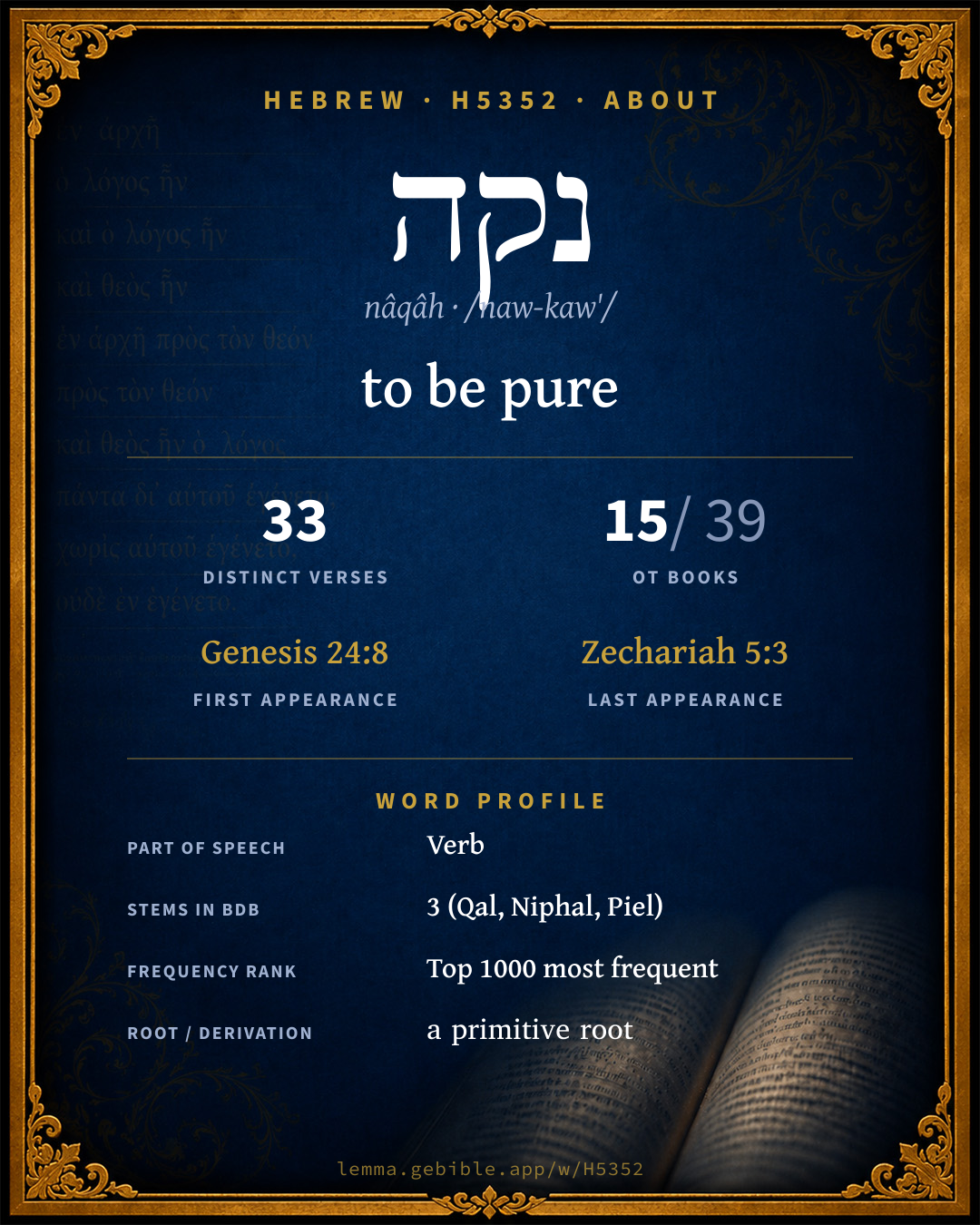
נָקָה
to be pure
‘to be pure’ is one of 2 main senses fuller range ↓
Full lexicon entry — Brown-Driver-Briggs (BDB)
From Brown-Driver-Briggs (BDB)
Where this word appears
See every Niphal verb in the Hebrew Bible →
Grammar key — what these labels mean
Part of speech
- Verb
- An action or state-of-being word.
Stem
- Niphal
- Usually the simple passive or reflexive of the Qal (“he was written”). Here: ‘be cleaned out’
- Piel
- An intensive or resultative active stem. Here: ‘hold innocent’
- Qal
- The basic, simple active stem — the plain form of the verb (“he wrote”).
Form
- Imperfect
- An incomplete, ongoing, or future action (“he will / would write”).
- Infinitive Absolute
- An unbound verbal noun, often intensifying or standing in for a finite verb.
- Sequential Perfect
- A perfect with prefixed waw continuing a preceding imperfect or command (waw-consecutive perfect).
- Perfect
- A completed action or state — Hebrew marks aspect (completeness) more than strict tense (“he wrote”).
- Imperative
- A direct command (“write!”).
- Jussive
- A third- or second-person volitional form expressing wish or command (“let him write”).
Person
- 3rd Person
- The one spoken about (“he / she / it / they”).
- 2nd Person
- The one addressed (“you”).
- 1st Person
- The speaker (“I / we”).
Gender
- Masculine
- Grammatically masculine.
- Feminine
- Grammatically feminine.
- Common
- Either gender — not distinguished for this form.
Number
- Singular
- One.
- Plural
- More than one (in Hebrew, generally three or more).
Grammatical forms 19 distinct
- Verb, Niphal, Imperfect, 3rd Person, Masculine, Singular 7 times (16%)
- Verb, Piel, Infinitive Absolute 5 times (11%)
- Verb, Piel, Imperfect, 3rd Person, Masculine, Singular 5 times (11%)
- Verb, Niphal, Sequential Perfect, 3rd Person, Masculine, Singular 3 times (7%)
- Verb, Niphal, Imperfect, 2nd Person, Masculine, Singular 3 times (7%)
- Verb, Niphal, Sequential Perfect, 3rd Person, Feminine, Singular 2 times (5%)
- Verb, Piel, Sequential Perfect, 1st Person, Common, Singular 2 times (5%)
- Verb, Niphal, Imperfect, 2nd Person, Masculine, Plural 2 times (5%)
+11 more forms (15 occurrences)
Parsed forms decoded from the imported morphology (morphhb / Westminster Leningrad Codex — WLC text public domain, morphhb tagging CC BY 4.0), counted across 44 parsed occurrences — not distinct verses.
Every verse where H5352 appears — 33 distinct verses across 15 books. Click any verse to open its interlinear word-by-word view. Verse text shown in the World English Bible for context — . Each verse’s Hebrew form is shown with its reference; the English is not keyword-highlighted, since the data carries no word-level English alignment. Use “Compare translations” on any verse to read it across multiple English versions. This concordance covers the Hebrew Bible; Septuagint (Greek Old Testament) occurrences are not indexed here.
Genesis 2 verses
- Genesis 24:8 וְ/נִקִּ֕יתָ conj + Niphal pf 2ms If the woman isn't willing to follow you, then you shall be clear from this my oath. Only you shall not bring my son there again."
- Genesis 24:41 תִּנָּקֶה֙ Niphal impf 2ms Then will you be clear from my oath, when you come to my relatives. If they don't give her to you, you shall be clear from my oath.'
Exodus 3 verses
- Exodus 20:7 יְנַקֶּה֙ Piel impf 3ms "You shall not take the name of Yahweh your God in vain, for Yahweh will not hold him guiltless who takes his name in vain.
- Exodus 21:19 וְ/נִקָּ֣ה conj + Niphal wpf 3ms if he rises again and walks around with his staff, then he who struck him shall be cleared: only he shall pay for the loss of his time, and shall provide for his healing until he is thoroughly healed.
- Exodus 34:7 וְ/נַקֵּה֙ יְנַקֶּ֔ה conj + Piel inf.abs Piel impf 3ms keeping loving kindness for thousands, forgiving iniquity and disobedience and sin; and that will by no means clear the guilty, visiting the iniquity of the fathers on the children, and on the children's children, on the third and on the fourth generation."
Numbers 4 verses
- Numbers 5:19 הִנָּקִ֕י Niphal impv 2fs The priest shall cause her to swear, and shall tell the woman, 'If no man has lain with you, and if you haven't gone aside to uncleanness, being under your husband, be free from this water of bitterness that brings a curse.
- Numbers 5:28 וְ/נִקְּתָ֖ה conj + Niphal wpf 3fs If the woman isn't defiled, but is clean; then she shall be free, and shall conceive seed.
- Numbers 5:31 וְ/נִקָּ֥ה conj + Niphal wpf 3ms The man shall be free from iniquity, and that woman shall bear her iniquity."
- Numbers 14:18 וְ/נַקֵּה֙ יְנַקֶּ֔ה conj + Piel inf.abs Piel impf 3ms Yahweh is slow to anger, and abundant in loving kindness, forgiving iniquity and disobedience; and that will by no means clear [the guilty], visiting the iniquity of the fathers on the children, on the third and on the fourth generation.
Deuteronomy 1 verse
Judges 1 verse
1 Samuel 1 verse
1 Kings 1 verse
Job 2 verses
Psalms 2 verses
- Psalms 19:12 נַקֵּֽ/נִי Piel impv 2ms + sfx pers 1cs Who can discern his errors? Forgive me from hidden errors.
- Psalms 19:13 וְ֝/נִקֵּ֗יתִי conj + Piel wpf 1cs Keep back your servant also from presumptuous sins. Let them not have dominion over me. Then I will be upright, I will be blameless and innocent of great transgression.
Proverbs 7 verses
- Proverbs 6:29 יִ֝נָּקֶ֗ה Niphal impf 3ms So is he who goes in to his neighbor's wife. Whoever touches her will not be unpunished.
- Proverbs 11:21 יִנָּ֣קֶה Niphal impf 3ms Most assuredly, the evil man will not be unpunished, But the seed of the righteous will be delivered.
- Proverbs 16:5 יִנָּקֶֽה Niphal impf 3ms Everyone who is proud in heart is an abomination to Yahweh: They shall assuredly not be unpunished.
- Proverbs 17:5 יִנָּקֶֽה Niphal impf 3ms Whoever mocks the poor reproaches his Maker. He who is glad at calamity shall not be unpunished.
- Proverbs 19:5 יִנָּקֶ֑ה Niphal impf 3ms A false witness shall not be unpunished. He who pours out lies shall not go free.
- Proverbs 19:9 יִנָּקֶ֑ה Niphal impf 3ms A false witness shall not be unpunished. He who utters lies shall perish.
- Proverbs 28:20 יִנָּקֶֽה Niphal impf 3ms A faithful man is rich with blessings; But one who is eager to be rich will not go unpunished.
Isaiah 1 verse
Jeremiah 5 verses
- Jeremiah 2:35 נִקֵּ֔יתִי Niphal pf 1cs Yet you said, I am innocent; surely his anger is turned away from me. Behold, I will enter into judgment with you, because you say, I have not sinned.
- Jeremiah 25:29 הִנָּקֵ֣ה תִנָּק֑וּ תִנָּק֔וּ Niphal inf.abs Niphal impf 2mp Niphal impf 2mp For, behold, I begin to work evil at the city which is called by my name; and should you be utterly unpunished? You shall not be unpunished; for I will call for a sword on all the inhabitants of the earth, says Yahweh of Hosts.
- Jeremiah 30:11 וְ/נַקֵּ֖ה אֲנַקֶּֽ/ךָּ conj + Piel inf.abs Piel impf 1cs + sfx pers 2ms For I am with you, says Yahweh, to save you: for I will make a full end of all the nations where I have scattered you, but I will not make a full end of you; but I will correct you in measure, and will in no way leave you unpunished.
- Jeremiah 46:28 וְ/נַקֵּ֖ה אֲנַקֶּֽ/ךָּ conj + Piel inf.abs Piel impf 1cs + sfx pers 2ms Don't be afraid you, O Jacob my servant, says Yahweh; for I am with you: for I will make a full end of all the nations where I have driven you; but I will not make a full end of you, but I will correct you in measure, and will in no way leave you unpunished.
- Jeremiah 49:12 נָקֹ֖ה תִּנָּקֶ֑ה תִנָּקֶ֔ה Qal inf.abs Niphal impf 2ms Niphal impf 2ms For thus says Yahweh: Behold, they to whom it didn't pertain to drink of the cup shall assuredly drink; and are you he who shall altogether go unpunished? you shall not go unpunished, but you shall surely drink.
Joel 1 verse
Nahum 1 verse
Zechariah 1 verse
About this entry
At a glance — auto-summarized from this page’s data, not written by a person. Every figure links to its source below. This summary describes the numbers; it doesn’t interpret them.
נקה (nâqâh) is a Hebrew verb most often rendered “to be pure.” Scripture first uses it in Genesis 24:8. It turns up in 33 verses across 15 books, a moderately common footprint. As a verb its force shifts by stem, across 3 stems (Qal, Niphal, and more). It clusters with מנקית, נקא and נקי under a shared root. For the data behind this summary, explore the sense tree and the renderings breakdown below.
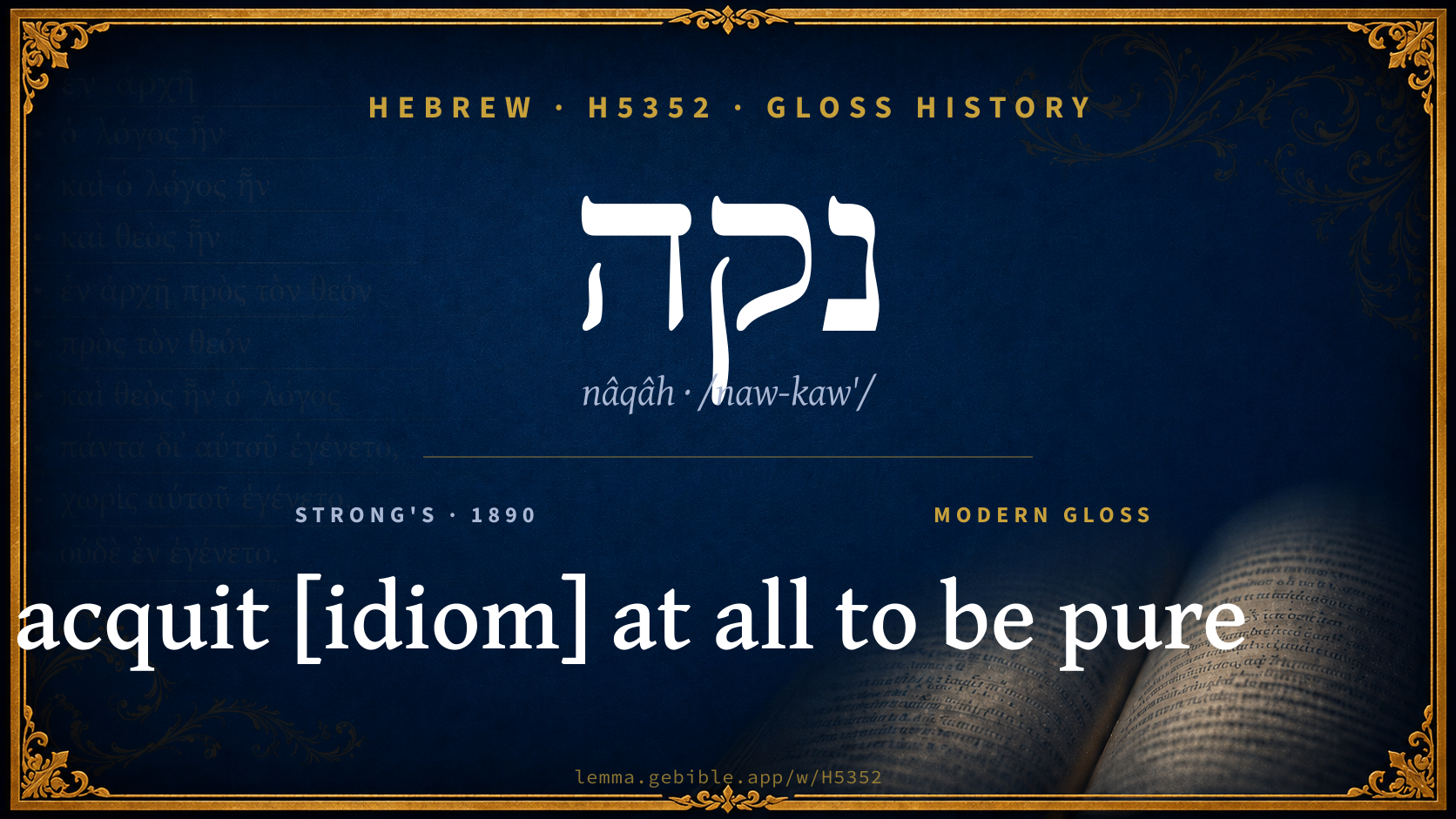
Gloss history
Strong's 1890 vs modern scholarship
About this word
Strong's H5352 catalogs a Hebrew word from the Hebrew Old Testament.
These counts are not copied from any lexicon or concordance. They are computed here, from the morphology-tagged Hebrew Old Testament. What Lemma adds →
- 33
- distinct verses
- The word appears in 33 distinct verses.
- 15 / 39
- OT books
- The word appears in 15 of 39 Old Testament books.
- #819
- by frequency
- Top 1000 most frequent Hebrew words (rank 819 of 8,640 Hebrew words by occurrence).
View all 33 occurrences in the concordance →
By section of the Old Testament
By traditional corpus
Conventional, traditional groupings — biblical authorship is debated, so this is a traditional corpus grouping, not an authorship claim. Each share is this word’s portion of its verses in that division of the Hebrew canon. Each figure is a share of the word’s 33 distinct verses.
- Prophets (Nevi'im) 12 verses · 36%
- Writings (Ketuvim) 11 verses · 33%
- Torah (Pentateuch) 10 verses · 30%
How translations render this word
Counts come from each version’s own published word-to-Strong’s tagging or interlinear alignment — an approximate guide to how each version renders this word, not a word-level alignment the data otherwise carries. Because each total is that version’s own tagged count, the per-version totals vary from one another and need not match the appearance or distinct-verse counts above. These counts may also differ from a printed concordance because Lemma counts each distinctly tagged rendering and does not collapse phrase taggings into a single head-word total. This is a fixed set of word-tagged versions (KJV, ASV, BSB, ULT) and does not change with the reading translation you choose elsewhere. Each version’s license is shown beside its name below (and on Sources).
- King James Version: Shall not be unpunished 4×, Unpunished 3×, Be guiltless 2×
- American Standard Version: Shall not be unpunished 5×, Clear 4×, Will by no means 3×
- Berean Standard Bible: Go unpunished 8×, Acquit me 2×, Leave anyone unpunished 2×
- unfoldingWord Literal Text: Will 8×, Remain blameless 5×, He will 4×
King James Version Public Domain
Renders H5352 across 44 tagged occurrences — most commonly:
Plus 29 renderings that appear only once — usually multi-word phrases or single function words the recovered tagging swept in, not distinct renderings.
American Standard Version Public Domain
Renders H5352 across 44 tagged occurrences — most commonly:
Plus 30 renderings that appear only once — usually multi-word phrases or single function words the recovered tagging swept in, not distinct renderings.
Berean Standard Bible Public Domain
Renders H5352 across 36 tagged occurrences — most commonly:
Plus 18 renderings that appear only once — usually multi-word phrases or single function words the recovered tagging swept in, not distinct renderings. Not rendered by a distinct English word in 7 further occurrences.
unfoldingWord Literal Text CC BY-SA 4.0
Renders H5352 across 57 tagged occurrences — most commonly:
Plus 25 renderings that appear only once — usually multi-word phrases or single function words the recovered tagging swept in, not distinct renderings.
9 senses and sub-senses in the full BDB
Hebrew verbs can shift meaning by stem (binyan): Qal is the basic action, Niphal is often passive or reflexive, Piel often intensifies or makes it factitive, and Hiphil is typically causative. The senses below are grouped under the stem BDB assigns to each.
What do BDB’s symbols mean?
BDB uses these scholarly abbreviations:
| Symbol | Meaning |
|---|---|
| 𝔊 | the Septuagint (the ancient Greek translation, LXX) |
| 𝔙 | the Vulgate (the Latin translation) |
| 𝔖 | the Syriac version (the Peshitta) |
| 𝔗 | the Targum (the Aramaic translation) |
| ψ | the Psalms |
| √ | root (the underlying root or stem) |
| ‖ | parallel passage (a synonymous or contrasted parallel) |
| † | the dagger: every passage where the word occurs is cited |
The 9 senses and sub-senses the full Brown-Driver-Briggs lexicon distinguishes for this word, in lexicon order (not ranked by frequency), with BDB’s own verbatim wording and sub-sense lettering. Shown in Hebrew script with BDB’s own scholarly abbreviations. The condensed entry is in the Lexicon Entry tab. See also the Forms in the corpus table below.
Qal
- Inf. abs. נָקֹה Je 49:12 (נָקֹה תִּנָּקֶה, prob. error for הנקה ת׳, cf. Je 25:29). e.g. Jeremiah 49:12
Niphal
- Pf. 3 ms. נִקָּה Zc 5:3 + 5 times; f. נִקְּתָה Nu 5:28; נִקָּ֑תָה Is 3:26; 2 ms. נִקֵּיתָ Gn 24:8; 1 s. נִקֵּיתִי Ju 15:3 + 2 times; Impf. יִנָּקֶה Pr 6:29 + 6 times; 2 ms. תִּנָּקֶה Gn 24:41 + 2 times; pl. תִּנָּקוּ Je 25:29(×2); Imv. הִנָּקִי Nu 5:19; Inf. הִנָּקֵה Je 25:29;— e.g. Zechariah 5:3
- 1. be cleaned out, of a plundered city Is 3:26; purged out, of liars and perjurers Zc 5:3(×2). e.g. Isaiah 3:26
- 2. be clean, free from guilt, innocent, Je 2:35 c. מִן, מִפֶּשַׁע ψ 19:14; מֵעָוֹן Nu 5:31 (P); מִפְּלִשְׁתִּים from (at the hands of) the Philistines Ju 15:3. e.g. Jeremiah 2:35
- 3. be free, exempt from punishment, abs. Ex 21:19 (E) Nu 5:28 (P) 1 S 26:9; לֹא יִנָּקֶה Pr 6:29; 11:21; 16:5; 17:5; 19:5, 9; 28:20; Je 25:29(×3) 49:12b, נָקֹה תִּנָּקֶה v 12a. e.g. Exodus 21:19
- 4. free, exempt from obligation, c. מִן, from oaths Gn 24:8, 41 (J); מִמֵּי הַמָּרִים from effects of drinking the bitter water Nu 5:19 (P). e.g. Genesis 24:8
Piel
- Pf. 1 s. נִקֵּיתִי Jo 4:21 (𝔊 𝔖 נִקַּמְתִּי; so Now SS Buhl); Impf. 3 ms. יְנַקֶּה Ex 20:7 + 2 times; יְנַקֵּ֑ה Nu 14:18 Na 1:3; 2 ms. sf. תְּנַקֵּנִי Jb 9:28; 10:14; תְּנַקֵּהוּ 1 K 2:9; 1 s. sf. אֲנַקֶּ֑ךָּ Je 30:11; 46:28; Imv. sf. נַקֵּנִי ψ 19:13; Inf. abs. נַקֵּה Ex 34:7 + 4 times;— e.g. Joel 4:21
- 1. hold innocent, acquit, Jb 9:28; מֵעֲוֹנִי Jb 10:14; מִנִּסְתָּרוֹת ψ 19:13. e.g. Job 9:28
- 2. leave unpunished: of man, c. acc. 1 K 2:9; elsewhere of God: abs. נַקֵּה לֹא יְנַקֶּה Ex 34:7(×2) = Nu 14:18(×2) (all J) = Na 1:3(×2); c. acc. לֹא יְנַקֶּה Ex 20:7 = Dt 5:11; נַקֵּה לֹא אֲנַקֶּךָּ Je 30:11(×2) = 46:28(×2), cf. Jo 4:21(×2) (but v. supr.). e.g. 1 Kings 2:9
Senses from the full Brown-Driver-Briggs lexicon (Brown, Driver, Briggs; Oxford 1906 — public domain), digitized via Sefaria, supplemented by the OpenScriptures HebrewLexicon (CC BY 4.0). Full attribution on Sources.
Word origin
vb. be empty (?), clean (Ecclus 16:11b Niph. Impf. ינקה be unpunished, so 40:15; 31:5 = Pr 28:20; NH Pi. = BH; Aramaic נְקָא Pa. = BH, adj. נְקֵא clean; Ph. נקי adj. pure; Palm. נקא be clean (perhaps) in n.pr. SachauZMG xxxv (1881), 735 Lzb325; Assyrian nâḳû, pour out, pour libation, make offering, nikû, libation, offering; Old Aramaic נקיה perhaps = נוּקָיָה libation (Lzb326), cf. Syriac ܢܽܘܩܳܝܳܐ Cook83; Syriac ܢܰܩܺܝ Pa. pour out, make a libation; 𝔗 נְקָא Pa. = cleanse (with lye) Is 1:25; adj. נְקֵא clean of bread or fruit Gn 40:16 𝔗J i, Dt 6:3 𝔗J ii, = exempt (BH נָקִי) 1 K 15:22. on the other hand, Arabic نَقِىَ purus, mundus fuit Kam. Frey; ii. cleanse, etc., Lane3037.—Orig. meaning prob. empty out, hence pour and be empty, clean);—
— Brown-Driver-Briggs (Oxford 1906, public domain), digitized via Sefaria, supplemented by the OpenScriptures HebrewLexicon (CC BY 4.0). See Sources.
Origin: a primitive root
Jastrow Dictionary
A second Hebrew/Aramaic lexicon for comparison, covering Aramaic and post-biblical (Talmudic, Targumic, Midrashic) usage that the biblical-Hebrew BDB does not. Matched by lemma rather than by Strong’s number, so a lemma may carry more than one Jastrow headword (shown separately below), and the entries cover usage well beyond the Bible.
נָקָה I
- f., v. נְאָקָה II
נָקָה II
- to be clean, v. נקי.
נקי
- (b. h.) [to be rubbed off, be white,] to be clean, clear (cmp. זָכָה).
- 1. to cleanse. Ex. R. s. 1 ומְנַקֶּה אותם and cleansed them (the new-born); Yalk. ib. 164; Yalk. Ez. 354; (Sot. 11ᵇ מנקיר). B. Kam. 93ᵇ פשתן ונִיקָּהוּ if he stole flax and cleansed (bleached) it; Tosef. ib. X, 2; a. e.
- 2. to clear, let go unpunished. Yoma 86ᵃ (ref. to Ex. XXXIV, 7) מנקה הוא וכ׳ he clears the repentant sinners &c. Tem. 3ᵇ. Pesik. R. s. 42 כדי לנַקּוֹת את שרה in order to clear Sarah (from suspicion); a. fr.—Part. pass. מְנוּקֶּה, pl. מְנוּקִּין clear, clean, bare. Snh. 49ᵃ מנ׳ מגזל innocent of robbery. Sot. 28ᵃ. Snh. 36ᵇ, a. e. כשם שב"ד מנ׳ בצדק … מנ׳ מכל מום as the judges must be clear (from suspicion) as to righteousness, so must they be clear of every blemish (of descent). Gitt. 86ᵃ מ׳ מכל מום free from all objectionable qualities; a. e. e.g. Exodus 34:7
- to be cleared, vindicated. Tosef. Sot. II, 3 שנ׳ ונקתה נִקְּתָה מכל פורעניות וכ׳ (v. ed. Zuck. note) the text says (Num. V, 28) ‘and she shall be cleared’, she shall be cleared (released) from all the evils which might come upon her deservedly (because she gave rise to suspicion through her conduct). Ib. שניקללה ניוולה (Var. שניקל) read: שניקתה בניוולה she is released from further visitation (being sufficiently punished) by her exposure to disgrace. Pesik. R. l. c. היאך … מִתְנַקֵּת by what severe means has Sarah been vindicated! e.g. Numbers 5:28
- to clear, remove. Kidd. 62ᵃ (ref. to הִנָּקִי, Num. V, 19) הַנְקִי כתיב it may be read hanḳi, clear thy life out of thy body (die, if thou art guilty); v. חָנַק. e.g. Numbers 5:19
A Dictionary of the Targumim, the Talmud Babli and Yerushalmi, and the Midrashic Literature (Marcus Jastrow; London, Luzac, 1903) — Public Domain. Digitized via Sefaria. Digitized via Sefaria. Full attribution on Sources.
Forms in the corpus
The 34 distinct written forms H5352 takes in the Hebrew Bible, most frequent first — each parse links to that stem’s occurrences in the concordance. Hebrew forms include their vowel points and cantillation, so a single lemma takes many written forms.
Same root — word family
Other BDB entries built from the same root as H5352, grouped by Strong’s listed origin. These share a root / origin per the lexicon — not necessarily a shared meaning. Each links to that word’s own entry.
Derived from this word
- מנקית mᵉnaqqîyth H4518 sacrificial bowl
- נקא nᵉqêʼ H5343 pure
- נקי nâqîy H5355 innocent
- נקיון niqqâyôwn H5356 innocence
Compare all same-root words → Showing 4 of 5 — not the complete family. They share a root, not necessarily a meaning.
Septuagint verse parallels
This word appears in 28 verses that also exist in the Greek Old Testament (Septuagint), out of the 33 Hebrew verses it occurs in. You can read those verses in Greek by switching the Old Testament edition to the Septuagint.
Read these verses in the Septuagint
- Genesis 24:8
- Exodus 20:7
- Numbers 5:19
- Deuteronomy 5:11
- Judges 15:3
- 1 Samuel 26:9
- 1 Kings 2:9
- Job 9:28
- Proverbs 6:29
- Isaiah 3:26
- Jeremiah 2:35
- Nahum 1:3
This is a verse-level parallel only — the same verses exist in both the Hebrew and Greek Old Testaments. No word-level Hebrew↔Greek correspondence is claimed: the data carries no such alignment, so no Greek word is shown as this Hebrew word’s translation. Coverage is not total — the Septuagint omits the deuterocanon and renumbers the Psalms, so some Hebrew verses have no direct Greek parallel.