
Jeremiah 17:4

Hebrew (Westminster Leningrad Codex) Jeremiah 17:4 appears in the Hebrew Old Testament. The text above is from the Westminster Leningrad Codex. Each word links to its Strong’s number, a concise gloss, and parsing drawn from the Open Scriptures Hebrew Bible morphology. Click any word for its full Brown-Driver-Briggs (BDB) entry.
Download image
Cite this verse

Jeremiah 17:4 (World English Bible). Public Domain. Lemma interlinear Bible study tool, https://lemma.gebible.app/v/jeremiah/17/4.

Show BibTeX & RIS
BibTeX
RIS
English Translation
You, even of yourself, shall discontinue from your heritage that I gave you; and I will cause you to serve your enemies in the land which you don't know: for you have kindled a fire in my anger which shall burn forever.
World English Bible · Public Domain
Download a study sheet

One document with this verse’s original text, its word-by-word gloss line, the meaning frame, cross-references with their text, attributed commentary, and full source and license credits — printable, and it pastes into notes with its structure intact.

This verse Autodidact and up

Study sheet (.html) Plain text (.txt)

A passage Seminary Student

Up to 50 verses in one chapter. A passage sheet keeps up to 6 commentary sources and 12 cross-references per verse, in the order this page ranks them, and says so on the sheet whenever that leaves anything out. Ask for a single verse and you get the Autodidact verse sheet above.

Everything on this page stays free to read, with no account — the sheet is a download of what is already on screen, not access to it.

Want to remove ads? Support Godless Engineer
Compare translations 3

The same verse in 3 English versions, stacked beneath the original-language interlinear above. Click any original word for its lexicon entry.

Each is an independent rendering of the whole verse — the interlinear is not word-aligned to these translations.

Highlighted words mark where these versions differ — a whole-verse word diff, not a word-by-word alignment.

  • World English Bible Public Domain
    You, even of yourself, shall discontinue from your heritage that I gave you; and I will cause you to serve your enemies in the land which you don't know: for you have kindled a fire in my anger which shall burn forever.
  • King James Version Public Domain
    And thou, even thyself, shalt discontinue from thine heritage that I gave thee; and I will cause thee to serve thine enemies in the land which thou knowest not: for ye have kindled a fire in mine anger, which shall burn for ever.
  • unfoldingWord Literal Text CC BY-SA 4.0
    And you shall loosen, even yourself, from the inheritance that I gave to you, and I will make you serve your enemies in the land that you do not know, for you have kindled a fire in my nose, which shall burn unto eternity.”

unfoldingWord Literal Text — © unfoldingWord, licensed CC BY-SA 4.0. Word-aligned USFM3 via Door43 (git.door43.org/unfoldingWord/en_ult).

Versions to compare (up to 4)

3 of 4 selected

Show all 18 translations

Every available English version of this verse, each an independent rendering of the whole verse.

  • World English Bible Public Domain
    You, even of yourself, shall discontinue from your heritage that I gave you; and I will cause you to serve your enemies in the land which you don't know: for you have kindled a fire in my anger which shall burn forever.
  • Berean Standard Bible Public Domain
    And you yourself will relinquish the inheritance that I gave you. I will enslave you to your enemies in a land that you do not know, for you have kindled My anger; it will burn forever.”
  • Majority Standard Bible Public Domain
    And you yourself will relinquish the inheritance that I gave you. I will enslave you to your enemies in a land that you do not know, for you have kindled My anger; it will burn forever.”
  • King James Version Public Domain
    And thou, even thyself, shalt discontinue from thine heritage that I gave thee; and I will cause thee to serve thine enemies in the land which thou knowest not: for ye have kindled a fire in mine anger, which shall burn for ever.
  • American Standard Version (1901) Public Domain
    And thou, even of thyself, shalt discontinue from thy heritage that I gave thee; and I will cause thee to serve thine enemies in the land which thou knowest not: for ye have kindled a fire in mine anger which shall burn for ever.
  • Revised Version (1885) Public Domain
    And thou, even of thyself, shalt discontinue from thine heritage that I gave thee; and I will cause thee to serve thine enemies in the land which thou knowest not: for ye have kindled a fire in mine anger which shall burn for ever.
  • Geneva Bible (1599) Public Domain
    And thou shalt rest, and in thee shall be a rest from thine heritage that I gaue thee, and I will cause thee to serue thine enemies in the land, which thou knowest not: for yee haue kindled a fire in mine anger, which shall burne for euer.
  • Douay-Rheims (1899) Public Domain
    And thou shalt be left stripped of thy inheritance, which I gave thee: and I will make thee serve thy enemies in a land which thou knowest not: because thou hast kindled a fire in my wrath, it shall burn for ever.
  • Young's Literal Translation Public Domain
    And thou hast let go -- even through thyself, Of thine inheritance that I gave to thee, And I have caused thee to serve thine enemies, In a land that thou hast not known, For a fire ye have kindled in Mine anger, Unto the age it doth burn.
  • Literal Standard Version CC BY-SA 4.0
    And you have let go—even through yourself, || Of your inheritance that I gave to you, || And I have caused you to serve your enemies, || In a land that you have not known, || For you have kindled a fire in My anger, || It burns for all time.”
  • Unlocked Literal Bible CC BY-SA 4.0
    You will lose the inheritance that I gave to you. I will enslave you to your enemies in a land that you do not know, for you have ignited a fire in my wrath, which will burn forever.”
  • unfoldingWord Literal Text CC BY-SA 4.0
    And you shall loosen, even yourself, from the inheritance that I gave to you, and I will make you serve your enemies in the land that you do not know, for you have kindled a fire in my nose, which shall burn unto eternity.”
  • Darby Bible Public Domain
    And of thyself thou shalt let go thine inheritance which I gave thee; and I will cause thee to serve thine enemies in a land that thou knowest not; for ye have kindled a fire in mine anger, -- it shall burn for ever.
  • World Messianic Bible Public Domain
    You, even of yourself, will discontinue from your heritage that I gave you. I will cause you to serve your enemies in the land which you don’t know, for you have kindled a fire in my anger which will burn forever.”
  • Webster's Bible Public Domain
    And thou, even thyself, shall discontinue from thy heritage that I gave thee; and I will cause thee to serve thy enemies in the land which thou knowest not: for ye have kindled a fire in my anger, which shall burn for ever.
  • Free Bible Version CC BY-SA 4.0
    You will have to give up the land I gave you. I will have your enemies make you their slaves in an unfamiliar country for you made my anger blaze, and it will burn forever.
  • Bible in Basic English Public Domain
    And your hand will have to let go your heritage which I gave you; and I will make you a servant to your haters in a land which is strange to you: for you have put my wrath on fire with a flame which will go on burning for ever.
  • JPS Tanakh (1917) Public Domain
    And thou, even of thyself, shalt discontinue from thy heritage that I gave thee; and I will cause thee to serve thine enemies in the land which thou knowest not; for ye have kindled a fire in My nostril, which shall burn for ever.

Literal Standard Version (2020), Covenant Press — licensed CC BY-SA 4.0. Text via the HelloAO Bible API (eBible.org). Unlocked Literal Bible (unfoldingWord) — licensed CC BY-SA 4.0. Text via the HelloAO Bible API (eBible.org). unfoldingWord Literal Text — © unfoldingWord, licensed CC BY-SA 4.0. Word-aligned USFM3 via Door43 (git.door43.org/unfoldingWord/en_ult). Free Bible Version, Dr. Jonathan Gallagher — licensed CC BY-SA 4.0. Text via the HelloAO Bible API (eBible.org).

Word by word

More ways to search: Search by grammar → Find every occurrence → Compare this word →

Practice this passage: Drill this verse → Learn its vocabulary →

קְדַחְתֶּ֥ם
qâdach
H6919
“to kindle”
Verb, Qal, Perfect, 2nd Person, Masculine, Plural
Part of Speech
Verb
Stem
Qal
Form
Perfect
Person
2nd Person
Gender
Masculine
Number
Plural
Full BDB Definition

Origin: a primitive root to inflame

TWOT: 1987

to kindle, be kindled - (Qal) - to kindle - to be kindled
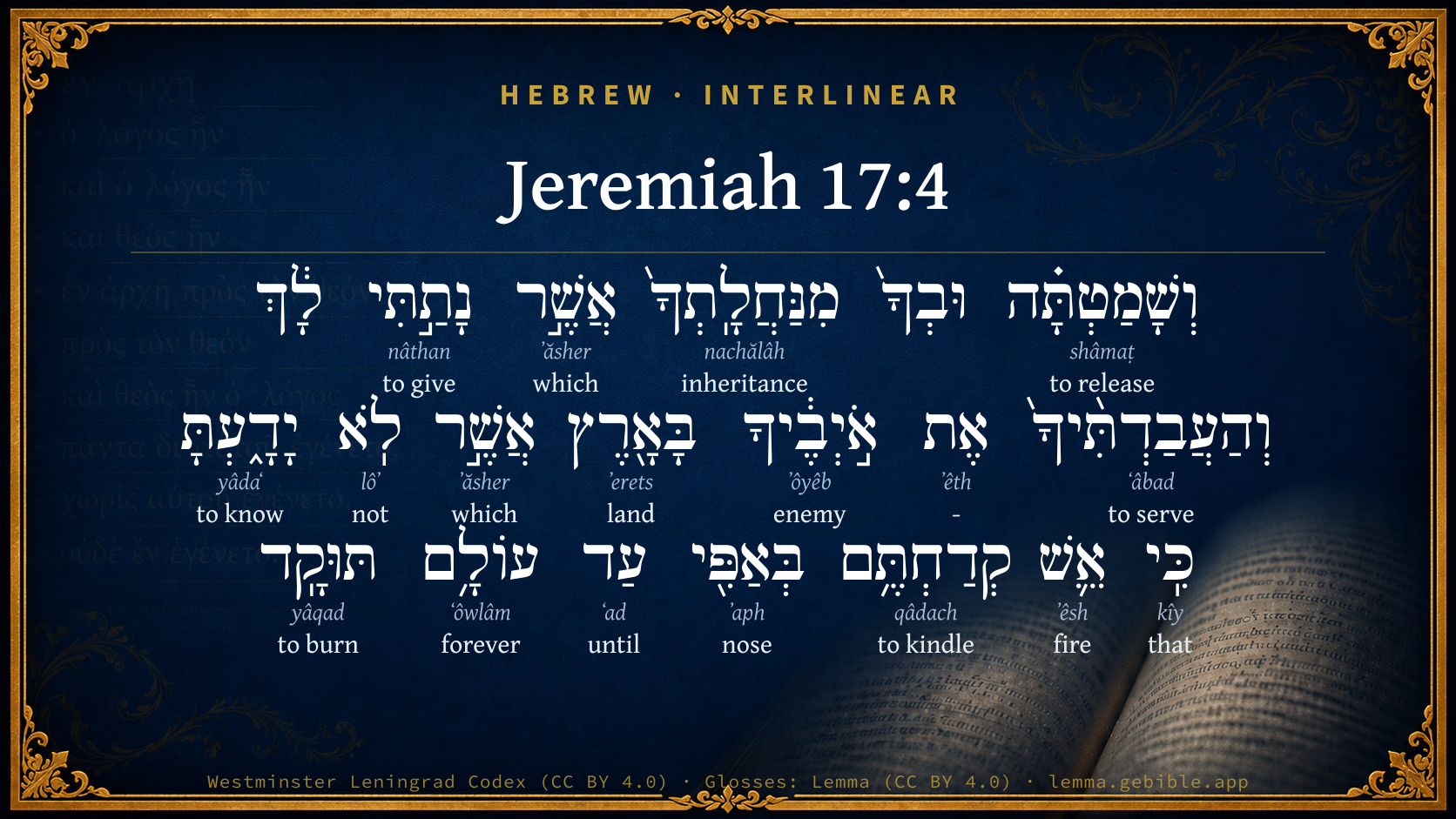
  1. וְשָׁמַטְתָּ֗ה shâmaṭ H8058 “and · to release” Conjunction + Verb, Qal, Sequential Perfect, 2nd Person, Masculine, Singular
  2. מִנַּחֲלָֽתְךָ֙ nachălâh H5159 “from · inheritance · your” Preposition + Noun, Common, Feminine, Singular, Construct + Suffix, Personal, 2nd Person, Masculine, Singular
  3. אֲשֶׁ֣ר ʼăsher H834 “which” Particle, Relative
  4. נָתַ֣תִּי nâthan H5414 “to give” Verb, Qal, Perfect, 1st Person, Common, Singular
  5. וְהַעֲבַדְתִּ֨יךָ֙ ʻâbad H5647 “and · to serve · you” Conjunction + Verb, Hiphil, Sequential Perfect, 1st Person, Common, Singular + Suffix, Personal, 2nd Person, Masculine, Singular
  6. אֶת ʼêth H853 “-” Particle, Direct Object
  7. אֹ֣יְבֶ֔יךָ ʼôyêb H341 “enemy · you” Verb, Qal, Participle Active, Masculine, Plural, Construct + Suffix, Personal, 2nd Person, Masculine, Singular
  8. בָּאָ֖רֶץ ʼerets H776 “in/at the · land” Preposition, Determined + Noun, Common, Both, Singular, Absolute
  9. אֲשֶׁ֣ר ʼăsher H834 “which” Particle, Relative
  10. לֹֽא lôʼ H3808 “not” Particle, Negative
  11. יָדָ֑עְתָּ yâdaʻ H3045 “to know” Verb, Qal, Perfect, 2nd Person, Masculine, Singular
  12. כִּֽי kîy H3588 “that” Conjunction
  13. אֵ֛שׁ ʼêsh H784 “fire” Noun, Common, Both, Singular, Absolute
  14. בְּאַפִּ֖י ʼaph H639 “in/at · nose · my” Preposition + Noun, Common, Masculine, Singular, Construct + Suffix, Personal, 1st Person, Common, Singular
  15. עַד ʻad H5704 “until” Preposition
  16. עוֹלָ֥ם ʻôwlâm H5769 “forever” Noun, Common, Masculine, Singular, Absolute
  17. תּוּקָֽד yâqad H3344 “to burn” Verb, Hophal, Imperfect, 3rd Person, Feminine, Singular

About this verse

These counts appear in no published source. They are computed here, from the morphology-tagged text and Lemma’s own curated glosses. What Lemma adds →

20
words
17
distinct lemmas
Prophets
section

Notable vocabulary

The rarest word here is קְדַחְתֶּ֥ם to kindle H6919 — appearing just 5 times in the whole Hebrew Bible.

Shared distinctive vocabulary

קְדַחְתֶּ֥ם to kindle H6919 occurs in 5 verses of the Hebrew Bible. Also found in:

Grammatical profile

  • 7 verbs
  • 5 nouns
  • 3 prepositions
  • 1 conjunction
  • 4 particles

Verb forms

  • וְשָׁמַטְתָּ֗ה Qal · Sequential Perfect
  • נָתַ֣תִּי Qal · Perfect
  • וְהַעֲבַדְתִּ֨יךָ֙ Hiphil · Sequential Perfect
  • אֹ֣יְבֶ֔יךָ Qal · Participle Active
  • יָדָ֑עְתָּ Qal · Perfect
  • קְדַחְתֶּ֥ם Qal · Perfect
  • תּוּקָֽד Hophal · Imperfect

Repetition

A word recurs within this verse — often emphatic in Hebrew:

  • אֲשֶׁ֣ר which H834 ×2

Cross-references

27

Topical passages linked to Jeremiah 17:4 in the Treasury of Scripture Knowledge — connected by theme and wording, ordered by reader-vote popularity; previews shown in the World English Bible.

  • Jeremiah 15:14 I will make [them] to pass with your enemies into a land which you don't know; for a fire is kindled in my anger, which shall burn on you.
  • Lamentations 5:2 Our inheritance is turned to strangers, Our houses to aliens.
  • Isaiah 5:25 Therefore Yahweh's anger burns against his people, And he has stretched out his hand against them, and has struck them. The mountains tremble, And their dead bodies are as refuse in the midst of the streets. For all this, his anger is not turned away, But his hand is still stretched out.
  • Jeremiah 7:20 Therefore thus says the Lord Yahweh: Behold, my anger and my wrath shall be poured out on this place, on man, and on animal, and on the trees of the field, and on the fruit of the ground; and it shall burn, and shall not be quenched.
  • Mark 9:43–49 If your hand causes you to stumble, cut it off. It is better for you to enter into life maimed, rather than having your two hands to go into Gehenna, into the unquenchable fire,
  • Deuteronomy 4:26–27 I call heaven and earth to witness against you this day, that you shall soon utterly perish from off the land whereunto you go over the Jordan to possess it; you shall not prolong your days on it, but shall utterly be destroyed.
  • Isaiah 14:3 It shall happen in the day that Yahweh shall give you rest from your sorrow, and from your trouble, and from the hard service in which you were made to serve,
  • Jeremiah 16:13 therefore will I cast you forth out of this land into the land that you have not known, neither you nor your fathers; and there shall you serve other gods day and night; for I will show you no favor.
  • Jeremiah 27:12–13 I spoke to Zedekiah king of Judah according to all these words, saying, Bring your necks under the yoke of the king of Babylon, and serve him and his people, and live.
  • Leviticus 26:31–34 I will lay your cities waste, and will bring your sanctuaries to desolation, and I will not take delight in the sweet fragrence of your offerings.
  • Deuteronomy 28:25 Yahweh will cause you to be struck before your enemies; you shall go out one way against them, and shall flee seven ways before them: and you shall be tossed back and forth among all the kingdoms of the earth.
  • Deuteronomy 28:47–48 Because you didn't serve Yahweh your God with joyfulness, and with gladness of heart, by reason of the abundance of all things;
  • Deuteronomy 29:26–28 and went and served other gods, and worshiped them, gods that they didn't know, and that he had not given to them:
  • Deuteronomy 32:22–25 For a fire is kindled in my anger, Burns to the lowest Sheol, Devours the earth with its increase, Sets on fire the foundations of the mountains.
  • Joshua 23:15–16 It shall happen, that as all the good things are come on you of which Yahweh your God spoke to you, so will Yahweh bring on you all the evil things, until he have destroyed you from off this good land which Yahweh your God has given you.
  • 1 Kings 9:7 then will I cut off Israel out of the land which I have given them; and this house, which I have made holy for my name, will I cast out of my sight; and Israel shall be a proverb and a byword among all peoples.
  • 2 Kings 25:21 The king of Babylon struck them, and put them to death at Riblah in the land of Hamath. So Judah was carried away captive out of his land.
  • Nehemiah 9:28 But after they had rest, they did evil again before you; therefore left you them in the hand of their enemies, so that they had the dominion over them: yet when they returned, and cried to you, you heard from heaven; and many times did you deliver them according to your mercies,
  • Isaiah 30:33 For a Topheth is prepared of old; yes, for the king it is made ready; he has made it deep and large; the pile of it is fire and much wood; the breath of Yahweh, like a stream of sulfur, does kindle it.
  • Isaiah 66:24 They shall go forth, and look on the dead bodies of the men who have transgressed against me: for their worm shall not die, neither shall their fire be quenched; and they shall be an abhorring to all flesh.
  • Jeremiah 5:29 Shall I not visit for these things? says Yahweh; shall not my soul be avenged on such a nation as this?
  • Jeremiah 12:7 I have forsaken my house, I have cast off my heritage; I have given the dearly beloved of my soul into the hand of her enemies.
  • Jeremiah 25:9–11 behold, I will send and take all the families of the north, says Yahweh, and [I will send] to Nebuchadrezzar the king of Babylon, my servant, and will bring them against this land, and against the inhabitants of it, and against all these nations round about; and I will utterly destroy them, and make them an astonishment, and a hissing, and perpetual desolations.
  • Lamentations 1:12 Is it nothing to you, all you who pass by? Look, and see if there be any sorrow like my sorrow, which is brought on me, With which Yahweh has afflicted [me] in the day of his fierce anger.
  • Ezekiel 20:47–48 and tell the forest of the South, Hear the word of Yahweh: Thus says the Lord Yahweh, Behold, I will kindle a fire in you, and it shall devour every green tree in you, and every dry tree: the flaming flame shall not be quenched, and all faces from the south to the north shall be burnt thereby.
  • Ezekiel 21:31 I will pour out my indignation on you; I will blow on you with the fire of my wrath; and I will deliver you into the hand of brutish men, skillful to destroy.
  • Nahum 1:5–6 The mountains quake before him, and the hills melt away. The earth trembles at his presence, yes, the world, and all who dwell in it.

Cross-references courtesy of OpenBible.info (CC BY 4.0).

Hebrew and Greek witnesses Masoretic Hebrew ↔ Greek Septuagint

The same verse in the two great witnesses to the Old Testament, shown verse-for-verse.

These are two independent witnesses, not word-aligned to each other, and the Septuagint is shown in lemma (dictionary) form.

Hebrew Jeremiah 17:4 Masoretic · Westminster Leningrad Codex

וְשָׁמַטְתָּ֗ה וּבְךָ֙ מִנַּחֲלָֽתְךָ֙ אֲשֶׁ֣ר נָתַ֣תִּי לָ֔ךְ וְהַעֲבַדְתִּ֨יךָ֙ אֶת אֹ֣יְבֶ֔יךָ בָּאָ֖רֶץ אֲשֶׁ֣ר לֹֽא יָדָ֑עְתָּ כִּֽי אֵ֛שׁ קְדַחְתֶּ֥ם בְּאַפִּ֖י עַד עוֹלָ֥ם תּוּקָֽד

You, even of yourself, shall discontinue from your heritage that I gave you; and I will cause you to serve your enemies in the land which you don't know: for you have kindled a fire in my anger which shall burn forever.

World English Bible · Public Domain

Greek LXX Structure differs

In the Septuagint, Jeremiah is about an eighth shorter than the Hebrew and arranges its material differently — the Oracles Against the Nations (Hebrew chapters 46–51) appear in the middle of the Greek book, after 25:13. Because the chapter and verse boundaries do not line up, a verse-for-verse comparison with the Hebrew is not shown.

A verse-for-verse comparison isn’t shown here because the chapters and verses don’t line up. Switch to the LXX edition with the MT / LXX toggle above to read the Greek directly.

On this verse, John Gill's Exposition discusses the Septuagint’s reading. Read the note in Commentary ↓

Hebrew: Westminster Leningrad Codex (CC BY 4.0). Greek: Septuagint (public domain); English from a public-domain English Septuagint. How the Septuagint differs from the Hebrew →

Targum (Aramaic paraphrase)

1

The Targum is the ancient Jewish Aramaic paraphrase of the Hebrew Scriptures — an interpretive translation, not the Hebrew text itself. Onkelos (literal) and Pseudo-Jonathan (expansive) render the Torah, and Jonathan the Prophets. Coverage is partial: where no permissively-licensed English translation exists for a verse, only the Aramaic is shown. This is verse-level text, not a word-by-word alignment to the Hebrew.

  1. Targum Jonathan Prophets (Joshua–Malachi)
    וְאַיְתֵי סָנְאָה עַל אַרְעֲכוֹן וּתְהֵי צַדְיָא כִּשְׁמִטְתָא וּבְכוֹן אַעְבֵּיד פוּרְעֲנוּת דִינִין עַד דְאַגְלֵי יַתְכוֹן מֵאַחְסַנְתְּכוֹן דִיהָבֵית לְכוֹן וְתִשְׁתַּעְבְּדוּן לְבַעֲלֵי דְבָבֵיכוֹן בְּאַרְעָא דְלָא יְדַעְתּוּן אֲרֵי קִדוּם תַּקִיף כְּאֶשְׁתָּא נְפַק מִן קֳדָמַי בִּרְגַז עַד עַלְמָא יֵיחוּל:

    (no public-domain English translation for this verse)

    Targum Jonathan — Aramaic: “Mikraot Gedolot” (public domain). English: “Sefaria Community Translation” (CC0 1.0 (public-domain dedication)); “London "Chaldee Paraphrase," 1871” (public domain). Text via Sefaria.

Commentary

Notes on Jeremiah 17:4 from classic Christian and Jewish commentators (each source and its license shown beneath its notes). The classic Christian expositions comment on the surrounding passage and are grouped to its opening verse, so a note may address several verses; the Jewish commentaries on the Tanakh (Rashi and others) are per-verse, so they appear only where the commentator wrote on this verse.

Lemma curates 59 commentaries, every one of them public domain or Creative Commons licensed, each selected and text-cleaned for this edition rather than reprinted as found. About our sources →

Trapp's Complete Commentary

John Trapp

Jer 17:4 And thou, even thyself, shalt discontinue from thine heritage that I gave thee; and I will cause thee to serve thine enemies in the land which thou knowest not: for ye have kindled a fire in mine anger, [which] shall burn for ever.

Ver. 4. And thou, even thyself, shalt discontinue.] Or intermit, scil., the tillage of thy land. See Exo 23:11 Lev 26:33-34. It shall keep her Sabbaths.

John Trapp, A Commentary or Exposition upon All the Books of the Old and New Testament (1647–1656) — public domain. Text from a community e-Sword module.

Tyndale Open Study Notes

Tyndale Open Resources

17:4 The wonderful possession, the Promised Land, would slip from Judah’s hands when the people were taken as captives to Babylon.

Tyndale Open Study Notes — © Tyndale Open Resources, licensed CC BY-SA 4.0. Text via the HelloAO Bible API.

Geneva Bible (1599)

Geneva Bible translators

Because thou wouldest not give the land rest, at such times, days, and years as I appointed, thou shalt hereafter be carried away, and it shall rest for lack of laborers.

Geneva Bible (1599) marginal notes — public domain. Text via Bolls.life.

Jamieson, Fausset & Brown

Robert Jamieson, A. R. Fausset & David Brown

even thyself--rather, "owing to thyself," that is, by thy own fault (Jer 15:13).

discontinue from--be dispossessed of. Not only thy substance, but thyself shall be carried off to a strange land (Jer 15:14).

Jamieson, Fausset & Brown — Commentary Critical and Explanatory on the Whole Bible (1871) — public domain (CC PDM 1.0). Text via the HelloAO Bible API.

John Calvin's Commentaries

Here, as it is a concise mode of speaking, there seems to be some obscurity; but as to the subject handled, the meaning of the Prophet is evident, that they would be dismissed from their inheritance, and as it were from their own bowels. Hence he says, You shall be dismissed from your inheritance; that is, though ye think yourselves to be beyond the reach of danger, because as yet the city remains safe, and ye continue in it; yet ye shall perish, as they say, living and seeing. There shall then be a dismissal from the inheritance even as to thee; that is, “Though the Lord should delay the time and suffer you to remain, yet ye shall be like the dead, for God will destroy you, though he may leave you a pining life.” It seems an emphatical expression when the Prophet says that there would be at length a dismissal even as to herself: he intimates, that though some of the people would remain alive, they would yet be given up to exile and dispersion. And it was a condition worse than death for the Jews to have their lives continued and to be scattered among their enemies.

And he says, From the inheritance which I gave to thee; and he says this that they might not expostulate with him, that their own was taken away from them. “How has the land,” he says, “become your inheritance? even because ye have obtained it through my bounty. And now, since ye are so ungrateful, why should I be blamed for taking away what I had given you? or what wrong is done to you? and what can ye object to me? for it has always been my heritage, though for a time I granted it to you. Had ye been thankful to me it would have been yours perpetually; but now when I deprive you of it, this you must ascribe to your own fault.”

For the same purpose he adds, I will make thee to serve thine enemies: and this was much more grievous than to serve their neighbors by whom they were not hated. But he shews here how dreadful would be their calamity, they being constrained to serve their enemies. He adds, In a land which thou knowest not. This is a repetition of what has been said before, and it requires no remark. He in the last place confirms what he had said of their wickedness; Burn, he says, shall fire in my nostril: but אף, aph, may be taken for God’s countenance, though it often means anger. As however he says, “Ye have kindled a fire,” it seems better to render it here, In my face. Further, by the word I never, he intimates that God would be implacable to the Jews, for they had so deserved.

John Calvin's Commentaries (1540-1563) — public domain. Text from the Calvin Translation Society English edition (1840s-50s) via the Christian Classics Ethereal Library (ccel.org). Calvin's coverage is partial (roughly two-thirds of the Bible); uncommented books and verses are honest gaps, never fabricated. The 19th-century editor's footnotes and remarks are omitted so the notes are faithfully Calvin's own voice.

Ellicott's Commentary for English Readers

(4) Thou, even thyself.—Literally, in or by thyself, an emphatic form for expressing loneliness and abandonment.

Shalt discontinue . . .—The word was a half-technical one, used to describe the act of leaving lands untilled and releasing creditors in the sabbatical year (Exo_23:11; Deu_15:2). The land would have its rest now, would “enjoy its Sabbaths” (Lev_26:34; 2Ch_36:21), though Judah had failed in obedience to the Law which prescribed them. For the rest of the verse, see Note on Jer_15:14.

A Bible Commentary for English Readers, edited by Charles John Ellicott (1878–1897) — public domain. Text from a community e-Sword module.

The Cambridge Bible for Schools and Colleges

gen. ed. J. J. S. Perowne

4. and thou, even of thyself, shalt discontinue] i.e. shalt cease to retain a hold upon thy country. We should rather read, and thou shalt let thine hand fall, adopting J. D. Michaelis’s emendation, suggested by Deu_15:3, where the same Hebrew verb in immediate connexion with “thy hand” is used to indicate the cancelling of a debt. Du. and Co. needlessly reject this part of the v., for metrical reasons and as prosaic in expression.

I will cause thee to serve thine enemies] So in all probability we should read in Jer_15:14, according to the second of the alternative margins there.

The Cambridge Bible for Schools and Colleges (gen. ed. J. J. S. Perowne; Cambridge University Press, 1878–1918) — public domain. Text from a community e-Sword module.

John Gill's Exposition

And thou, even thyself,.... Or, "thou, and in thee" (l); that is, thou and those that are in thee, all the inhabitants of Jerusalem and Judea; or, "thou even through thyself" (m); through thine own fault, by reason of thy sins and iniquities:

shalt discontinue from thine heritage that I gave thee; be removed from it, and no longer enjoy it: or, "shalt intermit from thine heritage" (n); shall not till the land, plough and sow, and reap, and gather the fruits of it: this was enjoined on every seventh year, when the land was to have its rest, or sabbath, Exo 23:10, but this law they did not observe; and now, therefore, whether they would or not, the land should be intermitted, and not tilled and enjoyed by them. The Targum takes in the whole of the sense,

"and I will bring an enemy upon your land; and it shall be desolate as in the year of intermission: and I will take vengeance of judgment upon you, until I remove you from your inheritance which I have given unto you;''

the land of Canaan, which was given them for an inheritance:

I will cause thee to serve thine enemies in the land which thou knowest not; the Babylonians in Chaldea; or, as Jerom thinks; the Romans. Of the different reading of these words; see Gill on Jer 15:13,

for ye have I kindled a fire in mine anger; or by their sins had caused the anger of the Lord to burn like fire:

which shall burn for ever; as it will in hell, and therefore called everlasting fire: here it only means until these people and their country were consumed by the enemy; perhaps some reference is had to the burning of the city and temple by the Babylonians, or Romans, or both. These first four verses are left out by the Septuagint interpreters, Jerom thinks, to spare their own people.

(l) "qui sunt apud te", Junius & Tremellius. (m) "Per te", Piscator. (n) "ita intermissionen facies", Junius & Tremellius; so Schmidt.

John Gill's Exposition of the Whole Bible (1746–1763) — public domain (CC PDM 1.0). Text via the HelloAO Bible API.

Albert Barnes' Notes on the Bible

The verb rendered “discontinue” is that used of letting the land rest Exo 23:11, and of releasing creditors Deu 15:2 in the sabbatical year. As Judah had not kept these sabbatical years she must now discontinue the tillage of God’s inheritance until the land had had its rest. “Even thyself may mean and that through thyself,” through thine own fault.

Albert Barnes' Notes on the Bible (1834–1885) — public domain. Text from a community e-Sword/MySword module.

Haydock's Catholic Bible Commentary

Be left. Protestants, "discontinue from thine," &c. (Haydock) --- The land shall have its sabbaths, which thou wouldst not allow. (Chaldean) (Exodus xxii. 11., and Leviticus xxvi. 34.)

George Leo Haydock (1774–1849), Haydock's Catholic Family Bible and Commentary, 1859 edition — public domain. Excludes Psalms (Douay-Rheims chapter numbering differs from Protestant) and Deuterocanonical books (Catholic canon only).

Matthew Poole's English Annotations

In the word

discontinue there is a secret promise that they should again come and possess and inherit their land; they should not lose their inheritance, but only discontinue their possession and occupation of it. Some learned authors considering that the same word is here used which is used Exo 23:11, in the law concerning the sabbatical rest, when they were to let the land rest, and lie still, Lev 26:34, think this text hath a reference to that, and the meaning is, Thou shalt discontinue thy ploughing and tilling the land; and go into thine enemies’ country, and serve them in a land of which thou hast no knowledge; because by thine idolatry and other sins thou hast increased my wrath into such a fire, as shall burn for a long time, for so the word for ever is oft taken, Exo 21:6; Deu 15:17; Psa 89:1; Isa 34:10.

Matthew Poole's English Annotations on the Holy Bible (1683–1685) — public domain. Text from a community e-Sword/MySword module.

Whedon's Commentary on the Bible

Daniel D. Whedon

4. Shalt discontinue — That is, be dispossessed of. Even thyself — By thine own fault, and by that only.

Daniel D. Whedon (gen. ed.), Commentary on the Old and New Testaments (1874–1909) — public domain. Text from a community e-Sword module.

The Pulpit Commentary

Comp. Jer_15:14 Even thyself; literally, even with thyself, i.e. with thy bare life (if the text, which is here evidently rather out of order, is correct). Shalt discontinue. The word involves an allusion to the Law in Exo_23:11 and (especially) Deu_15:2 (see the Hebrew). The latter passage suggests a correction of the difficult "even with thyself," just preceding, into "thy hand." Thus we get for the opening of this verse, "And thou shalt let loose thy hand" (i.e. as Authorized Version, "shalt discontinue").

The Pulpit Commentary (1880–1919), ed. H.D.M. Spence-Jones & Joseph S. Exell — public domain. Text from a community e-Sword module.

John Wesley's Explanatory Notes

For ever - For a long time; so the word ever is often taken.

John Wesley, Explanatory Notes Upon the Whole Bible (1754–1765) — public domain. Text via the GEBible commentary corpus.

Rashi

Rabbi Shlomo Yitzchaki (Rashi)

And you shall release Perforce you will release your land for the time that it did not rest on your Sabbaths, which I said to you (Lev. 25:2), “And the land shall rest a Sabbath for the Lord.”

of you I will avenge Myself of you because of your heritage that I gave you, that you did not perform My will to release it. Another explanation: even of you, from your heritage; I will avenge Myself of you from your heritage, that I will exile you from it.

for you have kindled fire in My nostrils Heb. קְדַכְתֶּם.

Rashi on the Tanakh — English translations: “The Judaica Press complete Tanach with Rashi, translated by A. J. Rosenberg” (CC BY 4.0); “Pentateuch with Rashi's commentary by M. Rosenbaum and A.M. Silbermann, 1929-1934” (public domain); “The Metsudah Tanach series, Lakewood, N.J” (CC BY 4.0); and “The Book of Joshua, Metsudah Publications, 1997” (CC BY 4.0). Text via Sefaria.

Lesson kit

Teaching starters — assembled from the data on this page, not authored interpretation. Every prompt links to the verse data it draws on. Edit before teaching.

Jeremiah, in the Prophets, opens this verse with 20 words (17 distinct Hebrew lemmas). Its most distinctive word is qâdach (“to kindle”). A historical commentator’s framing appears above. Read the whole chapter for the surrounding context.

Discussion questions

  1. What does “to kindle” (qâdach) contribute to the verse as a whole?
  2. How does Deuteronomy 32:22, which shares the word «to kindle», read alongside this verse?
  3. What does the repetition of “which” (2× in this one verse) do in this verse?
  4. These translations render this verse differently; the difference is in the English rendering, not the original. What questions does that raise?
  5. «וְשָׁמַטְתָּ֗ה» is a Qal Sequential Perfect verb. How does that grammatical form shape the action described?
  6. Compare how Trapp's Complete Commentary and Tyndale Open Study Notes read this verse. Where do they agree or differ?

Things to notice

Reading settings

Reading text

Shown beneath each verse's original-language words.

Old Testament
Old Testament edition

Read the OT as the Masoretic Hebrew (MT) or the Greek Septuagint (LXX).

English shown for the Greek Septuagint (in the Hebrew ↔ Greek comparison).

Comparing translations? Open the Compare panel on any verse page to stack up to four side by side.