
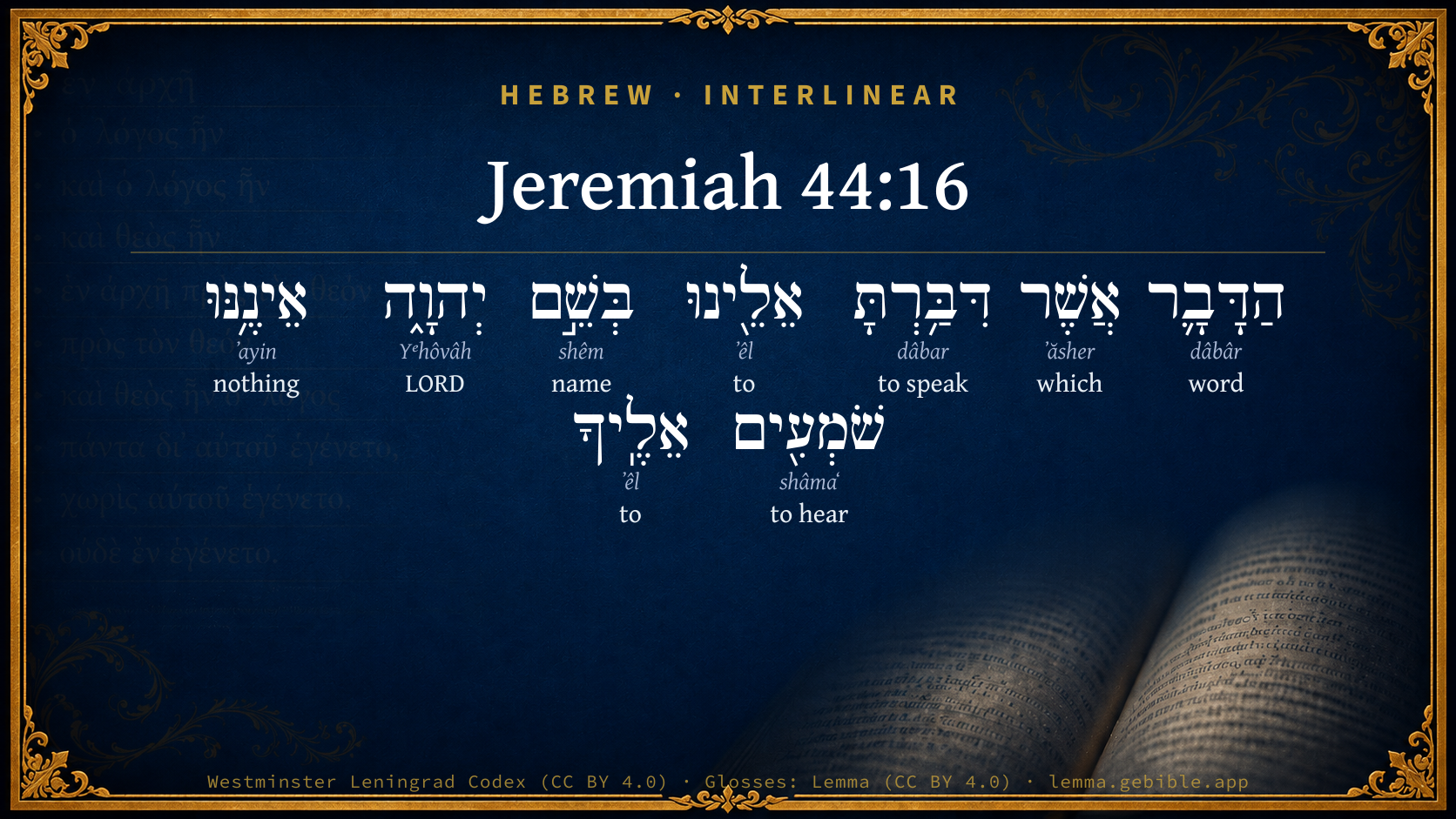
Jeremiah 44:16

Hebrew (Westminster Leningrad Codex) Jeremiah 44:16 appears in the Hebrew Old Testament. The text above is from the Westminster Leningrad Codex. Each word links to its Strong’s number, a concise gloss, and parsing drawn from the Open Scriptures Hebrew Bible morphology. Click any word for its full Brown-Driver-Briggs (BDB) entry.
Download image
Cite this verse

Jeremiah 44:16 (World English Bible). Public Domain. Lemma interlinear Bible study tool, https://lemma.gebible.app/v/jeremiah/44/16.

Show BibTeX & RIS
BibTeX
RIS
English Translation
As for the word that you have spoken to us in the name of Yahweh, we will not listen to you.
World English Bible · Public Domain
Download a study sheet

One document with this verse’s original text, its word-by-word gloss line, the meaning frame, cross-references with their text, attributed commentary, and full source and license credits — printable, and it pastes into notes with its structure intact.

This verse Autodidact and up

Study sheet (.html) Plain text (.txt)

A passage Seminary Student

Up to 50 verses in one chapter. A passage sheet keeps up to 6 commentary sources and 12 cross-references per verse, in the order this page ranks them, and says so on the sheet whenever that leaves anything out. Ask for a single verse and you get the Autodidact verse sheet above.

Everything on this page stays free to read, with no account — the sheet is a download of what is already on screen, not access to it.

Want to remove ads? Support Godless Engineer
Compare translations 3

The same verse in 3 English versions, stacked beneath the original-language interlinear above. Click any original word for its lexicon entry.

Each is an independent rendering of the whole verse — the interlinear is not word-aligned to these translations.

Highlighted words mark where these versions differ — a whole-verse word diff, not a word-by-word alignment.

  • World English Bible Public Domain
    As for the word that you have spoken to us in the name of Yahweh, we will not listen to you.
  • King James Version Public Domain
    As for the word that thou hast spoken unto us in the name of the LORD, we will not hearken unto thee.
  • unfoldingWord Literal Text CC BY-SA 4.0
    They said, “About the word that you have told us in Yahweh’s name—we will not listen to you.

unfoldingWord Literal Text — © unfoldingWord, licensed CC BY-SA 4.0. Word-aligned USFM3 via Door43 (git.door43.org/unfoldingWord/en_ult).

Versions to compare (up to 4)

3 of 4 selected

Show all 18 translations

Every available English version of this verse, each an independent rendering of the whole verse.

  • World English Bible Public Domain
    As for the word that you have spoken to us in the name of Yahweh, we will not listen to you.
  • Berean Standard Bible Public Domain
    “As for the word you have spoken to us in the name of the LORD, we will not listen to you!
  • Majority Standard Bible Public Domain
    “As for the word you have spoken to us in the name of the LORD, we will not listen to you!
  • King James Version Public Domain
    As for the word that thou hast spoken unto us in the name of the LORD, we will not hearken unto thee.
  • American Standard Version (1901) Public Domain
    As for the word that thou hast spoken unto us in the name of Jehovah, we will not hearken unto thee.
  • Revised Version (1885) Public Domain
    As for the word that thou hast spoken unto us in the name of the LORD, we will not hearken unto thee.
  • Geneva Bible (1599) Public Domain
    The worde that thou hast spoken vnto vs in the Name of the Lord, wee will not heare it of thee,
  • Douay-Rheims (1899) Public Domain
    As for the word which thou hast spoken to us in the name of the Lord, we will not hearken to thee:
  • Young's Literal Translation Public Domain
    `The word that thou hast spoken unto us in the name of Jehovah -- we are not hearkening unto thee;
  • Literal Standard Version CC BY-SA 4.0
    “The word that you have spoken to us in the Name of YHWH—we are not listening to you;
  • Unlocked Literal Bible CC BY-SA 4.0
    They said, “About the word that you have told us in Yahweh's name—we will not listen to you.
  • unfoldingWord Literal Text CC BY-SA 4.0
    They said, “About the word that you have told us in Yahweh’s name—we will not listen to you.
  • Darby Bible Public Domain
    [As for] the word that thou hast spoken unto us in the name of Jehovah, we will not hearken unto thee,
  • World Messianic Bible Public Domain
    “As for the word that you have spoken to us in the LORD’s name, we will not listen to you.
  • Webster's Bible Public Domain
    As for the word that thou hast spoken to us in the name of the LORD, we will not hearken to thee.
  • Free Bible Version CC BY-SA 4.0
    “Even though you say this message is from the Lord, we're not going to listen to you.
  • Bible in Basic English Public Domain
    As for the word which you have said to us in the name of the Lord, we will not give ear to you.
  • JPS Tanakh (1917) Public Domain
    'As for the word that thou hast spoken unto us in the name of the LORD, we will not hearken unto thee.

Literal Standard Version (2020), Covenant Press — licensed CC BY-SA 4.0. Text via the HelloAO Bible API (eBible.org). Unlocked Literal Bible (unfoldingWord) — licensed CC BY-SA 4.0. Text via the HelloAO Bible API (eBible.org). unfoldingWord Literal Text — © unfoldingWord, licensed CC BY-SA 4.0. Word-aligned USFM3 via Door43 (git.door43.org/unfoldingWord/en_ult). Free Bible Version, Dr. Jonathan Gallagher — licensed CC BY-SA 4.0. Text via the HelloAO Bible API (eBible.org).

Word by word

More ways to search: Search by grammar → Find every occurrence → Compare this word →

Practice this passage: Drill this verse → Learn its vocabulary →

אֵינֶ֥נּוּ
ʼayin
H369
“nothing · us”
Particle, Negative + Suffix, Personal, 1st Person, Common, Plural
Part of Speech
Particle
Type
Negative
Full BDB Definition

Origin: as if from a primitive root meaning to be nothing or not exist

TWOT: 81

nothing, not, nought - nothing, nought (noun) - not (negative) - to have not (of possession) - without (adverb) - for lack of (with a preposition)
  1. הַדָּבָ֛ר dâbâr H1697 “the · word” Particle, Definite Article + Noun, Common, Masculine, Singular, Absolute
  2. אֲשֶׁר ʼăsher H834 “which” Particle, Relative
  3. דִּבַּ֥רְתָּ dâbar H1696 “to speak” Verb, Piel, Perfect, 2nd Person, Masculine, Singular
  4. אֵלֵ֖ינוּ ʼêl H413 “to · us” Preposition + Suffix, Personal, 1st Person, Common, Plural
  5. בְּשֵׁ֣ם shêm H8034 “in/at · name of” Preposition + Noun, Common, Masculine, Singular, Construct
  6. יְהוָ֑ה Yᵉhôvâh H3068 “LORD” Noun, Proper
  7. שֹׁמְעִ֖ים shâmaʻ H8085 “hearing” Verb, Qal, Participle Active, Masculine, Plural, Absolute
  8. אֵלֶֽיךָ ʼêl H413 “to · you” Preposition + Suffix, Personal, 2nd Person, Masculine, Singular

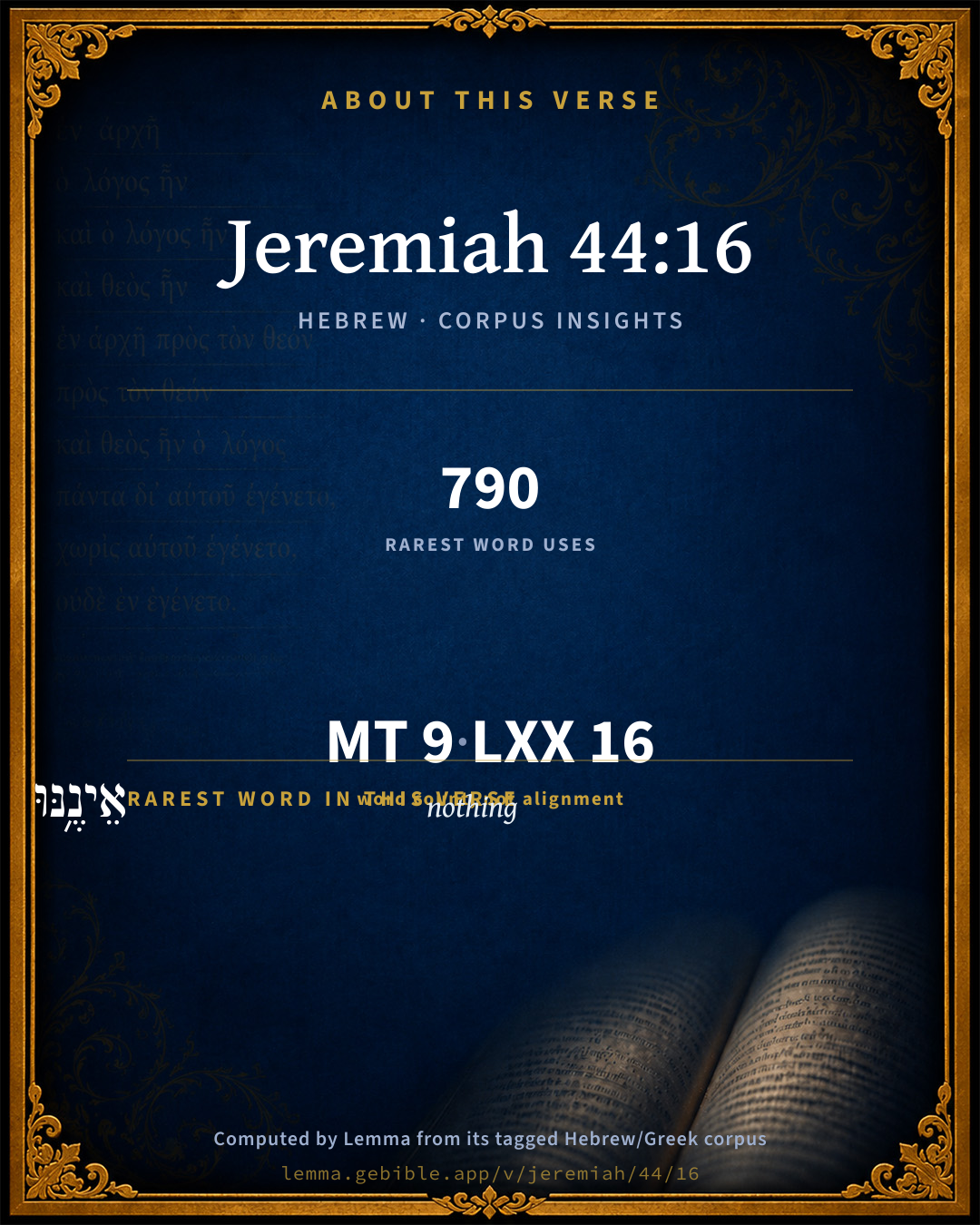
About this verse

These counts appear in no published source. They are computed here, from the morphology-tagged text and Lemma’s own curated glosses. What Lemma adds →

9
words
8
distinct lemmas
Prophets
section

Grammatical profile

  • 2 verbs
  • 3 nouns
  • 2 prepositions
  • 2 particles

Verb forms

  • דִּבַּ֥רְתָּ Piel · Perfect
  • שֹׁמְעִ֖ים Qal · Participle Active

Repetition

A word recurs within this verse — often emphatic in Hebrew:

  • אֵלֵ֖ינוּ to H413 ×2

Hebrew & Septuagint length

In the original languages it is 9 Hebrew tokens and 16 Greek tokens — but the two are counted differently (Hebrew bundles its prefixes and suffixes into one token; the Greek is in lemma form), so that isn’t a like-for-like length.

Cross-references

16

Topical passages linked to Jeremiah 44:16 in the Treasury of Scripture Knowledge — connected by theme and wording, ordered by reader-vote popularity; previews shown in the World English Bible.

  • Luke 19:27 But bring those enemies of mine who didn't want me to reign over them here, and kill them before me.'"
  • Job 21:14–15 They tell God, 'Depart from us, For we don't want to know about your ways.
  • Exodus 5:2 Pharaoh said, "Who is Yahweh, that I should listen to his voice to let Israel go? I don't know Yahweh, and moreover I will not let Israel go."
  • Job 15:25–27 Because he has stretched out his hand against God, And behaves himself proudly against the Almighty;
  • Psalms 2:3 "Let's break their bonds apart, And cast away their cords from us."
  • Psalms 73:8–9 They scoff and speak with malice. In arrogance, they threaten oppression.
  • Isaiah 3:9 The look of their faces testify against them. They parade their sin like Sodom. They don't hide it. Woe to their soul! For they have brought disaster upon themselves.
  • Jeremiah 8:6 I listened and heard, but they didn't speak aright: no man repents him of his wickedness, saying, What have I done? everyone turns to his course, as a horse that rushes headlong in the battle.
  • Jeremiah 8:12 Were they ashamed when they had committed abomination? nay, they were not at all ashamed, neither could they blush: therefore shall they fall among those who fall; in the time of their visitation they shall be cast down, says Yahweh.
  • Jeremiah 11:8 Yet they didn't obey, nor turn their ear, but walked everyone in the stubbornness of their evil heart: therefore I brought on them all the words of this covenant, which I commanded them to do, but they didn't do them.
  • Jeremiah 11:10 They are turned back to the iniquities of their forefathers, who refused to hear my words; and they are gone after other gods to serve them: the house of Israel and the house of Judah have broken my covenant which I made with their fathers.
  • Jeremiah 16:15–17 but, As Yahweh lives, who brought up the children of Israel from the land of the north, and from all the countries where he had driven them. I will bring them again into their land that I gave to their fathers.
  • Jeremiah 18:18 Then said they, Come, and let us devise devices against Jeremiah; for the law shall not perish from the priest, nor counsel from the wise, nor the word from the prophet. Come, and let us strike him with the tongue, and let us not give heed to any of his words.
  • Jeremiah 38:4 Then the princes said to the king, Let this man, we pray you, be put to death; because he weakens the hands of the men of war who remain in this city, and the hands of all the people, in speaking such words to them: for this man doesn't seek the welfare of this people, but the hurt.
  • Daniel 3:15 Now if you are ready whenever you hear the sound of the horn, flute, zither, lyre, harp, pipe, and all kinds of music to you fall down and worship the image which I have made, [well]: but if you don't worship, you shall be cast the same hour into the midst of a burning fiery furnace; and who is that god that shall deliver you out of my hands?
  • Luke 19:14 But his citizens hated him, and sent an envoy after him, saying, 'We don't want this man to reign over us.'

Cross-references courtesy of OpenBible.info (CC BY 4.0).

Hebrew and Greek witnesses Masoretic Hebrew ↔ Greek Septuagint

The same verse in the two great witnesses to the Old Testament, shown verse-for-verse.

These are two independent witnesses, not word-aligned to each other, and the Septuagint is shown in lemma (dictionary) form.

Hebrew Jeremiah 44:16 Masoretic · Westminster Leningrad Codex

הַדָּבָ֛ר אֲשֶׁר דִּבַּ֥רְתָּ אֵלֵ֖ינוּ בְּשֵׁ֣ם יְהוָ֑ה אֵינֶ֥נּוּ שֹׁמְעִ֖ים אֵלֶֽיךָ

As for the word that you have spoken to us in the name of Yahweh, we will not listen to you.

World English Bible · Public Domain

Greek LXX Structure differs

In the Septuagint, Jeremiah is about an eighth shorter than the Hebrew and arranges its material differently — the Oracles Against the Nations (Hebrew chapters 46–51) appear in the middle of the Greek book, after 25:13. Because the chapter and verse boundaries do not line up, a verse-for-verse comparison with the Hebrew is not shown.

A verse-for-verse comparison isn’t shown here because the chapters and verses don’t line up. Switch to the LXX edition with the MT / LXX toggle above to read the Greek directly.

Hebrew: Westminster Leningrad Codex (CC BY 4.0). Greek: Septuagint (public domain); English from a public-domain English Septuagint. How the Septuagint differs from the Hebrew →

Targum (Aramaic paraphrase)

1

The Targum is the ancient Jewish Aramaic paraphrase of the Hebrew Scriptures — an interpretive translation, not the Hebrew text itself. Onkelos (literal) and Pseudo-Jonathan (expansive) render the Torah, and Jonathan the Prophets. Coverage is partial: where no permissively-licensed English translation exists for a verse, only the Aramaic is shown. This is verse-level text, not a word-by-word alignment to the Hebrew.

  1. Targum Jonathan Prophets (Joshua–Malachi)
    פִּתְגָמָא דְמַלֵילְתָּא עִמָנָא בִּשְׁמָא דַייָ לֵית אֲנַחְנָא צָבָן לְקַבָּלָא מִנָךְ:

    (no public-domain English translation for this verse)

    Targum Jonathan — Aramaic: “Mikraot Gedolot” (public domain). English: “Sefaria Community Translation” (CC0 1.0 (public-domain dedication)); “London "Chaldee Paraphrase," 1871” (public domain). Text via Sefaria.

Commentary

Notes on Jeremiah 44:16 from classic Christian and Jewish commentators (each source and its license shown beneath its notes). The classic Christian expositions comment on the surrounding passage and are grouped to its opening verse, so a note may address several verses; the Jewish commentaries on the Tanakh (Rashi and others) are per-verse, so they appear only where the commentator wrote on this verse.

Lemma curates 59 commentaries, every one of them public domain or Creative Commons licensed, each selected and text-cleaned for this edition rather than reprinted as found. About our sources →

Trapp's Complete Commentary

John Trapp

Jer 44:16 [As for] the word that thou hast spoken unto us in the name of the LORD, we will not hearken unto thee.

Ver. 16. As for the word which thou hast spoken unto us in the name of the Lord, we will not hearken unto thee.] This is just woman-like. See Jer 44:15. When man lost his freewill, saith one, woman got it; and whereas there came twelve kabs (measures) of speech at first down from heaven, women ran away with ten of them, say the Rabbis merrily. Here they are very talkative and peremptory; in some there is a strong inclination, a vehement impetus, to whoredom, which the prophet Hosea calleth a spirit of whoredom. Such there was in these women to idolatry; they were fully set upon it.

John Trapp, A Commentary or Exposition upon All the Books of the Old and New Testament (1647–1656) — public domain. Text from a community e-Sword module.

The Biblical Illustrator

Joseph S. Exell

Jer_44:16

As for the word which thou hast spoken to us in the name of the Lord, we will net hearken unto thee.

The ministerial message and its reception

I. It devolves on ministers to speak to sinners in the name of the Lord.

1. They represent to them their deplorable situation; they describe to them the horrors of the pit wherein there is no water, in which they lie; the miseries of that prison in which they are closely confined; the unprofitableness of the drudgery in which they are engaged; and the tribulation and anguish which they have to expect. Knowing the terrors of the Lord, they persuade men; and sensible that, if they are unfaithful, the blood of souls will be required at their hands, they are instant in season and out of season, if by any means they Could persuade them to flee from the wrath to come.

2. They do all this in the name of the Lord.

(1) They speak in obedience to His command.

(2) They speak in perfect agreement with the Divine word.

(3) They preach in the hope of promoting His glory.

II. The unpleasant reception with which their message often meets. We will not hearken.

1. We hope that there are but few who would plainly say this in words; who are so hardened as to glory in their shame; or so incorrigible as to tell Gods ministers that they cast His words behind their back, as unworthy of attention, and beneath their notice: yet we are persuaded that there are many professors who say this in their hearts, and who will not see when the hand of God is lifted up; for if this were not the case, would ministers so often have to lament over them, saying, Oh, that they were wise; and, Oh, that there were such a heart in them, to keep His commandments and do them? Careless hearers all say, We will not hearken unto Thee. And oh, how few are there that will hear believingly! The word does not profit, not being mixed with faith in them that hear it; men often reject the counsel of God against themselves, and disbelieve the record that God has given of His Son. Their conduct shows that they believe not in the name of the only-begotten Son of God.

2. What is the reason that they will not attend to those things, which, it is evident, belong to their peace?

(1) Because they are in league with sin.

(2) What your ministers preach loudly speaks your condemnation.

I would say, by way of inference, In what an awful state are those persons who are making the resolution contained in the text. They are evidently exposed to the loss of their privileges; to hardness of heart, and contempt of Gods Word and commandments; and to utter and eternal destruction. (T. Spencer.)

.

The Biblical Illustrator, edited by Joseph S. Exell (c. 1880s–1900s) — public domain. Text from a community e-Sword module.

Joseph Benson's Commentary

Jer 44:16-19. As for the word thou hast spoken unto us, we will not hearken unto thee — Johanan and the rest (Jer 43:5) only denied that God had said such things, and told Jeremiah he had spoken falsely: but now these people rise higher; they acknowledge Jeremiah had spoken to them in the name of the Lord, but, nevertheless, tell him in plain terms they would not obey his word, and indeed this is in the hearts of all sinners that are ruled by their lusts; though they will sometimes pretend that what they hear is not the will of God, but spoken out of malice and prejudice; yet they are pre-resolved they will not comply with it, let their understandings be never so well informed. But will certainly do whatsoever thing goeth out of our own mouth — That is, that which we have solemnly vowed to perform. Here we have the root of all the disobedience of sinners, their resolution to please themselves, and do their own will, and not in any thing to deny themselves. To burn incense to the queen of heaven — To the moon and the rest of the host of heaven: see the note on Jer 7:18; and Jer 19:13. As we have done, we and our fathers, &c. — Their arguments for continuing in this idolatry are, 1st, Custom and antiquity; they and their fathers had practised it. 2d, The example of their kings and princes. 3d, The plenty and prosperity they had while they did so, as if their idols and not Jehovah had been the authors of it. They compared their former condition, before the invasion of Judea and the siege of Jerusalem, with their present state, and argued from their being in prosperity at that time, that they must needs have been then in the right; not considering that it was to be ascribed to the goodness and long-suffering of God waiting for their repentance, as being unwilling to destroy them, or even to bring any great calamity upon them. Besides, though on account of the measure of their iniquity being filled up, they now suffered more grievous calamities than they had ever done before, yet, if they were at all acquainted with the history of former times, they could not but know that idolatry had always brought calamities on their fathers, and that they never were so prosperous as when they worshipped and served Jehovah only. But since we left off, &c., we have wanted all things — This is their last argument in defence of their idolatry, an argument drawn from the evils that had befallen them since they had left off to worship the host of heaven; thus making their ceasing to commit the sin of idolatry the cause of their sufferings, whereas, in truth, the commission of that and their other sins had been the cause of all the calamities to which they had been exposed. And when we burned incense, &c., did we worship her without our men? — Here the women speak, and allege that their husbands had joined with them in offering incense to the host of heaven, and that it was not done without their privity. “By the law of Moses the men had an independent power of binding themselves by any religious vow or obligation; but the vows of the women were not binding, without the knowledge and consent of their fathers and husbands; but if the father or husband knew of the vow, and did not signify his dissent at the time, his consent was presumed, and the vow stood firm and irrevocable, Num 30:1-16. This appeal, therefore, to the concurrence of their men must be considered as coming from the female part of the assembly only, who thereby appear to declare that since they were thus authorized by those who alone had a legal right to control them, they should not submit to any other restraint upon their inclinations.” — Blaney.

Joseph Benson's Commentary on the Old and New Testaments (1811–1818) — public domain. Text from a community e-Sword module.

Geneva Bible (1599)

Geneva Bible translators

This declareth how dangerous a thing it is to decline once from God, and to follow our own fantasies: for Satan ever soliciteth such, and doth not leave them till he have brought them to extreme impudency and madness, even to justify their wickedness against God and his Prophets.

Geneva Bible (1599) marginal notes — public domain. Text via Bolls.life.

Jamieson, Fausset & Brown

Robert Jamieson, A. R. Fausset & David Brown

we will not-- (Jer 6:16).

Jamieson, Fausset & Brown — Commentary Critical and Explanatory on the Whole Bible (1871) — public domain (CC PDM 1.0). Text via the HelloAO Bible API.

John Calvin's Commentaries

We see, in short, that God’s Prophet was rejected; and yet there is no doubt but the Jews pretended some religion, but they did not think that they were bound to obey the command of man. And whence was this contempt? even from nothing but perverseness; for however hypocrites may dissemble and say that they do not despise God and his word, and address their words to ministers, yet their impiety betrays them when, on the one hand, they pretend that they worship God, and on the other they repudiate those furnished with his commands whom he would have them to hear. But God will not and cannot have himself separated from his word. Let us now go on —

John Calvin's Commentaries (1540-1563) — public domain. Text from the Calvin Translation Society English edition (1840s-50s) via the Christian Classics Ethereal Library (ccel.org). Calvin's coverage is partial (roughly two-thirds of the Bible); uncommented books and verses are honest gaps, never fabricated. The 19th-century editor's footnotes and remarks are omitted so the notes are faithfully Calvin's own voice.

John Gill's Exposition

As for the word that thou has, spoken unto us in the name of the Lord,.... Which they did not believe that it came from the Lord, but was a device of the prophet's, and a lie, as in Jer 43:2; and if it did come from the Lord, their impudence was risen to such a pitch, that they were determined not to regard it:

we will not hearken unto thee: to thy words; neither to thy exhortations, reproofs, or menaces, even though thou comest and speakest in the name of the Lord. This, and what follows, is an unparalleled instance of the pride, obstinacy, enmity, and rebellion of the carnal mind against God.

John Gill's Exposition of the Whole Bible (1746–1763) — public domain (CC PDM 1.0). Text via the HelloAO Bible API.

Matthew Poole's English Annotations

We read, Jer 43:5, Johanan and the rest only denied that God had spoken such things, and told Jeremiah he had spoken falsely; but now these women and men rise higher, they acknowledge Jeremiah had spoken to them in the name of the Lord, but tell him in plain and direct terms they would not obey it. And indeed this is in the hearts of all sinners that are ruled by their lusts; though they will sometimes pretend that what they hear is not the will of God, but spoken out of malice and prejudice, yet they are pre-resolved they will not do it, let their understandings be never so well informed.

Matthew Poole's English Annotations on the Holy Bible (1683–1685) — public domain. Text from a community e-Sword/MySword module.

The Pulpit Commentary

Open rebellion.

I GOD LEAVES US FREE TO ACCEPT OR REJECT HIS AUTHORITY. Whatever may be urged from the standpoints of abstract philosophy and of speculative theology, in practice, as Butler says, we all act as though we were free. In the Bible, too, this practical freedom of the will is constantly implied and appealed to. Though we have no moral right to renounce the Law of God, though we shall suffer if we do so, the terrible power of rebellion is entrusted to us that our loyalty may be proved and our service may remain free and willing.

II ALL EVIL CENTRES IN THE WILL. The idolatrous Jews will not hearken to the word of Jeremiah. Herein lies the sum and substance of their offence. Depraved appetites and wicked passions are temptations to the evil will or products of its deeds. In themselves they are no more wicked than the external temptations which appeal to the purest elements of our common human nature. Guilt consists in yielding to them in the act of the will that consents, indulges, or urges.

III WILFUL REJECTION OF TRUTH IS REBELLION AGAINST GOD. Not to hearken is to revolt. We must be careful to distinguish pure intellectual doubt and unbelief from this revolt of the will against truth. The latter may not deny the correctness of what it rejects; it simply refuses to follow it. If it does fail to believe the truth, but through only wilfully closing all avenues of evidence, the blame of an evil will must be attached to it.

IV SELF-WILL IS AN EVIL WILL. In rejecting the Divine message the idolatrous Jews insolently add, "We will certainly do the whole word which hath gone forth out of our own mouth" (see ver. 17).

1. Self-will even in regard to things innocent in themselves is nevertheless an evil will. For we are not our own masters. The servant is wrong if he disobey his master, though to do a harmless act. The soldier is guilty in disobeying orders, whatever other course he may take. We are "under authority." If our Captain says, "Go," we are not free to stand for the most innocent reason.

2. Self-will is too often directed to evil things. Those Jews who deliberately rejected the Divine message chose to perform acts of idolatry of their own will. Our will is corrupt. Left to itself it chooses much that is evil, To keep it pure we must lift it up to union with a higher will. When it breaks loose and defiantly chooses its own private course, its evil nature will incline it to a bad course.

V COMPANIONSHIP IN SIN BECOMES CONSPIRACY IN GREATER SIN. The husbands support their wives in the evil practices of the women, and together they declare that for the future they will pursue these practices openly and deliberately. But the closest relationship and the warmest affection are no reasons for defending wicked conduct, much less for encouraging and sharing it. When the love of husband and wife conflicts with the love of God, even that most near and sacred tie should yield to the highest of all obligations. Otherwise the marriage relation, which is instituted for the blessings of mutual comfort and happiness, becomes a curse.

The Pulpit Commentary (1880–1919), ed. H.D.M. Spence-Jones & Joseph S. Exell — public domain. Text from a community e-Sword module.

Lesson kit

Teaching starters — assembled from the data on this page, not authored interpretation. Every prompt links to the verse data it draws on. Edit before teaching.

Jeremiah, in the Prophets, opens this verse with 9 words (8 distinct Hebrew lemmas). Its most distinctive word is ʼayin (“nothing”). A historical commentator’s framing appears above. Read the whole chapter for the surrounding context.

Discussion questions

  1. The word ʼayin carries the sense “nothing.” How does it shape the verse?
  2. Luke 19:27 shares this passage’s theme. How do the two illuminate each other?
  3. “to” occurs 2× in this one verse. What is the effect of the repetition?
  4. These translations render this verse differently. What is at stake in choosing one wording over another?
  5. The verb «דִּבַּ֥רְתָּ» is Piel Perfect. How does its form color the action?
  6. Reading how Trapp's Complete Commentary and The Biblical Illustrator read this verse, where do the two commentators agree and where do they part?

Things to notice

Reading settings

Reading text

Shown beneath each verse's original-language words.

Old Testament
Old Testament edition

Read the OT as the Masoretic Hebrew (MT) or the Greek Septuagint (LXX).

English shown for the Greek Septuagint (in the Hebrew ↔ Greek comparison).

Comparing translations? Open the Compare panel on any verse page to stack up to four side by side.