
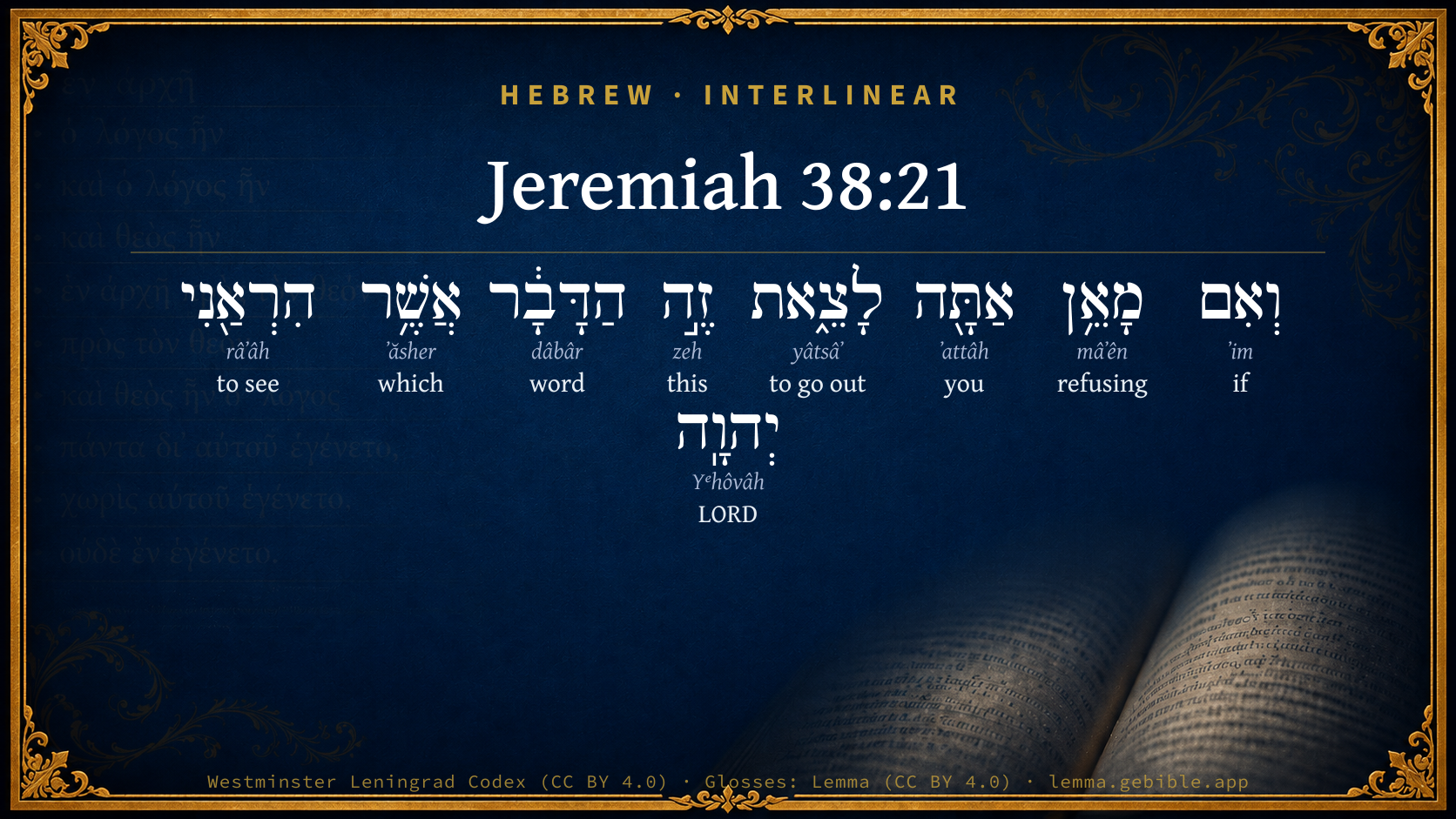
Jeremiah 38:21

Hebrew (Westminster Leningrad Codex) Jeremiah 38:21 appears in the Hebrew Old Testament. The text above is from the Westminster Leningrad Codex. Each word links to its Strong’s number, a concise gloss, and parsing drawn from the Open Scriptures Hebrew Bible morphology. Click any word for its full Brown-Driver-Briggs (BDB) entry.
Download image
Cite this verse

Jeremiah 38:21 (World English Bible). Public Domain. Lemma interlinear Bible study tool, https://lemma.gebible.app/v/jeremiah/38/21.

Show BibTeX & RIS
BibTeX
RIS
English Translation
But if you refuse to go forth, this is the word that Yahweh has shown me:
World English Bible · Public Domain
Download a study sheet

One document with this verse’s original text, its word-by-word gloss line, the meaning frame, cross-references with their text, attributed commentary, and full source and license credits — printable, and it pastes into notes with its structure intact.

This verse Autodidact and up

Study sheet (.html) Plain text (.txt)

A passage Seminary Student

Up to 50 verses in one chapter. A passage sheet keeps up to 6 commentary sources and 12 cross-references per verse, in the order this page ranks them, and says so on the sheet whenever that leaves anything out. Ask for a single verse and you get the Autodidact verse sheet above.

Everything on this page stays free to read, with no account — the sheet is a download of what is already on screen, not access to it.

Want to remove ads? Support Godless Engineer
Compare translations 3

The same verse in 3 English versions, stacked beneath the original-language interlinear above. Click any original word for its lexicon entry.

Each is an independent rendering of the whole verse — the interlinear is not word-aligned to these translations.

Highlighted words mark where these versions differ — a whole-verse word diff, not a word-by-word alignment.

  • World English Bible Public Domain
    But if you refuse to go forth, this is the word that Yahweh has shown me:
  • King James Version Public Domain
    But if thou refuse to go forth, this is the word that the LORD hath shewed me:
  • unfoldingWord Literal Text CC BY-SA 4.0
    But if you refuse to go out, this is what Yahweh has shown me.

unfoldingWord Literal Text — © unfoldingWord, licensed CC BY-SA 4.0. Word-aligned USFM3 via Door43 (git.door43.org/unfoldingWord/en_ult).

Versions to compare (up to 4)

3 of 4 selected

Show all 18 translations

Every available English version of this verse, each an independent rendering of the whole verse.

  • World English Bible Public Domain
    But if you refuse to go forth, this is the word that Yahweh has shown me:
  • Berean Standard Bible Public Domain
    But if you refuse to surrender, this is the word that the LORD has shown me:
  • Majority Standard Bible Public Domain
    But if you refuse to surrender, this is the word that the LORD has shown me:
  • King James Version Public Domain
    But if thou refuse to go forth, this is the word that the LORD hath shewed me:
  • American Standard Version (1901) Public Domain
    But if thou refuse to go forth, this is the word that Jehovah hath showed me:
  • Revised Version (1885) Public Domain
    But if thou refuse to go forth, this is the word that the LORD hath shewed me:
  • Geneva Bible (1599) Public Domain
    But if thou wilt refuse to go forth, this is the worde that the Lord hath shewed me.
  • Douay-Rheims (1899) Public Domain
    But if thou wilt not go forth, this is the word which the Lord hath shewn me:
  • Young's Literal Translation Public Domain
    `And if thou art refusing to go forth, this `is' the thing that Jehovah hath shewn me:
  • Literal Standard Version CC BY-SA 4.0
    And if you are refusing to go forth, this [is] the thing that YHWH has shown me:
  • Unlocked Literal Bible CC BY-SA 4.0
    But if you refuse to go out, this is what Yahweh has shown me.
  • unfoldingWord Literal Text CC BY-SA 4.0
    But if you refuse to go out, this is what Yahweh has shown me.
  • Darby Bible Public Domain
    But if thou refuse to go forth, this is the word which Jehovah hath shewn me:
  • World Messianic Bible Public Domain
    But if you refuse to go out, this is the word that the LORD has shown me:
  • Webster's Bible Public Domain
    But if thou shalt refuse to go forth, this is the word that the LORD hath shown me:
  • Free Bible Version CC BY-SA 4.0
    But if you refuse to hand yourself over, this is what the Lord has told me:
  • Bible in Basic English Public Domain
    But if you do not go out, this is what the Lord has made clear to me:
  • JPS Tanakh (1917) Public Domain
    But if thou refuse to go forth, this is the word that the LORD hath shown me:

Literal Standard Version (2020), Covenant Press — licensed CC BY-SA 4.0. Text via the HelloAO Bible API (eBible.org). Unlocked Literal Bible (unfoldingWord) — licensed CC BY-SA 4.0. Text via the HelloAO Bible API (eBible.org). unfoldingWord Literal Text — © unfoldingWord, licensed CC BY-SA 4.0. Word-aligned USFM3 via Door43 (git.door43.org/unfoldingWord/en_ult). Free Bible Version, Dr. Jonathan Gallagher — licensed CC BY-SA 4.0. Text via the HelloAO Bible API (eBible.org).

Word by word

More ways to search: Search by grammar → Find every occurrence → Compare this word →

Practice this passage: Drill this verse → Learn its vocabulary →

About this verse

These counts appear in no published source. They are computed here, from the morphology-tagged text and Lemma’s own curated glosses. What Lemma adds →

9
words
9
distinct lemmas
Prophets
section

Notable vocabulary

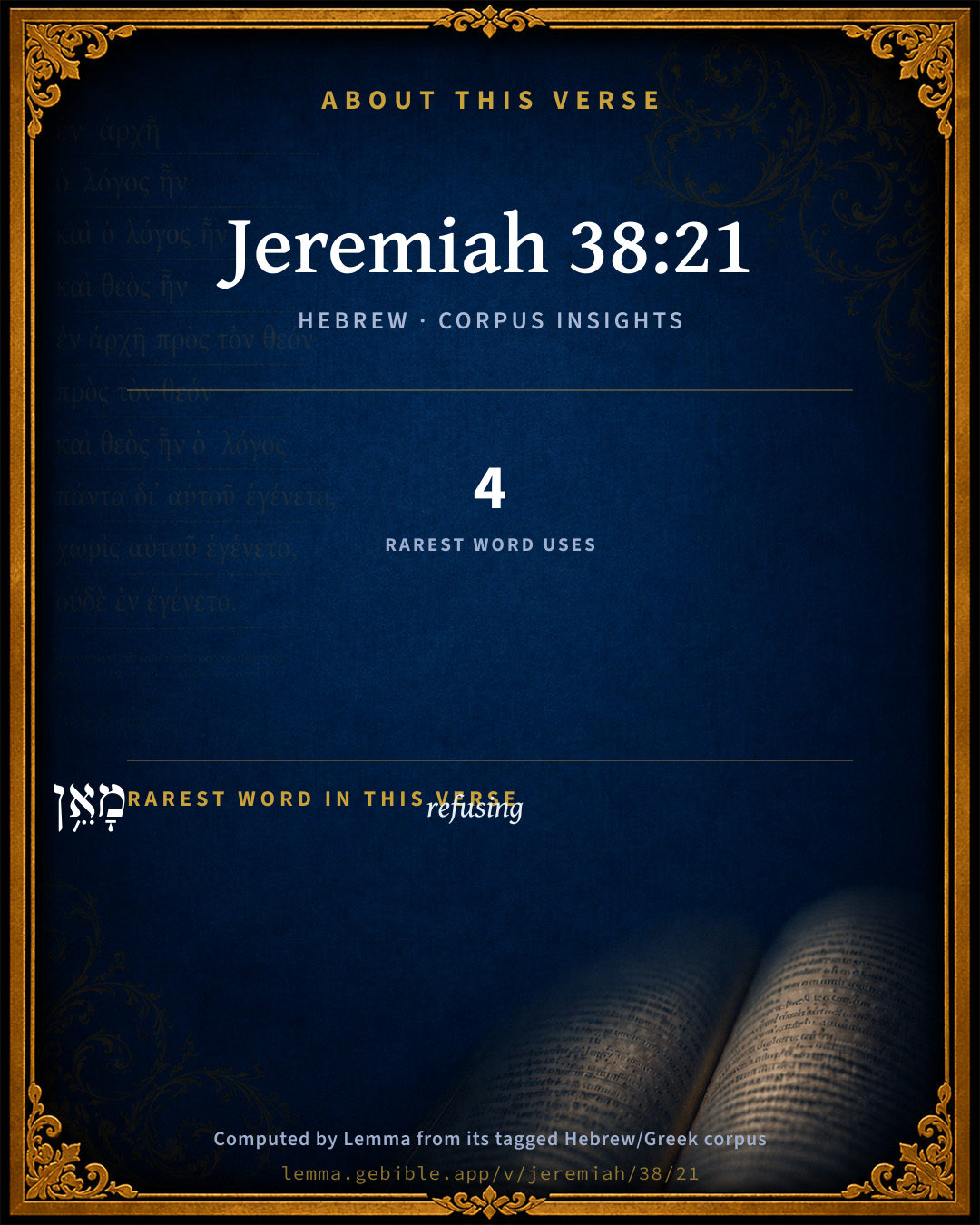
The rarest word here is מָאֵ֥ן refusing H3986 — appearing just 4 times in the whole Hebrew Bible.

Shared distinctive vocabulary

מָאֵ֥ן refusing H3986 occurs in 4 verses of the Hebrew Bible. Also found in:

Grammatical profile

  • 3 verbs
  • 2 nouns
  • 2 pronouns
  • 1 conjunction
  • 1 particle

Verb forms

  • מָאֵ֥ן Piel · Participle Active
  • לָצֵ֑את Qal · Infinitive Construct
  • הִרְאַ֖נִי Hiphil · Perfect

Cross-references

17

Topical passages linked to Jeremiah 38:21 in the Treasury of Scripture Knowledge — connected by theme and wording, ordered by reader-vote popularity; previews shown in the World English Bible.

  • Ezekiel 2:4–5 The children are impudent and stiff-hearted: I do sent you to them; and you shall tell them, Thus says the Lord Yahweh.
  • Ezekiel 2:7 You shall speak my words to them, whether they will hear, or whether they will forbear; for they are most rebellious.
  • Exodus 10:3–4 Moses and Aaron went in to Pharaoh, and said to him, "This is what Yahweh, the God of the Hebrews, says: 'How long will you refuse to humble yourself before me? Let my people go, that they may serve me.
  • Exodus 16:28 Yahweh said to Moses, "How long do you refuse to keep my commandments and my laws?
  • Numbers 23:19–20 God is not a man, that he should lie, Neither the son of man, that he should repent: Has he said, and will he not do it? Or has he spoken, and will he not make it good?
  • Numbers 24:13 If Balak would give me his house full of silver and gold, I can't go beyond the word of Yahweh, to do either good or bad of my own mind; what Yahweh speaks, that will I speak?
  • Job 23:13 But he stands alone, and who can oppose him? What his soul desires, even that he does.
  • Job 34:33 Shall his recompense be as you desire, that you refuse it? For you must choose, and not I. Therefore speak what you know.
  • Proverbs 1:24–31 Because I have called, and you have refused; I have stretched out my hand, and no one has paid attention;
  • Isaiah 1:19–20 If you are willing and obedient, You shall eat the good of the land;
  • Jeremiah 5:3 O Yahweh, don't your eyes look on truth? you have stricken them, but they were not grieved; you have consumed them, but they have refused to receive correction: they have made their faces harder than a rock; they have refused to return.
  • Jeremiah 15:19–21 Therefore thus says Yahweh, If you return, then will I bring you again, that you may stand before me; and if you take forth the precious from the vile, you shall be as my mouth: they shall return to you, but you shall not return to them.
  • Jeremiah 26:15 Only know for certain that, if you put me to death, you will bring innocent blood on yourselves, and on this city, and on the inhabitants of it; for of a truth Yahweh has sent me to you to speak all these words in your ears.
  • Ezekiel 3:17–19 Son of man, I have made you a watchman to the house of Israel: therefore hear the word at my mouth, and give them warning from me.
  • Acts 18:6 When they opposed him and blasphemed, he shook out his clothing and said to them, "Your blood be on your own heads! I am clean. From now on, I will go to the Gentiles!"
  • Acts 20:26–27 Therefore I testify to you this day that I am clean from the blood of all men,
  • Hebrews 12:25 See that you don't refuse him who speaks. For if they didn't escape when they refused him who warned on the Earth, how much more will we not escape who turn away from him who warns from heaven,

Cross-references courtesy of OpenBible.info (CC BY 4.0).

Hebrew and Greek witnesses Masoretic Hebrew ↔ Greek Septuagint

The same verse in the two great witnesses to the Old Testament, shown verse-for-verse.

These are two independent witnesses, not word-aligned to each other, and the Septuagint is shown in lemma (dictionary) form.

Hebrew Jeremiah 38:21 Masoretic · Westminster Leningrad Codex

וְאִם מָאֵ֥ן אַתָּ֖ה לָצֵ֑את זֶ֣ה הַדָּבָ֔ר אֲשֶׁ֥ר הִרְאַ֖נִי יְהוָֽה

But if you refuse to go forth, this is the word that Yahweh has shown me:

World English Bible · Public Domain

Greek LXX Structure differs

In the Septuagint, Jeremiah is about an eighth shorter than the Hebrew and arranges its material differently — the Oracles Against the Nations (Hebrew chapters 46–51) appear in the middle of the Greek book, after 25:13. Because the chapter and verse boundaries do not line up, a verse-for-verse comparison with the Hebrew is not shown.

A verse-for-verse comparison isn’t shown here because the chapters and verses don’t line up. Switch to the LXX edition with the MT / LXX toggle above to read the Greek directly.

Hebrew: Westminster Leningrad Codex (CC BY 4.0). Greek: Septuagint (public domain); English from a public-domain English Septuagint. How the Septuagint differs from the Hebrew →

Targum (Aramaic paraphrase)

1

The Targum is the ancient Jewish Aramaic paraphrase of the Hebrew Scriptures — an interpretive translation, not the Hebrew text itself. Onkelos (literal) and Pseudo-Jonathan (expansive) render the Torah, and Jonathan the Prophets. Coverage is partial: where no permissively-licensed English translation exists for a verse, only the Aramaic is shown. This is verse-level text, not a word-by-word alignment to the Hebrew.

  1. Targum Jonathan Prophets (Joshua–Malachi)
    וְאִם לֵית אַתְּ צָבֵי לְמִפַּק דֵין פִּתְגָמָא דְאַחְזְיַנִי יְיָ:

    (no public-domain English translation for this verse)

    Targum Jonathan — Aramaic: “Mikraot Gedolot” (public domain). English: “Sefaria Community Translation” (CC0 1.0 (public-domain dedication)); “London "Chaldee Paraphrase," 1871” (public domain). Text via Sefaria.

Commentary

Notes on Jeremiah 38:21 from classic Christian and Jewish commentators (each source and its license shown beneath its notes). The classic Christian expositions comment on the surrounding passage and are grouped to its opening verse, so a note may address several verses; the Jewish commentaries on the Tanakh (Rashi and others) are per-verse, so they appear only where the commentator wrote on this verse.

Lemma curates 59 commentaries, every one of them public domain or Creative Commons licensed, each selected and text-cleaned for this edition rather than reprinted as found. About our sources →

Trapp's Complete Commentary

John Trapp

Jer 38:21 But if thou refuse to go forth, this [is] the word that the LORD hath shewed me:

Ver. 21. Bat if thou refuse to go forth.] Promises and threatenings make an excellent mixture; the tartness of the one giveth us better to taste the sweetness of the other.

John Trapp, A Commentary or Exposition upon All the Books of the Old and New Testament (1647–1656) — public domain. Text from a community e-Sword module.

Joseph Benson's Commentary

Jer 38:21-23. But if thou refuse, this is the word that the Lord hath showed me — Namely, what follows in the next two verses. Behold, all the women that are left in the king of Judah’s house — The king’s wives, his daughters, and the other women that belong to the king’s court and family, shall become a prey to the chief officers of the king of Babylon’s army. And those women shall say, Thy friends have set thee on, &c. — They shall tell thee that, for these thy calamities, thou mayest thank thy hearkening to thy priests and false prophets; (called in the Hebrew the men of his peace, because they soothed up the king with the promises of peace;) in other words, those very women shall then reproach thee for having suffered thyself to be insnared by the ill advice of thy friends, and brought under insuperable difficulties. They will say to thee, Thy feet are sunk in the mire — Thou art plunged into calamities from which thou canst not extricate thyself. And they are turned away back — Even thy friends, by following whose counsel thou art brought into these snares and troubles, forsake thee in thy distress, every one shifting for himself. And thus shall a greater evil come upon thee than that which thou fearest, and the fear of which makes the unwilling to comply with the will of God concerning thee. So shall they bring out all thy wives, &c. — The prophet partly repeats and partly enlarges on the argument advanced in the former verse, with a view to prevail on the king to surrender himself to the Chaldeans. He urges, that if he would not do it, not only himself but his wives and children also would fall into his enemies’ hands, and that their reflection upon him, for the misery he had brought upon them and his country, would be no small aggravation of his affliction.

Joseph Benson's Commentary on the Old and New Testaments (1811–1818) — public domain. Text from a community e-Sword module.

John Calvin's Commentaries

He then adds, If thou refuse to go forth, this is the word which God hath shewed to me Jeremiah again declares that Zedekiah resisted in vain, because he kicked, as it is said, against the goad, for he could not possibly escape from coming into the hand of his enemies; which, when done, then neither the city nor the Temple would be spared. But the Prophet repeats again, that it had been shewn to him what to speak, he then spoke not in his own name, but by God’s command; which, it may be, was not then given him: but the Prophet knew that God’s decree, of which he had been the herald, could not be abolished. He then says, that this word had been shewed to him by God, even what follows —

John Calvin's Commentaries (1540-1563) — public domain. Text from the Calvin Translation Society English edition (1840s-50s) via the Christian Classics Ethereal Library (ccel.org). Calvin's coverage is partial (roughly two-thirds of the Bible); uncommented books and verses are honest gaps, never fabricated. The 19th-century editor's footnotes and remarks are omitted so the notes are faithfully Calvin's own voice.

The Cambridge Bible for Schools and Colleges

gen. ed. J. J. S. Perowne

21. the word] viz. the picture of the women which follows. Dr. makes it to be an actual vision on the part of the prophet, and so renders “all the women … were brought forth … while they said, etc.”

The Cambridge Bible for Schools and Colleges (gen. ed. J. J. S. Perowne; Cambridge University Press, 1878–1918) — public domain. Text from a community e-Sword module.

John Gill's Exposition

But if thou refuse to go forth,.... Out of Jerusalem, to the Chaldean army, and submit to them:

this is the word that the Lord hath showed me, or the thing which should certainly come to pass; the word of prophecy the Lord had showed to the prophet, and which he now declares to the king; who asked of him a word, was desirous to know whether there was a word from the Lord, and what it was; and this it is which follows, in case he continued impenitent, obstinate, and disobedient.

John Gill's Exposition of the Whole Bible (1746–1763) — public domain (CC PDM 1.0). Text via the HelloAO Bible API.

Lesson kit

Teaching starters — assembled from the data on this page, not authored interpretation. Every prompt links to the verse data it draws on. Edit before teaching.

Jeremiah, in the Prophets, opens this verse with 9 words (9 distinct Hebrew lemmas). Its most distinctive word is mâʼên (“refusing”). A historical commentator’s framing appears above. Read the whole chapter for the surrounding context.

Discussion questions

  1. The word mâʼên carries the sense “refusing.” How does it shape the verse?
  2. How does Exodus 8:2, which shares the word «refusing», read alongside this verse?
  3. These translations render this verse differently; the difference is in the English rendering, not the original. What questions does that raise?
  4. «מָאֵ֥ן» is a Piel Participle Active verb. How does that grammatical form shape the action described?
  5. Compare how Trapp's Complete Commentary and Joseph Benson's Commentary read this verse. Where do they agree or differ?

Things to notice

Reading settings

Reading text

Shown beneath each verse's original-language words.

Old Testament
Old Testament edition

Read the OT as the Masoretic Hebrew (MT) or the Greek Septuagint (LXX).

English shown for the Greek Septuagint (in the Hebrew ↔ Greek comparison).

Comparing translations? Open the Compare panel on any verse page to stack up to four side by side.