
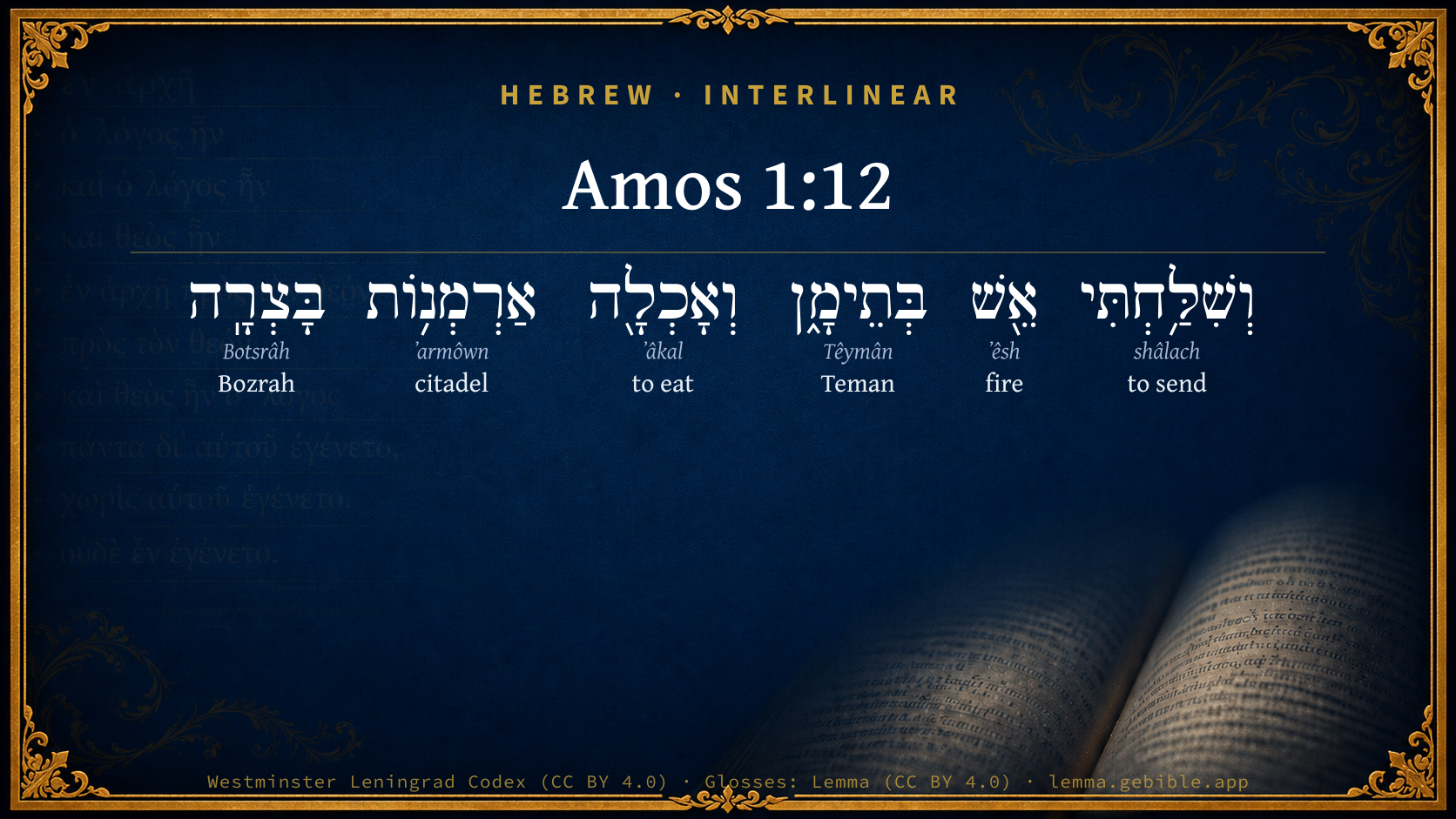
Amos 1:12

Hebrew (Westminster Leningrad Codex) Amos 1:12 appears in the Hebrew Old Testament. The text above is from the Westminster Leningrad Codex. Each word links to its Strong’s number, a concise gloss, and parsing drawn from the Open Scriptures Hebrew Bible morphology. Click any word for its full Brown-Driver-Briggs (BDB) entry.
Download image
Cite this verse

Amos 1:12 (World English Bible). Public Domain. Lemma interlinear Bible study tool, https://lemma.gebible.app/v/amos/1/12.

Show BibTeX & RIS
BibTeX
RIS
English Translation
But I will send a fire on Teman, And it will devour the palaces of Bozrah."
World English Bible · Public Domain
Download a study sheet

One document with this verse’s original text, its word-by-word gloss line, the meaning frame, cross-references with their text, attributed commentary, and full source and license credits — printable, and it pastes into notes with its structure intact.

This verse Autodidact and up

Study sheet (.html) Plain text (.txt)

A passage Seminary Student

Up to 50 verses in one chapter. A passage sheet keeps up to 6 commentary sources and 12 cross-references per verse, in the order this page ranks them, and says so on the sheet whenever that leaves anything out. Ask for a single verse and you get the Autodidact verse sheet above.

Everything on this page stays free to read, with no account — the sheet is a download of what is already on screen, not access to it.

Want to remove ads? Support Godless Engineer
Compare translations 3

The same verse in 3 English versions, stacked beneath the original-language interlinear above. Click any original word for its lexicon entry.

Each is an independent rendering of the whole verse — the interlinear is not word-aligned to these translations.

Highlighted words mark where these versions differ — a whole-verse word diff, not a word-by-word alignment.

  • World English Bible Public Domain
    But I will send a fire on Teman, And it will devour the palaces of Bozrah."
  • King James Version Public Domain
    But I will send a fire upon Teman, which shall devour the palaces of Bozrah.
  • unfoldingWord Literal Text CC BY-SA 4.0
    I will send fire on Teman, and it will devour the palaces of Bozrah.”

unfoldingWord Literal Text — © unfoldingWord, licensed CC BY-SA 4.0. Word-aligned USFM3 via Door43 (git.door43.org/unfoldingWord/en_ult).

Versions to compare (up to 4)

3 of 4 selected

Show all 18 translations

Every available English version of this verse, each an independent rendering of the whole verse.

  • World English Bible Public Domain
    But I will send a fire on Teman, And it will devour the palaces of Bozrah."
  • Berean Standard Bible Public Domain
    So I will send fire upon Teman to consume the citadels of Bozrah.”
  • Majority Standard Bible Public Domain
    So I will send fire upon Teman to consume the citadels of Bozrah.”
  • King James Version Public Domain
    But I will send a fire upon Teman, which shall devour the palaces of Bozrah.
  • American Standard Version (1901) Public Domain
    but I will send a fire upon Teman, and it shall devour the palaces of Bozrah.
  • Revised Version (1885) Public Domain
    but I will send a fire upon Teman, and it shall devour the palaces of Bozrah.
  • Geneva Bible (1599) Public Domain
    Therefore will I send a fire vpon Teman, and it shall deuoure the palaces of Bozrah.
  • Douay-Rheims (1899) Public Domain
    I will send a fire into Theman: and it shall devour the houses of Bosra.
  • Young's Literal Translation Public Domain
    And I have sent a fire against Teman, And it hath consumed palaces of Bozrah.
  • Literal Standard Version CC BY-SA 4.0
    And I have sent a fire against Teman, || And it has consumed palaces of Bozrah.”
  • Unlocked Literal Bible CC BY-SA 4.0
    I will send fire on Teman, and it will devour the palaces of Bozrah.”
  • unfoldingWord Literal Text CC BY-SA 4.0
    I will send fire on Teman, and it will devour the palaces of Bozrah.”
  • Darby Bible Public Domain
    And I will send a fire upon Teman, and it shall devour the palaces of Bozrah.
  • World Messianic Bible Public Domain
    but I will send a fire on Teman, and it will devour the palaces of Bozrah.”
  • Webster's Bible Public Domain
    But I will send a fire upon Teman, which shall devour the palaces of Bozrah.
  • Free Bible Version CC BY-SA 4.0
    So I will send down fire on Teman, and I will burn up the fortresses of Bozrah.
  • Bible in Basic English Public Domain
    And I will send a fire on Teman, burning up the great houses of Bozrah.
  • JPS Tanakh (1917) Public Domain
    So will I send a fire upon Teman, and it shall devour the palaces of Bozrah.

Literal Standard Version (2020), Covenant Press — licensed CC BY-SA 4.0. Text via the HelloAO Bible API (eBible.org). Unlocked Literal Bible (unfoldingWord) — licensed CC BY-SA 4.0. Text via the HelloAO Bible API (eBible.org). unfoldingWord Literal Text — © unfoldingWord, licensed CC BY-SA 4.0. Word-aligned USFM3 via Door43 (git.door43.org/unfoldingWord/en_ult). Free Bible Version, Dr. Jonathan Gallagher — licensed CC BY-SA 4.0. Text via the HelloAO Bible API (eBible.org).

Word by word

More ways to search: Search by grammar → Find every occurrence → Compare this word →

Practice this passage: Drill this verse → Learn its vocabulary →

About this verse

These counts appear in no published source. They are computed here, from the morphology-tagged text and Lemma’s own curated glosses. What Lemma adds →

6
words
6
distinct lemmas
Prophets
section

Notable vocabulary

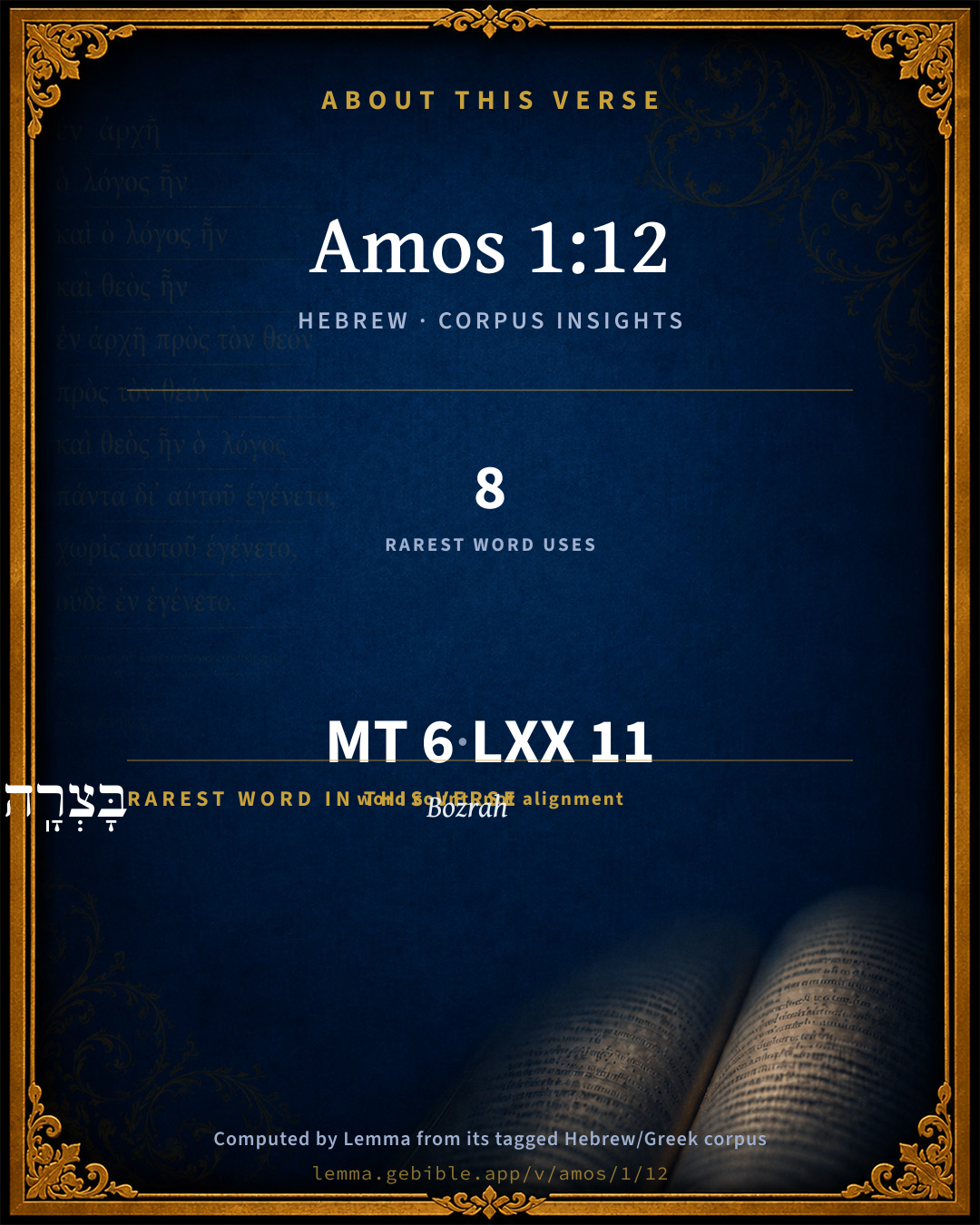
The rarest word here is בָּצְרָֽה Bozrah H1224 — appearing just 8 times in the whole Hebrew Bible.

Shared distinctive vocabulary

בָּצְרָֽה Bozrah H1224 occurs in 8 verses of the Hebrew Bible. Also found in:

Grammatical profile

  • 2 verbs
  • 4 nouns

Verb forms

  • וְשִׁלַּ֥חְתִּי Piel · Sequential Perfect
  • וְאָכְלָ֖ה Qal · Sequential Perfect

Hebrew & Septuagint length

In English translation the verse runs 16 words from the Hebrew and 18 from the Septuagint (LXX English) — closely comparable.

A rough comparison of the two English renderings, which tokenize alike — not a word-level alignment.

Word counts can differ between the Hebrew and the Greek without any difference in meaning — e.g. the Hebrew direct-object marker אֵת has no separate Greek word, and Greek often adds the article ὁ.

In the original languages it is 6 Hebrew tokens and 11 Greek tokens — but the two are counted differently (Hebrew bundles its prefixes and suffixes into one token; the Greek is in lemma form), so that isn’t a like-for-like length.

Cross-references

8

Topical passages linked to Amos 1:12 in the Treasury of Scripture Knowledge — connected by theme and wording, ordered by reader-vote popularity; previews shown in the World English Bible.

  • Jeremiah 49:7 Of Edom. Thus says Yahweh of Hosts: Is wisdom no more in Teman? is counsel perished from the prudent? is their wisdom vanished?
  • Jeremiah 49:20 Therefore hear the counsel of Yahweh, that he has taken against Edom; and his purposes, that he has purposed against the inhabitants of Teman: Surely they shall drag them away, [even] the little ones of the flock; surely he shall make their habitation desolate over them.
  • Obadiah 1:9–10 Your mighty men, Teman, will be dismayed, to the end that everyone may be cut off from the mountain of Esau by slaughter.
  • Jeremiah 49:13 For I have sworn by myself, says Yahweh, that Bozrah shall become an astonishment, a reproach, a waste, and a curse; and all the cities of it shall be perpetual wastes.
  • Jeremiah 49:22 Behold, he shall come up and fly as the eagle, and spread out his wings against Bozrah: and the heart of the mighty men of Edom at that day shall be as the heart of a woman in her pangs.
  • Genesis 36:11 The sons of Eliphaz were Teman, Omar, Zepho, and Gatam, and Kenaz.
  • Genesis 36:33 Bela died, and Jobab, the son of Zerah of Bozrah, reigned in his place.
  • Isaiah 34:6 The sword of Yahweh is filled with blood, it is made fat with fatness, with the blood of lambs and goats, with the fat of the kidneys of rams; for Yahweh has a sacrifice in Bozrah, and a great slaughter in the land of Edom.

Cross-references courtesy of OpenBible.info (CC BY 4.0).

Hebrew and Greek witnesses Masoretic Hebrew ↔ Greek Septuagint

The same verse in the two great witnesses to the Old Testament, shown verse-for-verse.

These are two independent witnesses, not word-aligned to each other, and the Septuagint is shown in lemma (dictionary) form.

Hebrew Amos 1:12 Masoretic · Westminster Leningrad Codex

וְשִׁלַּ֥חְתִּי אֵ֖שׁ בְּתֵימָ֑ן וְאָכְלָ֖ה אַרְמְנ֥וֹת בָּצְרָֽה

But I will send a fire on Teman, And it will devour the palaces of Bozrah."

World English Bible · Public Domain

Greek LXX Amos 1:12 Septuagint · lemma form

καί ἐκ ἀποστέλλω πῦρ εἰς θαιμαν καί καταἐσθίω θεμέλιον τεῖχος αὐτός

And I will send forth a fire upon Thaman, and it shall devour the foundations of her walls.

LXX2012 (modern English Septuagint) · Public Domain

On this verse, Haydock's Catholic Bible Commentary discusses the Septuagint’s reading. Read the note in Commentary ↓

Hebrew: Westminster Leningrad Codex (CC BY 4.0). Greek: Septuagint (public domain); English from LXX2012 (modern English Septuagint) (Public Domain). How the Septuagint differs from the Hebrew →

Targum (Aramaic paraphrase)

1

The Targum is the ancient Jewish Aramaic paraphrase of the Hebrew Scriptures — an interpretive translation, not the Hebrew text itself. Onkelos (literal) and Pseudo-Jonathan (expansive) render the Torah, and Jonathan the Prophets. Coverage is partial: where no permissively-licensed English translation exists for a verse, only the Aramaic is shown. This is verse-level text, not a word-by-word alignment to the Hebrew.

  1. Targum Jonathan Prophets (Joshua–Malachi)
    וְאֶשְׁלַח אֶשְׁתָּא בְּדָרוֹמָא וּתְשֵׁיצֵי בִּרְנְיַת בָּצְרָה:

    (no public-domain English translation for this verse)

    Targum Jonathan — Aramaic: “Mikraot Gedolot” (public domain). English: “Sefaria Community Translation” (CC0 1.0 (public-domain dedication)); “London "Chaldee Paraphrase," 1871” (public domain). Text via Sefaria.

Commentary

Notes on Amos 1:12 from classic Christian and Jewish commentators (each source and its license shown beneath its notes). The classic Christian expositions comment on the surrounding passage and are grouped to its opening verse, so a note may address several verses; the Jewish commentaries on the Tanakh (Rashi and others) are per-verse, so they appear only where the commentator wrote on this verse.

Lemma curates 59 commentaries, every one of them public domain or Creative Commons licensed, each selected and text-cleaned for this edition rather than reprinted as found. About our sources →

Trapp's Complete Commentary

John Trapp

Amo 1:12 But I will send a fire upon Teman, which shall devour the palaces of Bozrah.

Ver. 12. But I will send a fire] A fierce enemy, ut supra. The inhabitants of Teman and Bozra, together with other the posterity of Esau, were famous for power and policy, Oba 1:8-9 Jer 49:7 Isa 34:6. But there is no wisdom, might, nor counsel against the Lord, Pro 21:30-31. He can make fools and babies of the Church’s enemies: he can fire out their malice.

John Trapp, A Commentary or Exposition upon All the Books of the Old and New Testament (1647–1656) — public domain. Text from a community e-Sword module.

Tyndale Open Study Notes

Tyndale Open Resources

1:12 With the destruction of the major cities of Teman and Bozrah, Edom lost its capacity for continual warfare. Babylon destroyed Edom shortly after Judah in 553 BC (see Jer 27; 49:7-22; see also study note on Obad 1:18).

Tyndale Open Study Notes — © Tyndale Open Resources, licensed CC BY-SA 4.0. Text via the HelloAO Bible API.

Jamieson, Fausset & Brown

Robert Jamieson, A. R. Fausset & David Brown

Teman--a city of Edom, called from a grandson of Esau (Gen 36:11, Gen 36:15; Oba 1:8-9); situated five miles from Petra; south of the present Wady Musa. Its people were famed for wisdom (Jer 49:7).

Bozrah--a city of Edom (Isa 63:1). Selah or Petra is not mentioned, as it had been overthrown by Amaziah (Kg2 14:7).

Jamieson, Fausset & Brown — Commentary Critical and Explanatory on the Whole Bible (1871) — public domain (CC PDM 1.0). Text via the HelloAO Bible API.

Adam Clarke's Commentary

Verse 12. Teman-Bozrah.] Principal cities of Idumea.

Adam Clarke's Commentary on the Bible (1810–1826) — public domain. Text from a community e-Sword/MySword module.

John Calvin's Commentaries

He says in the last place, I will send fire on Teman, to consume the palaces of Bozrah By fire he ever means any kind of destruction. But he compares God’s vengeance to a burning fire. We know that when fire has once taken hold, not only on a house, but on a whole city, there is no remedy. So now the Prophet says, that God’s vengeance would be dreadful, that it would consume whatever hatred there was among them: I will then send fire on Teman; which, as it is well known, was the first city of Idumea. Let us now proceed —

John Calvin's Commentaries (1540-1563) — public domain. Text from the Calvin Translation Society English edition (1840s-50s) via the Christian Classics Ethereal Library (ccel.org). Calvin's coverage is partial (roughly two-thirds of the Bible); uncommented books and verses are honest gaps, never fabricated. The 19th-century editor's footnotes and remarks are omitted so the notes are faithfully Calvin's own voice.

Ellicott's Commentary for English Readers

(12) Teman.—According to Gen_36:11, a name for a grandson of Esau. The district and chief town of this name are often referred to in the Prophets (Jer_49:7-8; Eze_25:13; Hab_3:3; Oba_1:8-9). The wisdom and might of the Temanites were well known, and Eliphaz the Temanite was one of the sage interlocutors of the Book of Job. It was situated, according to Burckhardt and Robinson, south of the Wady Musa.

Bozrah.—Referred to in Jer_49:13; Jer_49:22; Mic_2:12; Isa_34:6; Isa_63:1. Quite distinct from Bozrah in Moab (Jer_48:24). The former is situated south of the Dead Sea, identified by Robinson and Burckhardt with the village of El Buseireh in Jebal.

A Bible Commentary for English Readers, edited by Charles John Ellicott (1878–1897) — public domain. Text from a community e-Sword module.

The Cambridge Bible for Schools and Colleges

gen. ed. J. J. S. Perowne

12. upon Teman] According to Eusebius and Jerome (Onomastica, ed. Lagarde, pp. 156, 260), a district of the chiefs (‘dukes’ [duces]) of Edom in Gebal, but also, they add, a village about 15 (Jerome 5) miles from Petra, and the station of a Roman garrison. From Eze_25:13, where it is implied that Teman was in an opposite quarter to Dedan, it may be inferred that, as Dedan was the name of a tribe on the S.E. of Edom, Teman was in the N. or W. part of Edom. It is mentioned elsewhere in the O.T., as synonymous with Edom, Jer_49:7; Oba_1:9; Hab_3:3, or in poetical parallelism with it, Jer_49:20 : cf. Gen_36:34. Eliphaz, Job’s friend, is described as a Temanite (Job_2:11 &c.) In Gen_36:11; Gen_36:15 Teman is a grandson of Esau (= Edom), the relation of the particular clan to the whole nation being represented genealogically: the name must thus have been that of an Edomite clan, as well as of the region inhabited by it.

Bozrah] A town of Edom, mentioned also Gen_36:33, Jer_49:13; and in poetical parallelism with Edom, Isa_34:6; Isa_63:1, Jer_49:22. From the manner in which it is named in most of these passages, it is clear that it must have been an important place. It is in all probability el-Buṣaireh (a diminutive of Boṣrah), about 35 miles N. of Petra, and 20 miles S.E. of the Dead Sea, with (Roman) ruins, first visited by Burckhardt in 1812 (Syria, 1822, p. 407: cf. also Rob. ii. 167; Doughty, Arabia Deserta, i. 31, 38).

Edom is mentioned as paying tribute to Rammân-nirâri III. (K.A.T[132][133] p. 190; K.B[134] i. 191), Tiglath-pileser III. (K.A.T[135][136] p. 258), Sennacherib (ib. p. 291), Esarhaddon, and Asshurbanipal (ib. p. 355). Afterwards, like its neighbours, it fell under the rule of Nebuchadnezzar (Jer_27:3 f.). During, and after, the Captivity, the Edomites extended their dominions W. of the Arabah, and ultimately transferred themselves thither altogether (the later ‘Idumaea’ being the southern part of Judah); Malachi (Amo_1:3-4) describes Edom as desolate in his day, though how it became so, we do not know; and in b.c. 312 the Nabataeans, an Arabian tribe, are found located in Edom, where they maintained themselves for many centuries. The cities of Edom finally fell to ruin after the Mohammedan conquest in the seventh century, a.d.

[132] .A.T. … Eb. Schrader, Die Keilinschriften und das A. T., ed. 2, 1883 (translated under the title The Cuneiform Inscriptions and the O. T. 1885, 1888). The references are to the pagination of the German, which is given on the margin of the English translation.

[133] … Eb. Schrader, Die Keilinschriften und das A. T., ed. 2, 1883 (translated under the title The Cuneiform Inscriptions and the O. T. 1885, 1888). The references are to the pagination of the German, which is given on the margin of the English translation.

[134] .B. … Eb. Schrader, Keilinschriftliche Bibliothek (1889 ff.).

[135] .A.T. … Eb. Schrader, Die Keilinschriften und das A. T., ed. 2, 1883 (translated under the title The Cuneiform Inscriptions and the O. T. 1885, 1888). The references are to the pagination of the German, which is given on the margin of the English translation.

[136] … Eb. Schrader, Die Keilinschriften und das A. T., ed. 2, 1883 (translated under the title The Cuneiform Inscriptions and the O. T. 1885, 1888). The references are to the pagination of the German, which is given on the margin of the English translation.

The authenticity of the oracle against Edom is doubted by Wellhausen, and at least suspected by G. A. Smith (p. 129 f.); the former supposes it to be an addition to the original text of Amos, dating from the Chaldaean age. Not only is there in the earlier prophets and historical books no other evidence of such animus against Edom as here displays itself, but Edom, when Amos wrote, had been for two centuries under the yoke of Judah; its first subjection had been accomplished with great cruelty (1Ki_11:16); Amaziah, also, more recently (801–792 b.c.), had severely smitten Edom (2Ki_14:7). Even, therefore, although Edom had shewn itself unfriendly, “was the right to blame them Judah’s, who herself had so persistently waged war, with confessed cruelty, against Edom? Could a Judaean prophet be just in blaming Edom and saying nothing of Judah?… To charge Edom, whom Judah had conquered and treated cruelly, with restless hate towards Judah seems to fall below that high impartial tone which prevails in the other oracles of this section. The charge was much more justifiable at the time of the Exile, when Edom did behave shamefully towards Israel” (G. A. Smith, p. 130). The argument is a forcible one, and the conclusion to which it points may be the true one: our ignorance, as the same writer proceeds to point out, prohibits our endorsing it absolutely: we do not for instance know the particulars of the revolt under Jehoram or what may have happened to provoke Amaziah’s attack upon Edom, or indeed what, generally, may have been Edom’s behaviour towards Judah during the century before Amos: there may have been occurrences during this period known to Amos and sufficient to justify the words used by him.

The Cambridge Bible for Schools and Colleges (gen. ed. J. J. S. Perowne; Cambridge University Press, 1878–1918) — public domain. Text from a community e-Sword module.

John Gill's Exposition

But I will send a fire upon Teman,.... A principal city of Edom or Idumea, so called from Teman a grandson of Esau, Gen 36:11. Jerom (x) says there was in his time a village called Theman, five miles distant from the city Petra, and had a Roman garrison; and so says Eusebius (y); who places it in Arabia Petraea; it is put for the whole country; it signifies the south. So the Targum renders it,

"a fire in the south.''

The "fire" signifies an enemy that should be sent into it, and destroy it: this was Nebuchadnezzar, who, as Josephus (z) says, five years after the destruction of Jerusalem led his army into Coelesyria, and took it; and fought against the Ammonites and Moabites, and very probably at the same time against the Edomites:

which shall devour the palaces of Bozrah; another famous city of the Edomites; there was one of this name in Moab; either there were two cities so called, one in Edom, and another in Moab; or rather this city lay, as Jarchi says, between Edom and Moab; and so sometimes is placed to one, and sometimes to another, its it might belong to the one and to the other, according to the event of war. It is the same with Bezer in the wilderness, appointed a Levitical city, and a city of refuge, by Joshua, Jos 20:8; and belonged to the tribe of Reuben; but being on the borders of that tribe, and of Moab and Edom, it is ascribed to each, as they at different times made themselves masters of it. It is the same with Bostra, which Ptolemy (a) places in Arabia Petraea; and being on the confines of Arabia Deserts, and surrounded on all sides with wild deserts, it is commonly spoken of as situated in a wilderness, Jerom (b) speaks of it as a city of Arabia in the desert, to the south, looking to Damascus; and, according to the Persian (c) geographer, it is four days' journey southward from Damascus; and Eusebius places it at the distance of twenty four miles from Adraa or Edrei. The destruction of this place is prophesied of by Jeremiah, Jer 48:24; and perhaps these prophecies were accomplished when Nebuchadnezzar made war with the Ammonites and Edomites, as before observed; or however in the times of the Maccabees, when Judas Maccabeus took this city, put all the males to the sword, plundered it, and then set fire to it, which literally fulfilled this prophecy,

"Hereupon Judas and his host turned suddenly by the way of the wilderness unto Bosora; and when he had won the city, he slew all the males with the edge of the sword, and took all their spoils, and burned the city with fire,'' (1 Maccabees 5:28)

It was afterwards rebuilt, and became a considerable city; in the time of the above Persian geographer (d), it had a very strong castle belonging to it, a gate twenty cubits high, and one of the largest basins or pools of water in all the east. In the fourth century there were bishops of this place, which assisted in the councils of Nice, Antioch, Ephesus, and Chalcedon, as Reland (e) observes; though he thinks that Bostra is not to be confounded with the Bezer of Reuben, or with the Bozra of Moab and Edom; though they seem to be all one and the same place.

(x) De locis Hebr. fol. 95. B. (y) Onomast. ad vocem (z) Antiqu. l. 10. c. 9. sect. 7. (a) Geograph. l. 5. c. 17. (b) De locis Hebr. in voce "Trachonitis", fol. 95. B. (c) Apud Calmet, Dictionary, on the word "Bosor". (d) Apud Calmet, ut supra. (e) Palestina Illustrata, tom. 2. l. 3. p. 666.

John Gill's Exposition of the Whole Bible (1746–1763) — public domain (CC PDM 1.0). Text via the HelloAO Bible API.

Albert Barnes' Notes on the Bible

But - (And I, in My turn and as a consequence of these sins) will send a fire upon Teman “Teman,” say Eusebius and Jerome , “was a country of the princes of Edom, which had its name from Teman son of Eliphaz, son of Esau Gen 36:11, Gen 36:15. But even to this day there is a village, called Teman, about 5 (Eusebius says 15) miles from Petra, where there is also a Roman garrison, from which place was Eliphaz, king of the Themanites.” It is, however, probably the district which is meant, of which Bozra was then the capital. For Amos when speaking of cities, uses some word to express this, as “the palaces of Benhadad, the wall of Gaza, of Tyrus, of Rabbah;” here he simply uses the name Teman, as he does those of Moab and Judah. Amos does not mention Petra, or Selah, for Amaziah had taken it, and called it Joktheel, “which God subdued,” which name it for some time retained 2Ki 14:7.

Bozrah - (Literally, which cuts off approach) is mentioned, as early as Genesis Gen 36:33, as the seat of one of the elective kings who, in times before Moses, reigned over Edom. It lay then doubtless in Idumea itself, and is quite distinct from the Bozrah of Hauran or Auranitis, from which Jerome also distinguishes it. : “There is another Bosor also, a city of Esau, in the mountains of Idumea, of which Isaiah speaks.” There is yet a small village of the like name (Busaira “the little Bozrah”) which “appears,” it is said , “to have been in ancient times a considerable city, if we may judge from the ruins which surround the village.” It has now “some 50 houses, and stands on an elevation, on the summit of which a small castle has been built.” The name however, “little Bozrah,” indicates the existence of a “great Bozrah,” with which its name is contrasted, and is not likely to have been the place itself . Probably the name was a common one, “the strong place” of its neighborhood . The Bozrah of Edom is either that little vilage, or is wholly blotted out.

Albert Barnes' Notes on the Bible (1834–1885) — public domain. Text from a community e-Sword/MySword module.

Haydock's Catholic Bible Commentary

Houses, &c. Septuagint, "its foundations," (Haydock) or the fortified country. (St. Jerome) --- Bosor lay towards Philadelphia, in the ancient territory of Edom. Their strong places were seized by Ozias, by the Chaldeans, and by the Machabees.

George Leo Haydock (1774–1849), Haydock's Catholic Family Bible and Commentary, 1859 edition — public domain. Excludes Psalms (Douay-Rheims chapter numbering differs from Protestant) and Deuterocanonical books (Catholic canon only).

Matthew Poole's English Annotations

I will send a fire: see Amo 1:4,7.

Teman; metropolis of Idumea, called from Esau’s grandson of that name; of this see Eze 25:13; Hab 3:3. And this here taken synecdochically implieth the inhabitants of this city, and of the whole country, which shall perish when the judgment here threatened shall be executed.

Which shall devour the palaces: see Amo 1:4.

Bozrah; a city bordering on Moab and Idumea, and which sometimes belonged to the one, sometimes to the other, as events of war determined. It may be there might be two cities of this name, the one in Moab, the other in Edom, or Idumea; however, this was a very strong city, and one of the chiefest in the whole kingdom, so that in the menace against Bozrah and Teman the strength and glory of Edom is threatened with an utter overthrow, as of that which is burnt up by fire.

Matthew Poole's English Annotations on the Holy Bible (1683–1685) — public domain. Text from a community e-Sword/MySword module.

The Pulpit Commentary

Teman is the region of Idumaea, of which Bozrah is the capital. Both Jerome and Eusebius ("Onomast.") speak of a city so called not far from Petra; but in the Old Testament the name is applied to a district; and as the word in Hebrew means "south," it is probably the southern portion of the land of Edom. Bozrah (hod. Busaireh) was the old capital of Edom, situated on a hill south of the Dead Sea. (see Isa_34:6) Jeremiah (Jer_49:17) predicts the punishment of Edom, and Ezekiel (Eze_25:12-14) does likewise. The monologue of Obadiah has been already referred to. The instrument of vengeance in the present ease was Nebuchadnezzar, though it suffered much at the hands of other enemies, as the Nabathaeans and Maccabees.

The Pulpit Commentary (1880–1919), ed. H.D.M. Spence-Jones & Joseph S. Exell — public domain. Text from a community e-Sword module.

John Wesley's Explanatory Notes

Teman - The metropolis of Idumea, so called from Esau's grandson of that name. Bozrah - This was a very strong city, and one of the chief in the whole kingdom, so that in the menace against Bozrah and Teman, the strength and glory of Edom is threatened with an utter overthrow.

John Wesley, Explanatory Notes Upon the Whole Bible (1754–1765) — public domain. Text via the GEBible commentary corpus.

Rashi

Rabbi Shlomo Yitzchaki (Rashi)

the palaces of Bozrah—It is between Moab and Edom, and it belonged to the land of Moab, but it was attracted to Edom. And it set up a king for them when the first king died, and it is said: (Gen. 36: 33) “Jobab the son of Zerah from Bozrah.” [from Gen. Rabbah 83:3]

Rashi on the Tanakh — English translations: “The Judaica Press complete Tanach with Rashi, translated by A. J. Rosenberg” (CC BY 4.0); “Pentateuch with Rashi's commentary by M. Rosenbaum and A.M. Silbermann, 1929-1934” (public domain); “The Metsudah Tanach series, Lakewood, N.J” (CC BY 4.0); and “The Book of Joshua, Metsudah Publications, 1997” (CC BY 4.0). Text via Sefaria.

Lesson kit

Teaching starters — assembled from the data on this page, not authored interpretation. Every prompt links to the verse data it draws on. Edit before teaching.

Amos, in the Prophets, opens this verse with 6 words (6 distinct Hebrew lemmas). Its most distinctive word is Botsrâh (“Bozrah”). A historical commentator’s framing appears above. Read the whole chapter for the surrounding context.

Discussion questions

  1. How does “Bozrah” (Botsrâh) shape what this verse is saying?
  2. Genesis 36:33 shares the word «Bozrah» with this verse. How do the two illuminate each other?
  3. These translations render this verse differently; the difference is in the English rendering, not the original. What questions does that raise?
  4. The verb «וְשִׁלַּ֥חְתִּי» is Piel Sequential Perfect. How does its form color the action?
  5. Reading how Trapp's Complete Commentary and Tyndale Open Study Notes read this verse, where do the two commentators agree and where do they part?

Things to notice

Reading settings

Reading text

Shown beneath each verse's original-language words.

Old Testament
Old Testament edition

Read the OT as the Masoretic Hebrew (MT) or the Greek Septuagint (LXX).

English shown for the Greek Septuagint (in the Hebrew ↔ Greek comparison).

Comparing translations? Open the Compare panel on any verse page to stack up to four side by side.