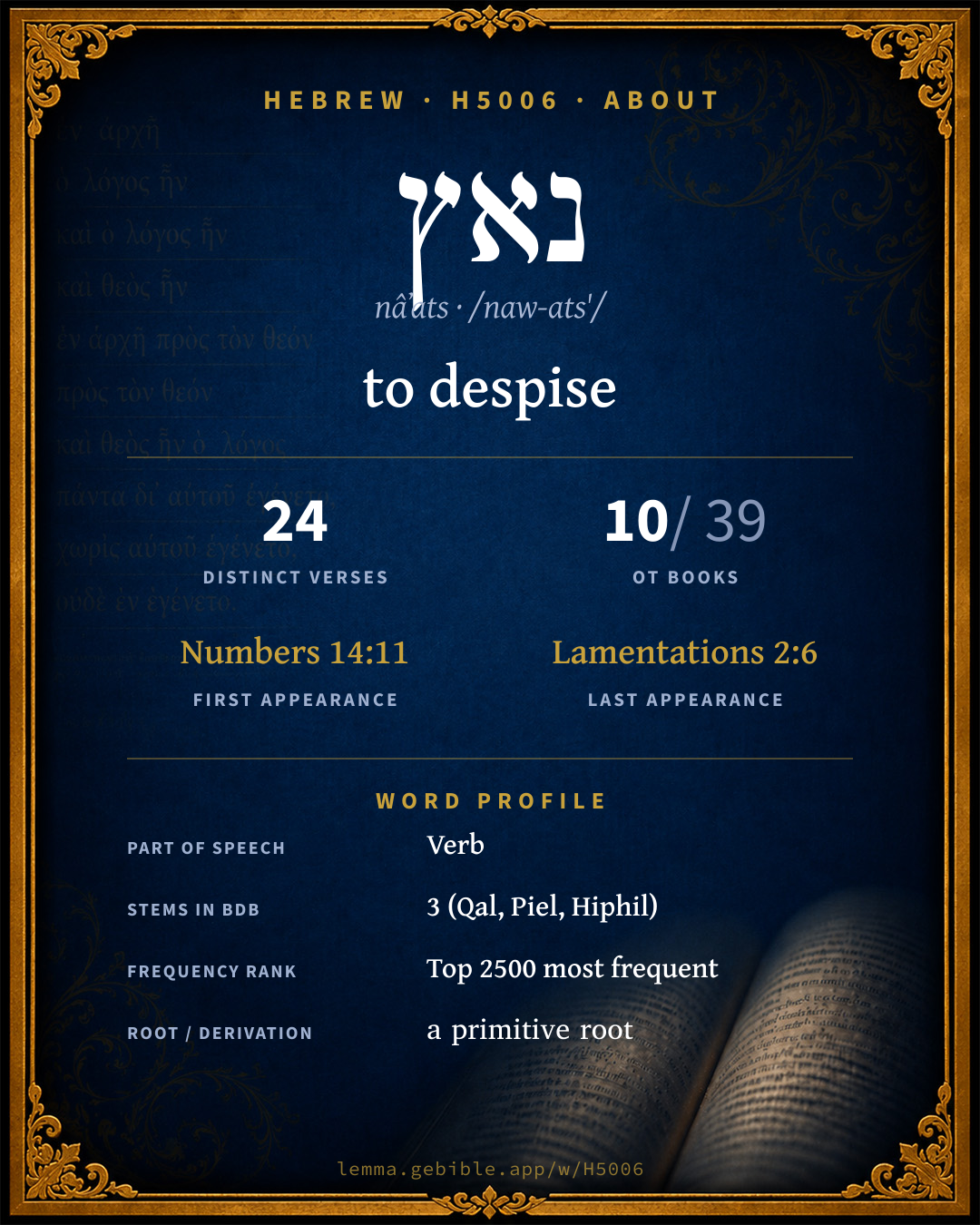
נָאַץ
to despise
‘to despise’ is one of 4 main senses fuller range ↓
Full lexicon entry — Brown-Driver-Briggs (BDB)
From Brown-Driver-Briggs (BDB)
Where this word appears
See every Piel verb in the Hebrew Bible →
Grammar key — what these labels mean
Part of speech
- Verb
- An action or state-of-being word.
Stem
- Piel
- An intensive or resultative active stem.
- Qal
- The basic, simple active stem — the plain form of the verb (“he wrote”).
- Hiphil
- The causative active stem (“he caused / brought about”).
- Hithpolel
- The reflexive counterpart of the Polel.
Form
- Perfect
- A completed action or state — Hebrew marks aspect (completeness) more than strict tense (“he wrote”).
- Sequential Imperfect
- An imperfect with prefixed waw — the standard past-narrative form (waw-consecutive imperfect).
- Imperfect
- An incomplete, ongoing, or future action (“he will / would write”).
- Sequential Perfect
- A perfect with prefixed waw continuing a preceding imperfect or command (waw-consecutive perfect).
- Participle Active
- A verbal adjective expressing ongoing or characteristic action (“writing / one who writes”).
- Infinitive Absolute
- An unbound verbal noun, often intensifying or standing in for a finite verb.
- Jussive
- A third- or second-person volitional form expressing wish or command (“let him write”).
- Participle Passive
- A verbal adjective expressing action received (“written”).
State
- Construct
- A noun bound to a following noun in a possessive / “of” relationship (the construct chain).
- Absolute
- The independent form of a noun, not bound to a following word.
Person
- 3rd Person
- The one spoken about (“he / she / it / they”).
- 2nd Person
- The one addressed (“you”).
Gender
- Common
- Either gender — not distinguished for this form.
- Masculine
- Grammatically masculine.
Number
- Plural
- More than one (in Hebrew, generally three or more).
- Singular
- One.
Grammatical forms 16 distinct
- Verb, Piel, Perfect, 3rd Person, Common, Plural 5 times (20%)
- Verb, Piel, Participle Active, Masculine, Plural, Construct 3 times (12%)
- Verb, Qal, Sequential Imperfect, 3rd Person, Masculine, Singular 2 times (8%)
- Verb, Piel, Perfect, 3rd Person, Masculine, Singular 2 times (8%)
- Verb, Qal, Perfect, 3rd Person, Common, Plural 2 times (8%)
- Verb, Hiphil, Imperfect, 3rd Person, Masculine, Singular 1 time (4%)
- Verb, Piel, Sequential Perfect, 3rd Person, Common, Plural 1 time (4%)
- Verb, Piel, Infinitive Absolute 1 time (4%)
+8 more forms (8 occurrences)
Parsed forms decoded from the imported morphology (morphhb / Westminster Leningrad Codex — WLC text public domain, morphhb tagging CC BY 4.0), counted across 25 parsed occurrences — not distinct verses.
Every verse where H5006 appears — 24 distinct verses across 10 books. Click any verse to open its interlinear word-by-word view. Verse text shown in the World English Bible for context — . Each verse’s Hebrew form is shown with its reference; the English is not keyword-highlighted, since the data carries no word-level English alignment. Use “Compare translations” on any verse to read it across multiple English versions. This concordance covers the Hebrew Bible; Septuagint (Greek Old Testament) occurrences are not indexed here.
Numbers 3 verses
- Numbers 14:11 יְנַאֲצֻ֖/נִי Piel impf 3mp + sfx pers 1cs Yahweh said to Moses, How long will this people despise me? and how long will they not believe in me, for all the signs which I have worked among them?
- Numbers 14:23 מְנַאֲצַ֖/י Piel ptcp.act mp cs + sfx pers 1cs surely they shall not see the land which I swore to their fathers, neither shall any of those who despised me see it:
- Numbers 16:30 נִֽאֲצ֛וּ Piel pf 3cp But if Yahweh make a new thing, and the ground open its mouth, and swallow them up, with all that appertain to them, and they go down alive into Sheol; then you shall understand that these men have despised Yahweh.
Deuteronomy 2 verses
- Deuteronomy 31:20 וְ/נִ֣אֲצ֔וּ/נִי conj + Piel wpf 3cp + sfx pers 1cs For when I shall have brought them into the land which I swore to their fathers, flowing with milk and honey, and they shall have eaten and filled themselves, and grown fat; then will they turn to other gods, and serve them, and despise me, and break my covenant.
- Deuteronomy 32:19 וַ/יִּנְאָ֑ץ conj + Qal wimpf 3ms Yahweh saw [it], and abhorred [them], Because of the provocation of his sons and his daughters.
1 Samuel 1 verse
2 Samuel 1 verse
Psalms 5 verses
- Psalms 10:3 נִ֘אֵ֥ץ Piel pf 3ms For the wicked boasts of his heart's cravings, He blesses the greedy, and condemns Yahweh.
- Psalms 10:13 נִאֵ֖ץ Piel pf 3ms Why does the wicked person condemn God, And say in his heart, "God won't call me into account?"
- Psalms 74:10 יְנָ֘אֵ֤ץ Piel impf 3ms How long, God, shall the adversary reproach? Shall the enemy blaspheme your name forever?
- Psalms 74:18 נִֽאֲצ֥וּ Piel pf 3cp Remember this, that the enemy has mocked you, Yahweh. Foolish people have blasphemed your name.
- Psalms 107:11 נָאָֽצוּ Qal pf 3cp Because they rebelled against the words of God, And condemned the counsel of the Most High.
Proverbs 3 verses
- Proverbs 1:30 נָ֝אֲצ֗וּ Qal pf 3cp They wanted none of my counsel. They despised all my reproof.
- Proverbs 5:12 נָאַ֥ץ Qal pf 3ms And say, "How I have hated instruction, And my heart despised reproof;
- Proverbs 15:5 יִ֭נְאַץ Qal impf 3ms A fool despises his father's correction, But he who heeds reproof shows prudence.
Ecclesiastes 1 verse
Isaiah 4 verses
- Isaiah 1:4 נִֽאֲצ֛וּ Piel pf 3cp Ah sinful nation, A people loaded with iniquity, A seed of evil-doers, Children who deal corruptly! They have forsaken Yahweh. They have despised the Holy One of Israel. They are estranged and backward.
- Isaiah 5:24 נִאֵֽצוּ Piel pf 3cp Therefore as the tongue of fire devours the stubble, And as the dry grass sinks down in the flame, So their root shall be as rottenness, And their blossom shall go up as dust; Because they have rejected the law of Yahweh of Hosts, And despised the word of the Holy One of Israel.
- Isaiah 52:5 מִנֹּאָֽץ Hithpolel ptcp.pass ms Now therefore, what do I here, says Yahweh, seeing that my people is taken away for nothing? those who rule over them do howl, says Yahweh, and my name continually all the day is blasphemed.
- Isaiah 60:14 מְנַֽאֲצָ֑יִ/ךְ Piel ptcp.act mp cs + sfx pers 2fs The sons of those who afflicted you shall come bending to you; and all those who despised you shall bow themselves down at the soles of your feet; and they shall call you The city of Yahweh, The Zion of the Holy One of Israel.
Jeremiah 3 verses
- Jeremiah 14:21 תִּנְאַץ֙ Qal juss 2ms Do not abhor [us], for your name's sake; do not disgrace the throne of your glory: remember, don't break your covenant with us.
- Jeremiah 23:17 לִֽ/מְנַאֲצַ֔/י prep + Piel ptcp.act mp cs + sfx pers 1cs They say continually to those who despise me, Yahweh has said, You shall have peace; and to everyone who walks in the stubbornness of his own heart they say, No evil shall come on you.
- Jeremiah 33:24 יִנְאָצ֔וּ/ן Qal impf 3mp + sfx n Don't you consider what this people has spoken, saying, The two families which Yahweh did choose, he has cast them off? thus do they despise my people, that they should be no more a nation before them.
Lamentations 1 verse
About this entry
At a glance — auto-summarized from this page’s data, not written by a person. Every figure links to its source below. This summary describes the numbers; it doesn’t interpret them.
“to despise” is the headline sense of the Hebrew verb נאץ (nâʼats). First canonically at Numbers 14:11, it enters the text early. The Hebrew Bible uses it across 24 verses — uncommon. Different stems carry different senses — BDB groups them under 3 stems, among them Qal and Piel. It shares a root with נאצה. The sections below give every sense, occurrence, and version rendering.
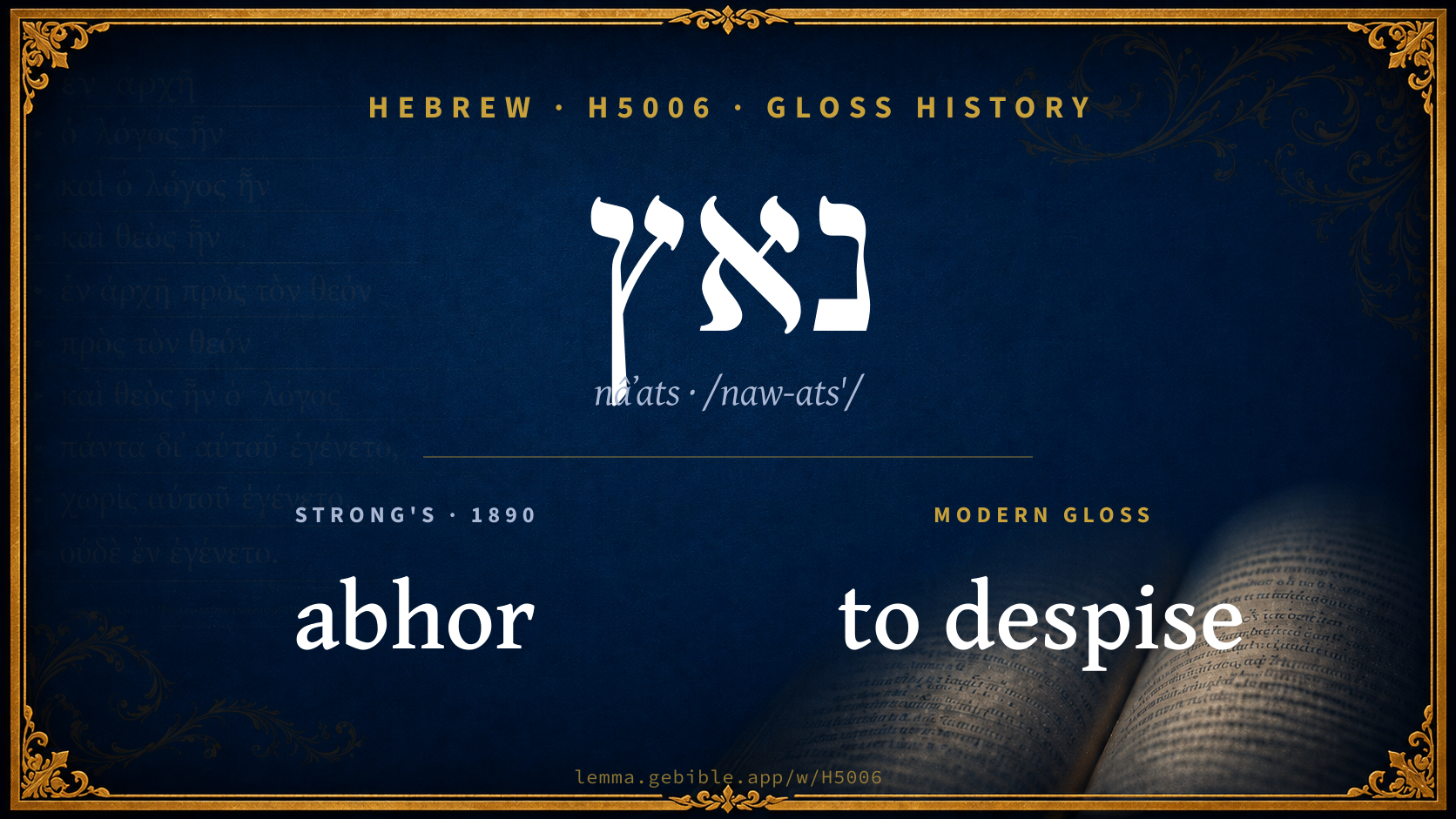
Gloss history
Strong's 1890 vs modern scholarship
About this word
Strong's H5006 catalogs a Hebrew word from the Hebrew Old Testament.
These counts are not copied from any lexicon or concordance. They are computed here, from the morphology-tagged Hebrew Old Testament. What Lemma adds →
- 24
- distinct verses
- The word appears in 24 distinct verses.
- 10 / 39
- OT books
- The word appears in 10 of 39 Old Testament books.
- #1,282
- by frequency
- Top 2500 most frequent Hebrew words (rank 1,282 of 8,640 Hebrew words by occurrence).
View all 24 occurrences in the concordance →
By section of the Old Testament
By traditional corpus
Conventional, traditional groupings — biblical authorship is debated, so this is a traditional corpus grouping, not an authorship claim. Each share is this word’s portion of its verses in that division of the Hebrew canon. Each figure is a share of the word’s 24 distinct verses.
- Writings (Ketuvim) 10 verses · 42%
- Prophets (Nevi'im) 9 verses · 38%
- Torah (Pentateuch) 5 verses · 21%
How translations render this word
Counts come from each version’s own published word-to-Strong’s tagging or interlinear alignment — an approximate guide to how each version renders this word, not a word-level alignment the data otherwise carries. Because each total is that version’s own tagged count, the per-version totals vary from one another and need not match the appearance or distinct-verse counts above. These counts may also differ from a printed concordance because Lemma counts each distinctly tagged rendering and does not collapse phrase taggings into a single head-word total. This is a fixed set of word-tagged versions (KJV, ASV, BSB, ULT) and does not change with the reading translation you choose elsewhere. Each version’s license is shown beside its name below (and on Sources).
BDB lists this Strong’s number as 3 distinct words (homographs). Each count above pools all of them and is not split by sense — see the Senses section below. A low-frequency rendering may belong to a different one of those words, not the primary meaning.
- King James Version†: Blaspheme 2×, Despised 2×, Provoke 2×
- American Standard Version†: Despised 3×, Blaspheme 2×, Despise 2×
- Berean Standard Bible†: Despised 3×
- unfoldingWord Literal Text†: Despise 2×, Despised 2×, They have despised 2×
King James Version Public Domain
Renders H5006 across 27† tagged occurrences — most commonly:
Plus 21 renderings that appear only once — usually multi-word phrases or single function words the recovered tagging swept in, not distinct renderings.
American Standard Version Public Domain
Renders H5006 across 26† tagged occurrences — most commonly:
Plus 19 renderings that appear only once — usually multi-word phrases or single function words the recovered tagging swept in, not distinct renderings.
Berean Standard Bible Public Domain
Renders H5006 across 24† tagged occurrences — most commonly:
Plus 21 renderings that appear only once — usually multi-word phrases or single function words the recovered tagging swept in, not distinct renderings. Not rendered by a distinct English word in 1 further occurrence.
unfoldingWord Literal Text CC BY-SA 4.0
Renders H5006 across 29† tagged occurrences — most commonly:
Plus 21 renderings that appear only once — usually multi-word phrases or single function words the recovered tagging swept in, not distinct renderings.
Senses in the full BDB
Hebrew verbs can shift meaning by stem (binyan): Qal is the basic action, Niphal is often passive or reflexive, Piel often intensifies or makes it factitive, and Hiphil is typically causative. The senses below are grouped under the stem BDB assigns to each.
What do BDB’s symbols mean?
BDB uses these scholarly abbreviations:
| Symbol | Meaning |
|---|---|
| 𝔊 | the Septuagint (the ancient Greek translation, LXX) |
| 𝔙 | the Vulgate (the Latin translation) |
| 𝔖 | the Syriac version (the Peshitta) |
| 𝔗 | the Targum (the Aramaic translation) |
| ψ | the Psalms |
| √ | root (the underlying root or stem) |
| ‖ | parallel passage (a synonymous or contrasted parallel) |
| † | the dagger: every passage where the word occurs is cited |
The 5 senses and sub-senses the full Brown-Driver-Briggs lexicon distinguishes for this word, in lexicon order (not ranked by frequency), with BDB’s own verbatim wording and sub-sense lettering. Shown in Hebrew script with BDB’s own scholarly abbreviations. The condensed entry is in the Lexicon Entry tab. See also the Forms in the corpus table below.
נאץ I contemn, spurn (NH id., Pi.
Qal
- Pf. נ׳ Pr 5:12; 3 pl. נָֽאֲצוּ Pr 1:30; נָאָ֑צוּ ψ 107:11; Impf. יִנְאַץ Pr 15:5; יִנְאָצ֑וּן Je 33:24, etc.;—contemn, subj. wicked and foolish, obj. תּוֹכַחַת Pr 1:30; 5:12; obj. מוּסָר Pr 15:5; עֵצָה ψ 107:11; Je 33:24 (obj. עַם י׳; cf. Gie); subj. י׳ Dt 32:19 Je 14:21 La 2:6. e.g. Proverbs 5:12
Piel
- Pf. נִאֵץ ψ 10:3, 13; נִאַ֫צְתָּ 2 S 12:14, etc.; Impf. יְנָאֵץ ψ 74:10, sf. יְנַאֲצֻנִי Nu 14:11; Inf. abs. נִאֵץ (Sta§ 221) 2 S 12:14; Pt. sf. מְנָֽאֲצַי Nu 14:23; מְנַאֲצַי Je 23:17; מְנַאֲצָ֑יִךְ Is 60:14;—contemn, spurn, subj.men, obj. י׳, etc.: Nu 14:11, 23; 16:30 (all J), Dt 31:20 Is 1:4 ψ 10:3, 13 Je 23:17; obj. שֵׁם י׳ ψ 74:10, 18; אִמְרַת י׳ Is 5:24; מִנְחַת י׳ 1 S 2:17; once obj. Jerus. Is 60:14; cause to contemn (blaspheme AV RV) 2 S 12:14(×2) (but אֹיְבֵי prob. interp.; v Comm). e.g. Psalms 10:3
Hiphil
- Impf. יָנֵ֯אץ v. נצץ. Hithpoʿel Pt. כל־היום שְׁמִי מִנֹּאָץ Is 52:5 every day is my name contemned. e.g. Isaiah 52:5
נאץ II shine, sparkle (NH נִצְנֵץ
Qal
- Pt. וְנֹצְצִים כְּעֵין נְחשֶׁת Ez 1:7 (of cherubim);—PerlesAnal.45 proposes נוֹצִיצָם their plumage (נ׳ ‖ form of נוֹצָה), cf. Ew. e.g. Ezekiel 1:7
נאץ III denom. bloom, blossom (NH id.
Hiphil
- Pf. 3 pl. הֵנֵ֫צוּ Ct 6:11 (no dagh., v. Köi. 381 Ges§ 67, 8, R. 11) the pomegranates have put forth blossoms, so 7:13; Impf. 3 ms. יָנֵאץ Ec 12:5 the almond-tree wears blossoms. e.g. Song of Solomon 6:11
Senses from the full Brown-Driver-Briggs lexicon (Brown, Driver, Briggs; Oxford 1906 — public domain), digitized via Sefaria, supplemented by the OpenScriptures HebrewLexicon (CC BY 4.0). Full attribution on Sources.
Word origin
I. vb. contemn, spurn (NH id., Pi.; 𝔗 נִיאוּצָא reviling);—
I. vb. shine, sparkle (NH נִצְנֵץ; akin to Arabic نَاضَ sparkle, flash, 𝔗 נְעָא);—
II. vb. denom. bloom, blossom (NH id.; Jewish-Aramaic נְצַץ id.);—
— Brown-Driver-Briggs (Oxford 1906, public domain), digitized via Sefaria, supplemented by the OpenScriptures HebrewLexicon (CC BY 4.0). See Sources.
Origin: a primitive root
Jastrow Dictionary
A second Hebrew/Aramaic lexicon for comparison, covering Aramaic and post-biblical (Talmudic, Targumic, Midrashic) usage that the biblical-Hebrew BDB does not. Matched by lemma rather than by Strong’s number, so a lemma may carry more than one Jastrow headword (shown separately below), and the entries cover usage well beyond the Bible.
נָאַץ
- [to press, stamp in anger, v. Deut. XXXII, 19,] to be indignant; to be bold; (act. verb) to reject, insult, blaspheme. e.g. Deuteronomy 32:19
- 1. same. Keth. 8ᵇ (ref. to Deut. l. c.) [read:] דור שאבות מְנָאֲצִים לו הקב"ה וכ׳ a generation in which the parents insult him, the Lord will &c.; Yalk. Deut. 945 מְנָאֲצִין בו וכ׳.…—Sifré Deut. 320 מנאצים לפניו, v. נָאֶה. Num. R. s. 7 כל מי שני׳ לאלהים נעשה זר whoever insults God becomes an outcast (leper). Ib. הם נִאֲצוּ אותי they insulted me. Ib. מי שמְנָאֵץ בדברי תורה who makes bold with the words of the Law (blasphemes); a. fr.
- 2. to threaten. Mekh. B’shall., Shir., s. 7 חמשה … מנאץ וכ׳ five things did Pharaoh threaten to do; Yalk. Ex. 249. Mekh. l. c.; Yalk. Ex. 250 היה עומד ומנ׳ אחר וכ׳ stood threatening at the palace &c.; a. e.
- to be insulted. Midr. Till. to Ps. LXXIV, end עשה בשביל … שמתחרף ומִתְנָאֵץ בעולם do it for the sake of thy great and holy Name which is blasphemed and insulted in the world; a. e.
A Dictionary of the Targumim, the Talmud Babli and Yerushalmi, and the Midrashic Literature (Marcus Jastrow; London, Luzac, 1903) — Public Domain. Digitized via Sefaria. Digitized via Sefaria. Full attribution on Sources.
Forms in the corpus
The 24 distinct written forms H5006 takes in the Hebrew Bible, most frequent first — each parse links to that stem’s occurrences in the concordance. Hebrew forms include their vowel points and cantillation, so a single lemma takes many written forms.
Same root — word family
Other BDB entries built from the same root as H5006, grouped by Strong’s listed origin. These share a root / origin per the lexicon — not necessarily a shared meaning. Each links to that word’s own entry.
Derived from this word
Compare all same-root words → They share a root, not necessarily a meaning.
Septuagint verse parallels
This word appears in 22 verses that also exist in the Greek Old Testament (Septuagint), out of the 24 Hebrew verses it occurs in. You can read those verses in Greek by switching the Old Testament edition to the Septuagint.
Read these verses in the Septuagint
- Numbers 14:11
- Deuteronomy 31:20
- 1 Samuel 2:17
- 2 Samuel 12:14
- Psalms 10:3
- Proverbs 1:30
- Ecclesiastes 12:5
- Isaiah 1:4
- Jeremiah 14:21
- Lamentations 2:6
This is a verse-level parallel only — the same verses exist in both the Hebrew and Greek Old Testaments. No word-level Hebrew↔Greek correspondence is claimed: the data carries no such alignment, so no Greek word is shown as this Hebrew word’s translation. Coverage is not total — the Septuagint omits the deuterocanon and renumbers the Psalms, so some Hebrew verses have no direct Greek parallel.