
Isaiah 41:16

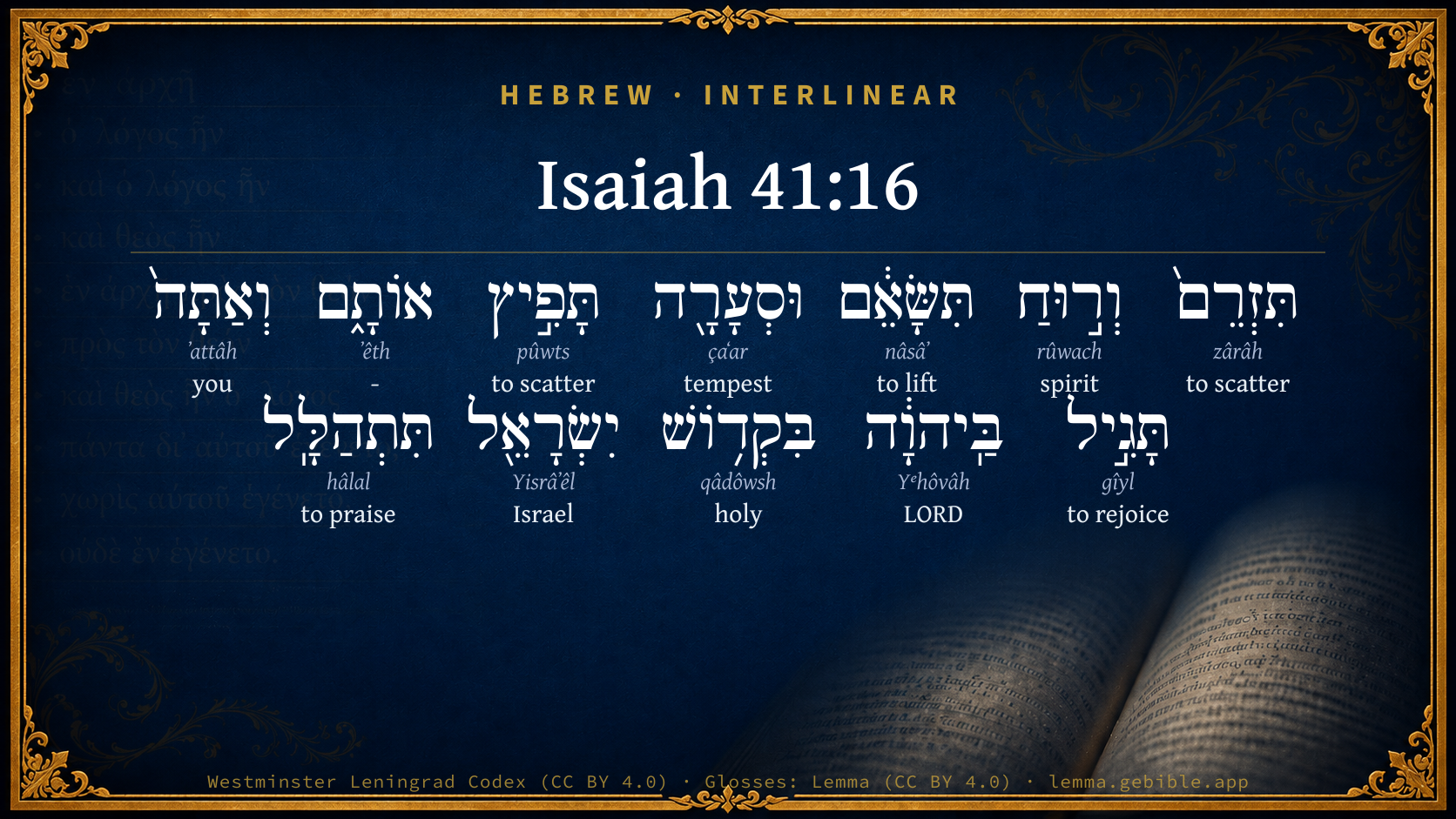
Hebrew (Westminster Leningrad Codex) Isaiah 41:16 appears in the Hebrew Old Testament. The text above is from the Westminster Leningrad Codex. Each word links to its Strong’s number, a concise gloss, and parsing drawn from the Open Scriptures Hebrew Bible morphology. Click any word for its full Brown-Driver-Briggs (BDB) entry.
Download image
Cite this verse

Isaiah 41:16 (World English Bible). Public Domain. Lemma interlinear Bible study tool, https://lemma.gebible.app/v/isaiah/41/16.

Show BibTeX & RIS
BibTeX
RIS
English Translation
You shall winnow them, and the wind shall carry them away, and the whirlwind shall scatter them; and you shall rejoice in Yahweh, you shall glory in the Holy One of Israel.
World English Bible · Public Domain
Download a study sheet

One document with this verse’s original text, its word-by-word gloss line, the meaning frame, cross-references with their text, attributed commentary, and full source and license credits — printable, and it pastes into notes with its structure intact.

This verse Autodidact and up

Study sheet (.html) Plain text (.txt)

A passage Seminary Student

Up to 50 verses in one chapter. A passage sheet keeps up to 6 commentary sources and 12 cross-references per verse, in the order this page ranks them, and says so on the sheet whenever that leaves anything out. Ask for a single verse and you get the Autodidact verse sheet above.

Everything on this page stays free to read, with no account — the sheet is a download of what is already on screen, not access to it.

Want to remove ads? Support Godless Engineer
Compare translations 3

The same verse in 3 English versions, stacked beneath the original-language interlinear above. Click any original word for its lexicon entry.

Each is an independent rendering of the whole verse — the interlinear is not word-aligned to these translations.

Highlighted words mark where these versions differ — a whole-verse word diff, not a word-by-word alignment.

  • World English Bible Public Domain
    You shall winnow them, and the wind shall carry them away, and the whirlwind shall scatter them; and you shall rejoice in Yahweh, you shall glory in the Holy One of Israel.
  • King James Version Public Domain
    Thou shalt fan them, and the wind shall carry them away, and the whirlwind shall scatter them: and thou shalt rejoice in the LORD, and shalt glory in the Holy One of Israel.
  • unfoldingWord Literal Text CC BY-SA 4.0
    You will winnow them, and the wind will carry them away, and the whirlwind will scatter them. But you, you will be glad in Yahweh, you will boast in the Holy of Israel.” q1

unfoldingWord Literal Text — © unfoldingWord, licensed CC BY-SA 4.0. Word-aligned USFM3 via Door43 (git.door43.org/unfoldingWord/en_ult).

Versions to compare (up to 4)

3 of 4 selected

Show all 18 translations

Every available English version of this verse, each an independent rendering of the whole verse.

  • World English Bible Public Domain
    You shall winnow them, and the wind shall carry them away, and the whirlwind shall scatter them; and you shall rejoice in Yahweh, you shall glory in the Holy One of Israel.
  • Berean Standard Bible Public Domain
    You will winnow them, and a wind will carry them away; a gale will scatter them. But you will rejoice in the LORD; you will glory in the Holy One of Israel.
  • Majority Standard Bible Public Domain
    You will winnow them, and a wind will carry them away; a gale will scatter them. But you will rejoice in the LORD; you will glory in the Holy One of Israel.
  • King James Version Public Domain
    Thou shalt fan them, and the wind shall carry them away, and the whirlwind shall scatter them: and thou shalt rejoice in the LORD, and shalt glory in the Holy One of Israel.
  • American Standard Version (1901) Public Domain
    Thou shalt winnow them, and the wind shall carry them away, and the whirlwind shall scatter them; and thou shalt rejoice in Jehovah, thou shalt glory in the Holy One of Israel.
  • Revised Version (1885) Public Domain
    Thou shalt fan them, and the wind shall carry them away, and the whirlwind shall scatter them: and thou shalt rejoice in the LORD, thou shalt glory in the Holy One of Israel.
  • Geneva Bible (1599) Public Domain
    Thou shalt fanne them, and the winde shall carie them away, and the whirlewinde shall scatter them: and thou shalt reioyce in the Lord, and shalt glory in the holy one of Israel.
  • Douay-Rheims (1899) Public Domain
    Thou shalt fan them, and the wind shall carry them away, and the whirlwind shall scatter them: and thou shalt rejoice in the Lord, in the Holy One of Israel thou shalt be joyful.
  • Young's Literal Translation Public Domain
    Thou winnowest them, and a wind lifteth them up, And a whirlwind scattereth them, And thou -- thou rejoicest in Jehovah, In the Holy One of Israel dost boast thyself.
  • Literal Standard Version CC BY-SA 4.0
    You winnow them, and a wind lifts them up, || And a whirlwind scatters them, || And you rejoice in YHWH, || [And] boast yourself in the Holy One of Israel.
  • Unlocked Literal Bible CC BY-SA 4.0
    You will winnow them, and the wind will carry them away; the wind will scatter them. You will rejoice in Yahweh, you will rejoice in the Holy One of Israel.
  • unfoldingWord Literal Text CC BY-SA 4.0
    You will winnow them, and the wind will carry them away, and the whirlwind will scatter them. But you, you will be glad in Yahweh, you will boast in the Holy of Israel.” q1
  • Darby Bible Public Domain
    thou shalt fan them, and the wind shall carry them away, and the whirlwind shall scatter them; and thou shalt rejoice in Jehovah, thou shalt glory in the Holy One of Israel.
  • World Messianic Bible Public Domain
    You will winnow them, and the wind will carry them away, and the whirlwind will scatter them. You will rejoice in the LORD. You will glory in the Holy One of Israel.
  • Webster's Bible Public Domain
    Thou shalt fan them, and the wind shall carry them away, and the whirlwind shall scatter them: and thou shalt rejoice in the LORD, and shalt glory in the Holy One of Israel.
  • Free Bible Version CC BY-SA 4.0
    You will throw them into the air, the wind will carry them away, and a storm will scatter them. Then you will be happy in the Lord, and boast about the Holy One of Israel.
  • Bible in Basic English Public Domain
    You will send the wind over them, and it will take them away; they will go in all directions before the storm-wind: you will have joy in the Lord, and be glad in the Holy One of Israel.
  • JPS Tanakh (1917) Public Domain
    Thou shalt fan them, and the wind shall carry them away, and the whirlwind shall scatter them; and thou shalt rejoice in the LORD, thou shalt glory in the Holy One of Israel.

Literal Standard Version (2020), Covenant Press — licensed CC BY-SA 4.0. Text via the HelloAO Bible API (eBible.org). Unlocked Literal Bible (unfoldingWord) — licensed CC BY-SA 4.0. Text via the HelloAO Bible API (eBible.org). unfoldingWord Literal Text — © unfoldingWord, licensed CC BY-SA 4.0. Word-aligned USFM3 via Door43 (git.door43.org/unfoldingWord/en_ult). Free Bible Version, Dr. Jonathan Gallagher — licensed CC BY-SA 4.0. Text via the HelloAO Bible API (eBible.org).

Word by word

More ways to search: Search by grammar → Find every occurrence → Compare this word →

Practice this passage: Drill this verse → Learn its vocabulary →

וּסְעָרָ֖ה
çaʻar
H5591
“and · tempest”
Conjunction + Noun, Common, Feminine, Singular, Absolute
Part of Speech
Conjunction + Noun
Type
Common
Gender
Feminine
Number
Singular
State
Absolute
Full BDB Definition

Origin: from H5590

TWOT: 1528

tempest, storm, whirlwind - tempest
  1. תִּזְרֵם֙ zârâh H2219 “to scatter · them” Verb, Qal, Imperfect, 2nd Person, Masculine, Singular + Suffix, Personal, 3rd Person, Masculine, Plural
  2. וְר֣וּחַ rûwach H7307 “and · spirit” Conjunction + Noun, Common, Both, Singular, Absolute
  3. תִּשָּׂאֵ֔ם nâsâʼ H5375 “to lift · them” Verb, Qal, Imperfect, 3rd Person, Feminine, Singular + Suffix, Personal, 3rd Person, Masculine, Plural
  4. תָּפִ֣יץ pûwts H6327 “to scatter” Verb, Hiphil, Imperfect, 3rd Person, Feminine, Singular
  5. אוֹתָ֑ם ʼêth H853 “- · them” Particle, Direct Object + Suffix, Personal, 3rd Person, Masculine, Plural
  6. וְאַתָּה֙ ʼattâh H859 “and · you” Conjunction + Pronoun, Personal, 2nd Person, Masculine, Singular
  7. תָּגִ֣יל gîyl H1523 “to rejoice” Verb, Qal, Imperfect, 2nd Person, Masculine, Singular
  8. בַּֽיהוָ֔ה Yᵉhôvâh H3068 “in/at · LORD” Preposition + Noun, Proper
  9. בִּקְד֥וֹשׁ qâdôwsh H6918 “in/at · holy of” Preposition + Adjective, Adjective, Masculine, Singular, Construct
  10. יִשְׂרָאֵ֖ל Yisrâʼêl H3478 “Israel” Noun, Proper
  11. תִּתְהַלָּֽל hâlal H1984 “to praise” Verb, Hithpael, Imperfect, 2nd Person, Masculine, Singular

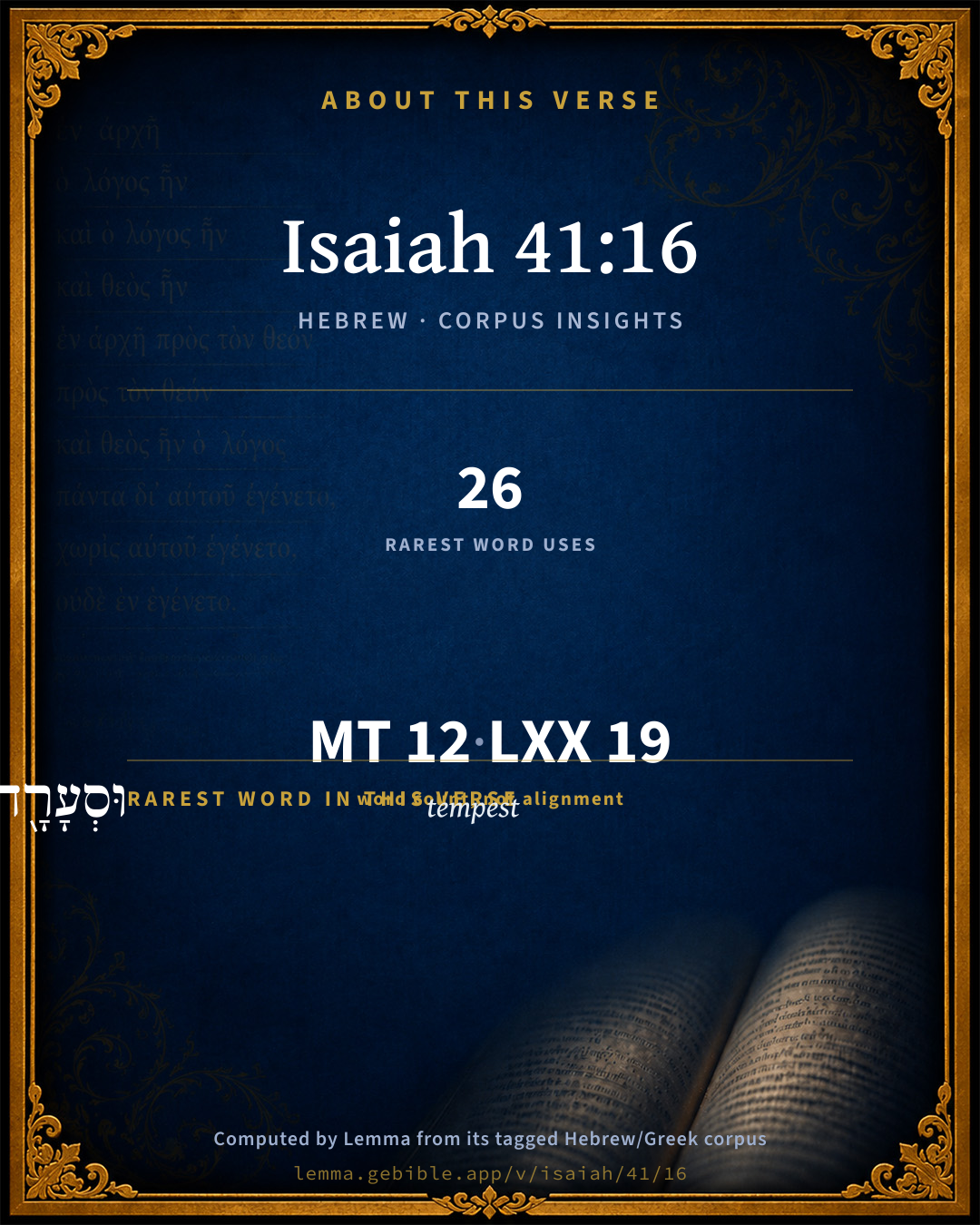
About this verse

These counts appear in no published source. They are computed here, from the morphology-tagged text and Lemma’s own curated glosses. What Lemma adds →

12
words
12
distinct lemmas
Prophets
section

Shared distinctive vocabulary

וּסְעָרָ֖ה tempest H5591 occurs in 22 verses of the Hebrew Bible. Also found in:

Grammatical profile

  • 5 verbs
  • 4 nouns
  • 1 adjective
  • 1 pronoun
  • 1 particle

Verb forms

  • תִּזְרֵם֙ Qal · Imperfect
  • תִּשָּׂאֵ֔ם Qal · Imperfect
  • תָּפִ֣יץ Hiphil · Imperfect
  • תָּגִ֣יל Qal · Imperfect
  • תִּתְהַלָּֽל Hithpael · Imperfect

Hebrew & Septuagint length

In English translation the verse runs 32 words from the Hebrew and 28 from the Septuagint (LXX English) — closely comparable.

A rough comparison of the two English renderings, which tokenize alike — not a word-level alignment.

Word counts can differ between the Hebrew and the Greek without any difference in meaning — e.g. the Hebrew direct-object marker אֵת has no separate Greek word, and Greek often adds the article ὁ.

In the original languages it is 12 Hebrew tokens and 19 Greek tokens — but the two are counted differently (Hebrew bundles its prefixes and suffixes into one token; the Greek is in lemma form), so that isn’t a like-for-like length.

Cross-references

16

Topical passages linked to Isaiah 41:16 in the Treasury of Scripture Knowledge — connected by theme and wording, ordered by reader-vote popularity; previews shown in the World English Bible.

  • Jeremiah 51:2 I will send to Babylon strangers, who shall winnow her; and they shall empty her land: for in the day of trouble they shall be against her round about.
  • Isaiah 45:24–25 Only in Yahweh, it is said of me, is righteousness and strength; even to him shall men come; and all those who were incensed against him shall be disappointed.
  • Isaiah 61:10–11 I will greatly rejoice in Yahweh, my soul shall be joyful in my God; for he has clothed me with the garments of salvation, he has covered me with the robe of righteousness, as a bridegroom decks himself with a garland, and as a bride adorns herself with her jewels.
  • Habakkuk 3:18 Yet I will rejoice in Yahweh. I will be joyful in the God of my salvation!
  • Jeremiah 9:23–24 Thus says Yahweh, Don't let the wise man glory in his wisdom, neither let the mighty man glory in his might, don't let the rich man glory in his riches;
  • Jeremiah 15:7 I have winnowed them with a fan in the gates of the land; I have bereaved [them] of children, I have destroyed my people; they didn't return from their ways.
  • 1 Samuel 2:1–2 Hannah prayed, and said: My heart exults in Yahweh; My horn is exalted in Yahweh; My mouth is enlarged over my enemies; Because I rejoice in your salvation.
  • Psalms 1:4 The wicked are not so, But are like the chaff which the wind drives away.
  • Isaiah 12:6 Cry aloud and shout, you inhabitant of Zion; for great in the midst of you is the Holy One of Israel!"
  • Isaiah 17:13 The nations shall rush like the rushing of many waters: but he shall rebuke them, and they shall flee far off, and shall be chased as the chaff of the mountains before the wind, and like the whirling dust before the storm.
  • Isaiah 25:1–3 Yahweh, you are my God; I will exalt you, I will praise your name; for you have done wonderful things, [even] counsels of old, in faithfulness [and] truth.
  • Matthew 3:12 His winnowing fork is in his hand, and he will thoroughly cleanse his threshing floor. He will gather his wheat into the barn, but the chaff he will burn up with unquenchable fire."
  • Luke 1:46–47 Mary said, "My soul magnifies the Lord.
  • Romans 5:11 Not only so, but we also rejoice in God through our Lord Jesus Christ, through whom we have now received the reconciliation.
  • 1 Corinthians 1:30–31 But of him, you are in Christ Jesus, who was made to us wisdom from God, and righteousness and sanctification, and redemption:
  • Philippians 3:3 For we are the circumcision, who worship God in the Spirit, and rejoice in Christ Jesus, and have no confidence in the flesh;

Cross-references courtesy of OpenBible.info (CC BY 4.0).

Hebrew and Greek witnesses Masoretic Hebrew ↔ Greek Septuagint

The same verse in the two great witnesses to the Old Testament, shown verse-for-verse.

These are two independent witnesses, not word-aligned to each other, and the Septuagint is shown in lemma (dictionary) form.

Hebrew Isaiah 41:16 Masoretic · Westminster Leningrad Codex

תִּזְרֵם֙ וְר֣וּחַ תִּשָּׂאֵ֔ם וּסְעָרָ֖ה תָּפִ֣יץ אוֹתָ֑ם וְאַתָּה֙ תָּגִ֣יל בַּֽיהוָ֔ה בִּקְד֥וֹשׁ יִשְׂרָאֵ֖ל תִּתְהַלָּֽל

You shall winnow them, and the wind shall carry them away, and the whirlwind shall scatter them; and you shall rejoice in Yahweh, you shall glory in the Holy One of Israel.

World English Bible · Public Domain

Greek LXX Isaiah 41:16 Septuagint · lemma form

καί λικμάω καί ἄνεμος λαμβάνω αὐτός καί καταιγίς διασπείρω αὐτός σύ δέ εὐφραίνω ἐν ὁ ἅγιος ἰσραήλ καί ἀγαλλιάομαι

and you shall winnow them, and the wind shall carry them away, and a tempest shall scatter them: but you shall rejoice in the holy ones of Israel.

LXX2012 (modern English Septuagint) · Public Domain

Hebrew: Westminster Leningrad Codex (CC BY 4.0). Greek: Septuagint (public domain); English from LXX2012 (modern English Septuagint) (Public Domain). How the Septuagint differs from the Hebrew →

Targum (Aramaic paraphrase)

1

The Targum is the ancient Jewish Aramaic paraphrase of the Hebrew Scriptures — an interpretive translation, not the Hebrew text itself. Onkelos (literal) and Pseudo-Jonathan (expansive) render the Torah, and Jonathan the Prophets. Coverage is partial: where no permissively-licensed English translation exists for a verse, only the Aramaic is shown. This is verse-level text, not a word-by-word alignment to the Hebrew.

  1. Targum Jonathan Prophets (Joshua–Malachi)
    תְּדִרִינוּן וְרוּחָא תִטְלוּנוּן וּמֵימְרֵהּ כְּעַלְעוֹלָא לְקַשָׁא יְבַדֵר יַתְהוֹן וְאַתְּ תְּבוּעַ בְּמֵימְרָא דַייָ בְּקַדִישָׁא דְיִשְׂרָאֵל תִּשְׁתַּבַּח:

    Thou shalt fan them, and the wind shall carry them away, and my WORD shall scatter them as the whirlwind scattereth the chaff; but as for thee, thou shalt rejoice in the Word of the Lord, thou shalt glory in the Holy One of Israel.

    Targum Jonathan — Aramaic: “Mikraot Gedolot” (public domain). English: “Sefaria Community Translation” (CC0 1.0 (public-domain dedication)); “London "Chaldee Paraphrase," 1871” (public domain). Text via Sefaria.

Commentary

Notes on Isaiah 41:16 from classic Christian and Jewish commentators (each source and its license shown beneath its notes). The classic Christian expositions comment on the surrounding passage and are grouped to its opening verse, so a note may address several verses; the Jewish commentaries on the Tanakh (Rashi and others) are per-verse, so they appear only where the commentator wrote on this verse.

Lemma curates 59 commentaries, every one of them public domain or Creative Commons licensed, each selected and text-cleaned for this edition rather than reprinted as found. About our sources →

Trapp's Complete Commentary

John Trapp

Isa 41:16 Thou shalt fan them, and the wind shall carry them away, and the whirlwind shall scatter them: and thou shalt rejoice in the LORD, [and] shalt glory in the Holy One of Israel.

Ver. 16. Thou shalt fan them.] But find nothing in them of any solidity. The heart of the wicked is little worth.

And thou shalt rejoice in the Lord.] As the sole doer of all; for it is he that subdueth the people under us, and doeth all our works for us. {Isa 26:12}

John Trapp, A Commentary or Exposition upon All the Books of the Old and New Testament (1647–1656) — public domain. Text from a community e-Sword module.

Tyndale Open Study Notes

Tyndale Open Resources

41:16 When the grain is thrown into the wind, the chaff is blown away. Likewise, Israel’s enemies appeared to be strong but would easily be driven off.

Tyndale Open Study Notes — © Tyndale Open Resources, licensed CC BY-SA 4.0. Text via the HelloAO Bible API.

Jamieson, Fausset & Brown

Robert Jamieson, A. R. Fausset & David Brown

fan--winnowed (compare Mat 3:12).

whirlwind . . . scatter them-- (Job 27:21; Job 30:22).

Jamieson, Fausset & Brown — Commentary Critical and Explanatory on the Whole Bible (1871) — public domain (CC PDM 1.0). Text via the HelloAO Bible API.

John Gill's Exposition

Thou shalt fan them, and the wind shall carry them away, and the whirlwind shall scatter them,.... In illusion to the custom of the Jews, who had their threshingfloors on the tops of hills and mountains, where they took the opportunity and advantage of the wind in winnowing their corn, which fanned it, and carried away the chaff, and scattered it abroad; in like manner, it is suggested, the enemies of the church and people of God should be dealt with, which are like the chaff the wind driveth away, and is found no more, Psa 1:5, and so Rome Pagan was no more as such when subdued by Constantine, nor will the Papal antichristian states, Dan 2:35. Compare with this what is said of literal Babylon, which will have its accomplishment in mystical Babylon, Jer 51:33,

and thou shalt rejoice in the Lord: the Targum is,

"in the word of the Lord;''

and so it paraphrases the preceding clause,

"his word shall scatter them as the whirlwind chaff;''

and therefore in him the saints shall rejoice, because it is he that destroys their enemies; so when Rome Pagan was abolished, and the devil and his angels, or the Heathen emperors, were drove out of it and destroyed, there was great joy among the people of God, saying, "now is come salvation and strength, and the kingdom of our God, and the power of his Christ", Rev 12:10 there will be great rejoicing in the Lord likewise when Rome Papal falls, and the saints have got the victory over the beast, Rev 15:2.

and shalt glory in the Holy One of Israel; whose arm alone has done the above things, and to whom the glory is to be given: it is the true character of believers to rejoice in Christ, in his person, offices, and grace, and to glory in his being made unto them wisdom, righteousness, sanctification, and redemption. Phi 3:3.

John Gill's Exposition of the Whole Bible (1746–1763) — public domain (CC PDM 1.0). Text via the HelloAO Bible API.

Albert Barnes' Notes on the Bible

Thou shalt fan them - Keeping up the figure commenced in the previous verse. To fan here means to winnow, an operation which was performed by throwing the threshed grain up with a shovel into the air, so that the wind drove the chaff away. So all their enemies, and all the obstacles which were in their way should be scattered.

And the whirlwind shall scatter them - The ancients believed that people might be swept away by a storm or whirlwind. See Job 27:

The cast wind carrieth him away and he departeth;

And as a storm hurleth him out of his place.

Compare Homer, Odys. xx. 63ff, thus rendered by Pope:

Snatch me, ye whirlwinds! far from human race,

Tost through the void illimitable space;

Or if dismounted from the rapid cloud,

Me with his whelming wave let ocean shroud!

See the notes at Job 30:22.

And thou shalt rejoice in the Lord - In view of the aid which he has vouchsafed, and the deliverance which he has performed for you.

Shalt glory - Shalt boast, or shalt exult. You will regard God as the author of your deliverance, and joy in the proofs of his interposition, and of his gracious protection and care.

Albert Barnes' Notes on the Bible (1834–1885) — public domain. Text from a community e-Sword/MySword module.

Matthew Poole's English Annotations

Thou shalt fan them, when thou hast beaten them as small as dust or chaff.

Shalt glory in the Holy One of Israel; for to him, and not to thyself, thou shalt ascribe thy victory over thine enemies.

Matthew Poole's English Annotations on the Holy Bible (1683–1685) — public domain. Text from a community e-Sword/MySword module.

John Wesley's Explanatory Notes

Fan - When thou hast beaten them as small as chaff. In the Holy One - For to him, thou shalt ascribe thy victory.

John Wesley, Explanatory Notes Upon the Whole Bible (1754–1765) — public domain. Text via the GEBible commentary corpus.

J. A. Alexander on Isaiah

Joseph Addison Alexander

“Thou shalt fan (or winnow) them, and a wind shall take them up, and a whirlwind shall scatter them, and thou shalt joy in Jehovah, in the holy One of Israel shalt thou boast (or glory).” The figure of the preceding verse is here carried out and completed. The mountains, having been completely threshed, are winnowed, in the usual oriental mode, by being thrown to the wind. Israel, on the other hand, is safe, not through his own strength but in that of his protector, in whom, (i.e., in his relation to Whom, he finds his highest happiness and honor). The writer’s main design is evidently still to exhibit the contrast between God and His people on the one hand, and the idols and their people on the other.

Joseph Addison Alexander, The Prophecies of Isaiah (1846–1847; New York: Scribner, 1870–1878) — public domain. Text from a community e-Sword module.

unfoldingWord translationNotes

Door43 World Missions Community

Connecting Statement:

Yahweh continues to use the metaphor of separating grain from chaff to describe how Israel will defeat their enemies.

You will winnow them ... the wind will scatter them

Here the word "them" refers to the mountains and hill in Isaiah 41:15. This represents the next step in the process of threshing grain, in which the grain is winnowed to get rid of the chaff. Israel's enemies will disappear like chaff blown away by the wind. (See: Metaphor)

the wind will carry them away; the wind will scatter them

These two phrases mean the same thing. AT: "the wind will blow them away" (See: Parallelism)

translationWords

winnow

joy

Yahweh

Holy One

Israel

unfoldingWord translationNotes — © Distant Shores Media and the Door43 World Missions Community, licensed CC BY-SA 4.0. Source: git.door43.org/Door43/en_tn.

Rashi

Rabbi Shlomo Yitzchaki (Rashi)

You shall winnow them You shall scatter them, as with a pitchfork, to the wind.

and a wind shall carry them off by themselves to Gehinnom.

Rashi on the Tanakh — English translations: “The Judaica Press complete Tanach with Rashi, translated by A. J. Rosenberg” (CC BY 4.0); “Pentateuch with Rashi's commentary by M. Rosenbaum and A.M. Silbermann, 1929-1934” (public domain); “The Metsudah Tanach series, Lakewood, N.J” (CC BY 4.0); and “The Book of Joshua, Metsudah Publications, 1997” (CC BY 4.0). Text via Sefaria.

Ibn Ezra

Rabbi Abraham ibn Ezra

Thou shalt scatter them, etc. This verse indicates that the greater part of the Babylonians will perish, and also that the Israelites will take their spoil.

Ibn Ezra on the Tanakh — English translations: “Sefaria Community Translation” (CC0 1.0 (public-domain dedication)); “Yalkut, Sifsei Chachomim Chumash, Metsudah Publications, 2009” (CC BY 4.0); and “Commentary of Ibn Ezra on Isaiah - trans. by M. Friedlander, 1873” (public domain). Text via Sefaria.

Lesson kit

Teaching starters — assembled from the data on this page, not authored interpretation. Every prompt links to the verse data it draws on. Edit before teaching.

Isaiah, in the Prophets, opens this verse with 12 words (12 distinct Hebrew lemmas). Its most distinctive word is çaʻar (“tempest”). A historical commentator’s framing appears above. Read the whole chapter for the surrounding context.

Discussion questions

  1. What does “tempest” (çaʻar) contribute to the verse as a whole?
  2. How does 2 Kings 2:1, which shares the word «tempest», read alongside this verse?
  3. These translations render this verse differently; the difference is in the English rendering, not the original. What questions does that raise?
  4. «תִּזְרֵם֙» is a Qal Imperfect verb. How does that grammatical form shape the action described?
  5. Compare how Trapp's Complete Commentary and Tyndale Open Study Notes read this verse. Where do they agree or differ?

Things to notice

Reading settings

Reading text

Shown beneath each verse's original-language words.

Old Testament
Old Testament edition

Read the OT as the Masoretic Hebrew (MT) or the Greek Septuagint (LXX).

English shown for the Greek Septuagint (in the Hebrew ↔ Greek comparison).

Comparing translations? Open the Compare panel on any verse page to stack up to four side by side.