Ephesians 1:17

Greek (Tischendorf 8th ed.) Ephesians 1:17 appears in the Greek New Testament. The text above is from the Tischendorf 8th edition. Each word links to its Strong’s number and a concise gloss. Click any word for its full Thayer’s Greek Lexicon entry.
Download image
Cite this verse

Ephesians 1:17 (World English Bible). Public Domain. Lemma interlinear Bible study tool, https://lemma.gebible.app/v/ephesians/1/17.

Show BibTeX & RIS
BibTeX
RIS
English Translation
that the God of our Lord Jesus Christ, the Father of glory, may give to you a spirit of wisdom and revelation in the knowledge of him;
World English Bible · Public Domain
Download a study sheet

One document with this verse’s original text, its word-by-word gloss line, the meaning frame, cross-references with their text, attributed commentary, and full source and license credits — printable, and it pastes into notes with its structure intact.

This verse Autodidact and up

Study sheet (.html) Plain text (.txt)

A passage Seminary Student

Up to 50 verses in one chapter. A passage sheet keeps up to 6 commentary sources and 12 cross-references per verse, in the order this page ranks them, and says so on the sheet whenever that leaves anything out. Ask for a single verse and you get the Autodidact verse sheet above.

Everything on this page stays free to read, with no account — the sheet is a download of what is already on screen, not access to it.

Want to remove ads? Support Godless Engineer
Compare translations 3

The same verse in 3 English versions, stacked beneath the original-language interlinear above. Click any original word for its lexicon entry.

Each is an independent rendering of the whole verse — the interlinear is not word-aligned to these translations.

Highlighted words mark where these versions differ — a whole-verse word diff, not a word-by-word alignment.

  • World English Bible Public Domain
    that the God of our Lord Jesus Christ, the Father of glory, may give to you a spirit of wisdom and revelation in the knowledge of him;
  • King James Version Public Domain
    That the God of our Lord Jesus Christ, the Father of glory, may give unto you the spirit of wisdom and revelation in the knowledge of him:
  • unfoldingWord Literal Text CC BY-SA 4.0
    so that the God of our Lord Jesus Christ, the Father of glory, would give to you a spirit of wisdom and revelation in the knowledge of him,

unfoldingWord Literal Text — © unfoldingWord, licensed CC BY-SA 4.0. Word-aligned USFM3 via Door43 (git.door43.org/unfoldingWord/en_ult).

Versions to compare (up to 4)

3 of 4 selected

Show all 19 translations

Every available English version of this verse, each an independent rendering of the whole verse.

  • World English Bible Public Domain
    that the God of our Lord Jesus Christ, the Father of glory, may give to you a spirit of wisdom and revelation in the knowledge of him;
  • Berean Standard Bible Public Domain
    that the God of our Lord Jesus Christ, the glorious Father, may give you a spirit of wisdom and revelation in your knowledge of Him.
  • Majority Standard Bible Public Domain
    that the God of our Lord Jesus Christ, the glorious Father, may give you a spirit of wisdom and revelation in your knowledge of Him.
  • King James Version Public Domain
    That the God of our Lord Jesus Christ, the Father of glory, may give unto you the spirit of wisdom and revelation in the knowledge of him:
  • American Standard Version (1901) Public Domain
    that the God of our Lord Jesus Christ, the Father of glory, may give unto you a spirit of wisdom and revelation in the knowledge of him;
  • Revised Version (1885) Public Domain
    that the God of our Lord Jesus Christ, the Father of glory, may give unto you a spirit of wisdom and revelation in the knowledge of him;
  • Geneva Bible (1599) Public Domain
    That the God of our Lord Iesus Christ, that Father of glory, might giue vnto you the Spirit of wisedome, and reuelation through the acknowledging of him,
  • Douay-Rheims (1899) Public Domain
    That the God of our Lord Jesus Christ, the Father of glory, may give unto you the spirit of wisdom and of revelation, in the knowledge of him:
  • Young's Literal Translation Public Domain
    that the God of our Lord Jesus Christ, the Father of the glory, may give to you a spirit of wisdom and revelation in the recognition of him,
  • Literal Standard Version CC BY-SA 4.0
    that the God of our Lord Jesus Christ, the Father of the glory, may give to you a spirit of wisdom and revelation in the recognition of Him,
  • Unlocked Literal Bible CC BY-SA 4.0
    I pray that the God of our Lord Jesus Christ, the Father of glory, will give to you a spirit of wisdom and revelation in the knowledge of him.
  • unfoldingWord Literal Text CC BY-SA 4.0
    so that the God of our Lord Jesus Christ, the Father of glory, would give to you a spirit of wisdom and revelation in the knowledge of him,
  • Darby Bible Public Domain
    that the God of our Lord Jesus Christ, the Father of glory, would give you [the] spirit of wisdom and revelation in the full knowledge of him,
  • World Messianic Bible Public Domain
    that the God of our Lord Yeshua the Messiah, the Father of glory, may give to you a spirit of wisdom and revelation in the knowledge of him,
  • Webster's Bible Public Domain
    That the God of our Lord Jesus Christ, the Father of glory, may give to you the spirit of wisdom and revelation in the knowledge of him:
  • Free Bible Version CC BY-SA 4.0
    I pray that the God of our Lord Jesus Christ, the glorious Father, may give you a spirit of wisdom to see and know him as he really is.
  • Bible in Basic English Public Domain
    That the God of our Lord Jesus Christ, the Father of glory, may give to you a spirit of wisdom and revelation in the knowledge of him;
  • Text-Critical English NT CC BY 4.0
    I pray that the God of our Lord Jesus Christ, the Father of glory, may give you a spirit of wisdom and revelation as you come to know him.
  • Tyndale New Testament (1534) Public Domain
    that the God of oure lorde Iesus Christ and the father of glory myght geve vnto you the sprete of wisdome and open to you the knowledge of him silfe

Literal Standard Version (2020), Covenant Press — licensed CC BY-SA 4.0. Text via the HelloAO Bible API (eBible.org). Unlocked Literal Bible (unfoldingWord) — licensed CC BY-SA 4.0. Text via the HelloAO Bible API (eBible.org). unfoldingWord Literal Text — © unfoldingWord, licensed CC BY-SA 4.0. Word-aligned USFM3 via Door43 (git.door43.org/unfoldingWord/en_ult). Free Bible Version, Dr. Jonathan Gallagher — licensed CC BY-SA 4.0. Text via the HelloAO Bible API (eBible.org).

Word by word

More ways to search: Search by grammar → Find every occurrence → Compare this word →

Practice this passage: Drill this verse → Learn its vocabulary →

ἀποκαλύψεως
apokálypsis
G602
“disclosure”
Noun, Genitive, Singular, Feminine
Part of Speech
Noun
Case
Genitive
Number
Singular
Gender
Feminine
Full Thayer's Definition

Origin: from G601

TDNT: 12:23,4

1. laying bear, making naked 2. a disclosure of truth, instruction a. concerning things before unknown b. used of events by which things or states or persons hitherto withdrawn from view are made visible to all 3. manifestation, appearance
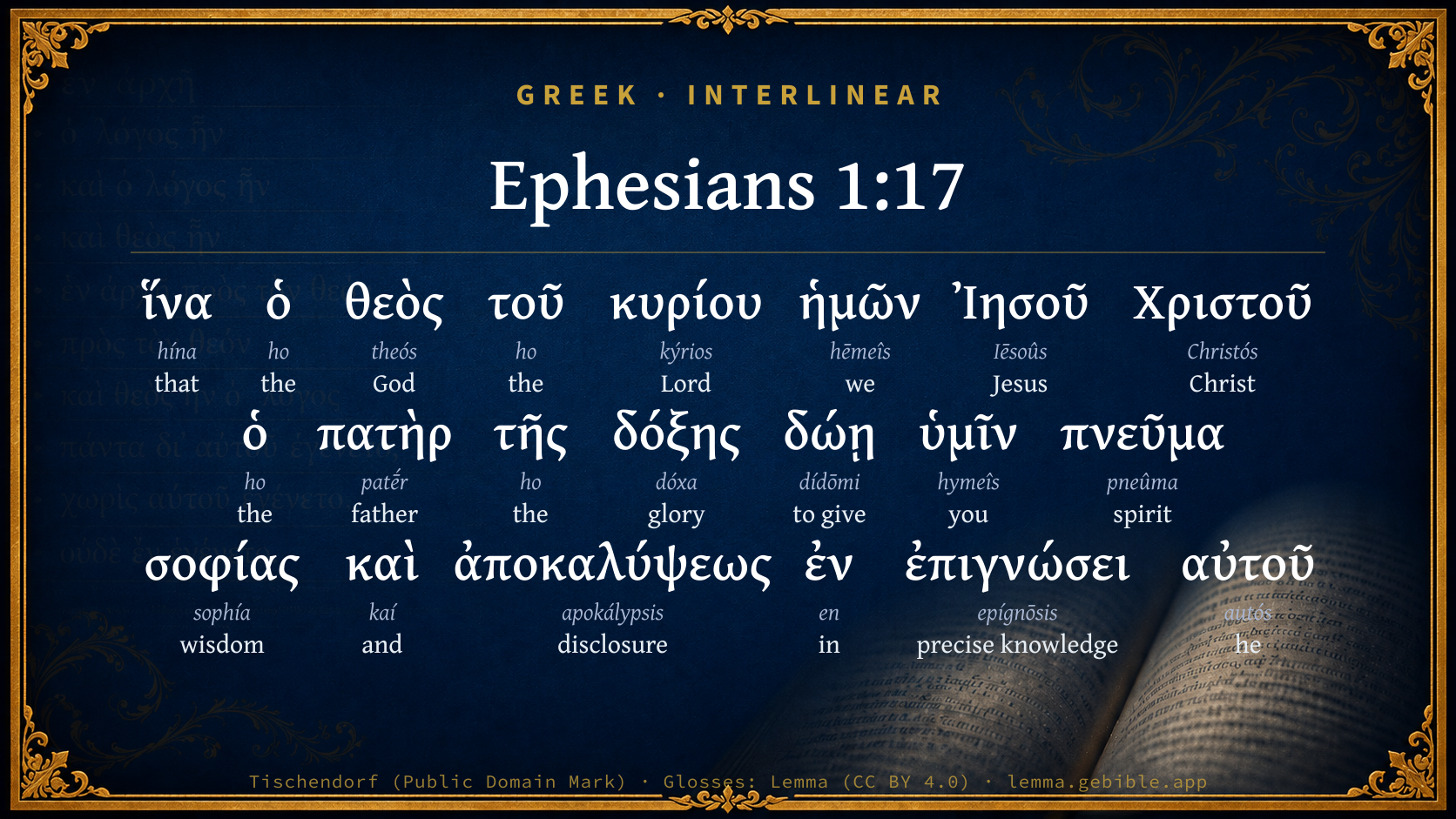
  1. ἵνα hína G2443 “that” Conjunction
  2. ὁ ho G3588 “the” Article, Nominative, Singular, Masculine
  3. θεὸς theós G2316 “God” Noun, Nominative, Singular, Masculine
  4. τοῦ ho G3588 “the” Article, Genitive, Singular, Masculine
  5. κυρίου kýrios G2962 “Lord” Noun, Genitive, Singular, Masculine
  6. ἡμῶν hēmeîs G2249 “we” Personal pronoun, 1st person, Genitive, Plural
  7. Ἰησοῦ Iēsoûs G2424 “Jesus” Noun, Genitive, Singular, Masculine
  8. Χριστοῦ Christós G5547 “Christ” Noun, Genitive, Singular, Masculine
  9. ὁ ho G3588 “the” Article, Nominative, Singular, Masculine
  10. πατὴρ patḗr G3962 “father” Noun, Nominative, Singular, Masculine
  11. τῆς ho G3588 “the” Article, Genitive, Singular, Feminine
  12. δόξης dóxa G1391 “glory” Noun, Genitive, Singular, Feminine
  13. δώῃ dídōmi G1325 “to give” Verb, Aorist, Active, Subjunctive, 3rd person, Singular
  14. ὑμῖν hymeîs G5210 “you” Personal pronoun, 2nd person, Dative, Plural
  15. πνεῦμα pneûma G4151 “spirit” Noun, Accusative, Singular, Neuter
  16. σοφίας sophía G4678 “wisdom” Noun, Genitive, Singular, Feminine
  17. καὶ kaí G2532 “and” Conjunction
  18. ἐν en G1722 “in” Preposition
  19. ἐπιγνώσει epígnōsis G1922 “precise knowledge” Noun, Dative, Singular, Feminine
  20. αὐτοῦ autós G846 “he” Personal pronoun, Genitive, Singular, Masculine

About this verse

These counts appear in no published source. They are computed here, from the morphology-tagged text and Lemma’s own curated glosses. What Lemma adds →

21
words
18
distinct lemmas
Pauline Epistles
section

Notable vocabulary

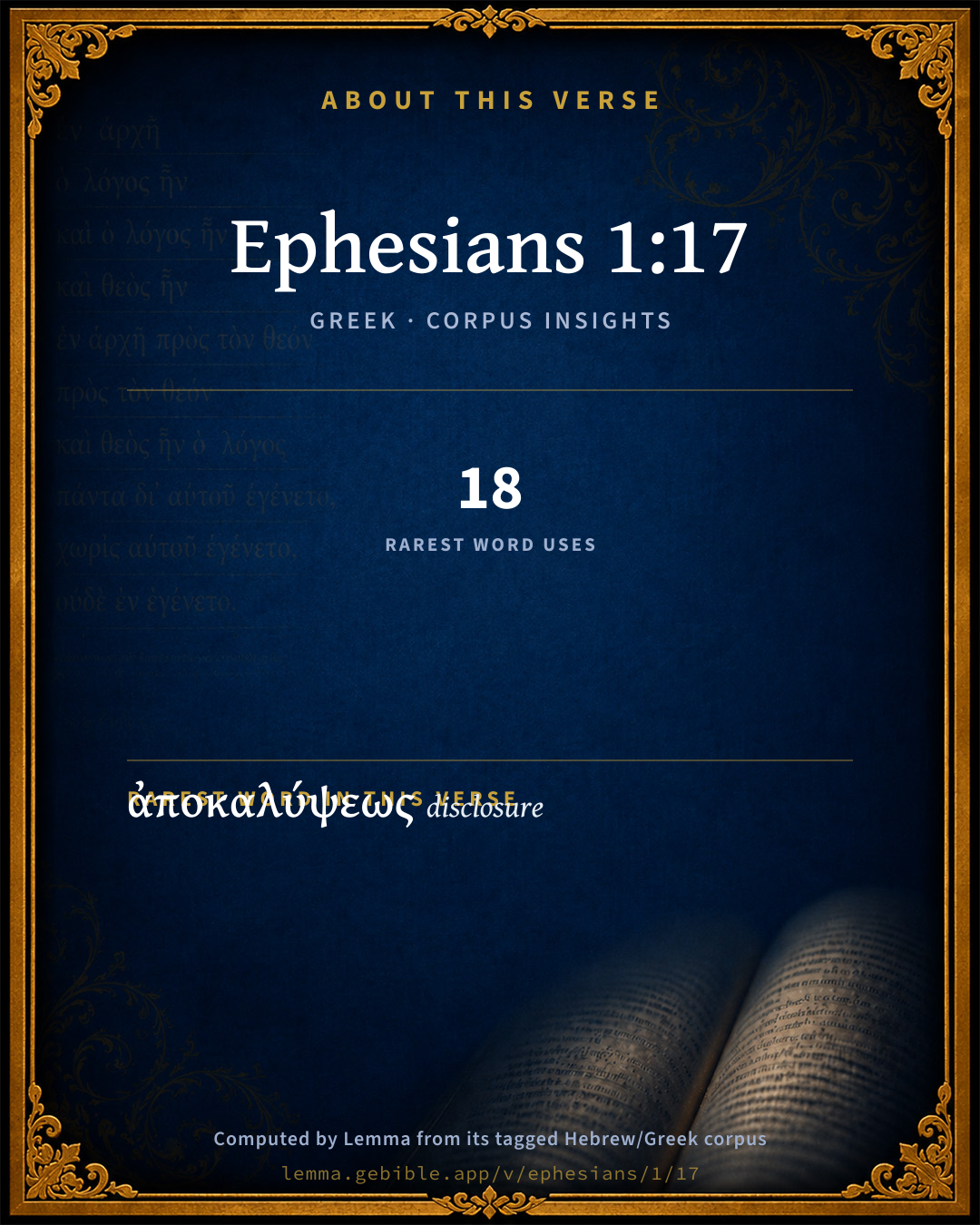
The rarest word here is ἀποκαλύψεως disclosure G602 — appearing just 18 times in the whole Greek New Testament.

Shared distinctive vocabulary

ἀποκαλύψεως disclosure G602 occurs in 18 verses of the Greek New Testament. Also found in:

Repetition

A word recurs within this verse:

Cross-references

50

Topical passages linked to Ephesians 1:17 in the Treasury of Scripture Knowledge — connected by theme and wording, ordered by reader-vote popularity; previews shown in the World English Bible.

  • Isaiah 11:2 The Spirit of Yahweh shall rest on him, the spirit of wisdom and understanding, the spirit of counsel and might, the spirit of knowledge and of the fear of Yahweh.
  • James 3:17–18 But the wisdom that is from above is first pure, then peaceful, gentle, reasonable, full of mercy and good fruits, without partiality, and without hypocrisy.
  • Colossians 1:9–10 For this cause, we also, since the day we heard this, don't cease praying and making requests for you, that you may be filled with the knowledge of his will in all spiritual wisdom and understanding,
  • Proverbs 2:5 Then you will understand the fear of Yahweh, And find the knowledge of God.
  • 2 Peter 1:3 seeing that his divine power has granted to us all things that pertain to life and godliness, through the knowledge of him who called us by his own glory and virtue;
  • Ephesians 3:18–19 may be strengthened to comprehend with all the saints what is the breadth and length and height and depth,
  • 2 Peter 3:18 But grow in the grace and knowledge of our Lord and Savior Jesus Christ. To him be the glory both now and forever. Amen.
  • John 17:3 This is eternal life, that they should know you, the only true God, and him whom you sent, Jesus Christ.
  • Ephesians 1:3 Blessed be the God and Father of our Lord Jesus Christ, who has blessed us with every spiritual blessing in the heavenly places in Christ;
  • Matthew 11:27 All things have been delivered to me by my Father. No one knows the Son, except the Father; neither does anyone know the Father, except the Son, and he to whom the Son desires to reveal him.
  • 1 Corinthians 2:10 But to us, God revealed them through the Spirit. For the Spirit searches all things, yes, the deep things of God.
  • Matthew 6:13 Bring us not into temptation, but deliver us from the evil one. For yours is the Kingdom, the power, and the glory forever. Amen.'
  • John 17:25–26 Righteous Father, the world hasn't known you, but I knew you; and these knew that you sent me.
  • Jeremiah 24:7 I will give them a heart to know me, that I am Yahweh: and they shall be my people, and I will be their God; for they shall return to me with their whole heart.
  • John 20:17 Jesus said to her, "Don't touch me, for I haven't yet ascended to my Father; but go to my brothers, and tell them, 'I am ascending to my Father and your Father, to my God and your God.'"
  • Ephesians 3:5 which in other generations was not made known to the children of men, as it has now been revealed to his holy apostles and prophets in the Spirit;
  • Colossians 2:2–3 that their hearts may be comforted, they being knit together in love, and gaining all riches of the full assurance of understanding, that they may know the mystery of God, both of the Father and of Christ,
  • John 14:26 But the Counselor, the Holy Spirit, whom the Father will send in my name, he will teach you all things, and will remind you of all that I said to you.
  • Acts 6:10 They weren't able to withstand the wisdom and the Spirit by which he spoke.
  • Psalms 24:7 Lift up your heads, you gates; Be lifted up, you everlasting doors: The King of glory will come in.
  • Daniel 2:28–30 but there is a God in heaven who reveals secrets, and he has made known to the king Nebuchadnezzar what shall be in the latter days. Your dream, and the visions of your head on your bed, are these:
  • Luke 21:15 for I will give you a mouth and wisdom which all your adversaries will not be able to withstand or to contradict.
  • Jeremiah 31:34 and they shall teach no more every man his neighbor, and every man his brother, saying, Know Yahweh; for they shall all know me, from the least of them to the greatest of them, says Yahweh: for I will forgive their iniquity, and their sin will I remember no more.
  • Daniel 10:1 In the third year of Cyrus king of Persia a thing was revealed to Daniel, whose name was called Belteshazzar; and the thing was true, even a great warfare: and he understood the thing, and had understanding of the vision.
  • John 8:54–55 Jesus answered, "If I glorify myself, my glory is nothing. It is my Father who glorifies me, of whom you say that he is our God.
  • John 16:3 They will do these things because they have not known the Father, nor me.
  • 1 Corinthians 2:8 which none of the rulers of this world has known. For had they known it, they wouldn't have crucified the Lord of glory.
  • 1 Corinthians 12:8 For to one is given through the Spirit the word of wisdom, and to another the word of knowledge, according to the same Spirit;
  • 2 Corinthians 12:1 It is doubtless not profitable for me to boast. For I will come to visions and revelations of the Lord.
  • Genesis 41:38–39 Pharaoh said to his servants, "Can we find such a one as this, a man in whom is the Spirit of God?"
  • Psalms 24:10 Who is this King of glory? Yahweh of Hosts, He is the King of glory. Selah.
  • Jeremiah 2:11 Has a nation changed [its] gods, which yet are no gods? but my people have changed their glory for that which does not profit.
  • Jeremiah 9:24 but let him who glories glory in this, that he has understanding, and knows me, that I am Yahweh who exercises loving kindness, justice, and righteousness, in the earth: for in these things I delight, says Yahweh.
  • Matthew 11:25 At that time, Jesus answered, "I thank you, Father, Lord of heaven and earth, that you hid these things from the wise and understanding, and revealed them to infants.
  • Matthew 16:17 Jesus answered him, "Blessed are you, Simon Bar Jonah, for flesh and blood has not revealed this to you, but my Father who is in heaven.
  • John 14:17 the Spirit of truth, whom the world can't receive; for it doesn't see him, neither knows him. You know him, for he lives with you, and will be in you.
  • 1 Chronicles 29:11 Yours, Yahweh, is the greatness, the power, the glory, the victory, and the majesty: for all that is in the heavens and in the earth is yours. Yours is the kingdom, Yahweh, and you are exalted as head above all.
  • Daniel 5:11 There is a man in your kingdom, in whom is the spirit of the holy gods; and in the days of your father light and understanding and wisdom, like the wisdom of the gods, were found in him; and the king Nebuchadnezzar your father, the king, [I say], your father, made him master of the magicians, enchanters, Chaldeans, and soothsayers;
  • Romans 15:6 that with one accord you may with one mouth glorify the God and Father of our Lord Jesus Christ.
  • Titus 1:1 Paul, a servant of God, and an apostle of Jesus Christ, according to the faith of God's chosen ones, and the knowledge of the truth which is according to godliness,
  • Revelation 7:12 saying, "Amen! Blessing, glory, wisdom, thanksgiving, honor, power, and might, be to our God forever and ever! Amen."
  • Luke 2:14 "Glory to God in the highest, On earth peace, good will toward men."
  • Luke 12:12 for the Holy Spirit will teach you in that same hour what you must say."
  • 1 Corinthians 14:6 But now, brothers, if I come to you speaking with other languages, what would I profit you, unless I speak to you either by way of revelation, or of knowledge, or of prophesying, or of teaching?
  • James 2:1 My brothers, don't hold the faith of our Lord Jesus Christ of glory with partiality.
  • Psalms 29:3 Yahweh's voice is on the waters. The God of glory thunders, even Yahweh on many waters.
  • 2 Timothy 2:25 in gentleness correcting those who oppose him: perhaps God may give them repentance leading to a full knowledge of the truth,
  • Romans 1:28 Even as they refused to have God in their knowledge, God gave them up to a reprobate mind, to do those things which are not fitting;
  • Acts 7:2 He said, "Brothers and fathers, listen. The God of glory appeared to our father Abraham, when he was in Mesopotamia, before he lived in Haran,
  • 1 John 2:3–4 This is how we know that we know him: if we keep his commandments.

Cross-references courtesy of OpenBible.info (CC BY 4.0).

Commentary

Notes on Ephesians 1:17 from classic Christian and Jewish commentators (each source and its license shown beneath its notes). The classic Christian expositions comment on the surrounding passage and are grouped to its opening verse, so a note may address several verses; the Jewish commentaries on the Tanakh (Rashi and others) are per-verse, so they appear only where the commentator wrote on this verse.

Lemma curates 59 commentaries, every one of them public domain or Creative Commons licensed, each selected and text-cleaned for this edition rather than reprinted as found. About our sources →

Ellicott's Commentary for English Readers

(17) The God of our Lord Jesus Christ.—See Joh_20:17, “I ascend unto My Father and your Father; and to My God and your God.” It has been noted that, while on the cross, our Lord, in the cry, “My God, why hast Thou forsaken Me?” adopted the common human language of the Psalmist, He here, after His resurrection, distinguished emphatically between His peculiar relation to God the Father and that relation in which we His members call God “our Father.” St. Paul’s usual phrase (see above, Eph_1:3) is “the God and Father of our Lord Jesus Christ;” the phrase here used is unique, probably substituted for the other on account of the use of the word “Father” in the next clause. It refers, of course, entirely to our Lord’s nature as the true Son of Man. In that respect God is in the full sense (which in us is interrupted by sin) His God, in whom He lived and had His being. In proportion as we are conformed to His likeness, “God is our God for ever and ever.”

The Father of glory.—Better, of the glory. This phrase is again unique. We have, indeed, such phrases as “Father of Mercies” (2Co_1:3), “Father of Lights” (Jas_1:17); and, on the other hand, “the King of Glory” (Psa_28:5), “the God of Glory” (Act_7:2), “the Lord of Glory” (1Co_2:8; Jas_2:1). In all these last instances “the glory” seems certainly to be the Shechinah of God’s manifested presence, and in all cases but one is ascribed to our Lord. But “the Father of the glory,” seems a phrase different from all these. I cannot help connecting it with the missing element in the preceding clause, and believing (with some old interpreters), in spite of the strangeness of expression, that God is here called “the Father of the glory” of the incarnate Deity in Jesus Christ (see Joh_1:14), called in 2Co_4:6, “the glory of God in the face (or person) of Jesus Christ.” (See Excursus A to St. John’s Gospel: On the Doctrine of the Word; dealing with the identification of “the Word” with the Shechinah by the Jewish interpreters). The prayer which follows connects the knowledge of the glory of our inheritance with the exaltation of our Lord in glory.

The knowledge of him.—The word here rendered “knowledge” signifies “perfect and thorough knowledge;” and the verb corresponding to it is used distinctively in this sense in Luk_1:4; 1Co_13:12. It is employed by St. Paul more especially in his later Epistles (Eph_4:13; Php_1:9; Col_1:9-10; Col_2:2; Col_3:10), dealing as they do with the deeper things of God, and assuming more of a contemplative tone. It is represented here as coming from distinct “revelation.”

A Bible Commentary for English Readers, edited by Charles John Ellicott (1878–1897) — public domain. Text from a community e-Sword module.

The Biblical Illustrator

Joseph S. Exell

Eph_1:17; Eph_1:19

That the God of our Lord Jesus Christ, the rather of glory, may give unto you the spirit of wisdom and revelation in the knowledge of Him.

What young believers require to receive

I. Increase of spiritual perception. Not so much new objects to contemplate, as clearer and deeper knowledge of objects already discerned. This is attained--

1. Through exercise of faith already possessed. It grows with the using.

2. Through the influence of the Holy Spirit. It assimilates the perceiving power to its own nature, and imparts new knowledge of Divine things. The powers of the spirit in general are heightened and extended--a spirit of wisdom. Truth not discernible by ordinary human faculties is made known--revelation.

II. Closer acquaintance with their Lord. In the knowledge of Him. He is the life book we are to study.

III. Access of Divine knowledge.

IV. Growth in experience. Amid the vague, new elements that crowd into their knowledge, certain great, central objects are to be realized most intensely.

1. The hope of their calling. Glory, complete salvation, eternal life, etc., are various aspects of this hope, which it is the great object of Christians to attain.

2. The riches of the glory of the Divine inheritance. The Kingdom of God grows in vastness, glory, and privilege, the more it is contemplated and sought.

3. The Divine resurrection power within themselves. The same power which raised Christ from the dead, and set Him at the right hand of God, works in the believer, evokes spiritual life, and sustains and develops it, from grace to grace, and glory to glory. As they compare their spiritual experience with His in resurrection and ascension, they will have grander realizations of the nature of the resurrection power that is working in themselves, and will trust it more intelligently and absolutely. There is no limit to this experience. (A. F. Muir, M. A.)

The presence of the Holy Ghost in the soul

I. The two mysteries which exist in the manhood of Christ, and in His mystic body, exist also in the ransomed soul; the presence of the Spirit, and union with the Son of God. You may conceive of the indwelling of the Spirit in Christs human nature. It was spotless: original sin found no place there. In the foundations of Christs created nature, there was no intermingling of the taint of the Fall. In His birth no sin, in His temptations no inward response. His soul was the mirror of unsullied holiness, and therefore a fit dwelling place for the Holy Spirit. But we are conceived in sin, born in sin, may have lived in sin, bear still the remains of a corrupt nature, the flesh lusteth against the Spirit. Who would dare then to speak of the indwelling of Almighty God the Comforter in our souls, had He not unmistakably affirmed it? The New Testament points to it as the characteristic glory of Christian life. The Spirit, who first dwelt in Jesus in His fulness, extends His presence to all in union with that manhood. As the little cloud about the size of a mans hand, when it rose up into the heavens, spread itself out over the whole sky, and there was an abundance of rain, so the Ascended Lord gathers His Saints around Him, and pours down upon the parched earth streams of Divine Life. Each soul in grace is a partaker of the Divine Nature. The pure nature of Christ is the instrument of the Spirit in the soul. There is in every baptized soul, not only the indwelling of the Comforter, but a jet of the Life of Jesus, through which the transformation of our nature is being accomplished, and His character gradually impressed.

II. Again, the expansion of the Church into the world finds its counterpart in the progressive development of the Kingdom of God within the soul. The same vital principles in both, if permitted to put themselves forth, will overcome all opposing forces. Of the Kingdom of God, it is said, the gates of hell shall not prevail against it. This may be true, too, of the reign of Christ in the soul. The Kingdom of God within has its persecutions to pass through. At its secret beginning, the whole of nature is in revolt; but if we are steadfast, grace will finally gain the ascendency, and sit in calm possession of the throne. The command of the Church, to disciple all nations, is only by degrees accomplished; so the leaven of grace in the soul will only gradually penetrate into our whole being, and in the end produce the measure of the stature of the fulness of Christ. The treasure of Divine truth, which the Spirit unfolds in the understanding, we will now consider. The understanding, through the Fall, is in a state of darkness as to supernatural things. Reason and conscience are two lights which rule the night. They are the only guides by which we find our path. The understanding being thus overclouded, much of the sin that is committed may be traced up to some error in this faculty. The Holy Spirit, as the Illuminator, dispels the darkness, and amplifies the view, correcting and ennobling the natural faculty with the grace of faith, and the gifts of wisdom, understanding, knowledge, and counsel. Faith is the dawn upon the soul of a supernatural world. It is the first fissure through the cloud. It may be only like the breaking of the day, an imperfect view, like the glimpse of the blind man, the sight of men as trees, walking; yet it is a revelation of the Invisible. The Invisible becomes a reality. Hence the gift of faith is the one the Spirit employs against the adversary. It is with the shield of faith we are to quench all the fiery darts of the wicked, whom we must resist steadfast in the faith. Why is faith the chosen engine against the Evil One, the shield of our spiritual armour? It is because through it a new set of motives is brought to bear upon our conduct. For instance: a temptation awaits us; the flesh is weak, and some powerful influence is required to prevent a fall. Faith supplies it. In the early stage of the spiritual life, the thought comes, There is heaven; if I commit this sin, I may lose it; or fear is excited; Here is hell; if I commit sin, I may fall into it. If there is a deeper life the thought of the Cross of Jesus and His constraining love will be felt; If I commit this sin, I shall be crucifying Him afresh. The light of faith furnishing motives which act either upon our fears or hopes, or rekindle our love, fulfils the office of a shield in the day of battle. Besides this grace, the Holy Spirit provides certain gifts which complete His work in the understanding, and are auxiliary to Divine faith. When the apostle used the words of the text, he was praying not simply for general enlightenment, but that his converts might possess and develop certain specific forms of spiritual knowledge. The gift of wisdom is the chief of the seven gifts of the Holy Spirit. St. Paul prays that the Ephesians may be endued with the spirit of wisdom; and Isaiah places it first, when he enumerates the gifts as they dwelt in our Lord. It is the highest quality which the Spirit bestows. The apostle links with the spirit of wisdom that of revelation. This may correspond with the gift of understanding, for it is a spiritual insight into the mysteries of the kingdom of grace. The gift of knowledge is another form of light, having for its object not God and His perfections, nor the mysteries of grace, but God as He is seen in created things. It discloses His designs in them, what they are in themselves, what purposes they are intended to fulfil, what portions of His being they reflect, how they may be enlisted in His service, and brought through our instrumentality to minister to His glory, how they may be rightfully used or enjoyed. This gift, too, is important as it relates to our inner life. Self-knowledge is obtained through it. The gift of counsel completes our intellectual equipment. Its name describes its nature. It guides the soul in the choice of the best means to be used for arriving at the desired end. It seeks advice from all past occurrences; teaching us how to use our falls, the various remedies to which we have been directed to resort, those which have best suited our disposition, what have been the occasions of sin, what the results,--in short, the gift of counsel treasures up all the complex experiences of the spiritual life, and puts them to account. There are two thoughts which suggest appropriate lessons on this part of our subject. If it be true, that the Holy Ghost dwells within us; that each one is a temple of His presence, and a member of Christ; that our understanding is now replete with such wonderful powers, supplied with Divine lights for the removal of the darkness which sin has occasioned; that the same gifts which the mind of Christ possesses, are in their measure communicated to all His brethren: then, surely, sin committed in such a state, will have a special heinousness about it. Hence there is a more minute inspection of sin in the new dispensation. The inward presence brings up to light inward sin. What a thought to influence our conduct, I am the temple of God! The rebuke of the apostle is not now unnecessary, or out of date--know ye not that the Spirit of God dwelleth in you? Another practical conclusion is to be drawn from what has been said. Life is manifested by action. A Divine life will be manifested by actions which exceed the power of nature. If I possess this life, I am thereby rendered capable of doing works which shall be pleasing to God. Grace, as a new principle of action, enables me to do works, which, by nature, I could not do. A supernatural life bestows on my actions a new value, so that they partake of the Eternity of God. The presence of the Holy Spirit imparts to them, when they are wrought in grace, and with a pure intention for Gods glory, an imperishable character. They are wrought in God. (W. H. Hutchings, M. A.)

Growth in spiritual knowledge

I. The means whereby this knowledge is attained. The spirit of wisdom and revelation. Here are two things--the spirit of wisdom and the spirit of revelation. This spirit of revelation I understand to mean inspiration. The prayer for its bestowment upon the Ephesian Church was in effect a prayer for the multiplication of its prophets, the then accredited guides and instructors of the Church, in the absence of the apostle, in all that related to spiritual matters. The spirit of revelation, however, is not a need of the Church now since it has the revelation of the spirit, for where the revelation of the spirit is, there can be no need for the spirit of revelation. But the spirit of wisdom is still a need of the Church, and will ever form one of its first necessities.

1. To secure an attitude of firm, unflinching faith in this revelation. Just as the force by which the earth is hurled along in its ceaseless course through space has never succeeded in overcoming the force by which it is kept in its orbit, so the spirit of wisdom in the Church will ever prevent the centrifugal force of free thought and free criticism from overcoming the centripetal force of faith in the Divine revelation, humanitys moral sun, the source of its spiritual life and glory.

2. It is not alone in relation to the attitude we are to assume towards Gods Word, in view of the modern spirit of unsparing, not to say reckless, criticism, that the spirit of wisdom is needed. It is needed also as the power by which alone we shall be able to unlock the spiritual secrets of that Word, to explore its hidden treasures, to take in fully and sympathetically its deepest teachings.

II. We come now to consider the second division of the subject of the text, namely, the object to whom this spiritual enlightenment relates--God. It is the spirit of wisdom and revelation in the knowledge of Him, Him as described in the preceding part of the verse. The full purport of this expression in reference to the Ephesians will be better understood if we remember that they had until very recently been heathens. It is thus reasonable to suppose that their conceptions of God were very defective. They had not as yet succeeded in entirely divesting their minds of the low, degrading notions of God with which their heathen training had impressed them. They had still much to learn concerning His nature and character. They had constant need of instruction whereby their notions of Him might be purified and elevated. Hence the prayer that they might have the spirit of wisdom and revelation in the knowledge of Him. Further, the apostle indicates the particular aspect of the Divine character upon which they were to seek further enlightenment--the God of our Lord Jesus Christ and the Father of glory. It is a description of God that covers the whole ground of His redemptive relation to men. And it is God in this inexpressibly glorious aspect of His character that the text represents as the great object of Christian knowledge. It is that the Ephesian believers might have a more abundant entrance into the transcendent glories and the ineffable joy of this truth, that the apostle prays that they might have the spirit of wisdom and revelation.

III. We now come to the consideration of the third truth indicated by the text, namely, the further experiences of spiritual things to which this knowledge of God conduces. The apostle specifies in the text and the next verse three things, to the right and full apprehension of which we come through the knowledge of Him. These are--the hope of His calling, the riches of the glory of His inheritance in the saints, and the exceeding greatness of His power to usward and Christward. The first includes Gods purpose in relation to men--to call them into glory. The second refers to the glory that shall accrue to Himself through men thus glorified. The third refers to the transcendent character of the means adopted to secure these glorious ends. Here are three matters of knowledge arrived at by the enlightenment of the understanding through the knowledge of Him. They are matters of transcendent glory, and sweep the whole horizon of our salvation. Yes, we are to come into the full meaning of these superlative truths through our knowledge of God, as the God of our Lord Jesus Christ, the Father of glory. The Divine Being, thus apprehended, is the higher plane from which alone the full glory of our salvation can be viewed and comprehended. It forms our coign of vantage for the attainment of an adequate conception of at least three things respecting this salvation.

1. The grandeur of its aim both as regards the individual and the race.

2. It is as viewed from this higher plane of spiritual knowledge that the infinite reasonableness of this munificent gift of grace and love will reveal itself to the mind.

3. Again, we notice that the knowledge of God is our vantage ground for understanding the infallible certainty of the accomplishment of these great ends. From this standpoint we enter into the full apprehension of the exceeding greatness of His power. Whatever fear or doubt may perplex the mind regarding the realization of the redemptive scheme, on the score of the grandeur of its aim and comprehensiveness of its scope, and the vastness of the difficulties in its way, will vanish in the light of this apprehension of the exceeding greatness of His power. This power covers every difficulty, is, in fact, illimitable and absolute in relation to the Divine purposes. He whose eyes have been enlightened knows this, and in this knowledge rests in unshaken tranquility. (A. J. Parry.)

The spirit of wisdom

1. We must so consider God, when we come to Him in prayer, as to see Him in what we desire. St. Paul when about to pray for these Ephesians who had believed on Christ, and to seek the glorious gifts of the Spirit which might help them to know the glory reserved for them, sets God before him as the God of that Christ whom they had now received by faith into their hearts, and the Father of all glory: both of which considerations strengthened his faith; for he could not think that God, the God of Christ, would be wanting to those who were Christs, or that the Father of all glory would deny those glorious gifts which he was about to ask Him to increase. So here is a lesson for all. Wouldst thou have remission of sin? Consider of God as a God with whom there is plenty of redemption or forgiveness. Wouldst thou have ease in any misery and grief? Consider of Him as a Father of all mercy and consolation, when thou comest to Him; this strengthens faith, and inflames affection. We seek things more securely, when we know them to be where we are looking for them; and we follow them more affectionately, when (so to speak) we see them before us.

2. Even true believers have great want of heavenly wisdom. They have it in a certain measure; but fall far short of what may be attained.

(1) Let us labour to find this want in ourselves, and to see our folly, that we may be made wise.

(2) Let us not be dismayed by our lack of wisdom. Things are not begun and perfected at once. Wisdom must rise from one degree to another in us.

3. We need light as well as wisdom. To have inward faculty of seeing is one thing: to have outward light, by means of which to see, is another. Light must come to light before we can see; the light in the eye must meet with the outward light of the sun, or a candle, or some other lightsome body, or nothing is perceived: so the light of wisdom which is in the soul must have shining to it this light of revelation, which makes manifest things spiritual; or else, be our sight never so quick, we shall be environed with darkness. The Spirit, therefore, is fitly compared with fire, which has not only heat resolving numbness and making stiff joints active, but also has light grateful to the eye of the body: so the Spirit has both love which warms our frozen hearts and affections, and also this light of revelation which delights the eye of the understanding and manifests heavenly things to its view.

4. It is God, by the Spirit of Christ, who works in us all true wisdom. It is not pregnancy of natural wit that can make us wise unto salvation, nor ripeness of years: but the inspiration of the Almighty giveth understanding. Yet we do attain ripeness of wisdom, under God, by the due use of means.

(1) One day teacheth another. As a man grows older, he ought to grow wiser.

(2) He tastes, as we say, many waters; finding by experience the good in some things, the evils in others.

(3) He becomes gradually weaned from his youthful lusts which, like a back bias, drew after themselves the understanding. We see, then, to whom we must give all thanks for whatever wisdom we have received, and to whom we must fly for the increase of it--even to God, who gives it plentifully, and upbraideth not. (Paul Bayne.)

Worldly wisdom worthless

What does the philosophy of the Agnostic for the despairs of the sinking human soul? Hear the sad summing up of one of the votaries of the cold wisdom of the world, which knows not God. It is that of Professor Clifford, dying early, with this sad word on his lips, My researches have revealed to me a soulless universe, looked down upon by a godless heaven. (Author of The Harvest of a Quiet Eye.)

We are nothing without Gods wisdom in us

See how much they think of me! said a lantern to some dips that were hanging, on a nail close by. The master says he doesnt know what he should do without me these dark nights. No doubt, said the candle; but hed sing a different song if it werent for one of us inside of you. Did it never occur to you, friend, that you wouldnt be of the least use to anybody if our light didnt shine through you? (Mrs. Prosser.)

The eyes of your understanding being enlightened.

Spiritual eye salve; or, the benefit of illumination

The special grace here prayed for is illumination.

I. The eye is the most excellent organ of sense. In a clear eye, the looker sees his own image; so God, in a sanctified understanding, sees a limited resemblance of His infinite Self. God has set two lids to defend the corporal eye from annoyance; and, in like manner, He has given faith and hope, to shelter the understanding.

1. The situation of this spiritual eye is in the soul. God, framing mans soul, planted in it two faculties: the superior, that is the understanding, which perceiveth and judgeth; the inferior, that is the will, which being informed of the other, accordingly follows or flies, chooseth or refuseth. The Scripture, favouring the simplest capacity, compares these two powers of the soul to two known parts of the body: the understanding to the eye, the affections to the foot--the eye directing, the foot walking. Every man is naturally born blind and lame: as Zedekiah, captivated to the king of Babylon; first they put out his eyes (2Ki_25:7), and then they lamed his feet with fetters of brass. So is every man by nature, and therefore easily made a slave to the king of infernal Babylon, if the mercy of Christ should not redeem him. This consideration reacheth forth to us two uses; the one of instruction, the other of reprehension:--

(1) This teacheth us to desire in the first place the enlightening of our eyes; and then after, the strengthening of our feet.

(2) This reprehends a common fashion of many auditors. When the preacher begins to analyse his text, and to open the points of doctrine, to inform the understanding, they lend him very cold attention. Your affections are stirred in vain without a precedent illumination of your souls. You must know to do before you can do what you know. And indeed he that attends only to exhortation, and not to instruction, seems to build more upon mans zeal than Gods Word.

2. I come from the situation to the qualification of this spiritual eye: enlightened. For this blessing the apostle prays to the Father of lights, from whom comes every good and perfect gift (Jam_1:17): from Him, and from Him only, comes this grace of illumination. I cannot leave this excellent organ, the eye, till I have showed you two things:

(1) The danger of spiritual blindness;

(2) The means to cure it.

Spiritual blindness shall appear the more perilous, if we compare it with natural. The bodys eye may be better spared than the souls; as to want the eyes of angels is far worse than to want the eyes of beasts. The want of corporal sight is often good, not evil: evil in the sense, and good in the consequence. He may the better intend heavenly things, that sees no earthly to draw him away. Many a mans eye hath done him hurt (Gen_6:4). Besides, the bodily blind feels and acknowledgeth his want of sight; but the spiritually blind thinks that none have clearer eyes than himself. He that wants corporal eyes blesseth them that see; this man derides and despiseth them (Joh_9:41). The blind in body is commonly led either by his servant, or his wife, or his dog: there may be yet some respect in these guides. But the blind in soul is led by the world, which should be his servant, is his traitor. Now the means to clear this eye is to get it a knowledge of God, of ourselves. That the eye may be cured, this knowledge must be procured. Now God must be known by His works, His word, and His Spirit.

II. We have now done with the organ of seeing, the understanding, or souls eye: let us come to the object to be seen, the hope of His calling, and the riches of the glory of Gods inheritance in the saints. The object is clear and transparent to a sanctified eye. The philosophers propound six necessary occurrences to our perfect seeing; and you shall see them all here met:--

1. Firmness or good disposition of the organ that seeth. A rolling eye beholds nothing perfectly. A Dinahs eye is the prologue to a ravished soul.

2. The spectacle must be objected to the sight: the eye cannot pierce into penetralia terrae, or sublimia caeli; nor can the understanding see into these supernatural joys, unless the Lord object them to it. Hence it is that many neglectfully pass by (sine lumine lumen) the light, for want of eyes to regard it.

3. That there be a proportional distance betwixt the organ and the object: neither too near, nor too far off. A bright thing held too near the sight confounds it: be it never so bright, if too far off, it cannot discern it. God hath sweetly ordered and compounded this difference. Those everlasting joys are not close by our eyes, lest the glory should swallow us up; for mortal eyes cannot behold immortal things, nor our corruptible sight see steadfastly that eternal splendour.

4. It is required that the objected matter be substantial; not altogether diaphanous and transparent, but massy, and of a solid being. But this object here proposed is no empty chimera, or imaginary, translucent, airy shadow, but substantial: the hope of Gods calling, and a glorious inheritance; which though natures dull eye cannot reach, faiths eye sees perfectly.

5. Clearness of space betwixt the organ and the object; for the interposition of some thick and gross body prevents the faculty of the eye. The quickest eye cannot see through hills; and a crass cloud is able to hide the sun from us at noonday.

6. Lastly, the object must be stable and firm, for if it move too swiftly, it dazzleth the eye, and cannot be truly (according to the perfect form of it) beholden. (T. Manton, D. D.)

The eyes of the understanding

Already, as believers in Christ, we are entitled in Him to all the spiritual blessing and Divine fulness laid up in Him; but for a fuller revelation of Him and of them the apostle prays. If we may use an illustration, it is as if a man were taken during the night to some lofty eminence shrouded in darkness and mystery. Suppose him surrounded on every side by a landscape of surpassing beauty and glory as yet unseen. But presently the morning dawns, the sun arises, the shadows flee away, the mists disperse in all directions, rolling up the mountain side in curling wreaths, and disclosing to the mans delighted vision the glories of the inheritance that unfolds itself. Such is the case before the apostles mind. (M. Rainsford. B. A.)

The eye open to spiritual things

To grow up in the acknowledging of Christ is the way to attain fuller measure of the Spirit in every kind. Everything which respects life or godliness is said to begiven us through the knowledge or acknowledging of Christ. When we first come to know Him as the truth is in Him, we partake according to our measure in His Spirit; when we grow to behold Him as in a mirror or glass, more clearly, we are turned into the same glorious image by the Spirit of the Lord more and more; when we shall see Him and know Him evidently and fully, we shall be as He is. The more we know Him, the more fully He dwells in us, the more we enjoy the influence of His Spirit; even as this bodily sun, the nearer it approaches to us, the more we have the light and heat of it.

1. They whose spiritual sight is restored, have need still to depend upon God, that their eyes may be more and more enlightened by Him. As it is with bodily sicknesses, when we recover from them, health comes not all at once, but by ounces (as we say): so in spiritual. When God raises us up from our death, we neither are fully sanctified, nor yet fully enlightened; it is with us as with the blind man (Mar_8:24); we see, but confusedly and indistinctly. Now this enlightening comprehends these four things, which we have still need to ask God for.

(1) The removal of those things which impede our sight. Mists of ignorance. Clouds of lust. Veils of hardness of heart.

(2) The inward light of knowledge augmented in us.

(3) The light of revelation.

(4) A direction and application of the minds eye, to behold spiritual things. If the natural man and all his faculties move in God, much more the spiritual. God is said to make the eye seeing, and the ear hearing; i.e., not only to create them, but govern and apply them to what they do; otherwise we might be like Hagar, not seeing that which was before our eyes. Even as it is not so much the eye that sees, as the soul in and by the eye, whence it is that if the mind be abstracted in serious thought, men see not that which is before them; so it is not so much the eye of our understanding, as the Spirit of Christ, which is the soul of all the Body Mystical, which causes sight in us.

2. Even true believers know not at first, in any measure, those hopes which are kept in heaven for them.

(1) The reason why these hopes are not fully known is partly because of their excellence, and the abundant light which is in them.

(2) The weak sight of younglings in Christianity, is not proportioned and fitted as yet to so high an object as this. Bring the light of a candle near to the natural babe, and it cannot endure to look up against it.

(3) Even as children are so taken up with their childish affairs, that they cannot bring themselves to the serious consideration of more important matters; so believers are long so carnally affected that they cannot set themselves steadily to this contemplation.

(4) As those possessed of valuable earthly goods are surrounded by crafty companions who will keep them from knowing the value of things belonging to them; so the devil tries hard to keep us hoodwinked this way.

3. There is no grounded hope, but of such things as God has called us to obtain.

(1) This calling is such a revealing of His grace within our heart, as makes us come to Him and follow Him for the obtaining of life through Christ.

(2) To those called, God reveals His will. We may know that we are called if our hearts answer God, and our wills respond to the indications of His will.

4. The inheritance kept for us is abundantly glorious. We are passing through this vale of misery to an excellent eternal weight of glory. Let this draw up our hearts. Riches and glory, what do they not with mortal men? But, alas, these worldly riches and glorious dignities are but pictures, not having the substance of what they show for. Men will sue upon their knees to recover small inheritances on earth. While time lasts, seek this inheritance. Let us think what a heart break it is to a man when he finds that by some default he has forfeited some earthly matters which he might have held had he been wary; but what a grief and confusion will this cause, when men shall see that through carelessness they have lost an everlasting inheritance of glory which they might have attained. There is but one life between us and possession; why should we be so negligent as we are?

5. It is to the saints that this inheritance belongs--those who are not only cleansed from the guilt of dead works, but by the Spirit of Christ renewed to true holiness.

(1) See how those deceive themselves who expect to be saved, but love not holiness; who love to live after their ignorance and lusts, and mock at men who will not run to the same excess of riot that they do. Know this, that just as wise men will not leave their substance to the children of an adulteress, so God will never give thee the inheritance of glory while thou continuest a child of this world, loving nothing so much as its pleasures, pomps, and profits.

(2) Labour for holiness. True holiness is not a good nature, nor moral justice, nor external profession of religion so far as fits in with our own will. No; where we first renounce our will, there we first begin to be holy. We must strike at the root, by getting purged of sin, and seeking all things from God. (Paul Bayne.)

The seat of the spiritual eye

I see there is a rendering of the text which runs thus, The eyes of your heart being enlightened, and it strikes me that this version has about it the appearance of being the correct one, because Divine things are usually better seen by the heart than by the understanding. There are a thousand things which God has revealed which we shall never understand, and yet we can know them by a loving, trustful experience. Our Saviour says, Blessed are the pure in heart, for they shall see God. The purifying of the heart is the enlightening of the spiritual eye. Strange as it may seem, the true eye of the renewed man is seated rather in the heart than in the head: holy affections enable us to see, and as far as possible to understand Divine things. (C. H. Spurgeon.)

Universal need of enlightenment

This prayer was offered for Christians. He who sees most needs to have his eyes enlightened to see more, for how little as yet of the glory of God have any of us beheld! Even that favoured pilgrim who has been led by the shepherds to the top of Mount Clear, to stand there with telescopic glass and gaze into the glories of Immanuels land, has yet only commenced to perceive the things which God has prepared for them that love Him. I pray God that if we do already see, we may see more, until our eye shall be so strengthened that the light of the New Jerusalem shall not be too strong for us, but amid the splendour of God which outshines the sun we shall find ourselves at home. But if believers need to have their eyes enlightened, how much more must those who are unconverted. They are altogether blinded, and consequently their need of enlightenment is far greater. They were born blind, and the god of this world takes care yet further to darken their minds. Around them there broods a sevenfold midnight, the gloom of spiritual death. They meet with darkness in the daytime, and grope in the noonday as in the night. O blind eye, may Jesus touch thee! (C. H. Spurgeon.)

The eyes of understanding

Myra used to be entertained by her grandfather, who likened her to a fresh bud, that would soon burst into a flower, and himself to a faded leaf, which was almost ready to fall from the tree. One day, after Myra had taken a pleasant walk with her grandfather, she sat down with her mother, and then they talked together in the following manner: I wish I had grandfathers eyes, mother! What can you possibly want with the eyes of your grandfather, Myra? Oh, if I had his eyes I should see all that he sees when we are walking together; but now I cannot see half as much as he does.--How is that, when you are young and he is old. He often says that his sight is not what it used to be; and though the Bible is in large print, he is obliged to use spectacles. Yes, mother, but for all that he can see more than I can. Tell me what you mean, my child, for I do not understand you. Why, when we walk out in the fields and lanes, let us look at what we will, he says he sees the goodness of God in everything. Ah, Myra! its not grandfathers eyes, but grandfathers faith that you want. Pray to God to open the eyes of your understanding, to give you a heart to love and trust Him, and you will then see Him, not only in all the works of His hand, but in all the events of life.

Spiritual enlightenment

I remember once being present, says Captain Basil Hall, at a meeting of the Geological Society, when a bottle was produced which was said to contain certain zoophytes (delicate water animals, having the form of plants). It was handed round in the first instance among the initiated on the foremost benches, who commented freely with one another on the forms of the animals in the fluid: but when it came to our hands, we could discover nothing in the bottle but the most limpid fluid, without any trace, so far as our eyes could make out, of animals dead or alive, the whole appearing absolutely transparent. The surprise of the ignorant at seeing nothing was only equal to that of the learned, who saw so much to admire. Nor was it till we were specifically instructed what it was we were to look for, and the shape, size, and general aspect of the zoophytes pointed out, that our understandings began to cooperate with our eyesight in peopling the fluid, which, up to that moment, had seemed perfectly uninhabited. The wonder then was, how we could possibly have omitted seeing objects now so palpable. How many are the things which appear to the illuminated Christian to be palpably revealed, which the unconverted cannot discover to have any place at all in the Scriptures of Truth; and how very much surprised does he feel, that he could ever have at any former time overlooked them! (F. F. Trench.)

What is the hope of His calling.--

The hope of His calling

Dwell for a moment on--

1. The ground of this hope. His calling! May He not do as He will with His own?

2. The grace of this hope. The God of all grace has called us to His eternal glory by Christ Jesus (1Pe_5:10). When the Lord Jesus Christ called blind Bartimeus (Mat_20:32), He also commanded him to be called (Mar_10:29); and He further commanded him to be brought unto Him (Luk_18:40). And thus it was with our apostle himself. It pleased God, who separated me from my mothers womb, and called me by His grace, to reveal His Son in me (Gal_1:15).

3. The objects of this hope. Whom He did foreknow, them He also did predestinate to be conformed to the image of His Son, that He might be the first born among many brethren. Moreover, whom He did predestinate, them He also called: and whom He called, them He also justified: and whom He justified, them He also glorified (Rom_8:29-30).

4. The subject of this hope. Christ in you, the hope of glory: whom we preach, warning every man, and teaching every man in all wisdom; that we may present every man perfect in Christ Jesus (Col_1:27-28). (M. Rainsford, B. A.)

The hope of His calling

This may be taken either in the sense of the hope which God inspires into the hearts of His people, by the Spirit; or it may be taken for the object of hope. In either case it is scriptural, and might be suitable in this passage; the first includes the second, for when that hope which the Spirit inspires is given to the heart, the hope laid up for it in heaven is the object of its anticipation. I therefore take this as being the fullest sense: as the hope to which He calls His people, that is the hope which those who are called by the Lord are privileged to possess and enjoy. God works in the mind, through the medium of its natural feelings. Hope is the great, animating principle of all human conduct. Hope is the expectation of a good to be attained, founded on a belief that we can attain it.

I. The nature of Gods calling.

1. It is a calling to peace (Col_3:15).

2. Through peace to hope. Called to inherit a blessing, and so to hope for the inheritance (1Pe_3:9).

3. It is a sure calling. Those who are called by the Spirit of God are never left to perish.

II. What is the hope founded upon this?

1. It is a hope that springs from faith. Founded on the belief of the truth--the only sure foundation.

2. A sober hope, drawn from the source of Gods truth. The hope of the gospel. (R. J. McGhee, M. A.)

The three whats

I. What is to seen and known according to the text? Three whats.

1. What is the hope of His calling? Brethren, let me describe the hope of those of us who have come out to walk by faith in Christ Jesus. We have already obtained enough abundantly to reward us for obedience to the call, and even if nothing were shut up in the closed hand of Hope, her open hand has greatly enriched us. Christian man, you have in possession already the forgiveness of your sin, acceptance in Christ, adoption into the Divine family, and the nature, rank, and rights of a child of God. Still our main possession lies in hope. We carry a bag of spending money in our hands, but the bulk of our wealth is deposited in the Bank of Hope. What then is the Christians hope?

(1) He hopes and believes that he shall be under Divine protection forever and ever, that he shall be the object of Divine love time out of mind, and when time shall be no more. He expects a stormy voyage, but because Christ is at the helm he hopes to come to the fair havens at the last. Sustained by this hope he dreads no labours and fears no difficulties.

(2) We hope also, and have good ground for it, that after death at the day of judgment we shall have, as we believe we have now, a perfect justification.

(3) We hope also for absolute perfection. The God who has changed our hearts will continue the good work of sanctification till He has taken every sin out of us, every desire for sin, every possibility of sin.

(4) We hope also that this body of ours will be perfected. Raised--changed, but still the same as to identity. Perpetual youth.

(5) We hope that being thus cleared in judgment and made thus absolutely perfect, we shall forever enjoy infinite happiness. We do not know what form the joys of eternity will take, but they will take such form as shall make us the most happy.

(6) Nor even now have we come to an end, for something more yet remains. You say, Can more be? Yes, we expect forever to be in a condition of power, and honour, and relationship to God. This is the hope of our calling.

2. What are the riches of the glory of His inheritance in the saints?

(1) He has spent riches of love upon them, for He loves them, poor as they are, and sick and sorry as they often are.

(2) Moreover, the Lord has spent a wealth of wisdom on His saints. This enhances their value in His eyes.

(3) He has expended a life of suffering upon them.

(4) There comes great glory to God from the workmanship which He puts into His people. An artisan can put into a small piece of iron, of no worth at all, so much labour that it shall be valued at scores of pounds, and the Triune God can expend so much workmanship upon our poor nature that a man shall be more precious than the gold of Ophir. Valued thus, the Lord may well speak of the riches of the glory of His inheritance in the saints.

3. What is the exceeding greatness of His power to usward who believe? Now, learn ye this and know it--that in the conversion, preservation, and salvation of any one person God exhibits as great power as He manifested when He raised Jesus Christ from the dead and set Him at His own right hand in the heavenly places. The salvation of no man in the world is by his own strength. It is by the power of God, for we are His workmanship.

II. Why we wish you to see and know all this.

1. That you may not neglect it, nor set anything in competition with it.

2. That you may see where your hope lies. Not in being your own any more, but in being the Lords. If you are His, He will take care of you.

3. That you may not doubt, or despond, or despair, but cast yourselves before the incarnate God, and let Him save you. (C. H. Spurgeon.)

Spiritual enlightenment

1. The source of spiritual enlightenment is God.

2. The agency is that of the Holy Spirit.

3. The end sought is the owning of the glory of God. For the marginal reading seems preferable here. For the acknowledgment of God, that in this whole matter He may be known, owned, glorified, is this prayer for the enlightenment of His people offered. But now, what is it that in terms of this apostolic prayer we are thus to know? Three things are specified, embracing three aspects of the religious life.

I. What is the hope of His calling. The hopefulness of Gods calling; what hope there is in it; how full of hope it is.

1. Consider who it is who calls, and in what character. God, in the character of the God of our Lord Jesus Christ, the Father of glory; the God who gives grace and glory.

2. Consider who are called. Men; all men, such as they are.

3. Consider the nature of this calling.

(1) The calling of God is hopeful; there is hope in it for sinners, because it is on the one hand absolutely free, and on the other hand peremptorily sovereign and commanding.

(2) The calling of God is hopeful, because it is on the one hand earnest, in the way of persuasion; and on the other hand effectual, as implying a Divine work of renewal in the will within,

(3) The calling of God is hopeful, because it is, on the one hand righteous, and on the other hand holy: righteous, as proceeding upon provision made for the righteousness of God, the righteousness of His character and government being maintained without compromise; holy, as making provision for our becoming personally righteous--upright, pure, holy.

4. There is hope in this calling of God; as being on the one hand sure on His part, and on the other hand capable of being made sure on our part.

II. What are the riches of the glory of His inheritance is the saints; its rich glory; its glorious richness. God takes us to be His inheritance.

III. And what is the exceeding greatness of His power to usward who believe. That is the third thing to be known. And here the apostle gives us a measure. It is according to the working, etc. It is a measure of amazing compass. It is nothing short of this, that you who believe may rely and reckon upon the power of God as available on your behalf, to the full extent of its exercise on behalf of Christ; in His victory over death, His resurrection to life, His ascension to the right hand of God, and His investiture with dominion over all. Application:

1. The knowledge for which Paul prays is altogether Divine; coming from a Divine source, through a Divine agency, for a Divine end. It is meant to be a knowledge both assured and assuring. But it cannot be so unless these conditions of it are duly observed.

2. The highest point in this threefold knowledge of God is the centre, and that implies your being His saints, His holy ones. It must be as His holy ones that you reach and realize the knowledge of the riches of the glory of His inheritance in you. Let no false humility come in here.

3. The exceeding greatness of Gods power is put forth in your exercising faith: it is to usward who believe. (R. S. Candlish, D. D.)

What the riches of the glory of His inheritance in the saints.--

Gods inheritance in His saints

Among men there is possession and inheritance, in beings as in things. The husband has a portion in his wife, and parents have a portion in their children. Lo, children are an heritage of the Lord. And, according to the text, God has His inheritance in the saints. He who is the first cause of all things owns all things, and all things are His inheritance, and as part of this vast possession, living beings are Gods peculiar treasure. That God has an inheritance in the things which He has made, is a fact asserted sometimes by Himself (Psa_50:10-12; Psa_127:3; Exo_19:5; Hag_2:8; Job_41:11, etc.) The redeemed of mankind--men, women, children--are Gods estate, His riches, His wealth.

1. Gods inheritance in the saints is possession of the highest kind. That which lives is superior to that which is inanimate. That which is moral and religious in its constitution is superior to that which is without moral sensibility. And the highest and best beings are they which are most like to God, possessing His image and wearing His likeness. Gods inheritance in the worlds upon worlds which He has made is inferior to His inheritance in the saints.

2. Gods inheritance in the saints is His own original possession. It is underived from any ancestor. He never was heir to it; He holds it in no succession. The saints are His from the beginning, and His alone.

3. While the saints are Gods inheritance naturally, He has a second or double title to the possession (Exo_15:16; Psa_74:2; Eph_1:14; 1Co_6:19-20, etc.). The sick child lifted up from the gates of death is a special inheritance to the mother who has fondly nursed it. The prodigal son restored to his father is a special inheritance to the parent, whose life was a blank until the lost one was found. A forgiven transgressor, an ungodly man justified, a bad man regenerated, a man in a second sense Gods child, is His peculiar treasure.

4. This inheritance, looked at from the God side and from the heaven side, is a rich and glorious inheritance. Considered from the human and earthly side, the possession is very poor. What can we see in ourselves that can make God rich? But God considers Himself rich and exalted and renowned, in being able to say of His saints, They are mine. The state of Gods heart toward His inheritance makes it appear to Himself as rich and glorious. We have seen that God has a rich and glorious inheritance in the saints.

Upon this fact we proceed to make a few practical observations.

1. If God have a rich and glorious inheritance in the saints, He will claim it. He will not leave it alone, as though it did not belong to Him, or as though it were worthless. And God does claim it. He claims it by the voice of the Holy Spirit speaking in the hearts of the saints. He claims it by the Spirit bearing witness with our spirit that we are children of God. He claims His inheritance by His work upon it. He claims it by His providence over it. He claims it by His conduct, when this inheritance is defiled or given to another. He claims it by frequently reminding His saints that they are not their own.

2. If God have a rich and glorious inheritance in His saints, He will take care of His possession. All the looking to and attention and regard and oversight, which it requires for its safety and prosperity, cannot but be bestowed. And this care will partake of all the qualities of His own nature. It will be independent care, almighty care, righteous care, loving care, sufficient care, perfect care.

3. If God have a rich and glorious inheritance in His saints, He will make use of that inheritance. The little in Gods hand shall produce more, and the more much, and the much a greater abundance. Christians are not senseless ornaments in Gods house, but servants.

4. If God have a rich and glorious inheritance in His saints, He must take pleasure in it. Although this delight may be disturbed by sin and by sorrow, without doubt it exists with no variableness or the shadow of turning.

5. If God have a rich and glorious inheritance in His saints, He will not forsake it. His natural and His special title to it, His having claimed it, His use of it, and care for it, and delight in it, are all so many reasons for retaining it. And He has the capacity and ability to retain it. The inheritance which husbands and wives have in each other, is an inheritance which by reason of death fades away. The inheritance which parents have in children, is one which by reason of death in some cases, of removal from home in other cases, and of other circumstances, either partially or entirely fades away. But in this case the heritor lives, and the inheritance itself is everlasting. And while He lives He changes not.

6. If God have a rich and glorious inheritance in His saints, and if He claim His inheritance, care for it, make use of it, and take pleasure in it, and if He will not forsake it, the saints themselves should think and feel and speak and act and live in harmony with this position. They who come suddenly into a fortune, or rise unexpectedly to a high social position, do not at first see and understand all that is required of them. And thus the appreciation of their position by the saints is a gradual experience.

7. If God have His inheritance in the saints, we ought to esteem it highly, and to cherish a living and loving care for it. Christians should care for themselves, because they are not their own, and should care for themselves for Gods sake. To defile or degrade or debase themselves, or to waste their energies, is to defile and debase and waste the inheritance of God. What motives are here to the cherishing of purity and righteousness and Christ-likeness! And how careful should saints be of each other! (S. Martin, D. D.)

Gods inheritance

Our inheritance in God is Christ, life, righteousness, peace, fulness, acceptance, Fatherhood, grace, and glory! But what can we say of His inheritance in us? Only this. That it is by His saints God intends to make known to principalities and powers in heavenly places His manifold wisdom, tenderness, long suffering, patience, and the boundless and inexhaustible abundance of His mercies and pardoning love. For even as this dark world needs the sun, so doth the sun need a world such as ours to shine upon, else his fulness of light and quickening, gladdening power would be unrevealed. And as the fulness of the earth sets forth the beauty and resources of the sun, so shall His vessels of mercy and His monuments of grace set forth the glory of our God. You may remember God speaks of His people as His garden. The figure is very instructive and very beautiful. What our gardens are to the sun, Gods children are to Him. As each flower attracts and absorbs the suns rays, receiving and reflecting his light and heat, and giving forth fragrance and fruit according to its nature, absorbing some rays and reflecting others, but all together setting forth in a variety of tints and shades, and fragrance and fruit, the infinite fulness and beauty of the light in which they dwell,--even so it shall be by and by when the Sun of Righteousness arises on us with healing in His wings. Each saint shall reflect some blessed aspect of His fulness of grace and glory. One shall set forth His patience, another His tenderness, another His faithfulness, another His strength, another His fulness, another His fruitfulness, another His loving kindness and tender mercies, but all together shall show forth the praises of Him who called them out of darkness into His marvellous light. (M. Rainsford, B. A.)

The Biblical Illustrator, edited by Joseph S. Exell (c. 1880s–1900s) — public domain. Text from a community e-Sword module.

Whedon's Commentary on the Bible

Daniel D. Whedon

17. The particular object for which Paul incessantly prayed in their behalf, namely, their elevation of view to take in this grandeur of the redeeming Christ, of which he gives a picture in Eph_1:20-23.

God of… Christ—In the entire passage, 20-23, St. Paul describes Christ rather in his manhood raised by process to a divine exaltation, just as in Php_2:6-8 he describes his divinity as gradually humanized and humiliated. The reason for the former view here is to furnish basis for the parallelism in Eph_2:4-7, identifying our exaltation with Christ’s, produced by our divine identification with him. This exaltation of both Christ and his elect finds its glorious cause in him who is God of both. For, as Meyer says, “God hath sent Christ, given him to death, raised and exalted him.”

Father of glory— See note on Act_7:2. The glory, sometimes made visible to human eyes in the old dispensation, represented the divine splendour which our thoughts necessarily attribute to God, like the light we attribute to the sun. And such visible glory also represents that moral glory we attribute to the divine actions and character. From such glory in both kinds, the Trinity, or the Father primarily, is called from his power, God of glory, Psa_29:3; and from his supremacy, King of glory, Psa_24:7. As origin and generator of all this gloriousness he is now here called Father of glory, as he is called “Father of lights,” Jas_1:17. So, Father of mercies, 2Co_1:3. Christ is Lord of glory, 1Co_2:8; and so there are cherubim of glory, Heb_9:5. It is of the moral glory made visible in our redemption to the eyes of your understanding, when enlightened by this Father of glory, that St. Paul specially here speaks; the glory, glory, glory, of Eph_1:6; Eph_1:12; Eph_1:14. This glory can break upon their view through the mists of earthliness only by the double process of verbal revelation to them and of quickening their inner powers to behold and realize it. For this they need wisdom, revelation, enlightened eyes.

Spirit—A divinely communicated spirit, by which revelation is made.

Daniel D. Whedon (gen. ed.), Commentary on the Old and New Testaments (1874–1909) — public domain. Text from a community e-Sword module.

Tyndale Open Study Notes

Tyndale Open Resources

1:17 spiritual wisdom (or the Spirit of wisdom): The word spirit can refer either to the Holy Spirit or to the human spirit. • Knowledge of God is to know God personally and experientially, not just to know about him intellectually (see John 17:3).

Tyndale Open Study Notes — © Tyndale Open Resources, licensed CC BY-SA 4.0. Text via the HelloAO Bible API.

Bengel's Gnomon

Johann Albrecht Bengel

Eph 1:17. Ἵνα, that) A subject of prayer for true Christians.—ὁ πατὴρ τῆς δόξης, the Father of glory) That infinite glory, which shines in the face of Christ; nay, more, [the Father] of the glory, which is the Son of God Himself; by whom also the glorious inheritance will become ours, Eph 1:18.—Πνεῦμα σοφίας καὶ ἀποκαλύψεως, the Spirit of wisdom and revelation) The same Spirit, who is the Spirit of promise, is, in the progress of believers, also the Spirit of wisdom and revelation. Wisdom works wisdom in us; revelation knowledge.—ἐν, in) Construe with may give.—αὐτοῦ, of Him) God.

Bengel's Gnomon of the New Testament — English translation (T&T Clark, Edinburgh, 1860) — public domain. Text from a community e-Sword module.

Meyer's Critical & Exegetical Commentary

Heinrich August Wilhelm Meyer

Eph_1:17. Ἵνα ὁ Θεὸς κ.τ.λ.] contains the design cherished by Paul in the μνείαν … προσευχ. μου: in order that God might give you, etc. In this expressed design is implied the intercessory tenor of the μνείαν ποιεῖσθαι; hence ἵνα is not here to be deprived of its notion of design, nor is it to be explained (Harless; comp. Rückert, Olshausen, Winer, and others) by supplying before it the conception of praying. The apostle would say that what he has heard of their faith, etc., induces him to unceasing thanksgiving on their behalf, while he makes mention of it in his prayers to the end that God might give them, etc. The telic ὅπως, Phm_1:6, stands in another connection than the ἵνα in our passage. See on Philem. l.c. The optative δῷη (on this form of later Greek instead of δοίη, see Buttmann, I. p. 507; Lobeck, ad Phryn. p. 346) is used, because the design is thought of as subjective conception and expectation, the realization of which is dependent entirely upon the will of God, and consequently belongs only to the category of what is wished and possible. On ἵνα with an optative[110] after the present or future, see, generally, Hermann, ad Soph. El. 57; ad Aj. 1217; Reisig, ad Oed. Ch. p. 168 ff.; Bernhardy, p. 407; and especially Klotz, ad Devar. p. 622 ff.

ὁ Θεὸς τοῦ κυρίου ἡμ. Ἰ. Χ.] for God has sent Christwho, having before all time proceeded from His essential nature (Col_1:15), was the creative organ of the Fatherforth in the fulness of the time in pursuance of His decree, to which the Son was obedient (Php_2:8), has given Him up to death, raised and exalted Him, and is continually the Head of Christ (1Co_11:3), who even as σύνθρονος of the Father is subordinate to the Father (Rom_8:34), and finally will give back to God the dominion which God has given to Him (1Co_15:27-28). In the consciousness of His relation of dependence on God, Christ Himself calls the Father Θεός μου, Joh_20:17; Mat_27:46. Comp. Col_2:2, Lachm. The opinion extorted in the anti-Arian interest from the Fathers (see Suicer, Thes. I. p. 944), that ὁ Θεὸς τοῦ κυρ. applies to Christs human nature, and ὁ πατὴρ τῆς δόξης to the divine (δόξαν γὰρ τὴν θείαν φύσιν ὠνόμασεν! Theodoret and Oecumenius; comp. even Bengel and Bisping), is to be mentioned only as matter of history, as are also the forced construction, to which Menochius and Vatablus were induced by a like prejudice to resort, that Θεὸς and τῆς δόξης are to be taken together (τοῦ κυρίου … πατήρ being inserted), and the at least more skilful turn of Estius: Deus, qui est Domini nostri Jesu Christi pater gloriosus.

ὁ πατὴρ τῆς δόξης] the Father (namely, of Christians) to whom the glory (the majesty κατʼ ἐξοχήν) belongs. See on Act_7:2, and 1Co_2:8. The resolution into an adjective pater gloriosus (Beza, Calvin, Estius, Michaelis, and others) is in itself arbitrary, does not exhaust the eminent sense of ἡ δόξα, and fails to perceive the oratorical force (Hermann, ad Viger. p. 887) of the substantival designation. Others take πατήρ in the derived sense of auctor (Erasm. Paraphr.; Bucer, Cornelius a Lapide, Grotius, Wolf, and others, including Holzhausen and Olshausen), so that God is designated as He, from whom the glory of the Christians (according to Grotius: of Christ and the Christians) proceeds. Certainly the idea of auctor may be expressed, specially in the more elevated style, by πατήρ (Job_38:28; Jam_1:17, where the φῶτα are personified; Pind. Pyth. iv. 313, where Orpheus is called ἀοιδᾶν πατήρ; and see Ast, Lex Plat. III. p. 66; Jacobs, ad Ach. Tat. p. 392 f.; Joh_8:44 is not here applicable); but as this is nowhere else done by Paul, so here he has no reason for resorting to such an usage, to which besides the analogous expressions, Θεὸς τῆς δόξης (Psa_29:3; Act_7:2), βασιλεὺς τῆς δόξης (Psa_24:7), κύριος τῆς δόξης (1Co_2:8), Χερουβὶμ δόξης (Heb_9:5), are opposed. We may add, that the description of God by ὁ Θεὸς … δόξης stands in appropriate relation to the design of the intercession; for of the God of Christ and Father of glory it is to be expected that He will do that, which the cause of Christ demands, and which serves to the manifestation of His own glory. Oecumenius rightly remarks: καὶ πρὸς τὸ προκείμενον ὀνομάζει τὸν Θεόν.

πνεῦμα σοφίας κ. ἀποκαλύψ.] The Holy Spirit, too (for it is not the human spirit that is here meant, as Michaelis, Rückert, de Wette, Baumgarten-Crusius, Bleek would take it[111]), Paul is wont to characterize πρὸς τὸ προκείμενον, Rom_7:2; Rom_7:15; 2Co_4:13; Gal_6:1. Comp. 2Ti_1:7. Here: the Spirit who works wisdom and gives revelation (1Co_2:10). The latter is a greater result of the work of the Spirit,[112] in accordance with which He not only by His enlightening operation furnishes wisdom (γνῶσις θείων κ. ἀνθρωπίνων πραγμάτων καὶ τῶν τούτων αἰτίων, 4Ma_1:16; conceived of, however, by Paul in reference to the Christian economy of salvation, comp. Eph_1:8), but further, as the organ of God, effects also special revelations of divine saving truths and purposes not otherwise known. Harless regards κ. ἀποκαλ. as the objective medium, which brought about the state of σοφία, so that the character of the σοφία is more precisely defined by κ. ἀποκαλ. But in passages like Rom_1:5, χάριν κ. ἀποστολήν, Rom_11:29, τὰ χαρίσματα κ. ἡ κλῆσις τοῦ Θεοῦ, the discourse advances from the general to the special, not from the thing itself to its objective medium. Logically more natural, besides, would be the advance from the objective medium to the subjective state, according to which Paul would have written: ἀποκαλύψεως καὶ σοφίας. Finally, the climactic relation, which is brought out in the two words under our view, makes the wish of the apostle appear more fervid and full, and so more in keeping with his mood. It is obvious of itself, we may add, that Paul here desires for his readers, to whom in fact the Spirit has been already given from the time of their conversion (Eph_1:13), a continued bestowal of the same for their ever increasing Christian enlightenment. Comp. Col_1:9. Baur, p. 437, conjectures here something of a Montanistic element. But it was not by the Montanists that the πνεῦμα was first regarded as the principle of Christian wisdom, etc.; it is so already in the teaching of the whole N.T.

ἐν ἐπιγνώσει αὐτοῦ] That αὐτοῦ does not apply to Christ (Beza, Calvin, Calovius, Baumgarten, Flatt), but to God (although we have not to write αὑτοῦ), is clear from the αὐτοῦ of Eph_1:18-19; it is only at Eph_1:20 that the discourse passes over to Christ. Nor is ἐν ἐπιγν. αὐτοῦ, with Chrysostom, Theophylact, Zachariae, Koppe (with hesitation), Lachmann, Olshausen (who was forced to this by his explaining πνεῦμα σοφ. κ. ἀποκαλ. in the sense of extraordinary charismata), to be attached to what follows, whereby the parallelism (πνεῦμα σοφ. κ. ἀποκ. is parallel with πεφωτ. τ. ὀφθ. τ. καρδ. ὑμ., and ἐν ἐπιγν. αὐτ. with εἰς τὸ εἰδέναι κ.τ.λ.) would without reason be destroyed (see Harless); but it denotes the sphere of mental activity, in which they, already at work therein (and that likewise through the Spirit, Eph_1:13), are to receive the spirit of wisdom and revelation. Comp. 2Pe_1:2. Erroneously ἐν is taken for εἰς (Luther, Castalio, Piscator, Cornelius a Lapide, Wolf, Bengel, Moldenhauer, Rosenmüller, and others), or as per (Erasmus, Calovius, and others), which latter would represent the knowledge of God as bringing about the communication of the Spirit, and so invert the state of the case. No doubt Calovius remarks: quo quis magis agnoscit Christum, eo sapientior fit et revelationem divini verbi magis intelligit; but the question is one, not of an agnitio, but of a cognitio, and not of understanding the revelation of the word, but of a revelation to be received through the agency of the Holy Spirit.

In ἐπίγνωσις observe the force of the compound, which implies an exact and penetrating γνῶσις, as is very evident especially from 1Co_13:12, and is wrongly denied by Olshausen.[113] Comp. Col_1:9.

[110] Lachmann and Rückert (as also Fritzsche, ad Rom. III. p. 230) write δώῃ with an iota subscriptum under η, so that it would thus be the Ionic subjunctive (Od. xii. 216). But often as the aorist subjunctive of δίδωμι occurs in the N.T., this Homeric form never presents itself. The form δῷ in B is a manifest emendation.

[111] Rückert: God grant you a heart wise and open for His revelations; de Wette: the quality of mind which consists in wisdom (mediate knowledge) and revelation (susceptibility for the immediate knowledge of divine truth). According to Schenkel, it is the spirit wrought in the regenerate by the Holy Spirit. All this is opposed to the N.T. use of πνεῦμα with the genitivus abstracti. And nowhere in the N.T., where the being given is predicated of the πνεῦμα, is it anything else than the objective πν., whether it be divine or demoniacal (Luk_11:13; Joh_3:34; Act_8:18; Act_15:8; 1Th_4:8; 2Ti_1:7; 1Jn_3:24; Rom_5:5; Rom_11:8). The presence or absence of the article with πνεῦμα makes no difference; see on Gal_5:16. As to the singular expression πνεῦμα ἁγιωσύνης, used of the Spirit of Christ, in Rom_1:4, see on that passage.

[112] But not, as Olshausen (comp. Grotius) maintains, the χάρισμα of prophecy, of which the more detailed exposition, ver. 18 ff., shows no trace. And Paul, in fact, is praying for all his readers. See, however, 1Co_12:29.

[113] Olshausen appeals to the fact that, just where the most exalted form of knowledgethe charismaticis spoken of, the word employed is not ἐπίγνωσις, but γνῶσις, 1Co_12:8; 1Co_13:8. Γνῶσις, however, in the charismatic sense was the nameas it were, the terminus technicus for the thingwhich as such was meant to denote the essence, not the degree.

Meyer — Critical and Exegetical Commentary on the New Testament — English translation by Peter Christie, edited by Frederick Crombie (T&T Clark, 1880) — public domain. Text from a community e-Sword module.

Expositor's Greek Testament

ed. W. Robertson Nicoll

Eph 1:17 . ἵνα ὁ Θεὸς τοῦ Κυρίου ἡμῶν Ἰησοῦ Χριστοῦ : that the God of our Lord Jesus Christ . In the parallel passage in Col 1:9 the ἵνα is preceded immediately by αἰτούμενοι , and has the reduced or sub-telic force which it has after verbs of asking, expressing the content of the prayer, but that in the light of purport. Here the ἵνα relates to the general idea of the sentence, instead of being immediately dependent on any verb for asking . It has more of the idea of purpose , therefore, in it. It is to be admitted, however, that in NT Greek the proper telic sense of ἵνα is seen in the process of weakening and passing over into the force of ἵνα as the sign of the inf. in modern Greek. Yet, even when expressing simple result or event , it has behind it the Hebrew idea of events as the results of Divine purpose cf. Blass, Gram. of N.T. Greek , pp. 224, 225; Buttm., Gram. of N.T. Greek , pp. 236 241; Ell. on Phi 1:9 . It is most usual for Paul to speak of God as the Father of our Lord Jesus Christ or as His God and Father . Here he speaks simply of “the God of our Lord Jesus Christ”. The designation, though misunderstood and misapplied by the Arians and their successors in modern times, is entirely consistent with Christ’s own words (Mat 27:46 ; Joh 20:17 ) and with the highest view of His Person. In the Eternal Godhead the Son has His life from the Father, the One Fount of Deity, and is subordinate in the sense in which son is subordinate to father , while He has the same Divine being. In the ministry of redemption our Lord, while the Son of the Eternal Father, is the Christ of God, God being revealed in Him, sending Him (Gal 4:4 ), exalting Him (Phi 2:9 ), receiving back the kingdom from Him (1Co 15:24 ). In respect of His mission, His mediation, His official work and relations, He has God as His God, whose commission He bears and whose redeeming purpose He is to fulfil. ὁ πατὴρ τῆς δόξης : the Father of glory . This is not to be taken in the reduced sense of “the glorious Father”. On the other hand it is not to be dealt with as if the δόξα referred to Christ’s divinity , as in the exigencies of the controversy with Arian views some were driven to interpret it, arguing that the one phrase, “the God of our Lord Jesus Christ,” applied to His human nature and the other, “the Father of the glory,” to His divine nature (Athan., Greg. Naz.). Nor yet, again, is δόξα to be regarded as referring to Christ’s glorified humanity (Stier). Taking the δόξης in its proper sense and with the full force of the gen. case, some give the πατήρ the sense of author or maker , understanding God to be designated as the Source of glory (Erasm., Grot., Olsh., etc.). For this some appeal to such instances as Job 38:28 ; Jas 1:17 . But that is at the best a rare sense of πατήρ and one otherwise unknown to Paul. More is to be said in favour of the idea that the gen. designates God as the Father who gives glory, the glory bestowed on Christ Himself ( cf. Act 3:13 ) no less than that reserved for Christians. It is best, however, to take it as the gen. of characteristic quality the Father to whom glory belongs (Mey., Ell., etc.); cf. the same designation in Psa 29:3 ; Act 7:2 ; also “the King of glory,” Psa 24:7 ; “the Lord of glory,” 1Co 2:8 ; “the cherubims of glory,” Heb 9:5 , etc. The appropriateness of the title here lies in the preceding definition of the final end of God’s counsel and grace εἰς ἔπαινον τῆς δόξης αὐτοῦ . δῴη ὑμῖν : may give unto you . Lachm., Fritzsche ( Rom. , iii. 230) and Haupt (who refers to the confirmation furnished recently by two inscriptions of the second century given in Dittenb., Syll. , 462 17, 4669) give the Ionic conj. δώῃ ; WH give δώῃ vel δῷ in the margin, but δῴη in the text. The latter form is to be preferred, although opinion is still divided to some extent on the conj. and opt. forms. Blass, e.g. , takes the δώῃ in the present passage to be really a conj. and to be best represented by the δῷ of Cod. B. He is inclined to regard the forms δοῖ , δώῃ as both conj. and opt. ( Gram. of N.T. Greek , pp. 49, 211). As in the NT ἵνα in the vast majority of cases is followed by the conj. or the fut. indic. even after past tenses, it would be most natural to accept the conj. form here. But this Ionic form of the conj. appears to be strange to the NT and to be “without analogies in later Greek” (Butt., Gram. of N.T. Greek , p. 46). On the other hand, the form δῴη seems to be recognised as a later Greek equivalent to δοίη , and Winer accepts it as an opt. pres. in NT Greek, pointing to such passages as Rom 15:5 ; 2Ti 1:16 ; 2Ti 1:18 (Eph 2:7 ); Joh 15:16 , as well as Eph 1:17 ; Eph 3:16 , and the comp. ἀποδῴη of 2Ti 4:14 (Win.-Moult, Gram. , p. 94. πνεῦμα σοφίας καὶ ἀποκαλύψεως : the Spirit of wisdom and revelation . The question here is whether the πνεῦμα is to be understood in the subjective sense of our spirit , or in the objective sense of the Holy Spirit. The former view is adopted by Chrys., Thdrt., Rückert, De Wette, Bleek, and more recently by Abbott and the Revisers, the RV rendering being “a spirit of wisdom and revelation”. This is urged on the analogy of such occurrences as Rom 8:15 ; Rom 11:8 ; Gal 6:1 ; 2Ti 1:7 . But there is much against this. As Meyer points out, it is doubtful whether in the NT there is any case in which, when the πνεῦμα is spoken of as given , it is not the objective πνεῦμα . But apart from this, the matter in view is what the Ephesians were themselves to be, not what they were to do for others, and although it is easy enough to suit the subjective view of the πνεῦμα σοφίας (“a wise spirit”) to this, the difficulty is to adjust to this the subjective view of the πνεῦμα ἀποκάλυψεως . The fatal objection, indeed, to the interpretation in question lies in the sense of the ἀποκάλυψις , which has the stated meaning not of understanding mysteries but of disclosing them; and the tenor of the paragraph makes it impossible to suppose that in the one case, that of the σοφία , Paul had in view a gift that was to make themselves wise, and in the other, the ἀποκάλυψις , a gift that was to render them capable of disclosing mysteries to others. How difficult it is to give ἀποκάλυψις its proper sense on the subjective view appears from the renderings proposed, e.g. , De Wette’s, Rückert’s, or Abbott’s. The first makes it = “the quality of mind which consists in wisdom (mediate knowledge) and revelation (susceptibility for the immediate knowledge of divine truth)”; the second takes it as = “a wise heart and open for His revelation”; the third gives “a spirit of wisdom,” but leaves the rest unattempted. But ἀποκάλυψις is not a susceptibility for knowledge, nor a mind open to revelation, nor anything like that. It is necessary, therefore, to take πνεῦμα as = the Holy Spirit , with Mey., Ell., Haupt. and most. The fact that the phrase is πνεῦμα and not τὸ πνεῦμα is no objection to that. The attempts made by Middleton, Harless, and others to make out an established distinction between the two forms, the one referring regularly to the personal Spirit of God and the other to the indwelling influence of the Spirit or the spirit of the believers as ruled by the Holy Spirit, cannot be regarded as successful; the terms πνεῦμα , πνεῦμα ἅγιον , πνεῦμα Θεοῦ being free to drop the article as proper names or terms of understood meaning. But what is the particular idea then in each of the two words σοφία and ἀποκάλυψις ? It cannot be that the latter refers specifically to the χάρισμα of prophecy (so Olsh., etc.). For that is presented as a gift bestowed only on some , whereas the prayer here contemplates gifts for all those addressed, and there is nothing to indicate that a gift for the time being only is in view. Nor can it well be that the second noun expresses the means by which the gift intimated by the first noun was to take effect, the gift of revelation bringing about the gift of wisdom (Harl.); for we should expect the order in that case to be reversed. The distinction between the terms is rather that of the gift of spiritual understanding generally and the gift of special revelations in particular, cf. 1Co 2:10 ; and so far the second is the higher idea. What Paul prays for on behalf of these Ephesian converts is that God might continue to bestow upon them the gift of His Holy Spirit already imparted to them, and that to the effect both of making them wise to understand the things of His grace and of disclosing to them more of the mysteries of His kingdom. ἐν ἐπιγνώσει αὐτοῦ : in the knowledge of him . The αὐτοῦ refers to God , as the context shows, not to Christ . The term ἐπίγνωσις occurs with special frequency in the Epistles of the Captivity and in 2 Peter with reference to the knowledge of God or of Christ , as in the Pastoral Epistles and Hebrews it is used of the knowledge of the truth . It means a knowledge that is true, accurate, thorough, and so might be rendered “full knowledge,” notwithstanding the fact that the simple γνῶσις may be used at times in much the same sense (as possibly in 1Co 12:8 ; 1Co 13:8 ). The use of γινώσκω and ἐπιγινώσκω in 1Co 13:12 points to the intensive sense of the compound form. The ἐν is not to be dealt with as = εἰς (Grot.) or διά (Beza), but must have either the instrumental sense or the local . It was by the knowledge of God Himself, or, as it may be better put, within the sphere of that knowledge that the gift of enlightenment and the reception of further disclosures of the Divine Counsel were to make themselves good. The only gifts desired for these converts were gifts of a spiritual order, meaning a better acquaintance with God Himself. The clause ἐν ἐπιγνώσει αὐτοῦ is connected by some (Chrys., Lachm., Olsh., etc.) with the sentence which follows , and by others only with the ἀποκαλύψεως . But the course of thought and the balance of the terms point to it as qualifying the two gifts specified in the preceding sentence.

The Expositor's Greek Testament, edited by W. Robertson Nicoll (1897–1910) — public domain. Text from a community e-Sword module.

Cambridge Greek Testament for Schools and Colleges

17. ἵνα. See Moulton, Proleg. p. 206.

ὁ θεὸς τοῦ κυρίου ἡμῶν Ἰ. Χ. Cf. on Eph 1:3.

ὁ πατὴρ τῆς δόξης. The Father from whom comes every manifestation of the Divine presence in the world, whether in the history of Israel, in ‘the face of Jesus Christ,’ or in the Church here and hereafter. Cf. ὁ πατὴρ τῶν οἰκτιρμῶν, 2Co 1:3; ὁ πατὴρ τῶν φώτων, Jas 1:17. See Additional Note.

δώῃ subj., not δῴη opt. See Moulton, Proleg. pp. 193 f. St Paul prays that power may come upon them from God, thus fully revealed through our Lord Jesus Christ, to give them moral and spiritual discernment, and to draw away the veils that hide the truth from the self-indulgent (Eph 4:17) and the self-sufficient (Mat 11:25).

πνεῦμα σοφίας καὶ ἀποκαλύψεως. Cf. Rom 11:8 πνεῦμα κατανύξεως, 2Ti 1:7 pν … δυνάμεως καὶ ἀγάπης καὶ σωφρονισμοῦ. σοφίας, see on Eph 1:9. ἀποκαλύψεως ‘unveiling.’ Cf. Luk 2:32 φῶς εἰς ἀποκάλυψιν ἐθνῶν. ‘The veil that is spread over all nations’ (Isa 25:7) needs to be taken away both that they may be seen in their true nature and that they may see the truth themselves; cf. 2Co 3:15.

ἐν ἐπιγνώσει αὐτοῦ. ἐπίγνωσις differs from γνῶσις (see Robinson’s Excursus) rather in clearness of definition than in fulness or completeness of content. Like ἐπιγινώσκειν it is specially appropriate in cases where the truth is present under a veil and is recognized in spite of the disguise. So here. The power for which St Paul prays developes in men as they learn to recognize the tokens of God’s presence in them and about them.

Cambridge Greek Testament for Schools and Colleges (Cambridge University Press, 1896; 21 vols, various authors incl. Carr, Maclear, Plummer, Farrar, Lumby, Moule, M. R. James, Simcox) — public domain. Text from a community e-Sword module.

Hodge's Commentary on Romans, Ephesians & First Corinthians

Charles Hodge

Eph_1:17

The burden of his prayer is contained in this and the verses following. The object of his prayer, or the person to whom it is addressed, is designated, first, as the God of our Lord Jesus Christ, i.e. the God whose work Christ came to do, by whom he was sent, of whom he testified and to whom he has gone; and secondly, ὁ πατὴρ τῆς δόξης, the Father of glory. This designation is variously explained. By glory many of the Fathers understood the divine nature of Christ, and remarked that Paul here calls God, the God of Christ as a man, but his Father as God.‹3› This interpretation of the phrase Father of glory, is without the least support from the analogy of Scripture. It means either, the source or author of glory; or the possessor of glory, i.e. who is glorious. Compare Act_7:1; 1Co_2:8, Lord of glory. Jam_2:1, and in Psa_24:7, the king of glory.

There are three leading petitions expressed in the prayer here recorded. First, for adequate knowledge of divine truth. Second, for due appreciation of the future blessedness of the saints. Third, for a proper understanding of what they themselves had already experienced in their conversion.

His first prayer is thus expressed: That he may give unto you the Spirit of wisdom and revelation in the knowledge of him. By πνεῦμα σοφίας, the Spirit of wisdom, is to be understood the Holy Spirit, the author of wisdom, and not merely a state of mind, which consists in wisdom. It is true the word spirit is sometimes used in periphrases expressive of mental acts or states. As in 1Co_4:21, spirit of meekness; and 2Co_4:13, The same spirit of faith, i.e. the same confidence. But in the present case the former interpretation is to be preferred.

1. Because the Holy Spirit is so constantly recognized as the source of all right knowledge; and

2. Because the analogy of Scripture is in favor of this view of the passage.

In such passages as the following the word spirit evidently is to be understood of the Holy Spirit. Joh_15:26, Spirit of truth; Rom_8:15, Spirit of adoption; Compare Gal_4:6, God sent forth the Spirit of his Son into your hearts, crying, Abba, Father; 1Th_1:6, Joy of the Holy Spirit; Rom_15:30, Love of the Spirit; Gal_5:5, We by the Spirit wait, etc. The Holy Spirit is the author of that wisdom of which the apostle speaks so fully in 1Co_2:6-10; and which he describes, first negatively as not of this world, and then affirmatively, as the hidden wisdom of God, which he had revealed, by the Spirit, for our glory. It is the whole system of divine truth, which constitutes the Gospel. Those who have this wisdom are the wise. There is a twofold revelation of this wisdom, the one outward, by inspiration, or through inspired men; the other inward, by spiritual illumination. Of both these the apostle speaks in 1Co_2:10-16, and both are here brought into view. Compare Phi_3:15. By ἀποκάλυψις, revelation, therefore, in this passage is not to be understood, the knowledge of future events, nor the prophetic gift, nor inspiration. It is something which all believers need and for which they should pray. It is that manifestation of the nature or excellence of the things of God, which the Spirit makes to all who are spiritually enlightened, and of which our Savior spoke, when he said in reference to believers, They shall all be taught of God.

In the knowledge of him. The pronoun him refers not to Christ, but to God the immediate subject in this context. The word ἐπγνώσις here rendered knowledge means accurate and certain, and especially, experimental knowledge; as in Rom_3:20, By the law is the knowledge (the conviction) of sin; Eph_4:13; Phi_1:9; 1Ti_2:4. The word expresses adequate and proper knowledge, the precise nature of which depends on the object known. The phrase is ἐν ἐπιγνώσει, which some render as though εἰς with the accusative were used unto knowledge, i.e. so as to know. Others connect these words with those which precede, and translate, wisdom in knowledge, i.e. wisdom consisting in knowledge. Others again connect them with the following clause, Through knowledge your eyes being enlightened. The simplest method is to refer them to what precedes. May give you wisdom together with the knowledge of himself. Compare Eph_1:8, and Phi_1:9, That your love may abound in, i.e. together with, knowledge. The apostles prayer is for the Holy Spirit to dwell in them, as the author of divine wisdom, and as the revealer of the things of God, which insight into the things of the Spirit, is connected with that knowledge of God in which eternal life essentially consists.

Charles Hodge — Commentary on Romans (1835), First Corinthians (1857), and Ephesians (1856) — public domain. Text from a community e-Sword module.

Geneva Bible (1599)

Geneva Bible translators

For it is not enough for us to have known God once, but we must know him every day more and more.

The causes of faith are God the Father lightening our minds with his holy spirit, that we may embrace Christ opened unto us in the Gospel, to the obtaining of everlasting life, and the setting forth of God’s glory.

Full of majesty.

Geneva Bible (1599) marginal notes — public domain. Text via Bolls.life.

Jamieson, Fausset & Brown

Robert Jamieson, A. R. Fausset & David Brown

A fit prayer for all Christians.

the God of our Lord Jesus--appropriate title here; as in Eph 1:20-22 he treats of God's raising Jesus to be Head over all things to the Church. Jesus Himself called the Father "My God" (Mat 27:46).

the Father of glory--(Compare Act 7:2). The Father of that infinite glory which shines in the face of Christ, who is "the glory" (the true Shekinah); through whom also "the glory of the inheritance" (Eph 1:18) shall be ours (Joh 17:24; 2Co. 3:7-4:6).

the spirit of wisdom--whose attribute is infinite wisdom and who works wisdom in believers (Isa 11:2).

and revelation--whose function it is to reveal to believers spiritual mysteries (Joh 16:14-15; Co1 2:10).

in the knowledge--rather, as Greek (see on Co1 13:12), "in the full knowledge of Him," namely, God.

Jamieson, Fausset & Brown — Commentary Critical and Explanatory on the Whole Bible (1871) — public domain (CC PDM 1.0). Text via the HelloAO Bible API.

Adam Clarke's Commentary

Verse 17. That the God of our Lord Jesus] Jesus Christ, as man and mediator, has the Father for his God and Father: and it is in reference to this that he himself says: I ascend unto my Father and your Father, and to my God and your God; Joh 20:17.

The Father of glory] The author and giver of that glory which you expect at the end of your Christian race. This may be a Hebraism for glorious Father, but the former appears to be the best sense.

The Spirit of wisdom and revelation] I pray that God may give you his Holy Spirit, by whom his will is revealed to men, that he may teach and make you wise unto salvation, that you may continue to acknowledge him, Christ Jesus, as your only Lord and Saviour.

Adam Clarke's Commentary on the Bible (1810–1826) — public domain. Text from a community e-Sword/MySword module.

John Calvin's Commentaries

17. That the God of our Lord Jesus Christ. But what does Paul wish for the Ephesians? The spirit of wisdom, and the eyes of their understanding being enlightened. And did they not possess these? Yes; but at the same time they needed increase, that, being endowed with a larger measure of the Spirit, and being more and more enlightened, they might more clearly and fully hold their present views. The knowledge of the godly is never so pure, but that some dimness or obscurity hangs over their spiritual vision. But let us examine the words in detail.

The God of our Lord Jesus Christ. The Son of God became man in such a manner, that God was his God as well as ours.

“I ascend,” says he, “to my Father, and your Father; and to my God, and your God.” (John 20:17)

And the reason why he is our God, is, that he is the God of Christ, whose members we are. Let us remember, however, that this relates to his human nature; so that his subjection takes nothing away from his eternal godhead.

The Father of glory. This title springs from the former; for God’s glory, as a Father, consists in subjecting his Son to our condition, that, through him, he might be our God. The Father of glory is a well-known Hebrew idiom for The glorious Father. There is a mode of pointing and reading this passage, which I do not disapprove, and which connects the two clauses in this manner: That God, the glorious Father of our Lord Jesus Christ, may give to you.

The Spirit of wisdom and revelation is here put, by a figure of speech, (metonymy,) for the grace which the Lord bestows upon us by his own Spirit. But let it be observed, that the gifts of the Spirit are not the gifts of nature. Till the Lord opens them, the eyes of our heart are blind. Till the Spirit has become our instructor, all that we know is folly and ignorance. Till the Spirit of God has made it known to us by a secret revelation, the knowledge of our Divine calling exceeds the capacity of our own minds.

In the knowledge of him. This might also be read, In the knowledge of himself. Both renderings agree well with the context, for he that knows the Son knows also the Father; but I prefer the former as more natively suggested by the Greek pronoun, ἐν ἐπιγνώσει αὐτοῦ

John Calvin's Commentaries (1540-1563) — public domain. Text from the Calvin Translation Society English edition (1840s-50s) via the Christian Classics Ethereal Library (ccel.org). Calvin's coverage is partial (roughly two-thirds of the Bible); uncommented books and verses are honest gaps, never fabricated. The 19th-century editor's footnotes and remarks are omitted so the notes are faithfully Calvin's own voice.

The Cambridge Bible for Schools and Colleges

gen. ed. J. J. S. Perowne

17. the God of our Lord Jesus Christ] Cp. the Saviour’s own words on the Cross, “Eli, Eli” (Mat_27:46); and after Resurrection (Joh_20:17), “I ascend unto … my God.” See also Joh_4:22.—The Father is the God of the Son Incarnate, in a sense which, however partially, we may be said to understand. Hence in the two passages just quoted, where the Death and the Resurrection of the Incarnate One Who could not “taste death” except as Incarnate (Heb_2:9), are respectively in view, the thought is specially in point; and so also in a passage like this, where the Saviour’s exaltation after death is before us. There may also lie in the phrase here the thought that He is “the God of our Lord” in the sense of being the God revealed and known through our Lord.

the Father of glory] Not merely “the glorious Father,” but the Father who is the Origin and King of all that is meant by eternal “glory.” Cp. the words “the Lord of glory” (Jas_2:1), used of the Son. Alford suggests that the “glory” here involves the thought of Christ as the true Shechinah, in whom the true glory of Godhead shines forth; who is thus the true “Glory of God.” But the suggestion, beautiful and true in itself, appears far-fetched here. Cp. the phrase “Father of mercies,” 2Co_1:3, to illustrate the interpretation above.

may give] Lit., might give. The writer records his object as it was when he last prayed.

the spirit] R. V., “a spirit.” The Gr. has no article, but this does not settle the question, for (not to speak of other grammatical reasons) the article is often omitted with well-known words, such as God, and Christ. And in passages where certainly “the Holy Spirit” is meant, we have the same omission; see esp. the LXX. of Isa_11:2, where lit., “A spirit of God shall rest upon Him, a spirit of wisdom and intelligence, &c.;” a close verbal parallel to this passage.—The Scripture use of the word “spirit” seems to us to favour the reference here to the Holy Spirit. The word is rarely if ever in Scripture used in the loose modern sense of “sentiment,” “tendency,” or the like, but far rather of personal spirits—the spirit of man, in or out of the body; spirits, good or evil, not human; and The Spirit of God. And the idea of Gift is deeply connected with this last, very usually betokening the impartation to man, in whatever mode, of the Holy Spirit in His presence and power, whether for lower effects and purposes (as e.g. Exo_28:3), or for the highest.—Rom_11:8 is an exception; “God hath given them the (or a) spirit of slumber.” But even there the reference is probably to a personal spiritual agent.

It may be asked, was not the Holy Spirit already “given” to these saints? Yes, undoubtedly. But where spirit is concerned we must be cautious how we insist too much on logical inferences from forms of expression. We are not to think of the “coming” of the Spirit as a literal passage through space to a locality, but a manifestation of His power in human subjects in a new way. Similarly we are not to think of the “giving” of the Spirit as of an isolated deposit of what, once given, is now locally in possession. The first “gift” is, as it were, the first point in a series of actions of which each one may be expressed also as a gift. Not infrequently in Scripture spiritual processes are viewed as beginning at what is more precisely a point of new development.

Practically, the bearing of this passage is not greatly affected by the question of “a” or “the”. The work would in any case be immediately done by the Holy Spirit, and would take the form of a developed experience in the spirit of the Christian.

in the knowledge of him] Precisely, in full, or thorough, knowledge; epignôsis, more than gnôsis. The same word is used, e.g. Rom_3:20; Rom_10:2; Col_2:2; and the cognate verb, e. g. 1Co_13:12.—The tendency of the word in N. T. usage is to denote knowledge which is not merely intellectual, but of the nature of spiritual experience.—“Of Him”:—of the Father, to Whom similar pronouns throughout the passage plainly refer. To know Him (in and with the Son) is the inmost secret of “life eternal”(Joh_17:3; cp. Mat_11:27). “Philosophy, taking, as it must, man for its centre, says to him, Know thyself. But the inspired Word, which alone can originate with God, is alone able to say to man, Know God” (Monod, after Pascal).

This Divine knowledge is the region, so to speak, “in” which the “wisdom and unveiling” just spoken of are to grow and work.

The Cambridge Bible for Schools and Colleges (gen. ed. J. J. S. Perowne; Cambridge University Press, 1878–1918) — public domain. Text from a community e-Sword module.

John Gill's Exposition

That the God of our Lord Jesus Christ,.... In what sense God the Father is the God of Christ; see Gill on Eph 1:3.

The Father of glory; or the glorious Father; who is glorious in himself, in the perfections of his nature, and in the works of his hands; and as a father, he is a glorious father to Christ, and is a father to him, as he is to none else; and has been honoured and glorified by Christ, and from whom Christ as man has received much honour and glory: and he is a glorious father to the saints, to whom he has shown inexpressible love, by adopting them into his family; and pities them, as a father does his children; takes care of them, and protects them, and makes a glorious provision for them; not only of good things now, but of an eternal inheritance hereafter: and he may be so called, because he is the author and giver of eternal glory and happiness; and because all glory is due unto him: the Arabic version reads, "God, our Lord Jesus Christ, the Father of glory", making all these epithets to belong to Christ:

may give unto you the spirit of wisdom and revelation, in the knowledge of him; this was one part of the apostle's prayers for the saints at Ephesus, that they might increase in divine knowledge; either in the knowledge of God, as the God of Christ, and the Father of glory, and as their God and Father in Christ; or of God, as considered in Christ the Mediator; or else of Christ himself: and designs not a notional and speculative knowledge of Christ, but what is practical and experimental; and which is joined with love of him, faith in him, and obedience to him; and which is not only approbative, but fiducial and appropriating; and though it is but imperfect, yet is progressive; and for the progression of it, the apostle prays; for it is certain, that these saints had a knowledge of Christ, but this was not perfect; and a larger measure of it was desirable: and in order to this, he prays for the Spirit, as a "spirit of wisdom"; who implants spiritual wisdom in the hearts of men, and instructs them in the Gospel, the hidden wisdom of God, leads them into all truths, and opens to them the treasures of wisdom and knowledge, which are hid in Christ, the wisdom of God; and as a spirit of "revelation"; who reveals Christ and the things of Christ, at first conversion; and afterwards reveals him and his righteousness, and other benefits of his more largely, even from faith to faith; and gives a clearer view of interest in them: hence it appears, that the Spirit is the gift of God; and that all spiritual light and knowledge, and the increase of it, are owing to him.

John Gill's Exposition of the Whole Bible (1746–1763) — public domain (CC PDM 1.0). Text via the HelloAO Bible API.

Trapp's Complete Commentary

John Trapp

17 That the God of our Lord Jesus Christ, the Father of glory, may give unto you the spirit of wisdom and revelation in the knowledge of him:

Ver. 17. The Father of glory] That is, the glorious Father, Act 7:2. Chrysostom expounds it the Father of Christ, as Eph 1:3.

The Spirit of wisdom and revelation] So called, because he revealeth unto us God’s depths, and reads us his riddles, 1Co 2:9-16. He enlightens both the organ and object; he anoints the eyes with eyesalve, and gives both sight and light. (Saint’s Progress, by Dr Taylor.)

John Trapp, A Commentary or Exposition upon All the Books of the Old and New Testament (1647–1656) — public domain. Text from a community e-Sword module.

Albert Barnes' Notes on the Bible

That the God of our Lord Jesus Christ - The God who has sent the Lord Jesus into the world, and appointed him as the Mediator between himself and man. The particular reason why Paul here speaks of him as “the God of the Lord Jesus” is, that he prays that they might be further acquainted with the Redeemer, and be enlightened in regard to the great work which he came to do.

The Father of glory - The glorious Father, that is, the Father who is worthy to be praised and honored.

May give unto you the Spirit of wisdom - May make you wise to understand the great doctrines of the religion of the Redeemer.

And revelation - That is, revealing to you more and more of the character of the Redeemer, and of the nature and results of his work. It is probable here that by the word “Spirit” the apostle refers to the Holy Spirit as the Author of all wisdom, and the Revealer of all truth. His prayer is, that God would grant to them the Holy Spirit to make them wise, and to reveal his will to them.

In the knowledge of him - Margin, “for the acknowledgment.” That is, in order that you may more fully acknowledge him, or know him more intimately and thoroughly. They had already made high attainments Eph 1:15, but Paul felt that they might make still higher; and the idea here is, that however far Christians may have advanced in knowledge and in love, there is an unfathomed depth of knowledge which they may still explore, and which they should be exhorted still to attempt to fathom. How far was Paul from supposing that the Ephesians had attained to perfection!

Albert Barnes' Notes on the Bible (1834–1885) — public domain. Text from a community e-Sword/MySword module.

Matthew Poole's English Annotations

That the God of our Lord Jesus Christ; he is the God of Christ not according to Christ’s Divine nature, but his human, and as Mediator, in which respect he was subject to the Father.

The Father of glory; the most glorious Father, and the Author of all glory and glorious things, and to whom all glory is due.

May give unto you the spirit of wisdom; a greater measure (for some they already had) of faith, {as Eph 1:8, where it is called wisdom} or of the knowledge of the things of God, whereof the Spirit is the Author. God is said to give or send the Spirit, where the Spirit works effectually; and, so to give the Spirit of wisdom, where the Spirit effectually works that wisdom.

And revelation: by revelation he means not extraordinary, such as the prophets had, but ordinary, such as was common to believers, and expresseth the manner of the Spirit’s working this wisdom, that he doth it by removing the covering or veil of natural ignorance, {Psa 119:18; Luk 24:45} shining into the mind, and making it see what before it saw not; sometimes new objects, sometimes new excellencies in objects before known. Thus the Spirit works not only in the beginning of faith and spiritual knowledge, but in its further progress he lets in new light into the mind, and removes some remaining degree of natural darkness.

In the knowledge, or acknowledgment, which may imply an ownng, approving, and embracing things before known.

Of him; i.e. God or Christ, or God in Christ: and so either he declares here wherein the wisdom he mentioned consists, viz. the knowledge of God and Christ, in whom are hid all the treasures of wisdom and knowledge: or rather, the end of that wisdom and revelation, viz. the acknowledgment of God or Christ, when we so know him, as to own him as ours, to embrace, and love, and wholly subject ourselves to him, Col 1:9,10.

Matthew Poole's English Annotations on the Holy Bible (1683–1685) — public domain. Text from a community e-Sword/MySword module.

The Pulpit Commentary

That the God of our Lord Jesus Christ, the Father of glory. The invocations of Paul the terms by which he calls on God are always significant, involving a plea for the blessings sought. God, as "the God of our Lord Jesus Christ," gave to him the Holy Spirit without measure, and might well, therefore, be asked and expected to give the gifts of the same Spirit to those who were in him one with him as members of his body. Being also the Father of glory," and having glorified Jesus, even after his suffering, with the glory which he had with him before the world began, he might well be asked and expected to glorify his people too. May give to you the Spirit of wisdom and revelation in the full knowledge of him. "Spirit" here is neither exclusively the Holy Spirit nor the spirit of man, but the complex idea of the spirit of man dwelt in and moved by the Spirit of God (Alford). Wisdom seems to denote the general gift of spiritual illumination; revelation, capacity of apprehending the revealed of perceiving the drift and meaning of what God makes known, so that it may be a real revelation to us. (comp. Mat_13:11) jEpignwsei is something more than mere gnwsei full knowledge of Christ, implying that it is in becoming better acquainted with Christ that we get the spirit of wisdom and revelation. In seeking to know Christ more, we are in the true way to get more insight into all that is Divine. (comp. Joh_14:9) The importance of seeking more knowledge, even after we have believed and been settled by the Holy Spirit, is here apparent; a growing knowledge is a most healthful feature of Christian life. "Grow in grace, and in the knowledge of our Lord and Savior Jesus Christ. (2Pe_3:18)

Ver. 17.

Prayer for the Holy Spirit.

The Ephesian saints had already received the Spirit, for they had been sealed by him; but the apostle wishes the Spirit to become a spirit of wisdom and revelation, for further enlargement in a spiritual sense can only be realized in the direction of new knowledge. Some persons say it is wrong to pray for the Holy Spirit, as it seems to imply that he has not already come. The apostle here expressly prays for the Spirit. Our prayers always acknowledge the Spirit as already come, and already operating with power in the Church, and what we desire from time to time is the individual application of his blessings to our hearts. Similarly, the apostle wishes grace and peace to Churches which already rejoiced in the experience of both blessings. "Ye have received an unction from the Holy One, and ye know all things." Jesus is the Holy One; his Spirit is the unction; the knowledge of all things the result. This unction imparts the germ and substance of all knowledge. T.C.

Prayer for the knowledge of God.

The apostle prays that the spirit of wisdom and revelation may be given, so that the Ephesian saints may have a fuller knowledge of God. Knowledge is an essential factor for promoting growth in grace. He does not pray for holiness, but for knowledge, because he knows it is only through the fuller knowledge of God, imparted by the Divine Spirit, that holiness can be promoted. Thus he prays for the Colossians that they may be "filled with the knowledge of God"s will in all wisdom and spiritual understanding"; (Col_1:9) that they may walk worthy of the Lord unto all pleasing." He prays for the Philippians that "their love may abound in knowledge and all judgment"; (Php_1:9) the knowledge and judgment being indispensable both for the regulation and for the increase of love. Similarly, Peter prays for the Christians of the dispersion, that grace and peace may be multiplied through the knowledge of God, and of Jesus our Lord". (2Pe_1:2) "The knowledge of God is thus the first and best of all the sciences. T.C.

Vers. 17-19.

Spiritual knowledge.

After thankfully recognizing the faith and love of the Christians he is addressing, St. Paul describes his prayers for their further endowment with Divine graces, and shows that he is especially anxious that they should receive a Spirit of wisdom. Possibly the Christians of Ephesus and its neighborhood were backward on the intellectual side of the spiritual life; but more probably wisdom was desirable for them just because they were exceptionally capable of high thinking, and would therefore profit above others by enjoying the light of heavenly revelation. In any case, it is to be observed that faith and love are the more essential graces; that they must precede wisdom and knowledge, which are not, as is often assumed, to be expected as the first and fundamental grounds of religion; but that, nevertheless, the intellectual side of religion is important as an addition to the moral.

I THE SOURCE OF SPIRITUAL KNOWLEDGE.

1. This knowledge comes from God. St. Paul makes it a matter of prayer. It is not to be attained, then, merely by intellectual culture, nor even by our own spiritual experience alone.

2. It is given as a revelation. In revelation God makes known what was naturally and previously hidden. While the curtain is drawn no guesses can tell what lies behind it. Speculation, unaided by revelation, is as much at sea in discussing the unseen universe today as it was at the dawn of Greek philosophy.

3. It results from an inspiration of the Spirit of God. We receive a Spirit of wisdom." The Holy Spirit is a Spirit of knowledge, leading us into all truth, at once purging us of the sin that blinds our vision, quickening the life within to a more keen sensitiveness, and bringing us into that sympathetic state in regard to spiritual things which makes us feel their presence and understand their character.

II THE ORGAN OF SPIRITUAL KNOWLEDGE. The eyes of our heart have to be enlightened that we may know spiritual things.

1. The heart has its eyes. There is an inner sight. This is not merely speculative. It is alive with feeling; it is in the heart. Thus the poet will see what the naturalist overlooks; the mother will know her children as the schoolmaster cannot know them; the saint will have visions of Divine truth to which the philosopher is blind.

2. All that the heart needs in order to see the highest truths is light. What is wanted is no new declaration, but an enlightening of our eyes. The landscape is as present when invisible at night as when seen in clear daylight. Divine truth lies open before us. We require no new voices from heaven. All that is wanted is a change in ourselves the unstopping of our deaf ears and the opening of our blind eyes.

III THE SUBJECTS OF SPIRITUAL KNOWLEDGE.

1. Christ. It is "the knowledge of him" for which St. Paul first prays. We must begin with knowing Christ. In knowing him we know all; for all the treasures of the gospel dwell in him.

2. The future inheritance. How vainly we speculate about this! We can know it only by spiritual illumination. Not that the formal nature of it can be discerned, but the true character and worth of it will be appreciated. There are riches in this inheritance of which we little dream. In our coldness of heart they look dim and faint. We have yet to learn how infinitely glorious they are. Such a discovery will gladden, cheer, and encourage us in the dark battle of the present.

3. The Divine power. By heaping up expressions, the apostle makes us realize the importance of this subject. God gives us the inheritance. It is vast and glorious. But terrible difficulties stand between us and it. Till we understand somewhat of the power of God, the hope will seem to be unattainable. But this we may understand in so far as we are enlightened rightly to appreciate the manifestation of it in the resurrection and triumph of Christ the pledges and grounds of our future blessedness. W.F.A.

The Pulpit Commentary (1880–1919), ed. H.D.M. Spence-Jones & Joseph S. Exell — public domain. Text from a community e-Sword module.

John Wesley's Explanatory Notes

That the Father of that infinite glory which shines in the face of Christ, from whom also we receive the glorious inheritance, ver. 18, may give you the Spirit of wisdom and Revelation - The same who is the Spirit of promise is also, in the progress of the faithful, the Spirit of wisdom and Revelation; making them wise unto salvation, and revealing to them the deep things of God. He is here speaking of that wisdom and Revelation which are common to all real Christians.

John Wesley, Explanatory Notes Upon the Whole Bible (1754–1765) — public domain. Text via the GEBible commentary corpus.

Burkitt's Expository Notes on the New Testament

William Burkitt

These words give us a short, but very comprehensive, account of that affectionate prayer which St. Paul put up to God on the behalf of these Ephesians, newly converted to Christianity; in which observe,

1. The person whom he prays unto, God, under a very endearing title, for the strengthening of his faith; he styles him, not as the Old-Testament saints, the God of Abraham, Isaac, and Jacob, but in the language of the New Testament, The God of our Lord Jesus Christ, the Father of Glory. The God of our Lord Jesus Christ, as he is Man and Mediator, commissioned of him, and sent by him; and the Father of Glory, as being in himself infinitely glorious; to whom all glory is and ought to be ascribed, and from whom alone it is communicated.

Learn hence, That as all our prayers and requests are and ought to be directed unto God only, so in order to our having access to God with assurance in prayer, it is our duty to apply to him as a Father, as a Father in Christ, as a Father in Christ to us, and under this notion and apprehension to strengthen our faith for the obtaining of what we ask in prayer; May the God of our Lord Jesus Christ, the Father of glory, give unto you, &c.

Observe, 2. The great and comprehensive blessing prayed for; namely, divine illumination and spiritual knowledge; that is, a farther increase of that wisdom and saving knowledge of divine mysteries, whereof the Spirit of God is the author.

Learn hence, That as spiritual wisdom, or the saving knowledge of divine mysteries, is necessary to a Christian; so those who have a good measure of this grace already received, ought not to sit down satisfied with it, but aspire after farther measures and degrees of it; spiritual knowledge is as necessary for increasing grace, as it is for working grace in the soul.

Observe, 3. The title here given to the Holy Spirit of God; he is styled the Spirit of wisdom and revelation; he being the author of all that knowledge in the mysteries of religion which we attain unto, and it being his proper work and office to reveal unto us the will of God for our salvation.

Learn hence, 1. That believers themselves, who are divinely enlightened by the Holy Spirit of God, have yet need of farther measures, and fuller degrees, of spiritual wisdom.

Learn 2.That the way to obtain this fuller measure of divine wisdom and spiritual illumination, is to be earnest with God in prayer for his Holy Spirit. So the apostle here.

William Burkitt's Expository Notes on the New Testament (1700–1703) — public domain. Text from a community e-Sword module.

The People's New Testament

B. W. Johnson

17–19. That. This introduces the things for which he prayed God in their behalf. The Father of glory. The source of all spiritual glory. Give unto you the Spirit of wisdom. A gift of the Spirit. See notes on 1 Cor. 12:8. Divine wisdom works wisdom in believers. And revelation. The Spirit that reveals a knowledge of God and spiritual mysteries. This Spirit would enable them to better comprehend the “mystery” of God, the divine plans for human redemption in a better knowledge of him.

B. W. Johnson's The People's New Testament with Notes (1889–1891) — public domain. Electronic text from the Christian Classics Ethereal Library (CCEL) ThML edition.

unfoldingWord translationNotes

Door43 World Missions Community

a spirit of wisdom and revelation in the knowledge of him

"spiritual wisdom to understand his revelation"

that the eyes of your heart may be enlightened

Here "heart" is a metonym for a person's mind. The phrase "eyes of your heart" is a metaphor for one's ability to gain understanding. AT: "that you may gain understanding and be enlightened" (See: Metonymy and Metaphor)

that the eyes of your heart may be enlightened

This may be stated in the active tense. AT: that God may enlighten your heart" or "that God may enlighten your understanding" (See: Active or Passive)

enlightened

"made to see"

inheritance

Receiving what God has promised believers, is spoken of as if one were inheriting property and wealth from a family member. (See: Metaphor)

all God's holy people

"all those whom he has set apart for himself" or "all those who belong completely to him"

translationWords

God

lord

Jesus

God the Father

glory

wise

reveal

heart

call

glory

inherit

unfoldingWord translationNotes — © Distant Shores Media and the Door43 World Missions Community, licensed CC BY-SA 4.0. Source: git.door43.org/Door43/en_tn.

Alford’s Greek Testament

Henry Alford

17.] purpose (including also the purport, see note on 1Co 14:13, and Ellicott’s note here) of the prayer:—that (depends on the sense of μνείαν ποι. ἐπὶ τ. προσευχῶν, implying that a prayer for them took place) the God of our Lord Jesus Christ (see on ver. 3. The appellation is here solemnly and most appropriately given, as leading on to what is about to be said in vv. 20 ff. of God’s exaltation of Christ to be Head over all things to His Church. To His God, Christ also in the days of His Flesh prayed, πάτερ, δόξασόν σου τὸν υἱόν: and even more markedly in that last cry, θεέ μου, θεέ μου), the Father of glory (not merely the auctor, fons, of glory, Grot., Olsh.: still less = πατὴρ ἔνδοξος: nor with Chrys. to be explained ὁ μεγάλα ἡμῖν δεδωκὼς ἀγαθά· ἀπὸ γὰρ τῶν ὑποκειμένων ἀεὶ αὐτὸν καλεῖ, ὡς, ὅταν λέγῃ ὁ πατὴρ τῶν οἰκτιρμῶν: nor is δόξης to be understood of the divine nature of Christ, as Thdrt.: θεὸν μὲν ὡς ἀνθρώπου, πατέρα δὲ ὡς θεοῦ, δόξαν γὰρ τὴν θείαν φύσιν ὠνόμασεν: for this would require τ. δόξης αὐτοῦ: but God is the Father,—by being the God and Father of our Lord Jesus Christ,—of that glory, the true and all-including glory, and only glory, of the Godhead, which shone forth in the manhood of the only-begotten Son (Joh 1:14),—the true Shechinah, which His saints beheld in the face of Christ, 2Co 4:4, 2Co 4:6, and into which they are changed by the Lord the Spirit, ib. 3:18. In fact, 2Co 3:7-6, is the key to this sublime expression), would give (the account of the optative after ἵνα, when a present (παύομαι) has preceded, is very simple. It is used when the purpose is not that of the writer as he is writing, but is described as that of himself or some one else at another time. Thus Herod. ii. 93, καταπλώουσι ἐς θάλασσαν, κ. ἀναπλώοντες ὀπίσω τῆς αὐτῆς ἀντέχονται, … ἵνα δὴ μὴ ἁμάρτοιεν τῆς ὁδοῦ διὰ τὸν ῥόον. See Klotz, Devar. p. 622) to you the Spirit (certainly it would not be right to take πνεῦμα here as solely the Holy Spirit, nor as solely the spirit of man: rather is it the complex idea, of the spirit of man indwelt by the Spirit of God, so that as such, it is His special gift, see below) of wisdom (not, which gives wisdom, but which possesses it as its character—q. d. to which appertains wisdom) and of revelation (i.e. that revelation which belongs to all Christians: see 1Co 2:10 ff.: not the χαρίσματα of the early Church, as Olsh.,—nor could the Apostle be alluding to any thing so trivial and fleeting, see 1Co 13:12. To those who are taught of God’s Spirit, ever more and more of His glories in Christ are revealed, see Joh 16:14, Joh 16:15) in (belongs to δῴη: as the element and sphere of the working of this gift of the Spirit) the full knowledge (for the distinction between γνῶσις and ἐπίγνωσις, see 1Co 13:12) of Him (Chr., Thl., Olsh., al., strangely connect ἐν ἐπιγνώσει αὐτοῦ with the following sentence, πεφωτισμ. κ.τ.λ. The whole paralleism is against this, in which πνεῦμα σοφ. κ. ἀποκ. is ║ πεφωτ. τ. ὀφθ. τ. κ. ὑμ. and ἐν ἐπιγνώσ. αὐτοῦ is ║ εἰς τὸ εἰδέναι κ.τ.λ.;—and the object being to exalt the gifts of the Spirit, ἐν ἐπ. αὐτ. would hardly come first in the sentence, and thus monopolize the emphasis. See also on a similar proposal, ver. 4, end.

αὐτοῦ (not αὑτοῦ) refers to the Father,—not to Christ, as Beza, Calv, al.; cf. αὐτοῦ four times in vv. 18, 19: Christ first becomes thus designated in ver. 20), having the eyes of your heart enlightened (the construction is as in Soph. Electr. 479, ὕπεστί μοι θράσος ἁδυπνόων κλύουσαν ἀρτίως ὀνειράτων,—Æsch. Choëph. 396, πέπαλται δʼ αὖτέ μοι φίλον κέαρ τόνδε κλύουσαν οἶκτον: see also Act 26:3,—Kühner ii. p. 381: so that πεφωτισμένους belongs to ὑμῖν, and τοὺς ὀφθαλμούς is the accusative of reference. So Beza, Beng., Koppe, Meyer, Ellic.: and such is the simpler and more forcible construction. But Grot., Rück., Harl., Olsh., De W., Stier, all., take πεφ. τ. ὀφθ. together, and govern it by δῴη, to which the article before ὀφθ. is no objection (as Beng.), but the logic of the passage is. The enlightening as regards (or of) the eyes of the heart, is a condition, subordinate to the πνεῦμα σοφ. κ. ἀποκ., not another gift, correlative with it. Besides which, the sentence, even after all the grammatical vindications of Harl., al.,—δῴη ὑμῖν … πεφωτισμένους τοὺς ὀφθ. τῆς καρδίας ὑμῶν, is clumsy and unpauline in the last degree. On πεφωτισμ., cf. Mat 4:16: ch. 3:9 (v. 14): Harl. gives an elaborate analysis, as usual, of the meaning, and remarks well that φωτίζω has the double meaning of ‘belehren und beleben’—‘enlightening and enlivening.’ He cites from Greg. Naz.: φῶς ὡς λαμπρότης ψυχῶν κ. λόγῳ κ. βίῳ καθαιρομένων. εἰ γὰρ σκότος ἡ ἄγνοια κ. ἡ ἁμαρτία, φῶς ἂν εἴη ἡ γνῶσις κ. ὁ βίος ὁ ἔνθεος. The expression τ. ὀφ. τῆς καρδίας is somewhat unusual. The καρδία of Scripture is, as Harl., the mittelpunkt des Lebens, the very core and centre of life, where the intelligence has its post of observation, where the stores of experience are laid up, and the thoughts have their fountain. Similarly the Homeric κραδίη, see Damm. Lex.: the Latin ‘cor’—cf. Cic. Tusc. i. 9,—‘aliis cor ipsum animus videtur, ex quo excordes, vecordes, concordesque dicuntur.’ Thus the ὀφθ. τῆς καρδίας would be those pointed at in Mat 6:22, Mat 6:23,—that inner eye of the heart, through which light is poured in on its own purposes and motives, and it looks out on, and perceives, and judges things spiritual: the eye, as in nature, being both receptive and contemplative of the light), that you may know (purpose of the πεφωτισμ., not of the πνεῦμ. σοφ. κ. ἀποκ. This which is now to be described, to the end of the chapter, is involved in the πν. σοφ. κ. ἀποκ., not its object: but it is the object of the enlightening, which will endue us with the knowledge) what (the dispute among the Commentators, whether τίς implies quality or quantity, seems hardly worth entering into. The fulness of the simple meaning, ‘what,’ embraces all categories under which the things mentioned can be contemplated. In the passage to which both sides appeal, ch. 3:18, τί τὸ πλάτος κ.τ.λ. of course implies, ‘how great is the breadth, &c.:’ but it implies this by the simple meaning ‘what is the breadth, &c.,’ not by making τί = quantum, quantity being already involved in the substantives) is the hope (again, it is mere trifling to enquire whether ἐλπίς is the hope (subjective) or the thing hoped for (objective), in this case. For the τίς involves in itself both these. If I know what the hope is, I know both its essence and its accidents. Undoubtedly such an objective sense of ἐλπίς does occur,—see on Col 1:5; but certainly the meaning here is far wider than in that passage. As well might the subjective sense of Col 1:23, be alleged on that side) of (belonging to, see on ch. 4:4) His calling (i.e. the calling wherewith He called us. All the matters mentioned, κλη̄σις, κληρονομία, δύναμις, are αὐτοῦ, His,—but not all in the same sense: see below. On κλῆσις, see notes, Rom 8:28-30), what the riches of the glory of His inheritance (“what a rich, sublime cumulation, setting forth in like terms the weightiness of the matters described;—and not to be weakened (verwässert) by any resolution of the genitives into adjectives.” Mey. See Col 1:27) in (in the case of, as exemplified in; not so weak as ‘among.’—nor merely ‘in,’ so as to refer to its subjective realization in them) the saints (much dispute has arisen on the construction of ἐν τ. ἁγ. Koppe and Winer (Gram. § 19.2. b, edn. 3: not appy in edn. 6), with whom Meyer and De Wette agree, connect it with ἐστίν understood, so as to mean ‘what the richness of, &c. is among the saints.’ To mention no other objection to this awkward construction, the context and sense are decisive against it. As Stier well says, ‘Paul does not pray for their eyes to be enlightened, to see what great and rich things are already among Christians.’ No: nor is it easy to conceive how any intelligent reader of the Epistle could ever maintain such a rendering. The other construction is, to take ἐν τ. ἁγ. as belonging either to πλοῦτος, or to δόξης, or to κληρονομίας, as if it had been ὁ (or τῆς) ἐν τοῖς ἁγ. And this is the only one allowed by the context: cf. vv. 19, 20, where εἰς ἡμᾶς, ἐν χριστῷ, form objects of reference precisely similar. Again there is manifestly a distinction between οἱ ἅγιοι here, and ἡμεῖς οἱ πιστεύοντες in the next verse: the former being the perfected, the latter the militant saints. And this decides for the joining ἐν τ. ἁγ. to κληρονομίας αὐτοῦ,—‘His inheritance in, whose example and fulness, and embodying is in the saints.’ The objection to this is supposed to be the want of the article before ἐν, which is urged by Meyer (see also Ellicott’s note here), because αὐτοῦ has intervened, thereby preventing κληρ. ἐν τ. ἁγ. being considered as one idea. But surely this is not so. If, before αὐτοῦ was inserted, ἡ κληρ. ἐν τ. ἁγίοις was sufficiently one to prevent the necessity of a specification of the genus κληρονομία that it was the κληρ. which was ἐν τ. ἁγ. (for such is the force of the inserted article), how can this logical fact be altered by the insertion of Him, whose κληρ. it is,—who originated and bestowed it,—and who is therefore necessarily prior to the κληρονομία, not intervening between it and its example? I therefore join it to κληρ., and so Rück., Harless, Olsh., Stier, al. This latter, as usual, combines the senses of κληρ. αὐτοῦ, including the inheritance which God has in His people, and that which they have in Him. His whole note is well worth attention),

Henry Alford, The Greek Testament (1849–1861) — public domain. Text from a community e-Sword module.

Vincent's Word Studies in the New Testament

Marvin R. Vincent

God of our Lord Jesus Christ. Compare Joh 20:17; Mt 27:46, and see on ver. 3.

Father of glory [ο πατηρ της δοξης] . The Father to whom the glory belongs. Note the article, the glory, preeminently. Compare Act 7:2; 1Co 2:8. See Psa 18:3, "who is worthy to be praised;" where the Hebrew is is praised. The exact phrase has no parallel in Scripture. The Spirit of wisdom and revelation. Spirit has not the article, but the reference is to the Holy Spirit. Compare Mt 12:28; Luk 1:15, 35, 41; Rom 1:4; 1Pe 1:2. Wisdom and revelation are special forms of the Spirit's operation. He imparts general illumination (wisdom) and special revelations of divine mysteries. The combination of two words with an advance in thought from the general to the special is characteristic of Paul. Compare grace and apostleship, Rom 1:5; gifts and calling, Rom 11:29; wisdom and prudence, Eph 1:8, wisdom and knowledge, Col 2:3.

In the knowledge of Him [εν επιγνωσει αυτου] The sphere in which they will receive God 's gift of wisdom and revelation. To know God is to be wise. The condition is not merely acknowledgment, but knowledge. Epignwsiv knowledge is never ascribed to God in the New Testament. Of Him refers to God.

Marvin R. Vincent, Word Studies in the New Testament (1887–1900) — public domain. Text from a community e-Sword/MySword module.

Lesson kit

Teaching starters — assembled from the data on this page, not authored interpretation. Every prompt links to the verse data it draws on. Edit before teaching.

Ephesians, in the Pauline Epistles, opens this verse with 21 words (18 distinct Greek lemmas). Its most distinctive word is apokálypsis (“disclosure”). A historical commentator’s framing appears above. Read the whole chapter for the surrounding context.

Discussion questions

  1. What does “disclosure” (apokálypsis) contribute to the verse as a whole?
  2. How does Luke 2:32, which shares the word «disclosure», read alongside this verse?
  3. What does the repetition of “the” (4× in this one verse) do in this verse?
  4. These translations render this verse differently; the difference is in the English rendering, not the original. What questions does that raise?
  5. Compare how Ellicott's Commentary for English Readers and The Biblical Illustrator read this verse. Where do they agree or differ?

Things to notice

Reading settings

Reading text

Shown beneath each verse's original-language words.

Old Testament
Old Testament edition

Read the OT as the Masoretic Hebrew (MT) or the Greek Septuagint (LXX).

English shown for the Greek Septuagint (in the Hebrew ↔ Greek comparison).

Comparing translations? Open the Compare panel on any verse page to stack up to four side by side.