Titus 3:6

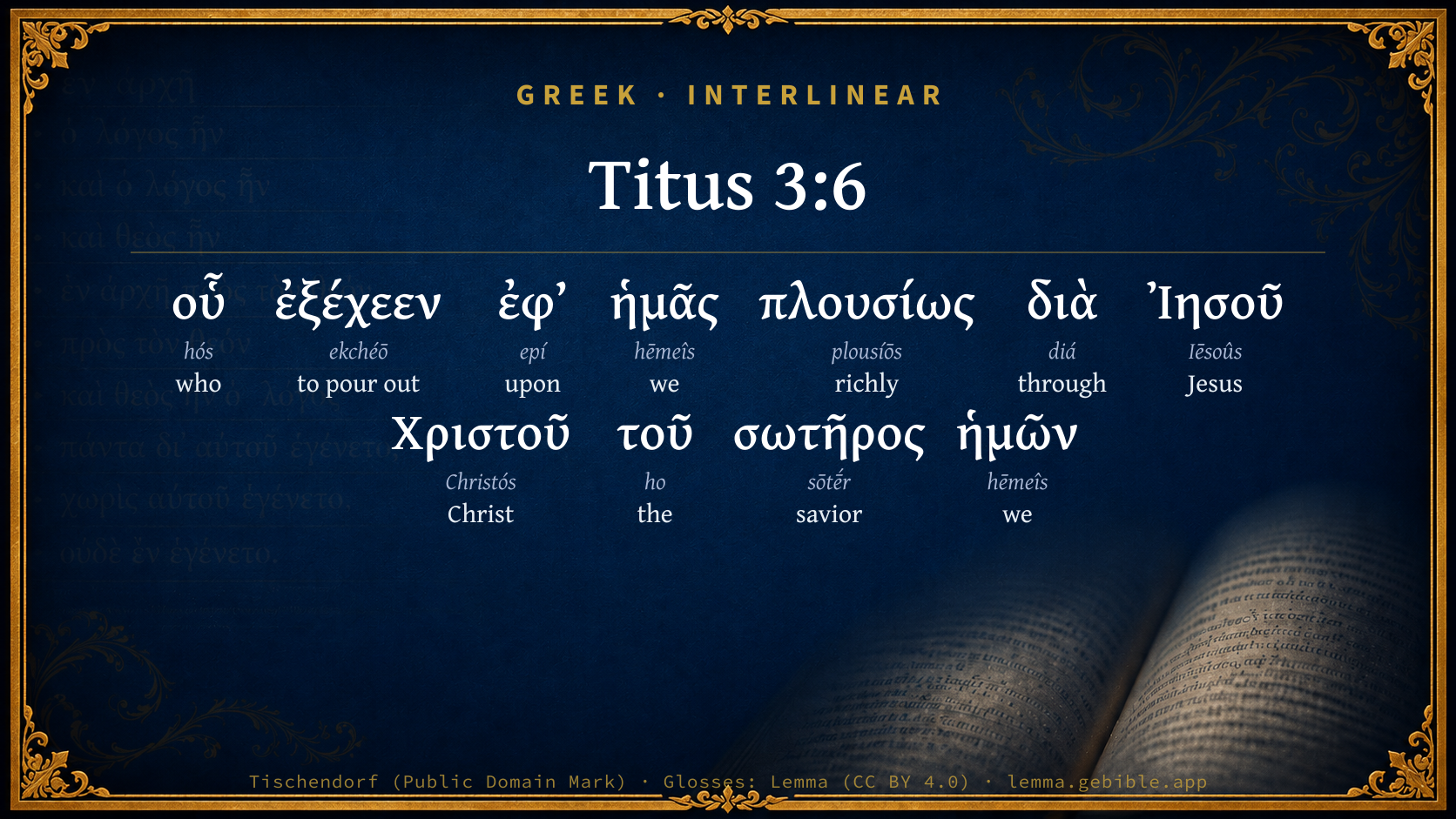
Greek (Tischendorf 8th ed.) Titus 3:6 appears in the Greek New Testament. The text above is from the Tischendorf 8th edition. Each word links to its Strong’s number and a concise gloss. Click any word for its full Thayer’s Greek Lexicon entry.
Download image
Cite this verse

Titus 3:6 (World English Bible). Public Domain. Lemma interlinear Bible study tool, https://lemma.gebible.app/v/titus/3/6.

Show BibTeX & RIS
BibTeX
RIS
English Translation
which he poured out on us richly, through Jesus Christ our Savior;
World English Bible · Public Domain
Download a study sheet

One document with this verse’s original text, its word-by-word gloss line, the meaning frame, cross-references with their text, attributed commentary, and full source and license credits — printable, and it pastes into notes with its structure intact.

This verse Autodidact and up

Study sheet (.html) Plain text (.txt)

A passage Seminary Student

Up to 50 verses in one chapter. A passage sheet keeps up to 6 commentary sources and 12 cross-references per verse, in the order this page ranks them, and says so on the sheet whenever that leaves anything out. Ask for a single verse and you get the Autodidact verse sheet above.

Everything on this page stays free to read, with no account — the sheet is a download of what is already on screen, not access to it.

Want to remove ads? Support Godless Engineer
Compare translations 3

The same verse in 3 English versions, stacked beneath the original-language interlinear above. Click any original word for its lexicon entry.

Each is an independent rendering of the whole verse — the interlinear is not word-aligned to these translations.

Highlighted words mark where these versions differ — a whole-verse word diff, not a word-by-word alignment.

  • World English Bible Public Domain
    which he poured out on us richly, through Jesus Christ our Savior;
  • King James Version Public Domain
    Which he shed on us abundantly through Jesus Christ our Saviour;
  • unfoldingWord Literal Text CC BY-SA 4.0
    whom he richly poured on us through our Savior Jesus Christ,

unfoldingWord Literal Text — © unfoldingWord, licensed CC BY-SA 4.0. Word-aligned USFM3 via Door43 (git.door43.org/unfoldingWord/en_ult).

Versions to compare (up to 4)

3 of 4 selected

Show all 19 translations

Every available English version of this verse, each an independent rendering of the whole verse.

  • World English Bible Public Domain
    which he poured out on us richly, through Jesus Christ our Savior;
  • Berean Standard Bible Public Domain
    This is the Spirit He poured out on us abundantly through Jesus Christ our Savior,
  • Majority Standard Bible Public Domain
    This is the Spirit He poured out on us abundantly through Jesus Christ our Savior,
  • King James Version Public Domain
    Which he shed on us abundantly through Jesus Christ our Saviour;
  • American Standard Version (1901) Public Domain
    which he poured out upon us richly, through Jesus Christ our Saviour;
  • Revised Version (1885) Public Domain
    which he poured out upon us richly, through Jesus Christ our Saviour;
  • Geneva Bible (1599) Public Domain
    Which he shed on vs aboundantly, through Iesus Christ our Sauiour,
  • Douay-Rheims (1899) Public Domain
    Whom he hath poured forth upon us abundantly, through Jesus Christ our Savior:
  • Young's Literal Translation Public Domain
    which He poured upon us richly, through Jesus Christ our Saviour,
  • Literal Standard Version CC BY-SA 4.0
    which He poured on us richly, through Jesus Christ our Savior,
  • Unlocked Literal Bible CC BY-SA 4.0
    God richly poured the Holy Spirit on us through our Savior Jesus Christ,
  • unfoldingWord Literal Text CC BY-SA 4.0
    whom he richly poured on us through our Savior Jesus Christ,
  • Darby Bible Public Domain
    which he poured out on us richly through Jesus Christ our Saviour;
  • World Messianic Bible Public Domain
    whom he poured out on us richly through Yeshua the Messiah our Savior;
  • Webster's Bible Public Domain
    Which he shed on us abundantly, through Jesus Christ our Savior;
  • Free Bible Version CC BY-SA 4.0
    which he poured out on us abundantly through Jesus Christ our Savior.
  • Bible in Basic English Public Domain
    Which he gave us freely through Jesus Christ our Saviour;
  • Text-Critical English NT CC BY 4.0
    He richly poured out his Spirit upon us through Jesus Christ our Savior,
  • Tyndale New Testament (1534) Public Domain
    which he shed on vs aboundantly thorow Iesus Christ oure saveoure

Literal Standard Version (2020), Covenant Press — licensed CC BY-SA 4.0. Text via the HelloAO Bible API (eBible.org). Unlocked Literal Bible (unfoldingWord) — licensed CC BY-SA 4.0. Text via the HelloAO Bible API (eBible.org). unfoldingWord Literal Text — © unfoldingWord, licensed CC BY-SA 4.0. Word-aligned USFM3 via Door43 (git.door43.org/unfoldingWord/en_ult). Free Bible Version, Dr. Jonathan Gallagher — licensed CC BY-SA 4.0. Text via the HelloAO Bible API (eBible.org).

Word by word

More ways to search: Search by grammar → Find every occurrence → Compare this word →

Practice this passage: Drill this verse → Learn its vocabulary →

About this verse

These counts appear in no published source. They are computed here, from the morphology-tagged text and Lemma’s own curated glosses. What Lemma adds →

11
words
10
distinct lemmas
Pauline Epistles
section

Notable vocabulary

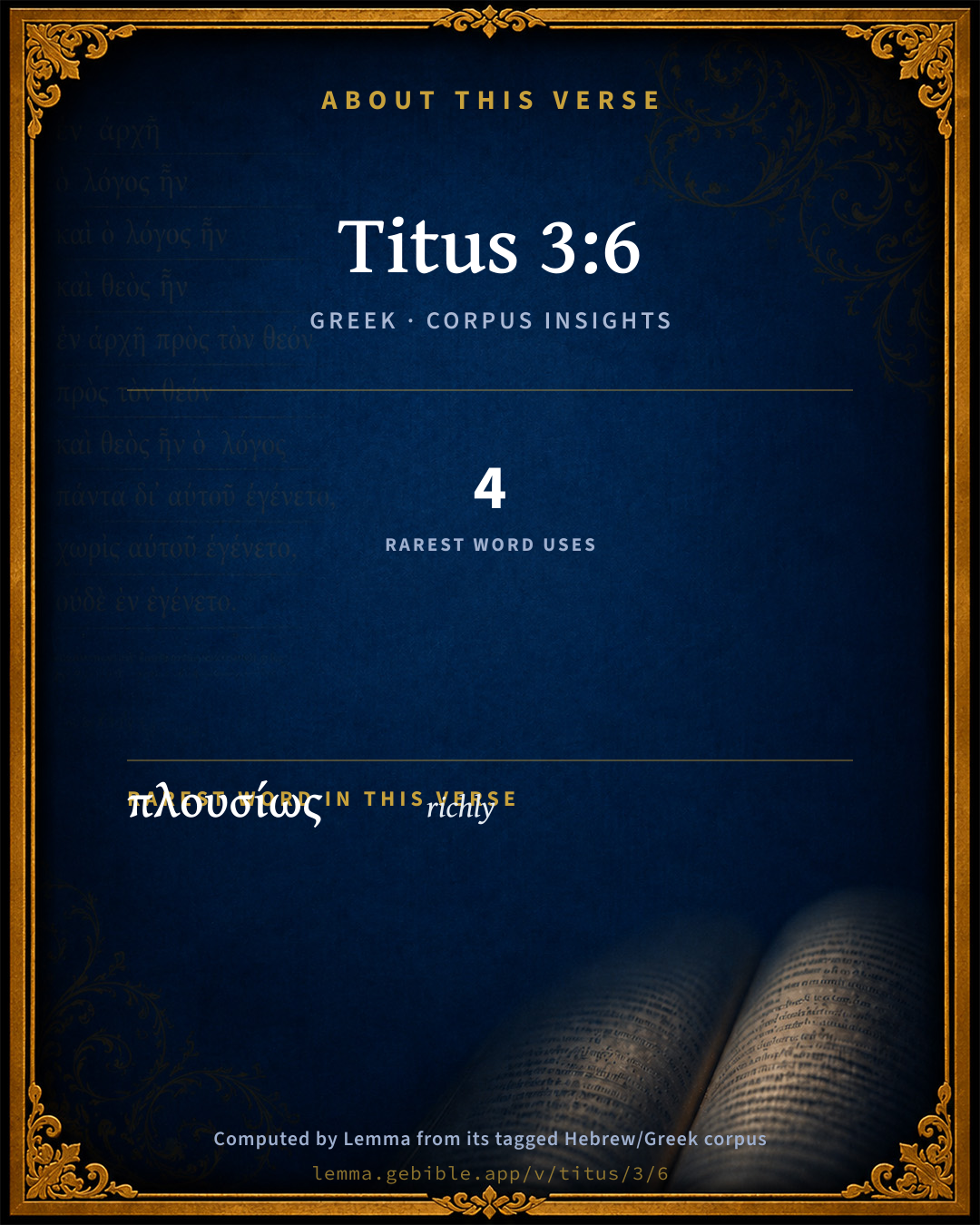
The rarest word here is πλουσίως richly G4146 — appearing just 4 times in the whole Greek New Testament.

Shared distinctive vocabulary

πλουσίως richly G4146 occurs in 4 verses of the Greek New Testament. Also found in:

Repetition

A word recurs within this verse:

  • ἡμᾶς we G2249 ×2

Cross-references

17

Topical passages linked to Titus 3:6 in the Treasury of Scripture Knowledge — connected by theme and wording, ordered by reader-vote popularity; previews shown in the World English Bible.

  • Joel 2:28 "It will happen afterward, that I will pour out my Spirit on all flesh; And your sons and your daughters will prophesy. Your old men will dream dreams. Your young men will see visions.
  • Romans 5:5 and hope doesn't disappoint us, because God's love has been poured out into our hearts through the Holy Spirit who was given to us.
  • Acts 10:45 They of the circumcision who believed were amazed, as many as came with Peter, because the gift of the Holy Spirit was also poured out on the Gentiles.
  • Isaiah 44:3 For I will pour water on him who is thirsty, and streams on the dry ground; I will pour my Spirit on your seed, and my blessing on your offspring:
  • Ezekiel 36:25 I will sprinkle clean water on you, and you shall be clean: from all your filthiness, and from all your idols, will I cleanse you.
  • Proverbs 1:23 Turn at my reproof. Behold, I will pour out my spirit on you. I will make known my words to you.
  • John 1:16 From his fullness we all received grace upon grace.
  • John 16:7 Nevertheless I tell you the truth: It is to your advantage that I go away, for if I don't go away, the Counselor won't come to you. But if I go, I will send him to you.
  • Isaiah 32:15 until the Spirit be poured on us from on high, and the wilderness become a fruitful field, and the fruitful field be esteemed as a forest.
  • John 4:10 Jesus answered her, "If you knew the gift of God, and who it is who says to you, 'Give me a drink,' you would have asked him, and he would have given you living water."
  • John 7:37 Now on the last and greatest day of the feast, Jesus stood and cried out, "If anyone is thirsty, let him come to me and drink!
  • John 14:16–17 I will pray to the Father, and he will give you another Counselor, that he may be with you forever,--
  • Acts 2:33 Being therefore exalted by the right hand of God, and having received from the Father the promise of the Holy Spirit, he has poured out this, which you now see and hear.
  • Romans 8:2 For the law of the Spirit of life in Christ Jesus made me free from the law of sin and of death.
  • Ephesians 3:8 To me, the very least of all saints, was this grace given, to preach to the Gentiles the unsearchable riches of Christ,
  • Ephesians 4:2 with all lowliness and humility, with patience, bearing with one another in love;
  • Titus 1:4 to Titus, my true child according to a common faith: Grace, mercy, and peace from God the Father and the Lord Jesus Christ our Savior.

Cross-references courtesy of OpenBible.info (CC BY 4.0).

Commentary

Notes on Titus 3:6 from classic Christian and Jewish commentators (each source and its license shown beneath its notes). The classic Christian expositions comment on the surrounding passage and are grouped to its opening verse, so a note may address several verses; the Jewish commentaries on the Tanakh (Rashi and others) are per-verse, so they appear only where the commentator wrote on this verse.

Lemma curates 59 commentaries, every one of them public domain or Creative Commons licensed, each selected and text-cleaned for this edition rather than reprinted as found. About our sources →

Bengel's Gnomon

Johann Albrecht Bengel

Tit 3:6. Οὗ) Πνεύματος Ἁγίου—διὰ, through) This depends on He saved, etc., Tit 3:5; as the conjugates saved and Saviour prove. [Through Jesus our Saviour is not to be connected, as in Engl. Vers., with He shed on us.]

Bengel's Gnomon of the New Testament — English translation (T&T Clark, Edinburgh, 1860) — public domain. Text from a community e-Sword module.

Expositor's Greek Testament

ed. W. Robertson Nicoll

Tit 3:6 . οὗ ἐξέχεεν : Joe 3:1 (Joe 2:28 ) is the passage alluded to. Cf. in addition to reff. given above, Act 10:45 , Rom 5:5 , Gal 4:6 . The οὗ refers of course to πνεύματ . ἁγ . by attraction, not to ἀνακαινώσεως . All gifts of the Holy Spirit that come through Jesus Christ are a continuation of the Pentecostal outpouring. The aorist is due to the Apostle’s thought of that occasion, although the ἡμᾶς shows that the immediate reference is to the experience of St. Paul and other Christians.

διὰ Ἰησοῦ Χριστοῦ : to be connected with ἐξέχεεν . See Joh 15:26 , Act 2:33 . The finished work of Jesus Christ was the necessary pre-condition to His effusion of the Holy Spirit.

The Expositor's Greek Testament, edited by W. Robertson Nicoll (1897–1910) — public domain. Text from a community e-Sword module.

Jamieson, Fausset & Brown

Robert Jamieson, A. R. Fausset & David Brown

Which--the Holy Ghost.

he shed--Greek, "poured out"; not only on the Church in general at Pentecost, but also "on us" individually. This pouring out of the Spirit comprehends the grace received before, in, and subsequently to, baptism.

abundantly--Greek, "richly" (Col 3:16).

through Jesus Christ--the channel and Mediator of the gift of the Holy Ghost.

our Saviour--immediately; as the Father is mediately "our Saviour." The Father is the author of our salvation and saves us by Jesus Christ.

Jamieson, Fausset & Brown — Commentary Critical and Explanatory on the Whole Bible (1871) — public domain (CC PDM 1.0). Text via the HelloAO Bible API.

Adam Clarke's Commentary

Verse 6. Which he shed on us abundantly] ου εξεχεεν. Which he poured out on us, as the water was poured out on them in baptism, to which there is here a manifest allusion; but as this was sometimes only sprinkled on the person, the heavenly gift was poured out, not in drops, but πλουσιως, richly, in great abundance.

Through Jesus Christ] Baptism is nothing in itself; and there had been no outpouring of the Holy Spirit, had there been no saving and atoning Christ. Through him alone all good comes to the souls of men.

Adam Clarke's Commentary on the Bible (1810–1826) — public domain. Text from a community e-Sword/MySword module.

John Calvin's Commentaries

6. Which he shed, (or, whom he shed.) In the Greek, the relative may apply either to the “washing” or to the “Spirit;” for both of the nouns — λουτρόν and Πνεῦμα — are neuter. It makes little difference as to the meaning; but the metaphor will be more elegant, if the relative be applied to λουτρόν the “washing” Nor is it inconsistent with this opinion, that all are baptized without any distinction; for, while he shews that the “washing” is “shed,” he speaks not of the sign, but rather of the thing signified, in which the truth of the sign exists.

When he, says, abundantly, he means that, the more any of us excels in the abundance of the gifts which he has received, so much the more is he under obligations to the mercy of God, which alone enriches us; for in ourselves we are altogether poor, and destitute of everything good. If it be objected that not all the children of God enjoy so great abundance, but, on the contrary, the grace of God drops sparingly on many; the answer is, that no one has received so small a measure that he may not be justly accounted rich; for the smallest drop of the Spirit (so to speak) resembles an ever-flowing fountain, which never dries up. It is therefore a sufficient reason for calling it “abundance,” that, how small soever the portion that has been given to us it is never exhausted.

Through Jesus Christ It is he alone in whom we are adopted; and therefore, it is he alone, through whom we are made partakers of the Spirit, who is the earnest and witness of our adoption. Paul therefore teaches us by this word, that the Spirit of regeneration is bestowed on none but those who are the members of Christ.

John Calvin's Commentaries (1540-1563) — public domain. Text from the Calvin Translation Society English edition (1840s-50s) via the Christian Classics Ethereal Library (ccel.org). Calvin's coverage is partial (roughly two-thirds of the Bible); uncommented books and verses are honest gaps, never fabricated. The 19th-century editor's footnotes and remarks are omitted so the notes are faithfully Calvin's own voice.

Ellicott's Commentary for English Readers

(6) Which he shed on us abundantly through Jesus Christ our Saviour.—In other words, which—namely, the Holy Ghost—the Father poured abundantly on us through Jesus Christ cur Saviour. The argument continues thus: He (God) saved us first by the laver of regeneration and of renewal of the Holy Ghost, which God—he proceeds to say—shed (or poured out) abundantly on us, and this constant renewal of the Holy Ghost poured out on the heart of each individual believer was owing to the mediation of Jesus Christ, without whose blessed atonement this effusion of the Holy Spirit never had taken place. In this verse the several operations of each of the Persons of the blessed Trinity are clearly set forth.

It is the Father who is ever pouring out upon us the Holy Ghost. It is owing to the Son’s atonement and intercession that this blessed outpouring takes place at all. It is the Holy Ghost poured out on us abundantly who builds us up in the new life, and trains us for the glories of eternity. Here the “Son” is given the same title of “Saviour,” which, in the preceding verse (Tit_3:5), was applied to the “Father.” The appellation belongs to both the First and Second Persons of the blessed Trinity, inasmuch as the Father may be said to have been the architect of our salvation, while the Son was its builder.

A Bible Commentary for English Readers, edited by Charles John Ellicott (1878–1897) — public domain. Text from a community e-Sword module.

The Cambridge Bible for Schools and Colleges

gen. ed. J. J. S. Perowne

6. which he shed on us abundantly] More closely in R.V. which he poured out upon us richly; the verb is the same, in the same tense, as in Act_2:33, ‘he hath poured forth this’; the aorist there being used according to Greek idiom of what has just happened, here of God’s objective act once for all, in which all His successive giving was potentially included.

through Jesus Christ our Saviour] ‘As its channel and medium,’ Alford. ‘All the spiritual Blessings of the New birth, and of the New life, are represented as flowing down to us from and out of the one fountain and well-spring of the love of God the Father; and are all derived to us through God the Son, God and Man, Who is the sole channel of all grace to men; and are applied to us personally by the agency of God the Holy Ghost. All these Blessings come to us through the Incarnation of God the Son, Who took our nature and died for us, and washed us from our sins by His blood. And the Incarnation is, as it were, the point of contact at which the Channel of Filial Grace joins on to the Well-spring of Paternal Love. And the point of contact at which the living water of Grace, which flows from the Well-spring of Paternal Love through the Filial channel of Grace, is poured forth into our souls is in the laver of our New Birth in Baptism.’ Wordsworth.

The Cambridge Bible for Schools and Colleges (gen. ed. J. J. S. Perowne; Cambridge University Press, 1878–1918) — public domain. Text from a community e-Sword module.

John Gill's Exposition

Which he shed on us abundantly,.... "Or richly"; either which love he shed abroad in the hearts of those whom he regenerated and renewed by his Spirit; or which water of regeneration, that is, grace, comparable to water, he plentifully shed, and caused to abound where sin had done; or rather whom, or which Holy Spirit, with his gifts and graces, such as faith, hope, and love, and every other, he poured forth in great abundance on them; see Isa 44:3

through Jesus Christ our Saviour; the love and kindness of God the Father our Saviour, comes through him; the mercy of God streams through him; the salvation itself is by, and through him; the grace communicated in regeneration and renovation is out of his fulness; the Spirit himself is given forth from him; and every supply of grace, by which the work is carried on, comes out of his hands; and everything wrought in us, that is well pleasing in the sight of God, is through him; and even the gift of God, eternal life itself.

John Gill's Exposition of the Whole Bible (1746–1763) — public domain (CC PDM 1.0). Text via the HelloAO Bible API.

Trapp's Complete Commentary

John Trapp

6 Which he shed on us abundantly through Jesus Christ our Saviour;

Ver. 6. Which he shed] Gr. εξεχεεν, Poured out (as it were by pail fulls) his Spirit (the best thing) upon all flesh (the basest thing), Joe 2:28.

John Trapp, A Commentary or Exposition upon All the Books of the Old and New Testament (1647–1656) — public domain. Text from a community e-Sword module.

Albert Barnes' Notes on the Bible

Which he shed on us - Greek, “Which he poured out on us” - ἐξέχην exechēn; see the notes at Act 2:17. The same Greek word is used there as here. It occurs also in the same sense in Act 2:18, Act 2:33.

Abundantly - Margin, as in Greek, “richly.” The meaning is, that the Holy Spirit had been imparted in copious measure in order to convert them from their former wickedness. There is no particular allusion here to the day of Pentecost, but the sense is, that the Holy Spirit had been imparted richly to all who were converted, at any time or place, from the error of their ways. What the apostle says here is true of all who become Christians, and can be applied to all who become believers in any age or land,

Through Jesus Christ our Saviour - See Notes, Act 2:33.

Albert Barnes' Notes on the Bible (1834–1885) — public domain. Text from a community e-Sword/MySword module.

Haydock's Catholic Bible Commentary

All presumption of human merits, which have not the grace of Jesus Christ for their principle, is here completely confounded; and the whole glory of our salvation is justly attributed to the mercy of God, through Jesus Christ. A new birth, new creature, new spirit. The effusion of the water upon the body in baptism, is a figure of the salutary effusion of the holy Spirit in the soul to renew it, and to make it a child of God.

George Leo Haydock (1774–1849), Haydock's Catholic Family Bible and Commentary, 1859 edition — public domain. Excludes Psalms (Douay-Rheims chapter numbering differs from Protestant) and Deuterocanonical books (Catholic canon only).

Matthew Poole's English Annotations

Which Holy Spirit, as well for the renewing of us, as for the collation of more common or extraordinary gifts, God poured out upon us

abundantly, through the merits and mediation of Jesus Christ our Saviour.

Matthew Poole's English Annotations on the Holy Bible (1683–1685) — public domain. Text from a community e-Sword/MySword module.

Whedon's Commentary on the Bible

Daniel D. Whedon

6. Which—Refers not to washing, but to Holy Ghost. Spiritually, our regeneration is wrought by the shedding, or affusion, of the Holy Ghost; by parity, corporeally, we are regenerated by the affusion of the baptismal element. If baptism by water is duly to picture and symbolize God’s baptism by the Holy Spirit, the water must be shed by affusion on us.

Abundantly—Literally richly, not only in quantity but in affluent value and gracious liberality.

Daniel D. Whedon (gen. ed.), Commentary on the Old and New Testaments (1874–1909) — public domain. Text from a community e-Sword module.

The Pulpit Commentary

Poured out upon us richly for shed on us abundantly, A.V Which (ou); viz. the Holy Ghost. It is in the genitive (instead of the accusative o , which is another reading), by what he grammarians call attraction. Poured out (execeen); the same word as is applied to the Holy Ghost in Act_2:17, Act_2:18, Act_2:33, and in the LXX of Joe_2:28, Joe_2:29. Richly (plousiwv); as 1Ti_6:17 Col_3:16 2Pe_1:11. (compare the use of ploutov in Eph_1:7 Eph_2:7) Through Jesus Christ. It is our baptism into Christ which entitles us to receive the Holy Spirit, which we have only in virtue of our union with him. The Spirit flows from the Head to the members. In Act_2:33, 34 Christ is said to have received the promise of the Holy Spirit from the Father, and to have poured it forth upon the Church.

The Pulpit Commentary (1880–1919), ed. H.D.M. Spence-Jones & Joseph S. Exell — public domain. Text from a community e-Sword module.

Fairbairn on Ezekiel, Jonah & the Pastoral Epistles

Patrick Fairbairn

Ver. 6. Having named the Holy Spirit as the efficient author of the renovation accomplished in believers, the apostle goes on to indicate, in further proof of the lovingkindness and mercy of God in the matter of our salvation, the copiousness of the gift; it is bestowed, not with a grudging, but with a free and benignant hand: which He poured out (οὗ ἐξέχεεν, the οὗ by attraction with the preceding Πνεύματος ἁγίου, not in any way dependent on λουτροῦ) on us richly through Jesus Christ our Saviour. The form of expression is derived from the language of Old Testament prophecy (Joe 2:28; Zec 12:10), adopted by the apostles at the commencement of the New Testament church (Act 2:17, Act 2:33, Act 10:45)—language proceeding on the similitude of the Spirit’s grace to quickening and refreshing streams of water. As such He is represented, not simply as given, but as poured out,—nay, poured out richly, in order to convey some idea of the plenteous beneficence of the gift. This rich bestowal is peculiar to New Testament times; and here, as elsewhere, it is expressly connected with the mediation of Christ, who as Saviour has opened the way for it, and Himself sends forth the Spirit as the fruit of His work on earth, and the token of its acceptance with the Father (Joh 14:16, Joh 14:26, Joh 16:7; Luk 24:49; Gal 4:6; Eph 4:7-11). So that the whole Trinity appears here as concurring in the blessed work of our salvation: we are saved by God the Father, through the ministration of His life-giving ordinances, rendered such by the presence and agency of the Holy Spirit; and this, again, proceeds on the ground of what was done for us by Christ as our Saviour, and what He still does in mediating between us and the Father respecting the bestowal of the Spirit. Such a style of representation could never have been used unless Father, Son, and Spirit had been co-ordinate agents in the work of salvation. And as regards the more specific topic in this verse—the, rich outpouring of the Spirit—there can be no doubt that, as the apostle is speaking more immediately of the salvation of individuals, it must be primarily understood with reference to this, though still of this only as a part of that general effusion of the Spirit’s grace which commenced on the day of Pentecost. The individual, in such a case, cannot be viewed apart from the general; and it is needless here to distinguish minutely between the two.

Patrick Fairbairn — An Exposition of Ezekiel (1851), Jonah (1849), and The Pastoral Epistles (1874) — public domain. Text from a community e-Sword module.

Scofield Reference Notes

C. I. Scofield

Saviour

(See Scofield "Rom 1:16").

The Scofield Reference Bible (1917 edition), notes by C. I. Scofield — public domain. Text from a community e-Sword module.

Burkitt's Expository Notes on the New Testament

William Burkitt

That is, which Holy Spirit was in its gifts and graces plentifully poured forth upon us, and dwelleth in us, not essentially, but energetically, illuminating, guiding, strengthening, and confirming of us: and the end of God herein is, That being justified by his grace, that is, by faith in his Son, we should be made heirs of eternal life, according to the hope which the promises of God have given us thereof.

Learn hence, 1. That all the grace which is so plentiful poured forth upon believers, is by the means and mediation of our Lord Jesus Christ.

Learn, 2. That justification being a sinner’s absolution from guilt and punishment by the satisfaction of Christ the Redeemer, is yet an act of special grace and free favour in God, That being justified by his grace.

Learn, 3. That it is the blessed privilege of all justified persons, that they are now heirs to, and shall ere long be possessors of, eternal life; they shall ere long have in hand, what they now possess in hope: Being justified by grace, we are heirs according to the hope of eternal life.

William Burkitt's Expository Notes on the New Testament (1700–1703) — public domain. Text from a community e-Sword module.

The People's New Testament

B. W. Johnson

6. Which. The Holy Spirit. Shed on us abundantly. On the church. On some even in miraculous measure. See Acts 2:1–10.

B. W. Johnson's The People's New Testament with Notes (1889–1891) — public domain. Electronic text from the Christian Classics Ethereal Library (CCEL) ThML edition.

unfoldingWord translationNotes

Door43 World Missions Community

richly poured the Holy Spirit on us

It is common for New Testament writers to speak of the Holy Spirit as a liquid that God can pour out in large amounts. AT: "gave the Holy Spirit to us generously" (See: Metaphor)

through our Savior Jesus Christ

"when Jesus saved us"

having been justified

This can be stated in active form. AT: "since God has declared us to be without sin" (See: Active or Passive)

we might become heirs with the certain hope of eternal life

The people to whom God has made promises are spoken of as if they were to inherit property and wealth from a family member. (See: Metaphor)

translationWords

God

Holy Spirit

Savior

Jesus

just

grace

eternity

unfoldingWord translationNotes — © Distant Shores Media and the Door43 World Missions Community, licensed CC BY-SA 4.0. Source: git.door43.org/Door43/en_tn.

Cambridge Greek Testament for Schools and Colleges

6. οὖ ἐξέχεεν ἐφʼ ἡμᾶς πλουσίως, which, sc. the Holy Spirit, He, sc. God the Father, the subject of the whole sentence, poured out upon us richly.

By the ordinary rules of attraction, οὖ is attracted into the case of the immediately preceding genitive, to which it refers.

The verb ἐκχέειν is the verb used to signify the outpouring of the Holy Spirit in Act 2:17 (Joe 3:1) and 33. In the former passage the occasion was the Day of Pentecost; here the reference is to that outpouring of grace in baptism which is always pledged to the penitent and faithful soul: cp. Act 2:38.

διὰ Ἰησοῦ Χριστοῦ τοῦ σωτῆρος ἡμῶν. This is closely connected with the preceding ἐξέχεεν and not, of course, with the more distant ἔσωσεν of Tit 3:5. The co-operation of all three Persons of the Blessed Trinity in the work of grace is tersely and pregnantly expressed in this short verse. If the Father is σωτήρ (Tit 3:4, see on 1Ti 1:1), so also the Son is σωτήρ, in a sense undreamed of under the Old Covenant.

Cambridge Greek Testament for Schools and Colleges (Cambridge University Press, 1896; 21 vols, various authors incl. Carr, Maclear, Plummer, Farrar, Lumby, Moule, M. R. James, Simcox) — public domain. Text from a community e-Sword module.

Alford’s Greek Testament

Henry Alford

6.] which (attr.; not = ἐξ οὗ, as Heydenr. οὗ, viz. the Holy Spirit, not λουτροῦ, as even De W. confesses, who yet maintains the dependence of both genitives on λουτροῦ) He poured out (reff.) on us richly (again, it is mere waste of time to debate whether this pouring out be the one general one at Pentecost, or that in the heart of each individual believer: the one was God’s objective act once for all, in which all its subjective exemplifications and applications were potentially enwrapped) through (as its channel and medium, He having purchased it for us, and made the pouring out possible, in and by His own blessed Sacrifice in our nature) Jesus Christ our Saviour (which title was used of the Father above: of Him,—ultimately: of our Lord, immediately: “Pater nostræ salutis primus auctor, Christus vero opifex, et quasi artifex,” as Justiniani in Ellicott, whose own remarks are well worth consulting),

Henry Alford, The Greek Testament (1849–1861) — public domain. Text from a community e-Sword module.

International Critical Commentary

6. ἐξέχεεν] recalling Joe 2:28 (ἐκχεῶ ἀπὸ τοῦ πνεύματός μου) as used by St. Peter in Act 2:17; Act 2:33; so with primary reference to Pentecost, but to Pentecost as an abiding reality affecting each Christian.

πλουσίως] cf. Eph 2:4. “abunde,” Vulg.; “ditissime,” Theod., sufficient for all men (Cf. 2:11), and for all the needs of each: “ad opulentiam sufficit quod, quantulumcunque nobis detur, nunquam deficiat” (Calvin). διὰἸης. Χρ.; cf. Act 2:33. τοῦ σωτῆρος ἡμῶν. His work is at once placed on a level with God’s; cf. 2:13 n.

International Critical Commentary — older volumes (1896–1929), various authors — public domain. Text from a community e-Sword module.

Vincent's Word Studies in the New Testament

Marvin R. Vincent

Shed [εξεχεεν] . Or poured forth. Only here in Pastorals. Most frequent in Revelation. The pouring out of the Spirit is an 0. T. metaphor. See Joe 3:1, 2, cit. in Act 2:17, 18; Zec 12:10. In Paul the verb occurs but once, of shedding blood, Rom 3:15, cit.

Marvin R. Vincent, Word Studies in the New Testament (1887–1900) — public domain. Text from a community e-Sword/MySword module.

Lesson kit

Teaching starters — assembled from the data on this page, not authored interpretation. Every prompt links to the verse data it draws on. Edit before teaching.

Titus, in the Pauline Epistles, opens this verse with 11 words (10 distinct Greek lemmas). Its most distinctive word is plousíōs (“richly”). A historical commentator’s framing appears above. Read the whole chapter for the surrounding context.

Discussion questions

  1. The word plousíōs carries the sense “richly.” How does it shape the verse?
  2. Colossians 3:16 shares the word «richly» with this verse. How do the two illuminate each other?
  3. “we” occurs 2× in this one verse. What is the effect of the repetition?
  4. These translations render this verse differently; the difference is in the English rendering, not the original. What questions does that raise?
  5. Reading how Bengel's Gnomon and Expositor's Greek Testament read this verse, where do the two commentators agree and where do they part?

Things to notice

Reading settings

Reading text

Shown beneath each verse's original-language words.

Old Testament
Old Testament edition

Read the OT as the Masoretic Hebrew (MT) or the Greek Septuagint (LXX).

English shown for the Greek Septuagint (in the Hebrew ↔ Greek comparison).

Comparing translations? Open the Compare panel on any verse page to stack up to four side by side.