Colossians 1:25

Greek (Tischendorf 8th ed.) Colossians 1:25 appears in the Greek New Testament. The text above is from the Tischendorf 8th edition. Each word links to its Strong’s number and a concise gloss. Click any word for its full Thayer’s Greek Lexicon entry.
Download image
Cite this verse

Colossians 1:25 (World English Bible). Public Domain. Lemma interlinear Bible study tool, https://lemma.gebible.app/v/colossians/1/25.

Show BibTeX & RIS
BibTeX
RIS
English Translation
of which I was made a servant, according to the stewardship of God which was given me toward you, to fulfill the word of God,
World English Bible · Public Domain
Download a study sheet

One document with this verse’s original text, its word-by-word gloss line, the meaning frame, cross-references with their text, attributed commentary, and full source and license credits — printable, and it pastes into notes with its structure intact.

This verse Autodidact and up

Study sheet (.html) Plain text (.txt)

A passage Seminary Student

Up to 50 verses in one chapter. A passage sheet keeps up to 6 commentary sources and 12 cross-references per verse, in the order this page ranks them, and says so on the sheet whenever that leaves anything out. Ask for a single verse and you get the Autodidact verse sheet above.

Everything on this page stays free to read, with no account — the sheet is a download of what is already on screen, not access to it.

Want to remove ads? Support Godless Engineer
Compare translations 3

The same verse in 3 English versions, stacked beneath the original-language interlinear above. Click any original word for its lexicon entry.

Each is an independent rendering of the whole verse — the interlinear is not word-aligned to these translations.

Highlighted words mark where these versions differ — a whole-verse word diff, not a word-by-word alignment.

  • World English Bible Public Domain
    of which I was made a servant, according to the stewardship of God which was given me toward you, to fulfill the word of God,
  • King James Version Public Domain
    Whereof I am made a minister, according to the dispensation of God which is given to me for you, to fulfil the word of God;
  • unfoldingWord Literal Text CC BY-SA 4.0
    of which I became a servant according to the stewardship of God, the one having been given to me for you, to fulfill the word of God,

unfoldingWord Literal Text — © unfoldingWord, licensed CC BY-SA 4.0. Word-aligned USFM3 via Door43 (git.door43.org/unfoldingWord/en_ult).

Versions to compare (up to 4)

3 of 4 selected

Show all 19 translations

Every available English version of this verse, each an independent rendering of the whole verse.

  • World English Bible Public Domain
    of which I was made a servant, according to the stewardship of God which was given me toward you, to fulfill the word of God,
  • Berean Standard Bible Public Domain
    I became its servant by the commission God gave me to fully proclaim to you the word of God,
  • Majority Standard Bible Public Domain
    I became its servant by the commission God gave me to fully proclaim to you the word of God,
  • King James Version Public Domain
    Whereof I am made a minister, according to the dispensation of God which is given to me for you, to fulfil the word of God;
  • American Standard Version (1901) Public Domain
    whereof I was made a minister, according to the dispensation of God which was given me to you-ward, to fulfil the word of God,
  • Revised Version (1885) Public Domain
    whereof I was made a minister, according to the dispensation of God which was given me to you-ward, to fulfill the word of God,
  • Geneva Bible (1599) Public Domain
    Whereof I am a minister, according to the dispensation of God, which is giuen mee vnto you ward, to fulfill the word of God,
  • Douay-Rheims (1899) Public Domain
    Whereof I am made a minister according to the dispensation of God, which is given me towards you, that I may fulfil the word of God:
  • Young's Literal Translation Public Domain
    of which I -- I did become a ministrant according to the dispensation of God, that was given to me for you, to fulfil the word of God,
  • Literal Standard Version CC BY-SA 4.0
    of which I became a servant according to the dispensation of God, that was given to me for you, to fulfill the word of God,
  • Unlocked Literal Bible CC BY-SA 4.0
    It is of this church that I am a servant, according to the responsibility from God that was given to me for you, to fulfill the word of God.
  • unfoldingWord Literal Text CC BY-SA 4.0
    of which I became a servant according to the stewardship of God, the one having been given to me for you, to fulfill the word of God,
  • Darby Bible Public Domain
    of which *I* became minister, according to the dispensation of God which [is] given me towards you to complete the word of God,
  • World Messianic Bible Public Domain
    of which I was made a servant according to the stewardship of God which was given me toward you to fulfill the word of God,
  • Webster's Bible Public Domain
    Of which I am made a minister, according to the dispensation of God which is given to me for you, to fulfill the word of God;
  • Free Bible Version CC BY-SA 4.0
    I serve the church following the direction God gave me about you, to present fully the word of God to you.
  • Bible in Basic English Public Domain
    Of which I became a servant by the purpose of God which was given to me for you, to give effect to the word of God,
  • Text-Critical English NT CC BY 4.0
    I became a servant of the church according to the stewardship from God that was given to me for you, to make the word of God fully known,
  • Tyndale New Testament (1534) Public Domain
    wherof I am made a minister acordynge to the ordinaunce of god which ordinaunce was geven me vnto you warde to fulfill the worde of god

Literal Standard Version (2020), Covenant Press — licensed CC BY-SA 4.0. Text via the HelloAO Bible API (eBible.org). Unlocked Literal Bible (unfoldingWord) — licensed CC BY-SA 4.0. Text via the HelloAO Bible API (eBible.org). unfoldingWord Literal Text — © unfoldingWord, licensed CC BY-SA 4.0. Word-aligned USFM3 via Door43 (git.door43.org/unfoldingWord/en_ult). Free Bible Version, Dr. Jonathan Gallagher — licensed CC BY-SA 4.0. Text via the HelloAO Bible API (eBible.org).

Word by word

More ways to search: Search by grammar → Find every occurrence → Compare this word →

Practice this passage: Drill this verse → Learn its vocabulary →

οἰκονομίαν
oikonomía
G3622
“management”
Noun, Accusative, Singular, Feminine
Part of Speech
Noun
Case
Accusative
Number
Singular
Gender
Feminine
Full Thayer's Definition

Origin: from G3623

TDNT: 07:31,7

1. the management of a household or of household affairs a. specifically, the management, oversight, administration, of other's property b. the office of a manager or overseer, stewardship c. administration, dispensation
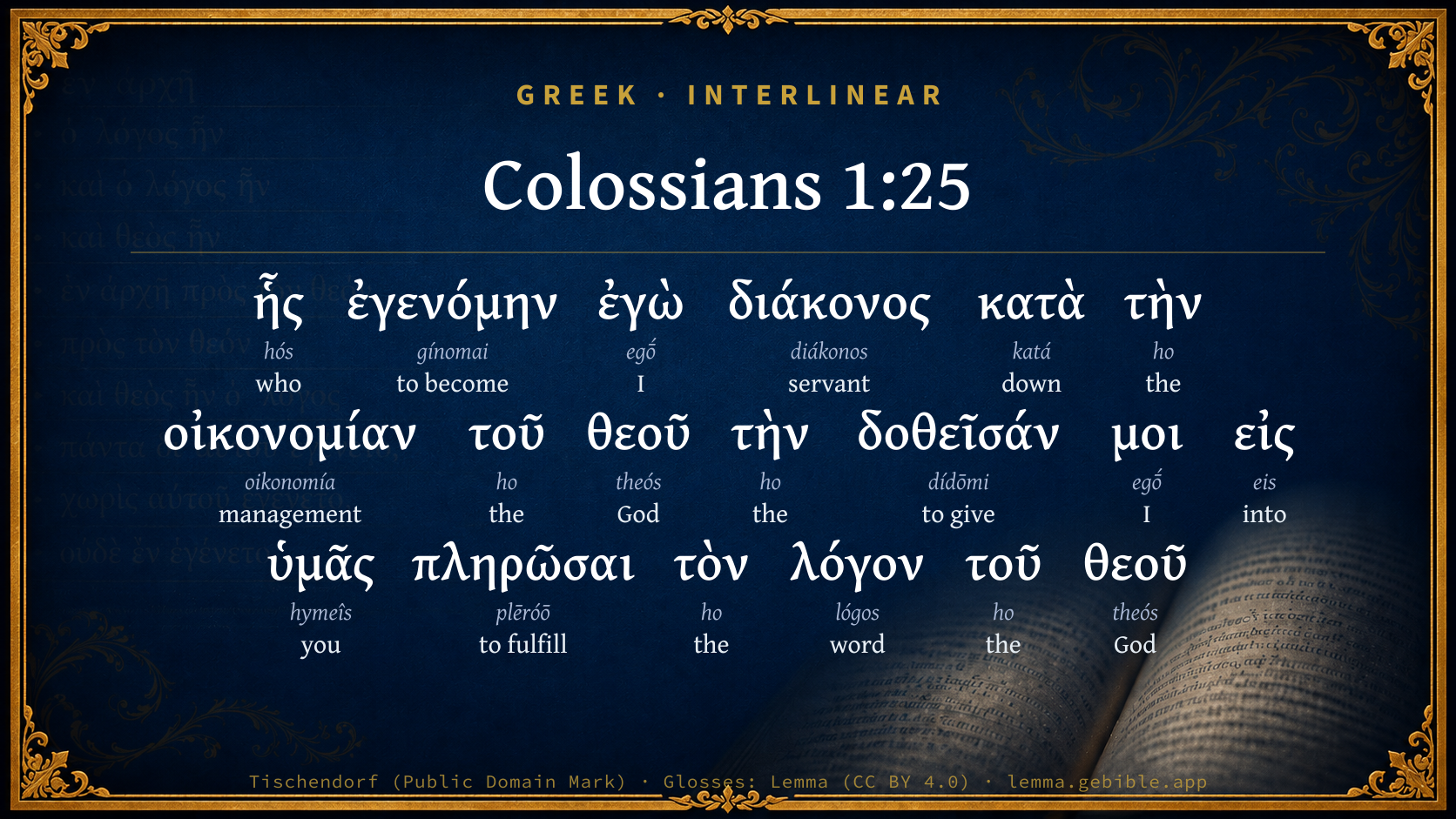
  1. ἧς hós G3739 “who” Relative pronoun, Genitive, Singular, Feminine
  2. ἐγενόμην gínomai G1096 “to become” Verb, Aorist, Middle deponent, Indicative, 1st person, Singular
  3. ἐγὼ egṓ G1473 “I” Personal pronoun, 1st person, Nominative, Singular
  4. διάκονος diákonos G1249 “servant” Noun, Nominative, Singular, Masculine
  5. κατὰ katá G2596 “down” Preposition
  6. τὴν ho G3588 “the” Article, Accusative, Singular, Feminine
  7. τοῦ ho G3588 “the” Article, Genitive, Singular, Masculine
  8. θεοῦ theós G2316 “God” Noun, Genitive, Singular, Masculine
  9. τὴν ho G3588 “the” Article, Accusative, Singular, Feminine
  10. δοθεῖσάν dídōmi G1325 “to give” Verb, Aorist, Passive, Participle, Accusative, Singular, Feminine
  11. μοι egṓ G1473 “I” Personal pronoun, 1st person, Dative, Singular
  12. εἰς eis G1519 “into” Preposition
  13. ὑμᾶς hymeîs G5210 “you” Personal pronoun, 2nd person, Accusative, Plural
  14. πληρῶσαι plēróō G4137 “to fulfill” Verb, Aorist, Active, Infinitive
  15. τὸν ho G3588 “the” Article, Accusative, Singular, Masculine
  16. λόγον lógos G3056 “word” Noun, Accusative, Singular, Masculine
  17. τοῦ ho G3588 “the” Article, Genitive, Singular, Masculine
  18. θεοῦ theós G2316 “God” Noun, Genitive, Singular, Masculine

About this verse

These counts appear in no published source. They are computed here, from the morphology-tagged text and Lemma’s own curated glosses. What Lemma adds →

19
words
13
distinct lemmas
Pauline Epistles
section

Notable vocabulary

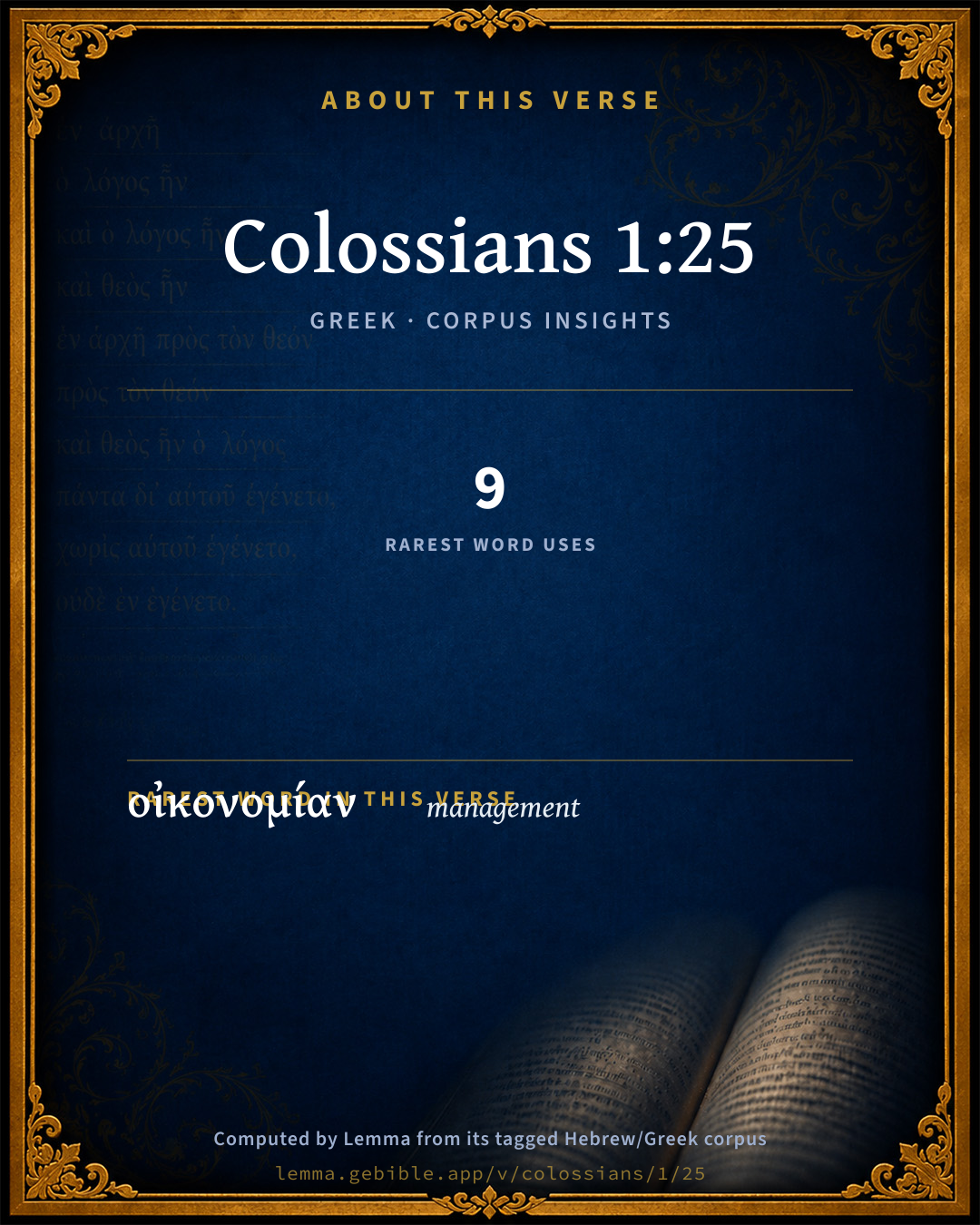
The rarest word here is οἰκονομίαν management G3622 — appearing just 9 times in the whole Greek New Testament.

Shared distinctive vocabulary

οἰκονομίαν management G3622 occurs in 9 verses of the Greek New Testament. Also found in:

Repetition

Words recur within this verse:

Cross-references

8

Topical passages linked to Colossians 1:25 in the Treasury of Scripture Knowledge — connected by theme and wording, ordered by reader-vote popularity; previews shown in the World English Bible.

  • Ephesians 3:2 if it is so that you have heard of the administration of that grace of God which was given me toward you;
  • Colossians 1:23 if it is so that you continue in the faith, grounded and steadfast, and not moved away from the hope of the Gospel which you heard, which is being proclaimed in all creation under heaven; of which I, Paul, was made a servant.
  • Galatians 2:7–8 but to the contrary, when they saw that I had been entrusted with the Gospel for the uncircumcision, even as Peter with the Gospel for the circumcision
  • 2 Timothy 4:2–5 preach the word; be urgent in season and out of season; reprove, rebuke, and exhort, with all patience and teaching.
  • Romans 15:15–19 But I write the more boldly to you in part, as reminding you, because of the grace that was given to me by God,
  • 1 Thessalonians 3:2 and sent Timothy, our brother and God's servant in the Gospel of Christ, to establish you, and to comfort you concerning your faith;
  • 1 Timothy 4:6 If you instruct the brothers of these things, you will be a good servant of Christ Jesus, nourished in the words of the faith, and of the good doctrine which you have followed.
  • 1 Corinthians 9:17 For if I do this of my own will, I have a reward. But if not of my own will, I have a stewardship entrusted to me.

Cross-references courtesy of OpenBible.info (CC BY 4.0).

Commentary

Notes on Colossians 1:25 from classic Christian and Jewish commentators (each source and its license shown beneath its notes). The classic Christian expositions comment on the surrounding passage and are grouped to its opening verse, so a note may address several verses; the Jewish commentaries on the Tanakh (Rashi and others) are per-verse, so they appear only where the commentator wrote on this verse.

Lemma curates 59 commentaries, every one of them public domain or Creative Commons licensed, each selected and text-cleaned for this edition rather than reprinted as found. About our sources →

The Biblical Illustrator

Joseph S. Exell

Col_1:25-27

Whereof I am made a minister.

The pre-eminent honour and sublime theme of the Christian ministry

I. The Christian ministry is a Divine institution.

1. The Christian minister is divinely commissioned. Dispensation involves the idea of stewardship.

2. The true minister is charged with the most complete proclamation of the Divine Word.

II. The Christian ministry deals with a theme of profound significance and ineffable worth.

1. It is designated a mystery. The gospel is still a mystery to the unconverted.

2. It is a mystery unveiled to those who are morally fitted to understand it. To His saints. God chose His own time for making it known. Like all the Divine procedures, the development was gradual, increasing in clearness and completeness as the fulness of time approached. It is an axiom in optics that the eye only sees what it brings with it the power to see: and in spiritual things the soul comprehends the revelation of God only as it is fitted by she Spirit.

3. The revelation of the mystery was an act of the Divine will. To whom God would make known. There was nothing impelling Him to unfold it but His own good pleasure.

4. The revelation of the mystery endowed humanity with a vast inheritance of moral wealth. What is the riches of the glory of this mystery.

(1) This inheritance enriched the most needy. It was exhibited among the Gentiles.

(2) This inheritance includes the hope inspired by the indwelling Christ. Which is Christ in you, the hope of glory.

Lessons--

1. The Christian ministry involves solemn responsibilities.

2. The transcendent theme of the Christian ministry is divinely revealed.

3. Personal experience of the grace of God endows man with the clearest insight into its mystery and the most satisfying possession of its spiritual riches. (G. Barlow.)

Divine ordination to the ministry

If they say, You have gifts for preaching, and you might have been a tolerable preacher if you had been properly ordained, I reply that I was properly ordained. My father ordained me. Ah! I was better ordained than that: my greater Father ordained me. He ordained me twice: first, when He put his hand on my head before I was born, and said, Be a head; and then, after I had carried it round a few years, when He stretched out His hand and touched my heart rather than my head, and said, Be ordained again. First, He makes the head-piece to think; and then He touches the heart, and says, Go preach My gospel. When a man has had that done to him, he is ordained. A pope could not make him any better; a bishop could not make him any better; a whole presbytery could not make him any better. (H. W. Beecher.)

St. Paul a proof of his gospel

This is not merely an appeal to their affection for him, though that is perfectly legitimate. Holy words may be holier because dear lips have taught them to us, and even the truth of God may allowably have a firmer hold upon our hearts because of our love for some who have ministered it to us. It is a poor commentary on a preachers work if, after long service to a congregation, his words do not come with power given to them by old affection and confidence. The humblest teacher who has done his masters errand will have some to whom he can appeal, as Paul did, and urge them to keep hold of the message he has preached. But there is more than that in the apostles mind. He was accustomed to quote the fact that he, the persecutor, had been made the messenger of Christ, as a living proof of the infinite mercy and power of that ascended Lord, whom His eyes saw on the road to Damascus. So here he puts stress on the fact that he became a minister as being an evidence of Christianity. The history of his conversion is one of the strongest proofs of the resurrection and ascension of Jesus Christ. You know, he seems to say, what turned me from being a persecutor into an apostle. It was because I saw the living Christ, and heard the words of His mouth, and, I beseech you, listen to no words which make His dominion less sovereign, and His sole and sufficient work on the Cross less mighty. (A. Maclaren, D. D.)

The Biblical Illustrator, edited by Joseph S. Exell (c. 1880s–1900s) — public domain. Text from a community e-Sword module.

The Preacher's Complete Homiletical Commentary

Joseph S. Exell (gen. ed.)

CRITICAL AND EXPLANATORY NOTES

Col_1:25-27. See notes on Eph_3:7 ff.

MAIN HOMILETICS OF THE PARAGRAPH.—Col_1:25-27

The Pre-eminent Honour and Sublime Theme of the Christian Ministry.

The highest dignity and most solemn responsibility are conferred on man when he is entrusted with the ministration of God’s word. It is the infinite condescension of God that we have this treasure in earthen vessels. He who, in the exercise of His unchallengeable wisdom, calls man to this work, can alone inspire and endow him with the necessary intellectual and moral fitness for the awful charge. In these verses we learn that the apostle was appointed a minister of the Church—a steward in God’s household—charged to preach without reserve the whole gospel of God, to dispense to the Gentiles the stores which His bountiful grace provided. Note:—

I. The Christian ministry is a divine institution.—

1. The true minister is divinely commissioned. “Whereof I am made a minister, according to the dispensation of God which is given to me for you” (Col_1:25). The word “dispensation” involves the idea of stewardship. God governs His Church, not as a tyrant, who rules what is not his own, not as a monarch, who knows not a thousandth part of his subjects; but as a father, who knows, loves, and provides for his own children. The apostle was entrusted with a stewardship in God’s household; he was “a steward of the mysteries of God.” He received the office from God. This invested it with the highest dignity; yet he was the minister of the Church, and it was his joy to serve it, whatever might be the labour, sacrifice, or suffering entailed. The Christian ministry is not a lordship, but a stewardship; the minister is solemnly commissioned of God to maintain, defend, and dispense the truth that saves and edifies. There are moments when the minister can derive stimulus and courage for his work only by falling back upon the irrefutable fact of his divine call.

2. The true minister is charged with the most complete proclamation of the divine word.—“To fulfil the word of God” (Col_1:25)—to preach fully, to give its most complete development to. The apostle had declared the gospel in all its depth and breadth of meaning, its wealth of blessing, and amplitude of revelation. He had proclaimed it in every direction, in harmony with his insight into its universal fitness and sufficiency. Fulfil implies the figure of a measure to be filled. The true minister is empowered to preach the word of God in all the fulness of its internal import, and in accord with the universality of its outward purpose. Whether palatable or unpalatable, he must not shun to declare everywhere the whole counsel of God. The fulness there is in Christ and the urgent needs of humanity alike demand this.

II. The Christian ministry deals with a theme of profound significance and ineffable worth.—

1. It is designated a mystery. “Even the mystery which hath been hid from ages and from generations” (Col_1:26). Mystery in the Scripture sense does not mean something actually incomprehensible, but something concealed or unknown until it please God to reveal it; something beyond the human mind to discover for itself, and which can only be attained by divine aid. The mystery comprehended two leading features—the divine purpose in saving man through a suffering and crucified Saviour, and the free admission of the Gentiles on equal terms with the Jews to the privileges of the covenant. Unlike the heathen mysteries, which were confined to a narrow circle, the Christian mystery is freely communicated to all. The mystery was concealed from the ages, which may be referred to the angels; and from the generations, which may be referred to men. Though faintly shadowed in types and figures, the truth would never have been discovered by man. In the revelation of the mystery the apostle applauded the lavish wealth of the divine goodness. The gospel is still a mystery to the unconverted.

2. It is a mystery unveiled to those who are morally fitted to understand it.—“But now is made manifest to His saints” (Col_1:26). God chose His own time for making known the mystery of the gospel. Like all the divine procedures, the development was gradual, increasing in clearness and completeness as the fulness of time approached; that time embraced the advent of the incarnate Son of God, His ascension and enthronement in heaven, and the descent of the revealing Spirit. It is an axiom in optics that the eye only sees what it brings with it the power to see; and it is equally true in spiritual things that the soul comprehends the revelation of God only as it is prepared and fitted by the good Spirit. The holier the organ of divine revelation, the clearer the vision. It was not to the dignitaries of imperial Rome or the ruling powers of Judea, but to humble shepherds that the tidings of the Saviour’s advent were first announced; not to the aristocracy of Pharisaic or Sadducean intellect, but to the plain, unlettered, believing fishermen of Galilee that the full glory of salvation by Christ was disclosed. Augustine has said, “Illiterate men rise and seize heaven, while we, with all our learning, are rolling in the filth of sin.”

3. The revelation of the mystery was an act of the divine will.—“To whom God would make known” (Col_1:27). There was nothing impelling Him to unfold this mystery but His own good pleasure. It was His sovereign will to disclose to the humble and devout, rather than to the proud and self-sufficient, the wondrous grace and glory of the gospel. The most sincere seeker after holiness could not of himself discover the mystery. But though made known in its richer spiritual developments only to the good, the good pleasure of God has put the knowledge of it within the reach of all.

4. The revelation of the mystery endowed humanity with a vast inheritance of moral wealth.—“What is the riches of the glory of this mystery” (Col_1:27). The terms employed seem inadequate to convey the meaning intended. It is impossible fully to explain or illustrate the sublime truths they indicate. The gospel is a mystery full of glory—a glory unique, resplendent, unsurpassable; and this glory is dowered with riches, abundant, inexhaustible, and divine. The riches of the glory appear in the manifestation of the nature and attributes of God which the mystery supplies, and also in the moral wealth that has descended upon man. Here is the most lavish provision for the salvation of sinful and perishing humanity—an inheritance of imperishable bliss.

(1) This inheritance enriched the most needy. It was exhibited “among the Gentiles” (Col_1:27). The Jews were the children of promise and possessed every religious privilege; the Gentiles were the children of mercy, and had never dared to dream of enjoying the blessings of the gospel. In the revelation of the mystery to them, the dispensation of grace achieved its greatest triumphs and displayed its transcendent glory. Here, too, was its wealth, for it overflowed all barriers of caste or race. Judaism was “beggarly” in comparison, since its treasures sufficed only for a few. The glory of the gospel was never so brilliant as in the moral transformations it effected among the degraded Gentiles.

(2) This inheritance includes the hope inspired by the indwelling Christ. “Which is Christ in you, the hope of glory” (Col_1:27). The mystery of the gospel begins and ends in Christ, and Christ is in every believer the hope of glory. Only in Christ can we hope for the highest glory, and in Him we infallibly find all the blessedness we can enjoy in this world or expect in the future. In Him we have here as seed what we shall have in Him there as harvest. “Even now we sit there in Him, and shall sit with Him in the end.”

Lessons.—

1. The Christian ministry involves solemn responsibilities.

2. The transcendent theme of the Christian ministry is divinely revealed.

3. Personal experience of the grace of God endows man with the clearest insight into its mystery, and the most satisfying possession of its spiritual riches.

GERM NOTES ON THE VERSES

Col_1:25-27. The Glory of the Gospel—

I. A mystery once hidden, but now revealed (Col_1:26-27).

II. Enriches all nations with moral blessings.

III. Is entrusted to divinely authorised messengers to make known (Col_1:25; Col_1:27).

Col_1:27. Christ in you the Hope of Glory.

I. What it implies of present experience.—

1. Generally—Christ among you.

2. Personally—Christ in you.

II. What it presages.—“The hope of glory.”

1. Personal glory—in the perfection of being where the servant is like his Lord.

2. Relative glory—sharing the throne with Jesus, and sharing in His triumph and glory.—Preacher’s Magazine.

The Preacher's Complete Homiletical Commentary (gen. ed. Joseph S. Exell; Funk & Wagnalls, c. 1892) — public domain (pre-1929). A full-Bible homiletical/sermon-outline anthology covering 65 of 66 books (2 John is absent from the source module). Text from a community e-Sword module.

Bengel's Gnomon

Johann Albrecht Bengel

Col 1:25. Τὴν οἰκονομίαν τοῦ Θεοῦ, the dispensation of God) Thence Paul (was) a steward [1Co 4:1, one having dispensation] of the grace of God, Eph 3:2.—εἰς ὑμᾶς, to you) Gentiles, Col 1:27.—πληρῶσαι) to fulfil, to bring it fully to all. Paul everywhere aims towards the farthest point; comp. Rom 15:19, πεπληρωκέναι [round about unto Illyricum I have fully preached]. The fulness of Christ and of the times required that.

Bengel's Gnomon of the New Testament — English translation (T&T Clark, Edinburgh, 1860) — public domain. Text from a community e-Sword module.

Meyer's Critical & Exegetical Commentary

Heinrich August Wilhelm Meyer

Col_1:25. That He suffers thus, as is stated in Col_1:24, for the good of the church, is implied in his special relation of service to the latter; hence the epexegetical relative clause ἧς ἐγενόμην κ.τ.λ. (comp. on Col_1:18): whose servant I have become in conformity with my divine appointment as preacher to the Gentiles (κατὰ τ. οἰκον. κ.τ.λ.). In this way Paul now brings this his specific and distinctive calling into prominence after the general description of himself as servant of the gospel in Col_1:23, and here again he gives expression to the consciousness of his individual authority by the emphasized ἐγώ. The relation of the testimony regarding himself in Col_1:25 to that of Col_1:23 is climactic, not that of a clumsy duplicate (Holtzmann).

κατὰ τὴν οἰκονομ. κ.τ.λ.] in accordance with the stewardship of God, which is given to me with reference to you. The οἰκονομία τ. Θεοῦ is in itself nothing else than a characteristic designation of the apostolic office, in so far as its holder is appointed as administrator of the household of God (the οἰκοδεσπότης), by which, in the theocratic figurative conception, is denoted the church (comp. 1Ti_3:15). Comp. 1Co_9:17; 1Co_4:1; Tit_1:7. Hence such an one is, in consequence of this office conferred upon him, in his relation to the church the servant of the latter (2Co_4:5), to which function God has appointed him, just because he is His steward. This sacred stewardship then receives its more precise distinguishing definition, so far as it is entrusted to Paul, by the addition of εἰς ὑμᾶς κ.τ.λ. It is purely arbitrary, and at variance with the context (τὴν δοθ. μοι), to depart from the proper signification, and to take it as institution, arrangement (see on Eph_1:10; Eph_3:2). So Chrysostom and his successors (with much wavering), Beza, Calvin, Estius, Rosenmüller, and others. It is well said by Cornelius a Lapide: in domo Dei, quae est ecclesia, sum oeconomus, ut dispensem … bona et dona Dei domini mei. Comp. on 1Co_4:1.

εἰς ὑμᾶς] although the office concerned Gentile Christians generally; a concrete appropriation, as in Col_1:24. Comp. on Php_1:24. It is to be joined with τ. δοθεῖσάν μοι, as in Eph_3:2; not with πληρῶσαι κ.τ.λ. (Hofmann), with the comprehensive tenor of which the individualizing for you is not in harmony, when it is properly explained (see below).

πληρῶσαι κ.τ.λ.] telic infinitive, depending on τὴν δοθεῖσάν μοι εἰς ὑμᾶς, beside which it stands (Rom_15:15 f.); not on ἧς ἐγεν. διάκ. (Huther). Paul, namely, has received the office of Apostle to the Gentiles, in order through the discharge of it to bring to completion the gospel (τὸν λόγον τ. Θεοῦ, 1Co_14:36; 2Co_2:17; 2Co_4:2; 1Th_2:13; Act_4:29; Act_4:31; Act_6:2, and frequently), obviously not as regards its contents, but as regards its universal destination, according to which the knowledge of salvation had not yet reached its fulness, so long as it was only communicated to the Jews and not to the Gentiles also. The latter was accomplished through Paul, who thereby made full the gospelconceived, in respect of its proclamation in accordance with its destiny, as a measure to be filledjust because the divine stewardship for the Gentiles had been committed to him. The same conception of πλήρωσις occurs in Rom_15:19. Comp. Erasmus, Paraphr.; also Calovius.[68] Similarly Bengel: ad omnes perducere; P. ubique ad summa tendit. Partly from not attending to the contextual reference to the element, contained in τ. δοθ. μοι εἰς ὙΜᾶς, of the ΠΛΉΡΩΣΙς of the gospel which was implied in the Gentile-apostolic ministry, and partly from not doing justice to the verbal sense of the selected expression πληρῶσαι, or attributing an arbitrary meaning to it, commentators have taken very arbitrary views of the passage, such as, for example, Luther: to preach copiously; Olshausen, whom Dalmer follows: to proclaim it completely as respects its whole tenor and compass; Cornelius a Lapide: ut compleam praedicationem ev., quam cocpit Christus; Vitringa, Storr, Flatt, Bähr: πληροῦν has after גמר the signification of the simple docere; Huther: it means either to diffuse, or (as Steiger also takes it) to realize, to introduce into the life, inasmuch as a doctrine not preached is empty;[69] de Wette: to execute, the word of God being regarded either as a commission or (comp. Heinrichs) as a decree; Estius and others, following Theodoret: ut omnia loca impleam verbo Dei (quite at variance with the words here, comp. Act_5:28); Fritzsche, ad Rom. III. p. 275: to supplement, namely, by continuing the instruction of your teacher Epaphras. Others, inconsistently with what follows, have explained the λόγος τ. Θεοῦ to mean the divine promise (partim de Christo in genere, partim de vocatione gentium, Beza, comp. Vatablus), in accordance with which πληρ. would mean exsequi. Chrysostom has rightly understood τ. λόγ. τ. Θεοῦ of the gospel, but takes πληρῶσαι, to which he attaches ΕἸς ὙΜᾶς, as meaning: to bring to full, firm faith (similarly Calvin)a view justified neither by the word in itself nor by the context.

[68] Who rightly says: Nimirum impletur ita verbum non ratione sui ceu imperfectum, sed ratione hominum, cum ad plures sese diffundit.

[69] In a similarly artificial fashion, emptying the purposely chosen expression of its meaning, Hofmann comes ultimately to the bare sense: to proclaim Gods word, asserting that the word is a fact, and so he who proclaims the fact fulfils it.

Meyer — Critical and Exegetical Commentary on the New Testament — English translation by Peter Christie, edited by Frederick Crombie (T&T Clark, 1880) — public domain. Text from a community e-Sword module.

Expositor's Greek Testament

ed. W. Robertson Nicoll

Col 1:25 . ἧς ἐγενόμην ἐγὼ διάκονος . With these words Paul returns to Col 1:23 , speaking of himself here, however, as a minister of the Church, there of the Gospel. Because he is a minister of the Church, it is a joy to suffer for its welfare. He proceeds to explain what his peculiar ( ἐγὼ emphatic) ministry is. κατὰ τὴν οἰκονομίαν : cf. Eph 3:2 . οἰκ . is “stewardship” rather than “dispensation” ( cf. 1Co 9:17 ). τ · Θεοῦ indicates that this office is held in the house of God, or that it has been entrusted to him by God. εἰς ὑμᾶς : to be taken with δοθ . as in Eph 3:2 , not with πληρ . (as by Chrys. and Hofm.). It means towards you Gentiles, that is for your benefit. The context shows that the Gentiles are uppermost in his thought. πληρῶσαι τὸν λόγον τοῦ Θεοῦ : “to fulfil the word of God”. πλ . is taken by some of the completion by this letter of the teaching already given to the Colossians. But Paul is speaking of the function specially entrusted to him. Generally this is explained of the geographical extension of the Gospel. Haupt thinks the geographical point of view is not present here. An essential characteristic of the Gospel is its universality. Paul’s special mission is to bring this to realisation. This he does by proclaiming the Gospel to the Gentiles, thus making clear the true nature of the Gospel. This suits the context better, for Paul proceeds to define the mystery entrusted to him as the universality of salvation, not the wide extension of the Gospel. Other interpretations may be seen in Meyer or Eadie.

The Expositor's Greek Testament, edited by W. Robertson Nicoll (1897–1910) — public domain. Text from a community e-Sword module.

Geneva Bible (1599)

Geneva Bible translators

He bringeth another proof of his Apostleship, to wit, that God is the author of it, by whom also he was appointed peculiarly Apostle of the Gentiles, to the end that by this means, that same might be fulfilled by him, which the Prophets foretold of the calling of the Gentiles.

Geneva Bible (1599) marginal notes — public domain. Text via Bolls.life.

Jamieson, Fausset & Brown

Robert Jamieson, A. R. Fausset & David Brown

am--Greek, "I was made a minister": resuming Col 1:23, "whereof I Paul was made a minister."

dispensation--the stewardship committed to me to dispense in the house of God, the Church, to the whole family of believers, the goods of my Master (Luk 12:42; Co1 4:1-2; Co1 9:17; Eph 3:2).

which is given--Greek, "which was given."

for you--with a view to you, Gentiles (Col 1:27; Rom 15:16).

to fulfil--to bring it fully to all: the end of his stewardship: "fully preached" (Rom 15:19). "The fulness of Christ (Col 1:19), and of the times (Eph 1:10) required him so to do" [BENGEL].

Jamieson, Fausset & Brown — Commentary Critical and Explanatory on the Whole Bible (1871) — public domain (CC PDM 1.0). Text via the HelloAO Bible API.

Adam Clarke's Commentary

Verse 25. Whereof I am made a minister] Having received especial commission from God to preach salvation to the Gentiles.

According to the dispensation] κατα την οικονομιαν. According to the Gospel economy or institution; the scheme or plan of salvation by Christ crucified.

To fulfil the word of God] The Greek πληρωσαι τον λογον του Θεου may be translated, fully to preach the doctrine of God. See Ro 15:19, and the note there. Were we to take the word in its common meaning, it might signify to accomplish the purpose of God, as predicted by the prophets.

Adam Clarke's Commentary on the Bible (1810–1826) — public domain. Text from a community e-Sword/MySword module.

John Calvin's Commentaries

25. Of which I am made a minister. Mark under what character he suffers for the Church — as being a minister, not to give the price of redemption, (as Augustine dexterously and piously expresses himself,) but to proclaim it. He calls himself, however, in this instance, a minister of the Church on a different ground from that on which he called himself elsewhere, (1 Corinthians 4:1,) a minister of God, and a little ago, (Colossians 1:23,) a minister of the gospel. For the Apostles serve God and Christ for the advancement of the glory of both: they serve the Church, and administer the gospel itself, with a view to promote salvation. There is, therefore, a different reason for the ministry in these expressions, but the one cannot subsist without the other. He says, however, towards you, that they may know that his office has a connection also with them.

To fulfill the word. He states the end of his ministry — that the word of God may be effectual, as it is, when it is obediently received. For this is the excellence of the gospel, that it is the

power of God unto salvation to every one that believeth. (Romans 1:16.)

God, therefore, gives efficacy and influence to his word through means of the Apostles. For although preaching itself, whatever may be its issue, is the fulfilling of the word, yet it is the fruit that shews at length that the seed has not been sown in vain.

John Calvin's Commentaries (1540-1563) — public domain. Text from the Calvin Translation Society English edition (1840s-50s) via the Christian Classics Ethereal Library (ccel.org). Calvin's coverage is partial (roughly two-thirds of the Bible); uncommented books and verses are honest gaps, never fabricated. The 19th-century editor's footnotes and remarks are omitted so the notes are faithfully Calvin's own voice.

Ellicott's Commentary for English Readers

(25) Whereof I am made (or, became) a minister.—Above (in Col_1:23) St. Paul describes himself as a “minister of the gospel,” here as a “minister (or, servant) of the Church.” Elsewhere he is always the “minister of God” and “of Christ”; here of the Church, as the Body of Christ, and so indissolubly united with Christ.

The dispensation of God.—See Eph_3:2-9, and Notes there. The reference is to his peculiar “Apostleship of the Gentiles.”

To fulfil.—The marginal reading and reference to Rom_15:19 give the explanation of the word, “fully to preach the Word of God”—to be a messenger of the perfect revelation, which had now unfolded what was previously a hidden “mystery.”

A Bible Commentary for English Readers, edited by Charles John Ellicott (1878–1897) — public domain. Text from a community e-Sword module.

The Cambridge Bible for Schools and Colleges

gen. ed. J. J. S. Perowne

25. whereof] That is, of the Church; on behalf of it, serving its holy interests.

according to] His “ministry” was conditioned and guided by the terms of “the dispensation” just about to be mentioned.

the dispensation] Better, the stewardship. So Eph_3:2, a close parallel. For the figure see 1Co_4:1-2; 1Co_9:17; 1Pe_4:10. And cp. Mat_13:52.—On Eph_1:10, where the word occurs in a somewhat different phase of meaning, see note in this Series.

It is almost needless to say that the N.T. use of the figure of stewardship has regard to the minister’s duty to provide the household of God with the food of truth, and not to any supposed right or duty to reserve that food.

fulfil the word of God] I.e. in the light of the context, not to “accomplish His promise,” but to “develope, unfold, His message to the full.” Cp. Rom_15:19; “I have fully preached (lit., fulfilled) the Gospel of Christ.”

The Cambridge Bible for Schools and Colleges (gen. ed. J. J. S. Perowne; Cambridge University Press, 1878–1918) — public domain. Text from a community e-Sword module.

John Gill's Exposition

Whereof I am made a minister,.... Not of Christ, or of the Gospel as before, though both were true; but of the churches for whose sake he endured afflictions; and which carries in it a reason of his suffering for them: he was not a saviour of the body, nor a redeemer of the church, nor Lord of it; but a minister, a servant of it, that ministered to it in holy things, in the word and ordinances; not a deacon, as the word, sometimes signifies, nor an ordinary minister, or a pastor of a particular church; but a minister of the church in general, being an apostle sent to preach the Gospel everywhere: he was made a minister of it, not by men, or anything he received from men; nor by himself, not by usurpation, he did not thrust himself into this office, or take it upon him of himself; but was put into it by Christ, who counted him faithful, he appeared to him, and made him a minister, qualified him for this office, called him to it, and sent him to perform it: and which he executed

according to the dispensation of God: or divine economy, which denotes such an authority and administration as is used in a family. The church is God's family, it is called the house and household of God, and the household of faith, part of which is in heaven and part on earth; God is the householder or master of the family; Christ is the Son over his own house; ministers are stewards in it, and their work is to give to everyone their portion of meat in due season; their authority from God to do so, and the exercise of it, are the economy or dispensation of the Gospel committed to them: this is of God and not man, for none but God can give them a power to dispense it, and which is purely of his grace, called therefore the dispensation of the grace of God, Eph 3:2; and here said to be given,

which is given to me for you; not according to any merits of his, who was before a blasphemer, a persecutor, and an injurious person to Christ and his Gospel; but according to the pure grace of God, and that not for himself, but for the good of others, for the Gentiles especially, and so for the Colossians:

to fulfil the word of God; either the promises and prophecies contained in the word of God, respecting the preaching of the Gospel to the Gentiles, and their conversion by it; which had in a great measure their accomplishment through the ministry of the apostle: or to fill all places with the word of God and Gospel of Christ, as the apostle did from Jerusalem, and round about to Illyricum, diffusing the savour of the knowledge of Christ in every place; and sinners being converted, churches were planted and daily filled with such as should be saved; or to preach fully and faithfully the Gospel, keeping back nothing that was profitable, but declaring the whole counsel of God, continuing faithful to it to the end, as he did: to fill up or fulfil words is an Hebraism, and signifies to confirm them, or act according to them; see Kg1 1:14 and the Septuagint there.

John Gill's Exposition of the Whole Bible (1746–1763) — public domain (CC PDM 1.0). Text via the HelloAO Bible API.

Trapp's Complete Commentary

John Trapp

25 Whereof I am made a minister, according to the dispensation of God which is given to me for you, to fulfil the word of God;

Ver. 25. According to the dispensation] What a horrid blasphemy therefore is that of the Jesuits, who stick not to tell the people in their pulpits that St Paul was not secure in his preaching, but by conference with St Peter, nor that he dared publish his Epistles till St Peter had allowed them! (Spec. Europ.)

John Trapp, A Commentary or Exposition upon All the Books of the Old and New Testament (1647–1656) — public domain. Text from a community e-Sword module.

Albert Barnes' Notes on the Bible

According to the dispensation of God - The arrangement which God has made. That is, he designed that the gospel should be preached to the Gentiles, and, in accordance with that arrangement, he has called me to be a minister. Notes, Eph 3:2.

To fulfil the word of God - Margin, “fully to preach.” The Greek is, “to fill up the word of God;” the meaning is, “fully to teach and promulgate the gospel;” compare the notes at Rom 15:19.

Albert Barnes' Notes on the Bible (1834–1885) — public domain. Text from a community e-Sword/MySword module.

Haydock's Catholic Bible Commentary

According to the dispensation of God; i.e. to the appointment of his divine providence. (Witham)

George Leo Haydock (1774–1849), Haydock's Catholic Family Bible and Commentary, 1859 edition — public domain. Excludes Psalms (Douay-Rheims chapter numbering differs from Protestant) and Deuterocanonical books (Catholic canon only).

Matthew Poole's English Annotations

Whereof I am made a minister; see under what title he suffers for the church, because a minister, ( in the more general acceptation of the word), as Col 1:23, not (as one of the ancients saith) to give the price of redemption, but to preach. He looked not on his apostleship as a domination, but ministration, 2Co 5:18; and though in regard of his call he was an extraordinary apostle, yet he, (remembering his Master’s injunction, Mat 20:26), no more than Peter did affect dominion or a lordship over Christ’s heritage 2Co 1:24; 1Pe 5:1-3, according to his singular and eminent call to be a minister and a witness, Act 26:16. As he doth elsewhere make mention of the minister of God, 2Co 6:4; 1Th 3:2; of the New Testament, gospel, word, reconciliation, Act 6:4; 2Co 3:6; 5:18,19; Eph 3:7; of Jesus Christ and of the Lord, Rom 15:8; 1Co 4:1; Eph 6:20; 1Ti 4:6; so he doth here, by reason of the union between the Head and the body, own himself to be constituted a minister of the church, which some, of a lower rank, like not now to be called.

According to the dispensation of God; and that by Divine vouchsafement and commandment, being called from persecution of the church to this ministry, Act 9:15,16; 1Co 4:1; 2Co 5:19; Eph 1:1. Yea, and also for them at Colosse, who, being of the Gentiles, were in his commission, according to the gift of the grace of God given to him, Eph 3:7.

Which is given to me for you, to fulfil the word of God; fully to preach the word of God amongst them, as well as to the Romans and others, Rom 15:19, and so to fulfil the prophecy, Zec 2:11, for the calling of the Gentiles by the promulgation of the gospel amongst them, Act 22:21; Rom 1:5; 11:13; 1Ti 2:7; and so fulfilling God’s word, by fully expounding the whole doctrine of salvation amongst them, and promoting of it to the end of his life.

Matthew Poole's English Annotations on the Holy Bible (1683–1685) — public domain. Text from a community e-Sword/MySword module.

Whedon's Commentary on the Bible

Daniel D. Whedon

25. Minister—Servant, of the gospel, in Col_1:23, here of the Church.

Dispensation—Stewardship, the office of a servant, for the work of preaching; not a priesthood to offer sacrifice or to administer sacraments. His sphere of labour was, by the terms of his commission, among the Gentiles, and his work was to preach to them the unsearchable riches of Christ. Eph_3:5.

Daniel D. Whedon (gen. ed.), Commentary on the Old and New Testaments (1874–1909) — public domain. Text from a community e-Sword module.

The Pulpit Commentary

Of which I became a minister (2Co_4:5 2Co_6:3-10 2Co_11:28, 2Co_11:29; 1Th_2:1-12; Act_20:28; 1Pe_5:1-4) His sufferings are, therefore, matter of duty, as well as of joy. As the Church"s minister, he is bound to toil and to suffer in whatever way her welfare requires. Elsewhere he styles himself "minister of the gospel", (Eph_3:7) "of God," "of Christ," "of a new covenant". (2Co_3:6) (On "minister," see note, ver. 7. According to the stewardship of God, that was given me to you-ward (Eph_3:1-13; 1Co_4:1-4 1Co_9:17; 1Ti_1:4, R.V; 3:15; Luk_12:42 Luk_16:2-4; Heb_3:2-6; 1Pe_4:10) Oijkonomia ("economy") is first "house-management," then "administration" generally the oijkonomov ("house-steward") was a confidential upper servant, frequently a slave, who controlled the general arrangements of a large establishment, and was responsible immediately to the master. Such an office the apostle holds, along with others, (1Co_4:1) in the Church, "the house of God". (Eph_2:19; 1Ti_3:15; 2Ti_2:20: this conception, like that of "the body of Christ comp. note on ver. 18 is fully developed only in the later Epistles) In this office he "administers the gospel", (1Co_9:17, 1Co_9:18) "the grace of God" (Eph_3:2; 1Pe_4:10) and here more especially "the mystery" of vers. 26, 27. (comp. Eph_3:9, R.V) In Eph_1:10 and 3:2, the oijkonomia is referred to God himself, the supreme Dispenser in his own house. This office "was given" him, and specifically as "toward the Gentiles" (for "you" points to the Colossians as Gentiles, vers. 24, 27, notes; (Rom_11:13) when he first became a servant of Christ (Act_9:15 Act_22:21 Act_26:16-18; Gal_1:15, Gal_1:16; 1Ti_1:11-15; Rom_15:15, Rom_15:16) Some interpreters connect "to you-ward" with the word "fulfil," but less suitably. (comp. Eph_3:2; (Rom_15:16) To fulfil the word of God. (Rom_15:16-19 Rom_16:25, Rom_16:26) "To fulfil" (see vers. 9, 24, and "fulness," ver. 19; also (Col_2:9, 10 4:12) is either "to complete," to give full development and extension to the gospel message; (vers. 5, 6 2Th_3:1; 2Co_2:14-17; Rom_15:19; Act_20:20, Act_20:21, Act_20:27) or "to accomplish" the prophetic word (Rom_9:24-26 Rom_15:8-12; Act_15:15-17) as inw, (Act_13:27, and frequently in the Gospels. This verb plhro) however, is not used by St. Paul elsewhere in the latter sense, and the former precisely suits the context (compare parallels from Romans). Other interpretations preach abundantly," "to continue Christ"s preaching" (Eph_2:17; Heb_2:3) "to execute the Divine commission miss the sense of the verb. The word which it is the object of the apostle"s ministry to fulfil, and in regard to which he had a special stewardship, is none other than

The Pulpit Commentary (1880–1919), ed. H.D.M. Spence-Jones & Joseph S. Exell — public domain. Text from a community e-Sword module.

John Wesley's Explanatory Notes

According to the dispensation of God which is given me - Or, the stewardship with which I am intrusted.

John Wesley, Explanatory Notes Upon the Whole Bible (1754–1765) — public domain. Text via the GEBible commentary corpus.

Burkitt's Expository Notes on the New Testament

William Burkitt

Our apostle in these words, seems to assign a reason why he underwent the sufferings mentioned in the former verse so cheerfully, as even to rejoice in them; namely, because he was a minister of the church, by the special dispensation of God, to preach the mysteries of the gospel to the Gentile world.

Learn hence, That such as are eminent in the church, and, as ministers of the gospel, do lay out themselves more abundantly in the church’s service, they must expect to meet with a measure, and a full measure of sufferings beyond others. There are no such enemies to the devil’s kingdom, as the zealous and faithful ministers of Jesus Christ; therefore he will be sure to revenge the ruins of his own kingdom.

Observe farther, What it was that St. Paul was appointed by God to preach to the Gentiles, namely, that great mystery of their vocation and calling; this he calls here a mystery, a rich mystery, a glorious mystery, a mystery bid from ages but now made manifest.

Learn hence, That the doctrine of salvation by Jesus Christ, as a Redeemer, was long hid from the knowledge of the Gentiles; and that at last they were brought to the knowledge of Christ, and the participation of gospel privileges was a great mystery awfully to be admired, and a glorious mercy with all thankfulness to be acknowledged, to whom God would make known what is the riches of the glory of this mystery among the Gentiles-which is Christ, in you, the hope of glory, which gospel, preached amongst you, and received and entertained by you, is an earnest and ground of your hope of glory.

Note here, 1. That Christ is in, and among believers; he is among them by the preaching of the gospel, he is in them by the inhabitation of his holy Spirit.

Note, 2. That all true believers, whilst here on earth, have an hope of glory.

Note, 3. That Christ’s indwelling presence in the souls of believers by his holy Spirit, is an earnest of that glory, and an evident demonstration of their hope of it: Believers have in them a glorious hope, they have before them a glory hoped for; Christ is the ground of both, by him we obtain the end of our hope, even the salvation of our souls.

William Burkitt's Expository Notes on the New Testament (1700–1703) — public domain. Text from a community e-Sword module.

The People's New Testament

B. W. Johnson

25. According to the dispensation. God made him a minister of the church. That ministry was a “stewardship” (dispensation) committed to him. He refers to the great responsibility of the apostolic office. He as a “steward of the grace of God” (Eph. 3:2). To fulfil the word of God. Not only to do what the word required, but to preach the word everywhere.

B. W. Johnson's The People's New Testament with Notes (1889–1891) — public domain. Electronic text from the Christian Classics Ethereal Library (CCEL) ThML edition.

Cambridge Greek Testament for Schools and Colleges

25. ἦς ἐγενόμην ἐγὼ διάκονος. He omits the Παῦλος of Col 1:23 because he has no longer need to suggest the marvellousness of the fact of his own conversion, but he retains the ἐγώ because he has not yet quite left the thought of the contrast in Col 1:24 between himself and Christ. A less probable reason for the insertion of ἐγώ is that by it St Paul begins to point out his distinction from others in his ministry, viz. to preach to the Gentiles.

κατά, i.e. his ministry was “conducted in pursuance of, after the requirements and conditions of” (Alf.).

τὴν οἰκονομίαν τοῦ θεοῦ, “the dispensation of God.” On οἰκονομία see especially Lightfoot’s full note on Eph 1:10 bringing out the various meanings of the word, Classical, Biblical, and Patristic.

Here it is sufficient to say that (a) Aristotle uses it of the administration of the State regarded as a great house: Pol. iii. 14, p. 1285, ὥσπερ ἡ οἰκονομικὴ βασιλεία τις οἰκίας ἐστίν, οὕτως ἡ βασιλεία πόλεως καὶ ἔθνους ἑνὸς ἢ πλειόνων οἰκονομία; and Polybius, vi. 12. 5, of military government.

(b) The idea of God as the οἰκοδεσπότης is common in the N.T. (e.g. Mat 13:27), with the Church as His οἷκος (1Ti 3:15), believers as His οἰκεῖοι (Eph 2:19), ministers His οἰκόνομοι (1Co 4:1).

(c) οἰκονομία itself has two meanings in the N.T.;

(α) the mode of administering, as in Eph 1:10,

(β) the office of an administrator, so Eph 3:2 and here; compare also Isa 22:19; Isa 22:21.

τὴν δοθεῖσάν μοι, “which was given me,” at my conversion, Act 9:15.

εἰς ὑμᾶς, certainly with τὴν δοθεῖσάν μοι, see Eph 3:2; cf. also Rom 15:16. εἰς, i.e. to be employed in your direction.

By ὑμᾶς we must understand specifically the Colossians. They are the concrete example of the direction generally.

πληρῶσαι τὸν λόγον τοῦ θεοῦ. It will be more convenient to consider the meaning of τὸν λόγον τοῦ θεοῦ first and then to return to πληρῶσαι.

The analogy of the common phrase in the Prophets, “the word of the Lord,” determines the force of the genitive here as subjective, i.e. it is not “the word about God” but “the word given by God.” But whereas in the O.T. it is often the specific message given at some definite time to a particular prophet, this meaning does not seem to occur in the N.T. Otherwise we might understand St Paul here to say that he was intended to accomplish the specific message (Act 26:16-18) delivered to him, which he further unfolds in the next verse. N.T. usage, however, points to a wider interpretation—God’s message in Christ, the Gospel as such. So often, e.g. Act 8:14; Act 18:11; 1Co 14:36; Heb 13:7. Cf. Swete on Rev 19:13.

It is thus in this passage a synonym of εὐαγγέλιον but regards the good news in its relation not to men but to God; see Bernard, Additional note on 1Ti 4:5 in this series. Cf. ὁ λόγ. τοῦ χρ. Col 3:16.

πληρῶσαι, explanatory. The dispensation given to him was to “fulfil the word of God,” i.e. to fill up the full measure of the Gospel, both in its reception by the Gentiles (Col 1:27 a) and in the moral and spiritual completion of every believer (Col 1:28). He toils and contends for nothing less (Col 1:29).

Cambridge Greek Testament for Schools and Colleges (Cambridge University Press, 1896; 21 vols, various authors incl. Carr, Maclear, Plummer, Farrar, Lumby, Moule, M. R. James, Simcox) — public domain. Text from a community e-Sword module.

International Critical Commentary

25. ἧς ἐγενόμην διάκονος resumes the οὗ ἐγεν. διάκ. of ver. 23, carrying out now the active side of the ministry, as ver. 24 the passive.

κατὰ τὴν οἰκονομίαν. “According to the stewardship in the house of God.” On οἰκ. cf. Eph 1:10. Here = the office or function of a steward, so that he is an οἰκονόμος Θεοῦ, cf. 1Co 9:17, οἰκονομίαν πεπίστευμαι, and Luk 16:2. So the apostles and other ministers of the Church are called οἰκονόμοι, 1Co 4:1, 1Co 4:7; Tit 1:7; see also 1Pe 4:10. The Church is οἶκος τοῦ Θεοῦ, 1Ti 3:15. Chrysostom, al., take οἰκ. in the sense “dispensation,” which is inconsistent with τὴν δοθεῖσάν μοι.

εἰς ὑμᾶς, cf. ver. 24. Connected by Scholefield and Hofmann with the following πληρῶσαι. But compare Eph 3:2, τὴν οἰκονομίαν τῆς χάριτος τοῦ Θεοῦ τῆς δοθείσης μοι εἰς ὑμᾶς: and Rom 15:16, τὴν χάριν τὴν δοθεῖσάν μοι ὑπὸ τοῦ Θεοῦ εἰς τὸ εἶναί με λειτουργὸν Χριστοῦ εἰς τὰ ἔθνη.

πληρῶσαι, not infin. of design, but explanatory of οἰκ. τὴν δοθ. κ.τ.λ. The verb is found in a similar connexion Rom 15:19, ὥστε με … μεχρὶ τοῦ Ἰλλυρικοῦ πεπληρωκέναι τὸ εὐαγγέλιον τοῦ Χριστοῦ. ὁ λόγος τοῦ Θεοῦ is frequently used by St. Paul for the gospel (1Co 14:36; 2Co 2:17, 2Co 2:4:2; 1Th 2:13; compare also Act 4:31, al.). The sense then is: “to carry out to the full the preaching of the gospel”; “ad summa perducere: Paulus ubique ad summa tendit,” Bengel. There is doubtless a reference to St. Paul’s special office as the apostle of the Gentiles, by virtue of which he gave full development to the “word of God.” This is suggested by δοθεῖσάν μοι εἰς ὑμᾶς.

Beza takes the phrase to mean “to fulfil the promise of God” (cf. 2Ch 36:21), which does not suit the context. Fritzsche understands it as meaning “to complete the teaching begun by Epaphras.” See on Luk 8:11.

International Critical Commentary — older volumes (1896–1929), various authors — public domain. Text from a community e-Sword module.

Lightfoot's Colossians and Philemon

J. B. Lightfoot

τοῦ σώματος αὐτοῦ An antithesis of the Apostle’s own flesh and Christ’s body. This antithetical form of expression obliges St Paul to explain what he means by the body of Christ, ὅ ἐστιν ἡ ἐκκλησία; comp. ver. 18. Contrast the explanation in ver. 22 ἐν τῷ σώματι τῆς σαρκὸς αὐτοῦ, and see the note there.

25. τὴν οἰκονομίαν κ.τ.λ.] ‘stewardship in the house of God.’ The word οἰκονομία seems to have two senses: (1) ‘The actual administration of a household’; (2) ‘The office of the administrator.’ For the former meaning see the note on Ephes. i. 10; for the latter sense, which it has here, compare 1 Cor. ix. 17 οἰκονομίαν πεπίστευμαι, Luke xvi. 2–4, Isaiah xxii. 19, 21. So the Apostles and ministers of the Church are called οἰκονόμοι, 1 Cor. iv. 1, 2, Tit. i. 7: comp. 1 Pet. iv. 10.

J. B. Lightfoot, St Paul's Epistles to the Colossians and Philemon: a revised text with introductions, notes and dissertations (London: Macmillan, 1875) — public domain. Electronic text from Project Gutenberg (ebook #50857). Covers Colossians and Philemon only (the verse-by-verse notes; introductions and dissertations are omitted); Lightfoot's companion Galatians and Philippians volumes are not included, as the available public-domain scans carry garbled Greek that cannot be faithfully reproduced.

Lesson kit

Teaching starters — assembled from the data on this page, not authored interpretation. Every prompt links to the verse data it draws on. Edit before teaching.

Colossians, in the Pauline Epistles, opens this verse with 19 words (13 distinct Greek lemmas). Its most distinctive word is oikonomía (“management”). A historical commentator’s framing appears above. Read the whole chapter for the surrounding context.

Discussion questions

  1. How does “management” (oikonomía) shape what this verse is saying?
  2. Luke 16:2 shares the word «management» with this verse. How do the two illuminate each other?
  3. “God” occurs 2× in this one verse. What is the effect of the repetition?
  4. These translations render this verse differently; the difference is in the English rendering, not the original. What questions does that raise?
  5. Reading how The Biblical Illustrator and The Preacher's Complete Homiletical Commentary read this verse, where do the two commentators agree and where do they part?

Things to notice

Reading settings

Reading text

Shown beneath each verse's original-language words.

Old Testament
Old Testament edition

Read the OT as the Masoretic Hebrew (MT) or the Greek Septuagint (LXX).

English shown for the Greek Septuagint (in the Hebrew ↔ Greek comparison).

Comparing translations? Open the Compare panel on any verse page to stack up to four side by side.