2 Timothy 1:11

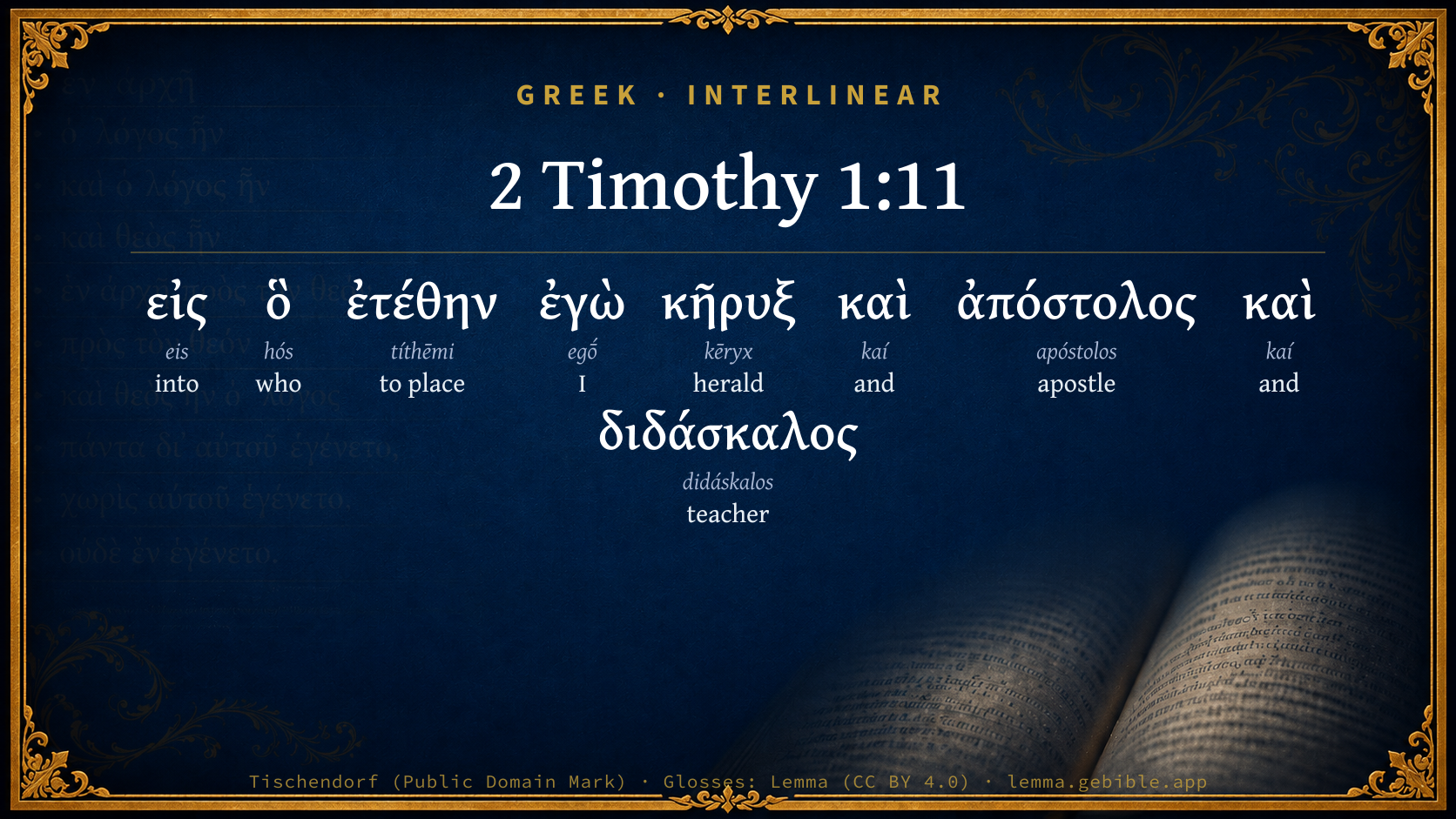
Greek (Tischendorf 8th ed.) 2 Timothy 1:11 appears in the Greek New Testament. The text above is from the Tischendorf 8th edition. Each word links to its Strong’s number and a concise gloss. Click any word for its full Thayer’s Greek Lexicon entry.
Download image
Cite this verse

2 Timothy 1:11 (World English Bible). Public Domain. Lemma interlinear Bible study tool, https://lemma.gebible.app/v/2-timothy/1/11.

Show BibTeX & RIS
BibTeX
RIS
English Translation
For this, I was appointed as a preacher, an apostle, and a teacher of the Gentiles.
World English Bible · Public Domain
Download a study sheet

One document with this verse’s original text, its word-by-word gloss line, the meaning frame, cross-references with their text, attributed commentary, and full source and license credits — printable, and it pastes into notes with its structure intact.

This verse Autodidact and up

Study sheet (.html) Plain text (.txt)

A passage Seminary Student

Up to 50 verses in one chapter. A passage sheet keeps up to 6 commentary sources and 12 cross-references per verse, in the order this page ranks them, and says so on the sheet whenever that leaves anything out. Ask for a single verse and you get the Autodidact verse sheet above.

Everything on this page stays free to read, with no account — the sheet is a download of what is already on screen, not access to it.

Want to remove ads? Support Godless Engineer
Compare translations 3

The same verse in 3 English versions, stacked beneath the original-language interlinear above. Click any original word for its lexicon entry.

Each is an independent rendering of the whole verse — the interlinear is not word-aligned to these translations.

Highlighted words mark where these versions differ — a whole-verse word diff, not a word-by-word alignment.

  • World English Bible Public Domain
    For this, I was appointed as a preacher, an apostle, and a teacher of the Gentiles.
  • King James Version Public Domain
    Whereunto I am appointed a preacher, and an apostle, and a teacher of the Gentiles.
  • unfoldingWord Literal Text CC BY-SA 4.0
    for which I was appointed a herald and an apostle and a teacher,

unfoldingWord Literal Text — © unfoldingWord, licensed CC BY-SA 4.0. Word-aligned USFM3 via Door43 (git.door43.org/unfoldingWord/en_ult).

Versions to compare (up to 4)

3 of 4 selected

Show all 19 translations

Every available English version of this verse, each an independent rendering of the whole verse.

  • World English Bible Public Domain
    For this, I was appointed as a preacher, an apostle, and a teacher of the Gentiles.
  • Berean Standard Bible Public Domain
    to which I was appointed as a preacher, an apostle, and a teacher.
  • Majority Standard Bible Public Domain
    to which I was appointed as a preacher, an apostle, and a teacher of the Gentiles.
  • King James Version Public Domain
    Whereunto I am appointed a preacher, and an apostle, and a teacher of the Gentiles.
  • American Standard Version (1901) Public Domain
    whereunto I was appointed a preacher, and an apostle, and a teacher.
  • Revised Version (1885) Public Domain
    whereunto I was appointed a preacher, and an apostle, and a teacher.
  • Geneva Bible (1599) Public Domain
    Whereunto I am appointed a preacher, and Apostle, and a teacher of the Gentiles.
  • Douay-Rheims (1899) Public Domain
    Wherein I am appointed a preacher, and an apostle, and teacher of the Gentiles.
  • Young's Literal Translation Public Domain
    to which I was placed a preacher and an apostle, and a teacher of nations,
  • Literal Standard Version CC BY-SA 4.0
    to which I was placed a preacher and an apostle, and a teacher of nations,
  • Unlocked Literal Bible CC BY-SA 4.0
    Because of this, I was appointed a preacher, an apostle, and a teacher.
  • unfoldingWord Literal Text CC BY-SA 4.0
    for which I was appointed a herald and an apostle and a teacher,
  • Darby Bible Public Domain
    to which *I* have been appointed a herald and apostle and teacher of [the] nations.
  • World Messianic Bible Public Domain
    For this I was appointed as a proclaimer, an emissary, and a teacher of the Gentiles.
  • Webster's Bible Public Domain
    To which I am appointed a preacher, and an apostle, and a teacher of the Gentiles.
  • Free Bible Version CC BY-SA 4.0
    I was appointed speaker, apostle, and teacher of this good news.
  • Bible in Basic English Public Domain
    Of which I was made a preacher and an Apostle and a teacher;
  • Text-Critical English NT CC BY 4.0
    For this gospel I was appointed to be a preacher, an apostle, and a teacher of the Gentiles.
  • Tyndale New Testament (1534) Public Domain
    whervnto I am apoynted a preacher and an Apostle and a teacher of the gentyls:

Literal Standard Version (2020), Covenant Press — licensed CC BY-SA 4.0. Text via the HelloAO Bible API (eBible.org). Unlocked Literal Bible (unfoldingWord) — licensed CC BY-SA 4.0. Text via the HelloAO Bible API (eBible.org). unfoldingWord Literal Text — © unfoldingWord, licensed CC BY-SA 4.0. Word-aligned USFM3 via Door43 (git.door43.org/unfoldingWord/en_ult). Free Bible Version, Dr. Jonathan Gallagher — licensed CC BY-SA 4.0. Text via the HelloAO Bible API (eBible.org).

Word by word

More ways to search: Search by grammar → Find every occurrence → Compare this word →

Practice this passage: Drill this verse → Learn its vocabulary →

About this verse

These counts appear in no published source. They are computed here, from the morphology-tagged text and Lemma’s own curated glosses. What Lemma adds →

9
words
8
distinct lemmas
Pauline Epistles
section

Notable vocabulary

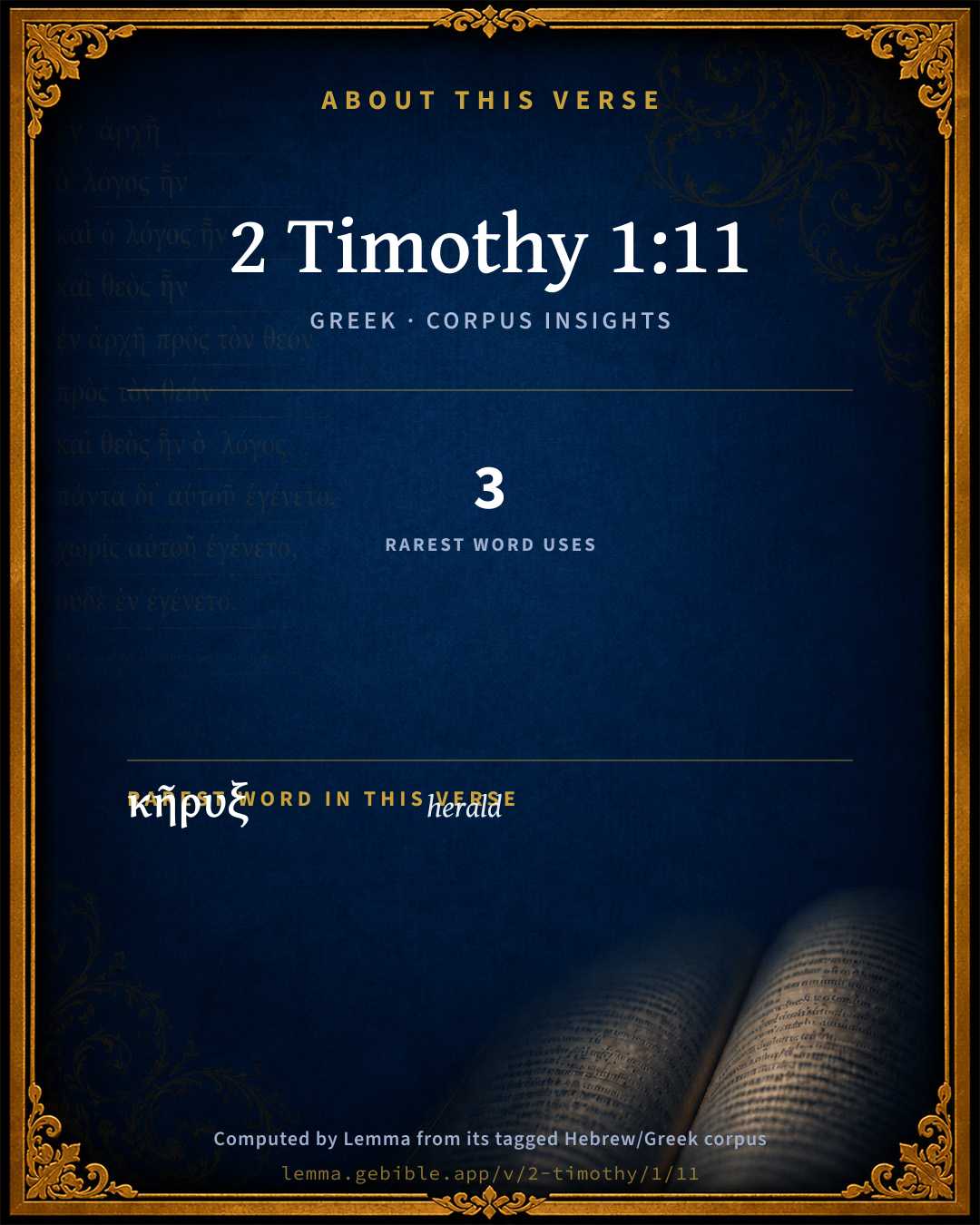
The rarest word here is κῆρυξ herald G2783 — appearing just 3 times in the whole Greek New Testament.

Shared distinctive vocabulary

κῆρυξ herald G2783 occurs in 3 verses of the Greek New Testament. Also found in:

Repetition

A word recurs within this verse:

Cross-references

4

Topical passages linked to 2 Timothy 1:11 in the Treasury of Scripture Knowledge — connected by theme and wording, ordered by reader-vote popularity; previews shown in the World English Bible.

  • 1 Timothy 2:7 to which I was appointed a preacher and an apostle (I am telling the truth in Christ, not lying), a teacher of the Gentiles in faith and truth.
  • Ephesians 3:7–8 of which I was made a servant, according to the gift of that grace of God which was given me according to the working of his power.
  • Acts 9:15 But the Lord said to him, "Go your way, for he is my chosen vessel to bear my name before the nations and kings, and the children of Israel.
  • 1 Timothy 1:7 desiring to be teachers of the law, though they understand neither what they say, nor about what they strongly affirm.

Cross-references courtesy of OpenBible.info (CC BY 4.0).

Where the printed editions differ

1 variant

Places in this verse where the major printed Greek editions disagree on the wording in a way that affects the translation — a comparison of editions, not a manuscript-by-manuscript collation. The editions are the modern critical texts (Nestlé-Aland 28/27, SBL, Westcott-Hort, Tregelles, Tyndale House) and the traditional texts behind the KJV (the Textus Receptus and the Byzantine/Majority text). It is not a claim about which reading is original.

  1. Extra text
    ἐθνῶν·

    “of gentiles;”

    In TregTRByz Not in NA28NA27TynSBLWH

    ἐθνῶν· (ethnōn) 'of gentiles;' is only in traditional manuscripts (Treg+TR+Byz)

Textual data: Translators Amalgamated Greek New Testament (STEPBible TAGNT) · CC BY 4.0.

Commentary

Notes on 2 Timothy 1:11 from classic Christian and Jewish commentators (each source and its license shown beneath its notes). The classic Christian expositions comment on the surrounding passage and are grouped to its opening verse, so a note may address several verses; the Jewish commentaries on the Tanakh (Rashi and others) are per-verse, so they appear only where the commentator wrote on this verse.

Lemma curates 59 commentaries, every one of them public domain or Creative Commons licensed, each selected and text-cleaned for this edition rather than reprinted as found. About our sources →

The Biblical Illustrator

Joseph S. Exell

2Ti_1:11

A preacher, and an apostle, and a teacher of the Gentiles.

I. A public preacher is one who may discharge his office ever in one and the same place.

II. An apostle goes about everywhere; but he would have fully satisfied the requirements of his apostolic office if he had once for all declared his message.

III. Teacher. Here we have in addition diligence and perseverance in teaching: from which arose suffering. (J. A. Bengel.)

The preacher a crier

It is an argument, that the preacher brings not stolen stuff nor bad commodity. He whose fruit is best, as we see in cities, crieth loudest. A low voice in the street argueth either an ill-commodity or a false way of obtaining it. (J. Barlow, D. D.)

Not to cavil with the preacher

Again, this must teach the auditors not to cavil with the crier, but to hear the words of exhortation patiently. Some, like Festus, tell Paul, if he cry aloud, that he is beside himself; reputing the preacher rude, indiscreet, passionate. Why? Can a bell have too shrill a sound? a hound too deep or bass a mouth? a piece give too great a report? or a crier extend his voice too high? Shall not the shepherd shout when the sheep are wandering, or ready to be devoured by the wolf? Will ye not ring the bells awake, when the city is on fire? Discharge the greatest cannon, when the ship is in distress, and in danger to be lost in the haven? And shall not the preacher cry, roar, and, as John, bellow like an ox (for so the word is read), when men sleep and sink in sin, and be in hazard to be drowned and devoured by Satan, that cruel wolf, and pirate of the soul? (J. Barlow, D. D.)

The servants of God take delight to dwell and discourse of good things

(Act_20:7):--Its no burden or wearisomeness to the saints to enlarge their speech on heavenly subjects. A traveller when he hath taken a view of the situation of many towns and countries, beheld the rare monuments that he hath met withal, rejoiceth to make relation thereof unto his friends after his return; and so is it with a Christian, who is a spiritual traveller: when he hath seen into the mysteries of religion, found out the great secrets therein contained, by the painful travel of his mind, he maketh it the joy of his heart largely to discourse thereof unto his brethren. (J. Barlow, D. D.)

Love makes teachers

But did they love the gospel they neither would or could be silent; for their word, like fire in straw, would burst forth. Will not the soldier speak of his wounds, the huntsman of his hounds, and the husbandman of his cattle and grounds? And shall we love the gospel and never make mention of it? No, no: this little speech of heavenly things argueth that the love of many is but cold. Love the word once, and say nothing of it, if thou canst. (J. Barlow, D. D.)

A gospel preacher

Bramwell was a plain preacher in the States, and to some extent an uncultivated preacher; but he was frill of faith and zeal, and his ministry was attended with marvellous power. He was preaching in a little village on one occasion, and the German minister, Trubner, was induced to go and hear him. Trubner was a very cultivated scholar, and a profound critic; and when some of Bramwells friends saw him there they said, Alas! alas! for poor Bramwell, how Trubner will criticise him! Precious little did Bramwell care for him, or for all the philosophers under the sun. He preached, and set before his audience the everlasting gospel of Jesus Christ, and when Trubner went out of the church one of his friends said to him, How did you like him? Dont you think he wanders a good deal in his preaching? Oh, yes, said the old Lutheran, he do wander most delightfully from de subject to de heart. (The Teachers Cabinet.)

The Biblical Illustrator, edited by Joseph S. Exell (c. 1880s–1900s) — public domain. Text from a community e-Sword module.

Joseph Benson's Commentary

2Ti 1:11-12. Whereunto — For proclaiming which good news; I am appointed a preacher — Κηρυξ, a herald; and an apostle — Invested with an extraordinary commission, and furnished with spiritual gifts to make me a successful teacher of the Gentiles — That is, of them chiefly. For which — Namely, my preaching to the Gentiles; I suffer these things — “By assigning his preaching salvation to the Gentiles through Christ, without obedience to the law of Moses, as the cause of his second bonds in Rome, he hath insinuated that the unbelieving Jews were active in getting him imprisoned, and tried for his life as a criminal.” — Macknight. Nevertheless — Though my condition may seem infamous; I am not ashamed — Either of my doctrine or of my sufferings. For I know whom I have believed — That is, whose word and promise I have credited, and to whom I have trusted all my important concerns: I know his power, and love, and faithfulness; and am persuaded, fully satisfied, he is able to keep that which I have committed to him — Την παραθηκην μου, my deposite, until that day — Of final retribution; meaning, undoubtedly, his immortal soul, or his whole person, soul and body. Thus Peter, (1Pe 4:19,) Let them that suffer according to the will of God, commit the keeping of their souls to him, (or, as may be included, the preservation, or, if taken away, the restoration, of the life of their bodies,) in well-doing, as unto a faithful Creator, who never did, and never will, deceive, or disappoint the hopes of any that trust in him.

Joseph Benson's Commentary on the Old and New Testaments (1811–1818) — public domain. Text from a community e-Sword module.

Bengel's Gnomon

Johann Albrecht Bengel

2Ti 1:11. Ἐθνῶν, of the Gentiles) Construe this not only with teacher, but also with preacher and apostle. There are three designations, preacher, apostle, teacher. I. A public preacher is one who may discharge his office even in one and the same place. II. An apostle goes about everywhere; but he would have fully satisfied the requirements of his apostolic office, if he had once for all declared his message. III. Teacher. Here we have in addition diligence and perseverance in teaching; from which arose suffering.

Bengel's Gnomon of the New Testament — English translation (T&T Clark, Edinburgh, 1860) — public domain. Text from a community e-Sword module.

Meyer's Critical & Exegetical Commentary

Heinrich August Wilhelm Meyer

2Ti_1:11. Εἰς ὃ ἐτέθην κ.τ.λ.] With these words the apostle turns to his office and his suffering in his office, in correspondence with μηδὲ ἐμὲ τ. δὲσμ. αὐτοῦ, 2Ti_1:8. The relative ὅ does not refer to the thoughts expressed in the previous verses, but to εὐαγγελίου: for which, i.e. in order to preach it. Comp. the parallel passages in 1Ti_2:7.

Meyer — Critical and Exegetical Commentary on the New Testament — English translation by Peter Christie, edited by Frederick Crombie (T&T Clark, 1880) — public domain. Text from a community e-Sword module.

Expositor's Greek Testament

ed. W. Robertson Nicoll

2Ti 1:11 . εἰς ὃ ἐτέθην , κ . τ . λ .: See 1Ti 2:7 , where these words are also found, and the note on 1Ti 1:11 .

The Expositor's Greek Testament, edited by W. Robertson Nicoll (1897–1910) — public domain. Text from a community e-Sword module.

Geneva Bible (1599)

Geneva Bible translators

That is, the Gospel which the Apostle preached.

Geneva Bible (1599) marginal notes — public domain. Text via Bolls.life.

Jamieson, Fausset & Brown

Robert Jamieson, A. R. Fausset & David Brown

Whereunto--For the publication of which Gospel.

I am appointed--Greek, "I was appointed."

preacher--Greek, "herald."

teacher of the Gentiles-- (Ti1 2:7). He brings forward his own example in this verse and Ti2 1:12, as a pattern for Timothy, as a public "preacher," an "apostle," or missionary from place to place, and a "teacher" in private instructing His flock with patient perseverance.

Jamieson, Fausset & Brown — Commentary Critical and Explanatory on the Whole Bible (1871) — public domain (CC PDM 1.0). Text via the HelloAO Bible API.

Adam Clarke's Commentary

Verse 11. Whereunto I am appointed a preacher] κηρυξ, a herald. See Clarke on Mt 3:17.

And an apostle] Sent immediately from God to man.

A teacher] One whose business it is to instruct men, and particularly the Gentiles, to whom he was especially sent; to proclaim the doctrines of eternal life, the resurrection and final incorruptibility of the human body; and, in a word, the salvation both of the body and soul of man by Christ Jesus.

Adam Clarke's Commentary on the Bible (1810–1826) — public domain. Text from a community e-Sword/MySword module.

John Calvin's Commentaries

11 To which I have been appointed Not without good reason does he so highly commend the gospel along with his apostleship. Satan labors, beyond all things else, to banish from our hearts, by every possible method, the faith of sound doctrine; and as it is not always easy for him to do this if he attack us in open war, he steals upon us by secret and indirect methods; for, in order to destroy the credibility of doctrine, he holds up to suspicion the calling of godly teachers. Paul, therefore, having death before his eyes, and knowing well the ancient and ordinary snares of Satan, determined to assert not only the doctrine of the gospel in general, but his own calling. Both were necessary; for, although there be uttered long discourses concerning the dignity of the gospel, they will not be of much avail to us, unless we understand what is the gospel. Many will agree as to the general principle of the undoubted authority of the gospel, who afterwards will have nothing certain that they can follow. This is the reason why Paul expressly wishes to be acknowledged to be a faithful and lawful minister of that life-giving doctrine which he had mentioned.

A herald, and an apostle, and a teacher of the Gentiles For the reasons now stated, he adorns himself with various titles for expressing one and the same thing. He calls himself a herald, whose duty it is, to publish the commands of princes and magistrates. The word apostle is here used in its ordinary and restricted meaning. Moreover, because there is a natural relation between a teacher and his disciples, he takes to himself also this third name, that they who learn from him may know that they have a master who has been appointed to them by God. And to whom does he declare that he was appointed? To the Gentiles; for the main hinge of the controversy was about them, because the Jews denied that the promises of life belonged to any others than to the fleshly children of Abraham. In order, therefore, that the salvation of the Gentiles may not be called in question, he affirms that to them he has been especially sent by God.

John Calvin's Commentaries (1540-1563) — public domain. Text from the Calvin Translation Society English edition (1840s-50s) via the Christian Classics Ethereal Library (ccel.org). Calvin's coverage is partial (roughly two-thirds of the Bible); uncommented books and verses are honest gaps, never fabricated. The 19th-century editor's footnotes and remarks are omitted so the notes are faithfully Calvin's own voice.

Ellicott's Commentary for English Readers

(11) Whereunto I am appointed a preacher . . . .—Whereunto—that is, to preach the gospel referred to in the previous verse. (On these titles see 1Ti_1:12; 1Ti_2:7.) In all his deep humiliation, a solitary prisoner awaiting death, deserted by his friends, St. Paul, with solemn emphasis, rehearses the titles of dignity which, by his Master’s appointment, he possessed in the Christian Church. The poor prisoner, waiting his summons to a painful death, wished his last charge to go forth with all the authority of an Apostle, adding, however, in the next verse, that his present sufferings were entailed on him, owing to this very position in the Christian community to which his Master had called him.

A Bible Commentary for English Readers, edited by Charles John Ellicott (1878–1897) — public domain. Text from a community e-Sword module.

The Cambridge Bible for Schools and Colleges

gen. ed. J. J. S. Perowne

11. whereunto I am appointed a preacher] Rather, for which I—remember—was appointed a herald. St Paul ‘magnifies his office’ here in the same terms as in 1Ti_2:7; but there to assert his authority for ruling, here to commend his example in suffering: see note.

The Cambridge Bible for Schools and Colleges (gen. ed. J. J. S. Perowne; Cambridge University Press, 1878–1918) — public domain. Text from a community e-Sword module.

John Gill's Exposition

Whereunto I am appointed a preacher,.... Both from eternity, in the counsel and purpose of God, Act 9:15 and in time, by the church at Antioch, and the prophets in it, according to the express order of the Holy Ghost, Act 13:2. And if ever there was a preacher of the Gospel, Paul was one; he preached purely, powerfully, publicly, constantly, boldly, and with all faithfulness and integrity:

and an apostle; that is, of the Gentiles, as follows, and as he elsewhere styles himself, Rom 11:13 for it does not run so smooth and easy to connect this with the word Gospel. In Ti2 1:1, he is called the apostle of Jesus Christ, because he was sent by him; and here the apostle of the Gentiles, because, he was sent to them; and this by the same appointment, by which he became a preacher:

and a teacher of the Gentiles; though all the apostles, by their commission, were sent to teach all nations, or the Gentiles in the several parts of the world, as well as Jews; yet the apostle was eminently a teacher of them; his work chiefly lay among them; the Gospel of the uncircumcision, or the ministration of the Gospel to the uncircumcised Gentiles, was committed to him; and he was a teacher of them in faith and verity, as in Ti1 2:7. The Alexandrian copy only reads, "and a teacher".

John Gill's Exposition of the Whole Bible (1746–1763) — public domain (CC PDM 1.0). Text via the HelloAO Bible API.

Trapp's Complete Commentary

John Trapp

11 Whereunto I am appointed a preacher, and an apostle, and a teacher of the Gentiles.

Ver. 11. A teacher of the Gentiles] His writings therefore should be the more highly prized and studied by us Gentiles, as being properly ours; like as Psa 127:1, was a song made (specially) for Solomon.

John Trapp, A Commentary or Exposition upon All the Books of the Old and New Testament (1647–1656) — public domain. Text from a community e-Sword module.

Albert Barnes' Notes on the Bible

Whereunto I am appointed a preacher - That is, I am appointed to make these truths known; see the notes at Eph 3:7-8.

Albert Barnes' Notes on the Bible (1834–1885) — public domain. Text from a community e-Sword/MySword module.

Matthew Poole's English Annotations

Whereunto I am appointed a preacher; for the publication of which gracious counsel and purpose of God thus made manifest by Christ’s coming, and of that life and immortality thus by the gospel brought to light, God hath appointed me as his crier;

and an apostle; and sent me immediately as his messenger to make publication of it;

and a teacher of the Gentiles; and hath made the instructing of the heathen my peculiar province, 1Ti 2:7.

Matthew Poole's English Annotations on the Holy Bible (1683–1685) — public domain. Text from a community e-Sword/MySword module.

Whedon's Commentary on the Bible

Daniel D. Whedon

11. Whereunto—To this most glorious gospel.

Appointed—Not by my own assumption, but by divine will. 2Ti_1:1.

A preacher—A herald; for so the Greek word signifies. A herald was an appointed messenger in war from one side to the other, whose person was sacred while in performance of his duties. Often was he the bearer of terms of peace; hence weapons of war must be quiet in his presence.

Apostle—Note, Mat_10:1-2; Luk_1:2.

Of the Gentiles—Which most of the Ephesian Church were.

Daniel D. Whedon (gen. ed.), Commentary on the Old and New Testaments (1874–1909) — public domain. Text from a community e-Sword module.

The Pulpit Commentary

Was for am, A.V; teacher for teacher of the Gentiles, A.V and T.R. Was appointed (ejteqhn); comp.menov 1Ti_1:12, qe eijv diakonian, "appointing me to the ministry;" and 2:7. A preacher, and an apostle, and a teacher (so also. (1Ti_2:7) Teacher (didaskalov) is one of the spiritual offices enumerated in 1Co_12:28 and Eph_4:11. It is surely remarkable that neither here nor elsewhere does St. Paul speak of any call to the priesthood in a sacerdotal sense (see Rom_1:1, 5 15:16; 1Co_1:1, etc.)

The Pulpit Commentary (1880–1919), ed. H.D.M. Spence-Jones & Joseph S. Exell — public domain. Text from a community e-Sword module.

Fairbairn on Ezekiel, Jonah & the Pastoral Epistles

Patrick Fairbairn

Ver. 11. The reference to the gospel, introduced so casually at the close of the preceding verse, is taken by the apostle as a link to introduce what follows respecting his office, and what it called him to suffer, as well as to do, for the sake of Christ: for which I was appointed a herald and apostle, and teacher of the Gentiles. The same description exactly that was given of his office in the first epistle, 1Ti 2:7. What follows, however, is different, having respect to the sufferings associated with the calling, as formerly it stood connected with his authority to prescribe and rule in church affairs.

Patrick Fairbairn — An Exposition of Ezekiel (1851), Jonah (1849), and The Pastoral Epistles (1874) — public domain. Text from a community e-Sword module.

Cambridge Greek Testament for Schools and Colleges

11. διδάσκαλος ἐθνῶν. ἐθνῶν is omitted by א*A 17, and it is regarded by some critical editors as introduced here from 1Ti 2:7, where it is certainly genuine; it is consequently omitted both by Tischendorf and by WH. But the external evidence for its retention is very strong, including as it does not only all MSS. save those cited, but the witness of the Egyptian, Syriac and Old Latin versions.

11. εἰς ὃ ἐτέθην ἐγώ, for which, sc. for the proclamation of which Gospel, I was appointed. Cp. 1Ti 1:12 and esp. 1Ti 2:7 where the same three offices are named. See critical note.

Cambridge Greek Testament for Schools and Colleges (Cambridge University Press, 1896; 21 vols, various authors incl. Carr, Maclear, Plummer, Farrar, Lumby, Moule, M. R. James, Simcox) — public domain. Text from a community e-Sword module.

International Critical Commentary

11. Cf. 1Ti 2:7.

International Critical Commentary — older volumes (1896–1929), various authors — public domain. Text from a community e-Sword module.

Vincent's Word Studies in the New Testament

Marvin R. Vincent

A teacher of the Gentiles [διδασκαλος εθνων] . Omit of the Gentiles. Comp. 1Ti 2:7, from which the words were probably transferred when the three Epistles were jointly edited. Paul calls himself an apostle, and describes himself as preaching [κηρυσσων] ; but he nowhere calls himself didaskalov a teacher, although he uses didaskein to teach, of himself, 1Co 4:17; Col 1:28. He also uses didach teaching, of matter given by him to the converts, Rom 6:17; Rom 16:17; 1Co 14:6. He distinguishes between the apostle and the teacher, 1Co 12:28; Eph 4:11.

Marvin R. Vincent, Word Studies in the New Testament (1887–1900) — public domain. Text from a community e-Sword/MySword module.

Lesson kit

Teaching starters — assembled from the data on this page, not authored interpretation. Every prompt links to the verse data it draws on. Edit before teaching.

2 Timothy, in the Pauline Epistles, opens this verse with 9 words (8 distinct Greek lemmas). Its most distinctive word is kēryx (“herald”). A historical commentator’s framing appears above. Read the whole chapter for the surrounding context.

Discussion questions

  1. The word kēryx carries the sense “herald.” How does it shape the verse?
  2. How does 1 Timothy 2:7, which shares the word «herald», read alongside this verse?
  3. What does the repetition of “and” (2× in this one verse) do in this verse?
  4. These translations render this verse differently. What is at stake in choosing one wording over another?
  5. Compare how The Biblical Illustrator and Joseph Benson's Commentary read this verse. Where do they agree or differ?

Things to notice

  • These translations choose different wording for 6 words in this verse.
  • “and” occurs 2× in this single verse.
  • 8 distinct Greek lemmas span 9 words in this verse.

Reading settings

Reading text

Shown beneath each verse's original-language words.

Old Testament
Old Testament edition

Read the OT as the Masoretic Hebrew (MT) or the Greek Septuagint (LXX).

English shown for the Greek Septuagint (in the Hebrew ↔ Greek comparison).

Comparing translations? Open the Compare panel on any verse page to stack up to four side by side.