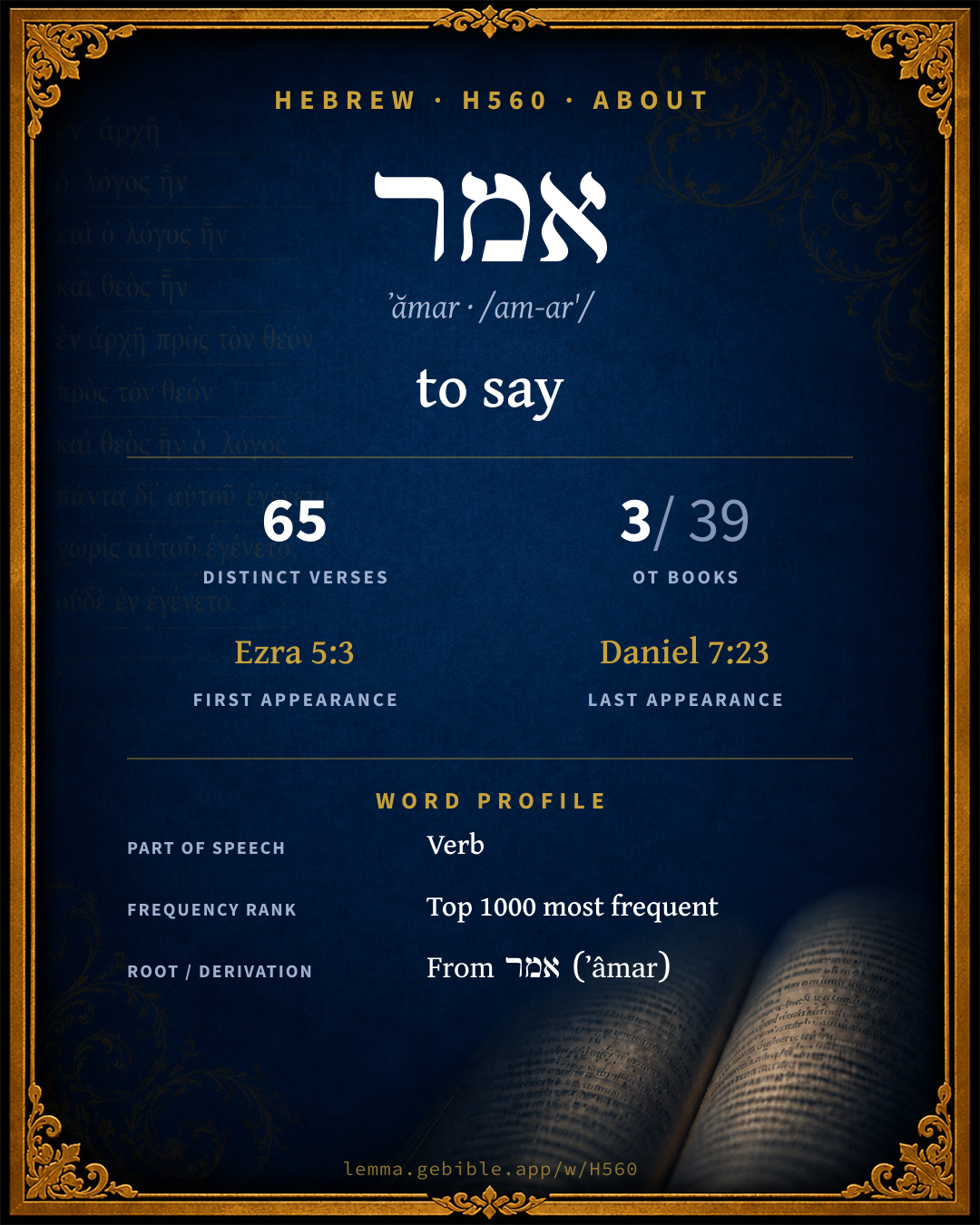
אֲמַר
to say
Full lexicon entry — Brown-Driver-Briggs (BDB)
From Brown-Driver-Briggs (BDB)
Where this word appears
Grammar key — what these labels mean
Part of speech
- Verb
- An action or state-of-being word.
Stem
- Qal
- The basic, simple active stem — the plain form of the verb (“he wrote”).
Form
- Participle Active
- A verbal adjective expressing ongoing or characteristic action (“writing / one who writes”).
- Perfect
- A completed action or state — Hebrew marks aspect (completeness) more than strict tense (“he wrote”).
- Imperative
- A direct command (“write!”).
- Infinitive Construct
- A bound verbal noun, frequently with prepositions (“to write / in writing”).
- Imperfect
- An incomplete, ongoing, or future action (“he will / would write”).
State
- Absolute
- The independent form of a noun, not bound to a following word.
Person
- 3rd Person
- The one spoken about (“he / she / it / they”).
- 2nd Person
- The one addressed (“you”).
- 1st Person
- The speaker (“I / we”).
Gender
- Masculine
- Grammatically masculine.
- Common
- Either gender — not distinguished for this form.
- Feminine
- Grammatically feminine.
Number
- Singular
- One.
- Plural
- More than one (in Hebrew, generally three or more).
Every verse where H560 appears in the Book of Daniel — 59 distinct verses. Click any verse to open its interlinear word-by-word view. Verse text shown in the World English Bible for context — . Each verse’s Hebrew form is shown with its reference; the English is not keyword-highlighted, since the data carries no word-level English alignment. Use “Compare translations” on any verse to read it across multiple English versions. This concordance covers the Hebrew Bible; Septuagint (Greek Old Testament) occurrences are not indexed here.
Daniel
- Daniel 2:4 אֱמַ֥ר Qal impv 2ms Then spoke the Chaldeans to the king in the Syrian language, O king, live forever: tell your servants the dream, and we will show the interpretation.
- Daniel 2:5 וְ/אָמַ֣ר conj + Qal ptcp.act ms The king answered the Chaldeans, The thing is gone from me: if you don't make known to me the dream and the interpretation of it, you shall be cut in pieces, and your houses shall be made a dunghill.
- Daniel 2:7 וְ/אָמְרִ֑ין יֵאמַ֥ר conj + Qal ptcp.act mp Qal impf 3ms They answered the second time and said, Let the king tell his servants the dream, and we will show the interpretation.
- Daniel 2:8 וְ/אָמַ֔ר conj + Qal ptcp.act ms The king answered, I know of a certainty that you would gain time, because you see the thing is gone from me.
- Daniel 2:9 לְ/מֵאמַ֣ר אֱמַ֣רוּ prep + Qal inf.cs Qal impv 2mp But if you don't make known to me the dream, there is but one law for you; for you have prepared lying and corrupt words to speak before me, until the time be changed: therefore tell me the dream, and I shall know that you can show me the interpretation of it.
- Daniel 2:10 וְ/אָ֣מְרִ֔ין conj + Qal ptcp.act mp The Chaldeans answered before the king, and said, There is not a man on the earth who can show the king's matter, because no king, lord, or ruler, has asked such a thing of any magician, or enchanter, or Chaldean.
- Daniel 2:12 וַ/אֲמַר֙ conj + Qal pf 3ms For this cause the king was angry and very furious, and commanded to destroy all the wise men of Babylon.
- Daniel 2:15 וְ/אָמַ֗ר conj + Qal ptcp.act ms he answered Arioch the king's captain, Why is the decree so urgent from the king? Then Arioch made the thing known to Daniel.
- Daniel 2:20 וְ/אָמַ֔ר conj + Qal ptcp.act ms Daniel answered, Blessed be the name of God forever and ever; for wisdom and might are his.
- Daniel 2:24 אֲמַר Qal ptcp.act ms Therefore Daniel went in to Arioch, whom the king had appointed to destroy the wise men of Babylon; he went and said thus to him: Don't destroy the wise men of Babylon; bring me in before the king, and I will show to the king the interpretation.
- Daniel 2:25 אֲמַר Qal pf 3ms Then Arioch brought in Daniel before the king in haste, and said thus to him, I have found a man of the children of the captivity of Judah, who will make known to the king the interpretation.
- Daniel 2:26 וְ/אָמַ֣ר conj + Qal ptcp.act ms The king answered Daniel, whose name was Belteshazzar, Are you able to make known to me the dream which I have seen, and the interpretation of it?
- Daniel 2:27 וְ/אָמַ֑ר conj + Qal ptcp.act ms Daniel answered before the king, and said, The secret which the king has demanded can neither wise men, enchanters, magicians, nor soothsayers, show to the king;
- Daniel 2:36 נֵאמַ֥ר Qal impf 1cp This is the dream; and we will tell the interpretation of it before the king.
- Daniel 2:46 אֲמַ֖ר Qal pf 3ms Then the king Nebuchadnezzar fell on his face, and worshiped Daniel, and commanded that they should offer an offering and sweet odors to him.
- Daniel 2:47 וְ/אָמַ֗ר conj + Qal ptcp.act ms The king answered to Daniel, and said, Of a truth your God is the God of gods, and the Lord of kings, and a revealer of secrets, seeing you have been able to reveal this secret.
- Daniel 3:4 אָֽמְרִין֙ Qal ptcp.act mp Then the herald cried aloud, To you it is commanded, peoples, nations, and languages,
- Daniel 3:9 וְ/אָ֣מְרִ֔ין conj + Qal ptcp.act mp They answered Nebuchadnezzar the king, O king, live for ever.
- Daniel 3:13 אֲמַר֙ Qal pf 3ms Then Nebuchadnezzar in [his] rage and fury commanded to bring Shadrach, Meshach, and Abednego. Then they brought these men before the king.
- Daniel 3:14 וְ/אָמַ֣ר conj + Qal ptcp.act ms Nebuchadnezzar answered them, Is it on purpose, Shadrach, Meshach, and Abednego, that you don't serve my god, nor worship the golden image which I have set up?
- Daniel 3:16 וְ/אָמְרִ֖ין conj + Qal ptcp.act mp Shadrach, Meshach, and Abednego answered the king, Nebuchadnezzar, we have no need to answer you in this matter.
- Daniel 3:19 וְ/אָמַר֙ conj + Qal ptcp.act ms Then was Nebuchadnezzar full of fury, and the form of his visage was changed against Shadrach, Meshach, and Abednego: [therefore] he spoke, and commanded that they should heat the furnace seven times more than it was wont to be heated.
- Daniel 3:20 אֲמַר֙ Qal pf 3ms He commanded certain mighty men who were in his army to bind Shadrach, Meshach, and Abednego, [and] to cast them into the burning fiery furnace.
- Daniel 3:24 וְ/אָמַ֜ר וְ/אָמְרִין֙ conj + Qal ptcp.act ms conj + Qal ptcp.act mp Then Nebuchadnezzar the king was astonished, and rose up in haste: he spoke and said to his counselors, Didn't we cast three men bound into the midst of the fire? They answered the king, True, O king.
- Daniel 3:25 וְ/אָמַ֗ר conj + Qal ptcp.act ms He answered, Look, I see four men loose, walking in the midst of the fire, and they have no hurt; and the aspect of the fourth is like a son of the gods.
- Daniel 3:26 וְ/אָמַ֗ר conj + Qal ptcp.act ms Then Nebuchadnezzar came near to the mouth of the burning fiery furnace: he spoke and said, Shadrach, Meshach, and Abednego, you servants of the Most High God, come forth, and come here. Then Shadrach, Meshach, and Abednego came forth out of the midst of the fire.
- Daniel 3:28 וְ/אָמַ֗ר conj + Qal ptcp.act ms Nebuchadnezzar spoke and said, Blessed be the God of Shadrach, Meshach, and Abednego, who has sent his angel, and delivered his servants who trusted in him, and have changed the king's word, and have yielded their bodies, that they might not serve nor worship any god, except their own God.
- Daniel 3:29 יֵאמַ֤ר Qal impf 3ms Therefore I make a decree, that every people, nation, and language, which speak anything evil against the God of Shadrach, Meshach, and Abednego, shall be cut in pieces, and their houses shall be made a dunghill; because there is no other god who is able to deliver after this sort.
- Daniel 4:7 אָמַ֤ר Qal ptcp.act ms Then came in the magicians, the enchanters, the Chaldeans, and the soothsayers; and I told the dream before them; but they did not make known to me the interpretation of it.
- Daniel 4:8 אַמְרֵֽת Qal pf 1cs But at the last Daniel came in before me, whose name was Belteshazzar, according to the name of my god, and in whom is the spirit of the holy gods: and I told the dream before him, [saying],
- Daniel 4:9 אֱמַֽר Qal impv 2ms Belteshazzar, master of the magicians, because I know that the spirit of the holy gods is in you, and no secret troubles you, tell me the visions of my dream that I have seen, and the interpretation of it.
- Daniel 4:14 אָמַ֗ר Qal ptcp.act ms He cried aloud, and said thus, Hew down the tree, and cut off its branches, shake off its leaves, and scatter its fruit: let the animals get away from under it, and the fowls from its branches.
- Daniel 4:18 אֱמַ֗ר Qal impv 2ms This dream I, king Nebuchadnezzar, have seen; and you, Belteshazzar, declare the interpretation, because all the wise men of my kingdom are not able to make known to me the interpretation; but you are able; for the spirit of the holy gods is in you.
- Daniel 4:19 וְ/אָמַ֗ר וְ/אָמַ֔ר conj + Qal ptcp.act ms conj + Qal ptcp.act ms Then Daniel, whose name was Belteshazzar, was stricken mute for a while, and his thoughts troubled him. The king answered, Belteshazzar, don't let the dream, or the interpretation, trouble you. Belteshazzar answered, My lord, the dream be to those who hate you, and the interpretation of it to your adversaries.
- Daniel 4:23 וְ/אָמַר֩ conj + Qal ptcp.act ms Whereas the king saw a watcher and a holy one coming down from the sky, and saying, Hew down the tree, and destroy it; nevertheless leave the stump of the roots of it in the earth, even with a band of iron and brass, in the tender grass of the field, and let it be wet with the dew of the sky: and let his portion be with the animals of the field, until seven times pass over him;
- Daniel 4:26 אֲמַ֗רוּ Qal pf 3mp Whereas they commanded to leave the stump of the roots of the tree; your kingdom shall be sure to you, after that you shall have known that the heavens do rule.
- Daniel 4:30 וְ/אָמַ֔ר conj + Qal ptcp.act ms The king spoke and said, Is not this great Babylon, which I have built for the royal dwelling-place, by the might of my power and for the glory of my majesty?
- Daniel 4:31 אָֽמְרִין֙ Qal ptcp.act mp While the word was in the king's mouth, there fell a voice from the sky, [saying], O king Nebuchadnezzar, to you it is spoken: The kingdom is departed from you:
- Daniel 4:35 וְ/יֵ֥אמַר conj + Qal impf 3ms All the inhabitants of the earth are reputed as nothing; and he does according to his will in the army of heaven, and among the inhabitants of the earth; and none can stay his hand, or tell him, What do you?
- Daniel 5:2 אֲמַ֣ר Qal pf 3ms Belshazzar, while he tasted the wine, commanded to bring the golden and silver vessels which Nebuchadnezzar his father had taken out of the temple which was in Jerusalem; that the king and his lords, his wives and his concubines, might drink from it.
- Daniel 5:7 וְ/אָמַ֣ר conj + Qal ptcp.act ms The king cried aloud to bring in the enchanters, the Chaldeans, and the soothsayers. The king spoke and said to the wise men of Babylon, Whoever shall read this writing, and show me the interpretation of it, shall be clothed with purple, and have a chain of gold about his neck, and shall be the third ruler in the kingdom.
- Daniel 5:10 וַ/אֲמֶ֗רֶת conj + Qal pf 3fs [Now] the queen by reason of the words of the king and his lords came into the banquet house: the queen spoke and said, O king, live forever; don't let your thoughts trouble you, nor let your face be changed.
- Daniel 5:13 וְ/אָמַ֣ר conj + Qal ptcp.act ms Then was Daniel brought in before the king. The king spoke and said to Daniel, Are you that Daniel, who are of the children of the captivity of Judah, whom the king my father brought out of Judah?
- Daniel 5:17 וְ/אָמַר֙ conj + Qal ptcp.act ms Then Daniel answered before the king, Let your gifts be to yourself, and give your rewards to another; nevertheless I will read the writing to the king, and make known to him the interpretation.
- Daniel 5:29 אֲמַ֣ר Qal pf 3ms Then commanded Belshazzar, and they clothed Daniel with purple, and put a chain of gold about his neck, and made proclamation concerning him, that he should be the third ruler in the kingdom.
- Daniel 6:5 אָֽמְרִ֔ין Qal ptcp.act mp Then said these men, We shall not find any occasion against this Daniel, except we find it against him concerning the law of his God.
- Daniel 6:6 אָמְרִ֣ין Qal ptcp.act mp Then these presidents and satraps assembled together to the king, and said thus to him, King Darius, live forever.
- Daniel 6:12 וְ/אָמְרִ֥ין וְ/אָמַ֗ר conj + Qal ptcp.act ms conj + Qal ptcp.act ms Then they came near, and spoke before the king concerning the king's interdict: Haven't you signed an interdict, that every man who shall make petition to any god or man within thirty days, save to you, O king, shall be cast into the den of lions? The king answered, The thing is true, according to the law of the Medes and Persians, which doesn't alter.
- Daniel 6:13 וְ/אָמְרִין֮ conj + Qal ptcp.act mp Then answered they and said before the king, That Daniel, who is of the children of the captivity of Judah, doesn't regard you, O king, nor the interdict that you have signed, but makes his petition three times a day.
- Daniel 6:15 וְ/אָמְרִ֣ין conj + Qal ptcp.act mp Then these men assembled together to the king, and said to the king, Know, O king, that it is a law of the Medes and Persians, that no interdict nor statute which the king establishes may be changed.
- Daniel 6:16 אֲמַ֗ר וְ/אָמַ֣ר Qal pf 3ms conj + Qal ptcp.act ms Then the king commanded, and they brought Daniel, and cast him into the den of lions. [Now] the king spoke and said to Daniel, Your God whom you serve continually, he will deliver you.
- Daniel 6:20 וְ/אָמַ֣ר conj + Qal ptcp.act ms When he came near to the den to Daniel, he cried with a lamentable voice; the king spoke and said to Daniel, Daniel, servant of the living God, is your God, whom you serve continually, able to deliver you from the lions?
- Daniel 6:23 אֲמַ֖ר Qal pf 3ms Then was the king exceeding glad, and commanded that they should take Daniel up out of the den. So Daniel was taken up out of the den, and no manner of hurt was found on him, because he had trusted in his God.
- Daniel 6:24 וַ/אֲמַ֣ר conj + Qal pf 3ms The king commanded, and they brought those men who had accused Daniel, and they cast them into the den of lions, them, their children, and their wives; and the lions had the mastery of them, and broke all their bones in pieces, before they came to the bottom of the den.
- Daniel 7:1 אֲמַֽר Qal pf 3ms In the first year of Belshazzar king of Babylon Daniel had a dream and visions of his head on his bed: then he wrote the dream and told the sum of the matters.
- Daniel 7:2 וְ/אָמַ֔ר conj + Qal ptcp.act ms Daniel spoke and said, I saw in my vision by night, and, behold, the four winds of the sky broke forth on the great sea.
- Daniel 7:5 אָמְרִ֣ין Qal ptcp.act mp Behold, another animal, a second, like a bear; and it was raised up on one side, and three ribs were in its mouth between its teeth: and they said thus to it, Arise, devour much flesh.
- Daniel 7:16 וַ/אֲמַר conj + Qal pf 3ms I came near to one of those who stood by, and asked him the truth concerning all this. So he told me, and made me know the interpretation of the things.
- Daniel 7:23 אֲמַר֒ Qal pf 3ms Thus he said, The fourth animal shall be a fourth kingdom on earth, which shall be diverse from all the kingdoms, and shall devour the whole earth, and shall tread it down, and break it in pieces.
About this entry
At a glance — auto-summarized from this page’s data, not written by a person. Every figure links to its source below. This summary describes the numbers; it doesn’t interpret them.
The Hebrew verb אמר centers on the idea of “to say.” Daniel dominates its distribution — 59 of 65 verses. Spanning 65 verses in 3 books, it ranks among the moderately common words of the Hebrew Bible. Its earliest occurrence is Ezra 5:3. Related forms include אמר, אמיר and אמר. Dig into 65-verse concordance and the renderings breakdown below.
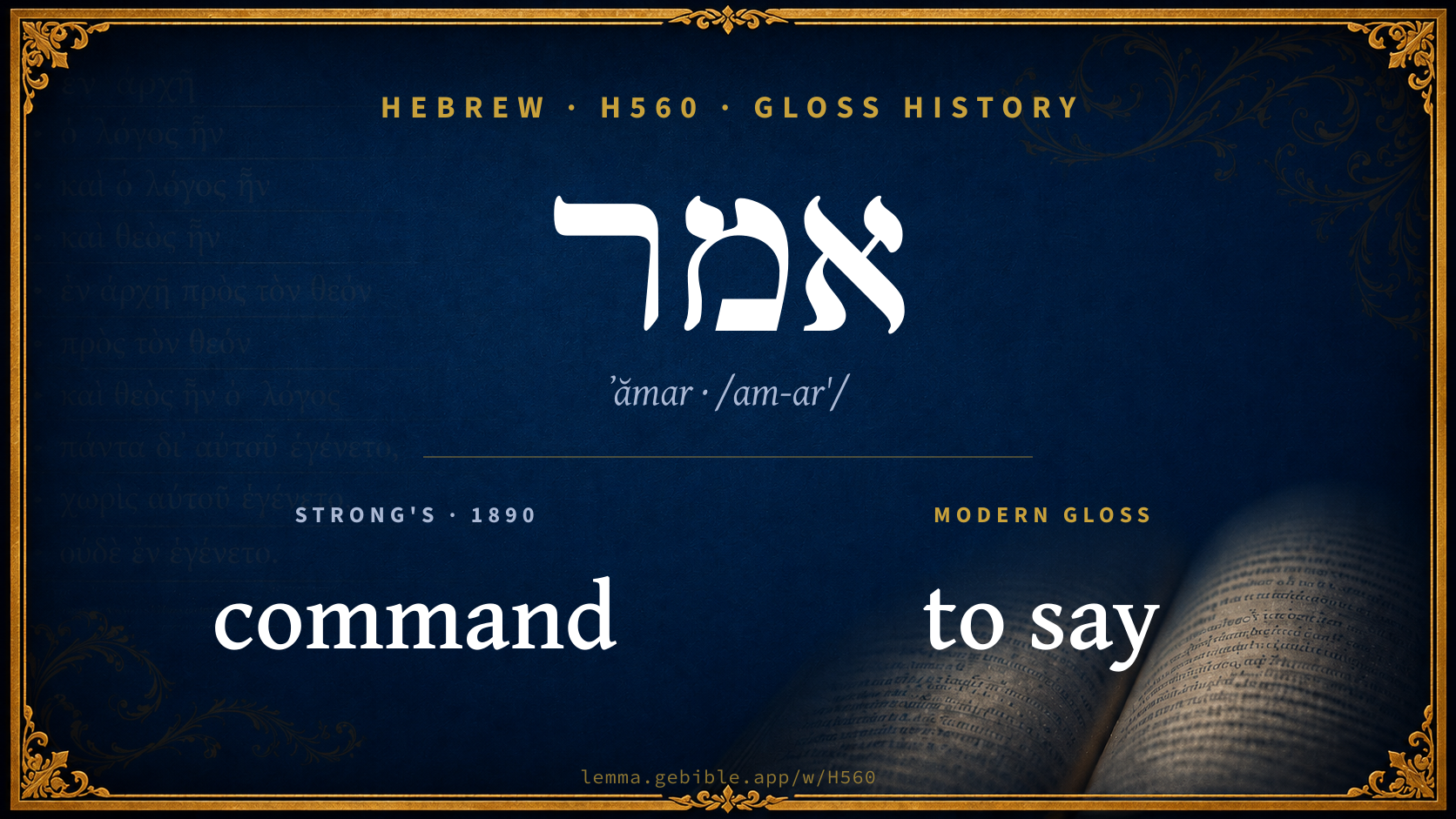
Gloss history
Strong's 1890 vs modern scholarship
About this word
Strong's H560 catalogs a Hebrew word from the Hebrew Old Testament.
These counts are not copied from any lexicon or concordance. They are computed here, from the morphology-tagged Hebrew Old Testament. What Lemma adds →
- 65
- distinct verses
- The word appears in 65 distinct verses.
- 3 / 39
- OT books
- The word appears in 3 of 39 Old Testament books.
- #558
- by frequency
- Top 1000 most frequent Hebrew words (rank 558 of 8,640 Hebrew words by occurrence).
View all 65 occurrences in the concordance →
By section of the Old Testament
By traditional corpus
Conventional, traditional groupings — biblical authorship is debated, so this is a traditional corpus grouping, not an authorship claim. Each share is this word’s portion of its verses in that division of the Hebrew canon. Each figure is a share of the word’s 65 distinct verses.
- Writings (Ketuvim) 64 verses · 98%
- Prophets (Nevi'im) 1 verse · 2%
How translations render this word
Counts come from each version’s own published word-to-Strong’s tagging or interlinear alignment — an approximate guide to how each version renders this word, not a word-level alignment the data otherwise carries. Because each total is that version’s own tagged count, the per-version totals vary from one another and need not match the appearance or distinct-verse counts above. These counts may also differ from a printed concordance because Lemma counts each distinctly tagged rendering and does not collapse phrase taggings into a single head-word total. This is a fixed set of word-tagged versions (KJV, ASV, BSB, ULT) and does not change with the reading translation you choose elsewhere. Each version’s license is shown beside its name below (and on Sources).
- King James Version: Said 38×, Commanded 9×, Tell 3×
- American Standard Version: Said 34×, Commanded 9×, Tell 3×
- Berean Standard Bible: Said 9×, Asked 6×, Tell 3×
- unfoldingWord Literal Text: Said 34×, Gave an order 3×, He said 3×
King James Version Public Domain
Renders H560 across 71 tagged occurrences — most commonly:
Plus 15 renderings that appear only once — usually multi-word phrases or single function words the recovered tagging swept in, not distinct renderings.
American Standard Version Public Domain
Renders H560 across 71 tagged occurrences — most commonly:
Plus 17 renderings that appear only once — usually multi-word phrases or single function words the recovered tagging swept in, not distinct renderings.
Berean Standard Bible Public Domain
Renders H560 across 47 tagged occurrences — most commonly:
Plus 25 renderings that appear only once — usually multi-word phrases or single function words the recovered tagging swept in, not distinct renderings. Not rendered by a distinct English word in 24 further occurrences.
unfoldingWord Literal Text CC BY-SA 4.0
Renders H560 across 72 tagged occurrences — most commonly:
Plus 17 renderings that appear only once — usually multi-word phrases or single function words the recovered tagging swept in, not distinct renderings.
Senses in BDB
The 1 sense BDB distinguishes for this word, in lexicon order (not ranked by frequency or importance). The full entry — with sub-senses — is in the Lexicon Entry tab.
- (Peal) to say, to speak, to command, to tell, to relate
Word origin
אֲמַר 71 vb. say, tell, command
— Brown-Driver-Briggs (Oxford 1906, public domain), digitized via Sefaria, supplemented by the OpenScriptures HebrewLexicon (CC BY 4.0). See Sources.
Derived from אמר (ʼâmar) (H559) — to say.
Jastrow Dictionary
A second Hebrew/Aramaic lexicon for comparison, covering Aramaic and post-biblical (Talmudic, Targumic, Midrashic) usage that the biblical-Hebrew BDB does not. Matched by lemma rather than by Strong’s number, so a lemma may carry more than one Jastrow headword (shown separately below), and the entries cover usage well beyond the Bible.
אָמַר I
- (a) to join, knot; to be knotted, thick; b) to heap up; c) transf. to join words, compose, cmp. דבר; d) to contract, bargain, exchange. [As to Assyr. to see, cmp. חמא.])
- 1. to speak, think, say, relate &c. … א׳ ר׳ … א׳ ר׳ Rabbi … related in the name of R. … Ber. 3ᵇ; a. v. fr.—Part. pass. אָמוּר expression. Yoma 70ᵇ, a. fr. הוא הא׳ וכ׳ it is the same expression (‘one ram’) used here and in the Book of Numbers. Sifré Deut. s. 334, a. fr. אֱמוֹר מעתה say from now, i.e. from this draw the conclusion. Gen. R. s. 39 תאמר שהבירה וכ׳ (usu. שמא תאמר) will you say (is it possible), this castle has no commander?—אֲמוּרִים דברים במה (abbr. בד׳'א) in what case are these words said? i.e. this applies only. Ḥull. 3ᵃ; a. fr.—זאת אוֹמֶרֶת this tells, i.e. this proves. Ber. 11ᵇ; a. fr.—אָמְרוּ it is said, told &c.; v. next w.—Inf. לוֹמַר = לֵאמֹר. Ḥag. 14ᵇ; a. fr.
- 2. to vow, devote. אָמוּר (לגבוה) devoted to the Lord. Succ. 55ᵇ; v. אֲמִירָה I, 3, a. אֵימוּרִים.
- (b. h.) to be said, to read … נא׳ כאן … ונ׳ להלן we read here … and we read there … (the same expression is used here and there in the Scriptural text). Ber. 9ᵃ; a. v. fr.—שֶׁנֶּאֱמַר (abbr. שנ׳, שנא׳) for it is said in the Scriptures (as evidence in favor of an opinion). Snh. X, 1; a. v. fr.; also כמה שנ׳ (כמו) as it is said.—מִשּׁוּם שנ׳ because it is said in the Scriptures, i.e. you may possibly be misled by a certain expression to think …, therefore another term is used in its stead in an analogous case, or added to the ambiguous word; v. שׁוּם.
אֲמַר
- 1) as preced. 1). Targ. Gen. I, 3; a. v. fr.—א׳ מר above you quoted an authority, or, it has been stated. Ber. 2ᵃ; a. fr.—א׳ קרא the Scripture says. Ib. 13ᵃ; a. fr.—Y. Orl. III, end, 63ᵇ, a. fr. אמרונה בשם … (in Bab. heb. אֲמָרוּהָ) they said it in behalf of … i.e. as a tradition.—Y. Ber. I, 2ᵈ מילתיה אמרה his word (statement, opinion &c.) proves.—הדא אמרה = זאת אומרת; v. preced.—אַמְרֵי (h. אָמְרוּ) they say, it is said. Sabb. 19ᵃ אמרו עליו על … ואמרי לה וכ׳ it is told about R. …, and another relation refers this to R.—; a. fr.—קאמר, קאמרי &c. = קא אמר &c. Ḥull. 85ᵃ; a. fr.—מנא תימרא whence dost thou prove? Sabb. 23ᵃ; a. fr.—Inf. מֵימַר, מֵימְרָא. סבר מ׳, סבר למ׳ originally he was of the opinion. Y. Sabb. VI, 8ᶜ top; Keth. 87ᵇ; a. v. fr.—לְמֵימְרָא does this mean to say? Sabb. 15ᵇ; a. fr. לא אמרן אלא … אבל … this has been said, i.e. this applies only to a case … but if … Ber. 43ᵇ; a. fr.—כְּלוֹמַר as if saying, meaning to say, viz; v. כִּילּוּ.—Y. Kil. IV, 32ᶜ bot. אימורין לבני וכ׳ say ye to &c.—מאי איכא למימר, v. אִיכָּא; Answ. אֵימוּר say … Sabb. 6ᵃ; a. fr.—Hor. 13ᵃ א׳ כולה who orders every thing (as an etymol. of אֲמַרְכָּל).—2) to praise, proclaim. Targ. Is. VIII, 13; a. fr.—Part. pass. אָמִיר q. v.
- , contr. אִתְּמַר, אִיתְּ׳ it is said, taught. Targ. Job XXXIV, 31.—Y. Yoma V, end, 43ᵃ אתאמרת, contr. אִתַּמְרַת it has been said with refer. to the opinion of …—אִתְּ׳, אִיתְּ׳ it has been said (above);we have been taught. Succ. 15ᵃ; a. fr.
- same. Targ. Gen. XXII, 14; a. e.
אָמַר II
- , v. אָמַר I, a) to be thick, strong.
- 1. to thrive; to boast, vaunt, be oppressive (cmp. Ps. XCIV, 4). Sot. IX, 15 (49ᵇ) יוקר יַאֲמִיר the nobility shall be oppressive (Snh. 97ᵃ יְעַוֵּת; Der. Er. Zut. X יעוות; Cant. R. to II, 13 הווה).—*[ e.g. Psalms 94:4
- 2. (denom. of מריא to fatten. Sabb. XXIV, 3 (155ᵇ) Bab. מַאֲמִירִין, Ms. Oxf., Mish. a. Y. מַמְרִים, מַמְרִין, v. מרי.]
אֵמֶר
- , v. אֵימַר a. אִמְרָה.
אִמַּר
- lamb, v. אִימַּר.
מְרַר
- same, to be bitter; to grieve, mourn. Perf. מַר, imperf. יֵימַר, יֵמַר. Targ. Is. XXIV, 9. Targ. I Sam. XXX, 6; a. fr.—Targ. Zech. XII, 10 ויֵימְרוּן, v. infra.
- to embitter, aggrieve. Targ. Ruth I, 13 תְמָרְרוּן (ed. Amst. תִמְרְ׳). Targ. Y. I Deut. XXXII, 32 מְמַרְרִין (some ed. מְמַרְרַן; Y. II מַרְרַן).
- 1. same. Targ. Ruth I, 20 (not same. Targ. Ruth I, 20 (not אֲמַרִ׳). Targ. Ex. I, 14; a. e.
- 2. to arrange mourning. Targ. Zech. XII, 10 ויימרון … כמא דמַמְרִין וכ׳ they shall arrange mourning for him, as is arranged for &c. (v. infra).—[אָמְרָרוּ, v. Ithpa.]
- to aggrieve. Targ. Prov. XVII, 25. Targ. Y. I Gen. XLIX, 23 ממרירו, read: מַרְמִירוּ; (Y. II אֲמָרוּ, read: אַמָּ׳ Af.).
- 1. to be enraged, fight. Targ. O. Gen. l. c. (Var. אָמְרָרוּ, v. Berl. Targ. O. II, p. 18; oth. ed. אַמְרָרוּ Af.).
- 2. to mourn. Targ. Zech. l. c. Var. (v. Lag. Proph. I, p. XLII).
A Dictionary of the Targumim, the Talmud Babli and Yerushalmi, and the Midrashic Literature (Marcus Jastrow; London, Luzac, 1903) — Public Domain. Digitized via Sefaria. Digitized via Sefaria. Full attribution on Sources.
Forms in the corpus
The 44 distinct written forms H560 takes in the Hebrew Bible, most frequent first — each parse links to that stem’s occurrences in the concordance. Hebrew forms include their vowel points and cantillation, so a single lemma takes many written forms.
| Form | Parsing | Example | Uses |
|---|---|---|---|
| וְ/אָמַ֗ר | Verb, Qal, Participle Active, Masculine, Singular, Absolute | Daniel 2:15 | 7 |
| וְ/אָמַ֣ר | Verb, Qal, Participle Active, Masculine, Singular, Absolute | Daniel 2:5 | 7 |
| וְ/אָמַ֔ר | Verb, Qal, Participle Active, Masculine, Singular, Absolute | Daniel 2:8 | 5 |
| אָמְרִ֣ין | Verb, Qal, Participle Active, Masculine, Plural, Absolute | Daniel 6:6 | 3 |
| אֲמַר | Verb, Qal, Perfect, 3rd Person, Masculine, Singular | Daniel 2:25 | 2 |
| אֲמַ֖ר | Verb, Qal, Perfect, 3rd Person, Masculine, Singular | Daniel 2:46 | 2 |
| אֲמַ֣ר | Verb, Qal, Perfect, 3rd Person, Masculine, Singular | Daniel 5:2 | 2 |
| אֲמַ֣רְנָא | Verb, Qal, Perfect, 1st Person, Common, Plural | Ezra 5:4 | 2 |
| אֲמַר֙ | Verb, Qal, Perfect, 3rd Person, Masculine, Singular | Daniel 3:13 | 2 |
| אָֽמְרִין֙ | Verb, Qal, Participle Active, Masculine, Plural, Absolute | Daniel 3:4 | 2 |
| וְ/אָ֣מְרִ֔ין | Verb, Qal, Participle Active, Masculine, Plural, Absolute | Daniel 2:10 | 2 |
| וְ/אָמַר֙ | Verb, Qal, Participle Active, Masculine, Singular, Absolute | Daniel 3:19 | 2 |
| וַ/אֲמַר | Verb, Qal, Perfect, 3rd Person, Masculine, Singular | Daniel 7:16 | 2 |
| אֱמַ֗ר | Verb, Qal, Imperative, 2nd Person, Masculine, Singular | Daniel 4:18 | 1 |
| אֱמַ֣רוּ | Verb, Qal, Imperative, 2nd Person, Masculine, Plural | Daniel 2:9 | 1 |
| אֱמַ֥ר | Verb, Qal, Imperative, 2nd Person, Masculine, Singular | Daniel 2:4 | 1 |
| אֱמַֽר | Verb, Qal, Imperative, 2nd Person, Masculine, Singular | Daniel 4:9 | 1 |
| אֲמַ֗ר | Verb, Qal, Perfect, 3rd Person, Masculine, Singular | Daniel 6:16 | 1 |
| אֲמַ֗רוּ | Verb, Qal, Perfect, 3rd Person, Masculine, Plural | Daniel 4:26 | 1 |
| אֲמַֽר | Verb, Qal, Perfect, 3rd Person, Masculine, Singular | Daniel 7:1 | 1 |
| אֲמַר֒ | Verb, Qal, Perfect, 3rd Person, Masculine, Singular | Daniel 7:23 | 1 |
| אַמְרֵֽת | Verb, Qal, Perfect, 1st Person, Common, Singular | Daniel 4:8 | 1 |
| אָֽמְרִ֔ין | Verb, Qal, Participle Active, Masculine, Plural, Absolute | Daniel 6:5 | 1 |
| אָמַ֗ר | Verb, Qal, Participle Active, Masculine, Singular, Absolute | Daniel 4:14 | 1 |
| אָמַ֤ר | Verb, Qal, Participle Active, Masculine, Singular, Absolute | Daniel 4:7 | 1 |
| וְ/אָמְרִ֑ין | Verb, Qal, Participle Active, Masculine, Plural, Absolute | Daniel 2:7 | 1 |
| וְ/אָמְרִ֖ין | Verb, Qal, Participle Active, Masculine, Plural, Absolute | Daniel 3:16 | 1 |
| וְ/אָמְרִ֣ין | Verb, Qal, Participle Active, Masculine, Plural, Absolute | Daniel 6:15 | 1 |
| וְ/אָמְרִ֥ין | Verb, Qal, Participle Active, Masculine, Singular, Absolute | Daniel 6:12 | 1 |
| וְ/אָמְרִין֙ | Verb, Qal, Participle Active, Masculine, Plural, Absolute | Daniel 3:24 | 1 |
| וְ/אָמְרִין֮ | Verb, Qal, Participle Active, Masculine, Plural, Absolute | Daniel 6:13 | 1 |
| וְ/אָמַ֑ר | Verb, Qal, Participle Active, Masculine, Singular, Absolute | Daniel 2:27 | 1 |
| וְ/אָמַ֜ר | Verb, Qal, Participle Active, Masculine, Singular, Absolute | Daniel 3:24 | 1 |
| וְ/אָמַר֩ | Verb, Qal, Participle Active, Masculine, Singular, Absolute | Daniel 4:23 | 1 |
| וְ/יֵ֥אמַר | Verb, Qal, Imperfect, 3rd Person, Masculine, Singular | Daniel 4:35 | 1 |
| וַ/אֲמֶ֗רֶת | Verb, Qal, Perfect, 3rd Person, Feminine, Singular | Daniel 5:10 | 1 |
| וַ/אֲמַ֣ר | Verb, Qal, Perfect, 3rd Person, Masculine, Singular | Daniel 6:24 | 1 |
| וַ/אֲמַר֙ | Verb, Qal, Perfect, 3rd Person, Masculine, Singular | Daniel 2:12 | 1 |
| יֵאמַ֤ר | Verb, Qal, Imperfect, 3rd Person, Masculine, Singular | Daniel 3:29 | 1 |
| יֵאמַ֥ר | Verb, Qal, Imperfect, 3rd Person, Masculine, Singular | Daniel 2:7 | 1 |
| לְ/מֵאמַ֣ר | Verb, Qal, Infinitive Construct | Daniel 2:9 | 1 |
| לְ/מֵמַ֑ר | Verb, Qal, Infinitive Construct | Ezra 5:11 | 1 |
| נֵאמַ֥ר | Verb, Qal, Imperfect, 1st Person, Common, Plural | Daniel 2:36 | 1 |
| תֵּאמְר֣וּן | Verb, Qal, Imperfect, 2nd Person, Masculine, Plural | Jeremiah 10:11 | 1 |
Same root — word family
Other BDB entries built from the same root as H560, grouped by Strong’s listed origin. These share a root / origin per the lexicon — not necessarily a shared meaning. Each links to that word’s own entry.
Derives from
Shares the same root
Derived from this word
Proper names from this root
People and places named from this root — a name, not an additional meaning of the word.
Compare all same-root words → Showing 4 of 10 — not the complete family. 4 of the same-root words are proper names (people or places). They share a root, not necessarily a meaning.
Septuagint verse parallels
This word appears in 61 verses that also exist in the Greek Old Testament (Septuagint), out of the 65 Hebrew verses it occurs in. You can read those verses in Greek by switching the Old Testament edition to the Septuagint.
Read these verses in the Septuagint
This is a verse-level parallel only — the same verses exist in both the Hebrew and Greek Old Testaments. No word-level Hebrew↔Greek correspondence is claimed: the data carries no such alignment, so no Greek word is shown as this Hebrew word’s translation. Coverage is not total — the Septuagint omits the deuterocanon and renumbers the Psalms, so some Hebrew verses have no direct Greek parallel.