
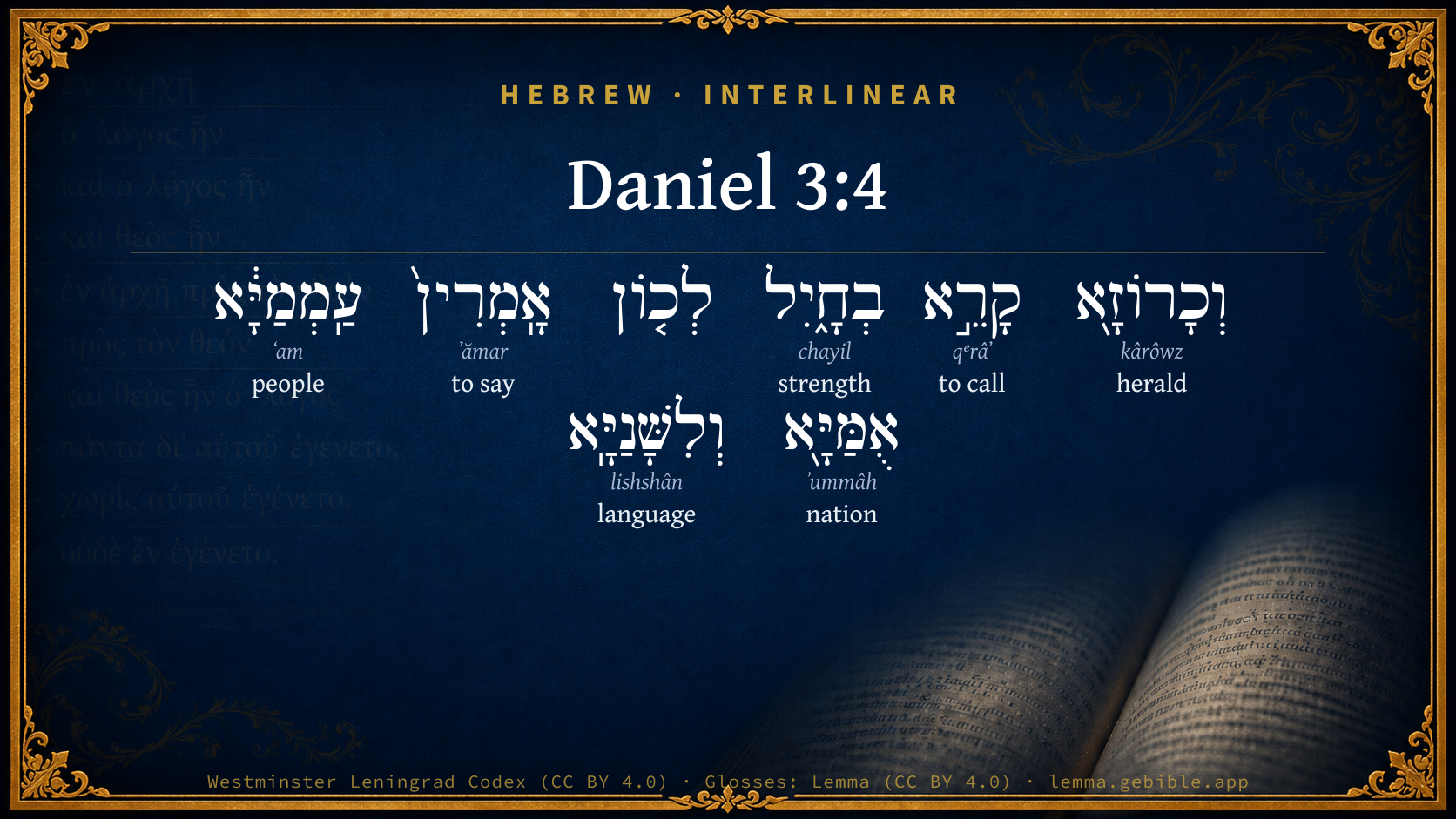
Daniel 3:4

Hebrew (Westminster Leningrad Codex) Daniel 3:4 appears in the Hebrew Old Testament. The text above is from the Westminster Leningrad Codex. Each word links to its Strong’s number, a concise gloss, and parsing drawn from the Open Scriptures Hebrew Bible morphology. Click any word for its full Brown-Driver-Briggs (BDB) entry.
Download image
Cite this verse

Daniel 3:4 (World English Bible). Public Domain. Lemma interlinear Bible study tool, https://lemma.gebible.app/v/daniel/3/4.

Show BibTeX & RIS
BibTeX
RIS
English Translation
Then the herald cried aloud, To you it is commanded, peoples, nations, and languages,
World English Bible · Public Domain
Highlights
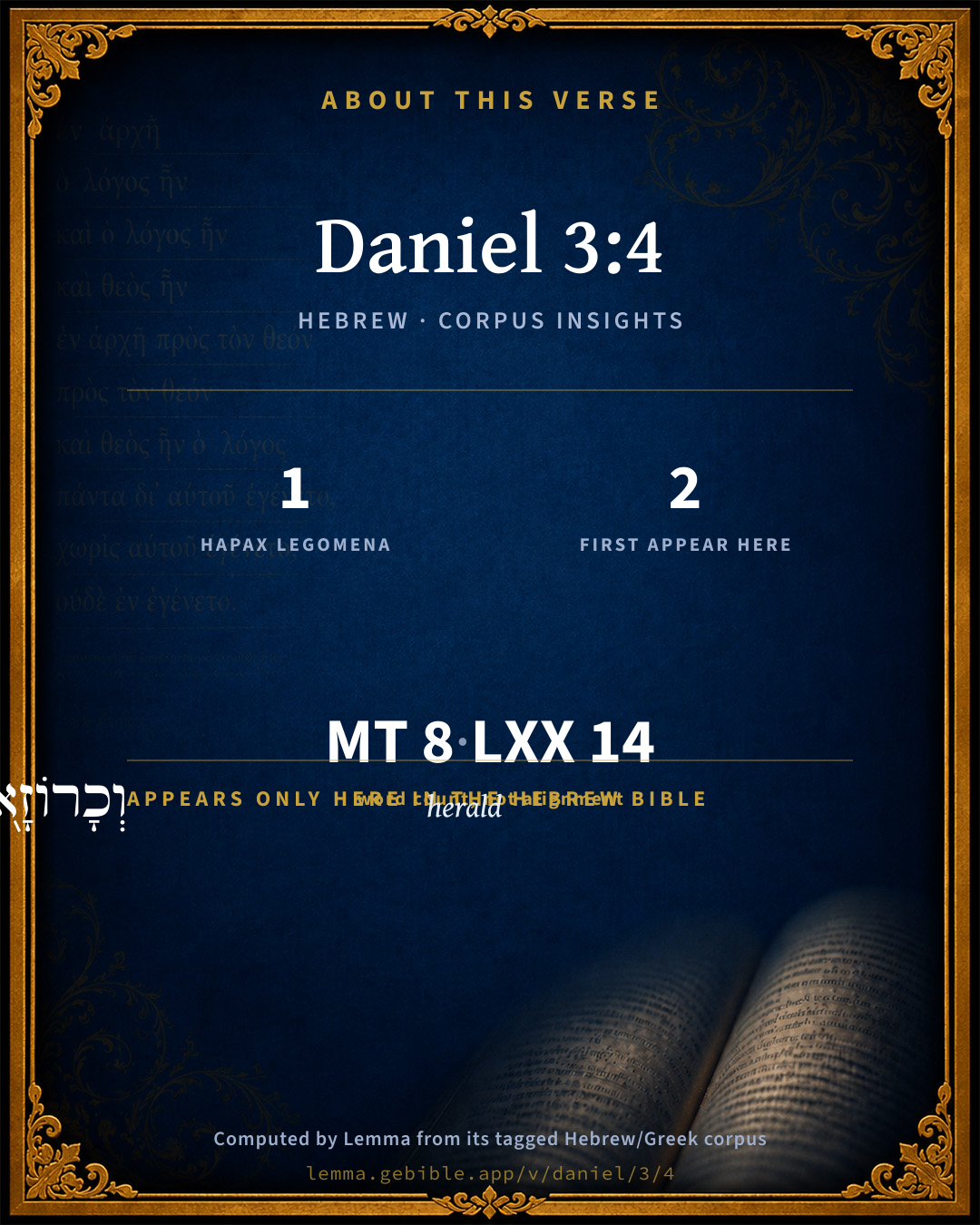
  • 1 hapax legomenon — only here in the Hebrew Bible
  • 2 first appearances in the Hebrew Bible
Full analysis ↓
Download a study sheet

One document with this verse’s original text, its word-by-word gloss line, the meaning frame, cross-references with their text, attributed commentary, and full source and license credits — printable, and it pastes into notes with its structure intact.

This verse Autodidact and up

Study sheet (.html) Plain text (.txt)

A passage Seminary Student

Up to 50 verses in one chapter. A passage sheet keeps up to 6 commentary sources and 12 cross-references per verse, in the order this page ranks them, and says so on the sheet whenever that leaves anything out. Ask for a single verse and you get the Autodidact verse sheet above.

Everything on this page stays free to read, with no account — the sheet is a download of what is already on screen, not access to it.

Want to remove ads? Support Godless Engineer
Compare translations 3

The same verse in 3 English versions, stacked beneath the original-language interlinear above. Click any original word for its lexicon entry.

Each is an independent rendering of the whole verse — the interlinear is not word-aligned to these translations.

Highlighted words mark where these versions differ — a whole-verse word diff, not a word-by-word alignment.

  • World English Bible Public Domain
    Then the herald cried aloud, To you it is commanded, peoples, nations, and languages,
  • King James Version Public Domain
    Then an herald cried aloud, To you it is commanded, O people, nations, and languages,
  • unfoldingWord Literal Text CC BY-SA 4.0
    Then the herald loudly proclaimed, “You are commanded, O peoples, nations, and languages,

unfoldingWord Literal Text — © unfoldingWord, licensed CC BY-SA 4.0. Word-aligned USFM3 via Door43 (git.door43.org/unfoldingWord/en_ult).

Versions to compare (up to 4)

3 of 4 selected

Show all 18 translations

Every available English version of this verse, each an independent rendering of the whole verse.

  • World English Bible Public Domain
    Then the herald cried aloud, To you it is commanded, peoples, nations, and languages,
  • Berean Standard Bible Public Domain
    Then the herald loudly proclaimed, “O people of every nation and language, this is what you are commanded:
  • Majority Standard Bible Public Domain
    Then the herald loudly proclaimed, “O people of every nation and language, this is what you are commanded:
  • King James Version Public Domain
    Then an herald cried aloud, To you it is commanded, O people, nations, and languages,
  • American Standard Version (1901) Public Domain
    Then the herald cried aloud, To you it is commanded, O peoples, nations, and languages,
  • Revised Version (1885) Public Domain
    Then the herald cried aloud, to you it is commanded, O peoples, nations, and languages,
  • Geneva Bible (1599) Public Domain
    Then an herald cried aloude, Be it knowen to you, O people, nations, and languages,
  • Douay-Rheims (1899) Public Domain
    Then a herald cried with a strong voice: To you it is commanded, O nations, tribes, and languages:
  • Young's Literal Translation Public Domain
    And a crier is calling mightily: `To you they are saying: O peoples, nations, and languages!
  • Literal Standard Version CC BY-SA 4.0
    And a crier is calling mightily: “They are saying to you: O peoples, nations, and languages!
  • Unlocked Literal Bible CC BY-SA 4.0
    Then a herald loudly shouted, “You are commanded, peoples, nations, and languages,
  • unfoldingWord Literal Text CC BY-SA 4.0
    Then the herald loudly proclaimed, “You are commanded, O peoples, nations, and languages,
  • Darby Bible Public Domain
    And the herald cried aloud, To you it is commanded, [O] peoples, nations, and languages,
  • World Messianic Bible Public Domain
    Then the herald cried aloud, “To you it is commanded, peoples, nations, and languages,
  • Webster's Bible Public Domain
    Then a herald cried aloud, To you it is commanded, O people, nations, and languages,
  • Free Bible Version CC BY-SA 4.0
    Then a herald announced in a loud voice, “People of all nations and languages, pay attention to the king's command!
  • Bible in Basic English Public Domain
    Then one of the king's criers said in a loud voice, To you the order is given, O peoples, nations, and languages,
  • JPS Tanakh (1917) Public Domain
    And the herald cried aloud: 'To you it is commanded, O peoples, nations, and languages,

Literal Standard Version (2020), Covenant Press — licensed CC BY-SA 4.0. Text via the HelloAO Bible API (eBible.org). Unlocked Literal Bible (unfoldingWord) — licensed CC BY-SA 4.0. Text via the HelloAO Bible API (eBible.org). unfoldingWord Literal Text — © unfoldingWord, licensed CC BY-SA 4.0. Word-aligned USFM3 via Door43 (git.door43.org/unfoldingWord/en_ult). Free Bible Version, Dr. Jonathan Gallagher — licensed CC BY-SA 4.0. Text via the HelloAO Bible API (eBible.org).

Word by word

More ways to search: Search by grammar → Find every occurrence → Compare this word →

Practice this passage: Drill this verse → Learn its vocabulary →

About this verse

These counts appear in no published source. They are computed here, from the morphology-tagged text and Lemma’s own curated glosses. What Lemma adds →

8
words
7
distinct lemmas
Prophets
section

Notable vocabulary

1 hapax legomenon — a word that appears only here in the entire Hebrew Bible:

  • וְכָרוֹזָ֖א herald H3744

First appearance in Scripture

These words make their first canonical appearance in the Hebrew Bible here:

  • וְכָרוֹזָ֖א herald H3744
  • וְלִשָּׁנַיָּֽא language H3961

Shared distinctive vocabulary

בְחָ֑יִל strength H2429 occurs in 6 verses of the Hebrew Bible. Also found in:

Grammatical profile

  • 1 noun
  • 3 adjectives
  • 4 particles

Hebrew & Septuagint length

In English translation the verse runs 14 words from the Hebrew and 15 from the Septuagint (LXX English) — closely comparable.

A rough comparison of the two English renderings, which tokenize alike — not a word-level alignment.

Word counts can differ between the Hebrew and the Greek without any difference in meaning — e.g. the Hebrew direct-object marker אֵת has no separate Greek word, and Greek often adds the article ὁ.

In the original languages it is 8 Hebrew tokens and 14 Greek tokens — but the two are counted differently (Hebrew bundles its prefixes and suffixes into one token; the Greek is in lemma form), so that isn’t a like-for-like length.

Cross-references

9

Topical passages linked to Daniel 3:4 in the Treasury of Scripture Knowledge — connected by theme and wording, ordered by reader-vote popularity; previews shown in the World English Bible.

  • Daniel 4:1 Nebuchadnezzar the king, to all the peoples, nations, and languages, who dwell in all the earth: Peace be multiplied to you.
  • Daniel 6:25 Then king Darius wrote to all the peoples, nations, and languages, who dwell in all the earth: Peace be multiplied to you.
  • Micah 6:16 For the statutes of Omri are kept, And all the works of the house of Ahab. You walk in their counsels, That I may make you a ruin, And her inhabitants a hissing; And you will bear the reproach of my people."
  • Esther 8:9 Then were the king's scribes called at that time, in the third month Sivan, on the three and twentieth [day] of it; and it was written according to all that Mordecai commanded to the Jews, and to the satraps, and the governors and princes of the provinces which are from India to Ethiopia, one hundred twenty-seven provinces, to every province according to the writing of it, and to every people after their language, and to the Jews according to their writing, and according to their language.
  • Proverbs 9:13–15 The foolish woman is loud, Undisciplined, and knows nothing.
  • Isaiah 40:9 You who tell good news to Zion, go up on a high mountain; you who tell good news to Jerusalem, lift up your voice with strength; lift it up, don't be afraid; say to the cities of Judah, Behold, your God!
  • Isaiah 58:1 Cry aloud, don't spare, lift up your voice like a trumpet, and declare to my people their disobedience, and to the house of Jacob their sins.
  • Daniel 4:14 He cried aloud, and said thus, Hew down the tree, and cut off its branches, shake off its leaves, and scatter its fruit: let the animals get away from under it, and the fowls from its branches.
  • Hosea 5:11 Ephraim is oppressed, He is crushed in judgment; Because he is intent in his pursuit of idols.

Cross-references courtesy of OpenBible.info (CC BY 4.0).

Hebrew and Greek witnesses Masoretic Hebrew ↔ Greek Septuagint

The same verse in the two great witnesses to the Old Testament, shown verse-for-verse.

These are two independent witnesses, not word-aligned to each other, and the Septuagint is shown in lemma (dictionary) form.

Hebrew Daniel 3:4 Masoretic · Westminster Leningrad Codex

וְכָרוֹזָ֖א קָרֵ֣א בְחָ֑יִל לְכ֤וֹן אָֽמְרִין֙ עַֽמְמַיָּ֔א אֻמַּיָּ֖א וְלִשָּׁנַיָּֽא

Then the herald cried aloud, To you it is commanded, peoples, nations, and languages,

World English Bible · Public Domain

Greek LXX Daniel 3:4 Septuagint · lemma form

καί ὁ κῆρυξ κηρύσσω ὁ ὄχλος σύ παραἀγγέλλω ἔθνος καί χώρα λαός καί γλῶσσα

Then a herald cried aloud, To you it is commanded, you⌃ peoples, tribes, and languages,

LXX2012 (modern English Septuagint) · Public Domain

On this verse, The Pulpit Commentary discusses the Septuagint’s reading. Read the note in Commentary ↓

Hebrew: Westminster Leningrad Codex (CC BY 4.0). Greek: Septuagint (public domain); English from LXX2012 (modern English Septuagint) (Public Domain). How the Septuagint differs from the Hebrew →

Commentary

Notes on Daniel 3:4 from classic Christian and Jewish commentators (each source and its license shown beneath its notes). The classic Christian expositions comment on the surrounding passage and are grouped to its opening verse, so a note may address several verses; the Jewish commentaries on the Tanakh (Rashi and others) are per-verse, so they appear only where the commentator wrote on this verse.

Lemma curates 59 commentaries, every one of them public domain or Creative Commons licensed, each selected and text-cleaned for this edition rather than reprinted as found. About our sources →

Trapp's Complete Commentary

John Trapp

Dan 3:4 Then an herald cried aloud, To you it is commanded, O people, nations, and languages,

Ver. 4. To you it is commanded.] Chald., They command; i.e., the king and his council. {as Est 1:13; Est 1:15} But what said the heathen? Obediemus Atridis honesta mandantibus, {a} we will obey rulers if they command things honest, but not else. The Bishop of Norwich asked Roger Coo, martyr in Queen Mary’s days, whether he would not obey the queen’s laws? He answered, As far as they agree with the Word of God I will obey them. The bishop replied, Whether they agree with the Word of God or not we are bound to obey them, if the queen were an infidel. Coo answered, If Shadrach, Meshaeh, and Abednego had done so, Nebuchadnezzar had not confessed the living God. {b}

{a} Eurip. in Phaeniss.

{b} Acts and Mon., fol. 1550.

John Trapp, A Commentary or Exposition upon All the Books of the Old and New Testament (1647–1656) — public domain. Text from a community e-Sword module.

The Biblical Illustrator

Joseph S. Exell

Dan_3:4-5

To you it is commanded, O people.

The Importance of the Imperative

We cannot do without this word command in our religious education. It is a Divine word. It would be instructive to trace the history of that term, and to study its meaning in the various relations which it assumes. The Bible is full of commandments; in Genesis the Lord commands, in the Apocalypse there is a commanding voice; and Jesus, gracious, meek, patient, tender Jesus, commands--He says, A new commandment give I unto you. How, then, can Jesus give commands? Because of what He is. God can give commands because He is God; and not only so, but being God, He knows human nature, and can address it in its own terms, and according to the line of its own instincts and necessities. When He thunders down His commands there is nothing that offends the mental or moral constitution on which the commanding voice falls with ineffable authority. The command awakens something that is already slumbering in the nature. We must have our duties in the first instance in the form of commands, but only God can tell what commands are not arbitrary, but are natural, and operate in the line of instinct and Divine intention. What is a commandment to one man is an easy task to another. Some hard and all but impenetrable natures require to be commanded, stirred, roused; and others hear the word of the Lord and spring to it in obedience that seems to understand it all ere it be fully spoken. Many have sweetened the bitterness of their lot by an ample and proper use of the promises who have forgotten that every promise has behind it or near it a corresponding command. The imperative mood has never been allowed to fall into disuse in the Bible; it is, Son, give me thine heart; it is, Love one another; it is, Hear my words and do them. We draw the line, then, as between human authority and Divine sovereignty, as between an arbitrary decree and a command that is in harmony with the wisdom and love of God, and in harmony with the peculiarity of human constitution and capacity. (Joseph Parker, D.D.)

The Biblical Illustrator, edited by Joseph S. Exell (c. 1880s–1900s) — public domain. Text from a community e-Sword module.

Joseph Benson's Commentary

Dan 3:4-6. Then a herald cried aloud — Made proclamation in the languages of the several nations assembled; To you it is commanded, O people, nations, and languages — Whatever parts of the empire you come from, and whatever language you speak. This form of speech was doubtless designed to set forth the largeness and extent of the Babylonish empire. That at what time ye hear the sound of the cornet, &c. — That is, of wind and stringed instruments of various sorts. It is justly observed by Mr. Scott here, that “the several words by which the several kinds of musical instruments are enumerated in this chapter, do not seem to admit of any satisfactory explanation:” certainly, “without distinctly referring to ancient usages,” and going to a great length of explication, “they cannot be made intelligible, except to those few who are fully acquainted with those usages, and perhaps scarcely even to them:” and if the reader could attain correct ideas of the forms and powers of them all, he would from this derive but little edification. Ye fall down and worship the golden image — Let all take notice, 1st, That the king strictly charges and commands all manner of persons, whatever other gods they worship at other times, now to worship this. 2d, That all do this just at the same time, in token of their communion with each other at this service. And whosoever falleth not down and worshippeth — St. Jerome observes, that falling down is applied, in Scripture, rather to idols than the true God; (see Mat 4:9;) shall the same hour, &c. — This is the first place in the Old Testament where we meet with the division of time into hours. The Greeks ascribe the invention of them to Anaximander, who, perhaps, received it from the Chaldees. The mode of punishment here mentioned was common among this people: compare Jer 29:22. It has been said, that Abraham was exposed to this punishment before his departure from Chaldea: see Gen 11:31; and Calmet. Similar methods has mystical Babylon followed, to compel those she denominates heretics to embrace her creed, and join in her anti-christian worship.

Joseph Benson's Commentary on the Old and New Testaments (1811–1818) — public domain. Text from a community e-Sword module.

Ibn Ezra

Rabbi Abraham ibn Ezra

[Daniel 3:4] And the herald (וְכָרוֹזָא - v'kharoza): The one who transmits a proclamation forcefully/loudly (הַמַּעֲבִיר קוֹל בְּחַיִל - ha-maʿavir kol b'chayil). Yefet [ben Ali] said: That ‘peoples’ (עַמְמַיָּא - ʿammemaya) are those who have [their own distinct] gods, while ‘nations’ (אֻמַּיָּא - ʾummayya) are [those groups defined perhaps more politically or ethnically, possibly] without a [specific foundational] law/religion (Torah). And [regarding] ‘languages’ (לִשָּׁנַיָּא - lishanayya): among them [groups sharing a language], there might be one law/religion (Torah) for them but not one language [unifying them with others of the same religion], or [they might exist] without a [distinct unifying] law/religion (Torah).

Ibn Ezra on the Tanakh — English translations: “Sefaria Community Translation” (CC0 1.0 (public-domain dedication)); “Yalkut, Sifsei Chachomim Chumash, Metsudah Publications, 2009” (CC BY 4.0); and “Commentary of Ibn Ezra on Isaiah - trans. by M. Friedlander, 1873” (public domain). Text via Sefaria.

Geneva Bible (1599)

Geneva Bible translators

These are the two dangerous weapons, wherewith Satan used to fight against the children of God, the consent of the multitude, and the cruelty of the punishment: for though some feared God, yet the multitude, which consented to the wickedness, astonied them: and here the King required, not an inward consent, but an outward gesture, that the Jews might by little and little learn to forget their true religion.

Geneva Bible (1599) marginal notes — public domain. Text via Bolls.life.

Jamieson, Fausset & Brown

Robert Jamieson, A. R. Fausset & David Brown

The arguments of the persecutor are in brief, Turn or burn.

Jamieson, Fausset & Brown — Commentary Critical and Explanatory on the Whole Bible (1871) — public domain (CC PDM 1.0). Text via the HelloAO Bible API.

Adam Clarke's Commentary

Verse 4. Then a herald cried aloud] כרוזא קרא בחיל caroza kara bechayil, "a crier called with might." A bedel cried mightili. - Old MS. Bible.

Adam Clarke's Commentary on the Bible (1810–1826) — public domain. Text from a community e-Sword/MySword module.

John Calvin's Commentaries

It is afterwards added — A herald cried out lustily, or among the multitude. This latter explanation does not suit so well — the herald crying amidst the multitude — -since there were a great concourse of nations, and the kingdom of Babylon comprehended many provinces. The herald, therefore, cried with a loud voice, An edict is gone forth for you, O nations, peoples, and tongues. This would strike them with terror, since the king made no exception to his command for every province to worship his idol; for each person would observe the rest, and when every one sees the whole multitude obedient, no one would dare to refuse; hence all liberty is at an end. It now follows, — When ye hear the sound of the trumpet or horn, harp, pipe, psaltery, sackbut, etc., ye must fall down and adore the image. But whoever did not fall down before it, should be cast the same hour into a burning fiery furnace. This would excite the greater terror, since King Nebuchadnezzar sanctioned this impious worship with a punishment so severe; for he was not content with a usual kind of death, but commanded every one who did not worship the statue to be cast into the fire. Now, this denunciation of punishment sufficiently demonstrates now the king suspected some of rebellion. There would have been no dispute if Jews had not been mixed with Chaldeans and Assyrians, for they always worshipped the same gods, and it was a prevailing custom with them to worship those deities whom their kings approved. Hence it appears that the statue was purposely erected to give the king an opportunity of accurately ascertaining whether the Jews, as yet unaccustomed to Gentile superstitions, were obedient to his command. He wished to cause the sons of Abraham to lay aside sincere piety, and to submit to his corruption’s, by following the example of others, and framing their conduct according to the king’s will and the practice of the people among whom they dwelt. But we shall treat this hereafter.

John Calvin's Commentaries (1540-1563) — public domain. Text from the Calvin Translation Society English edition (1840s-50s) via the Christian Classics Ethereal Library (ccel.org). Calvin's coverage is partial (roughly two-thirds of the Bible); uncommented books and verses are honest gaps, never fabricated. The 19th-century editor's footnotes and remarks are omitted so the notes are faithfully Calvin's own voice.

Ellicott's Commentary for English Readers

(4) People, nations.—In Biblical language the latter word is used (Gen_25:16) of the tribes of Ishmael, each of which had its own head, or of the Midianites (Num_25:15). The former is applied to Israel in Psa_111:6, where occurs the phrase, “people of Jehovah.” The word “languages” is applied (Gen_10:5; Gen_10:20, &c.) to tribes as represented by their languages. Hence these three expressions denote all nations subject to the empire, of whatever description of language, government, or federation. (Comp. Dan_3:29, and Dan_4:1; Dan_7:14.)

A Bible Commentary for English Readers, edited by Charles John Ellicott (1878–1897) — public domain. Text from a community e-Sword module.

The Cambridge Bible for Schools and Colleges

gen. ed. J. J. S. Perowne

4. And the herald cried aloud] lit. with might: Son_4:14; Son_5:7; and in Heb. (though the substantive is a different one) Jon_3:8.

peoples, nations, and languages] the same pleonastic combination, Dan_3:7; Dan_3:29, Dan_4:1, Dan_5:19, Dan_6:25, Dan_7:14; cf. also Isa_66:18. Similarly Rev_5:9; Rev_7:9; Rev_10:11; Rev_11:9; Rev_13:7; Rev_14:6; Rev_17:16. Here the combination is no doubt used under the idea that strangers from different countries ruled by Nebuchadnezzar, as well as from other parts (such as were always to be found in Babylon: Isa_13:14 b, Isa_47:15; Jer_50:16), would be present on such an occasion.

peoples] i.e. nations, a sense not now expressed by the English ‘people.’ See the remarks on this word in the Preface to the Revised Version of the O.T.

The Cambridge Bible for Schools and Colleges (gen. ed. J. J. S. Perowne; Cambridge University Press, 1878–1918) — public domain. Text from a community e-Sword module.

John Gill's Exposition

Then an herald cried aloud,.... That his voice might be heard all over the plain; or if it should be thought that one was not sufficient to be heard throughout, which probably was the case, and where; so great a number being assembled together, all could not hear one man, the singular may be put for the plural; and many being set in different places in the plain, and speaking different languages, might proclaim when the image was dedicated, as follows:

to you it is commanded; by the king's authority:

O people, nations, and languages; the several kingdoms, states, and provinces, that belonged to the Babylonian monarchy, and spoke different languages, as now represented by their several governors and officers; as the Armenians, Parthians, Medes, Persians, &c.

John Gill's Exposition of the Whole Bible (1746–1763) — public domain (CC PDM 1.0). Text via the HelloAO Bible API.

Albert Barnes' Notes on the Bible

Then an herald cried aloud - Margin, as in Chaldee, “with might.” He made a loud proclamation. A “herald” here means a public crier.

To you it is commanded - Margin, “they commanded.” Literally, “to you commanding” (plural); that is, the king has commanded.

O people, nations, and languages - The empire of Babylon was made up of different nations, speaking quite different languages. The representatives of these nations were assembled on this occasion, and the command would extend to all. There was evidently no exception made in favor of the scruples of any, and the order would include the Hebrews as well as others. It should be observed, however, that no others but the Hebrews would have any scruples on the subject. They were all accustomed to worship idols, and the worship of one god did not prevent their doing homage also to another. It accorded with the prevailing views of idolaters that there were many gods; that there were tutelary divinities presiding over particular people; and that it was not im proper to render homage to the god of any people or country. Though, therefore, they might themselves worship other gods in their own countries, they would have no scruples about worshipping also the one that Nebuchadnezzar had set up. In this respect the Jews were an exception. They acknowledged but one God; they believed that all others were false gods, and it was a violation of the fundamental principles of their religion to render homage to any other.

Albert Barnes' Notes on the Bible (1834–1885) — public domain. Text from a community e-Sword/MySword module.

Matthew Poole's English Annotations

An herald: it is likely there were many heralds at the head of that great concourse, else they could not all hear.

People, nations, and languages: proclamation was made therefore in several languages, to some of several nations assembled there, and to the representatives of all.

Matthew Poole's English Annotations on the Holy Bible (1683–1685) — public domain. Text from a community e-Sword/MySword module.

Whedon's Commentary on the Bible

Daniel D. Whedon

4. Compare Dan_4:1; Dan_6:25. Recent excavations prove that Babylon was a city of many tongues. Hilprecht has been able to declare that, from the amalgamation of languages used in the texts, it is clear that at a time only a little later than this “the population of Babylon was as thoroughly mixed as that of the States of New York and Pennsylvania at our own time” (ibid.); but this amalgamation of languages could not have taken place in an hour. It is absolutely certain that in Nebuchadnezzar’s time all the tongues of the civilized world could be heard in the streets of the capital, and representatives of these languages no doubt took part in his great triumphs and festivals. (See Introduction, III, 2.)

Daniel D. Whedon (gen. ed.), Commentary on the Old and New Testaments (1874–1909) — public domain. Text from a community e-Sword module.

The Pulpit Commentary

Vers. 4, 5. Then a herald cried aloud, To you it is commanded, O people, nations, and languages, that at what time ye hear the sound of the cornet, flute, harp, sackbut, psaltery, dulcimer, and all kinds of music, ye fall down and worship the golden image that Nebuchadnezzar the king hath set up. The Septuagint rendering is, "And the herald proclaimed to the multitudes, To you it is announced, peoples and countries, nations and tongues, when ye hear the sound of the trumpet, the pipe, the harp, the sackbut, and psaltery, of chorus, and of all kinds of music, that ye fall down and worship the golden image which King Nebuchadnezzar set up." It is clear that the Septuagint translator rendered lyj as "host," and translated b as if it were l. The balanced cadence of the next clause seems more natural, if due to the Aramaic source than to the Greek translator. The musical instruments are also arranged in the same cadenced fashion, broken to some extent by sumfwnia. Theodotion is, as usual, in closer agreement with the Massoretic text, but omits sumfwnia. The Peshitta in the fourth verse agrees not only word for word, but we might almost say syllable for syllable, with the Massoretic text. In the fifth verse it omits pesanterin; instead of sabka, it has kinora, which is usually regarded as the Hebrew equivalent of kiqara; instead of sumfwnia, it has tziphonia, which suggests a different etymology. It is true Strack ("Neu Hebraische Sprache") points out that s has a tendency to become x before syllables with the d sound or at the end of words, but this is neither of these; the syllable with x is the first, not the last, and there is no d or t sound in the word. Jerome is in strict verbal agreement with the Massoretic text. We shall have to devote a short excursus to the names of the musical instruments which occur here. In eagerness to find proofs of the late origin of the Book of Daniel of its origin in the times of the Hellenic domination, karoza was derived from.khrux, that etymology is universally abandoned now. O people, nations, and languages. It ought rather to be peoples. Bishop Wordsworth remarks on the resemblance which this phrase bears to tsar used of the mystical Babylon in Revelation, (Rev_13:7 Rev_17:15) and adds that she also "commands them to fall down and worship the image which she has set up." In regard to the following verse, the sculptures of Nineveh prove the prominence given to music in all important occasions, as the celebration of a triumph or the dedication of a temple. The names of the musical instruments are not so generally preserved. It was most likely when the rays of the morning sun smote the golden tip of the obelisk, that there came the burst of music which was to serve as a signal for all the multitudes to fall down and worship. The image was looked upon as the sign of the god it represented; it received the worship meant for him.

The Pulpit Commentary (1880–1919), ed. H.D.M. Spence-Jones & Joseph S. Exell — public domain. Text from a community e-Sword module.

John Wesley's Explanatory Notes

Nations and languages - Proclamation was made therefore in several languages.

John Wesley, Explanatory Notes Upon the Whole Bible (1754–1765) — public domain. Text via the GEBible commentary corpus.

Rashi

Rabbi Shlomo Yitzchaki (Rashi)

And the announcement was issued aloud [as translated,] and the announcement was issued aloud.

To you we are saying, O peoples [as translated,] To you, all peoples and nations, we are announcing the command of the king as a message from the king.

Rashi on the Tanakh — English translations: “The Judaica Press complete Tanach with Rashi, translated by A. J. Rosenberg” (CC BY 4.0); “Pentateuch with Rashi's commentary by M. Rosenbaum and A.M. Silbermann, 1929-1934” (public domain); “The Metsudah Tanach series, Lakewood, N.J” (CC BY 4.0); and “The Book of Joshua, Metsudah Publications, 1997” (CC BY 4.0). Text via Sefaria.

Lesson kit

Teaching starters — assembled from the data on this page, not authored interpretation. Every prompt links to the verse data it draws on. Edit before teaching.

Daniel, in the Prophets, opens this verse with 8 words (7 distinct Hebrew lemmas). Its most distinctive word is kârôwz (“herald”). A historical commentator’s framing appears above. Read the whole chapter for the surrounding context.

Discussion questions

  1. What does “herald” (kârôwz) contribute to the verse as a whole?
  2. This verse holds 1 word here found nowhere else in the Hebrew Bible. What might the rare word draw attention to?
  3. 2 words here appear for the first time in Scripture. What is being introduced at this debut?
  4. Ezra 4:23 shares the word «strength» with this verse. How do the two illuminate each other?
  5. These translations render this verse differently. What is at stake in choosing one wording over another?
  6. Reading how Trapp's Complete Commentary and The Biblical Illustrator read this verse, where do the two commentators agree and where do they part?

Things to notice

Reading settings

Reading text

Shown beneath each verse's original-language words.

Old Testament
Old Testament edition

Read the OT as the Masoretic Hebrew (MT) or the Greek Septuagint (LXX).

English shown for the Greek Septuagint (in the Hebrew ↔ Greek comparison).

Comparing translations? Open the Compare panel on any verse page to stack up to four side by side.