
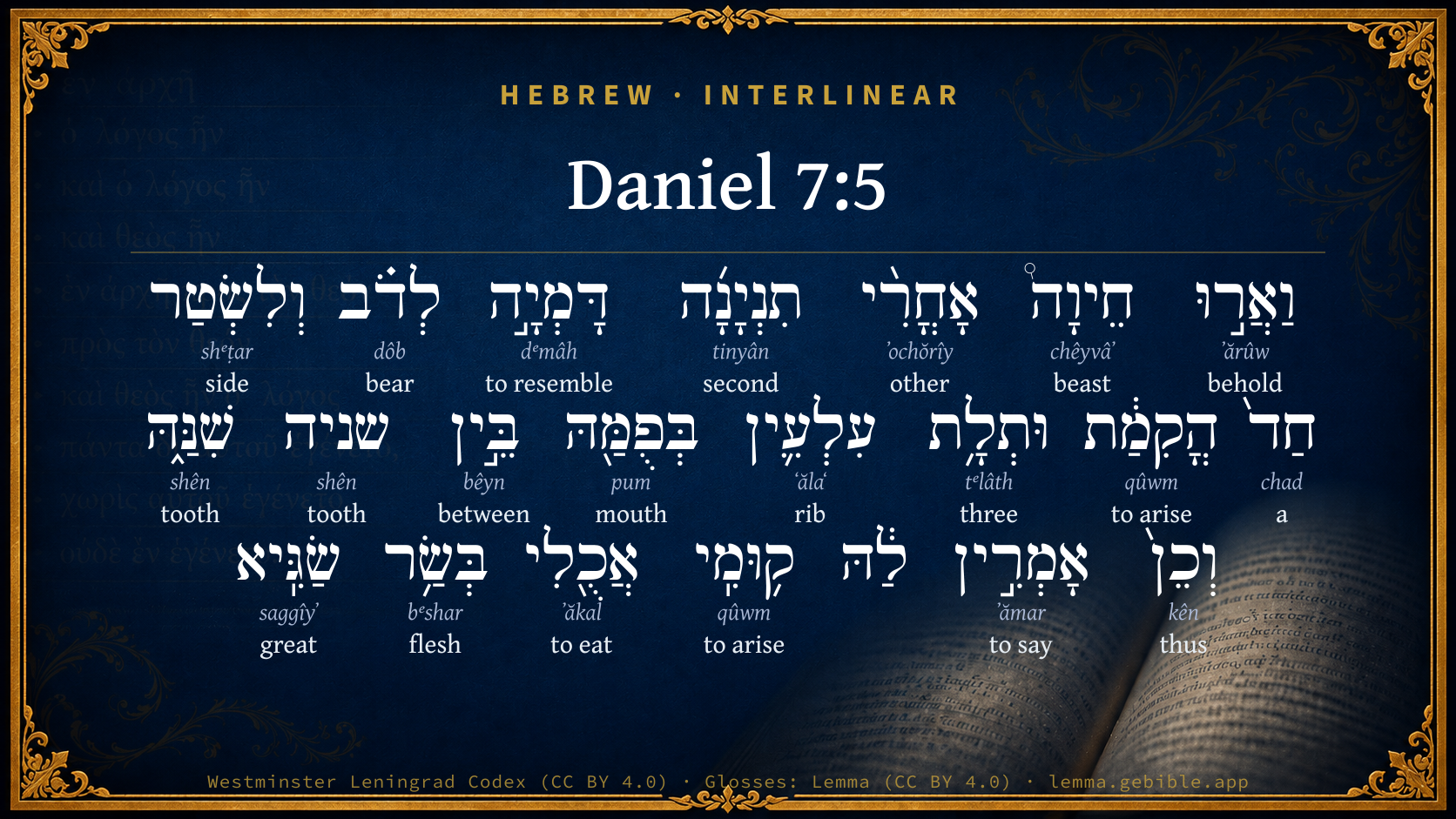
Daniel 7:5

Hebrew (Westminster Leningrad Codex) Daniel 7:5 appears in the Hebrew Old Testament. The text above is from the Westminster Leningrad Codex. Each word links to its Strong’s number, a concise gloss, and parsing drawn from the Open Scriptures Hebrew Bible morphology. Click any word for its full Brown-Driver-Briggs (BDB) entry.
Download image
Cite this verse

Daniel 7:5 (World English Bible). Public Domain. Lemma interlinear Bible study tool, https://lemma.gebible.app/v/daniel/7/5.

Show BibTeX & RIS
BibTeX
RIS
English Translation
Behold, another animal, a second, like a bear; and it was raised up on one side, and three ribs were in its mouth between its teeth: and they said thus to it, Arise, devour much flesh.
World English Bible · Public Domain
Highlights
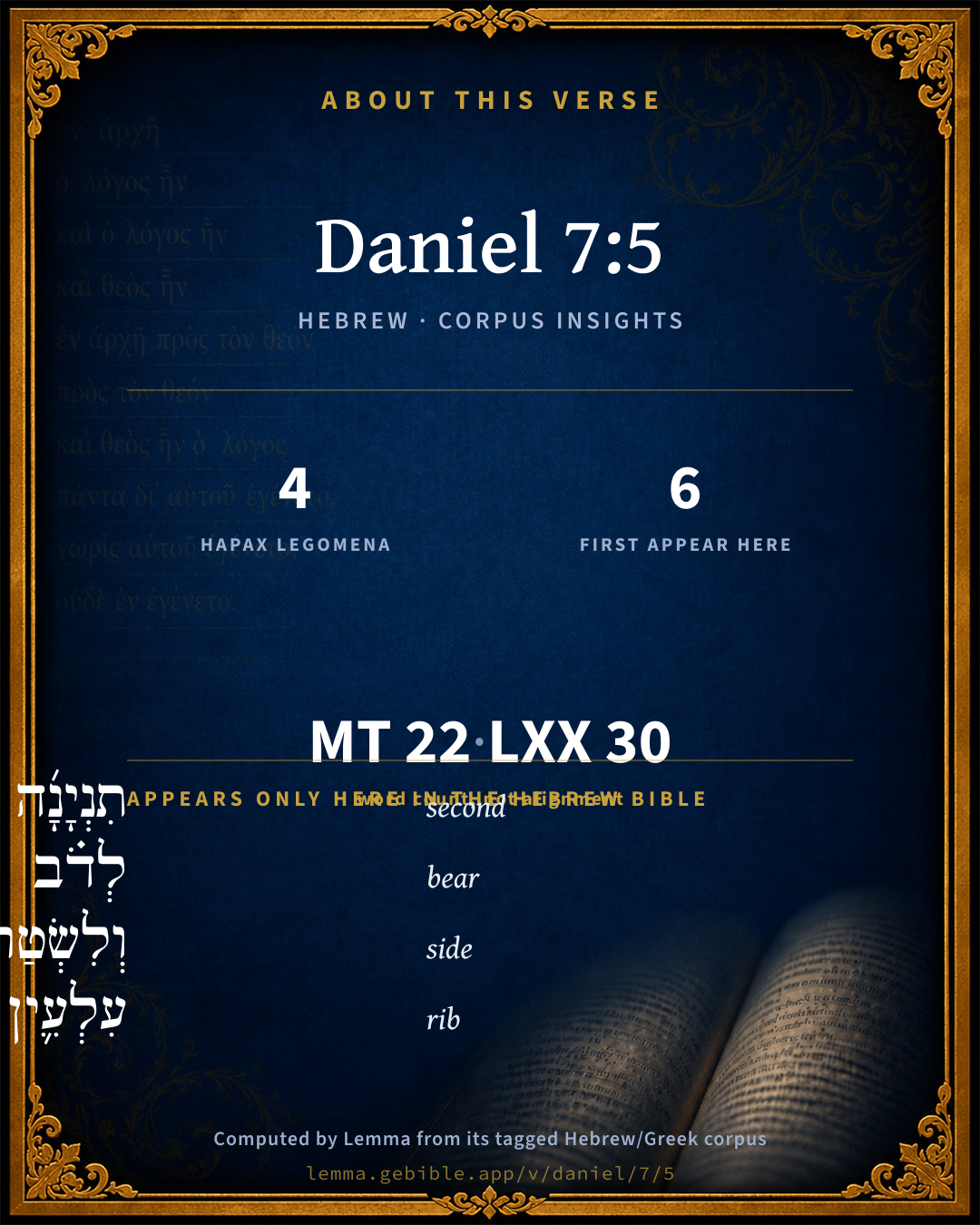
  • 4 hapax legomena — only here in the Hebrew Bible
  • 6 first appearances in the Hebrew Bible
Full analysis ↓
Download a study sheet

One document with this verse’s original text, its word-by-word gloss line, the meaning frame, cross-references with their text, attributed commentary, and full source and license credits — printable, and it pastes into notes with its structure intact.

This verse Autodidact and up

Study sheet (.html) Plain text (.txt)

A passage Seminary Student

Up to 50 verses in one chapter. A passage sheet keeps up to 6 commentary sources and 12 cross-references per verse, in the order this page ranks them, and says so on the sheet whenever that leaves anything out. Ask for a single verse and you get the Autodidact verse sheet above.

Everything on this page stays free to read, with no account — the sheet is a download of what is already on screen, not access to it.

Want to remove ads? Support Godless Engineer
Compare translations 3

The same verse in 3 English versions, stacked beneath the original-language interlinear above. Click any original word for its lexicon entry.

Each is an independent rendering of the whole verse — the interlinear is not word-aligned to these translations.

Highlighted words mark where these versions differ — a whole-verse word diff, not a word-by-word alignment.

  • World English Bible Public Domain
    Behold, another animal, a second, like a bear; and it was raised up on one side, and three ribs were in its mouth between its teeth: and they said thus to it, Arise, devour much flesh.
  • King James Version Public Domain
    And behold another beast, a second, like to a bear, and it raised up itself on one side, and it had three ribs in the mouth of it between the teeth of it: and they said thus unto it, Arise, devour much flesh.
  • unfoldingWord Literal Text CC BY-SA 4.0
    And behold, another beast, a second one, like a bear. It was raised up on one side. Three ribs were in its mouth between its teeth; and thus it was told, ‘Arise, devour much flesh.’

unfoldingWord Literal Text — © unfoldingWord, licensed CC BY-SA 4.0. Word-aligned USFM3 via Door43 (git.door43.org/unfoldingWord/en_ult).

Versions to compare (up to 4)

3 of 4 selected

Show all 18 translations

Every available English version of this verse, each an independent rendering of the whole verse.

  • World English Bible Public Domain
    Behold, another animal, a second, like a bear; and it was raised up on one side, and three ribs were in its mouth between its teeth: and they said thus to it, Arise, devour much flesh.
  • Berean Standard Bible Public Domain
    Suddenly another beast appeared, which looked like a bear. It was raised up on one of its sides, and it had three ribs in its mouth between its teeth. So it was told, ‘Get up and gorge yourself on flesh!’
  • Majority Standard Bible Public Domain
    Suddenly another beast appeared, which looked like a bear. It was raised up on one of its sides, and it had three ribs in its mouth between its teeth. So it was told, ‘Get up and gorge yourself on flesh!’
  • King James Version Public Domain
    And behold another beast, a second, like to a bear, and it raised up itself on one side, and it had three ribs in the mouth of it between the teeth of it: and they said thus unto it, Arise, devour much flesh.
  • American Standard Version (1901) Public Domain
    And, behold, another beast, a second, like to a bear; and it was raised up on one side, and three ribs were in its mouth between its teeth: and they said thus unto it, Arise, devour much flesh.
  • Revised Version (1885) Public Domain
    And behold another beast, a second, like to a bear, and it was raised up on one side, and three ribs were in his mouth between his teeth: and they said thus unto it, Arise, devour much flesh.
  • Geneva Bible (1599) Public Domain
    And beholde, another beast which was the second, was like a beare and stood vpon the one side: and hee had three ribbes in his mouth betweene his teeth, and they saide thus vnto him, Arise and deuoure much flesh.
  • Douay-Rheims (1899) Public Domain
    And behold another beast like a bear stood up on one side: and there were three rows in the mouth thereof, and in the teeth thereof, and thus they said to it: Arise, devour much flesh.
  • Young's Literal Translation Public Domain
    And lo, another beast, a second, like to a bear, and to the same authority it hath been raised, and three ribs `are' in its mouth, between its teeth, and thus they are saying to it, Rise, consume much flesh.
  • Literal Standard Version CC BY-SA 4.0
    And behold, another beast, a second, like to a bear, and to the same authority it has been raised, and three ribs [are] in its mouth, between its teeth, and thus they are saying to it, Rise, consume much flesh.
  • Unlocked Literal Bible CC BY-SA 4.0
    Then there was a second animal, like a bear, and it was bending over; it had three ribs between its teeth in its mouth. It was told, 'Get up and devour many people.'
  • unfoldingWord Literal Text CC BY-SA 4.0
    And behold, another beast, a second one, like a bear. It was raised up on one side. Three ribs were in its mouth between its teeth; and thus it was told, ‘Arise, devour much flesh.’
  • Darby Bible Public Domain
    And behold, another beast, a second, like unto a bear, and it raised up itself on one side; and [it had] three ribs in its mouth between its teeth; and they said thus unto it: Arise, devour much flesh.
  • World Messianic Bible Public Domain
    “Behold, there was another animal, a second, like a bear. It was raised up on one side, and three ribs were in its mouth between its teeth. They said this to it: ‘Arise! Devour much flesh!’
  • Webster's Bible Public Domain
    And behold another beast, a second, like a bear, and it raised itself on one side, and it had three ribs in the mouth of it between the teeth of it: and they said thus to it, Arise, devour much flesh.
  • Free Bible Version CC BY-SA 4.0
    A second beast appeared, looking like a bear, hunched up on one side and holding three ribs in its mouth with its teeth. It was told, “Get up and eat all the flesh you can.”
  • Bible in Basic English Public Domain
    And I saw another beast, like a bear, and it was lifted up on one side, and three side-bones were in its mouth, between its teeth: and they said to it, Up! take much flesh.
  • JPS Tanakh (1917) Public Domain
    And behold another beast, a second, like to a bear, and it raised up itself on one side, and it had three ribs in its mouth between its teeth; and it was said thus unto it: 'Arise, devour much flesh.'

Literal Standard Version (2020), Covenant Press — licensed CC BY-SA 4.0. Text via the HelloAO Bible API (eBible.org). Unlocked Literal Bible (unfoldingWord) — licensed CC BY-SA 4.0. Text via the HelloAO Bible API (eBible.org). unfoldingWord Literal Text — © unfoldingWord, licensed CC BY-SA 4.0. Word-aligned USFM3 via Door43 (git.door43.org/unfoldingWord/en_ult). Free Bible Version, Dr. Jonathan Gallagher — licensed CC BY-SA 4.0. Text via the HelloAO Bible API (eBible.org).

Word by word

More ways to search: Search by grammar → Find every occurrence → Compare this word →

Practice this passage: Drill this verse → Learn its vocabulary →

תִנְיָנָ֜ה
tinyân
H8578
“second”
Adjective, A
Part of Speech
Adjective
Full BDB Definition

Origin: corresponding to H8147

TWOT: 3061a

second
  1. וַאֲר֣וּ ʼărûw H718 “and · behold” Adjective, C + Particle, Demonstrative
  2. חֵיוָה֩ chêyvâʼ H2423 “beast” Adjective, N, Common
  3. אָחֳרִ֨י ʼochŏrîy H317 “other” Adjective, A
  4. דָּמְיָ֣ה dᵉmâh H1821 “resembling” Adjective, V
  5. לְדֹ֗ב dôb H1678 “to/for · bear” Adjective, R + Noun, Common, Masculine, Singular, Absolute
  6. וְלִשְׂטַר shᵉṭar H7859 “and · to/for · side” Adjective, C + Preposition + Noun, Common, Masculine, Singular, Absolute
  7. חַד֙ chad H2298 “a” Adjective, A, Common
  8. הֳקִמַ֔ת qûwm H6966 “to arise” Adjective, V, Plural
  9. וּתְלָ֥ת tᵉlâth H8532 “and · three” Adjective, C + Adjective, Cardinal number, Both, Singular, Absolute
  10. עִלְעִ֛ין ʻălaʻ H5967 “ribs” Adjective, N, Common
  11. בְּפֻמַּ֖הּ pum H6433 “in/at · mouth · her” Adjective, R + Noun, Common, Masculine, Singular, Construct + Suffix, Personal, 3rd Person, Feminine, Singular
  12. בֵּ֣ין bêyn H997 “between” Adjective, R
  13. שניה shên H8128 “teeth · the” Adjective, N, Common + Particle, Definite Article
  14. שִׁנַּ֑הּ shên H8128 “tooth · her” Adjective, N, Common + Suffix, Personal, 3rd Person, Feminine, Singular
  15. וְכֵן֙ kên H3652 “and · thus” Adjective, C + Adverb
  16. אָמְרִ֣ין ʼămar H560 “saying” Adjective, V
  17. ק֥וּמִֽי qûwm H6966 “arise” Adjective, V
  18. אֲכֻ֖לִי ʼăkal H399 “eat” Adjective, V
  19. בְּשַׂ֥ר bᵉshar H1321 “flesh” Adjective, N, Common
  20. שַׂגִּֽיא saggîyʼ H7690 “great” Adjective, A

About this verse

These counts appear in no published source. They are computed here, from the morphology-tagged text and Lemma’s own curated glosses. What Lemma adds →

22
words
19
distinct lemmas
Prophets
section

Notable vocabulary

4 hapax legomena — words that appear only here in the entire Hebrew Bible:

  • תִנְיָנָ֜ה second H8578
  • לְדֹ֗ב bear H1678
  • וְלִשְׂטַר side H7859
  • עִלְעִ֛ין rib H5967

First appearance in Scripture

These words make their first canonical appearance in the Hebrew Bible here:

  • תִנְיָנָ֜ה second H8578
  • לְדֹ֗ב bear H1678
  • וְלִשְׂטַר side H7859
  • עִלְעִ֛ין rib H5967
  • בֵּ֣ין between H997
  • שניה tooth H8128

Shared distinctive vocabulary

דָּמְיָ֣ה to resemble H1821 occurs in 2 verses of the Hebrew Bible. Also found in:

Grammatical profile

  • 3 nouns
  • 16 adjectives
  • 1 adverb
  • 2 particles

Repetition

Words recur within this verse — often emphatic in Hebrew:

  • הֳקִמַ֔ת to arise H6966 ×2
  • שניה tooth H8128 ×2

Hebrew & Septuagint length

In English translation the verse runs 36 words from the Hebrew and 36 from the Septuagint (LXX English) — the same length.

A rough comparison of the two English renderings, which tokenize alike — not a word-level alignment.

Word counts can differ between the Hebrew and the Greek without any difference in meaning — e.g. the Hebrew direct-object marker אֵת has no separate Greek word, and Greek often adds the article ὁ.

In the original languages it is 22 Hebrew tokens and 30 Greek tokens — but the two are counted differently (Hebrew bundles its prefixes and suffixes into one token; the Greek is in lemma form), so that isn’t a like-for-like length.

Cross-references

11

Topical passages linked to Daniel 7:5 in the Treasury of Scripture Knowledge — connected by theme and wording, ordered by reader-vote popularity; previews shown in the World English Bible.

  • Daniel 2:39 After you shall arise another kingdom inferior to you; and another third kingdom of brass, which shall bear rule over all the earth.
  • 2 Kings 2:24 He looked behind him and saw them, and cursed them in the name of Yahweh. There came forth two she-bears out of the wood, and mauled forty-two lads of them.
  • Proverbs 17:12 Let a bear robbed of her cubs meet a man, Rather than a fool in his folly.
  • Isaiah 13:17–18 Behold, I will stir up the Medes against them, who shall not regard silver, and as for gold, they shall not delight in it.
  • Isaiah 56:9 All you animals of the field, come to devour, [yes], all you animals in the forest.
  • Jeremiah 50:21–32 Go up against the land of Merathaim, even against it, and against the inhabitants of Pekod: kill and utterly destroy after them, says Yahweh, and do according to all that I have commanded you.
  • Hosea 13:8 I will meet them like a bear that is bereaved of her cubs, And will tear the covering of their heart. And there I will devour them like a lioness. The wild animal will tear them.
  • Ezekiel 39:17–20 You, son of man, thus says the Lord Yahweh: Speak to the birds of every sort, and to every animal of the field, Assemble yourselves, and come; gather yourselves on every side to my sacrifice that I do sacrifice for you, even a great sacrifice on the mountains of Israel, that you may eat flesh and drink blood.
  • Daniel 5:28 PERES; your kingdom is divided, and given to the Medes and Persians.
  • Daniel 8:3–4 Then I lifted up my eyes, and saw, and, behold, there stood before the river a ram which had two horns: and the two horns were high; but one was higher than the other, and the higher came up last.
  • Daniel 11:2 Now will I show you the truth. Behold, there shall stand up yet three kings in Persia; and the fourth shall be far richer than they all: and when he has grown strong through his riches, he shall stir up all against the realm of Greece.

Cross-references courtesy of OpenBible.info (CC BY 4.0).

Hebrew and Greek witnesses Masoretic Hebrew ↔ Greek Septuagint

The same verse in the two great witnesses to the Old Testament, shown verse-for-verse.

These are two independent witnesses, not word-aligned to each other, and the Septuagint is shown in lemma (dictionary) form.

Hebrew Daniel 7:5 Masoretic · Westminster Leningrad Codex

וַאֲר֣וּ חֵיוָה֩ אָחֳרִ֨י תִנְיָנָ֜ה דָּמְיָ֣ה לְדֹ֗ב וְלִשְׂטַר חַד֙ הֳקִמַ֔ת וּתְלָ֥ת עִלְעִ֛ין בְּפֻמַּ֖הּ בֵּ֣ין שניה שִׁנַּ֑הּ וְכֵן֙ אָמְרִ֣ין לַ֔הּ ק֥וּמִֽי אֲכֻ֖לִי בְּשַׂ֥ר שַׂגִּֽיא

Behold, another animal, a second, like a bear; and it was raised up on one side, and three ribs were in its mouth between its teeth: and they said thus to it, Arise, devour much flesh.

World English Bible · Public Domain

Greek LXX Daniel 7:5 Septuagint · lemma form

καί ἰδού μετά αὐτός ἄλλος θηρίον ὁμοίωσις ἔχω ἄρκος καί ἐπί ὁ εἷς πλευρόν ἵστημι καί τρεῖς πλευρόν εἰμί ἐν ὁ στόμα αὐτός καί οὕτως εἶπον ἀναἵστημι καταἐσθίω σάρξ πολύς

And, behold, a second beast like a bear, and it supported itself on one side, and there were three ribs in its mouth, between its teeth: and thus they said to it, Arise, devour much flesh.

LXX2012 (modern English Septuagint) · Public Domain

On this verse, The Pulpit Commentary discusses the Septuagint’s reading. Read the note in Commentary ↓

Hebrew: Westminster Leningrad Codex (CC BY 4.0). Greek: Septuagint (public domain); English from LXX2012 (modern English Septuagint) (Public Domain). How the Septuagint differs from the Hebrew →

Commentary

Notes on Daniel 7:5 from classic Christian and Jewish commentators (each source and its license shown beneath its notes). The classic Christian expositions comment on the surrounding passage and are grouped to its opening verse, so a note may address several verses; the Jewish commentaries on the Tanakh (Rashi and others) are per-verse, so they appear only where the commentator wrote on this verse.

Lemma curates 59 commentaries, every one of them public domain or Creative Commons licensed, each selected and text-cleaned for this edition rather than reprinted as found. About our sources →

Trapp's Complete Commentary

John Trapp

Dan 7:5 And behold another beast, a second, like to a bear, and it raised up itself on one side, and [it had] three ribs in the mouth of it between the teeth of it: and they said thus unto it, Arise, devour much flesh.

Ver. 5. And behold another beast, a second, like to a bear.] Which is nothing so generous and ingenuous as a lion; but slow, dull, cruel, ravenous. Such were the Persians; a mountainous, rough, uncivil people, of barbarous and beastly cruelty.

And it raised up itself on one side,] scil., By joining with the Medes, by whose help Cyrus subdued the Syrians, Assyrians, Arabians, Cappadocians, and many more nations act easily reckoned, who, to gratify him, desired to be ruled according to his pleasure. {a}

And it had three ribs in the mouth of it.] While they conquered three parts of the known world, pushing westward, northward, and southward. {Dan 8:4} Westward by Cyrus, southward by Cambyses, and northward by Darius Hystaspis.

And they said (or, it was said) thus unto it, Arise, devour.] Intimating that it was God who turned this bear loose upon the nations, and gave them to him for a prey. Tyrants prosper by God’s permission. {Joh 19:11}

{a} Xenoph.

John Trapp, A Commentary or Exposition upon All the Books of the Old and New Testament (1647–1656) — public domain. Text from a community e-Sword module.

Joseph Benson's Commentary

Dan 7:5. And behold another beast like a bear — This is the kingdom of the Medes and Persians, who, for their cruelty and greediness after blood, are compared to a bear, which is a most voracious and cruel animal. Bochart recounts several particulars wherein the Persians resembled bears; but the chief likeness consisted in what has been just mentioned, and this likeness was principally intended by the prophet, as may be inferred from the words of the text, Arise, devour much flesh. A bear, saith Aristotle, is an all-devouring animal; and so the Medo-Persians were great robbers and spoilers, according to Jer 51:48; Jer 51:56 : see Bishop Newton and the note on Isa 13:18. And it raised up itself on one side — Some think the allusion is to the eastern quarter of the world, from whence the Persians came; others, to the elevation of the Persians above the Medes and Babylonians, which three powers are conceived to be meant by the three ribs in the mouth of the bear: but Sir Isaac Newton and Bishop Chandler, with great propriety, explain them as signifying the kingdoms of Babylon, Lydia, and Egypt, which were conquered by it, but were not properly parts and members of its body. They might be called ribs, as the conquest of them much strengthened the Persian empire; and they might be said to be between the teeth of the bear, as they were much grinded and oppressed by the Persians.

Joseph Benson's Commentary on the Old and New Testaments (1811–1818) — public domain. Text from a community e-Sword module.

Tyndale Open Study Notes

Tyndale Open Resources

7:5 The second beast probably represents Persia (2:34-40; 6:9, 12, 15; 8:20). • The bear was known for its vicious attacks (Prov 28:15). Three ribs may refer to Babylon, Media, and Lydia, all of which Cyrus conquered. • many people: God called Cyrus and Persia to conquer many nations (Isa 41:2-3; 44:28; 45:1, 13; 46:11).

Tyndale Open Study Notes — © Tyndale Open Resources, licensed CC BY-SA 4.0. Text via the HelloAO Bible API.

Geneva Bible (1599)

Geneva Bible translators

To wit, the Angels by God’s commandment, who by this means punished the ingratitude of the world.

They were small in the beginning and were shut up in the mountains and had no bruit.

Meaning, the Persians which were barbarous and cruel.

That is, destroyed many kingdoms, and was insatiable.

Geneva Bible (1599) marginal notes — public domain. Text via Bolls.life.

Jamieson, Fausset & Brown

Robert Jamieson, A. R. Fausset & David Brown

bear--symbolizing the austere life of the Persians in their mountains, also their cruelty (Isa 13:17-18; Cambyses, Ochus, and other of the Persian princes were notoriously cruel; the Persian laws involved, for one man's offense, the whole kindred and neighborhood in destruction, Dan 6:24) and rapacity. "A bear is an all-devouring animal" [ARISTOTLE, 8.5], (Jer 51:48, Jer 51:56).

raised . . . itself on one side--but the Hebrew, "It raised up one dominion." The Medes, an ancient people, and the Persians, a modern tribe, formed one united sovereignty in contrast to the third and fourth kingdoms, each originally one, afterwards divided. English Version is the result of a slight change of a Hebrew letter. The idea then would be, "It lay on one of its fore feet, and stood on the other"; a figure still to be seen on one of the stones of Babylon [MUNTER, The Religion of Babylonia, 112]; denoting a kingdom that had been at rest, but is now rousing itself for conquest. Media is the lower side, passiveness; Persia, the upper, active element [AUBERLEN]. The three ribs in its mouth are Media, Lydia, and Babylon, brought under the Persian sway. Rather, Babylon, Lydia, and Egypt, not properly parts of its body, but seized by Medo-Persia [SIR ISAAC NEWTON]. Called "ribs" because they strengthened the Medo-Persian empire. "Between its teeth," as being much grinded by it.

devour much flesh--that is, subjugate many nations.

Jamieson, Fausset & Brown — Commentary Critical and Explanatory on the Whole Bible (1871) — public domain (CC PDM 1.0). Text via the HelloAO Bible API.

Adam Clarke's Commentary

Verse 5. Another beast-like to a bear] This was the Medo-Persian empire, represented here under the symbol of the bear, as the largest species of these animals was found in Media, a mountainous, cold, and rough country, covered with woods. The Medes and Persians are compared to a bear on account of their cruelty and thirst after blood, a bear being a most voracious and cruel animal; the bear is termed by Aristotle an all-devouring animal; and the Medo-Persians are known to have been great robbers and spoilers. See Jer 51:48-56. The Persians were notorious for the cruelty of their punishments. See Calmet.

Raised up itself on one side] Cyrus arose on the borders of Chaldea, and thus the bear appeared to put itself in the position to attack the lion.

It had three ribs in the mouth of it] As if it had just finished its repast on some animal that it had seized. Some think three tusks, curved like ribs, are meant; others three throats, עלעין illin, by which it (Cyrus) had absorbed the three empires of the Babylonians, Medes, and Persians; for these symbolic animals do not so much denote four empires, as four kings. See Da 7:17. Others think three row of teeth are meant to denote the triple power of the Medes, Persians, and Babylonians, conjoined. Or the east, north, and south, which were subdued by the Persians. But the ribs being between the teeth of the bear may show how Babylon, Lydia, and Egypt were ground and oppressed by the bear-the Persians; though, as ribs strengthen the body, they were a powerful support to their conquerors.

Adam Clarke's Commentary on the Bible (1810–1826) — public domain. Text from a community e-Sword/MySword module.

John Calvin's Commentaries

Here the Prophet proclaims how he was instructed by a dream concerning the second beast. If we will only judge by the event, this beast doubtless represented the kingdom of the Medes and Persians, although the Prophet specifies the Persians, as the Medes had long ago submitted to their yoke. Behold, says he, another beast like a bear. We know a bear to be a mean and foul animal, slothful and inert, as well as cruel. In comparing the bear with the lion, its appearance is foul and displeasing, while the lion is remarkable for beauty, although it is formidable. He compares the Persians to a bear, on account of their barbarity, since we have already pronounced that nation fierce and savage. Then, again, the Persians were not civilized like the Assyrians and Chaldeans, who dwelt in the most beautiful region in the whole world, and in a most lovely country like a most noble theater; but the Persians lay hid like wild beasts in their caves. They dwelt among their mountains, and lived like the brutes. Hence the Prophet compares them very appositely to a bear; nay, God showed this form to his Prophet. He afterwards adds, It stood on one side Some think this to have been added to express the more contracted dominion of the Medes and Persians, but this opinion is unsuitable. We know how extensive was the sway of the Medes before they came under the power of Cyrus and the Persians. By themselves the Medes were most powerful; then the Persians were added, and afterwards Cyrus seized upon the possessions of the Chaldean monarchy. He possessed even the keys of Egypt, reigned in Syria, held Judea, and extended beyond the sea, till at length he was conquered by the Scythians. When, therefore, it is said, he stood on one side, the obscure origin of his kingdom is intended, for the fame of the Persians was included within their mountains until Cyrus acquired for them a name by his exploits. For he was a brave warrior, and deservedly eclipsed the glory of all others. Hence, at first this beast stood on one side; that is, the Persians were without fame or reputation; they had no wealth, and never emerged from their lurking-places. We see how this particular is restricted to their origin in consequence of its obscurity.

The Prophet then adds: Three ribs were in the beast’s mouth between its teeth; and it was thus proclaimed, Arise, eat much flesh! Those who understand three definite kingdoms by the three ribs, seem to refine far too minutely. I think the number indefinite, because this beast had bitten by its mouth not one rib but more; because the Persians, as we have said, drew to themselves the power of the Medes, and afterwards subdued the Assyrians and Chaldeans, and Cyrus also subdued many nations, until all Asia Minor acknowledged his authority. When, therefore, the Prophet speaks of three ribs, it implies the insatiable nature of this beast, since it was not content with a single body, but devoured many men together. For, by “many ribs,” he meant much prey. This is the whole sense. I do not hesitate to explain the following words, it was said to the beast, of angels, or of God himself. Some prefer to understand this of the stimulus by which Cyrus was instigated to cruelty. But since God exhibits to his Prophet the image of his Providence, what I have lately suggested becomes very probable: namely, it was said to the beast, Arise, eat much flesh; not; because God was the author of cruelty, but since He governs by His secret counsel the events which men carry on without method, His authority is here deservedly placed be/ore our eyes; for Cyrus would not have penetrated so swiftly into different regions, and have drawn to himself so many empires, and subjugated so many powerful nations, had not God wished to punish the world, and had made Cyrus the instrument of slaughter. As therefore Cyrus executed God’s vengeance by shedding so much human blood, the Prophet declares it to have been said to him, Arise, and eat flesh. In one respect God was not pleased by the slaughter of so many nations by Cyrus, and by the increase of one man’s power and tyranny through so much human bloodshed; but in another respect God is said to have commanded the conduct of Cyrus, since he wished to punish the world for its ingratitude, to which the most desperate obstinacy and rebellion were added. There was no remedy for these vices; hence God entrusted Cyrus with the duty of executing His judgment,. I am compelled to stop here.

John Calvin's Commentaries (1540-1563) — public domain. Text from the Calvin Translation Society English edition (1840s-50s) via the Christian Classics Ethereal Library (ccel.org). Calvin's coverage is partial (roughly two-thirds of the Bible); uncommented books and verses are honest gaps, never fabricated. The 19th-century editor's footnotes and remarks are omitted so the notes are faithfully Calvin's own voice.

Ellicott's Commentary for English Readers

(5) And behold another beast.—We are not told what became of the first beast. (Comp. Dan_7:12.) The word “behold” implies that this was the next object which arrested the seer’s attention. The second beast corresponds to the silver portion of the Colossus (Daniel 2).

One side.—In explaining this very difficult phrase, it must be remembered that the two sides of the bear are parallel in meaning to the two breasts and two arms of the Colossus. It is implied, therefore, that the second kingdom consists of two parts, and the raising up of one side implies that one part of the kingdom would come into greater prominence than the other. Such was the case with the Medo-Persian Empire (comp. Dan_8:3), in which the Persian element surpassed the Median.

Three ribs.—These cannot signify the people who constitute the second empire, but rather some kingdoms which had already been subdued by it; and by the command, “Arise and devour,” the second empire is permitted to make further conquests before its disappearance. The three ribs have been understood from the time of St. Hippolytus to mean three nations: the Babylonians, the Lydians, and the Egyptians.

A Bible Commentary for English Readers, edited by Charles John Ellicott (1878–1897) — public domain. Text from a community e-Sword module.

The Cambridge Bible for Schools and Colleges

gen. ed. J. J. S. Perowne

5. The second beast.

like to a bear] The bear is a voracious[268] animal, living indeed principally upon roots, bulbs, fruits, and other vegetable products, but, especially when pressed by hunger, ready to attack both the smaller wild and domestic animals, and even man[269]. In the O.T. it is spoken of as being, next to the lion, the most formidable beast of prey known in Palestine (1Sa_17:34; Amo_5:19; cf. 2Ki_2:24; Hos_13:8); at the same time it is inferior to the lion in strength and appearance, and is heavy and ungainly in its movements. The kingdom denoted by it corresponds to the ‘silver’ kingdom of Dan_2:32, which was ‘inferior’ (Dan_2:39) to that of Nebuchadnezzar, i.e. the empire of the Medes; as was pointed out on Dan_2:39, the book of Daniel represents the Chaldæan empire as succeeded not immediately by Cyrus, but by a Median ruler, Darius.

[268] Arist. H. N. viii. 5 παμφάγον (with reference, as the explanation following shews, to its eating fruits, roots, &c., as well as flesh).

[269] See many illustrations from different authorities collected by Bochart, Hieroz. iii. ix. (ii. 138 ff., ed. Leipz. 1794).

it had raised up one side] This is the Massoretic reading; R.V. it was raised up on one side, follows a reading (implying a change of only one point) found in some MSS. and editions, but possessing less authority. The two readings do not however differ materially in meaning; though what either is intended to denote cannot be said to be altogether clear. Perhaps, on the whole, the most probable view is that the trait is intended to indicate the animal’s aggressiveness: it is pictured as raising one of its shoulders, so as to be ready to use its paw on that side. (The rendering of A.V. and R.V. marg., ‘raised up one dominion,’ implies shetar for setar; and is not probable.)

and it had three ribs, &c.] as the prey which it had seized. Those who regard the bear as symbolizing the Medo-Persian empire generally suppose the three ribs to denote Lydia, Babylonia, and Egypt, three prominent countries conquered, the first two by Cyrus, and the third by Cambyses; but it is quite possible that the ribs in the creature’s mouth are meant simply as an indication of its voracity, and are not intended as an allusion to three particular countries absorbed by the empire which it represents.

and they said] or, and it was said: see on Dan_4:25.

Arise, devour much flesh] as its nature would prompt it to do. The Medes are the people whom the Heb. prophets of the exile represent as summoned to destroy Babylon (Isa_13:17; Isa_21:2; Jer_51:11; Jer_51:28); and Isa_13:17-18 gives a graphic picture of the insolence and cruelty of their attack.

The Cambridge Bible for Schools and Colleges (gen. ed. J. J. S. Perowne; Cambridge University Press, 1878–1918) — public domain. Text from a community e-Sword module.

John Gill's Exposition

And, behold, another beast, a second, like to a bear,.... Another monarchy, and which succeeded the former, and rose up upon the ruins of it, the Medo-Persian monarchy; and so the Syriac version prefixes to this verse, by way of explanation,

"the kingdom of the Medes''

like to a bear, less generous and strong than the lion; more rough and uncivil, but equally cruel and voracious; which describes the Medes and Persians as a fierce and cruel people, and less polished, and more uncivilized, than the Chaldeans; and answers to the silver breasts and arms in Nebuchadnezzar's dream; see Isa 13:17,

and it raised up itself on one side; either of the lion, the first beast it destroyed; or rather on one side of itself, on the side of Persia; from whence Cyrus came, who was the principal instrument of raising this empire to the pitch it was brought unto. Some render it, "and it raised up one government" (d); one empire out of many nations and kingdoms it subdued:

and it had three ribs in the mouth of it, between the teeth of it; that is, three ribs covered with flesh, which, it was devouring; the bear being very voracious, and a great flesh eater: these, according to some, signify three kings that followed Darius the Mede; Cyrus, Ahasuerus, and Darius; so Jarchi and Jacchiades; and, according to Jerom, three kingdoms, the Babylonian, Median, and Persian: but neither of these kings nor kingdoms can be said to be in its mouth, and between its teeth, as ground and devoured by it, unless the Babylonian; wherefore it is better interpreted by others, as Theodoret, the three parts of the world it conquered, westward, northward, and southward, Dan 8:4, though it is best of all, with Sir Isaac Newton and Bishop Chandler, to understand by them Babylon, Lydia, and Egypt; which countries were ground and oppressed by the Medes and Persians, as the ribs of any creature are ground in the mouth of a bear:

and they said thus unto it, arise, devour much flesh; which Jerom refers to Haman's orders to destroy the Jews in the times of Ahasuerus; but it is much better applied by others to Cyaxares or Darius sending for Cyrus to take upon him the command of his army; and to the Hyrcanians, Gobryas, and others, inviting him to avenge them on the Babylonians, promising to join and assist him, as Xenophon (e) relates: or rather this is to be interpreted of the divine will, and of the conduct of Providence by means of angels stirring up the spirit of Cyrus, and of the Medes and Persians, to attack and subdue many nations, and particularly the Babylonians, and fill themselves with their wealth and substance; hence they are styled the Lord's sanctified, whom he ordered and called to such service; see Isa 13:3.

(d) "quae dominatum unum erexit", Junius & Tremellius, Polanus; "et dominatum quendana erexit", Piscator. (e) Cyropaedia l. 1. c. 22. l. 4. c. 4, 24.

John Gill's Exposition of the Whole Bible (1746–1763) — public domain (CC PDM 1.0). Text via the HelloAO Bible API.

Albert Barnes' Notes on the Bible

And, behold, another beast, a second, like to a bear - That is, after the lion had appeared, and he had watched it until it had undergone these surprising transformations. There are several circumstances, also, in regard to this symbol, all of which, it is to be supposed, were significant, and all of which demand explication before it is attempted to apply them.

(a) The animal seen: the bear. For a full description of the bear, see Bochart, Hieroz. lib. iii. c. 9: The animal is well known, and has properties quite distinct from the lion and other animals. There was doubtless some reason why this symbol was employed to denote a particular kingdom, and there was something in the kingdom that corresponded with these peculiar properties, as there was in the case of the lion. The bear might, in some respects, have been a proper representative of Babylon, but it would not in all nor in the main respects. According to Bochart (Hiefoz, vol. i. p. 812), the bear is distinguished mainly for two things, cunning and ferocity. Aristotle says that the bear is greedy as well as silly and foolhardy. (Wemyss, Key to the Symbolic Language of Scripture.) The name in Hebrew is taken from his grumbling or growling. Compare Isa 19:11 :

“We roar all like bears.”

Compare Horace, Epod. 16, 51:

“Nec vespertinus circumgemit ursus ovile.”

Virgil mentions their ferocity:

“Atque in praesepibus ursi Saevire.”

- AEn. vii. 17.

The bear is noted as especially fierce when hungry, or when robbed of its whelps. Jerome (on Hos 13:8) remarks, “It is said by those who have studied the nature of wild beasts, that none among them is more ferocious than the bear when deprived of its young, or when hungry.” Compare 2Sa 17:8; Pro 17:12; Hos 13:8. The characteristics of the kingdom, therefore, that would be denoted by the bear would be ferocity, roughness, fierceness in war, especially when provoked; a spirit less manly and noble than that denoted by the lion; severe in its treatment of enemies, with a mixture of fierce and savage cunning.

(b) Its rising up on one of its sides: “and it raised up itself on one side.” The Chaldee word used here (שׁטר sheṭar) occurs nowhere else. It means side (Gesenius), and would be applied here to the side of an animal, as if he lifted up one side before the other when he rose. The Latin Vulgate renders it, in parte stetit. The Greek (Walton), έις μέρος ἕν ἐστάθη eis meros hen estathē - “it stood on one part;” or, as Thompson renders it, “he stood half erect.” The Codex Chisianus, ἐπὶ τοῦ ἑνὸς πλευροῦ ἐστάθη epi tou henos pleurou estathē - “it stood upon one side.” Maurer renders this, “on one of its forefeet it was recumbent, and stood on the other,” and says that this is the figure exhibited on one of the stones found in Babylon, an engraving of which may be seen in Munter, Religion d. Babyl. p. 112. The animal referred to here, as found in Babylon, says Lengerke, “lies kneeling on the right forefoot, and is in the act of rising on the left foot.” Bertholdt and Havernick understand this as meaning that the animal stood on the hindfeet, with the forepart raised, as the bear is said to do; but probably the true position is that referred to by Maurer and Lengerke, that the animal was in the act of raising itself up from a recumbent posture, and rested on one of its forefeet while the other was reached out, and the body on that side was partially raised. This position would naturally denote a kingdom that had been quiet and at rest, but that was now rousing itself deliberately for some purpose, as of conquest or war - as the bear that had been couching down would rise when hungry, or when going forth for prey.

(c) The ribs in its mouth: “and it had three ribs in the mouth of it between the teeth of it.” Bertholdt understands this of fangs or tusks - or fangs crooked or bent like ribs, p. 451, But the proper meaning of the Chaldee עלע ‛ala‛ is the same as the Hebrew צלע tsēlâ‛ - “a rib.” - Gesenius. The Latin Vulgate is, tres ordines - three rows; the Syriac and the Greek, three ribs. This would be sufficiently characteristic of a bear, and the attitude of the animal here seems to be that it had killed some other animal, and had, in devouring it, torn out three ribs from its side, and now held them in its mouth. It was slowly rising from a recumbent posture, with these ribs in its mouth, and about to receive a command to go forth and devour much flesh. The number three, in this place, Lengerke supposes to be a round number, without any special significancy; others suppose that it denotes the number of nations or kingdoms which the people here represented by the bear had overcome. Perhaps this latter would be the more obvious idea as suggested by the symbol, but it is not necessary, in order to a proper understanding of a symbol, to press such a point too closely. The natural idea which would be suggested by this part of the symbol would be that of a kingdom or people of a fierce and rough character having already subdued some, and then, after reposing, rising up with the trophies of its former conquests to go forth to new victories, or to overcome others. The symbol would be a very striking one to represent a conquering nation in such a posture.

(d) The command given to this beast: “and they said thus unto it, Arise, devour much flesh.” That is, it was said to it; or some one having authority said it. A voice was heard commanding it to go forth and devour. This command is wholly in accordance with the nature of the bear. The bear is called by Aristotle σαρκοφαγῶν sarkofagōn, flesh-eater, and ξῶον πάμφαγον xōon pamphagon, a beast devouring everything (Hist. Nat. viii. 5), and no better description could be given of it. As a symbol, this would properly be applicable to a nation about receiving, as it were, a command from God to go forth to wider conquests than it had already made; to arouse itself from its repose and to achieve new triumphs.

The application of this symbol was not explained by the angel to Daniel; but if the former pertained to Babylon, there can be little difficulty in understanding to what this is to be applied. It is evidently to what succeeded the Babylonian - the Medo-Persian, the kingdom ruled successively by Cyrus, Cambyses, Smerdis, Darius, Xerxes, Artaxerxes, and Darius Nothus, until it was overthrown by Alexander the Great. The only inquiry now is as to the pertinency of the symbol here employed to represent this kingdom.

(a) The symbol of the bear. As already seen, the bear would denote any fierce, rough, overbearing, and arbitrary kingdom, and it is clear that while it might have applicability to any such kingdom, it would better represent that of Medo-Persia than the lion would, for while, in some respects, either symbol would be applicable to either nation, the Medo-Persian did not stand so decidedly at the head of nations as the Babylonian. As to its character, however, the bear was not an inappropriate symbol. Taking the whole nation together, it was fierce and rough, and unpolished, little disposed to friendliness with the nations, and dissatisfied while any around it had peace or prosperity. In the image seen in Dan. ii., this kingdom, denoted by the breast and arms of silver Dan. 7:32, is described in the explanation Dan. 7:39 as “inferior to thee;” that is, to Nebuchadnezzar. For a sufficiently full account of this kingdom - of the mad projects of Cambyses, and his savage rage against the Ethiopians - well represented by the ferocity of the bear; of the ill-starred expedition to Greece under Xerxes - an expedition in its fierceness and folly well represented by the bear, and of the degeneracy of the national character after Xerxes - well represented by the bear as compared with the lion, see the notes at Dan 2:39. No one acquainted with the history of that nation can doubt the propriety and applicability of the emblem.

(b) The rising up on its side, or from a recumbent posture, as if it had been in a state of repose, and was now arousing itself for action. Different interpretations have been adopted of this emblem as applicable to the Medo-Persians. The ancient Hebrew interpreters, as Jerome remarks, explain it as meaning that that kingdom was “on one side” in the sense of separate; that is, that this kingdom kept itself aloof from Judea, or did not inflict injury on it. Thus also Grotius explains it as meaning that it did not injure Judea - Judea nihil nocuit.” Ephraern the Syrian, and Theodoret, explain it as meaning that the empire of the Medo-Persians was situated on the side of Judea, or held itself within its proper bounds, in the sense that it never extended its dominion, like Babylon, over the whole earth. Rosenmuller explains it as meaning that in relation to the kingdom represented by the lion, it was at its side, both occupying the regions of the East. John D. Michaelis understands it as denoting that, as the bear was raising itself up, one part being more raised than the other, the Medo-Persian empire was composed of two kingdoms, one of which was more exalted or advanced than the other.

Compare Lengerke. The true meaning however, is that, as seen by Daniel, the nation that had been in a state of repose was now preparing itself for new conquests - a state descriptive of, and in every way quite applicable to the condition of the Medo-Persian empire, after the conquests by Cyrus, as he overran the kingdom of Lydia, etc., then reposing, and now about arousing to the conquest and subjugation of Babylon. The precise time, therefore, indicated would be about 544 b.c. (Calmer), when, having overcome the Medes, and having secured the conquest of Lydia, and the dethronement of Croesus, he is meditating the destruction of Babylon. This interval of repose lasted about a year, and it is at this time that the united empire is seen, under the image of the bear rising on its side, arousing itself to go forth to new conquests.

(c) The ribs in the mouth of the beast. This, as above remarked, would properly refer to some previous conquest - as a bear appearing in that manner would indicate that some other animal had been overcome and slain by him, and torn in pieces. The emblem would be fulfilled if the power here symbolized had been successful in former wars, and had rent kingdoms or people asunder. That this description would apply to the Medo-Persian power before its attack on Babylon, or before extending its dominion over Babylon, and its establishment as the Medo-Persian kingdoms, no one can doubt. Compare the notes at Dan 2:39. It has been commonly supposed that Cyrus succeeded to the throne of Media without war. But this is far from being the case - though so represented in what may be regarded as the romance of the Cyropaedia In the Anabasis of Xenophon, however, the fact of his having subdued Media by arms is distinctly admitted, Dan 3:4, Dan 3:7, Dan 3:12. Herodotus, Ctesias, Isocrates, and Strabo, all agree also in the fact that it was so. The Upper Tigris was the seat of one campaign, where the cities of Larissa and Mespila were taken by Cyrus. From Strabo we learn that the decisive battle was fought on the spot where Cyrus afterward built Pasargardae, in Persia, for his capital. See Kitto, Cyclo., art. “Cyrus.” In addition to this, we are to remember the well-known conquests of Cyrus in Lydia and elsewhere, and the propriety of the emblem will be apparent. It may not be certain that the number three is significant in the emblem, but it is possible that there may have been reference to the three kingdoms of Persia, Media, and Lydia, that were actually under the dominion of Cyrus when the aggressive movement was made on Babylon.

(d) The command to “arise and devour much flesh.” No one can fail to see the appropriateness of this, considered as addressed to the Medo-Persian power - that power which subdued Babylon; which brought under its dominion a considerable part of the world, and which, under Darius and Xerxes, poured its million on Greece. The emblem used here is, therefore, one of the most striking and appropriate that could be employed, and it cannot be doubted that it had reference to this kingdom, and that, in all the particulars, there was a clear fulfillment.

Albert Barnes' Notes on the Bible (1834–1885) — public domain. Text from a community e-Sword/MySword module.

Haydock's Catholic Bible Commentary

Bear, which is cruel, and eats what is set before it greedily. (Worthington) --- Side. Cyrus did not attack the Jews. (St. Jerome) --- He stood ready to attack the Chaldeans. --- Three. He ruled over the Medes and Chaldeans, as well as over the Persians. (Calmet) --- Rows. Greek: "wings or sides" of an animal, (Haydock) or "bones." (Grotius) --- Cyrus was always at war; and Justin (1.) says, that Tomyris II. of Scythia, ordered his head to be cut off, and thrown into a vessel full of blood. His troops are styled robbers, Jeremias li. 48. The ambition of Cambyses, Hystaspes, &c. are insatiable.

George Leo Haydock (1774–1849), Haydock's Catholic Family Bible and Commentary, 1859 edition — public domain. Excludes Psalms (Douay-Rheims chapter numbering differs from Protestant) and Deuterocanonical books (Catholic canon only).

Matthew Poole's English Annotations

Another beast, viz. the Medes and Persians, a fierce, grim, ravenous creature, and barbarously cruel, especially the mountainous part, as of Caucasus, Armenia, and Media by The Caspian Sea near the Tartars, and that which borders upon the Mogul, the Usbecks, and the Sasbuts; read Isa 13:17,18; Jer 51:48,53, called

spoilers. See Jer 51:11, &c. Thus God sent in the northern bears upon Babylon to devour flesh. See how God calls them against Babylon, Jer 51:20-23,27,28; he reckons Ararat, Minni, and Ashchenaz, and the Medes, i.e. Armenia, Parthia, Hyrcania, &c., the rough northern hungry bears.

On one side, i.e. the north side; for the Mede first arose and sent to Cyrus the Persian to come in and assist him against the Assyrian, and made him general.

It had three ribs in the mouth of it: several of the Babylonian subjects revolted from the Babylonian, (and all these made the three ribs,) as the Hyrcanians, and Gobrias.

Matthew Poole's English Annotations on the Holy Bible (1683–1685) — public domain. Text from a community e-Sword/MySword module.

Whedon's Commentary on the Bible

Daniel D. Whedon

5. For the proof that the second beast was the Medo-Persian empire see note Dan_2:39; Dan_8:20. The mention here of its two sides, one of which was more active than the other, emphasizes again the duality of this empire; not its torpidity, as Terry and others maintain. (See also Dan_8:3.) Prince — though believing that Daniel, through lack of historic knowledge, mentions a Median empire separate from the Persian empire after Nebuchadnezzar — acknowledges that ancient history establishes the closest connection between the Medes and Persians, the Greeks frequently applying the common term “Medes” indifferently to either nation (p. 116), and concludes: “It cannot of course be denied that the Medes enjoyed a special prominence in the empire. Indeed the place which they occupied in the inscriptions, next to the Persians, and the fact that Medes are found in the most important and responsible positions, seem to point to such a conclusion. Part of their powerful influence may have been due to the sacerdotal caste of the Magi, who were probably originally of Median origin. The very fact that the name Mede survived so long as almost a synonym for Persian certainly seems to show that the individuality of the older people was extremely prominent throughout a long period of the Persian history.… Throughout the entire Book of Daniel wherever both nations are mentioned the Medes have the first place, while in the Book of Esther Persia is put before Media except in Dan_10:2, where an allusion is made to the book of the chronicles of the kings of Media and Persia — perhaps an old record” (pp. 117, 121, 122). The Persians might therefore be represented by the active, and the Medes by the passive side of this beast, although its standing “on one side” may merely mean that its aggressiveness extended in one direction only (Cowles). The three ribs in the lion’s mouth show that it has been killing and devouring already. Many expositors name these ribs, which it is still crunching, as Babylonia, Egypt, and Syria; Babylonia, Assyria, and Syria; or Babylonia, Lydia, and Egypt. Three, however, was used as a round number for “several,” both in Judea and Babylonia, and this phrase probably only means that when the successor of the Babylonian empire first appeared it was already hungry for conquest and glutted with spoil.

Dr. Terry strongly maintains that the whole picture here is that of a torpid beast who holds a few ribs in his mouth and cannot be urged to further killing; but if this were the meaning there would surely be some indication given that this beast did not obey the command to “arise and devour much flesh.” Even Bevan sees that the picture, as given here, is that of a “ravenous beast… whose chief characteristic is destruction.” Thomson thinks the bear exactly represents King Cyrus, who, like the bear, came originally from the mountains, and who conquered various countries before he attacked Babylonia. The idea of the old Jewish commentators that these “three ribs” meant that the empire governed by Cyrus covered three quarters of the globe is no less contrary to all the analogies of symbolism than that of Kuenen, who thinks that its lifting itself up on one side shows that it was “threatening to fall,” while the three ribs indicate that the empire was divided into three parts, or ruled by three princes.

Daniel D. Whedon (gen. ed.), Commentary on the Old and New Testaments (1874–1909) — public domain. Text from a community e-Sword module.

The Pulpit Commentary

And behold another beast, a second, like to a bear, and it raised up itself on one side, and it had three ribs in the mouth of it between the teeth of it: and they said thus unto it, Arise, devour much flesh. The Septuagint rendering here differs but slightly. "A second" is omitted, and instead of "they said", it is "one said" or "he said." Theodotion agrees with the Septuagint in omitting the word "second," but agrees with the Massoretic in having "they said." The Peshitta begins more abruptly than the others, "And the second beast was like to a bear," etc. In regard to the Aramaic text, the use of the haphel form must be observed. The presence of the c instead of the s is an indication of antiquity in the word rcB (besar), which becomes in the Targums dsB. It has been supposed that the reading should be rvebi (bishayr) with v, which would mean" dominion a phrase that would give a sense out of harmony with the context. It is in regard to the meaning of this symbol that interpreters begin to be divided. The most common view is that this refers to the Median Empire. There is nothing to support the assumption that the author of Daniel distinguished between the Median and the Persian empires; everything, indeed, which, fairly interpreted, proves that, while he regarded the races as different, he looked upon the empire as one. It is the laws of "the Medes and the Persians" that are appealed to before Darius the Mede. The united empire is symbolized as a ram with two horns. Dr. Davidson, in his review of Professor Bevan"s Commentary (Critical Review) on Daniel, shows the duality indicated by the animal raising one of its two sides. That one race was stronger than the other had to be symbolized, and this was done by making the symbolic animal raise one side. The attitude at first sight may be difficult to comprehend. There is a figure in Rawlinson"s "Five Great Monarchies," vol. 1. p. 332, in which a pair of winged bulls are kneeling with one leg; the side opposite to the kneeling leg is thus the higher. Kliefoth denounces this interpretation as mistaken, without assigning any reason against it. The interpretation by which he would supersede it is that it means "to one side of Babylonia." There is no reference to locality at all. Moreover, as all the animals come out of the sea, their relationship to Babylonia would be remote. It had three ribs in the mouth of it between the teeth of it. What is meant by these three ribs has been much debated. In the first place, Havernick thinks that it is a mistake to translate yl (il"een) "ribs;" he maintains the true rendering to be "tusks." He identifies l with lx (Hebrew); but even if we grant this identification, we do not find any justification for this rendering. The word for "tusks" seems rather to be ybyn, which occurs in the Targum of Joe_1:6 and Job_29:17, and the same word occurs in the Peshitta.

At the same time, the symmetry of the figure would fit some such view. In none of the other beasts is there any reference to what they are devouring. Still, one cannot lay stress on this. When we come to consider what is meant by the "three ribs," we have great diversity of opinion. On the supposition that the ribs are in the mouth of the bear, and being gnawed by it, it must mean that at the time when by the conquest of Babylon it came into the apocalyptic succession, the bear-empire had laid waste three territories. Ewald agrees that three countries must be meant, but assumes these countries to be Babylonia, Assyria, Syria. There is no evidence, Biblical or other, that the Median Empire ever extended to Syria. If we grant that the author of Daniel lived in the time of Epiphanes, then no authority open to him, so tar as we know, brought the Medes into Syria before the day of the Persian rule. We need not assume a blunder for our author, and then build further assumptions on that assumed blunder. Moreover, by the conquest of Babylonia and Assyria, the bear came into the apocalyptic succession, whereas he had already devoured those provinces represented by ribs when he appears. Hitzig, following Ben Ezra, takes the ribs as three cities Nineveh and two others. There seems nothing to identify "ribs" with "cities;" we can imagine it to mean "provinces." Thus we are led to Kraniehfeld"s opinion, that it represents constituent portions of an older confederation broken up. The view of Kliefoth, that the conquests of the Medo-Persian Empire are intended Babylonia, Lydia, and Egypt sins again st the symbol, which implies that the ribs are already in the bear"s teeth when he enters into the sphere of apocalyptic history. Jephet-ibn-Ali maintains the "three fibs" to refer to the three quarters of the world over which the Persian Empire ruled; and this is the view of Keil. It seems better, with Von Lengerke, to regard the number three as not important, but a general term for a few, though, at the same time, we can make approximation to the number when we look not at the Medea, but at Cyrus. Moreover, had we a better knowledge of early apocalyptic, it is at least a possible thing that we might find that "three" was the designating number of Lydia or Armenia, as "two" was of Medo-Persia, "four" of Greece, "five" of Egypt, and "ten" of Rome. It seems to us that the position of Cyrus at the time we assume the vision to have been given to Daniel suits admirably with the picture of the bear. Like the bear, he came from the mountains, in contradistinction from the lion of the plains. He united under his rule his hereditary kingdom Ansan, Elam, and Media. Thus we might have the three ribs if we might lay aside the notion of these being devoured. He overthrew the Manda and Croesus before he conquered Babylon, and it is probable that Armenia had also to be conquered before he could encounter Croesus. It is singular that writers who are determined to maintain that Daniel drew all his information as to Babylonian history from Jeremiah and other early writers, should also, by implication, maintain that, in defiance of the continual mention by these writers of kings of the Medes, as if they were a numerous confederacy, (Jer_51:11) Daniel held that there was a united empire of the Medes separate from the Persian Empire. The second empire is not, as maintained by Ewald, represented by a bear, "because its empire was less extensive than that of Babylon," but because it was a falling off from the theocratic monarch the monarch who ruled as God. They said thus unto it, Arise, devour much flesh. The speakers here may be "the watchers," or it may be used impersonally. On the assumption that the bear is the shadowy Median Empire, what meaning can this command have? The Medes, as distinct from the Persians, by the time that Epiphanes ascended the throne, had become very shadowy. The scriptural account of them does not represent them as pre-eminently cruel. Isaiah (Isa_13:17) foretells they will conquer Babylon, with all the concomitants of a city taken by assault. Jeremiah (Jer_25:25) places the Medes with other nations under the dominion of Nebuchadnezzar King of Babylon, and (Jer_51:11, Jer_51:28) he too asserts that the Modes will assail Babylon. There is nothing here to indicate the expectation that Media should be a pre-eminently destructive power. This applied correctly enough to Persia. Even on the assumption that the author of Daniel was a Jew of the time of Epiphanes, it seems very improbable that he should have placed Media as an empire coordinate with Babylonia, Persia, and the Greek Empire of Alexander and his successors. Still more improbable that he should attribute pre-eminent cruelty to it, when all the cruelty ascribed to the Medes by the prophets was exercised against Babylon, and even that was not beyond the ordinary measure exercised by a conqueror in a city taken by assault.

The Pulpit Commentary (1880–1919), ed. H.D.M. Spence-Jones & Joseph S. Exell — public domain. Text from a community e-Sword module.

John Wesley's Explanatory Notes

Another beast - The Mede's and Persians, a fierce, ravenous creature. On one side - The north side; for the Mede first arose and sent to Cyrus the Persian to come and assist him against the Assyrian. Three ribs - Several of the Babylonian subjects revolted, and all these made the three ribs.

John Wesley, Explanatory Notes Upon the Whole Bible (1754–1765) — public domain. Text via the GEBible commentary corpus.

Scofield Reference Notes

C. I. Scofield

three ribs A reference to the three-fold dominion of the second empire, Media, Persia, Babylonia.

devour i.e. Lydia, Babylonia, Egypt, etc.

The Scofield Reference Bible (1917 edition), notes by C. I. Scofield — public domain. Text from a community e-Sword module.

Rashi

Rabbi Shlomo Yitzchaki (Rashi)

another [as translated,] another.

second that emerged second from the sea.

resembling a bear This represents the kingdom of Persia, which will reign after Babylon, who eats and drinks like a bear and is enwrapped in flesh like a bear.

resembling a bear It is spelled לְדֹב [without a “vav,”] like דִיבָא, the Aramaic for זְאֵב, a wolf, for the kingdom of Persia was also called a wolf, as it is said: (Jer. 5: 6): “Therefore a lion smote them, a wolf of the deserts spoils them.”

and it stood to one side and it stood to one side, indicating that when the kingdom of Babylon terminates, Persia will wait one year, when Media will reign.

and there were three ribs in its mouth Aram. וּתְלָת עִלָעִין בְּפֻמַּהּ, three ribs. Our Sages explained that three provinces were constantly rebelling against it [i.e., Persia] and making peace with it; sometimes it would swallow them and sometimes spit them out. That is the meaning of “in its mouth between its teeth,” sometimes outside its teeth, sometimes inside (Kid. 72a), but I say that the three עִלָעִין are three kings who will rise from Persia: Cyrus, Ahasuerus, and Darius who built the Temple.

much meat [as translated,] much meat.

Rashi on the Tanakh — English translations: “The Judaica Press complete Tanach with Rashi, translated by A. J. Rosenberg” (CC BY 4.0); “Pentateuch with Rashi's commentary by M. Rosenbaum and A.M. Silbermann, 1929-1934” (public domain); “The Metsudah Tanach series, Lakewood, N.J” (CC BY 4.0); and “The Book of Joshua, Metsudah Publications, 1997” (CC BY 4.0). Text via Sefaria.

Lesson kit

Teaching starters — assembled from the data on this page, not authored interpretation. Every prompt links to the verse data it draws on. Edit before teaching.

Daniel, in the Prophets, opens this verse with 22 words (19 distinct Hebrew lemmas). Its most distinctive word is tinyân (“second”). A historical commentator’s framing appears above. Read the whole chapter for the surrounding context.

Discussion questions

  1. What does “second” (tinyân) contribute to the verse as a whole?
  2. 4 words here appear nowhere else in the Hebrew Bible. Why might the author reach for such rare wording?
  3. 6 words make their first appearance in Scripture here. What does this debut establish?
  4. How does Daniel 3:25, which shares the word «to resemble», read alongside this verse?
  5. What does the repetition of “to arise” (2× in this one verse) do in this verse?
  6. These translations render this verse differently; the difference is in the English rendering, not the original. What questions does that raise?
  7. Compare how Trapp's Complete Commentary and Joseph Benson's Commentary read this verse. Where do they agree or differ?

Things to notice

  • 4 words in this verse appear nowhere else in the Hebrew Bible.
  • 6 words make their first canonical appearance in Scripture here.
  • This verse counts 22 Hebrew ↔ 30 Greek words.
  • These translations choose different wording for 6 words in this verse.
  • “to arise” occurs 2× in this single verse.

Reading settings

Reading text

Shown beneath each verse's original-language words.

Old Testament
Old Testament edition

Read the OT as the Masoretic Hebrew (MT) or the Greek Septuagint (LXX).

English shown for the Greek Septuagint (in the Hebrew ↔ Greek comparison).

Comparing translations? Open the Compare panel on any verse page to stack up to four side by side.