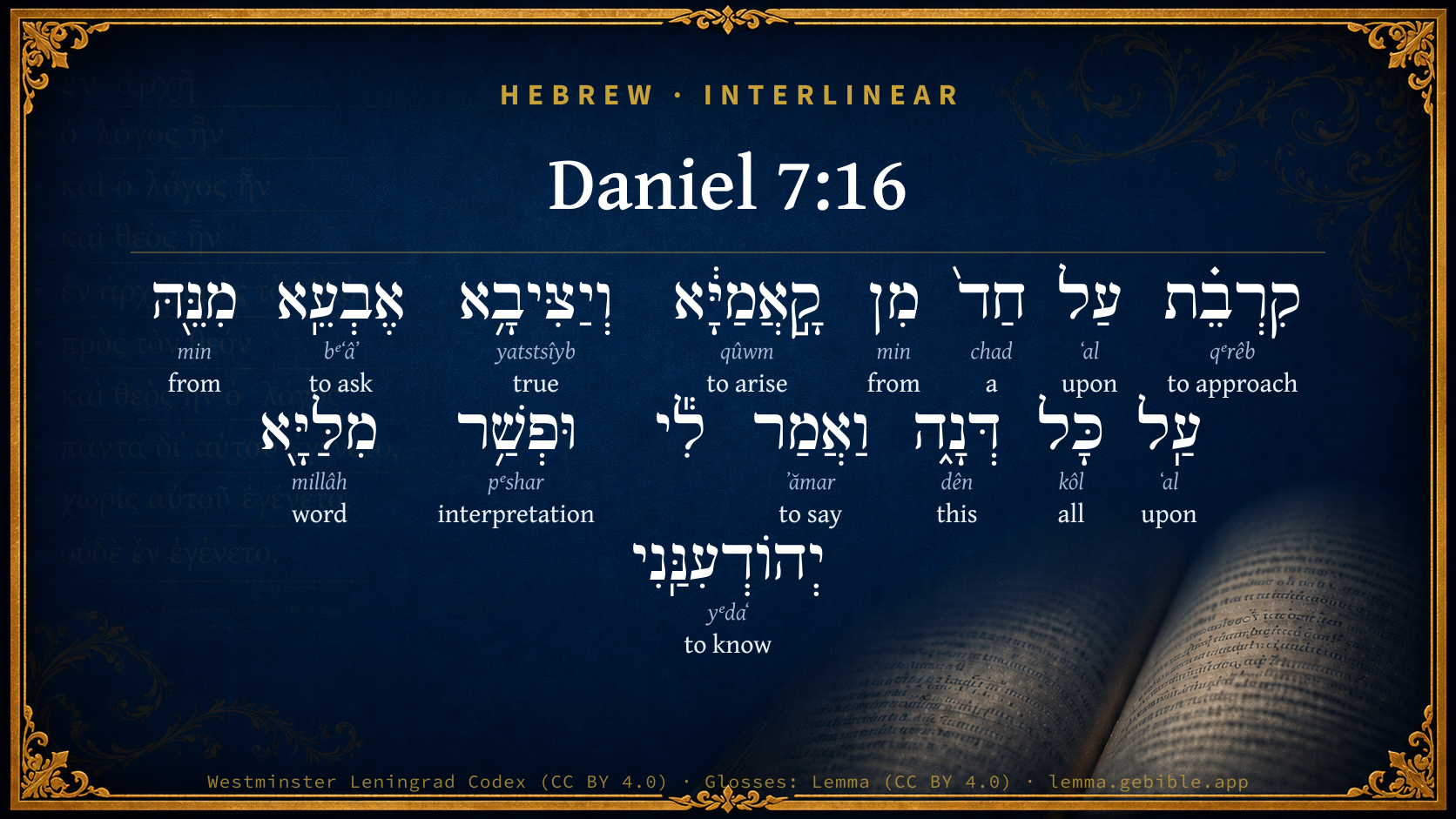
Daniel 7:16

Hebrew (Westminster Leningrad Codex) Daniel 7:16 appears in the Hebrew Old Testament. The text above is from the Westminster Leningrad Codex. Each word links to its Strong’s number, a concise gloss, and parsing drawn from the Open Scriptures Hebrew Bible morphology. Click any word for its full Brown-Driver-Briggs (BDB) entry.
Download image
Cite this verse

Daniel 7:16 (World English Bible). Public Domain. Lemma interlinear Bible study tool, https://lemma.gebible.app/v/daniel/7/16.

Show BibTeX & RIS
BibTeX
RIS
English Translation
I came near to one of those who stood by, and asked him the truth concerning all this. So he told me, and made me know the interpretation of the things.
World English Bible · Public Domain
Download a study sheet

One document with this verse’s original text, its word-by-word gloss line, the meaning frame, cross-references with their text, attributed commentary, and full source and license credits — printable, and it pastes into notes with its structure intact.

This verse Autodidact and up

Study sheet (.html) Plain text (.txt)

A passage Seminary Student

Up to 50 verses in one chapter. A passage sheet keeps up to 6 commentary sources and 12 cross-references per verse, in the order this page ranks them, and says so on the sheet whenever that leaves anything out. Ask for a single verse and you get the Autodidact verse sheet above.

Everything on this page stays free to read, with no account — the sheet is a download of what is already on screen, not access to it.

Want to remove ads? Support Godless Engineer
Compare translations 3

The same verse in 3 English versions, stacked beneath the original-language interlinear above. Click any original word for its lexicon entry.

Each is an independent rendering of the whole verse — the interlinear is not word-aligned to these translations.

Highlighted words mark where these versions differ — a whole-verse word diff, not a word-by-word alignment.

  • World English Bible Public Domain
    I came near to one of those who stood by, and asked him the truth concerning all this. So he told me, and made me know the interpretation of the things.
  • King James Version Public Domain
    I came near unto one of them that stood by, and asked him the truth of all this. So he told me, and made me know the interpretation of the things.
  • unfoldingWord Literal Text CC BY-SA 4.0
    I approached one of those who were standing there and asked him the truth concerning all this. So he told me and made known to me the interpretation of the things.

unfoldingWord Literal Text — © unfoldingWord, licensed CC BY-SA 4.0. Word-aligned USFM3 via Door43 (git.door43.org/unfoldingWord/en_ult).

Versions to compare (up to 4)

3 of 4 selected

Show all 18 translations

Every available English version of this verse, each an independent rendering of the whole verse.

  • World English Bible Public Domain
    I came near to one of those who stood by, and asked him the truth concerning all this. So he told me, and made me know the interpretation of the things.
  • Berean Standard Bible Public Domain
    I approached one of those who were standing there, and I asked him the true meaning of all this. So he told me the interpretation of these things:
  • Majority Standard Bible Public Domain
    I approached one of those who were standing there, and I asked him the true meaning of all this. So he told me the interpretation of these things:
  • King James Version Public Domain
    I came near unto one of them that stood by, and asked him the truth of all this. So he told me, and made me know the interpretation of the things.
  • American Standard Version (1901) Public Domain
    I came near unto one of them that stood by, and asked him the truth concerning all this. So he told me, and made me know the interpretation of the things.
  • Revised Version (1885) Public Domain
    I came near unto one of them that stood by, and asked him the truth concerning all this. So he told me, and made me know the interpretation of the things.
  • Geneva Bible (1599) Public Domain
    Therefore I came vnto one of them that stoode by, and asked him the trueth of all this: so he tolde me, and shewed me the interpretation of these things.
  • Douay-Rheims (1899) Public Domain
    I went near to one of them that stood by, and asked the truth of him concerning all these things, and he told me the interpretation of the words, and instructed me:
  • Young's Literal Translation Public Domain
    I have drawn near unto one of those standing, and the certainty I seek from him of all this; and he hath said to me, yea, the interpretation of the things he hath caused me to know:
  • Literal Standard Version CC BY-SA 4.0
    I have drawn near to one of those standing, and the certainty I seek from him of all this; and he has spoken to me, indeed, the interpretation of the things he has caused me to know:
  • Unlocked Literal Bible CC BY-SA 4.0
    I approached one of them standing there and asked him to show me the meaning of these things.
  • unfoldingWord Literal Text CC BY-SA 4.0
    I approached one of those who were standing there and asked him the truth concerning all this. So he told me and made known to me the interpretation of the things.
  • Darby Bible Public Domain
    I came near unto one of them that stood by, and asked him the certainty of all this. And he told me, and made me know the interpretation of the things:
  • World Messianic Bible Public Domain
    I came near to one of those who stood by, and asked him the truth concerning all this. “So he told me, and made me know the interpretation of the things.
  • Webster's Bible Public Domain
    I came near to one of them that stood by, and asked him the truth of all this. So he told me, and made me know the interpretation of the things.
  • Free Bible Version CC BY-SA 4.0
    I went up to one of the attendants and asked him to explain what all this meant. He said he would explain it so I could understand.
  • Bible in Basic English Public Domain
    I came near to one of those who were waiting there, questioning him about what all this was. And he said to me that he would make clear to me the sense of these things.
  • JPS Tanakh (1917) Public Domain
    I came near unto one of them that stood by, and asked him the truth concerning all this. So he told me, and made me know the interpretation of the things:

Literal Standard Version (2020), Covenant Press — licensed CC BY-SA 4.0. Text via the HelloAO Bible API (eBible.org). Unlocked Literal Bible (unfoldingWord) — licensed CC BY-SA 4.0. Text via the HelloAO Bible API (eBible.org). unfoldingWord Literal Text — © unfoldingWord, licensed CC BY-SA 4.0. Word-aligned USFM3 via Door43 (git.door43.org/unfoldingWord/en_ult). Free Bible Version, Dr. Jonathan Gallagher — licensed CC BY-SA 4.0. Text via the HelloAO Bible API (eBible.org).

Word by word

More ways to search: Search by grammar → Find every occurrence → Compare this word →

Practice this passage: Drill this verse → Learn its vocabulary →

וְיַצִּיבָ֥א
yatstsîyb
H3330
“and · true”
Adjective, C + Adjective, Adjective, Feminine, Singular, Absolute
Part of Speech
Adjective + Adjective
Type
Adjective
Gender
Feminine
Number
Singular
State
Absolute
Full BDB Definition

Origin: from H3321

TWOT: 2773a

the truth (noun) - surely, reliably, truly (adjective) - reliable, true, certain, sure (adjective)
  1. קִרְבֵ֗ת qᵉrêb H7127 “to approach” Adjective, V, Plural
  2. עַל ʻal H5922 “upon” Adjective, R
  3. חַד֙ chad H2298 “a” Adjective, A
  4. מִן min H4481 “from” Adjective, R
  5. קָ֣אֲמַיָּ֔א qûwm H6966 “arising · the” Adjective, V + Particle, Definite Article
  6. אֶבְעֵֽא bᵉʻâʼ H1156 “to ask” Adjective, V
  7. מִנֵּ֖הּ min H4481 “from · him” Adjective, R + Suffix, Personal, 3rd Person, Masculine, Singular
  8. עַֽל ʻal H5922 “upon” Adjective, R
  9. כָּל kôl H3606 “all of” Adjective, N, Common
  10. דְּנָ֑ה dên H1836 “this” Adjective, P
  11. וַאֲמַר ʼămar H560 “and · to say” Adjective, C + Verb, Qal, Perfect, 3rd Person, Masculine, Singular
  12. וּפְשַׁ֥ר pᵉshar H6591 “and · interpretation of” Adjective, C + Noun, Common, Masculine, Singular, Construct
  13. מִלַּיָּ֖א millâh H4406 “words · the” Adjective, N, Common + Particle, Definite Article
  14. יְהוֹדְעִנַּֽנִי yᵉdaʻ H3046 “to know · me” Adjective, V + Suffix, Personal, 1st Person, Common, Singular

About this verse

These counts appear in no published source. They are computed here, from the morphology-tagged text and Lemma’s own curated glosses. What Lemma adds →

16
words
13
distinct lemmas
Prophets
section

Notable vocabulary

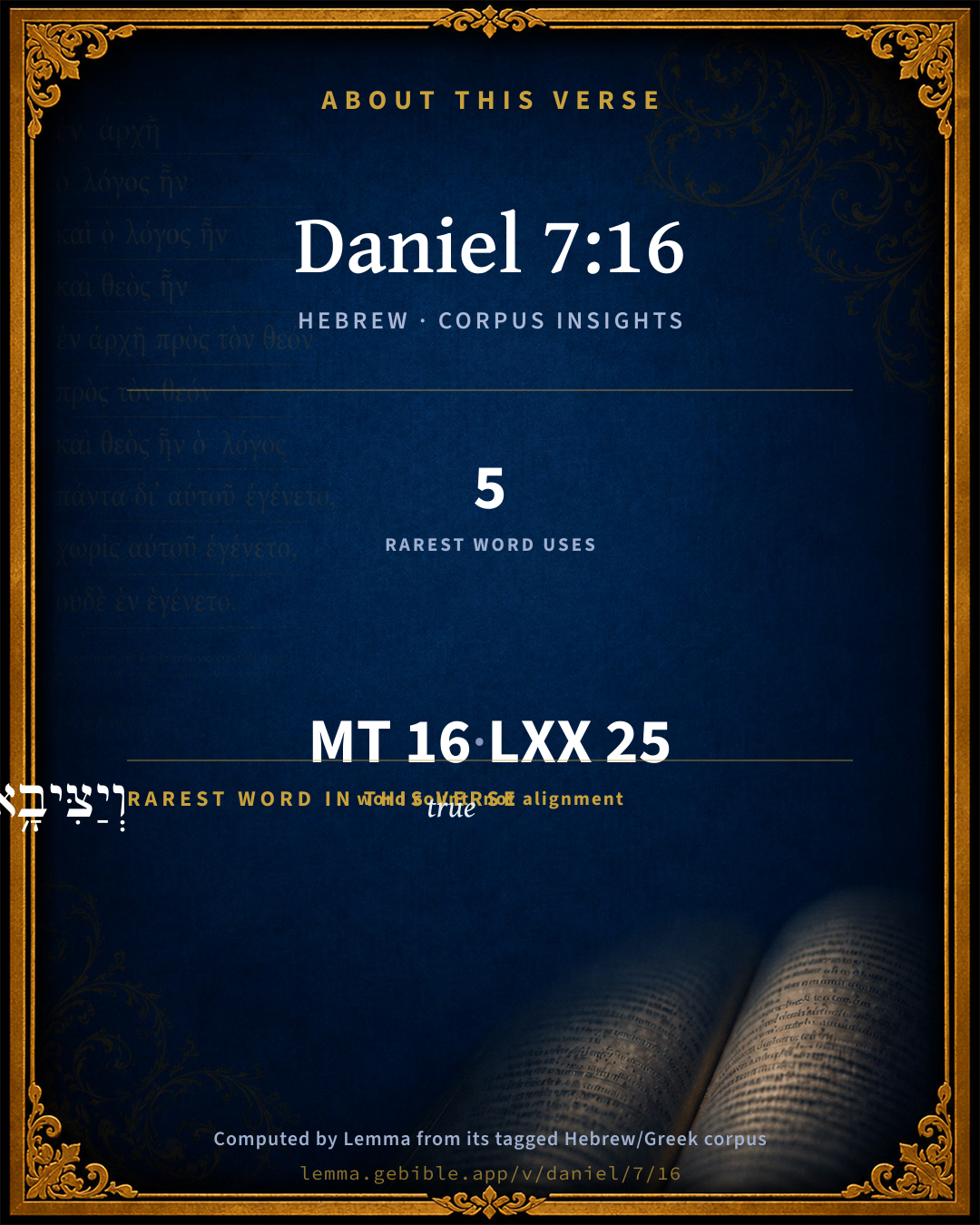
The rarest word here is וְיַצִּיבָ֥א true H3330 — appearing just 5 times in the whole Hebrew Bible.

Shared distinctive vocabulary

וְיַצִּיבָ֥א true H3330 occurs in 5 verses of the Hebrew Bible. Also found in:

Grammatical profile

  • 1 verb
  • 1 noun
  • 12 adjectives
  • 2 particles

Verb forms

  • וַאֲמַר Qal · Perfect

Repetition

Words recur within this verse — often emphatic in Hebrew:

Hebrew & Septuagint length

In English translation the verse runs 31 words from the Hebrew and 40 from the Septuagint (LXX English) — closely comparable.

A rough comparison of the two English renderings, which tokenize alike — not a word-level alignment.

Word counts can differ between the Hebrew and the Greek without any difference in meaning — e.g. the Hebrew direct-object marker אֵת has no separate Greek word, and Greek often adds the article ὁ.

In the original languages it is 16 Hebrew tokens and 25 Greek tokens — but the two are counted differently (Hebrew bundles its prefixes and suffixes into one token; the Greek is in lemma form), so that isn’t a like-for-like length.

Cross-references

11

Topical passages linked to Daniel 7:16 in the Treasury of Scripture Knowledge — connected by theme and wording, ordered by reader-vote popularity; previews shown in the World English Bible.

  • Revelation 7:13–14 One of the elders answered, saying to me, "These who are arrayed in white robes, who are they, and from where did they come?"
  • Daniel 7:10 A fiery stream issued and came forth from before him: thousands of thousands ministered to him, and ten thousand times ten thousand stood before him: the judgment was set, and the books were opened.
  • Zechariah 2:3 Behold, the angel who talked with me went forth, and another angel went out to meet him,
  • Revelation 5:5 One of the elders said to me, "Don't weep. Behold, the Lion who is of the tribe of Judah, the Root of David, has overcome; he who opens the book and its seven seals."
  • Daniel 8:13–16 Then I heard a holy one speaking; and another holy one said to that certain one who spoke, How long shall be the vision [concerning] the continual [burnt-offering], and the disobedience that makes desolate, to give both the sanctuary and the host to be trodden under foot?
  • Daniel 9:22 He instructed me, and talked with me, and said, Daniel, I am now come forth to give you wisdom and understanding.
  • Daniel 10:5–6 I lifted up my eyes, and looked, and, behold, a man clothed in linen, whose loins were girded with pure gold of Uphaz:
  • Daniel 10:11–12 He said to me, Daniel, you man greatly beloved, understand the words that I speak to you, and stand upright; for to you am I now sent. When he had spoken this word to me, I stood trembling.
  • Daniel 12:5–6 Then I, Daniel, looked, and, behold, there stood other two, the one on the brink of the river on this side, and the other on the brink of the river on that side.
  • Zechariah 1:8–11 "I had a vision in the night, and, behold, a man riding on a red horse, and he stood among the myrtle trees that were in a ravine; and behind him there were red, brown, and white horses.
  • Zechariah 3:7 "Thus says Yahweh of hosts: 'If you will walk in my ways, and if you will keep my charge, then you also shall judge my house, and shall also keep my courts, and I will give you a place of access among these who stand by.

Cross-references courtesy of OpenBible.info (CC BY 4.0).

Hebrew and Greek witnesses Masoretic Hebrew ↔ Greek Septuagint

The same verse in the two great witnesses to the Old Testament, shown verse-for-verse.

These are two independent witnesses, not word-aligned to each other, and the Septuagint is shown in lemma (dictionary) form.

Hebrew Daniel 7:16 Masoretic · Westminster Leningrad Codex

קִרְבֵ֗ת עַל חַד֙ מִן קָ֣אֲמַיָּ֔א וְיַצִּיבָ֥א אֶבְעֵֽא מִנֵּ֖הּ עַֽל כָּל דְּנָ֑ה וַאֲמַר לִ֕י וּפְשַׁ֥ר מִלַּיָּ֖א יְהוֹדְעִנַּֽנִי

I came near to one of those who stood by, and asked him the truth concerning all this. So he told me, and made me know the interpretation of the things.

World English Bible · Public Domain

Greek LXX Daniel 7:16 Septuagint · lemma form

προςἔρχομαι πρός εἷς ὁ ἵστημι καί ὁ ἀκρίβεια ζητέω παρά αὐτός ὑπέρ πᾶς οὗτος ἀποκρίνω δέ λέγω ἐγώ καί ὁ κρίσις ὁ λόγος δηλόω ἐγώ

And I drew near to one of them that stood by, and I sought to learn of him the truth of all these things: and he told me the truth, and made known to me the interpretation of the things.

LXX2012 (modern English Septuagint) · Public Domain

Hebrew: Westminster Leningrad Codex (CC BY 4.0). Greek: Septuagint (public domain); English from LXX2012 (modern English Septuagint) (Public Domain). How the Septuagint differs from the Hebrew →

Commentary

Notes on Daniel 7:16 from classic Christian and Jewish commentators (each source and its license shown beneath its notes). The classic Christian expositions comment on the surrounding passage and are grouped to its opening verse, so a note may address several verses; the Jewish commentaries on the Tanakh (Rashi and others) are per-verse, so they appear only where the commentator wrote on this verse.

Lemma curates 59 commentaries, every one of them public domain or Creative Commons licensed, each selected and text-cleaned for this edition rather than reprinted as found. About our sources →

Trapp's Complete Commentary

John Trapp

Dan 7:16 I came near unto one of them that stood by, and asked him the truth of all this. So he told me, and made me know the interpretation of the things.

Ver. 16. I came near unto one of them that stood by,] i.e., To one of the holy angels. {as Dan 7:10} Let us have recourse in like case to Christ’s ministers, who are called "angels of the churches"; like as angels, by a like change of name, are called "ministering spirits." {Heb 1:14} The preaching of the gospel is taken from the angels, {Luk 2:10} and given to the ministers: hence Paul was sent to Ananias for further direction, {Act 9:10-11} and Cornelius to Peter. {Act 10:3-5}

And asked him the truth,] i.e., The thing hereby signified. See Joh 1:17; Joh 14:7; holy minds are industrious after knowledge.

John Trapp, A Commentary or Exposition upon All the Books of the Old and New Testament (1647–1656) — public domain. Text from a community e-Sword module.

Geneva Bible (1599)

Geneva Bible translators

Meaning, of the Angels, as verse 10.

Geneva Bible (1599) marginal notes — public domain. Text via Bolls.life.

Ellicott's Commentary for English Readers

(16) That stood by—i.e., one out of the multitudes mentioned (Dan_7:10).

A Bible Commentary for English Readers, edited by Charles John Ellicott (1878–1897) — public domain. Text from a community e-Sword module.

The Cambridge Bible for Schools and Colleges

gen. ed. J. J. S. Perowne

16. one of them that were standing (there)] One of the angels that ‘stood’ before the Almighty (Dan_7:10), who happened to be nearer than the others to Daniel himself. For the part of interpreter taken by an angel in a vision, cf. Zec_1:7 to Zec_6:8 passim; and the Apocalypses of Enoch and 2 Esdras. It is characteristic of the later prophecies: in the visions of the earlier prophets (as Amos 7, 8, Isaiah 6, Jeremiah 1, Ezekiel 2-5, 8, 9, &c.), Jehovah speaks Himself to the prophet. We have the transition in Ezekiel 40-48, where an angel conducts the prophet, and usually explains things to him (Eze_40:3-4, &c.), though sometimes Jehovah also speaks Himself (Eze_43:7-9, Eze_44:2; Eze_44:5, &c.).

of all this] better, concerning all this (R.V.).

The Cambridge Bible for Schools and Colleges (gen. ed. J. J. S. Perowne; Cambridge University Press, 1878–1918) — public domain. Text from a community e-Sword module.

John Gill's Exposition

I came near unto one of them that stood by,.... To one of the angels that attended, either the throne of judgment, or, the Son of man in his approach to his divine Father:

and asked him the truth of all this; the substance of these visions; what these images, presented to his view, were shadows and representations of; so type and truth, shadow and substance, are opposed to each other. The real meaning of all this was what he asked; nor need any be ashamed to ask of whomsoever they can hope to get knowledge of truth, and especially of superiors, of the angels of the churches, or pastors of them:

so he told me, and made me know the interpretation of the things; he interpreted everything in the vision to him, and gave him the true meaning and real design of the whole, as follows: this was asked and told, not when Daniel was awake, and was considering of what he had dreamed; but in his dream, in his vision by night; this was all transacted in a visionary way, both the things and the interpretation of them.

John Gill's Exposition of the Whole Bible (1746–1763) — public domain (CC PDM 1.0). Text via the HelloAO Bible API.

Albert Barnes' Notes on the Bible

I came near unto one of them that stood by - That is, to one of the angels who appeared to stand near the throne. Dan 7:10. Compare Dan 8:13; Zec 4:4-5; Rev 7:13. It was natural for Daniel to suppose that the angels who were seen encircling the throne would be able to give him information on the subject, and the answers which Daniel received show that he was not mistaken in his expectation. God has often employed angels to communicate important truths to men, or has made them the medium of communicating his will. Compare Rev 1:1; Act 7:53; Heb 2:2.

So he told me, and made me know the interpretation of the things - He explained the meaning of the symbols, so that Daniel understood them. It would seem probable that Daniel has not recorded all that the angel communicated respecting the vision, but he has preserved so much that we may understand its general signification.

Albert Barnes' Notes on the Bible (1834–1885) — public domain. Text from a community e-Sword/MySword module.

Matthew Poole's English Annotations

Unto one of them that stood by; that is, to an angel that ministered, Zec 3:4,7.

Asked him the truth of all this; that I might learn of him the true and full meaning of this vision; which the angel readily told him.

Matthew Poole's English Annotations on the Holy Bible (1683–1685) — public domain. Text from a community e-Sword/MySword module.

John Wesley's Explanatory Notes

Unto one - That is, to an angel, that ministered. The truth - The true meaning of this vision.

John Wesley, Explanatory Notes Upon the Whole Bible (1754–1765) — public domain. Text via the GEBible commentary corpus.

Rashi

Rabbi Shlomo Yitzchaki (Rashi)

I drew near to one of those standing I drew near to one of those standing there beside the Ancient of Days. The angels are called standing ones, as it is said: (Zech. 3:7): “among these who stand by (הָעמְדִים),” because they have no joints.

and I asked him the truth [as translated,] and I asked him the truth.

Rashi on the Tanakh — English translations: “The Judaica Press complete Tanach with Rashi, translated by A. J. Rosenberg” (CC BY 4.0); “Pentateuch with Rashi's commentary by M. Rosenbaum and A.M. Silbermann, 1929-1934” (public domain); “The Metsudah Tanach series, Lakewood, N.J” (CC BY 4.0); and “The Book of Joshua, Metsudah Publications, 1997” (CC BY 4.0). Text via Sefaria.

Lesson kit

Teaching starters — assembled from the data on this page, not authored interpretation. Every prompt links to the verse data it draws on. Edit before teaching.

Daniel, in the Prophets, opens this verse with 16 words (13 distinct Hebrew lemmas). Its most distinctive word is yatstsîyb (“true”). A historical commentator’s framing appears above. Read the whole chapter for the surrounding context.

Discussion questions

  1. How does “true” (yatstsîyb) shape what this verse is saying?
  2. How does Daniel 2:8, which shares the word «true», read alongside this verse?
  3. What does the repetition of “upon” (2× in this one verse) do in this verse?
  4. These translations render this verse differently; the difference is in the English rendering, not the original. What questions does that raise?
  5. «וַאֲמַר» is a Qal Perfect verb. How does that grammatical form shape the action described?
  6. Compare how Trapp's Complete Commentary and Geneva Bible (1599) read this verse. Where do they agree or differ?

Things to notice

Reading settings

Reading text

Shown beneath each verse's original-language words.

Old Testament
Old Testament edition

Read the OT as the Masoretic Hebrew (MT) or the Greek Septuagint (LXX).

English shown for the Greek Septuagint (in the Hebrew ↔ Greek comparison).

Comparing translations? Open the Compare panel on any verse page to stack up to four side by side.