
Ezra 5:3

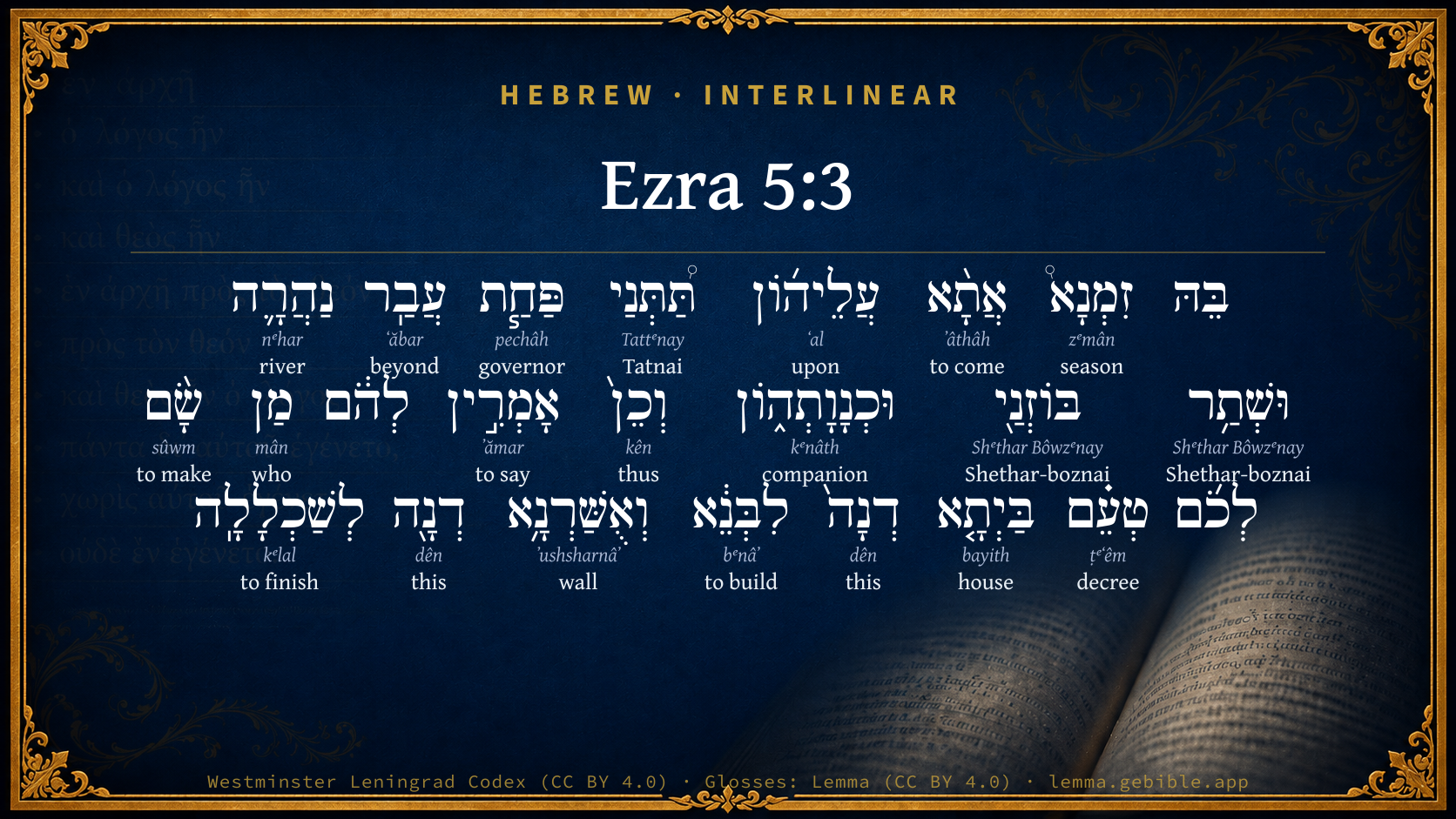
Hebrew (Westminster Leningrad Codex) Ezra 5:3 appears in the Hebrew Old Testament. The text above is from the Westminster Leningrad Codex. Each word links to its Strong’s number, a concise gloss, and parsing drawn from the Open Scriptures Hebrew Bible morphology. Click any word for its full Brown-Driver-Briggs (BDB) entry.
Download image
Cite this verse

Ezra 5:3 (World English Bible). Public Domain. Lemma interlinear Bible study tool, https://lemma.gebible.app/v/ezra/5/3.

Show BibTeX & RIS
BibTeX
RIS
English Translation
At the same time came to them Tattenai, the governor beyond the River, and Shetharbozenai, and their companions, and said thus to them, Who gave you a decree to build this house, and to finish this wall?
World English Bible · Public Domain
Highlights
  • 8 first appearances in the Hebrew Bible
Full analysis ↓
Download a study sheet

One document with this verse’s original text, its word-by-word gloss line, the meaning frame, cross-references with their text, attributed commentary, and full source and license credits — printable, and it pastes into notes with its structure intact.

This verse Autodidact and up

Study sheet (.html) Plain text (.txt)

A passage Seminary Student

Up to 50 verses in one chapter. A passage sheet keeps up to 6 commentary sources and 12 cross-references per verse, in the order this page ranks them, and says so on the sheet whenever that leaves anything out. Ask for a single verse and you get the Autodidact verse sheet above.

Everything on this page stays free to read, with no account — the sheet is a download of what is already on screen, not access to it.

Want to remove ads? Support Godless Engineer
Compare translations 3

The same verse in 3 English versions, stacked beneath the original-language interlinear above. Click any original word for its lexicon entry.

Each is an independent rendering of the whole verse — the interlinear is not word-aligned to these translations.

Highlighted words mark where these versions differ — a whole-verse word diff, not a word-by-word alignment.

  • World English Bible Public Domain
    At the same time came to them Tattenai, the governor beyond the River, and Shetharbozenai, and their companions, and said thus to them, Who gave you a decree to build this house, and to finish this wall?
  • King James Version Public Domain
    At the same time came to them Tatnai, governor on this side the river, and Shetharboznai and their companions, and said thus unto them, Who hath commanded you to build this house, and to make up this wall?
  • unfoldingWord Literal Text CC BY-SA 4.0
    At that time, Tattenai, the governor of Beyond-the-River, and Shethar-Bozenai, and their companions came to them and spoke to them thus, “Who set for you a decree to build this house and to complete this structure?”

unfoldingWord Literal Text — © unfoldingWord, licensed CC BY-SA 4.0. Word-aligned USFM3 via Door43 (git.door43.org/unfoldingWord/en_ult).

Versions to compare (up to 4)

3 of 4 selected

Show all 18 translations

Every available English version of this verse, each an independent rendering of the whole verse.

  • World English Bible Public Domain
    At the same time came to them Tattenai, the governor beyond the River, and Shetharbozenai, and their companions, and said thus to them, Who gave you a decree to build this house, and to finish this wall?
  • Berean Standard Bible Public Domain
    At that time Tattenai the governor of the region west of the Euphrates, Shethar-bozenai, and their associates went to the Jews and asked, “Who authorized you to rebuild this temple and restore this structure?”
  • Majority Standard Bible Public Domain
    At that time Tattenai the governor of the region west of the Euphrates, Shethar-bozenai, and their associates went to the Jews and asked, “Who authorized you to rebuild this temple and restore this structure?”
  • King James Version Public Domain
    At the same time came to them Tatnai, governor on this side the river, and Shetharboznai and their companions, and said thus unto them, Who hath commanded you to build this house, and to make up this wall?
  • American Standard Version (1901) Public Domain
    At the same time came to them Tattenai, the governor beyond the River, and Shethar-bozenai, and their companions, and said thus unto them, Who gave you a decree to build this house, and to finish this wall?
  • Revised Version (1885) Public Domain
    At the same time came to them Tattenai, the governor beyond the river, and Shethar-bonzenai, and their companions, and said thus to them, Who gave you a decree to build this house, and to finish this wall?
  • Geneva Bible (1599) Public Domain
    At the same time came to them Tatnai, which was captaine beyonde the Riuer, and Shether-boznai and their companions, and sayd thus vnto them, Who hath giuen you commandement to buylde this house, and to lay the foundations of these walles?
  • Douay-Rheims (1899) Public Domain
    And at the same time came to them Thathanai, who was governor beyond the river, and Stharbuzanai, and their counsellors: and said thus to them: Who hath given you counsel to build this house, and to repair the walls thereof?
  • Young's Literal Translation Public Domain
    At that time come to them hath Tatnai, governor beyond the river, and Shethar-Boznai, and their companions, and thus they are saying to them, `Who hath made for you a decree this house to build, and this wall to finish?'
  • Literal Standard Version CC BY-SA 4.0
    At that time have come to them Tatnai, governor beyond the river, and Shethar-Boznai, and their companions, and thus they are saying to them, “Who has made for you a decree to build this house, and to finish this wall?”
  • Unlocked Literal Bible CC BY-SA 4.0
    Then Tattenai the governor of the Province Beyond the River, Shethar-Bozenai, and his associates came and said to them, “Who gave you a decree to build this house and complete these walls?”
  • unfoldingWord Literal Text CC BY-SA 4.0
    At that time, Tattenai, the governor of Beyond-the-River, and Shethar-Bozenai, and their companions came to them and spoke to them thus, “Who set for you a decree to build this house and to complete this structure?”
  • Darby Bible Public Domain
    At that time came to them Tatnai, governor on this side the river, and Shethar-boznai, and their companions, and said thus to them: Who gave you orders to build this house and to complete this wall?
  • World Messianic Bible Public Domain
    At the same time Tattenai, the governor beyond the River, came to them, with Shetharbozenai and their companions, and asked them, “Who gave you a decree to build this house and to finish this wall?”
  • Webster's Bible Public Domain
    At the same time came to them Tatnai, governor on this side of the river, and Shethar-boznai, and their companions, and said thus to them, Who hath commanded you to build this house, and to make up this wall?
  • Free Bible Version CC BY-SA 4.0
    Almost immediately Tattenai, the governor of the province west of the Euphrates, Shethar-bozenai, and their fellow officials arrived and asked, “Who gave you permission to rebuild this Temple and finish it?”
  • Bible in Basic English Public Domain
    At the same time, Tattenai, ruler of the land across the river, and Shethar-bozenai, and their men, came to them and said, Who gave you orders to go on building this house and this wall?
  • JPS Tanakh (1917) Public Domain
    At the same time came to them Tattenai, the governor beyond the River, and Shethar-bozenai, and their companions, and said thus unto them: 'Who gave you a decree to build this house, and to finish this structure?'

Literal Standard Version (2020), Covenant Press — licensed CC BY-SA 4.0. Text via the HelloAO Bible API (eBible.org). Unlocked Literal Bible (unfoldingWord) — licensed CC BY-SA 4.0. Text via the HelloAO Bible API (eBible.org). unfoldingWord Literal Text — © unfoldingWord, licensed CC BY-SA 4.0. Word-aligned USFM3 via Door43 (git.door43.org/unfoldingWord/en_ult). Free Bible Version, Dr. Jonathan Gallagher — licensed CC BY-SA 4.0. Text via the HelloAO Bible API (eBible.org).

Word by word

More ways to search: Search by grammar → Find every occurrence → Compare this word →

Practice this passage: Drill this verse → Learn its vocabulary →

וְאֻשַּׁרְנָ֥א
ʼushsharnâʼ
H846
“and · wall · the”
Adjective, C + Noun, Common, Masculine, Singular, Determined + Particle, Definite Article
Part of Speech
Adjective + Noun + Particle
Type
Definite Article
Full BDB Definition

Origin: from a root corresponding to H833

TWOT: 2616

wall, panelling, beams, structure (precise meaning and derivation uncertain)
  1. זִמְנָא֩ zᵉmân H2166 “season · the” Adjective, N, Common + Particle, Definite Article
  2. אֲתָ֨א ʼâthâh H858 “to come” Adjective, V, Plural
  3. עֲלֵיה֜וֹן ʻal H5922 “upon · them” Adjective, R + Suffix, Personal, 3rd Person, Masculine, Plural
  4. תַּ֠תְּנַי Tattᵉnay H8674 “Tatnai” Adjective, N
  5. פַּחַ֧ת pechâh H6347 “governor of” Adjective, N, Common
  6. עֲבַֽר ʻăbar H5675 “beyond” Adjective, N
  7. נַהֲרָ֛ה nᵉhar H5103 “river · the” Adjective, N + Particle, Definite Article
  8. וּשְׁתַ֥ר Shᵉthar Bôwzᵉnay H8370 “and · Shethar-boznai” Adjective, C + Noun, Proper
  9. בּוֹזְנַ֖י Shᵉthar Bôwzᵉnay H8370 “Shethar-boznai” Adjective, N
  10. וּכְנָוָתְה֑וֹן kᵉnâth H3675 “and · companion · their” Adjective, C + Noun, Common, Masculine, Singular, Construct + Suffix, Personal, 3rd Person, Masculine, Plural
  11. וְכֵן֙ kên H3652 “and · thus” Adjective, C + Adverb
  12. אָמְרִ֣ין ʼămar H560 “saying” Adjective, V
  13. מַן mân H4479 “who” Adjective, P
  14. שָׂ֨ם sûwm H7761 “to make” Adjective, V, Plural
  15. טְעֵ֗ם ṭᵉʻêm H2942 “decree” Adjective, N, Common
  16. בַּיְתָ֤א bayith H1005 “house · the” Adjective, N, Common + Particle, Definite Article
  17. דְנָה֙ dên H1836 “this” Adjective, P
  18. לִבְּנֵ֔א bᵉnâʼ H1124 “to build” Adjective, R + Verb, Qal, Infinitive Construct
  19. דְנָ֖ה dên H1836 “this” Adjective, P
  20. לְשַׁכְלָלָֽה kᵉlal H3635 “to finish” Adjective, R + Verb, e, Infinitive Construct

About this verse

These counts appear in no published source. They are computed here, from the morphology-tagged text and Lemma’s own curated glosses. What Lemma adds →

24
words
19
distinct lemmas
Historical
section

Notable vocabulary

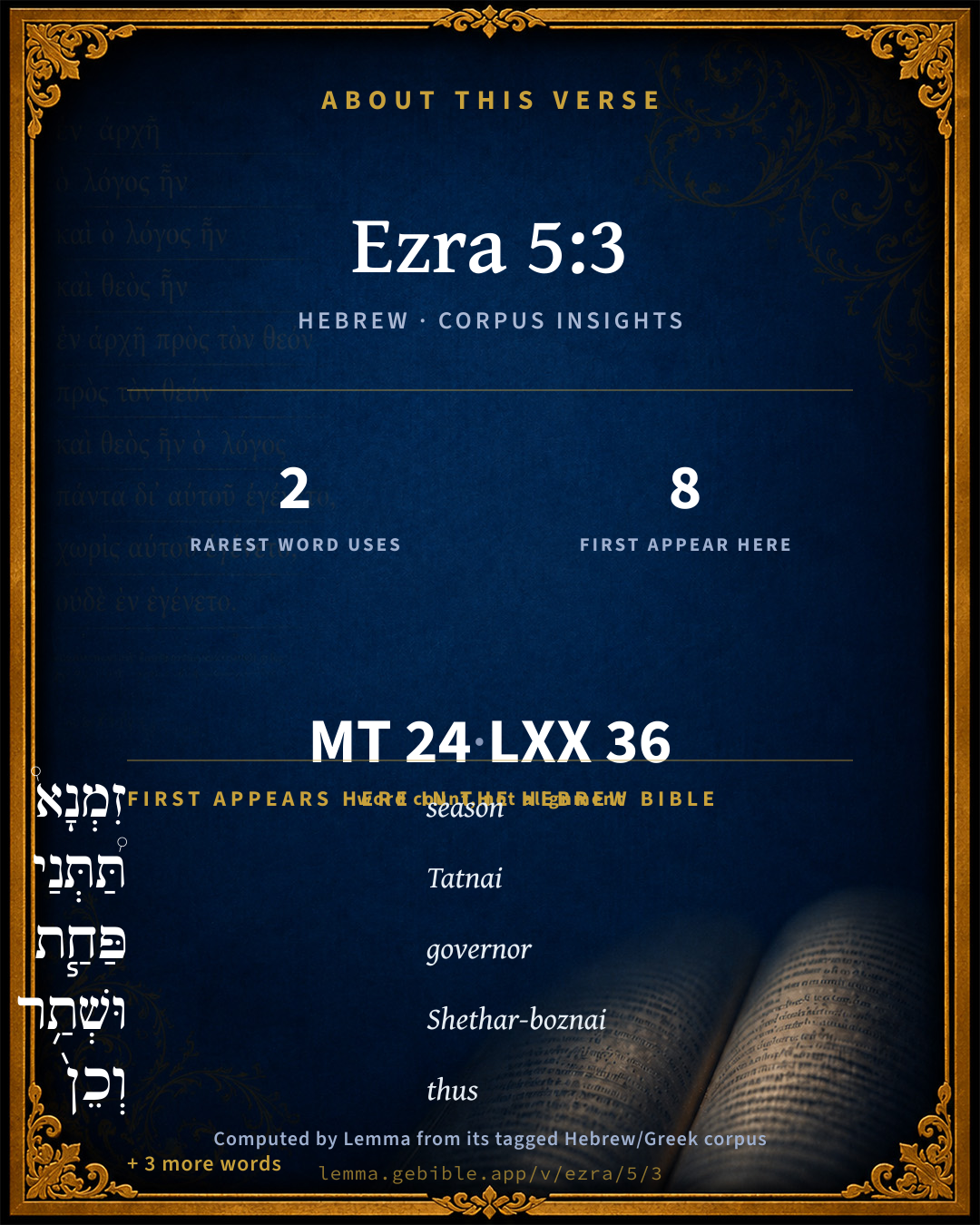
The rarest word here is וְאֻשַּׁרְנָ֥א wall H846 — appearing just 2 times in the whole Hebrew Bible.

First appearance in Scripture

These words make their first canonical appearance in the Hebrew Bible here:

  • זִמְנָא֩ season H2166
  • תַּ֠תְּנַי Tatnai H8674
  • פַּחַ֧ת governor H6347
  • וּשְׁתַ֥ר Shethar-boznai H8370
  • וְכֵן֙ thus H3652
  • אָמְרִ֣ין to say H560
  • מַן who H4479
  • וְאֻשַּׁרְנָ֥א wall H846

Shared distinctive vocabulary

וְאֻשַּׁרְנָ֥א wall H846 occurs in 2 verses of the Hebrew Bible. Also found in:

Grammatical profile

  • 2 verbs
  • 2 nouns
  • 15 adjectives
  • 1 adverb
  • 4 particles

Verb forms

  • לִבְּנֵ֔א Qal · Infinitive Construct
  • לְשַׁכְלָלָֽה Infinitive Construct

Repetition

Words recur within this verse — often emphatic in Hebrew:

  • וּשְׁתַ֥ר Shethar-boznai H8370 ×2
  • דְנָה֙ this H1836 ×2

Hebrew & Septuagint length

In English translation the verse runs 37 words from the Hebrew and 42 from the Septuagint (LXX English) — closely comparable.

A rough comparison of the two English renderings, which tokenize alike — not a word-level alignment.

Word counts can differ between the Hebrew and the Greek without any difference in meaning — e.g. the Hebrew direct-object marker אֵת has no separate Greek word, and Greek often adds the article ὁ.

In the original languages it is 24 Hebrew tokens and 36 Greek tokens — but the two are counted differently (Hebrew bundles its prefixes and suffixes into one token; the Greek is in lemma form), so that isn’t a like-for-like length.

Cross-references

10

Topical passages linked to Ezra 5:3 in the Treasury of Scripture Knowledge — connected by theme and wording, ordered by reader-vote popularity; previews shown in the World English Bible.

  • Ezra 6:6 Now therefore, Tattenai, governor beyond the River, Shetharbozenai, and your companions the Apharsachites, who are beyond the River, be you far from there:
  • Ezra 1:3 Whoever there is among you of all his people, his God be with him, and let him go up to Jerusalem, which is in Judah, and build the house of Yahweh, the God of Israel (he is God), which is in Jerusalem.
  • Ezra 5:9 Then asked we those elders, and said to them thus, Who gave you a decree to build this house, and to finish this wall?
  • Ezra 6:13 Then Tattenai, the governor beyond the River, Shetharbozenai, and their companions, because that Darius the king had sent, did accordingly with all diligence.
  • Ezra 4:12 Be it known to the king, that the Jews who came up from you are come to us to Jerusalem; they are building the rebellious and the bad city, and have finished the walls, and repaired the foundations.
  • Ezra 5:6 The copy of the letter that Tattenai, the governor beyond the River, and Shetharbozenai, and his companions the Apharsachites, who were beyond the River, sent to Darius the king;
  • Ezra 7:21 I, even I Artaxerxes the king, do make a decree to all the treasurers who are beyond the River, that whatever Ezra the priest, the scribe of the law of the God of heaven, shall require of you, it be done with all diligence,
  • Nehemiah 2:7–9 Moreover I said to the king, If it please the king, let letters be given me to the governors beyond the River, that they may let me pass through until I come to Judah;
  • Matthew 21:23 When he had come into the temple, the chief priests and the elders of the people came to him as he was teaching, and said, "By what authority do you do these things? Who gave you this authority?"
  • Acts 4:7 When they had stood them in the middle of them, they inquired, "By what power, or in what name, have you done this?"

Cross-references courtesy of OpenBible.info (CC BY 4.0).

Hebrew and Greek witnesses Masoretic Hebrew ↔ Greek Septuagint

The same verse in the two great witnesses to the Old Testament, shown verse-for-verse.

These are two independent witnesses, not word-aligned to each other, and the Septuagint is shown in lemma (dictionary) form.

Hebrew Ezra 5:3 Masoretic · Westminster Leningrad Codex

בֵּהּ זִמְנָא֩ אֲתָ֨א עֲלֵיה֜וֹן תַּ֠תְּנַי פַּחַ֧ת עֲבַֽר נַהֲרָ֛ה וּשְׁתַ֥ר בּוֹזְנַ֖י וּכְנָוָתְה֑וֹן וְכֵן֙ אָמְרִ֣ין לְהֹ֔ם מַן שָׂ֨ם לְכֹ֜ם טְעֵ֗ם בַּיְתָ֤א דְנָה֙ לִבְּנֵ֔א וְאֻשַּׁרְנָ֥א דְנָ֖ה לְשַׁכְלָלָֽה

At the same time came to them Tattenai, the governor beyond the River, and Shetharbozenai, and their companions, and said thus to them, Who gave you a decree to build this house, and to finish this wall?

World English Bible · Public Domain

Greek LXX Ezra 5:3 Septuagint · lemma form

ἐν αὐτός ὁ καιρός ἔρχομαι ἐπί αὐτός θανθαναι ἔπαρχος πέραν ὁ ποταμός καί σαθαρβουζανα καί ὁ σύνδουλος αὐτός καί τοῖος εἶπον αὐτός τίς τίθημι σύ γνώμη ὁ οἰκοδομέω ὁ οἶκος οὗτος καί ὁ χορηγία οὗτος καταἀρτίζω

At the same time came there upon them Thanthanai, the governor on this side the river, and Satharbuzanai, and their fellow-servants, and spoke thus to them, Who has ordained a decree for you to build this house, and to provide this preparation?

LXX2012 (modern English Septuagint) · Public Domain

In the Septuagint this is one book — Esdras B (2 Esdras): Ezra is chapters 1–10, Nehemiah 11–23.

On this verse, The Pulpit Commentary discusses the Septuagint’s reading. Read the note in Commentary ↓

Hebrew: Westminster Leningrad Codex (CC BY 4.0). Greek: Septuagint (public domain); English from LXX2012 (modern English Septuagint) (Public Domain). How the Septuagint differs from the Hebrew →

Commentary

Notes on Ezra 5:3 from classic Christian and Jewish commentators (each source and its license shown beneath its notes). The classic Christian expositions comment on the surrounding passage and are grouped to its opening verse, so a note may address several verses; the Jewish commentaries on the Tanakh (Rashi and others) are per-verse, so they appear only where the commentator wrote on this verse.

Lemma curates 59 commentaries, every one of them public domain or Creative Commons licensed, each selected and text-cleaned for this edition rather than reprinted as found. About our sources →

Matthew Henry's Commentary

We have here, I. The cognizance which their neighbours soon took of the reviving of this good work. A jealous eye, it seems, they had upon them, and no sooner did the Spirit of God stir up the friends of the temple to appear for it than the evil spirit stirred up its enemies to appear against it. While the people built and ceiled their own houses their enemies gave them no molestation (Hag 1:4), though the king's order was to put a stop to the building of the city (Ezr 4:21); but when they fell to work again at the temple then the alarm was taken, and all heads were at work to hinder them, Ezr 5:3, Ezr 5:4. The adversaries are here named: Tatnai and Shethar-boznai. The governors we read of (ch. 4) were, it is probable, displaced at the beginning of this reign, as is usual. It is the policy of princes often to change their deputies, proconsuls, and rulers of provinces. These, though real enemies to the building of the temple, were men of better temper than the other, and made some conscience of telling truth. If all men have not faith (Th2 3:2), it is well some have, and a sense of honour. The church's enemies are not all equally wicked and unreasonable. The historian begins to relate what passed between the builders and those inquisitors (Ezr 5:3, Ezr 5:4), but breaks off his account, and refers to the ensuing copy of the letter they sent to the king, where the same appears more fully and at large, which he began to abridge (Ezr 5:4), or make an extract out of, though, upon second thoughts, he inserted the whole.

II. The care which the divine Providence took of this good work (Ezr 5:5): The eye of their God was upon the elders of the Jews, who were active in the work, so that their enemies could not cause them to cease, as they would have done, till the matter came to Darius. They desired they would only cease till they had instructions from the king about it. But they would not so much as yield them that, for the eye of God was upon them, even their God. And, 1. That baffled their enemies, infatuated and enfeebled them, and protected the builders from their malicious designs. While we are employed in God's work we are taken under his special protection; his eye is upon us for good, seven eyes upon one stone in his temple; see Zac 3:9; Zac 4:10. 2. That quickened them. The elders of the Jews saw the eye of God upon them, to observe what they did and own them in what they did well, and then they had courage enough to face their enemies and to go on vigorously with their work, notwithstanding all the opposition they met with. our eye upon God, observing his eye upon us, will keep us to our duty and encourage us in it when the difficulties are ever so discouraging.

III. The account they sent to the king of this matter, in which we may observe,

1. How fully the elders of the Jews gave the Samaritans an account of their proceedings. They, finding them both busy and prosperous, that all hands were at work to run up this building and that it went on rapidly, put these questions to them: - "By what authority do you do these things, and who gave you that authority? Who set you to work? Have you that which will bear you out?" To this they answered that they had sufficient warrant to do what they did; for, (1.) "We are the servants of the God of heaven and earth. The God we worship is not a local deity, and therefore we cannot be charged with making a faction, or setting up a sect, in building this temple to his honour: but we pay our homage to a God on whom the whole creation depends, and therefore ought to be protected and assisted by all and hindered by none." It is the wisdom as well as duty of kings to countenance the servants of the God of heaven. (2.) "We have a prescription to this house; it was built for the honour of our God by Solomon many ages ago. It is no novel invention of our own; we are but raising the foundations of many generations," Isa 58:12. (3.) "It was to punish us for our sins that we were, for a time, put out of the possession of this house; not because the gods of the nations had prevailed against our God, but because we had provoked him (Ezr 5:12), for which he delivered us and our temple into the hands of the king of Babylon, but never intended thereby to put a final period to our religion. We were only suspended for a time, not deprived for ever." (4.) "We have the royal decree of Cyrus to justify us and bear us out in what we do. He not only permitted and allowed us, but charged and commanded us to build this house (Ezr 5:13), and to build it in its place (Ezr 5:15), the same place where it had stood before." He ordered this, not only in compassion to the Jews, but in veneration of their God, saying, He is the God. He also delivered the vessels of the temple to one whom he entrusted to see them restored to their ancient place and use, Ezr 5:14. And they had these to show in confirmation of what they alleged. (5.) "The building was begun according to this order as soon as ever we had returned, so that we have not forfeited the benefit of the order for want of pursuing it in time; still it has been in building, but, because we have met with opposition, it is not finished." But, observe, they mention not the falsehood and malice of the former governors, nor make any complaint of them, though they had cause enough, to teach us not to render bitterness for bitterness, nor the most just reproach for that which is most unjust, but to think it enough if we can obtain fair treatment for the future, without an invidious reference to former injuries, Ezr 5:16. This is the account they give of their proceedings, not asking what authority they had to examine them, nor upbraiding them with their idolatry, and superstitions, and medley religion. Let us learn hence with meekness and fear to give a reason of the hope that is in us (Pe1 3:15), rightly to understand, and then readily to declare, what we do in God's service and why we do it.

2. How fairly the Samaritans represented this to the king. (1.) They called the temple at Jerusalem the house of the great God (Ezr 5:8); for though the Samaritans, as it should seem, had yet gods many and lords many, they owned the God of Israel to be the great God, who is above all gods. "It is the house of the great God, and therefore we dare not oppose the building of it without orders from thee." (2.) They told him truly what was done, not stating, as their predecessors did, that they were fortifying the city as if they intended war, but only that they were rearing the temple as those that intended worship, Ezr 5:8. (3.) They fully represented their plea, told him what they had to say for themselves, and were willing that the cause should be set in a true light. (4.) They left it to the king to consult the records whether Cyrus had indeed made such a decree, and then to give directions as he should think fit, Ezr 5:17. We have reason to think that if Artaxerxes, in the foregoing chapter, had had the Jews' cause as fairly represented to him as it was here to Darius, he would not have ordered the work to be hindered. God's people could not be persecuted if they were not belied, could not be baited if they were not dressed up in bears' skins. Let but the cause of God and truth be fairly stated, and fairly heard, and it will keep its ground.

Matthew Henry's Commentary on the Whole Bible (1708–1710) — public domain (CC PDM 1.0). Text via the HelloAO Bible API.

Trapp's Complete Commentary

John Trapp

Ezr 5:3 At the same time came to them Tatnai, governor on this side the river, and Shetharboznai, and their companions, and said thus unto them, Who hath commanded you to build this house, and to make up this wall?

Ver. 3. At the same time] So soon as ever they began but to build God’s house they meet with opposition; which is still Evangelii Genius, guardian spirit of the truth, saith Calvin, the bad angel that haunts the cause of God, and dogs it at the heels. Satan, out of his inveterate envy and enmity, can in no wise brook the propagation of the truth and dilatation of Christ’s curtains. No sooner is Israel out of Egypt, but Pharaoh pursueth them. No sooner had Hezekiah kept that solemn passover, but Sennacherib comes up against him. Esau began to jostle Jacob in the womb, that no time might be lost; and when he set his face homewards, Laban follows him with one troop, Esau meets him with another; both with hostile intentions. Dream not of a delicacy in God’s ways, but suffer hardship, as a good soldier of Jesus Christ.

And their companions] Cum collegio suo (Junius), a company of captives combined to do mischief. See Ezr 4:9. {See Trapp on "Ezr 4:9"}

Who hath commanded you to build this house?] Their own houses they built, and were never once questioned. All the while our Saviour lay in his father’s shop, and meddled only with carpenter’s chips, the devil and his imps never troubled him; but when he was entering upon his ministry he is sharply assaulted in the wilderness. And when he took upon him to purge the temple, and better inform the people, presently the leaders came upon him as he was teaching, and said, "By what authority doest thou these things? and who gave thee this authority?" Mat 21:23. Like unto these were the questions put by the Papists to those noble reformers, Luther, Zuinglius, &c. Farellus was at his first coming to Geneva more harshly handled, and by the bishop and his clerks thus accosted: Quid tu, diabole nequissime, ad hanc civitatem perturbandam accessisti? What a devil makest thou here to make this disturbance &c., and so was driven out of the city, where afterwards he wrought a glorious reformation (Scultet. Annal.).

John Trapp, A Commentary or Exposition upon All the Books of the Old and New Testament (1647–1656) — public domain. Text from a community e-Sword module.

The Biblical Illustrator

Joseph S. Exell

Ezr_5:3-5

At the same time came to them Tatntia.

The great work investigated and continued

The sacred work investigated by the secular authorities.

1. The nature of the investigation.

2. The spirit of the investigation.

The eye of the world is upon the work of the Church to-day. Let the members see to it that it shall be apparent to all unprejudiced persons that their work tends to promote truth and righteousness, purity and peace, piety and patriotism.

II. The sacred wore carried on through the divine blessing, But the eye of their God was upon the elders of the Jews, etc. This suggests--

1. The Divine interest in the work.

2. The Divine oversight of the work.

3. The Divine inspiration of the workers.

4. The Divine protection of the workers. (William Jones.)

The Biblical Illustrator, edited by Joseph S. Exell (c. 1880s–1900s) — public domain. Text from a community e-Sword module.

Joseph Benson's Commentary

Ezr 5:3-4. Tatnai and Shethar-boznai — These were probably new governors, or prefects, whom Darius had sent; for it was usual with new kings to change the governors of provinces. Who hath commanded you to build this house? — No sooner did the Spirit of God stir up the friends of the temple to appear for it, but the evil spirit stirred up its enemies to appear against it. While the people builded and ceiled their own houses, their enemies gave them no molestation, (Hag 1:4,) though the king’s order was to put a stop to the building of the city, Ezr 4:21. But when they fell to work again at the temple, then the alarm was taken, and all heads were at work to hinder it. Then said we unto them — We Jews; What are the names, &c. — Certainly there ought to be no interrogation in this verse, but the words should be rendered, Then we told them accordingly (that is, according to what they asked) what were the names of the men that made this building; that is, who were the chief undertakers and encouragers of the work. For it appears, from Ezr 5:10, that Tatnai and his companions inquired who were the chief promoters of the work, to which a true answer was immediately given.

Joseph Benson's Commentary on the Old and New Testaments (1811–1818) — public domain. Text from a community e-Sword module.

Whedon's Commentary on the Bible

Daniel D. Whedon

INTERFERENCE OF TATNAI THE GOVERNOR, Ezr_5:3-17.

3. Tatnai — Probably the successor of Rehum “the chancellor.” Chapter Ezr_4:8.

Governor on this side the river — Literally, Governor of beyond the river. Compare note on Ezr_4:10, and on beyond Jordan at Jos_1:14. The country beyond the river in the Persian usus loquendi comprised especially Syria and Palestine, and seems to have been one of the satrapies of the Persian empire. According to Herodotus (iii, 89) Darius Hystaspes “established twenty governments of the kind which the Persians call satrapies, assigning to each its governor, and fixing the tribute which was to be paid him by the several nations. And generally he joined together in one satrapy the nations that were neighbours, but sometimes he passed over the nearer tribes, and put in their stead those that were more remote.” Tatnai seems to have been the governor of one of the subdivisions of the satrapy west of the Euphrates, commonly called beyond the river, as above described. The Hebrew word for governor is פחה, pechah, a term of Persian origin, and kindred to the Sanscrit paksha and Turkish pasha. See note on 2Ki_18:24.

Shethar-boznai — He was probably the secretary or scribe of Tatnai, sustaining to him the same relation that Shimshai did to Rehum. Ezr_4:8.

Their companions — Compare Ezr_4:9.

Daniel D. Whedon (gen. ed.), Commentary on the Old and New Testaments (1874–1909) — public domain. Text from a community e-Sword module.

The Pulpit Commentary

CHAPTER 5:3-17

RENEWAL OF OPPOSITION ON THE PART OF THE NEIGHBOURING HEATHEN. LETTER WRITTEN BY THEM AND SENT TO DARIUS (vers. 3-17). Once more opposition showed itself. Tatnai, a high officer, called "governor on this side the river" (ver. 3), perhaps satrap of Syria, and Shethar-boznai, or Sitrabarzanes, a Persian noble probably, at this time took the lead, and learning that the building was making progress, came in person to Jerusalem, and demanded to know by what authority the temple and city were being restored. Zerubbabel seems to have answered, "By the authority of a decree of Cyrus, issued in the year that he became king of Babylon" (ver. 13); whereupon a second question was asked, "What are the names of the men responsible for carrying on the work?" Zerubbabel answered that he was alone responsible, giving his name as Sheshbazzar, and declaring himself to be acting under a commission received from Cyrus (ver. 15), and never revoked. Thereupon Tatnai and Shethar-boznai seem to have proposed a cessation of the building until reference could be made to Darius and his pleasure learnt (ver. 5); but Zerubbabel declined to agree to this, and the work proceeded without intermission (ibid. ). Meanwhile, a letter was written to Darius, not unfairly stating the case, and suggesting that the state archives should be searched for the decree ascribed to Cyrus, that it might be seen what exactly it was that the decree sanctioned, and further that the king should expressly declare what his own pleasure was in the matter (ver. 17). This letter Tatnai, in his capacity of satrap, despatched to the court by special messenger, and so left the business to the decision of Darius and his counsellors, without further seeking to influence him. Remark the strong contrast between this despatch and that of the Samaritans. In the Samaritan letter private pique and enmity show themselves Jerusalem is "the rebellious and the bad city", (Ezr_4:12) hurtful unto kings and provinces" (ibid. ver. 15); its intention to revolt is assumed (ver. 13); the king is warned that his dominion and revenue are in danger (ver. 16); no hint is given of there having ever been any such document as the decree of Cyrus; no reference is made to Sheshbazzar or the royal commission that he had received; altogether, the case is stated as strongly as possible against the Jews, with great and manifest unfairness. Here, on the contrary, where the person who takes up the matter is the Persian governor, a dispassionate tone prevails; no charges are made; no abuse uttered; the letter is confined to a statement of facts and an inquiry; the Jews are allowed to give their own account of their proceedings, nearly half the letter being their statement of their own case (vers. 11-15); the decree of Cyrus is brought into prominence, asserted on the one hand, not denied on the other; that it should be searched for is suggested; and finally there is a simple request that the king will declare his will in respect of the building. Tatnai, governor on this side the river. The title given to Tatnai is the same which is assigned to Zerubbabel, both in Ezr_6:7 and in Haggai, (Hag_1:1, Hag_1:14, etc.) viz., pechah, which is a somewhat vague term of authority, translated sometimes "captain, (Dan_3:2, Dan_3:3, etc.) sometimes "deputy, (Est_8:9 Est_9:3) but generally, as here, "governor." The etymology is uncertain, but seems not to be Semitic (see Pusey"s "Daniel," pp. 570-572). The respective rank of Tatnai and Zerub-babel is indicated, not by this term, but by what follows it. Tatnai was pechah be yond the river," i.e. governor of the whole tract west of the Euphrates; Zerubbabel was pechah of Judah only. A Greek writer would have called the one satrap of Syria," the other sub-satrap of Judaea." It was the duty of Tatuai to watch the proceedings of his sub-satraps. \\ Vers. 3-17.

Opposition revived.

We have in these verses a twofold account of two different things. In vers. 3, 4, in the first place, we have the historian"s account of the revived opposition called out by the revival of the work of temple-building on the part of the Jews. In vers. 6-10 we have an almost identical but slightly fuller account of the same matter in the letter sent by the opponents themselves to Darius. In ver. 5, in the next place, we have the historian"s account of the amount of success to which that revived opposition attained, viz., to obtaining the consent of the builders, whilst still justifying and continuing their operations, to refer the whole subject to King Darius. In vers. 11-17 that same letter of the same opponents to Darius gives us a fuller account of this point also. Altogether, we cannot help seeing how very marked is the difference, so far as the question of result is concerned, between this attempt and that made before. In that other case, while the appeal was pending, the work on the spot almost expired of itself (ch. 4:4). In this case, although the appeal is consented to, the work on the spot, meanwhile, thrives to perfection (vers. 5, 8). What are the reasons of this striking difference? So far as second causes go, they will be found, we believe, in two things, viz., I In comparatively greater moderation on the part of the attack; and, II In comparatively greater vigour on the part of the defence. Let us proceed to see how the whole story illustrates these two points.

I A WEAKER ATTACK. For example, it was

(1) apparently not so general. Names we read of before, (Ezr_4:7, Ezr_4:9) such as Bishlam, etc., the Dinaites, etc., are now mentioned no more.

Tatnai and Shethar-boznai are acting, if not in ignorance, yet in independence, of native ideas. So much so, that the only "companions" mentioned in this case, the Apharsachites, are supposed by some to be themselves "Persians" of some sort. At any rate, all the other previous "companions" are only conspicuous now by their absence. The present movement is less formidable than the previous one both in numbers and names. Also the attack is

(2) less vital. There is no such plausible yet utterly fatal proposal for cooperation in this instance as that we read of before; only certain not unnatural and, all things considered, not disrespectful inquiries are addressed to those engaged in so evidently important a work. "Where is your authority for operations such as these? Who are the persons who hold themselves really responsible for them." (See vers. 3, 4, 9, 10, reading "they" for "we" in ver. 4 with Septuagint, Syriac, and Arabic versions, and even in the Chaldee with very slight change.) These deputy rulers would have failed in their duty if they had asked any less; even if we infer, as we must, from ver. 5, that their object in so doing, at any rate in the first instance, was to "cause" the Jewish elders to "cease" for the time. Such opposition, even so, is very different from that settled intention to "frustrate" the Jewish "purpose" entirely of which we find traces before (iv. 5). Once more, the attack is

(3) less unreasonable and malignant. The answer of the elders to the official inquiries put to them is heard with candour, and reported with truth. Nor are any charges made, as before, of treachery or sedition. Nor is anything more proposed to the king than a due hearing and examination of the appeal which the Jews have made to a previous edict of Cyrus in justification of their conduct (ver. 17). Meanwhile, moreover, though apparently with some reluctance, the chief authorities of the province in which Judaea was situated have consented to treat that justification as being, till proved otherwise, sufficient and valid, by allowing that work to go on without endeavouring to stop it by menace or force. In all this, if there is something of opposition, as there undoubtedly is, it is not like that of the previous occasion not a wide conspiracy, not a deadly aim, not a malignant effort, like that before.

II A STRONGER DEFENCE. The answer of the Jewish elders was a good one

1. On the score of principle. "We are the servants of the God of heaven and earth" (ver. 11). In other words, "Do you ask our names? We are named after the great God (see ver. 8), the God of heaven and earth. Do you ask why we are thus labouring? Because in doing so we serve him". (Act_27:23) It was well for them to put this first, like soldiers displaying the flag they fight under on entering into the battle. "Before all things we wish you to understand that this is a question with us of religion.

2. On the score of precedent. This was no novel idea that they were engaged in promoting. They were not beginning, but restoring, the temple. Many successive centuries (though these officials were perhaps not aware of it) a glorious temple to the great God had stood on that place. Not only so, the man who had originally "built" and "set it up" had been one of the greatest of their kings. This was also a wise line to adopt. If they were permitted to be Jews at all (as they certainly were), they might not only be allowed to worship their own God (as already touched on), but also to worship him according to so long-established and truly national a manner.

3. On the score of necessity. Their national welfare and even existence depended on the work they were engaged on. Long experience and heavy affliction had brought home this truth to their hearts. Why had their fathers gone into captivity? Why had the original house been destroyed? Because their "fathers" had "provoked the God of heaven" for years in connection with the worship of that house (ver. 12; also (2Ch_36:14-20; Jer_7:1-15, Jer_7:30) On the restoration, therefore, of the true worship of Jehovah, and, as a first step towards that, on the restoration of this his house, depended, nationally, their very life. The very permission, in fact, to rebuild it at all was a kind of token of restored animation which it would be double death to neglect.

4. On the score of authority. In all this they were acting, furthermore, as good subjects of Persia. One of the first decrees of that king of Persia who conquered "Babylon" and became its "king" (see ver. 13) was a decree to rebuild this house. Also, one of his first appointments the appointment by name (ver. 14) of a Jewish "governor" to see to this work. Also, one of his first actions the very significant action of restoring the temple vessels.

5. In the way of conclusion. All these things being so, was it to be wondered at that "the same Sheshbazzar," thus empowered and equipped, had come to Jerusalem and begun the work? Was it not rather to be wondered at that a work of such amazing importance should have remained on hand for so long (ver. 16)? Even yet it is not finished!" What a master-stroke was that to end with. "You ask why we have done so much. As Persian officials, speaking to us as Jews, rather ask why we have done so little." Observe, in all this

1. The secret of spiritual deliverance. God delivers his people sometimes by restraining their adversaries (Psa_76:10; Pro_16:7) sometimes by giving themselves special wisdom and courage; (Act_6:10) sometimes, as here, by doing both. How comparatively tame these adversaries. How bold and wise these defenders. How complete, therefore, even so far, the deliverance granted. (comp. Act_4:8-14, Act_4:21)

1. The secret of spiritual courage. Why is it we fear man so much? Because, as a rule, we fear God too little. (Luk_12:4, Luk_12:5) How different the case when, as here, we feel the "eye of our God" to be "upon" us (ver. 5). See also, in case previously referred to, Act_4:19, and Act_5:29; also Isa_51:12, Isa_51:13. Many feel a difficulty in speaking for Christ. If they were more often in the habit of speaking with him the difficulty would greatly diminish. Possibly it might even be found on the opposite side. (see once more Act_4:20)

1. The secret of dealing with honest doubt; viz.,

1. listen to it, do not repel it;

2. confront it, do not avoid it;

3. enlighten it, do not despise it.

The reason why many are "scepticsi.e. (if they are so honestly) merely "inquirers is because they do not know the strength of the believer"s position. If you know it, as the true strength of their position was known by the Jews before us, and can make it known in turn to such "inquirers" with like courage and wisdom, you will at least obtain their respect. It may also please God to cause your effort to do even more. (see 2Ti_2:24, 2Ti_2:25)

HOMILIES BY J.A. MACDONALD. Vers. 3-5.

The eye of God.

The "people of the land" procured authority from the Persian king to stop the rebuilding of the city and wall of Jerusalem, and used it to stop the rebuilding of the temple as well. After an interval of nine years, through the incitement of the prophets Haggai and Zechariah, the great work was resumed, and with the resumption the old hostility was revived. So the text, etc. The eye of their God was upon them

I To GIVE THEM ASSURANCE AND COMFORT.

1. This figure expresses his watchful care.

(1) His eyes are everywhere. (see Job_28:24; Pro_15:3) He observes us in the work of the sanctuary. When working in the city. When working on the wall.

(2) His vision searches the heart. (see 1Sa_16:7) He fully comprehends the hypocrite. So the sincerity of the innocent. How assuring! How nerving to moral courage!

2. It also expresses loving favour.

(1) As pity is expressed by the human eye, so, etc. Thus used to express the compassion of God for his suffering people in Egypt. (Exo_3:7-10) Also, for the tears of Hezekiah. (2Ki_20:5) So he pitied his people in Babylon, and his eye of pity is over them here.

(2) As the eye also expresses satisfaction, so the complaisancy of God, etc. Thus favour towards the holy land. (Deu_11:12) Towards the holy temple. (1Ki_8:29) Towards the holy people (Psa_34:15; Jer_24:4) What comfort to the faithful!

II TO GIVE THEM WISDOM AND DISCRETION.

1. They need this in the presence of their inquisitors.

(1) They are people of influence. There is "Tatnai, the governor on this side the river." If the "river" here be the Euphrates, then he would be over the provinces of Syria, Arabia Deserta, Phoenicia, and Samaria. If the Jordan, then still a great personage. There was Shethar-boznai, probably the secretary appointed by the Persian crown, as was customary, to act as a check upon the governor. There were "their companions," probably magistrates.

(2) They put questions which imported mischief. By whose authority do you build (ver. 3)? Expressed again, ver. 9. Who are your leaders in this questionable business? Implied, ver. 4 (see ver. 10).

2. Their answers were guided by a watchful wisdom.

(1) That they acted as the "servants of the God of heaven and earth" (see ver. 11). No authority could be higher. Query Do we always and adequately recognise that authority?

(2) That they claimed a prescriptive right in the temple which was originally built by one of their great kings (see ver. 11).

(3) That their captivity did not forfeit them that right. For God banished them into captivity for their sin: Nebuchadnezzar was but his servant; and God now favours their restoration (see vers. 11, 12). We should never be ashamed to avow our connection with God and his work.

III To DEFEND THEM FROM THEIR ENEMIES.

1. By moderating the opposition.

(1) Their former unscrupulous foes are not mentioned (see ch. 4:7-9). Changes in the supreme government often involve changes of provincial rulers. Possibly the judgment of God may have overtaken them.

(2) The temper of these men is better. They state facts honestly.

2. By sustaining them at their work.

(1) Tatnai proposed that, until the question of their right should be determined by Darius, the work should cease. But they saw the eye of their God, and declined (ver. 5).

(2) The prophets kept this vision vividly before them. They came forth from the presence of God, having witnessed his visions and heard his words, which, under the strongest sense of the reality, they so communicated that the people saw as it were the very eye of God upon them, and went on with his work. Query Should not ministers, as coming from the very presence of God, so deliver the gospel message that? etc.

3. By bringing good out of the evil.

(1) The attention of Darius was thus called to the decree of Cyrus (see ver. 17).

(2) The king issued instructions accordingly. (Ezr_6:6-12)

(3) These instructions were carded out, and the good work was carried on to its completion. J.A.M. (Ezr_6:13-15)

HOMILIES BY W. CLARKSON

Vers. 3-17.

Wisdom in trial.

Hardly had the Jews recommenced their work, when they again found themselves subjected to a

I TRIAL OF FAITH. "At the same time," etc. (ver. 3). Again their unfriendly neighbours came to the attack. They challenged their right to build up the walls: "Who hath commanded you to build?" "By whose authority do ye these things?" The names of the leading men were demanded (ver. 4), with a view of sending them on to the Persian court. Pressure was evidently to be brought to bear on them to compel them to desist. Accusations would certainly be made against them; ill feeling would inevitably be fostered; prohibition would probably be issued; and, not unlikely, there would be forfeiture of privileges if not loss of goods, perchance of liberty. What, now, should they do? Should they again lay down the saw and the trowel, leave the woodwork and the walls till a more favoured time, and content themselves with using the altar they had reared, as hitherto? They were enjoying freedom in their own land, with liberty to worship the Lord according to their ancient law; perhaps they would lose everything by striving after more than they had. Should they yield to these alarms presenting themselves in the form of prudence? or should they dismiss them as cowardly fears, and go on with their work, confiding in the help of Jehovah? Such distractions must have (or may have) agitated and perplexed their minds. Such trials of faith we may expect when we have entered the path of piety or the field of Christian work. Inexperience might imagine that in a path so sacred and Divine the adversary would not be allowed to enter. But experience knows that it is not so; that "there are many adversaries" we must expect to encounter. Not only from "them that are without," but also from those that are within the Church do obstacles, hindrances, discouragements arise. We may look for sympathy, help, success, victory; and, behold l there meets us conflict, disappointment, defeat. Shall we, we ask ourselves, retire as unfitted for what we have undertaken? or shall we hold on our way, still grasp our weapon, trusting that the insufficiency which is of man will he more than made up by the sufficiency which is of God? But in this trial of faith we have, as they had

II A TWOFOLD INCENTIVE. "The eye of their God was upon the elders of the Jews, that they could not cause them to cease" (ver. 5). Here was

(1) a spiritual force working within them. They felt that their work was marked of God. The active participation of his prophets in the work (ver. 2) would help them to this. They realised that they were being Divinely guided, and were engaged in the most sacred cause: "We are servants of the God of heaven" (ver. 11). They were wisely conscious that past misdoings had led to penalty and suffering (ver. 12). They lived and wrought "as ever in the great Taskmaster"s eye;" and because they felt that he who "looketh from heaven and beholdeth all the sons of men" (Psa_33:13) was continually regarding them, accepting their service, recording their negligence and distrust, prepared to reward or to rebuke, they were incited to continue, let their enemies say or do what they please. The thought of God"s all-seeing eye, of his all-searching glance, is one of the strongest spiritual forces which can work within us. Man sees and blames. Man sees and threatens. Yes; but God is an on-looker also, and an in-looker too. What does he see? What does he think? What judgment is he forming? What does he purpose? If he is for us, who can be against us? But here was also

(2) a Divine power working upon them. There is suggested here a prompting, controlling influence exerted upon them from on high. God saw them, and, beholding their difficulty and their need of his Divine help, interposed to sustain their courage, to strengthen their hand, to uphold them in their work. This is a power to be earnestly sought, and found, in believing prayer, when we are passing through the time of trial.

III A TIME OF SUSPENSE (vers. 13-17). Their adversaries now laid their case before the Persian authorities. They gave a fair representation of the answer of the Jews to the royal court, and begged that steps should be taken to confirm or disprove this their reply. "Now therefore, if it seem good to the king, let there be search made in the king"s treasure house whether it be so" (ver. 17). We may presume that the Jews knew the tenor of this communication. We can picture to ourselves their anxiety to know the result of the appeal. What if the record should not be found in the Persian archives I What if some ignorant librarian failed to know where it was kept l What if some venal officer should be bribed to get at it and destroy it I etc., etc. Should they win or lose their case? It might, after all, go ill with them and their work. It was a time of suspense. A very hard time to go through. Souls that can endure all else know not how to he tranquil then. Then is the time to trust in God, to cast ourselves on him. When we can do nothing else, we can look up to heaven and wait the issue calmly, because all issues are in the hands of the holy and the mighty One. "What time I am afraid I will trust in thee". C. (Psa_56:3)

The Pulpit Commentary (1880–1919), ed. H.D.M. Spence-Jones & Joseph S. Exell — public domain. Text from a community e-Sword module.

Keil & Delitzsch

C. F. Keil & F. Delitzsch

When the building was recommenced, the governor on this side Euphrates, and other royal officials, evidently informed of the undertaking by the adversaries of the Jews, made their appearance for the purpose of investigating matters on the spot. עליהון אתּה, came to them, to the two above-named rulers of the community at Jerusalem. Tatnai (lxx Θανθαναΐ́) was פּחה, viceroy, in the provinces west of Euphrates, i.e., as correctly expanded in 1 Esdras, of Syria and Phoenicia, to which Judaea with its Pecha Zerubbabel was subordinate. With him came Shethar-Boznai, perhaps his secretary, and their companions, their subordinates. The royal officials inquired: "Who has commanded you to build this house, and to finish this wall?" The form לבנא here and Ezr 5:13 is remarkable, the infinitive in Chaldee being not בנא, butמבנא; compare Ezr 5:2, Ezr 5:17, and Ezr 6:8. Norzi has both times לבּנא, as through the Dagesh forte were compensating for an omitted .מ אשּׁרנא which occurs only here and Ezr 5:9, is variously explained. The Vulgate, the Syriac, and also the Rabbins, translate: these walls. This meaning best answers to the context, and is also linguistically the most correct. It can hardly, however, be derived (Gesenius) from אשׁר, but rather from אשׁן, in Chaldee אשׁוּן, firm, strong-walls as the strength or firmness of the building. The form אשּׁרנא has arisen from אשׁנּא, and is analogous to the form בּשׁנה.

(Note: The interpretations of the lxx, τὴν χορηγίαν ταύτην, meaning these building materials, and of 1 Esdr. 6:4, τὴν στέγην ταύτην καὶ τὰ ἄλλα πάντα, this roof and all besides, for which Bertheau decides, without considering that שׁכלל may mean to complete, and not to prepare for anything, are but conjectures.)

Ezr 5:4

Then told we them after this manner (כּנמא, Ezr 4:8), what were the names of the men who were building this building. From אמרנא, we said, it is obvious that the author of this account was an eye-witness of, and sharer in, the work of building. These is not a shadow of reason for altering אמרנא into אמרוּ, or into the participle אמרין (Ew., Berth., and others); the εἴποσαν of the lxx being no critical authority for so doing. The answer in Ezr 5:4 seems not to correspond with the question in Ezr 5:3. The royal officials asked, Who had commanded them to build? The Jews told them the names of those who had undertaken and were conducting the building. But this incongruity between the question and answer is merely caused by the fact that the discussion is reported only by a short extract restricted to the principal subjects. We learn that this is the case from the contents of the letter sent by the officials to the king. According to these, the royal functionary inquired not merely concerning the author of the command to build, but asked also the names of those who were undertaking the work (comp. Ezr 5:9 and Ezr 5:10); while the rulers of the Jews gave a circumstantial answer to both questions (Ezr 5:11-15).

Ezr 5:5

Tatnai and Shethar-Boznai had power to prohibit them from proceeding; they allowed them, however, to go on with their work till the arrival of an answer from the king, to whom they had furnished a written report of the matter. In these dealings, the historian sees a proof of the divine protection which was watching over the building. "The eye of their God was over the elders of the Jews, that they should not restrain them (from building) till the matter came to Darius; and they should then receive a letter concerning this matter." Bertheau incorrectly translates יהך לד עד־טעמא: until the command of King Darius should arrive. ל is only used as a paraphrase of the genitive in statements of time; otherwise the genitive, if not expressed by the status construc., is designated by דּ or דּי. יהך, fut. Peal of הלך, formed by the rejection of ל, construed with ל, signifies to go to a place (comp. Ezr 7:13), or to come to a person. טעמא (טעם) does not here mean commandment, but the matter, causa, which the king is to decide; just as פּתגּן, Ezr 6:11, means thing, res. The clause יתיבוּן ואדין still depends upon עד: and till they (the royal officials) then receive a letter, i.e., obtain a decision.

Keil & Delitzsch — Biblical Commentary on the Old Testament (1861–1891) — public domain (CC PDM 1.0). Text via the HelloAO Bible API. (Old Testament only.)

The Expositor's Bible

NEW DIFFICULTIES MET IN A NEW SPIRIT

Ezr_5:3-17; Ezr_6:1-5

IT is in keeping with the character of his story of the returned Jews throughout, that no sooner has the chronicler let a ray of sunshine fall on his page-in his brief notice of the inspiriting mission of the two prophets-than he is compelled to plunge his narrative again into gloom. But he shows that there was now a new spirit in the Jews, so that they were prepared to meet opposition in a more manly fashion. If their jealous neighbours had been able to paralyse their efforts for years, it was only to be expected that a revival of energy in Jerusalem should provoke an increase of antagonism abroad, and doubtless the Jews were prepared for this. Still it was not a little alarming to learn that the infection of the anti-Jewish temper had spread over a wide area. The original opposition had come from the Samaritans. But in this later time the Jews were questioned by the Satrap of the whole district east of the Euphrates-"the governor beyond the river," {Ezr_5:3} as the chronicler styles him, describing his territory as it would be regarded officially from the standpoint of Babylon. His Aramaic name, Tattenai, shows that he was not a Persian, but a native Syrian, appointed to his own province, according to the Persian custom. This man and one Shethar-bozenai, whom we may assume to be his secretary, must have been approached by the colonists in such a way that their suspicions were roused. Their action was at first only just and reasonable. They asked the Jews to state on what authority they were rebuilding the temple with its massive walls. In the Hebrew Bible the answer of the Jews is so peculiar as to suggest a corruption of the text. It is in the first person plural-"Then said we unto them," etc. {Ezr_5:4} In the Septuagint the third person is substituted" Then said they," etc., and this rendering is followed in the Syriac and Arabic versions. It would require a very slight alteration in the Hebrew text. The Old Testament Revisers have retained the first person-setting the alternative reading in the margin. If we keep to the Hebrew text as it stands, we must conclude that we have here a fragment from some contemporary writer which the chronicler has transcribed literally. But then it seems confusing. Some have shaped the sentence into a direct statement, so that in reply to the inquiry for their authority the Jews give the names of the builders. How is this an answer? Possibly the name of Zerubbabel, who had been appointed governor of Jerusalem by Cyrus, could be quoted as an authority. And yet the weakness of his position was so evident that very little would be gained in this way, for it would be the right of the Satrap to inquire into the conduct of the local governor. If, however, we read the sentence in the third person, it will contain a further question from the Satrap and his secretary, inquiring for the names of the leaders in the work at Jerusalem. Such an inquiry threatened danger to the feeble Zerubbabel.

The seriousness of the situation is recognised by the grateful comment of the chronicler, who here remarks that "the eye of their God was upon the elders of the Jews." {Ezr_5:5} It is the peculiarity of even the driest records of Scripture that the writers are always ready to detect the presence of God in history. This justifies us in describing the Biblical narratives as "sacred history," in contrast to the so-called "secular history" of such authors as Herodotus and Livy. The narrow conception of the difference is to think that God was with the Jews, while He left the Greeks and Romans and the whole Gentile world to their fate without any recognition or interference on His part. Such a view is most dishonouring to God, who is thus regarded as no better than a tribal divinity, and not as the Lord of heaven and earth. It is directly contradicted by the Old Testament historians, for they repeatedly refer to the influence of God on great world monarchies. No doubt a claim to the Divine graciousness as the peculiar privilege of Israel is to be seen in the Old Testament. As far as this was perverted into a selfish desire to confine the blessings of God to the Jews, it was vigorously rebuked in the Book of Jonah. Still it is indisputable that those who truly sought Gods grace, acknowledged His authority, and obeyed His will, must have enjoyed privileges which such of the heathen as St. Paul describes in the first chapter of his Epistle to the Romans could not share. Thus the chronicler writes as though the leaders of the Jews in their difficulties were the special objects of the Divine notice. The eye of God was on them, distinctively. God is spoken of as their God. They were men who knew, trusted, and honoured God, and at the present moment they were loyally carrying out the direction of Gods prophets. All this is special. Nevertheless, it remains true that the chief characteristic of Biblical history is its recognition of the presence of God in the affairs of mankind generally, and this applies to all nations, although it is most marked among those nations in which God is known and obeyed.

The peculiar form of Providence which is brought before us in the present instance is the Divine observation. It is difficult to believe that, just as the earth is visible to the stars throughout the day while the stars are invisible to the earth, we are always seen by God although we never see Him. When circumstances are adverse-and these circumstances are only too visible - it is hard not to doubt that God is still watching all that happens to us, because although we cry out in our agony no answer breaks the awful silence and no hand comes out of the clouds to hold us up. It seems as though our words were lost in the void. But that is only the impression of the moment. If we read history with the large vision of the Hebrew chronicler, can we fail to perceive that this is not a God-deserted world? In the details His presence may not be discerned, but when we stand back from the canvas and survey the whole picture, it flashes upon us like a sunbeam spread over the whole landscape. Many a man can recognise the same happy truth in the course of his own life as he looks back over a wide stretch of it, although while he was passing through his perplexing experience the thicket of difficulties intercepted his vision of the heavenly light.

Now it is a most painful result of unbelief and cowardice working on the consciousness of guilt lurking in the breast of every sinful man, that the "eye of God" has become an object of terror to the imagination of to many people. Poor Hagars exclamation of joy and gratitude has been sadly misapprehended. Discovering to her amazement that she is not alone in the wilderness, the friendless, heart-broken slave-girl looks up through her tears with a smile of sudden joy on her face, and exclaims, "Thou God seest me!" {Gen_16:13} And yet her happy words have been held over terrified children as a menace! That is a false thought of God which makes any of His children shrink from His presence, except they are foul and leprous with sin, and even then their only refuge is, as St. Augustine found, to come to the very God against whom they have sinned. We need not fear lest some day God may make a miserable discovery about us. He knows the worst, already. Then it is a ground of hope that while He sees all the evil in us God still loves His children-that He does not love us, as it were, under a misapprehension. Our Lords teaching on the subject of the Divine observation is wholly reassuring. Not a sparrow falls to the ground without our Fathers notice, the very hairs of our head are all numbered, and the exhortation based on these facts is not "Beware of the all-seeing Eye!" but "Fear not." {Luk_12:7}

The limitation of the chroniclers remark is significant. He speaks of the eye of God, not of Gods mighty hand, nor of His outstretched arm. It was not yet the time for action; but God was watching the course of events. Or if God was acting, His procedure was so secret that no one could perceive it. Meanwhile it was enough to know that God was observing everything that was transpiring. He could not be thought of as an Epicurean divinity, surveying the agony and tragedy of human life with a stony gaze of supercilious indifference, as the proud patrician looks down on the misery of the dim multitude. For God to see is for God to care; and for God to care is for God to help. But this simple statement of the Divine observation maintains a reserve as to the method of the action of God, and it is perhaps the best way of describing Providence so that it shall not appear to come into collision with the free will of man.

The chronicler distinctly associates the Divine observation with the continuance of the Jews in their work. Because the eye of God was on them their enemies could not cause them to cease until the matter had been referred to Darius and his answer received. This may be explained by some unrecorded juncture of circumstances which arrested the action of the enemies of Israel; by the overruling Providence according to which the Satrap was led to perceive that it would not be wise or just for him to act until he had orders from the king; or by the new zeal with which the two prophets had inspired the Jews, so that they took up a bold position in the calm confidence that God was with them. Account for it as we may, we see that in the present case the Jews were not hindered in their work. It is enough for faith to perceive the result of the Divine care without discovering the process.

The letter of the Satrap and his secretary embodies the reply of the Jews to the official inquiries, and that reply clearly and boldly sets forth their position. One or two points in it call for passing notice.

In the first place, the Jews describe themselves as "servants of the God of heaven and earth." Thus they start by mentioning their religious status, and not any facts about their race or nation. This was wise, and calculated to disarm suspicion as to their motives; and it was strictly true, for the Jews were engaged in a distinctly religious work. Then the way in which they describe their God is significant. They do not use the national name "Jehovah." That would serve no good purpose with men who did not know or acknowledge their special faith. They say nothing to localise and limit their idea of God. To build the temple of a tribal god would be to further the ends of the tribe, and this the jealous neighbours of the Jews supposed they were doing. By the larger title the Jews lift their work out of all connection with petty personal ends. In doing so they confess their true faith. These Jews of the return were pure monotheists. They believed that there was one God who ruled over heaven and earth.

In the second place, with just a touch of national pride, pathetic under the circumstances, they remind the Persians that their nation has seen better days, and that they are rebuilding the temple which a great king has set up. Thus, while they would appeal to the generosity of the authorities, they would claim their respect, with the dignity of men who know they have a great history. In view of this the next statement is most striking. Reciting the piteous story of the overthrow of their nation, the destruction of their temple, and the captivity of their fathers, the Jews ascribe it all to their national sins. The prophets had long ago discerned the connection of cause and effect in these matters. But while it was only the subject of prediction, the proud people indignantly rejected the prophetic view. Since then their eyes had been opened by the painful purging of dire national calamities. One great proof that the nation had profited by the fiery ordeal of the captivity is that it now humbly acknowledged the sins which had brought it into the furnace. Trouble is illuminating. While it humbles men, it opens their eyes. It is better to see clearly in a lowly place than to walk blindfold on perilous heights.

After this explanatory preamble, the Jews appeal to the edict of Cyrus, and describe their subsequent conduct as a direct act of obedience to that edict. Thus they plead their cause as loyal subjects of the Persian empire. In consequence of this appeal the Satrap and his secretary request the king to order a search to be made for the edict, and to reply according to his pleasure.

The chronicler then proceeds to relate how the search was prosecuted, first among the royal archives at Babylon-in "the house of books." {Ezr_6:1} One of Mr. Layards most valuable discoveries was that of a set of chambers in a palace at Koyunjik, the whole of the floor of which was covered more than a foot deep with terra-cotta tablets inscribed with public records. A similar collection has been recently found in the neighbourhood of Babylon. In some such record-house the search for the edict of Cyrus was made. But the cylinder or tablet on which it was written could not be found. The searchers then turned their attention to the roll-chamber at the winter palace of Ecbatana, and there a parchment or papyrus copy of the edict was discovered.

One of the items of this edict as it is now given is somewhat surprising, for it was not named in the earlier account in the first chapter of the Book of Ezra. This is a description of the dimensions of the temple which was to be built at Jerusalem. It must have been not a little humiliating to the Jews to have to take these measurements from a foreign sovereign, a heathen, a polytheist. Possibly, however, they had been first supplied to the king by the Jews, so that the builders might have the more explicit permission for what they were about to undertake. On the other hand, it may be that we have here the outside dimensions, beyond which the Jews were not permitted to go, and that the figures represent a limit for their ambitions. In either case the appearance of the details in the decree at all gives us a vivid conception of the thoroughness of the Persian autocracy, and of the perfect subjection of the Jews to Cyrus.

Some difficulty has been felt in interpreting the figures because they seem to point to a larger building than Solomons temple. The height is given at sixty cubits, and the breadth at the same measurement. But Solomons temple was only thirty cubits high, and its total breadth, with its side-chambers, was not more than forty cubits. {1Ki_6:2} When we consider the comparative poverty of the returned Jews, the difficulties under which they laboured, the disappointment of the old men who had seen the former building, and the short time within which the work was finished-only four years-{Ezr_4:24; Ezr_5:15} it is difficult to believe that it was more than double the size of the glorious fabric for which David collected materials, on which Solomon lavished the best resources of his kingdom, and which even then took many more years in building. Perhaps the height includes the terrace on which the temple was built, and the breadth of the temple adjuncts. Perhaps the temple never attained the dimensions authorised by the edict. But even if the full size were reached, the building would not have approached the size of the stupendous temples of the great ancient empires. Apart from its courts Solomons temple was certainly a small building. It was not the size, but the splendour of that famous fabric that led to its being regarded with so much admiration and pride.

The most remarkable architectural feature of all these ancient temples was the enormous magnitude of the stones with which they were built. At the present day the visitor to Jerusalem gazes with wonder at huge blocks, all carefully chiselled and accurately fitted together, where parts of the old foundations may still be discerned. The narrative in Ezra makes several references to the great stones-"stones of rolling" {Ezr_5:8} it calls them, because they could only be moved on rollers. Even the edict mentions "three rows of great stones," together with "a row of new timber," {Ezr_6:4} -an obscure phrase, which perhaps means that the walls were to be of the thickness of three stones, while the timber formed an inner pannelling; or that there were to be three storeys of stone and one of wood; or yet another possibility, that on three tiers of stone a tier of wood was to be laid. In the construction of the inner court of Solomons temple this third method seems to have been followed, for we read, "And he built the. inner court with three rows of hewn stone and a row of cedar beams." {1Ki_6:36} However we regard it-and the plan is confusing and a matter of much discussion-the impression is one of massive strength. The jealous observers noted especially the building of "the wall" of the temple. {Ezr_5:9} So solid a piece of work might be turned into a fortification. But no such end seems to have been contemplated by the Jews. They built solidly because they wished their work to stand. It was to be no temporary tabernacle, but a permanent temple designed to endure to posterity. We are struck with the massive character of the Roman remains in Britain, which show that when the great world conquerors took possession of our island they settled down in it and regarded it as a permanent property. The same grand consciousness of permanence must have been in the minds of the brave builders who planted this solid structure at Jerusalem in the midst of troubles and threatenings of disaster. Today, when we look at the stupendous Phoenician and Jewish architecture of Syria, we are, struck with admiration at the patience, the perseverance, the industry, the thoroughness, the largeness of idea that characterised the work of these old-world builders. Surely it must have been the outcome of a similar tone and temper of mind. The modern mind may be more nimble, as the modern work is more expeditious. But for steadfastness of purpose the races that wrought so patiently at great enduring works seem to have excelled anything we can attain. And yet here and there a similar characteristic is observable-as, for example, in the self-restraint and continuous toil of Charles Darwin, when he collected facts for twenty years before he published the book which embodied the conclusion he had drawn from his wide induction.

The solid character of the temple-building is further suggestive, because the work was all done for the service of God. Such work should never be hasty, because God has the leisure of eternity in which to inspect it. It is labour lost to make it superficial and showy without any real strength, because God sees behind all pretences. Moreover, the fire will try every mans work of what sort it is. We grow impatient of toil; we weary for quick results; we forget that in building the spiritual temple strength to endure the shocks of temptation and to outlast the decay of time is more valued by God than the gourd-like display which is the sensation of the hour, only to perish as quickly as it has sprung up.

William Robertson Nicoll, ed., The Expositor's Bible (London: Hodder & Stoughton, 1887–1910) — public domain. 65 of 66 books (1 Corinthians is not separately keyed, as that volume carries no machine-parseable verse references); section-level commentary keyed to the opening verse. Introductory and overview sections not keyed to a specific passage are excluded.

Tyndale Open Study Notes

Tyndale Open Resources

5:3 Who gave you permission? Unlike the hostile opposition recorded in ch 4, this seems to have been a routine inquiry to make sure that everything was done according to official requirements.

Tyndale Open Study Notes — © Tyndale Open Resources, licensed CC BY-SA 4.0. Text via the HelloAO Bible API.

Jamieson, Fausset & Brown

Robert Jamieson, A. R. Fausset & David Brown

At the same time came to them Tatnai, governor on this side the river--The Persian empire west of the Euphrates included at this time Syria, Arabia, Egypt, Phœnicia, and other provinces subject to Darius. The empire was divided into twenty provinces, called satrapies. Syria formed one satrapy, inclusive of Palestine, Phœnicia, and Cyprus, and furnished an annual revenue of three hundred fifty talents. It was presided over by a satrap or viceroy, who at this time resided at Damascus. Though superior to the native governors of the Jews appointed by the Persian king, he never interfered with their internal government except when there was a threatened disturbance of order and tranquillity. Tatnai, the governor (whether this was a personal name or an official title is unknown), had probably been incited by the complaints and turbulent outrages of the Samaritans against the Jews; but he suspended his judgment, and he prudently resolved to repair to Jerusalem, that he might ascertain the real state of matters by personal inspection and enquiry, in company with another dignified officer and his provincial council.

Jamieson, Fausset & Brown — Commentary Critical and Explanatory on the Whole Bible (1871) — public domain (CC PDM 1.0). Text via the HelloAO Bible API.

Adam Clarke's Commentary

Verse 3. Tatnai, governor] He was governor of the provinces which belonged to the Persian empire on their side of the Euphrates, comprehending Syria, Arabia Deserta, Phoenicia, and Samaria. He seems to have been a mild and judicious man; and to have acted with great prudence and caution, and without any kind of prejudice. The manner in which he represented this to the king is a full proof of this disposition.

Adam Clarke's Commentary on the Bible (1810–1826) — public domain. Text from a community e-Sword/MySword module.

Ellicott's Commentary for English Readers

(3) Tatnai, governor on this side the river.—Satrap, or Pechah, of the entire province of Syria and Phœnicia, and therefore with a jurisdiction over Judaea, and over Zerubbabel its Pechah or sub-Satrap. What Shimshai was to the Samaritan Pechah, Rehum, Shethar-boznai seems to be to Tatnai—his secretary.

Who hath commanded you?—It is obvious that the overthrow of Smerdis, the Magian hater of Zoroastrianism and destroyer of temples, had encouraged the builders to go on without fearing molestation from the Court of Darius. Moreover, the two prophets had made their duty too plain to be deferred. Still, the decree of the preceding chapter had never been expressly revoked.

(3-17) Tatnai’s appeal to Darius.

A Bible Commentary for English Readers, edited by Charles John Ellicott (1878–1897) — public domain. Text from a community e-Sword module.

The Cambridge Bible for Schools and Colleges

gen. ed. J. J. S. Perowne

3–17. The Complaint against the Jews

3. And] Omit R.V. Not in the original.

Tatnai, governor on this side the river] R.V. Tattenai, the governor beyond the river. Tattenai appears as Sisinnes in 1Es_6:3, as Θανθεναὶ in the LXX. The name is not found except in this connexion. He was governor (probably satrap) of the whole district of Syria and Cilicia on the west of the Euphrates. There were twenty satrapies in the Persian kingdom (Herod. III. 89). Tattenai was therefore a man of the greatest eminence in Syria, next to the king himself. The expression ‘governor beyond the river’ is not due to the writer living on the eastern or Babylonian side of the river. It was the technical title of the governor of that satrapy. It appears on the coins of the Persian empire. Thus upon one coin appears the inscription “Maydi who is over the ‘Abhar Nahara’ (country beyond the River) and Cilicia”.

Tattenai was the superior official, to whom Zerubbabel, the pekhah or governor of the small district of Jerusalem and its neighbourhood, would have to give account upon any report being made of treacherous action.

Shethar-boznai] R.V. Shethar-bozenai. 1Es_6:3, ‘Sathrabuzanes’, LXX. Σαθαρβουζαναί, has been conjectured to be the Persian ‘Chitrabarschana’ (cf. a Persian name, ‘Satibarzanes’, in Arrian). His position is not described. Perhaps a ‘secretary’ to Tattenai, as Shimshai to Rehum (Ezr_4:8).

Who hath commanded you] R.V. gave yon a decree. The original requires the more weighty and official ‘decree’. Cf. Ezr_4:21, Ezr_5:13.

to build this house] referring to the Temple: the first subject of complaint: very different from the passage in Ezr_4:8-23.

and to make up this wall] R.V. ‘and to finish this wall’. 1Es_6:4, ‘By whose appointment do ye build this house and this roof, and perform all the other things?’

We may assume that complaints from the Samaritans induced the satrap to inquire what authority the Jews had received to undertake the work. Seventeen or eighteen years had elapsed since Cyrus issued his decree. Two other kings had succeeded him. The third, Darius, was only just assuring his position upon the throne after two years of incessant warring. During this interval the affairs of a comparatively unimportant city in Syria may well have been almost forgotten.

The Cambridge Bible for Schools and Colleges (gen. ed. J. J. S. Perowne; Cambridge University Press, 1878–1918) — public domain. Text from a community e-Sword module.

John Gill's Exposition

At the same time came to them Tatnai, governor on this side the river, and Shetharboznai, and their companions,.... These were new governors and officers under the king of Persia in those parts, the old ones, Rehum, Shimshai, &c. being either dead, or removed upon this new king coming to the throne: these came to the Jews:

and said thus unto them, who hath commanded you to build this house, and to make up this wall? for it seems by this time they had raised up the walls of the temple from its foundation to some height; for of these it must be understood, see Ezr 4:8 for it can hardly be thought they were as yet enclosing it with a wall round about it; now they asked them by what authority they did this? who set them to work? and what were their names? for that this question was asked, though not here expressed, is clear from Ezr 4:10 and to which an answer is given in the next verse.

John Gill's Exposition of the Whole Bible (1746–1763) — public domain (CC PDM 1.0). Text via the HelloAO Bible API.

Albert Barnes' Notes on the Bible

Governor on this side the river - Compare Ezr 4:10 note. Tatnai was apparently satrap of Syria, which included the whole tract west of the Euphrates from Cilicia to the borders of Egypt. Zerubbabel must have been, to some extent, under his authority.

Who hath commanded you to build? - There was no doubt a formal illegality in the conduct of Zerubbabel and Jeshua: since all edicts of Persian kings continued in force unless revoked by their successors. But they felt justified in disobeying the decree of the Pseudo-Smerdis (see the Ezr 4:7 note), because the opposition between his religious views and those of his successor was matter of notoriety.

Albert Barnes' Notes on the Bible (1834–1885) — public domain. Text from a community e-Sword/MySword module.

Haydock's Catholic Bible Commentary

River, over all Syria, &c. This man had not been bribed, but acted with great moderation, and in compliance with his duty. (Calmet) --- Counsel. Chaldean, "order....to make up this wall."

George Leo Haydock (1774–1849), Haydock's Catholic Family Bible and Commentary, 1859 edition — public domain. Excludes Psalms (Douay-Rheims chapter numbering differs from Protestant) and Deuterocanonical books (Catholic canon only).

Matthew Poole's English Annotations

Tatuai and Shethar-boznai; not Rehum and Shimshai &c., who were either dead, or removed from their offices by the new emperor Darius, as is very usual.

Matthew Poole's English Annotations on the Holy Bible (1683–1685) — public domain. Text from a community e-Sword/MySword module.

John Wesley's Explanatory Notes

Shethar-boznai - Not Rehum and Shimshai, &c. who were either dead, or removed from their office by Darius.

John Wesley, Explanatory Notes Upon the Whole Bible (1754–1765) — public domain. Text via the GEBible commentary corpus.

unfoldingWord translationNotes

Door43 World Missions Community

Tattenai ... Shethar-Bozenai

men's names (See: How to Translate Names)

the Province Beyond the River

This is the name of the province that was west of the Euphrates River. It was across the river from the city of Susa. See how you translated it in Esra 4:10. (See: How to Translate Names)

God's eye was on

The eye represents the person watching over another person. AT: "God was watching over" (See: Synecdoche)

for a letter to be sent to the king and for a decree to be returned to them

This can be translated in active form. AT: "for an official to send a letter to the king and for the king to send a letter back to them with a decree" (See: Active or Passive)

translationWords

companion

decree

elder

unfoldingWord translationNotes — © Distant Shores Media and the Door43 World Missions Community, licensed CC BY-SA 4.0. Source: git.door43.org/Door43/en_tn.

Rashi

Rabbi Shlomo Yitzchaki (Rashi)

At that time, there came upon them At that time, there came upon them these adversaries of Judah and Benjamin to accuse and to slander them regarding the matter of the building.

the governor of the other side of the river [as translated,] the governor of the other side of the river.

and their companies [as translated,] and their companies.

and so they said to them [as translated,] and so they said to them.

Who issued to you Who ordered you, regarding the matter of building the Temple?

and to found these walls Aram. וְאֻשַּׁרְנָא, and to found these walls, like (4:12): “and the walls (וְאֻשַּׁיָא) they have joined,” the building of walls of bricks (לְבֵנִים) so did Menahem (p. 36) associate it.

Rashi on the Tanakh — English translations: “The Judaica Press complete Tanach with Rashi, translated by A. J. Rosenberg” (CC BY 4.0); “Pentateuch with Rashi's commentary by M. Rosenbaum and A.M. Silbermann, 1929-1934” (public domain); “The Metsudah Tanach series, Lakewood, N.J” (CC BY 4.0); and “The Book of Joshua, Metsudah Publications, 1997” (CC BY 4.0). Text via Sefaria.

Lesson kit

Teaching starters — assembled from the data on this page, not authored interpretation. Every prompt links to the verse data it draws on. Edit before teaching.

Ezra, in the Historical, opens this verse with 24 words (19 distinct Hebrew lemmas). Its most distinctive word is ʼushsharnâʼ (“wall”). A historical commentator’s framing appears above. Read the whole chapter for the surrounding context.

Discussion questions

  1. What does “wall” (ʼushsharnâʼ) contribute to the verse as a whole?
  2. 8 words here appear for the first time in Scripture. What is being introduced at this debut?
  3. Ezra 5:9 shares the word «wall» with this verse. How do the two illuminate each other?
  4. “Shethar-boznai” occurs 2× in this one verse. What is the effect of the repetition?
  5. The translations on this page render this verse differently — a whole-verse word diff, not a word-by-word alignment. What might account for the different wordings?
  6. The verb «לִבְּנֵ֔א» is Qal Infinitive Construct. How does its form color the action?
  7. Reading how Matthew Henry's Commentary and Trapp's Complete Commentary read this verse, where do the two commentators agree and where do they part?

Things to notice

Reading settings

Reading text

Shown beneath each verse's original-language words.

Old Testament
Old Testament edition

Read the OT as the Masoretic Hebrew (MT) or the Greek Septuagint (LXX).

English shown for the Greek Septuagint (in the Hebrew ↔ Greek comparison).

Comparing translations? Open the Compare panel on any verse page to stack up to four side by side.