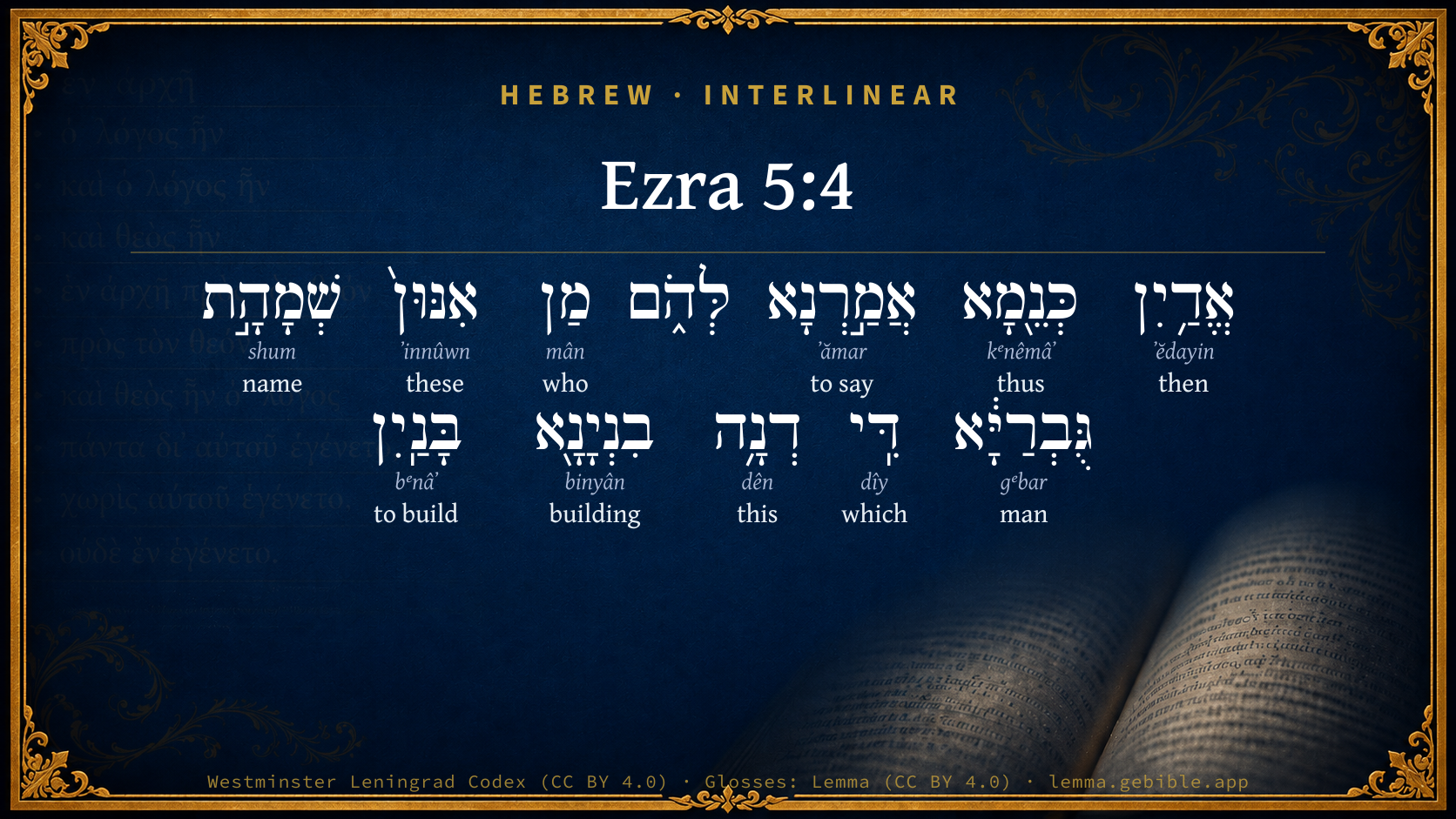
Ezra 5:4

Hebrew (Westminster Leningrad Codex) Ezra 5:4 appears in the Hebrew Old Testament. The text above is from the Westminster Leningrad Codex. Each word links to its Strong’s number, a concise gloss, and parsing drawn from the Open Scriptures Hebrew Bible morphology. Click any word for its full Brown-Driver-Briggs (BDB) entry.
Download image
Cite this verse

Ezra 5:4 (World English Bible). Public Domain. Lemma interlinear Bible study tool, https://lemma.gebible.app/v/ezra/5/4.

Show BibTeX & RIS
BibTeX
RIS
English Translation
Then we told them after this manner, what the names of the men were who were making this building.
World English Bible · Public Domain
Highlights
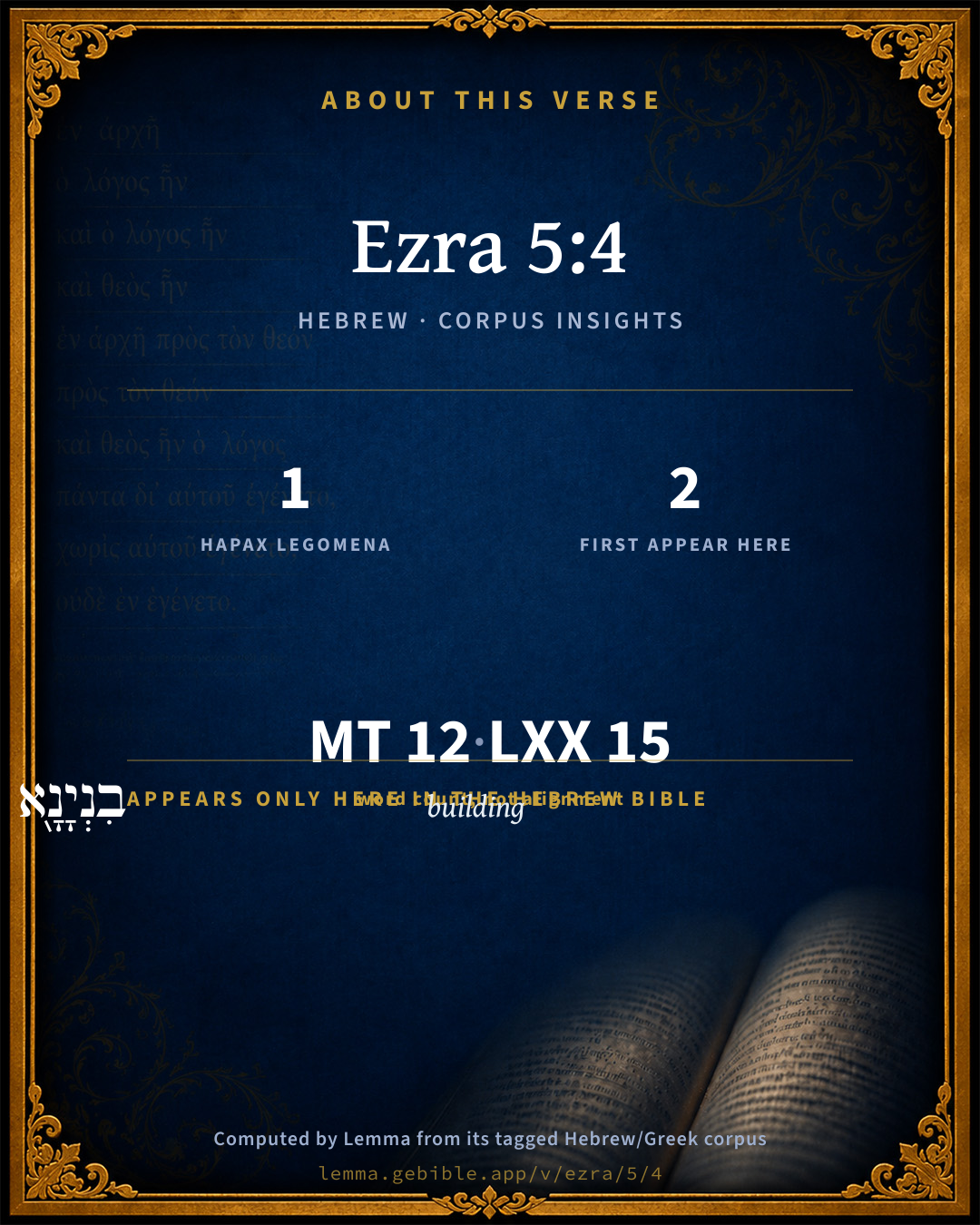
  • 1 hapax legomenon — only here in the Hebrew Bible
  • 2 first appearances in the Hebrew Bible
Full analysis ↓
Download a study sheet

One document with this verse’s original text, its word-by-word gloss line, the meaning frame, cross-references with their text, attributed commentary, and full source and license credits — printable, and it pastes into notes with its structure intact.

This verse Autodidact and up

Study sheet (.html) Plain text (.txt)

A passage Seminary Student

Up to 50 verses in one chapter. A passage sheet keeps up to 6 commentary sources and 12 cross-references per verse, in the order this page ranks them, and says so on the sheet whenever that leaves anything out. Ask for a single verse and you get the Autodidact verse sheet above.

Everything on this page stays free to read, with no account — the sheet is a download of what is already on screen, not access to it.

Want to remove ads? Support Godless Engineer
Compare translations 3

The same verse in 3 English versions, stacked beneath the original-language interlinear above. Click any original word for its lexicon entry.

Each is an independent rendering of the whole verse — the interlinear is not word-aligned to these translations.

Highlighted words mark where these versions differ — a whole-verse word diff, not a word-by-word alignment.

  • World English Bible Public Domain
    Then we told them after this manner, what the names of the men were who were making this building.
  • King James Version Public Domain
    Then said we unto them after this manner, What are the names of the men that make this building?
  • unfoldingWord Literal Text CC BY-SA 4.0
    Then accordingly we said to them, “What are the names of the men who are building this building?”

unfoldingWord Literal Text — © unfoldingWord, licensed CC BY-SA 4.0. Word-aligned USFM3 via Door43 (git.door43.org/unfoldingWord/en_ult).

Versions to compare (up to 4)

3 of 4 selected

Show all 18 translations

Every available English version of this verse, each an independent rendering of the whole verse.

  • World English Bible Public Domain
    Then we told them after this manner, what the names of the men were who were making this building.
  • Berean Standard Bible Public Domain
    They also asked, “What are the names of the men who are constructing this building?”
  • Majority Standard Bible Public Domain
    They also asked, “What are the names of the men who are constructing this building?”
  • King James Version Public Domain
    Then said we unto them after this manner, What are the names of the men that make this building?
  • American Standard Version (1901) Public Domain
    Then we told them after this manner, what the names of the men were that were making this building.
  • Revised Version (1885) Public Domain
    Then spake we unto them after this manner, What are the names of the men that make this building?
  • Geneva Bible (1599) Public Domain
    Then sayde we vnto them after this maner, What are the names of the men that buylde this buylding?
  • Douay-Rheims (1899) Public Domain
    In answer to which we gave them the names of the men who were the promoters of that building.
  • Young's Literal Translation Public Domain
    Then thus we have said to them, `What `are' the names of the men who are building this building?'
  • Literal Standard Version CC BY-SA 4.0
    Then we have said thus to them, “What [are] the names of the men who are building this building?”
  • Unlocked Literal Bible CC BY-SA 4.0
    They also said, “What are the names of the men building this building?”
  • unfoldingWord Literal Text CC BY-SA 4.0
    Then accordingly we said to them, “What are the names of the men who are building this building?”
  • Darby Bible Public Domain
    And they said to them after this manner: What are the names of the men that build this building?
  • World Messianic Bible Public Domain
    They also asked for the names of the men who were making this building.
  • Webster's Bible Public Domain
    Then said we to them after this manner, What are the names of the men that make this building?
  • Free Bible Version CC BY-SA 4.0
    Then they asked, “What are the names of the men who are working on this building?”
  • Bible in Basic English Public Domain
    Then they said these words to them: What are the names of the men who are at work on this building?
  • JPS Tanakh (1917) Public Domain
    'Then spoke we unto them after this manner, wrote they: What are the names of the men that build this building?'

Literal Standard Version (2020), Covenant Press — licensed CC BY-SA 4.0. Text via the HelloAO Bible API (eBible.org). Unlocked Literal Bible (unfoldingWord) — licensed CC BY-SA 4.0. Text via the HelloAO Bible API (eBible.org). unfoldingWord Literal Text — © unfoldingWord, licensed CC BY-SA 4.0. Word-aligned USFM3 via Door43 (git.door43.org/unfoldingWord/en_ult). Free Bible Version, Dr. Jonathan Gallagher — licensed CC BY-SA 4.0. Text via the HelloAO Bible API (eBible.org).

Word by word

More ways to search: Search by grammar → Find every occurrence → Compare this word →

Practice this passage: Drill this verse → Learn its vocabulary →

About this verse

These counts appear in no published source. They are computed here, from the morphology-tagged text and Lemma’s own curated glosses. What Lemma adds →

12
words
11
distinct lemmas
Historical
section

Notable vocabulary

1 hapax legomenon — a word that appears only here in the entire Hebrew Bible:

  • בִנְיָנָ֖א building H1147

First appearance in Scripture

These words make their first canonical appearance in the Hebrew Bible here:

  • אִנּוּן֙ these H581
  • בִנְיָנָ֖א building H1147

Shared distinctive vocabulary

אִנּוּן֙ these H581 occurs in 4 verses of the Hebrew Bible. Also found in:

Grammatical profile

  • 10 adjectives
  • 2 particles

Hebrew & Septuagint length

In English translation the verse runs 19 words from the Hebrew and 17 from the Septuagint (LXX English) — closely comparable.

A rough comparison of the two English renderings, which tokenize alike — not a word-level alignment.

Word counts can differ between the Hebrew and the Greek without any difference in meaning — e.g. the Hebrew direct-object marker אֵת has no separate Greek word, and Greek often adds the article ὁ.

In the original languages it is 12 Hebrew tokens and 15 Greek tokens — but the two are counted differently (Hebrew bundles its prefixes and suffixes into one token; the Greek is in lemma form), so that isn’t a like-for-like length.

Hebrew and Greek witnesses Masoretic Hebrew ↔ Greek Septuagint

The same verse in the two great witnesses to the Old Testament, shown verse-for-verse.

These are two independent witnesses, not word-aligned to each other, and the Septuagint is shown in lemma (dictionary) form.

Hebrew Ezra 5:4 Masoretic · Westminster Leningrad Codex

אֱדַ֥יִן כְּנֵ֖מָא אֲמַ֣רְנָא לְּהֹ֑ם מַן אִנּוּן֙ שְׁמָהָ֣ת גֻּבְרַיָּ֔א דִּֽי דְנָ֥ה בִנְיָנָ֖א בָּנַֽיִן

Then we told them after this manner, what the names of the men were who were making this building.

World English Bible · Public Domain

Greek LXX Ezra 5:4 Septuagint · lemma form

τότε οὗτος εἶπον αὐτός τίς εἰμί ὁ ὄνομα ὁ ἀνήρ ὁ οἰκοδομέω ὁ πόλις οὗτος

Then they spoke thus to them, What are the names of the men that build this city?

LXX2012 (modern English Septuagint) · Public Domain

In the Septuagint this is one book — Esdras B (2 Esdras): Ezra is chapters 1–10, Nehemiah 11–23.

On this verse, The Cambridge Bible for Schools and Colleges discusses the Septuagint’s reading. Read the note in Commentary ↓

Hebrew: Westminster Leningrad Codex (CC BY 4.0). Greek: Septuagint (public domain); English from LXX2012 (modern English Septuagint) (Public Domain). How the Septuagint differs from the Hebrew →

Commentary

Notes on Ezra 5:4 from classic Christian and Jewish commentators (each source and its license shown beneath its notes). The classic Christian expositions comment on the surrounding passage and are grouped to its opening verse, so a note may address several verses; the Jewish commentaries on the Tanakh (Rashi and others) are per-verse, so they appear only where the commentator wrote on this verse.

Lemma curates 59 commentaries, every one of them public domain or Creative Commons licensed, each selected and text-cleaned for this edition rather than reprinted as found. About our sources →

The Cambridge Bible for Schools and Colleges

gen. ed. J. J. S. Perowne

4. Then said we unto them, &c.] R.V. Then spake we unto them after this manner, What, &c. Margin, ‘Or, Then spake we unto them after this manner. What, said they, are the names’, &c. ‘Or, according to some ancient versions, Then spake they unto them, &c. See Ezr_5:10.’

(a) The reading followed in the A.V. and R.V. is practically unintelligible. ‘Then spake we’ would naturally introduce the Jews’ reply (the first person being remarkable, but quite intelligible): but the question, ‘What are the names of the men that make this building?’ is as obviously the question of the governor. It is equally impossible to apply ‘we’ to the governor and his companions, and to see in ‘Then spake we unto them’, &c. a continuance of ‘came Tattenai’, &c. The only possible rendering is, ‘Then spake we unto them after this manner (with reference to the question), What are’, &c. But the ellipse is so harsh as to make this, even if it were grammatically possible, inadmissible.

(b) On the other hand, the alternative reading, given as the second alternative in the Margin of the R.V., supplies the sense needed by the context, i.e. ‘They said’. This is supported by the LXX. (τότε ταῦτα εἴποσαν αὐτοῖς) and the Peshitto Syriac. It is also supported by internal evidence. In Ezr_5:3, Tattenai and his friends ask the first question relating to official permission; in Ezr_5:4 (according to the emended reading) they ask a further question, as to the names of the Jewish leaders. To neither question is the answer of the Jews directly recorded, since the substance of their answers is reported in the letter to Darius (2–16). That letter mentions also the interrogatories. The first interrogation is repeated verbatim (Ezr_5:9). The second is described (Ezr_5:10), ‘We asked them their names also’, in a manner exactly corresponding to the present verse, Then spake they unto them after this manner, What are the names?

The emendation, it must be admitted, is the easier reading, and is therefore perhaps to be suspected as a correction. But it is impossible to accept the A.V. text as representing the original. It is best to receive the reading of the LXX. ‘They said’, and to regard the reading ‘we said’, as a very early error of a scribe who by a natural mistake began to write the 4th verse as the answer in a dialogue.

What are the names, &c.] Cf. Ezr_5:10, ‘the names of the men that were at the head of them’.

This enquiry would hardly have been made if the correspondence recorded in Ezr_4:7-23 had taken place in the seven months’ reign of Pseudo-Smerdis, and had brought official investigation so recently to bear upon the affairs of Jerusalem.

The Cambridge Bible for Schools and Colleges (gen. ed. J. J. S. Perowne; Cambridge University Press, 1878–1918) — public domain. Text from a community e-Sword module.

Trapp's Complete Commentary

John Trapp

Ezr 5:4 Then said we unto them after this manner, What are the names of the men that make this building?

Ver. 4. Then said we unto them] We (Tatnai, Shetherboznai, and their companions) thus said, and thus inquired; see Ezr 5:16, and be sensible how wicked men conceive mischief, and bring forth iniquity, "and their belly prepareth deceit," Job 15:35. Not their heads only are hammering it, but their bellies are hatching it; they take a kind of contemplative kind of pleasure in their wily projects, as the epicure doth in his dainties; he delights to be acting them over beforehand.

What are the names of the men] They that are minded to do mischief unto others will do what they can to know their names. I have heard of one (saith Master Fox) who being sent to the Christian congregation in Queen Mary’s days in London to take their names, and to espy their doings, yet in being among them was converted, and cried them all mercy (Acts and Mon. fol. 1881). Tremellius readeth this text otherwise. Then answered we them thus, and [told them] what were the names of the men who built this building. He means, as I conceive, We were not ashamed or afraid to make them around and ready answer; and to give them the names of our chieftains, Zerubbabel, Jeshua, Haggai, Zechariah, &c. This was better than that of those cold friends to religion, 1Ki 18:11, who (when the prophet had said, If the Lord be God, follow him) held their peace, and thought it good policy to reserve themselves. Better also than that of the bondslaves of Antichrist, who receive his mark in their hand, the which they may, as occasion serveth, cover or discover, Rev 13:16. The servants of the God of heaven and earth (such as were these in this chapter, Ezr 5:11) receive his mark in their foreheads, where it may be seen and read of all, Rev 7:3. The primitive Christians were called in derision Confitentes; and Chrysostom saith of them, that they would not be kept from visiting the martyrs in prison, tametsi multis terroribus, &c., though they were much threatened, and punished for so doing (Hom. Deu 2:1-37 Martyr.).

John Trapp, A Commentary or Exposition upon All the Books of the Old and New Testament (1647–1656) — public domain. Text from a community e-Sword module.

Geneva Bible (1599)

Geneva Bible translators

That is, the enemies asked this, as verse 10.

Geneva Bible (1599) marginal notes — public domain. Text via Bolls.life.

Adam Clarke's Commentary

Verse 4. What are the names] It is most evident that this is the answer of the Jews to the inquiry of Tatnai, Ezr 5:3, and the verse should be read thus: Then said we unto them after this manner: THESE are the names of the men who make this building.

Adam Clarke's Commentary on the Bible (1810–1826) — public domain. Text from a community e-Sword/MySword module.

Ellicott's Commentary for English Readers

(4) Then said we.—The LXX. must here have read, “then said they.” But there is no need to change the text; the sentence is not a question, but a statement: “we said to the effect, what the names were.”

What are the names of the men . . .?—It is clear that this graphic account is much compressed. We must understand (see Ezr_5:10) that the authorities demanded the names of the chief promoters of the building in order to make them responsible.

A Bible Commentary for English Readers, edited by Charles John Ellicott (1878–1897) — public domain. Text from a community e-Sword module.

John Gill's Exposition

Then said we unto them after this manner,.... In answer to their questions; namely, Ezra and other Jews replied; for though Ezra is said after this to come from Babylon in the seventh year of Artaxerxes, he might go thither on some business, and then return again at that time; some indeed think these are the words of Tatnai and those with him; so Ben Melech, which seems to be favoured by Ezr 4:10, and by reading the words with an interrogation, as we do; Aben Ezra says they are either the words of the builders, or of the scribes, the secretaries that came to question them; but they are the words of the former, as order requires, or otherwise no answer would be returned, at least as expressed; and the next clause may be read without an interrogation, and the sense be, that they told them not only that they acted according to an edict of Cyrus king of Persia, for this was said, as appears from Ezr 5:13, but they declared

what were the names of the men that did make this building; or employed them in it, namely, Zerubbabel, Jeshua, and the chief men of the Jews; they made no scruple of telling them who they were; neither ashamed of their masters nor of their work, nor afraid of any ill consequences following hereafter.

John Gill's Exposition of the Whole Bible (1746–1763) — public domain (CC PDM 1.0). Text via the HelloAO Bible API.

Albert Barnes' Notes on the Bible

Then said we - The Septuagint, Syriac, and Arabic versions have “Then said they,” which brings this verse into exact accordance with Ezr 5:10.

Albert Barnes' Notes on the Bible (1834–1885) — public domain. Text from a community e-Sword/MySword module.

Haydock's Catholic Bible Commentary

In. Septuagint, "Then I (or they; Greek: eipon. The Syriac and Arabic declare for the latter) said thus to them: What," &c. --- We gave. Chaldean, "what are the names?" (Haydock) --- It seems Thathanai asked this question, ver. 10. The Jews might give in the names of Zorobabel, Josue, Aggeus, &c. (Calmet)

George Leo Haydock (1774–1849), Haydock's Catholic Family Bible and Commentary, 1859 edition — public domain. Excludes Psalms (Douay-Rheims chapter numbering differs from Protestant) and Deuterocanonical books (Catholic canon only).

Matthew Poole's English Annotations

Then said we; either,

1. We Tatnai and Shethar-boznai. And so this is an additional and more express inquiry concerning the names of the builders. And this sense is favoured by comparing Ezr 5:9,10, where the same questions here severally made, Ezr 5:3,4, are in like manner distinguished. And so the sacred writer speaks this in their person; such variation of persons being frequent in the Hebrew language, as the learned know. Or,

2. We Jews; and so the translation must be a little varied, and the words read without an interrogation, thus, Then we told them accordingly (i.e. according to what they asked)

what were the names of the men that made this building, i.e. who were the chief undertakers and encouragers of this work; for although the Hebrew particle mah, rendered what, seems always to be used interrogatively, yet the Chaldee particle man, here rendered what, is used otherwise, as is manifest from Dan 4:17.

Matthew Poole's English Annotations on the Holy Bible (1683–1685) — public domain. Text from a community e-Sword/MySword module.

Whedon's Commentary on the Bible

Daniel D. Whedon

4. Then said we — The elders of the Jews. From the use of the first person here, it is evident that this account was written by an eye-witness.

What are the names of the men — Not to be taken interrogatively, but thus, what the names of the men were. Literally, who they were — the names of the men. The whole verse should be translated thus: Then thus told we them who they were — the names of the men — who this building were building.

Daniel D. Whedon (gen. ed.), Commentary on the Old and New Testaments (1874–1909) — public domain. Text from a community e-Sword module.

The Pulpit Commentary

Then said we unto them. It is impossible that the existing text can be sound here. Ezra must have written, "Then said they to them." Tatnai and Shethar-boznai followed up their first question by a second, "What are the names of the men that make this building?" (comp. below, vers. 9, 10).

The Pulpit Commentary (1880–1919), ed. H.D.M. Spence-Jones & Joseph S. Exell — public domain. Text from a community e-Sword module.

John Wesley's Explanatory Notes

We - Jews. Accordingly - According to what they asked. That made this building - That were the undertakers and encouragers of it.

John Wesley, Explanatory Notes Upon the Whole Bible (1754–1765) — public domain. Text via the GEBible commentary corpus.

Rashi

Rabbi Shlomo Yitzchaki (Rashi)

Then [as translated,] then.

as we will say [as translated,] as we will say.

they said to them Those adversaries of Judah and Benjamin said to them [i.e.,] to Israel.

What are What are the names of the men?

who...this who are building this building.

Rashi on the Tanakh — English translations: “The Judaica Press complete Tanach with Rashi, translated by A. J. Rosenberg” (CC BY 4.0); “Pentateuch with Rashi's commentary by M. Rosenbaum and A.M. Silbermann, 1929-1934” (public domain); “The Metsudah Tanach series, Lakewood, N.J” (CC BY 4.0); and “The Book of Joshua, Metsudah Publications, 1997” (CC BY 4.0). Text via Sefaria.

Lesson kit

Teaching starters — assembled from the data on this page, not authored interpretation. Every prompt links to the verse data it draws on. Edit before teaching.

Ezra, in the Historical, opens this verse with 12 words (11 distinct Hebrew lemmas). Its most distinctive word is binyân (“building”). A historical commentator’s framing appears above. Read the whole chapter for the surrounding context.

Discussion questions

  1. What does “building” (binyân) contribute to the verse as a whole?
  2. 1 word here appears nowhere else in the Hebrew Bible. Why might the author reach for such rare wording?
  3. 2 words make their first appearance in Scripture here. What does this debut establish?
  4. How does Daniel 2:44, which shares the word «these», read alongside this verse?
  5. The translations on this page render this verse differently — a whole-verse word diff, not a word-by-word alignment. What might account for the different wordings?
  6. Compare how The Cambridge Bible for Schools and Colleges and Trapp's Complete Commentary read this verse. Where do they agree or differ?

Things to notice

Reading settings

Reading text

Shown beneath each verse's original-language words.

Old Testament
Old Testament edition

Read the OT as the Masoretic Hebrew (MT) or the Greek Septuagint (LXX).

English shown for the Greek Septuagint (in the Hebrew ↔ Greek comparison).

Comparing translations? Open the Compare panel on any verse page to stack up to four side by side.