
Daniel 4:14

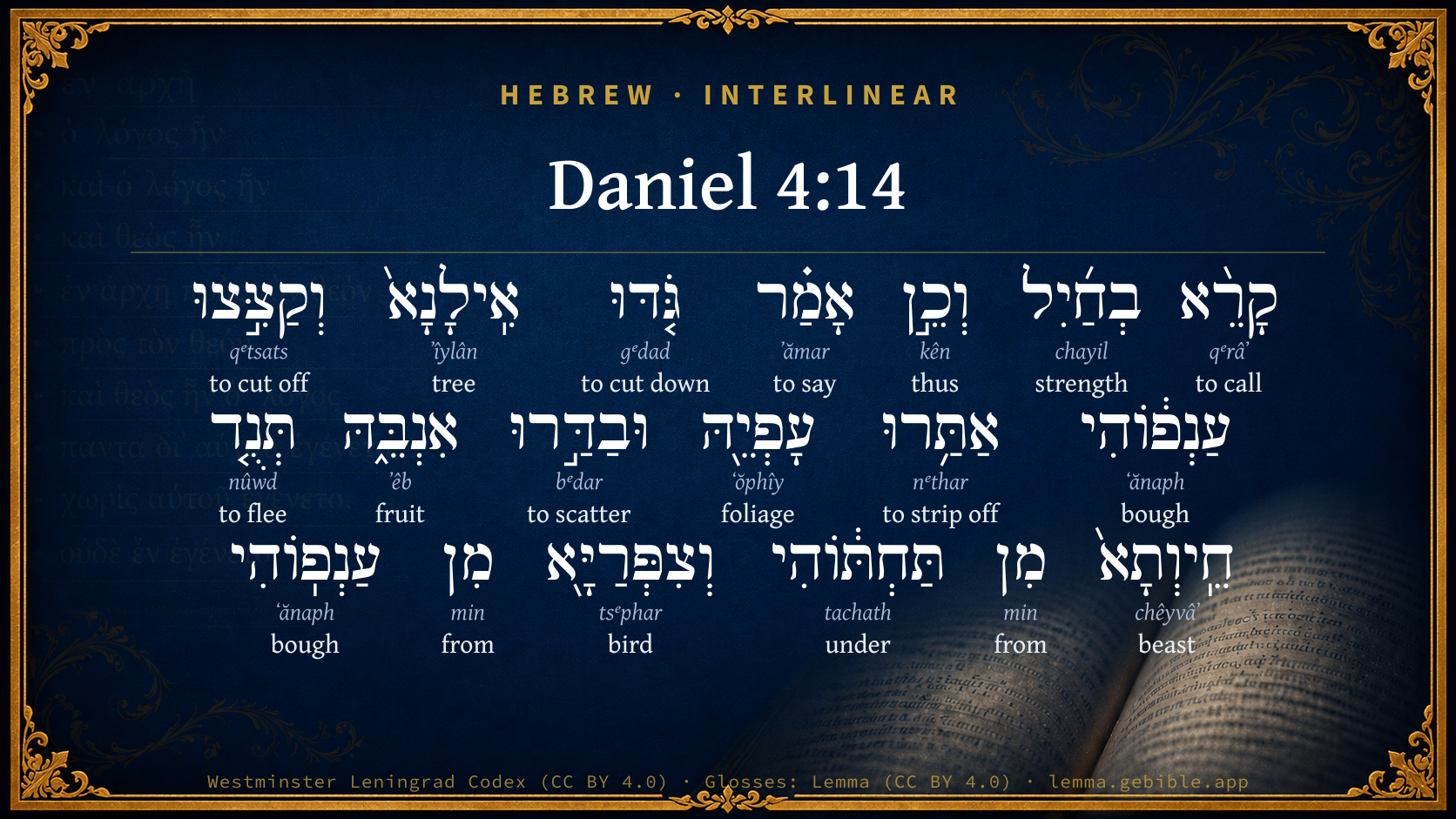
Hebrew (Westminster Leningrad Codex) Daniel 4:14 appears in the Hebrew Old Testament. The text above is from the Westminster Leningrad Codex. Each word links to its Strong’s number, a concise gloss, and parsing drawn from the Open Scriptures Hebrew Bible morphology. Click any word for its full Brown-Driver-Briggs (BDB) entry.
Download image
Cite this verse

Daniel 4:14 (World English Bible). Public Domain. Lemma interlinear Bible study tool, https://lemma.gebible.app/v/daniel/4/14.

Show BibTeX & RIS
BibTeX
RIS
English Translation
He cried aloud, and said thus, Hew down the tree, and cut off its branches, shake off its leaves, and scatter its fruit: let the animals get away from under it, and the fowls from its branches.
World English Bible · Public Domain
Highlights Full analysis ↓
Download a study sheet

One document with this verse’s original text, its word-by-word gloss line, the meaning frame, cross-references with their text, attributed commentary, and full source and license credits — printable, and it pastes into notes with its structure intact.

This verse Autodidact and up

Study sheet (.html) Plain text (.txt)

A passage Seminary Student

Up to 50 verses in one chapter. A passage sheet keeps up to 6 commentary sources and 12 cross-references per verse, in the order this page ranks them, and says so on the sheet whenever that leaves anything out. Ask for a single verse and you get the Autodidact verse sheet above.

Everything on this page stays free to read, with no account — the sheet is a download of what is already on screen, not access to it.

Want to remove ads? Support Godless Engineer
Compare translations 3

The same verse in 3 English versions, stacked beneath the original-language interlinear above. Click any original word for its lexicon entry.

Each is an independent rendering of the whole verse — the interlinear is not word-aligned to these translations.

Highlighted words mark where these versions differ — a whole-verse word diff, not a word-by-word alignment.

  • World English Bible Public Domain
    He cried aloud, and said thus, Hew down the tree, and cut off its branches, shake off its leaves, and scatter its fruit: let the animals get away from under it, and the fowls from its branches.
  • King James Version Public Domain
    He cried aloud, and said thus, Hew down the tree, and cut off his branches, shake off his leaves, and scatter his fruit: let the beasts get away from under it, and the fowls from his branches:
  • unfoldingWord Literal Text CC BY-SA 4.0
    He shouted aloud and said thus, ‘Chop down the tree and cut off its branches, strip off its leaves, and scatter its fruit. Let the animals flee from under it and the birds from its branches.

unfoldingWord Literal Text — © unfoldingWord, licensed CC BY-SA 4.0. Word-aligned USFM3 via Door43 (git.door43.org/unfoldingWord/en_ult).

Versions to compare (up to 4)

3 of 4 selected

Show all 18 translations

Every available English version of this verse, each an independent rendering of the whole verse.

  • World English Bible Public Domain
    He cried aloud, and said thus, Hew down the tree, and cut off its branches, shake off its leaves, and scatter its fruit: let the animals get away from under it, and the fowls from its branches.
  • Berean Standard Bible Public Domain
    He called out in a loud voice: ‘Cut down the tree and chop off its branches; strip off its leaves and scatter its fruit. Let the beasts flee from under it, and the birds from its branches.
  • Majority Standard Bible Public Domain
    He called out in a loud voice: ‘Cut down the tree and chop off its branches; strip off its leaves and scatter its fruit. Let the beasts flee from under it, and the birds from its branches.
  • King James Version Public Domain
    He cried aloud, and said thus, Hew down the tree, and cut off his branches, shake off his leaves, and scatter his fruit: let the beasts get away from under it, and the fowls from his branches:
  • American Standard Version (1901) Public Domain
    He cried aloud, and said thus, Hew down the tree, and cut off its branches, shake off its leaves, and scatter its fruit: let the beasts get away from under it, and the fowls from its branches.
  • Revised Version (1885) Public Domain
    He cried aloud, and said thus, Hew down the tree, and cut off his branches, shake off his leaves, and scatter his fruit: let the beasts get away from under it, and the fowls from his branches.
  • Geneva Bible (1599) Public Domain
    The sentence is according to the decree of the watchmen, and according to the word of the holy ones: the demaunde was answered, to the intent that liuing men may knowe, that the most High hath power ouer the kingdome of men, and giueth it to whomsoeuer he will, and appointeth ouer it the most abiect among men.
  • Douay-Rheims (1899) Public Domain
    He cried aloud, and said thus: Cut down the tree, and chop off the branches thereof: shake off its leaves, and scatter its fruits: let the beasts fly away that are under it, and the birds from its branches.
  • Young's Literal Translation Public Domain
    He is calling mightily, and thus hath said, Cut down the tree, and cut off its branches, shake off its leaves, and scatter its budding, move away let the beast from under it, and the birds from off its branches;
  • Literal Standard Version CC BY-SA 4.0
    He is calling mightily, and thus has said, Cut down the tree, and cut off its branches, shake off its leaves, and scatter its budding, move away let the beast from under it, and the birds from off its branches;
  • Unlocked Literal Bible CC BY-SA 4.0
    He shouted and said, 'Chop down the tree and cut off its branches, strip off its leaves, and scatter its fruit. Let the animals flee from under it and the birds fly away from its branches.
  • unfoldingWord Literal Text CC BY-SA 4.0
    He shouted aloud and said thus, ‘Chop down the tree and cut off its branches, strip off its leaves, and scatter its fruit. Let the animals flee from under it and the birds from its branches.
  • Darby Bible Public Domain
    he cried aloud, and said thus: Hew down the tree, and cut off its branches, shake off its leaves, and scatter its fruit; let the beasts get away from under it, and the birds from its branches.
  • World Messianic Bible Public Domain
    He cried aloud and said this: ‘Cut down the tree, and cut off its branches! Shake off its leaves and scatter its fruit! Let the animals get away from under it and the birds from its branches.
  • Webster's Bible Public Domain
    He cried aloud, and said thus, Hew down the tree, and cut off its branches, shake off its leaves, and scatter its fruit: let the beasts escape from under it, and the fowls from its branches.
  • Free Bible Version CC BY-SA 4.0
    He cried out in a loud voice, ‘Cut down the tree and chop off its branches! Shake off its leaves and scatter its fruit! Drive the animals away from its shade, and scare off the birds from its branches.
  • Bible in Basic English Public Domain
    Crying out with a loud voice; and this is what he said: Let the tree be cut down and its branches broken off; let its leaves be taken off and its fruit sent in every direction: let the beasts get away from under it and the birds from its branches:
  • JPS Tanakh (1917) Public Domain
    (4-11) He cried aloud, and said thus: Hew down the tree, and cut off its branches, shake off its leaves, and scatter its fruit; let the beasts get away from under it, and the fowls from its branches.

Literal Standard Version (2020), Covenant Press — licensed CC BY-SA 4.0. Text via the HelloAO Bible API (eBible.org). Unlocked Literal Bible (unfoldingWord) — licensed CC BY-SA 4.0. Text via the HelloAO Bible API (eBible.org). unfoldingWord Literal Text — © unfoldingWord, licensed CC BY-SA 4.0. Word-aligned USFM3 via Door43 (git.door43.org/unfoldingWord/en_ult). Free Bible Version, Dr. Jonathan Gallagher — licensed CC BY-SA 4.0. Text via the HelloAO Bible API (eBible.org).

Word by word

More ways to search: Search by grammar → Find every occurrence → Compare this word →

Practice this passage: Drill this verse → Learn its vocabulary →

וְקַצִּ֣צוּ
qᵉtsats
H7113
“and · cut off”
Adjective, C + Verb, Piel, Imperative, 2nd Person, Masculine, Plural
Part of Speech
Adjective + Verb
Stem
Piel
Form
Imperative
Person
2nd Person
Gender
Masculine
Number
Plural
Full BDB Definition

Origin: corresponding to H7112

TWOT: None

(Pael) to cut off
  1. קָרֵ֨א qᵉrâʼ H7123 “calling” Adjective, V
  2. בְחַ֜יִל chayil H2429 “in/at · strength” Adjective, R + Noun, Common, Masculine, Singular, Absolute
  3. וְכֵ֣ן kên H3652 “and · thus” Adjective, C + Adverb
  4. אָמַ֗ר ʼămar H560 “saying” Adjective, V
  5. גֹּ֤דּוּ gᵉdad H1414 “cut down” Adjective, V
  6. אִֽילָנָא֙ ʼîylân H363 “tree · the” Adjective, N, Common + Particle, Definite Article
  7. עַנְפ֔וֹהִי ʻănaph H6056 “boughs · his” Adjective, N, Common + Suffix, Personal, 3rd Person, Masculine, Singular
  8. אַתַּ֥רוּ nᵉthar H5426 “strip off” Adjective, V
  9. עָפְיֵ֖הּ ʻŏphîy H6074 “foliage · his” Adjective, N, Common + Suffix, Personal, 3rd Person, Masculine, Singular
  10. וּבַדַּ֣רוּ bᵉdar H921 “and · scatter” Adjective, C + Verb, Piel, Imperative, 2nd Person, Masculine, Plural
  11. אִנְבֵּ֑הּ ʼêb H4 “fruit · his” Adjective, N, Common + Suffix, Personal, 3rd Person, Masculine, Singular
  12. תְּנֻ֤ד nûwd H5111 “to flee” Adjective, V
  13. חֵֽיוְתָא֙ chêyvâʼ H2423 “beast · the” Adjective, N, Common + Particle, Definite Article
  14. מִן min H4481 “from” Adjective, R
  15. תַּחְתּ֔וֹהִי tachath H8479 “under · him” Adjective, R + Suffix, Personal, 3rd Person, Masculine, Singular
  16. וְצִפְּרַיָּ֖א tsᵉphar H6853 “and · birds · the” Adjective, C + Noun, Common, Feminine, Plural, Determined + Particle, Definite Article
  17. מִן min H4481 “from” Adjective, R
  18. עַנְפֽוֹהִי ʻănaph H6056 “bough · his” Adjective, N, Common + Suffix, Personal, 3rd Person, Masculine, Singular

About this verse

These counts appear in no published source. They are computed here, from the morphology-tagged text and Lemma’s own curated glosses. What Lemma adds →

19
words
17
distinct lemmas
Prophets
section

Notable vocabulary

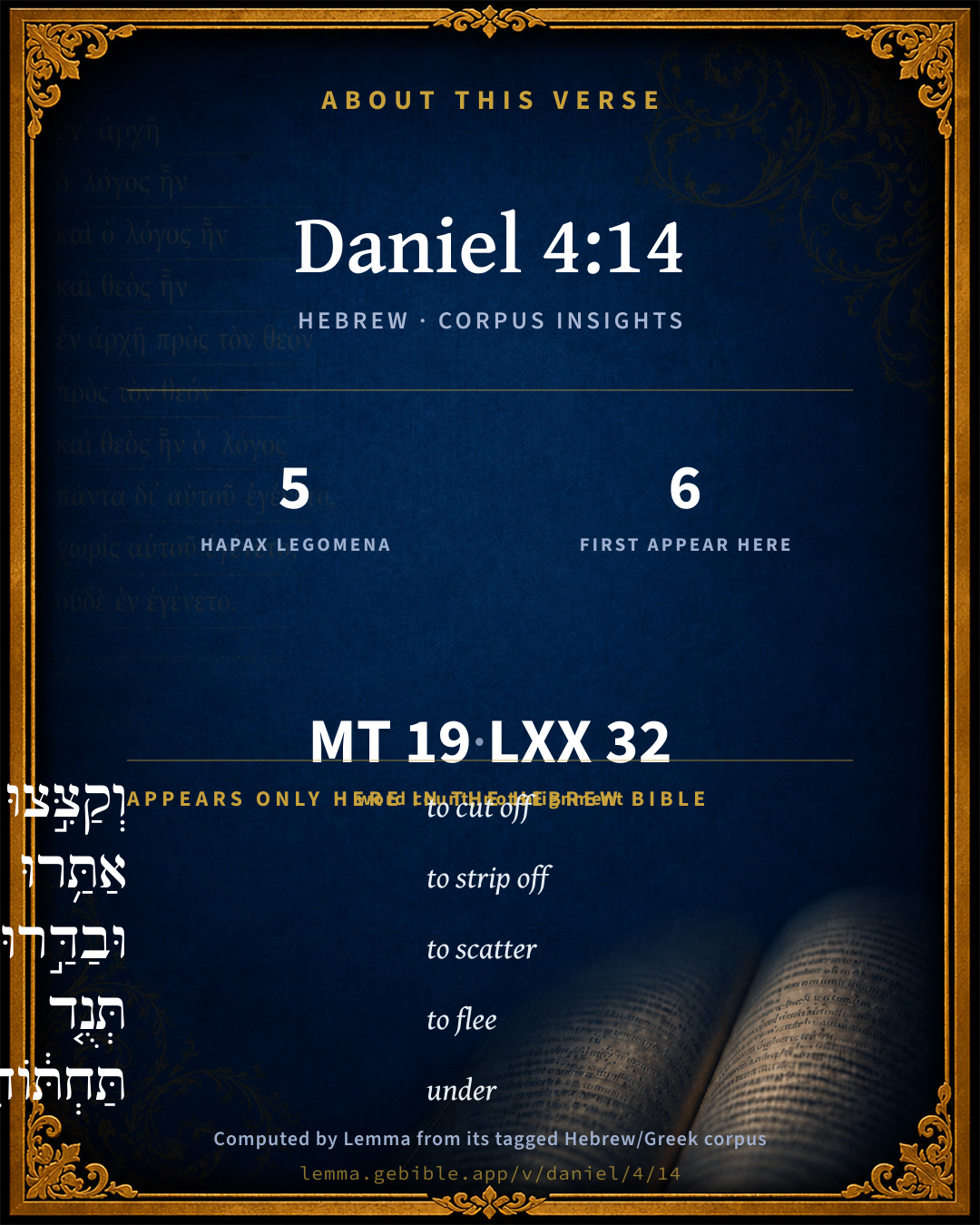
5 hapax legomena — words that appear only here in the entire Hebrew Bible:

  • וְקַצִּ֣צוּ to cut off H7113
  • אַתַּ֥רוּ to strip off H5426
  • וּבַדַּ֣רוּ to scatter H921
  • תְּנֻ֤ד to flee H5111
  • תַּחְתּ֔וֹהִי under H8479

First appearance in Scripture

These words make their first canonical appearance in the Hebrew Bible here:

  • גֹּ֤דּוּ to cut down H1414
  • וְקַצִּ֣צוּ to cut off H7113
  • אַתַּ֥רוּ to strip off H5426
  • וּבַדַּ֣רוּ to scatter H921
  • תְּנֻ֤ד to flee H5111
  • תַּחְתּ֔וֹהִי under H8479

Shared distinctive vocabulary

גֹּ֤דּוּ to cut down H1414 occurs in 2 verses of the Hebrew Bible. Also found in:

Grammatical profile

  • 2 verbs
  • 1 noun
  • 12 adjectives
  • 1 adverb
  • 3 particles

Verb forms

  • וְקַצִּ֣צוּ Piel · Imperative
  • וּבַדַּ֣רוּ Piel · Imperative

Repetition

Words recur within this verse — often emphatic in Hebrew:

  • עַנְפ֔וֹהִי bough H6056 ×2
  • מִן from H4481 ×2

Hebrew & Septuagint length

In English translation the verse runs 37 words from the Hebrew and 59 from the Septuagint (LXX English) — the Septuagint runs noticeably longer here. See the side-by-side →

A rough comparison of the two English renderings, which tokenize alike — not a word-level alignment.

Word counts can differ between the Hebrew and the Greek without any difference in meaning — e.g. the Hebrew direct-object marker אֵת has no separate Greek word, and Greek often adds the article ὁ.

In the original languages it is 19 Hebrew tokens and 32 Greek tokens — but the two are counted differently (Hebrew bundles its prefixes and suffixes into one token; the Greek is in lemma form), so that isn’t a like-for-like length.

Cross-references

13

Topical passages linked to Daniel 4:14 in the Treasury of Scripture Knowledge — connected by theme and wording, ordered by reader-vote popularity; previews shown in the World English Bible.

  • Matthew 3:10 "Even now the axe lies at the root of the trees. Therefore, every tree that doesn't bring forth good fruit is cut down, and cast into the fire.
  • Ezekiel 31:12–13 Strangers, the terrible of the nations, have cut him off, and have left him: on the mountains and in all the valleys his branches are fallen, and his boughs are broken by all the watercourses of the land; and all the peoples of the earth are gone down from his shadow, and have left him.
  • Daniel 4:23 Whereas the king saw a watcher and a holy one coming down from the sky, and saying, Hew down the tree, and destroy it; nevertheless leave the stump of the roots of it in the earth, even with a band of iron and brass, in the tender grass of the field, and let it be wet with the dew of the sky: and let his portion be with the animals of the field, until seven times pass over him;
  • Daniel 3:4 Then the herald cried aloud, To you it is commanded, peoples, nations, and languages,
  • Daniel 4:12 The leaves of it were beautiful, and the fruit of it much, and in it was food for all: the animals of the field had shadow under it, and the birds of the sky lived in the branches of it, and all flesh was fed from it.
  • Matthew 7:19 Every tree that doesn't grow good fruit is cut down, and thrown into the fire.
  • Luke 3:9 Even now the axe also lies at the root of the trees. Every tree therefore that doesn't bring forth good fruit is cut down, and thrown into the fire."
  • Luke 13:7–9 He said to the vine dresser, 'Behold, these three years I have come looking for fruit on this fig tree, and found none. Cut it down. Why does it waste the soil?'
  • Jeremiah 51:6 Flee out of the midst of Babylon, and save every man his life; don't be cut off in her iniquity: for it is the time of Yahweh's vengeance; he will render to her a recompense.
  • Jeremiah 51:9 We would have healed Babylon, but she is not healed: forsake her, and let us go everyone into his own country; for her judgment reaches to heaven, and is lifted up even to the skies.
  • Daniel 5:20 But when his heart was lifted up, and his spirit was hardened so that he dealt proudly, he was deposed from his kingly throne, and they took his glory from him:
  • Revelation 10:3 He cried with a loud voice, as a lion roars. When he cried, the seven thunders uttered their voices.
  • Revelation 18:2 He cried with a mighty voice, saying, "Fallen, fallen is Babylon the great, and she has become a habitation of demons, a prison of every unclean spirit, and a prison of every unclean and hateful bird!

Cross-references courtesy of OpenBible.info (CC BY 4.0).

Hebrew and Greek witnesses Masoretic Hebrew ↔ Greek Septuagint

The same verse in the two great witnesses to the Old Testament, shown verse-for-verse.

Here the Septuagint runs noticeably longer than the Hebrew — LXX2012 (modern English Septuagint) 59 words vs World English Bible 37. A rough length comparison of the two English translations, not a word-level alignment — read both below.

These are two independent witnesses, not word-aligned to each other, and the Septuagint is shown in lemma (dictionary) form.

Hebrew Daniel 4:14 Masoretic · Westminster Leningrad Codex

קָרֵ֨א בְחַ֜יִל וְכֵ֣ן אָמַ֗ר גֹּ֤דּוּ אִֽילָנָא֙ וְקַצִּ֣צוּ עַנְפ֔וֹהִי אַתַּ֥רוּ עָפְיֵ֖הּ וּבַדַּ֣רוּ אִנְבֵּ֑הּ תְּנֻ֤ד חֵֽיוְתָא֙ מִן תַּחְתּ֔וֹהִי וְצִפְּרַיָּ֖א מִן עַנְפֽוֹהִי

He cried aloud, and said thus, Hew down the tree, and cut off its branches, shake off its leaves, and scatter its fruit: let the animals get away from under it, and the fowls from its branches.

World English Bible · Public Domain

Greek LXX Daniel 4:14 Septuagint · lemma form

καί πᾶς ὁ πετεινός ὁ οὐρανός ὁ νοσσεύω ἐν αὐτός ὁ ἰσχύς ὁ γῆ καί ὁ ἔθνος καί ὁ γλῶσσα πᾶς ἕως ὁ πέρας ὁ γῆ καί πᾶς ὁ χώρα σύ δουλεύω

The matter is by the decree of the watcher, and the demand is a word of the holy ones; that the living may known that the Lord is most high over the kingdom of men, and he will give it to whoever he shall please, and will set up over it that which is set at nothing of men.

LXX2012 (modern English Septuagint) · Public Domain

On this verse, The Pulpit Commentary discusses the Septuagint’s reading. Read the note in Commentary ↓

Hebrew: Westminster Leningrad Codex (CC BY 4.0). Greek: Septuagint (public domain); English from LXX2012 (modern English Septuagint) (Public Domain). How the Septuagint differs from the Hebrew →

Commentary

Notes on Daniel 4:14 from classic Christian and Jewish commentators (each source and its license shown beneath its notes). The classic Christian expositions comment on the surrounding passage and are grouped to its opening verse, so a note may address several verses; the Jewish commentaries on the Tanakh (Rashi and others) are per-verse, so they appear only where the commentator wrote on this verse.

Lemma curates 59 commentaries, every one of them public domain or Creative Commons licensed, each selected and text-cleaned for this edition rather than reprinted as found. About our sources →

Trapp's Complete Commentary

John Trapp

Dan 4:14 He cried aloud, and said thus, Hew down the tree, and cut off his branches, shake off his leaves, and scatter his fruit: let the beasts get away from under it, and the fowls from his branches:

Ver. 14. Hew down the tree, and cut off his branches.] One angel seems to call to another to expedite the execution, so earnest they are in the Church’s revenge. {Rev 18:21}

Let the beasts get away.] Let this great conqueror be stripped at once of his train and dignity. The Duke of Florence gave for his ensign a great tree with many spreading boughs, one of them being cut off, with this posy, Uno avulso non deficit alter; but here it was otherwise.

John Trapp, A Commentary or Exposition upon All the Books of the Old and New Testament (1647–1656) — public domain. Text from a community e-Sword module.

Tyndale Open Study Notes

Tyndale Open Resources

4:14-17 The messenger had full authority as the representative of the Most High to announce God’s decrees and demand that they be fulfilled.

Tyndale Open Study Notes — © Tyndale Open Resources, licensed CC BY-SA 4.0. Text via the HelloAO Bible API.

Ibn Ezra

Rabbi Abraham ibn Ezra

[Daniel 4:14] By the decree (בִּגְזֵרַ֤ת): Thus they [the Watchers] decreed, for they are the ministers of God (מְשָׁרְתֵי הַשֵּׁם - m'shar'tei Hashem), [acting] as He commanded them. And “this is the command of the holy ones” (וּמֵאמַ֥ר קַדִּישִׁ֖ין שְׁאֵֽלְתָ֑א). And the question is, why this [decree]? [The verse answers:] “So that the living may know” (עַד־דִּבְרַ֡ת דִּ֣י יִנְדְּע֣וּן חַ֠יַּיָּ֠א) that the Most High (הָעֶלְיוֹן - Ha-Elyon), who is God (הַשֵּׁם - Hashem), “is sovereign over the lowly kingdom of men” (שַׁלִּ֨יט... בְּמַלְכ֣וּת אֲנָשָׁ֗א הַשְּׁפֵלָה - shallit... b'malchut anasha ha-sh'felah), “and He gives it to whom He wishes, and sets up over it the lowest of men” (וּלְמַן־דִּ֤י יִצְבֵּא֙ יִתְּנִנַּ֔הּ וּשְׁפַ֥ל אֲנָשִׁ֖ים יְקִ֥ים עֲלַֽהּ).

Ibn Ezra on the Tanakh — English translations: “Sefaria Community Translation” (CC0 1.0 (public-domain dedication)); “Yalkut, Sifsei Chachomim Chumash, Metsudah Publications, 2009” (CC BY 4.0); and “Commentary of Ibn Ezra on Isaiah - trans. by M. Friedlander, 1873” (public domain). Text via Sefaria.

Geneva Bible (1599)

Geneva Bible translators

God hath decreed this judgment and the whole army of heaven have as it were subscribed unto it, like as also they desire the execution of his decree against all them that lift up themselves against God.

Geneva Bible (1599) marginal notes — public domain. Text via Bolls.life.

Jamieson, Fausset & Brown

Robert Jamieson, A. R. Fausset & David Brown

Hew down-- (Mat 3:10; Luk 13:7). The holy (Jde 1:14) one incites his fellow angels to God's appointed work (compare Rev 14:15, Rev 14:18).

beasts get away from under it--It shall no longer afford them shelter (Eze 31:12).

Jamieson, Fausset & Brown — Commentary Critical and Explanatory on the Whole Bible (1871) — public domain (CC PDM 1.0). Text via the HelloAO Bible API.

Adam Clarke's Commentary

Verse 14. Hew down the tree] As the tree was to be cut down, the beasts are commanded to flee away from under his branches. His courtiers, officers, c., all abandoned him as soon as his insanity appeared but he soon fled from the society of men.

Adam Clarke's Commentary on the Bible (1810–1826) — public domain. Text from a community e-Sword/MySword module.

John Calvin's Commentaries

He afterwards adds—the angel cried with a loud voice, cut down the tree, strip off the leaves, cut off its boughs, scatter its fruits, (or throw them away,) and let the beasts flee from its shadow, and the birds of heaven dwell no longer under its branches By this figure God meant to express that King Nebuchadnezzar should be for a time like a beast. This ought not to seem absurd, although it is but rough to speak of a tree being deprived of a human heart, since men know trees to have no other life than that usually called vegetable. The dignity or excellence of the tree cannot be lessened by its being without a human heart, for it never had one originally. But though this is rather a rough mode of expression., yet it contains in it nothing absurd, although Daniel bends a little aside from the strictness of the allegory; nay, Nebuchadnezzar himself had an allegorical dream, and yet God mingled something with it by which he might comprehend the meaning veiled under the image of a tree. The angel, then, orders the tree to be deprived of its human heart, and its bough and fruit to be torn down and cast away, after it had been cut down; next he orders the heart of a beast to be given to it, and thus its portion might be with the wild animals of the woods. But as this must be repeated elsewhere, I now pass it by rather hastily. The general meaning is this; King Nebuchadnezzar was to be deprived for a time not only of his empire but even of his human sense, and to be in no way different from the beasts, since he was unworthy of holding even the lowest place among mankind. Although he seemed to surpass the human race in his elevation, yet he must be cast down and thrown below even the lowest mortals!

John Calvin's Commentaries (1540-1563) — public domain. Text from the Calvin Translation Society English edition (1840s-50s) via the Christian Classics Ethereal Library (ccel.org). Calvin's coverage is partial (roughly two-thirds of the Bible); uncommented books and verses are honest gaps, never fabricated. The 19th-century editor's footnotes and remarks are omitted so the notes are faithfully Calvin's own voice.

Ellicott's Commentary for English Readers

(14) Aloud—i.e., like a king’s herald. (Comp. Dan_3:4.)

Hew down.—The plural is here used, implying that several persons are employed in carrying out the order.

A Bible Commentary for English Readers, edited by Charles John Ellicott (1878–1897) — public domain. Text from a community e-Sword module.

The Cambridge Bible for Schools and Colleges

gen. ed. J. J. S. Perowne

14. The strength and magnificence of the great tree are all to be stripped from it.

aloud] lit. with might, as Dan_3:4.

Hew down &c.] who are addressed, is not stated: as in other similar cases (Isa_13:2; Isa_40:3; Isa_57:14, Jer_4:5, &c.), those whose duty it would naturally be to fulfil such a command are intended.

The Cambridge Bible for Schools and Colleges (gen. ed. J. J. S. Perowne; Cambridge University Press, 1878–1918) — public domain. Text from a community e-Sword module.

John Gill's Exposition

He cried aloud,.... Or, with strengths; (l) being a mighty angel, and that he might be heard far and near:

and said thus, hew down the tree; remove this mighty monarch from his throne; take away his government from him: this is said to fellow angels employed in the affairs of Providence, and the execution of them, to bring about an event so momentous:

and cut off his branches; take away his provinces, each of the parts of his dominion, from him:

shake off his leaves: cause his deputy governors to shake off their allegiance to him:

and scatter his fruit; the revenues of his vast empire, and let others take them:

let the beasts get away from under it, and the fowls from his branches; those that have either voluntarily betook themselves to him for protection; or have been carried captive by him, and have lived under his shadow, whether of the more barbarous nations, or more civilized, as the Jews; let them take the opportunity of withdrawing from him, and returning to their own lands; see Jer 51:9.

(l) "in virtute", Montanus; "cum robore", Gejerus; "fortier", Cocceius, Michaelis; "strenue", Junius & Tremellius, Broughtonus.

John Gill's Exposition of the Whole Bible (1746–1763) — public domain (CC PDM 1.0). Text via the HelloAO Bible API.

Albert Barnes' Notes on the Bible

He cried aloud - Margin, as in the Chaldee, “with might.” That is, he cried with a strong voice.

Hew down the tree - This command does not appear to have been addressed to any particular ones who were to execute the commission, but it is a strong and significant way of saying that it would certainly be done. Or possibly the command may be understood as addressed to his fellow-watchers Dan 4:17, or to orders of angels over whom this one presided.

And cut off his branches ... - The idea here, and in the subsequent part of the verse, is, that the tree was to be utterly cut up, and all its glory and beauty destroyed. It was first to be felled, and then its limbs chopped off, and then these were to be stripped of their foliage, and then the fruit which it bore was to be scattered. All this was strikingly significant, as applied to the monarch, of some awful calamity that was to occur to him after he should have been brought down from his throne. A process of humiliation and desolation was to continue, as if the tree, when cut down, were not suffered to lie quietly in its grandeur upon the earth. “Let the beasts get away,” etc. That is, it shall cease to afford a shade to the beasts and a home to the fowls. The purposes which it had answered in the days of its glory will come to an end.

Albert Barnes' Notes on the Bible (1834–1885) — public domain. Text from a community e-Sword/MySword module.

Haydock's Catholic Bible Commentary

Over it. Kings are not always of the most noble dispositions. (Haydock) --- "All honour comes from Jove." (Homer, Iliad 17.) --- Let the greatest monarchs be humble, (Haydock) and cast their crowns at the feet of God. (Calmet)

George Leo Haydock (1774–1849), Haydock's Catholic Family Bible and Commentary, 1859 edition — public domain. Excludes Psalms (Douay-Rheims chapter numbering differs from Protestant) and Deuterocanonical books (Catholic canon only).

Matthew Poole's English Annotations

He cried aloud, and said; whereby is shown the consent of the angels, when one stirs up another to cut down, i.e. to cast out and take away.

Matthew Poole's English Annotations on the Holy Bible (1683–1685) — public domain. Text from a community e-Sword/MySword module.

The Pulpit Commentary

He cried aloud, and said thus, Hew down the tree, cut off his branches, shako off his leaves, and scatter his fruit: let the beasts get away from under it, and the fowls from his branches. The Septuagint Version is, "And one called and said to him, Cut it down, and destroy it; for it is decreed by the Highest to root it out and destroy it." It is possible that abbey in the Greek was due to ke (kayn) being read as wOl (lo"). The phrase as it stands in the Greek is not unlike Rev_14:18, "And another cried with a loud voice to him that had the sharp sickle." It is, therefore, equally possible that wOl (lo) has been changed into ke (kayn). The latter part of the verse is more condensed, and therefore, by that, more probable; only the rooting out commanded seems to contradict the fact that it is also commanded to leave "one root of it." Theodotion is in much closer agreement with the Massoretic, save that the beasts, instead of being warned to depart from beneath the shadow of the tree, are to be shaken (saleuqhiwsan) from beneath it, as are all the birds from its branches. The Peshitta is an accurate translation of the text of the Massoretes. A peculiarity to be observed in the Aramaic is that the verbs are in the plural, which is retained in Theodotion and the Peshitta. It seems difficult to understand this. Stuart"s explanation which is practically that of Havernick and Hitzig that the command is addressed by the ryi ("eer) to his retinue, seems highly forced, as there has been no word of a retinue. Keil"s and Kliefoth"s view, that the plural is the impersonal, does not suit the circumstances. We have a suspicion that the plural is due to a mistake thinking the watcher and the holy one were separate persons. The Septuagint, however, has the plural, which is all the more extraordinary that aujtw is singular. The function assigned here to the angels must be observed. Here, as in the parables of our Lord, the angels are the instruments by whom the decrees of providence are executed. In our days angels are not believed in. It is possible that materialism has much of its advantage over us, in that we do not recognize the existence and activity of angelic forces among the agencies of nature and providence.

The Pulpit Commentary (1880–1919), ed. H.D.M. Spence-Jones & Joseph S. Exell — public domain. Text from a community e-Sword module.

Keil & Delitzsch

C. F. Keil & F. Delitzsch

The messenger of God cried with might (cf. Dan 3:4), "as a sign of the strong, firm utterance of a purpose" (Kran.). The command, Hew it down, is not given to the angels (Hv., Hitz., Auberl.). The plur. here is to be regarded as impersonal: the tree shall be cut down. אתּרוּ stands for אתּרוּ according to the analogy of the verbs 3rd gutt., from נתד, to fall off, spoken of withering leaves. In consequence of the destruction of the tree, the beasts which found shelter under it and among its branches flee away. Yet the tree shall not be altogether destroyed, but its stock (v. 12 15) shall remain in the earth, that it may again afterwards spring up and grow into a tree. The stem is not the royalty, the dynasty which shall remain in the house of Nebuchadnezzar (Hv.), but the tree with its roots is Nebuchadnezzar, who shall as king be cut down, but shall as a man remain, and again shall grow into a king. But the stock must be bound "with a band of iron and brass." With these words, to complete which we must supply שׁבקוּ from the preceding context, the language passes from the type to the person represented by it. This transition is in the last part of the verse: with the beasts of the field let him have his portion in the grass of the earth; for this cannot be said of the stock with the roots, therefore these words are in the interpretation also (Dan 4:22 [25]) applied directly to Nebuchadnezzar. But even in the preceding passages this transition is not doubtful. Neither the words in the grass of the field, nor the being wet with the dew of heaven, are suitable as applied to the stock of the tree, because both expressions in that case would affirm nothing; still less is the band of iron and brass congruous, for the trunk of a tree is not wont to be surrounded with bands of iron in order to prevent its being rent in pieces and completely destroyed. Thus the words refer certainly to Nebuchadnezzar; but the fastening in brass and iron is not, with Jerome and others, to be understood of the binding of the madman with chains, but figuratively or spiritually of the withdrawal of free self-determination through the fetter of madness; cf. The fetters of affliction, Psa 107:10; Job 36:8. With this fettering also agrees the going forth under the open heaven among the grass of the field, and the being wet with the dew of heaven, without our needing thereby to think of the maniac as wandering about without any oversight over him.

Keil & Delitzsch — Biblical Commentary on the Old Testament (1861–1891) — public domain (CC PDM 1.0). Text via the HelloAO Bible API. (Old Testament only.)

Rashi

Rabbi Shlomo Yitzchaki (Rashi)

the edict a decree, but since they take counsel from the Holy One, blessed be He, before they issue the decree, he calls it a question.

in order that Aram. עַד דִּבְרַת, like לְמַעַן.

that the living should know in order that all the living should know.

and to whom He wishes [as translated,] and to whom He wishes.

Rashi on the Tanakh — English translations: “The Judaica Press complete Tanach with Rashi, translated by A. J. Rosenberg” (CC BY 4.0); “Pentateuch with Rashi's commentary by M. Rosenbaum and A.M. Silbermann, 1929-1934” (public domain); “The Metsudah Tanach series, Lakewood, N.J” (CC BY 4.0); and “The Book of Joshua, Metsudah Publications, 1997” (CC BY 4.0). Text via Sefaria.

Lesson kit

Teaching starters — assembled from the data on this page, not authored interpretation. Every prompt links to the verse data it draws on. Edit before teaching.

Daniel, in the Prophets, opens this verse with 19 words (17 distinct Hebrew lemmas). Its most distinctive word is qᵉtsats (“to cut off”). The Greek Septuagint runs longer here. A historical commentator’s framing appears above. Read the whole chapter for the surrounding context.

Discussion questions

  1. How does “to cut off” (qᵉtsats) shape what this verse is saying?
  2. This verse holds 5 words here found nowhere else in the Hebrew Bible. What might the rare words draw attention to?
  3. 6 words here appear for the first time in Scripture. What is being introduced at this debut?
  4. Daniel 4:23 shares the word «to cut down» with this verse. How do the two illuminate each other?
  5. “bough” occurs 2× in this one verse. What is the effect of the repetition?
  6. Compared with the Hebrew, the Septuagint runs longer here. What questions does that raise?
  7. These translations render this verse differently. What is at stake in choosing one wording over another?
  8. The verb «וְקַצִּ֣צוּ» is Piel Imperative. How does its form color the action?

Things to notice

  • 5 words in this verse appear nowhere else in the Hebrew Bible.
  • 6 words make their first canonical appearance in Scripture here.
  • This verse counts 19 Hebrew ↔ 32 Greek words.
  • These translations choose different wording for 13 words in this verse.
  • “bough” occurs 2× in this single verse.

Reading settings

Reading text

Shown beneath each verse's original-language words.

Old Testament
Old Testament edition

Read the OT as the Masoretic Hebrew (MT) or the Greek Septuagint (LXX).

English shown for the Greek Septuagint (in the Hebrew ↔ Greek comparison).

Comparing translations? Open the Compare panel on any verse page to stack up to four side by side.