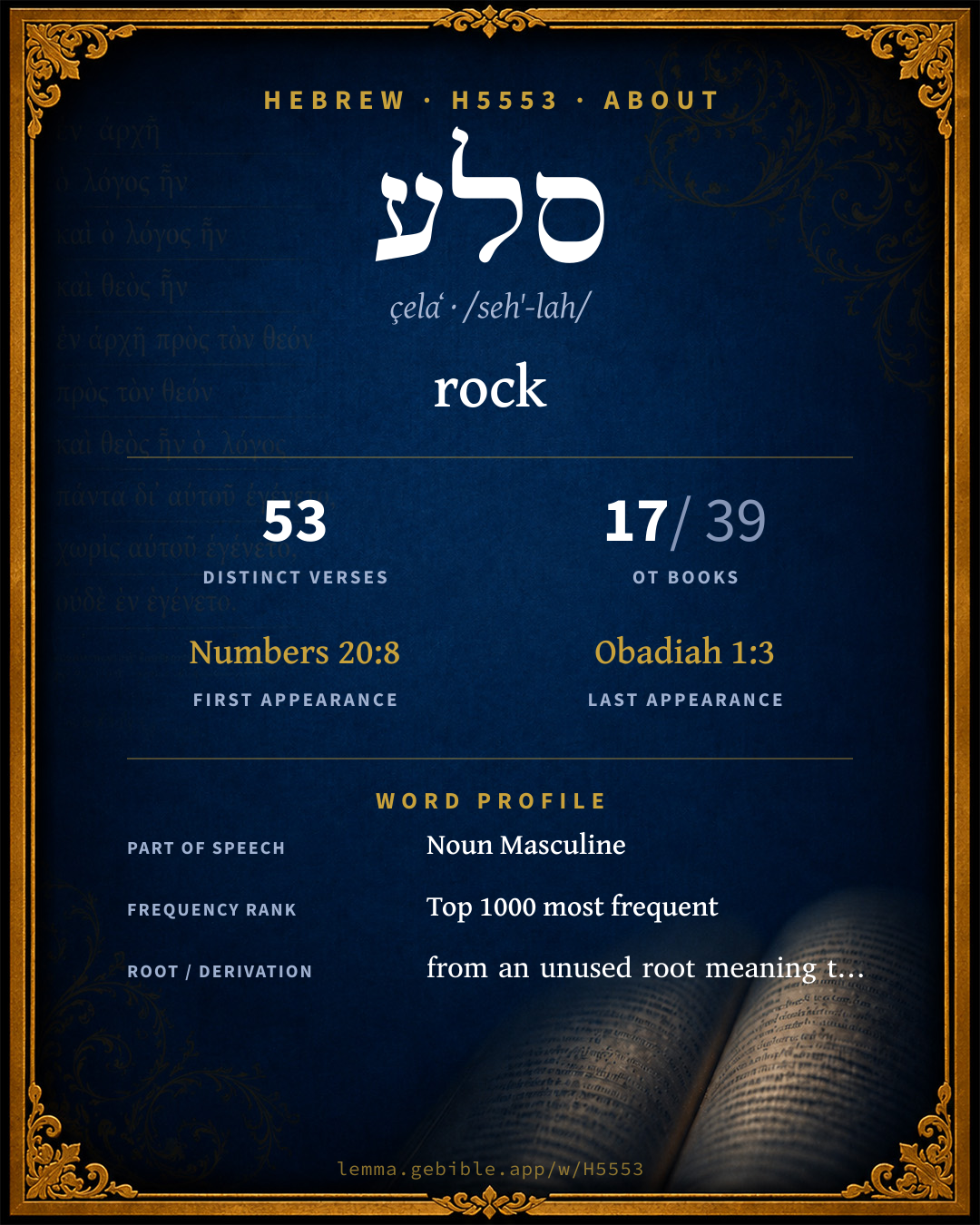
סֶ֫לַע
rock
also: crag, cliff fuller range ↓
Full lexicon entry — Brown-Driver-Briggs (BDB)
From Brown-Driver-Briggs (BDB)
Where this word appears
See every Absolute-state word in the Hebrew Bible →
Grammar key — what these labels mean
Part of speech
- Noun
- A naming word — a person, place, thing, or idea.
Noun type
- Common
- A common noun — a general class of person, place, or thing (“king,” “city,” “water”), not a specific name.
- Proper
- A name of a specific person, place, or people (e.g. Abraham, Zion, Israel).
State
- Absolute
- The independent form of a noun, not bound to a following word.
- Construct
- A noun bound to a following noun in a possessive / “of” relationship (the construct chain).
Gender
- Masculine
- Grammatically masculine.
Number
- Singular
- One.
- Plural
- More than one (in Hebrew, generally three or more).
Grammatical forms
- Noun, Common, Masculine, Singular, Absolute 37 times (63%)
- Noun, Common, Masculine, Singular, Construct 12 times (20%)
- Noun, Common, Masculine, Plural, Absolute 9 times (15%)
- Noun, Proper 1 time (2%)
Parsed forms decoded from the imported morphology (morphhb / Westminster Leningrad Codex — WLC text public domain, morphhb tagging CC BY 4.0), counted across 59 parsed occurrences — not distinct verses.
Every verse where H5553 appears — 53 distinct verses across 17 books. Click any verse to open its interlinear word-by-word view. Verse text shown in the World English Bible for context — . Each verse’s Hebrew form is shown with its reference; the English is not keyword-highlighted, since the data carries no word-level English alignment. Use “Compare translations” on any verse to read it across multiple English versions. This concordance covers the Hebrew Bible; Septuagint (Greek Old Testament) occurrences are not indexed here.
Numbers 4 verses
- Numbers 20:8 הַ/סֶּ֛לַע הַ/סֶּ֔לַע ptcl def.art + n c ms ptcl def.art + n c ms Take the rod, and assemble the congregation, you, and Aaron your brother, and speak you to the rock before their eyes, that it give forth its water; and you shall bring forth to them water out of the rock; so you shall give the congregation and their cattle drink.
- Numbers 20:10 הַ/סָּ֑לַע הַ/סֶּ֣לַע ptcl def.art + n c ms ptcl def.art + n c ms Moses and Aaron gathered the assembly together before the rock, and he said to them, Hear now, you rebels; shall we bring you forth water out of this rock?
- Numbers 20:11 הַ/סֶּ֛לַע ptcl def.art + n c ms Moses lifted up his hand, and struck the rock with his rod twice: and water came forth abundantly, and the congregation drank, and their cattle.
- Numbers 24:21 בַּ/סֶּ֖לַע prep det + n c ms He looked at the Kenite, and took up his parable, and said, Strong is your dwelling-place, Your nest is set in the rock.
Deuteronomy 1 verse
Judges 8 verses
- Judges 1:36 מֵ/הַ/סֶּ֖לַע prep + ptcl def.art + n Proper The border of the Amorites was from the ascent of Akrabbim, from the rock, and upward.
- Judges 6:20 הַ/סֶּ֣לַע ptcl def.art + n c ms The angel of God said to him, Take the flesh and the unleavened cakes, and lay them on this rock, and pour out the broth. He did so.
- Judges 15:8 סֶ֥לַע n c ms cs He struck them hip and thigh with a great slaughter: and he went down and lived in the cleft of the rock of Etam.
- Judges 15:11 סֶ֣לַע n c ms cs Then three thousand men of Judah went down to the cleft of the rock of Etam, and said to Samson, "Don't you know that the Philistines are rulers over us? What then is this that you have done to us?" He said to them, As they did to me, so have I done to them.
- Judges 15:13 הַ/סָּֽלַע ptcl def.art + n c ms They spoke to him, saying, No; but we will bind you fast, and deliver you into their hand: but surely we will not kill you. They bound him with two new ropes, and brought him up from the rock.
- Judges 20:45 סֶ֣לַע n c ms cs They turned and fled toward the wilderness to the rock of Rimmon: and they gleaned of them in the highways five thousand men, and followed hard after them to Gidom, and struck of them two thousand men.
- Judges 20:47 סֶ֣לַע בְּ/סֶ֣לַע n c ms cs prep + n c ms cs But six hundred men turned and fled toward the wilderness to the rock of Rimmon, and abode in the rock of Rimmon four months.
- Judges 21:13 בְּ/סֶ֣לַע prep + n c ms cs The whole congregation sent and spoke to the children of Benjamin who were in the rock of Rimmon, and proclaimed peace to them.
1 Samuel 3 verses
- 1 Samuel 13:6 וּ/בַ/סְּלָעִ֔ים conj + prep det + n c mp When the men of Israel saw that they were in a strait (for the people were distressed), then the people did hide themselves in caves, and in thickets, and in rocks, and in coverts, and in pits.
- 1 Samuel 14:4 הַ/סֶּ֤לַע הַ/סֶּ֥לַע ptcl def.art + n c ms ptcl def.art + n c ms Between the passes, by which Jonathan sought to go over to the Philistines' garrison, there was a rocky crag on the one side, and a rocky crag on the other side: and the name of the one was Bozez, and the name of the other Seneh.
- 1 Samuel 23:25 הַ/סֶּ֔לַע ptcl def.art + n c ms Saul and his men went to seek him. They told David: why he came down to the rock, and abode in the wilderness of Maon. When Saul heard [that], he pursued after David in the wilderness of Maon.
2 Samuel 1 verse
1 Kings 1 verse
2 Chronicles 1 verse
Nehemiah 1 verse
Job 2 verses
Psalms 9 verses
- Psalms 18:2 סַֽלְעִ֥/י n c ms cs + sfx pers 1cs Yahweh is my rock, my fortress, and my deliverer; My God, my rock, in whom I take refuge; My shield, and the horn of my salvation, my high tower.
- Psalms 31:3 סַלְעִ֣/י n c ms cs + sfx pers 1cs For you are my rock and my fortress, Therefore for your name's sake lead me and guide me.
- Psalms 40:2 סֶ֥לַע n c ms He brought me up also out of a horrible pit, Out of the miry clay. He set my feet on a rock, And gave me a firm place to stand.
- Psalms 42:9 סַלְעִ/י֮ n c ms cs + sfx pers 1cs I will ask God, my rock, "Why have you forgotten me? Why do I go mourning because of the oppression of the enemy?"
- Psalms 71:3 סַלְעִ֖/י n c ms cs + sfx pers 1cs Be to me a rock of refuge to which I may always go. Give the command to save me, For you are my rock and my fortress.
- Psalms 78:16 מִ/סָּ֑לַע prep + n c ms He brought streams also out of the rock, And caused waters to run down like rivers.
- Psalms 104:18 סְ֝לָעִ֗ים n c mp The high mountains are for the wild goats. The rocks are a refuge for the rock badgers.
- Psalms 137:9 הַ/סָּֽלַע ptcl def.art + n c ms Happy shall he be, Who takes and dashes your little ones against the rock.
- Psalms 141:6 סֶ֭לַע n c ms Their judges are thrown down by the sides of the rock. They will hear my words, for they are well spoken.
Proverbs 1 verse
Song of Solomon 1 verse
Isaiah 7 verses
- Isaiah 2:21 הַ/סְּלָעִ֑ים ptcl def.art + n c mp To go into the caverns of the rocks, And into the clefts of the ragged rocks, From before the terror of Yahweh, And from the glory of his majesty, When he arises to shake the earth mightily.
- Isaiah 7:19 הַ/סְּלָעִ֑ים ptcl def.art + n c mp They shall come, and shall all rest in the desolate valleys, in the clefts of the rocks, on all thorn-hedges, and on all pastures.
- Isaiah 22:16 בַ/סֶּ֖לַע prep det + n c ms "What are you doing here? and who has you here, that you have hewed out a tomb here? Cutting him out a tomb on high, chiseling a habitation for himself in the rock!"
- Isaiah 31:9 וְ/סַלְע/וֹ֙ conj + n c ms cs + sfx pers 3ms His rock shall pass away by reason of terror, and his princes shall be dismayed at the ensign, says Yahweh, whose fire is in Zion, and his furnace in Jerusalem.
- Isaiah 32:2 סֶֽלַע n c ms A man shall be as a hiding-place from the wind, and a covert from the tempest, as streams of water in a dry place, as the shade of a great rock in a weary land.
- Isaiah 33:16 סְלָעִ֖ים n c mp He shall dwell on high; his place of defense shall be the munitions of rocks; his bread shall be given [him]; his waters shall be sure.
- Isaiah 57:5 הַ/סְּלָעִֽים ptcl def.art + n c mp you who inflame yourselves among the oaks, under every green tree; who kill the children in the valleys, under the clefts of the rocks?
Jeremiah 7 verses
- Jeremiah 5:3 מִ/סֶּ֔לַע prep + n c ms O Yahweh, don't your eyes look on truth? you have stricken them, but they were not grieved; you have consumed them, but they have refused to receive correction: they have made their faces harder than a rock; they have refused to return.
- Jeremiah 13:4 הַ/סָּֽלַע ptcl def.art + n c ms Take the belt that you have bought, which is on your loins, and arise, go to the Euphrates, and hide it there in a cleft of the rock.
- Jeremiah 16:16 הַ/סְּלָעִֽים ptcl def.art + n c mp Behold, I will send for many fishermen, says Yahweh, and they shall fish them up; and afterward I will send for many hunters, and they shall hunt them from every mountain, and from every hill, and out of the clefts of the rocks.
- Jeremiah 23:29 סָֽלַע n c ms Isn't my word like fire? says Yahweh; and like a hammer that breaks the rock in pieces?
- Jeremiah 48:28 בַּ/סֶּ֔לַע prep det + n c ms You inhabitants of Moab, leave the cities, and dwell in the rock; and be like the dove that makes her nest over the mouth of the abyss.
- Jeremiah 49:16 הַ/סֶּ֔לַע ptcl def.art + n c ms As for your terror, the pride of your heart has deceived you, O you who dwell in the clefts of the rock, who hold the height of the hill: though you should make your nest as high as the eagle, I will bring you down from there, says Yahweh.
- Jeremiah 51:25 הַ/סְּלָעִ֔ים ptcl def.art + n c mp Behold, I am against you, destroying mountain, says Yahweh, which destroy all the earth; and I will stretch out my hand on you, and roll you down from the rocks, and will make you a burnt mountain.
Ezekiel 4 verses
- Ezekiel 24:7 סֶ֖לַע n c ms For her blood is in the midst of her; she set it on the bare rock; she didn't pour it on the ground, to cover it with dust.
- Ezekiel 24:8 סָ֑לַע n c ms That it may cause wrath to come up to take vengeance, I have set her blood on the bare rock, that it should not be covered.
- Ezekiel 26:4 סָֽלַע n c ms They shall destroy the walls of Tyre, and break down her towers: I will also scrape her dust from her, and make her a bare rock.
- Ezekiel 26:14 סֶ֗לַע n c ms I will make you a bare rock; you shall be a place for the spreading of nets; you shall be built no more: for I Yahweh have spoken it, says the Lord Yahweh.
Amos 1 verse
Obadiah 1 verse
About this entry
At a glance — auto-summarized from this page’s data, not written by a person. Every figure links to its source below. This summary describes the numbers; it doesn’t interpret them.
סלע (çelaʻ) is a Hebrew noun most often rendered “rock.” Debuting at Numbers 20:8, it then recurs through the corpus. The Hebrew Bible uses it across 53 verses — moderately common. It also covers “crag” and “cliff”, alongside “rock” — see its full sense range. Related forms include סלעם, סלע and סלע המחלקות. For the data behind this summary, explore the sense tree and the renderings breakdown below.
Gloss history
Strong's 1890 vs modern scholarship
About this word
Strong's H5553 catalogs a Hebrew word from the Hebrew Old Testament.
These counts are not copied from any lexicon or concordance. They are computed here, from the morphology-tagged Hebrew Old Testament. What Lemma adds →
- 53
- distinct verses
- The word appears in 53 distinct verses.
- 17 / 39
- OT books
- The word appears in 17 of 39 Old Testament books.
- #647
- by frequency
- Top 1000 most frequent Hebrew words (rank 647 of 8,640 Hebrew words by occurrence).
View all 53 occurrences in the concordance →
By section of the Old Testament
By traditional corpus
Conventional, traditional groupings — biblical authorship is debated, so this is a traditional corpus grouping, not an authorship claim. Each share is this word’s portion of its verses in that division of the Hebrew canon. Each figure is a share of the word’s 53 distinct verses.
- Prophets (Nevi'im) 33 verses · 62%
- Writings (Ketuvim) 15 verses · 28%
- Torah (Pentateuch) 5 verses · 9%
How translations render this word
Counts come from each version’s own published word-to-Strong’s tagging or interlinear alignment — an approximate guide to how each version renders this word, not a word-level alignment the data otherwise carries. Because each total is that version’s own tagged count, the per-version totals vary from one another and need not match the appearance or distinct-verse counts above. These counts may also differ from a printed concordance because Lemma counts each distinctly tagged rendering and does not collapse phrase taggings into a single head-word total. This is a fixed set of word-tagged versions (KJV, ASV, BSB, ULT) and does not change with the reading translation you choose elsewhere. Each version’s license is shown beside its name below (and on Sources).
BDB lists this Strong’s number as 2 distinct words (homographs). Each count above pools all of them and is not split by sense — see the Senses section below. A low-frequency rendering may belong to a different one of those words, not the primary meaning.
- King James Version†: Rock 39×, Rocks 9×, Is my rock 2×
- American Standard Version†: Rock 36×, Rocks 8×, Is my rock 2×
- Berean Standard Bible†: Rock 25×, Rocks 9×, Cliffs 5×
- unfoldingWord Literal Text†: Rock 29×, Cliff 5×, Crag 4×
King James Version Public Domain
Renders H5553 across 60† tagged occurrences — most commonly:
Plus 8 renderings that appear only once — usually multi-word phrases or single function words the recovered tagging swept in, not distinct renderings.
American Standard Version Public Domain
Renders H5553 across 60† tagged occurrences — most commonly:
Plus 14 renderings that appear only once — usually multi-word phrases or single function words the recovered tagging swept in, not distinct renderings.
Berean Standard Bible Public Domain
Renders H5553 across 54† tagged occurrences — most commonly:
Plus 4 renderings that appear only once — usually multi-word phrases or single function words the recovered tagging swept in, not distinct renderings. Not rendered by a distinct English word in 4 further occurrences.
unfoldingWord Literal Text CC BY-SA 4.0
Renders H5553 across 57† tagged occurrences — most commonly:
Plus 6 renderings that appear only once — usually multi-word phrases or single function words the recovered tagging swept in, not distinct renderings.
Senses in the full BDB
What do BDB’s symbols mean?
BDB uses these scholarly abbreviations:
| Symbol | Meaning |
|---|---|
| 𝔊 | the Septuagint (the ancient Greek translation, LXX) |
| 𝔙 | the Vulgate (the Latin translation) |
| 𝔖 | the Syriac version (the Peshitta) |
| 𝔗 | the Targum (the Aramaic translation) |
| ψ | the Psalms |
| √ | root (the underlying root or stem) |
| ‖ | parallel passage (a synonymous or contrasted parallel) |
| † | the dagger: every passage where the word occurs is cited |
The 2 senses and sub-senses the full Brown-Driver-Briggs lexicon distinguishes for this word, in lexicon order (not ranked by frequency), with BDB’s own verbatim wording and sub-sense lettering. Shown in Hebrew script with BDB’s own scholarly abbreviations. The condensed entry is in the Lexicon Entry tab. See also the Forms in the corpus table below.
סלע I
- 1. lit. cliff, crag Ju 6:20; Is 2:21; 7:19 Am 6:12 Nu 20:8(×2), 10(×2), 11 (cf. Ne 9:15 ψ 78:16, and contr. the צוּר of Ex 17:6), Nu 24:21; Dt 32:13 (not elsewhere Hex) Je 13:4, + 9 times; שֵׁן הַסּ׳ 1 S 14:4(×2) tooth of the crag, i.e. sharp crag, so Jb 39:28; excav. in cliff as place of burial Is 22:16; abode of wild animals, יַעֲלֵי־ס׳ v 1, cf. ψ 104:18; Pr 30:26, of birds Jb 39:28 Ct 2:14 (in fig.), cf. Je 48:28, so of Edom Ob 3 = Je 49:16; cf. (Nu 24:21 supr. and) Is 42:11; particular cliffs are: ס׳ עֵיטָם Ju 15:8, 11 cf. v 13, ס׳ (הָ)רִמּוֹן 20:45, 47(×2); 21:13 ס׳ הַמַּחְלְקוֹת 1 S 23:28 cf. v 25; v. also ii. סֶלַע. e.g. Judges 6:20
- 2. fig., especially סַלְעִי of י׳ (only ψψ), ψ 18:3 = 2 S 22:2, ψ 31:4; 42:10; 71:3; of Assyrian god Is 31:9 (prob.; cf. צוּר Dt 32:31, 37); צֵל ס׳ כָּבֵד Is 32:2 (sim. of protecting care); fig. of security ψ 40:3 (feet on cliff), מְצָדוֹת סְלָעִים מִשְׂגַּבּוֹ Is 33:16; symb. of obstinacy חִזְּקוּ פְנֵיהֶם מִסּ׳ Je 5:3; צְחִיחַ ס׳ (bare cliff, lit. glare of [the] cliff), in fig. of openness, flagrancy Ez 24:7, 8, of razed city 26:4, 14 (only here Ez); in fig. of fall of Bab. Je 51:25. e.g. Psalms 18:3
סלע II loc. in Edom, מֵהַסּ׳ Ju 1
Senses from the full Brown-Driver-Briggs lexicon (Brown, Driver, Briggs; Oxford 1906 — public domain), digitized via Sefaria, supplemented by the OpenScriptures HebrewLexicon (CC BY 4.0). Full attribution on Sources.
Word origin
I. n.m. Ju 6:20 crag, cliff, synon. צוּר;—abs. ס׳ Ju 6:20 +, סָ֑לַע Nu 20:10 +; cstr. סֶ֫לַע 1 S 23:23; sf. סַלְעִי 2 S 22:2 +, סַלְעוֹ Is 31:9; pl. סְלָעִים Is 2:21 +;—
II. n.pr.loc. in Edom, מֵהַסּ׳ Ju 1:36 (del. מֵ, cf. GFM); הַסּ׳ captured in war 2 K 14:7 (and called יָקְתְאֵל); מִסּ׳ Is 16:1; site dub.; old identif. with Petra denied, plausibly, by BuhlEdom GFM Ju 1:36 (who thinks of an actual cliff), but held Benz 2 K 14:7 BdPal (1898), 206; 𝔊 (ἡ) πέτρα.
— Brown-Driver-Briggs (Oxford 1906, public domain), digitized via Sefaria, supplemented by the OpenScriptures HebrewLexicon (CC BY 4.0). See Sources.
Origin: from an unused root meaning to be lofty
Jastrow Dictionary
A second Hebrew/Aramaic lexicon for comparison, covering Aramaic and post-biblical (Talmudic, Targumic, Midrashic) usage that the biblical-Hebrew BDB does not. Matched by lemma rather than by Strong’s number, so a lemma may carry more than one Jastrow headword (shown separately below), and the entries cover usage well beyond the Bible.
סֶלַע
- Arab. salʿa, to cleave)
- 1. rock, clod, boulder. Tosef. B. Bath. I, 1 בס׳ הבא בידים if there is (between the two pits) a clod which crumbles under one’s hands; B. Bath. 17ᵇ; 19ᵃ. Orl. I, 3 אילן שנעקר והס׳ עמו if a tree has been uprooted with the clod on its roots; a. fr.—Pl. סְלָעִים, סְלָעִין. B. Bath. II, 1 מרחיקין … את הס׳ וכ׳ deposits of stones (or earth) must be kept off the neighbor’s wall &c.; Y. Sabb. IV, 6ᵈ bot. לא שהס׳ מרתיחין וכ׳ not because they generate heat, but because they generate mould and ruin the wall. B. Bath. l. c. תנא הכא ס׳ והוא הדין לחול the Mishnah mentions stones and implies sand. Tanḥ. Ḥuck. 20 ס׳ כמין שדים rocks protruding like breasts; a. fr.
- 2. pl. as ab. scales on the bodies of serpents. Tanḥ. M’tsorʿa 2 הס׳ שהן על הנחש וכ׳ the scales on the serpent’s back are its leprosy.
- 3. Sela, a weight and a coin equal to one sacred or two common Shekels (v. Zuckerm. Talm. Münz., pp. 9; 24). Kel. XII, 7 ס׳ שנפסלה וכ׳ a Sela which has been unfitted (as a coin) and which has been fitted up for use as a weight. Bekh. 50ᵃ ס׳ של קדש וכ׳ the sacred S. contains 48 dupondia. Ib. כל כסף האמור בתורה סתם ס׳ every silver piece mentioned in the Pentateuch without any qualification means a S. Ib.ᵇ (ref. to B. Kam. VIII, 6) ולא תימא ס׳ ארבע זוזי וכ׳ think not that the Mishnah means a S. of four Zuz, but it means half a Zuz, for people call half a Zuz a Sela (split, cmp. בֶּקַע); B. Kam. 36ᵇ ס׳ צורי a Tyrian S.; ס׳ מדינה a country S. (one eighth of a Tyrian S., half a Zuz; v. supra); a. v. fr.—In gen. coin. Sabb. VI, 6 ס׳ שעל הצינית a coin placed on a sore of the foot. Ab. Zar. 54ᵇ ס׳ שלי my (the Lord’s) coin (divine image of man), v. פּוּמְבִּי.—Pl. as ab. Y. Sabb. l. c. תיפתר בס׳ של כסף it means s’laʿim (coins) of silver; בשל זהב וכ׳ golden, copper s’laʿim. Keth. V, 9 משקל חמשה ס׳ שתי וכ׳ warp of the weight of five S. in Judæa which is equal to ten S. in Galilee &c. Y. Kidd. I, 59ᵈ bot., a. e. כל שקלים … ס׳ all Shekels mentioned in the Pentateuch mean S., v. supra; a. fr.—[Tosef. Ukts. I, 2 (T’bul Yom III) ס׳ של שבלים, v. מֵלַע.]
A Dictionary of the Targumim, the Talmud Babli and Yerushalmi, and the Midrashic Literature (Marcus Jastrow; London, Luzac, 1903) — Public Domain. Digitized via Sefaria. Digitized via Sefaria. Full attribution on Sources.
Forms in the corpus
The 41 distinct written forms H5553 takes in the Hebrew Bible, most frequent first — each parse links to that state’s occurrences in the concordance. Hebrew forms include their vowel points and cantillation, so a single lemma takes many written forms.
Same root — word family
Other BDB entries built from the same root as H5553, grouped by Strong’s listed origin. These share a root / origin per the lexicon — not necessarily a shared meaning. Each links to that word’s own entry.
Derived from this word
Proper names from this root
People and places named from this root — a name, not an additional meaning of the word.
Compare all same-root words → 2 of the same-root words are proper names (people or places). They share a root, not necessarily a meaning.
Septuagint verse parallels
This word appears in 48 verses that also exist in the Greek Old Testament (Septuagint), out of the 53 Hebrew verses it occurs in. You can read those verses in Greek by switching the Old Testament edition to the Septuagint.
Read these verses in the Septuagint
- Numbers 20:8
- Deuteronomy 32:13
- Judges 1:36
- 1 Samuel 13:6
- 2 Samuel 22:2
- 1 Kings 19:11
- 2 Chronicles 25:12
- Job 39:1
- Psalms 18:2
- Proverbs 30:26
- Song of Solomon 2:14
- Isaiah 2:21
This is a verse-level parallel only — the same verses exist in both the Hebrew and Greek Old Testaments. No word-level Hebrew↔Greek correspondence is claimed: the data carries no such alignment, so no Greek word is shown as this Hebrew word’s translation. Coverage is not total — the Septuagint omits the deuterocanon and renumbers the Psalms, so some Hebrew verses have no direct Greek parallel.